Researcher of Hadith compilation and transmission, Islamic jurisprudence with emphasis on early developmental period. Muslim. Ahl al-Haqq wa-l istiqama. Follower of the Qur'an and Sunnah as understood by the earliest school in Islam.
“We take the truth even from a man of hatred and we reject falsehood even from a chosen friend. We have no respect for a man, however exalted, If from the truth he has deflected.”-Shaykh Abdullah bin Humeid Al Salmy
“Who respond to their Lord, establish prayer, conduct their affairs by mutual consultation, and donate from what We have provided for them.” (Qur’an 42:38)
﷽
Professor Joseph Lumbard made a very interesting assertion during a teaching/lecture in New Mexico on Islam.
For those not familiar, Professor Lumbard He received a Ph.D and M.Phil in Islamic Studies from Yale University, an M.A. in Religious Studies and a B.A. from the George Washington University.
He is an American Muslim scholar of Islamic studies and associate professor of Qur’anic studies at the College of Islamic Studies at Hamad Bin Khalifa University in Qatar. He is the author, editor, and translator of several scholarly books and many articles on Islamic philosophy, Sufism, and Quranic studies
So let us get the disappointment out of the way. Disappointing because the respected Professor knows better than to label one according to the epitaph of their opponents.
@1:36 he says: “That was against the Kharijites, from which the Ibadis came out.”
Well, so with that disappointing statement out of the way we can get to the interesting point.
@1:55 “What the Ibadis have done which is different very different from the Sunnis and the Shiites is that they claimed that somebody outside of Quraysh could be the leader. They, their basic claim was that they most…shall we say…what is the word I’m looking for? Um, the most qualified person was the person who should be the leader. And that actually the community can force that person to be the leader if that person doesn’t want to be the leader.” -Professor Lumbard.
“And so remember how we went through and this is where it becomes very important, remember we looked through that the that For the Umayyads and for the Abbasids, the Caliph came through the lineage of the Quraysh. Of course for the uh for the Shiites the caliph is going to be from the lineage of the Quraysh; because its a descendant of the Prophet. Right?” -Professor Lumbard.
“So, Here they were the first ones to come out and say, “No!” Actually that doesn’t matter that is not where it needs to be located. It needs to be the most qualified person and they said theologically in a reading of the Qur’an, this is the best theological understanding of what God intended in the Qur’an. “On that particular point I agree with them, actually. ” -Professor Lumbard.
Al hamdulillah.
What makes this a particularly powerful admission is that Professor Lumbard has not shown himself invested in sectarianism. He is certainly familiar with Sunni claims, as well as that of the Shiites that the ahl bayt are the crème de la crème.
When the respected Professor stated:
“They said theologically in a reading of the Qur’an, this is the best theological understanding of what God intended in the Qur’an.”
Personally I am not quite sure what the respected Professor intended by this. Or what his reading of the Qur’an that makes this clear for him. It is just that these ideas of leadership being from the Quraysh or from the family of the Blessed Prophet (saw) were not seen as established from their point of view.
Though, we do have our justifications from the Qur’an for the position that we hold. I would have been keen to see the respected Professor flesh that out.
In fact, for us it was Al-Ash’ath bin Qais who had as one of his motivating factors to get Ali to move against the people of Nahrawan because of the election of Imam Ar Rasibi (ra). -aka a Non Qurayshi.
Al-Ash’ath bin Qais motive was clear.
Divert Ali’s attention away from the Syrians. Giving them more time to strengthen and solidify their positions.
Pit Ali against the former die hard loyalist knowing full well that the killing of these companions and tabi’un would leave a bitter taste in the mouth of many -as we will see with Ibn Abbas (ra).
Ensure the nexus of power remains among the Quraysh and that any non-Quraysh would not even have a whiff of authority over the Quraysh.
Any qualified righteous believer, be they Arab, Jewish, Ethiopian, or any ethnic group or tribe you can think of, can be the Amir Al Mumineen. That is to say: The Commander of the Faithful for the entirety of the Muslim Ummah.
Here are some reasons on why we do not believe the leadership of the Muslims needs to be exclusively from the Quraysh(though it can be).
Perhaps the follower articles will be of interest to you.
“And don’t mix the truth with the falsehood, or conceal the truth while you know.” (Qur’an 2:42)
﷽
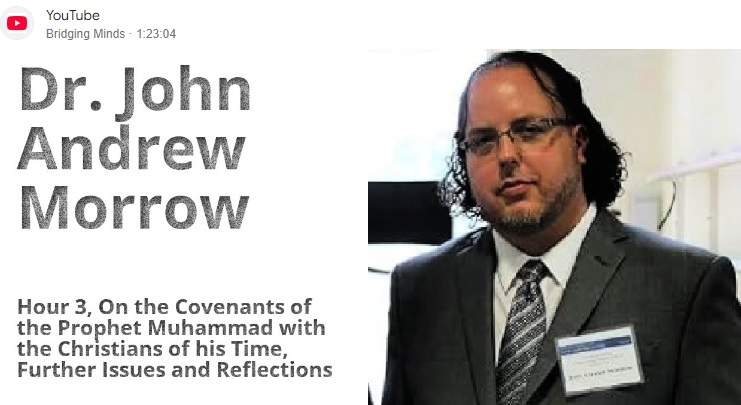
There was a recent interview with Dr. John Andrew Morrow on the Bridging Minds Channel on YouTube. I would encourage those who visit Prima Qur’an to subscribe to the following channel: https://www.youtube.com/@bridgingminds7512 -the channel is in its infancy and insh’Allah good things will follow.
“And don’t mix the truth with the falsehood, or conceal the truth while you know.” (Qur’an 2:42)
I lead with this particular verse because as a Muslim I am dutybound not to conceal the truth when I know what it is.
Also, unfortunately our school, the Ibadi school has a great deal of misunderstandings surrounding it and we take opportunities when and where we can to clarify these misunderstandings.
I believe that this article will also prove that being in academia does not necessarily entail that a person is well informed on a particular matter.
Case in point. Let us look at Brother Dr. John Andrew Morrow’s impressive CV- curriculum vitae.
“Dr. John Andrew Morrow is a professor, research scholar, and author. He has three degrees from the University of Toronto: an Honors BA with double majors in Spanish and French Language and Literature, as well as an MA and a PhD in Spanish American Literature.”
“After completing his PhD, he pursued post-doctoral studies in the Arabic language at the Arabic Language Institute in Fez, the University of Utah’s Middle East Center, and the Qalam wa Lawh Center in Rabat.”
“Dr. Morrow has been an undergraduate and graduate faculty member at numerous universities, holding the ranks of Assistant Professor, Associate Professor, Full Professor, Program Head, and Department Head. He has taught at the University of Toronto, Park University, Northern State University, and Eastern New Mexico University, receiving student impact, performance, and leadership awards for outstanding teaching and service. “
“Dr. Morrow has also been a Visiting Researcher at Harvard University, Purdue University, and the University of Chicago. In the Fall of 2011, he served as professor of Spanish, English, and Religious Studies for the University of Virginia’s Semester at Sea Program. A specialist in Hispanic, Native, and Arabic-Islamic Studies, he has lectured worldwide in his areas of expertise.”
“His research interests include the Amerindian influence on Spanish American poetry, the Arabic and Islamic influence on Spanish and French literature, Aljamiado literature, Arabic sociolinguistics, Islamic Studies, and herbal medicine. A prolific, internationally recognized researcher and writer, Dr. Morrow has hundreds of scholarly, literary and artistic publications to his credit, including: “The Covenants of the Prophet Muhammad with the Christians of the World,” “Islamic Images and Ideas: Essays on Sacred Symbolism,” “The Encyclopedia of Islamic Herbal Medicine,” “Amerindian Elements in the Poetry of Ernesto Cardenal,” “Islamic Insights: Writings and Reviews,” “Amerindian Elements in the Poetry of Rubén Darío,” “Arabic, Islam, and the Allah Lexicon,” ” The Book of Divine Unity,” “El islam shiita: ¿ortodoxia o heterodoxia?,” “Shiite Islam: Orthodoxy or Heterodoxy?,” and “Humanos casi humanos.”
Brother Kamal Southall and Brother Dr. John Andrew Morrow were having a really great back and forth conversation, sharing information. It is when the conversation became more free that there were some comments made about the Ibadi school that caught my attention.
The conversation begins at around @1:13:19
Brother Kamal was leading in with ISIS having what he believes to be a khariji tendency.
Dr. John Morrow: “and I believe it’s true it’s true and I’ve condemned the Khawarij a lot in the past as well but I’ve reconsidered my assessment of them. I mean there again it’s their enemies who wrote these narratives and demonized them. There are some good things about the Ibadis that you know I came to discover. Um so yeah!”
Brother Kamal: “That’s a good point!”
Dr. John Morrow: “Now, now for example, okay? So again the Khawarij, the Khawarij okay, their, their demonized by the Sunnis and by the Shi’a; and of course I did the same thing. I said you know what I’m going to study Ibadi literature. I’m going to connect with Ibadis and get to the bottom of this.” “They’re very moderate people by and large. They’re quite tolerant. They’re not very strict about hijab or things like that. Any how, so they they repudiate they repudiate the extreme Khawarij of the past. But in any event okay so these people revolted. Nobody questions why they revolted. Okay so, okay why did they revolt? Alright, so you have Ali on one side and then you have Muawiya on the other side, and Aisha, and all of these people. Okay? So, on the side Muawiya they believe that the Caliphate belongs only to the tribe of Quraysh. This is like even in Sunni-you know doctrine and everything. It belongs to Quraysh that’s that. Okay, that’s a type of dynasty.”
Brother Kamal: “Right.”
Dr. John Morrow: “I’m sorry it’s very racist too. It’s supremacist, it’s a type of dynasty and monarchy and so on. On the other side you have Ali and he says nuh-uh my family only my family. But the funny thing about the Shi’a they can never agree as to who was part of this family or which member should be the successor. And each time an Imam died they would break up into even more factions; everyone fighting for this and that. Even within the same family. Okay they say oh Imam Jafir As-Sadiq was the successor. Well, his brother thought he was the successor too. And you had brothers fighting each other. It was just like any kingdom, they were fighting for power. So, okay and what was the point of the view of the Khawarij? Any just knowledgeable Muslim can aspire to leadership? Hello? Egalitarian. Based on Shura, every democratic. It was not a dynasty, it wasn’t a monarchy.So, wait a second are these guys really so, so know I’ve compared Isis to the khawarij. But I was wrong. That’s not what they were fighting for. You know the other thing that revolted them? The marriage of 9-year-old girls. They thought that was the sickest thing they had ever heard of.”
Brother Kamal: “The Ibadis?”
Dr. John Morrow: “The Khawarij, the Ibadis.”
Dr. John Morrow: “This is one of the reasons they revolted. They said what the F? No way in hell! Now wait a second these are Tabi’un. Some of these people are sahabas. They had a radically different understanding of the message of this religion, and it’s practices. They didn’t buy this child marriage thing.”
Brother Kamal: “I don’t either.” Dr. John Morrow: “I don’t either.”
Prima-Qur’an comments:
There is a lot to unpack here.
First and foremost, the good. I want to thank my brother, Dr. John Andrew Morrow (Imam Ilyas ‘Abd al-‘Alim Islam) for being humble enough to walk back associations of Isis with the Khawarij. (Though he is not entirely mistaken-will come to this).
I think that all of us, as lovers of truth and people who pursue truth, need to amend positions when mistaken. I was dismayed that the terms Ibadi and Khawrij were swapped out and interchangeable. However, we are getting there. What I mean by ‘getting there’ is that there is a willingness to go beyond the Sunni paintbrush of their opponents. This I am grateful for. May Allah (swt) bless him for this.
To admit to making mistakes is a sign of true moral character and real moral strength. Not many people can do that. We must always be right.
Points of concern andoutright shock.
“They’re not very strict about hijab or things like that.”
I am not quite sure what brother, Dr. John Morrow based this on?
If it was a book of jurisprudence, could he cite it?
Did he have interactions with people who identified as ‘Ibadi’ and were flippant in regard to their dress code?
I have to ask these questions because the ‘Ibadi’ school takes the Khimar, what Dr. John calls ‘the hijab’ very seriously. Modest dress for Muslim men and women is a very important matter for us. It is a matter of obeying Allah and his Messenger.
In fact, the Mufti of Oman says it is preferable for women to wear a niqab if possible. Though he does not say it is proved by the Qur’an and Sunnah.
One of our teachers that we have theology classes with, Shaykh Juma Al Mazruii, cleared up wide-eyed rumors and speculation circulating around Reddit.
Negligence with regard to a modest dress code is considered a sin by us. I personally have not known any of our scholars or teachers to be lax in regard to the ‘khimar’ or hijab.
So I am not sure what that statement is based upon.
Why did many of the companions and successors leave the army of Imam Ali?
“But in any event, okay, so these people revolted. Nobody questions why they revolted. Okay so, okay, why did they revolt?”
It is clear that brother, Dr. John Morrow is of the understanding that it was primarily done to who should lead the Muslims. I am here as an Ibadi to tell you that this is not the case at all. The primary reason for leaving the camp of Ali was his decision to arbitrate on matters in which Allah (swt) made his judgement clear.
Now, we do say that one of the motivations for Ali attacking the Muslims at Nahrawan was from Al-Ash’ath bin Qais, an individual who did not want to see the Imamate leave the Quraysh. For Imam Abdul-Allah bin Wahab Ar-Rasbi Al-Azdi (r) appointed Imam was not from the Quraysh. But this was not ‘THE’ reason to leave the camp of Ali.
Let us think about this logically as well. If that was ‘THE’ reason, then why be in the camp of Ali to begin with?
Ibadi’s predecessors revolted against Ali because he was a supporter of 9-year-old child marriages?!!
“You know the other thing that revolted them? The marriage of a 9-year-old girl. They thought that was the sickest thing they had ever heard of.”
“This is one of the reasons they revolted. They said “What the F? No way in hell!” Now wait a second. These are Tabi’un. Some of these people are sahabas. They had a radically different understanding of the message of this religion and its practices. They didn’t buy this child marriage thing.”
Now I have seen some academics make mistakes -we all do. However, I have to be quite honest in saying these are some of the wildest assertions yet!
This is the wildest assertion attributed to our school that I have ever seen! I am going to attribute these statements to the free flow of the discussion and perhaps there were many thoughts swirling around and somewhere things got lost in the conversation.
There are many thoughts here.
First and foremost is, what is the source of this?!
This actually goes against all those people who are arguing against child marriage! All those liberals, Hafs-only Quranists, modernists are now shaking their heads and wondering what on Earth? Because now what our brother, Dr. John Morrow has effectively done is to assert that this (child marriage) was indeed held by early Muslims, many of them companions and successors, and that Muslims had a major war over this!
Considering that the Ibadi predecessors were the muhakima that split from Ali’s camp and they (the Ibadi predecessors are portrayed as saying: “What the F No way in hell” this must mean that Ali and his supporters were gung ho for child marriages? How can one not draw this conclusion based upon the data given?
Considering that it is suggested that Ali and his supporters were gung ho for child marriages, should we then understand that Imami and Zaydi Shi’i are pro-child marriage?
Considering the person in question -Aisha (ra) was not anywhere near Siffin, how would she not play a role in any of that?
I have shared my concerns with Brother Kamal -who is a very good friend, close brother and sincere Muslim. May Allah bless him and bless his channel.
I have to write things like this because our school is terribly misunderstood and maligned. Brother Dr. John Morrow has shown his willingness to backtrack statements. Which is the sign of a sincere believer. May Allah love him.
I hope that maybe in the future he can clarify some of these statements.
For those who are keen and interested in learning more about the Ibadi school from Ibadi sources, I would kindly direct your attention to our resource page here:
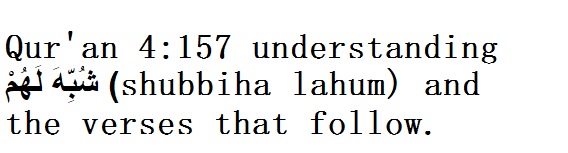
“And for their saying, “Indeed, we have killed the Messiah, Jesus, the son of Mary, the Messenger of Allah.” And they did not kill him nor did they impale (ṣalabūhu) him; (وَمَا قَتَلُوهُ وَمَا صَلَبُوهُ وَلَٰكِنْ شُبِّهَ لَهُمْ)but it was made to appear to them so. Those who differ therein are full of doubts. They have no certain knowledge of it, but only follow conjecture. For certainly, they did not kill him.” (Qur’an 4:157)
﷽
As mentioned before we do a tight textual analsysis of the Qur’an in order to reach the correct understanding. This is done by comparing a word with all other instances of that word in the Qur’an. This is done by also comparing the context of verses with their surrounding verses. This is known as Tafsir al-Quran bi-l-Quran. (Interpreting the Qur’an by the Qur’an)
In a discussion on Blogging Theology titled: “Jesus was not crucified: the evidence with Dr. Ali Ataie.” Dr. Ali Ataie made some very interesting assertions. Assertions which move him closer to our position.
@40:28 Dr. Ataie states: “But I do believe that myth and legend has probably soo permeated the gospel accounts of Jesus passion narratives that it is not at all beyond reason to dismiss them completely as historical fiction!”
Prima-Qur’an comments: Allahu Akbar! there you go Dr. Ataie now that is the ticket! Than the idea that someone was “crucified” is likely based upon what? Myth and legend.
Dr. Ataie gets into his understanding of: Qur’an 4:157 “It was made to appear to them so.“
@53:38 “They did not have information. It did not come from a reliable source.” @54:11 “Jews and Christians ended up following hearsay reports about some crucifixion event from non eye-witnesses….”
Prima-Qur’an comments: Dr. Ataie state: ” “Jews and Christians ended up following hearsay reports about some crucifixionevent from non eye-witnesses….”
I would replace some words in the above sentence: “Jews and Christians ended up following hearsay reports about some imaplement event from non eye-witnesses….
“Christ has redeemed us from the curse of the law, having become a curse for us (for it is written, “Cursed is everyone who hangs on a tree”), (Galatians 3:13)
Paul is quoting from a text that mentions a post mortem suspension punishment. The individual is killed first and while dead then supsended. Christians understand the Crucifixion as an ante mortem suspension punishment where the person is killed via asphyxiation while alive and being suspended.
This is exactly what shubbiha lahum means. It is not shubi ha alayhim!
In fact because we love you the readers insh’Allah I will give you a sneak peak at one of the slides that Shaykh Hilal and I are working on.
No pay wall and no gate keeping information!
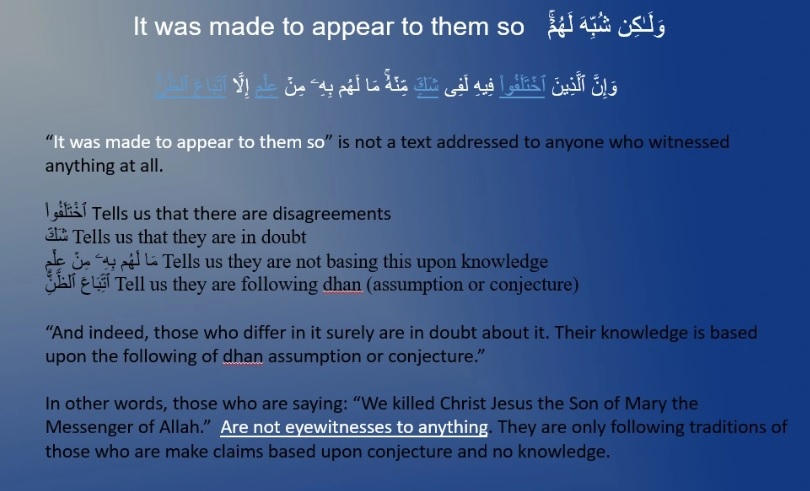
This is the critical linguistic and contextual refinement. This is a far more precise reading of the phrase شُبِّهَ لَهُمْ (shubbiha lahum) and the verses that follow.
From the Ibadi perspective and reading of the verse the point fundamentally shifts the understanding of the verse from a narrativeabout a visual illusionin real-time toa critique of a historical claim based on unreliable transmission. Let’s integrate this correction.
The Correct Understanding of Point 4:167
The phrase وَ لٰكِنْ شُبِّهَ لَهُمْ (“but it was made to appear so to them”) does not describe a miraculous event witnessed by onlookers in real time. Instead, it critiques the oral tradition and historical narrative that the Jewish community subsequent to the event had come to believe and propagate.
The Qur’an’s own subsequent words completely invalidate the possibility of this being an eye-witness account:
إِنَّ الَّذِينَ اخْتَلَفُوا فِيهِ لَفِي شَكٍّ مِنْهُ – “Indeed, those who differ over it are surely in doubt about it.” (4:157)
Doubt (شَكٍّ – shakk) is impossible for someone who witnessed an execution firsthand.
مَا لَهُمْ بِهِ مِنْ عِلْمٍ – “They have no knowledge of it.” (4:157)
Knowledge (عِلْمٍ – ‘ilm) is exactly what an eye-witness would claim to have.
Assumption (الظَّنَّ – al-ẓann) is the antithesis of eye-witness testimony.
A Hadith that is classified as الظَّنَّ (al-ẓann), meaning “conjectural” or “of presumptive status,” and comes from a lone narrator (or a single strand of transmission) is known as a Khabar al-Āḥād (خبر الآحاد).
Here’s a detailed breakdown:
Definition: A Khabar al-Āḥād is a report (Hadith) that does not reach the highest level of mass transmission (Mutawātir). It is narrated by one or a few individuals at any stage of its chain of narration (isnad), such that the number of narrators does not generate absolute, certain knowledge (ilm al-yaqīn) in the listener. Instead,it generates presumptive knowledge (ilm al-ẓannī), which is sufficient for action but is theoretically open to doubt.
Therefore, the Qur’an is not describing a supernatural trickery of the senses that happened in the past. It is describing the state of the received narrative in the present tense of its revelation.
The chain of meaning, according to this corrected interpretation, is:
The Claim: A specific Jewish community (contemporary to the Prophet Muhammed or just prior) boasts, “We killed the Messiah, Jesus son of Mary, the messenger of Allah.” This is their historical claim.
The Denial: The Qur’an flatly denies this: “And they did not kill him, nor did they impale him (وَ مَا صَلَبُوهُ).”
The Explanation for the False Claim: How did this false claim arise? The event was “made to appear to them (شُبِّهَ لَهُمْ)” in their oral traditions and historical accounts. The truth was obscured within their own narrative.
The Proof of the Falsehood: The proof that this claim is a baseless tradition and not established fact is that those who argue over it are in doubt, devoid of certain knowledge, and following only assumptions about what truly happened. True eye-witnesses to a capital punishment would not be in a state of doubt and conjecture; they would be certain.
“And for their saying, “Indeed, we have killed the Messiah, Jesus, the son of Mary, the Messenger of Allah.” And they did not kill him nor did they impale (ṣalabūhu) him; (وَمَا قَتَلُوهُ وَمَا صَلَبُوهُ وَلَٰكِنْ شُبِّهَ لَهُمْ)but it was made to appear to them so. Those who differ therein are full of doubts. They have no certain knowledge of it, but only follow conjecture. For certainly, they did not kill him.” (Qur’an 4:157)
﷽
This is a recent e-mail sent to Todd Lawson an Emeritus Professor of Islamic thought at the University of Toronto.
I sent this inquiry as I am genuinely curious as to why he or anyone for that matter think that the Qur’an 4:157 seem to be interacting with anything that the Romans have done, or that the text is talking about a historical event known as the “Crucifixion” or that the Qur’an is denying/or affirming anything about a Cross at all.
Greetings Professor Lawson
I hope this email finds you in the best of health.
I had read your book “The Crucifixion and the Qur’an: A Study in the HIstory of Muslim Thought.”
It was certainly an interesting read.
You have noted how extraneous material has influenced the Sunni Tafsir tradition and popular interpretation of Qur’an 4:157.
So to this point I am curious as to why you think the Qur’an engaged with an historical event popularly known as “The Crucifixion” at all?
The reason I ask this is because when one looks at the immediate text of the Qur’an 4:157 there does not seem to be any mention of Romans or Roman involvement at all.
I am deeply interested why your good self or anyone would feel that the Qur’an 4:157 engages with an historical event popularly known as “The Crucifixion” at all. I believe that a reading of the text without extraneous material tells us that the text is interacting with certain Jews who were making certain claims about Jesus.
When we read Qur’an 4:155 for example:
“They have incurred Allah’s wrath for their breaking the covenant, and their rejection of the signs of Allah and for slaying Prophets without right, and for saying: ‘Our hearts are wrapped up in covers-even though in fact Allah has sealed their hearts because of their unbelief, so that they scarcely believe.”
I believe we both concur that it would seem out of place for that text to address the Romans of the time of Jesus.
Furthermore the Qur’an 4:157 has a double denial in the text. They did not kill him nor did they (salabu). The initial denial is general and it can easily accommodate any understanding of a possible demise of Jesus.
It is immensely curious to follow up a general denial that can accommodate any particular understanding of any possible demise of Jesus with a particular denial immediately after.
Is it not more sensible in keeping with the immediate text and surrounding text to see this as the Qur’an interacting with particular claims made by Jews about Jesus? Rather these claims are based upon any historical event, document or even oral transmissions in certain circles that the Qur’an would be familiar with?
Given that this seems to be the very obvious case, how do you propose somehow Romans, and a “Crucifixion” is posited upon the text of Qur’an 4:157?
It is peculiar because Jews do not crucify people in their law. It is not a part of the Torah nor of the Talmud of which I am sure you are aware.
They do have laws about killing people and then impailing them. They do have assertions about those impaled being cursed by God.
Equally curious is the idea that (salabu) would translate to a Latin Cross, or the Tau Cross.
Given that the Qur’an in (7:124); 20:71; & 26:49) all describe cutting off the hands and the feet and given what we know about supporting the body weight on an ecclesiastical “Cross” it is it not presumptuous of us to assume Latin Cross, Tau etc?
The two noun forms in Qur’an 86:7 & Qur’an 4:23 which relate to the loins and the lumbus region seem to forcefully argue with a type of punishment that would involve impalement rather than anything to do with being tied to a patibulum and affixed to a crux or stake and than having nails driven in ones hands and feet.
When we look at the text of Qur’an 5:33 on page 31 of your book you state:
“the criminal was killed by a separate means before their corpse was publicly displayed on a pike or cross.”
This does not seem to correlate to what Christians have in mind when they invoke the “Crucifixion” of Jesus. They seem to think this is a death on a cross and not a death prior to a cross.
I also felt that pike was more appropriate than cross given what we know about the Islamic legal schools. None of the legal schools, Ibadi, Zaydi, Zahiri, Shafi’i, Imami, Maliki, Hanafi or Hanbali make it a requirement to put someone on a patibulum and affix that patibulum to a crux or stake and than proceed to drive nails in the hands and feet.
Much more can be said. Again I believe my initial inquiry is that if we do a plain reading of Qur’an 4:157 or even invoke the immediate context where are we drawing upon the idea that this is interacting with something the Romans are said to have done to Jesus?
Thank you for your time.
Have a blessed weekend ahead.
If you would like to read more on this subject I invite you to read the following:
“My Lord! Increase me in knowledge.” (Qur’an 20: 114)
﷽
“My Lord! Increase me in knowledge.” (Qur’an 20:114)
The above verse is a direct plea to our Creator. That we ask Allah (swt) to advance us in knowledge.
“Then ask those who have knowledge.” (Qur’an 21:17)
The above verse has its context; however it is apt. If you do not know ask those who do know. It is quite sensible.
It is in this spirit that the Ibadi have been on the forefront of opening thier libraries to the curious researchers from Western Academia.
Western academia has a penchat for pursing degrees and doctorate thesis on novel subjects or that which seems to be obscure.
This creates wonderful opportunities to learn.
Some brief comments about the author.
Valerie J. Hoffman, research professor emerita in the Department of Religion, has served at the University of Illinois for more than 39 years.
Valerie Hoffman was one of the first women in the field of Islamic Studies at a time when few universities even offered such a program.
It is said that she recently retired from her position at the University of Illinois Urbana-Champaign.
She has otherwise presented excellent lectures and introductions on the Ibadi school.
She plans a forthcoming book: “Islamic Sectarianism Reconsidered: Ibadi Islam in the Modern Age.”
That book may well have been prompted by this site: primaquran.com
It is hoped that she will take on board the feedback and introduce the very important and crucial nuances that she missed.
For you, the reader, you need to understand something before reading this book. Valerie Hoffman, by profession, is not a trained theologian. So it cannot be said that she translated this book with the authority of a trained theologian. Second, we are not aware of any senior scholar from the Ibadi school that has endorsed this translation. Do keep these things in mind.
It is also hoped that she introduces the eye opening statment from Shaykh Shamsu-Deen Abū Ya‘qūb Yūsuf ibn Ibrāhīm al-Warijilānī (r) that is quoted in Kitab al Wada’ Al Mukhtasar Fi Usul Al -Fiqh by Shaykh Abū Zakariyyā Yaḥyā ibn Abī al-Khayr al-Jannāwunī.
These were Shaykhs in the 12th century. To have the positions that they had at the time would be considered quite ‘progressive’. We don’t take into account the blame of the blamers. We take into account the Qur’an and the Sunnah. That forms the basis of our judgements.
Some breif comments about the book.
The Essentials of Ibadi Islam:-Valerie J. Hoffman. An Orientalist translation of Arabic Ibadi creedal text into English. This basically is a translation work of: Al-Aqidah ‘l-Wahbiyya -the most relied upon by the Ibadi in the West. As well as a treatise from Shaykh ‘Abd al-Aziz al-Thamini al-Mus’abi on God’s Power and Human Acts, from Kitab Ma’alim al-Din
The author overall does a faithful job of sticking to the original sources. She often engages the text by asking questions left unresolved*(which could have been resolved had she consulted the scholars in her midst). She often correctly detects errors in the Arabic and other times superimposes what she thinks it should mean. Notwithstanding these minor irritations, it is overall a faithful translation.
*To give you just one example of this in Ms. Hoffman’s work.
Source: (pg. 172)
So, this can leave in the mind of the reader that we some how are going against a clear edict in the Qur’an. Unfortunately, this shows Ms. Hoffman’s lack of engagement with our scholars in regards to some questions she raises in the book.
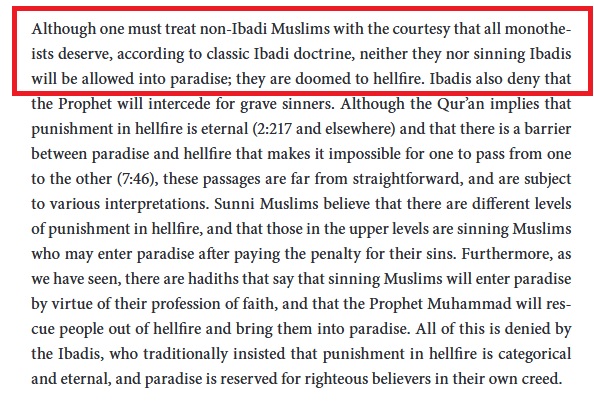
Another point. She recklessly misrepresents as the default view of the Ibadi school that:
“Although one must treat non-Ibadi Muslims with the courtesy that all monotheist deserve, according to classic Ibadi doctrine, neither they nor sinning Ibadis will be allowed into paradise they are doomed to hellfire.” Source: (pg. 30)
This is extremely reckless and can be the cause of real life physical attack upon those in our community. For example: It has NEVER been the position of the Ibadi school that sinning Ibadi or sinning non-Ibadi Muslims are doomed to hellfire. The position has ALWAYS been that Ibadi’s who repent are subject to the mercy of Allah. Second as regard non-Ibadi at the very least a person needs to be: mukallāf-someone pubescent and sane. Next the clear evidence has to be presented to the individual and we take as evidence the following:
“So after the truth, what else can there be, save error? How then are you turned away?” –(Qur’an 10:32).
That judgement can only be passed on non-Ibadi on the basis of masail al din and not masail al-ra’y. If she bothered to look into the position of the school in regard to the theological position as regard those who Islam may not have reached (isolated islands etc.) she would have appreciated as much.
Again, personally I find it a bit of a disrespect. Here you are being welcomed in a country by its people, they open up their libraries and manuscripts to you. The claim is that you are exposing the Western world to Ibadhism. Yet, you leave comments like the above which could have been clarified. It is certainly not helpful. In regard to one passing comment it is actually dangerous in today’s hyper-sectarian world not to clarify the position of the school or at the very least pass over the matter.
Though, as stated: minor irritations, it is overall a faithful translation. Surely she will receive her reward with her Lord in this life. My hope is that she will embrace the haqq before she meets her Lord.
In fairness to her one man did an interview with her. Our understanding from him is that prior to the interview she wanted to make sure it was not a ‘hit piece’ on the Ibadi school. Now rather or not that was to ensure she would be invited back to Oman (self-interest) or out of genuine concern that it would stir up sectarian passions (selfless-interest) and (altruism) Allah knows best.
Also, keep in mind that we encourage people to study text with our teachers and with our scholars. We had an individual some years back who made the boisterous claim that he was teaching Ibadi Aqidah using Ms. Hoffman’s work! Notwithstanding the fact that this person scarcely knowns Arabic, nor receieved knowledge from teachers, but the book leaves out many fundamentals that would be taught in a structured class on the subject. It is a translation of particular text.
The book itself it is put in the format of Student/Teacher. Surely this would have opened some eyes.
May Allah (swt) forgive our obstinance and soften our hard hearts.
Books are helpful. I said before and I said again. If you want to learn about the Ibadi school, the Hanafi school, the Maliki school, the Zaydi school, or any school you absolutely must connect with practices teachers and masters of those schools. Otherwise all you will ever half are baked surface level knowledge -which often could be mistaken.
“Have you not considered that Allah knows what is in the heavens and what is on the earth? There is in no private conversation three but that He is the fourth of them, nor are there five but that He is the sixth of them – and no less than that and no more except that He is with them [in knowledge] wherever they are. Then He will inform them of what they did, on the Day of Resurrection. Indeed Allah is, of all things, Knowing.” (Qur’an 58:7)
﷽
“The Most Compassionate, over the throne is established.” (Qur’an 20:5)
If someone ask us if we affirm the above verse the answer to that is, “Of course as Muslims we believe in every verse of the Qur’an.” If they are content to leave it at that we too are content.
If they ask us if we affirm the meaning that they affirm. Then that is a matter of discussion.
Those who ask WHERE but now WHEN in regard to their Lord.
“No indeed! The truth is that their hearts have become rusted on account of their evil deeds.” (Qur’an 83:14)
﷽
The following is taken from a lecture from Abdul Hakim Murad.
“As we are initiated into the distractions of the world, however, it [heart] is covered over with the ‘rust’ (ran) of which the Qur’an speaks. This rust is made up of two things: sin and distraction. When, through the process of self-discipline, these are banished, so that the worshipper is preserved from sin and is focusing entirely on the immediate presence and reality of Allah, the rust is dissolved, and the ruh once again is free. The heart is sound; and salvation, and closeness to Allah, are achieved.”
What Sins Do To The Heart – Shaykh Dawud Bu-Sinani.
“The Day when neither wealth nor children will be of any benefit. Only those who come before Allah with a pure heart..” (Qur’an 26:88-89)
Special thanks to the ‘Ibadi Theologian’ for this timely reminder.
Remember, we do not need to wait until Ramadan to get close to Allah and to repent and to reform. Every breath that enters our lunges, every passes moment is a chance to turn it all around dear brothers and sisters!
“Every soul will taste death. And you will only receive your full reward on the Day of Judgment. Whoever is spared from the Fire and is admitted into Paradise will triumph, whereas the life of this world is no more than the delusion of enjoyment.” (Qur’an 3:185)
﷽
Ramadan Day 26:Purifyyour intentions and work hard.
*26th of Ramadan* ——————————– *Heart Illness: Loving the Dunya* From the things that destroy the heart is the love of this life and its desires. Loving this life is the start of every sin, the permitted things in this life are reckoning, it’s prohibitions are punishments, its start is crying, its middle is pain and its ending is mortality.
Allah says:
“The enjoyment of desires—women, children, treasures of gold and silver, fine horses, cattle, and fertile land—has been made appealing to people. These are the pleasures of this worldly life, but with Allah is the finest destination.” (Qur’an 3:14)
and
“And give them a parable of this worldly life. like the plants of the earth, thriving when sustained by the rain We send down from the sky. Then they turn into chaff scattered by the wind. And Allah is fully capable of all things.” (Qur’an 18:45)
The companions, may Allah be pleased with them, were filled with a love for the Blessed Prophet (saw) that was deeper than the love for their own families. They wished for every comfort and ease for him, and it pained them to see him in any state of hardship.
On one occasion, they entered upon the Messenger of Allah (saw) and saw that he had been sleeping on a simple, coarse mat made of palm fibers. The harsh weave of the mat had left its clear imprint on his blessed side, marking his skin with its pattern.
Their hearts swelled with compassion and concern. One of them exclaimed, “O Messenger of Allah! Why didn’t you call us so that we could have spread a softer, more comfortable bedding for you?”
They longed to provide him with every comfort, to spare him from the slightest discomfort. But the Blessed Prophet (saw), whose mission was to teach humanity the meaning of life, turned to them with a gaze filled with profound wisdom. He was not concerned with the fleeting comforts of a world he understood to be a mere passage.
He (saw) said:
“What have I to do with this world? My example and the example of this worldly life is but that of a rider who journeyed on a scorching summer’s day. He stopped to rest in the shade of a tree for a short while. Then, he rose and continued on his journey, leaving it behind.”
—
Explanation and Meaning:
With this magnificent parable, the Blessed Prophet (saw) distilled the entire Islamic outlook on life:
The Rider: This is the believer, the soul on its journey through existence. Our ultimate destination is not this world, but the Hereafter (al-Ākhirah)—the meeting with our Lord.
The Scorching Summer Day: This represents the toil, trials, heat, and hardships of worldly life. It is a temporary state of difficulty through which one must pass.
The Shade of the Tree: This is the metaphor for the worldly life (ad-Dunyā) itself. It is a temporary respite, a momentary relief from the journey’s heat. It is a blessing from Allah, to be used gratefully but not to be mistaken for a permanent home.
The Short Nap: This signifies the brevity of human life. No matter how long one lives—60, 70, or 100 years—in the grand scale of eternity, it is nothing more than a brief pause, a short nap.
Leaving it Behind: This is the crucial point. The rider does not pack up the tree and take it with him. He does not become attached to the shade. He enjoys its respite, thanks Allah for it, and then moves on toward his real goal without a backward glance. Similarly, a believer uses the comforts and blessings of this world as a means to aid their worship and journey to Allah, never becoming enslaved by them or heartbroken at their loss.
*Walayah and Bara’ah of Dhahir* Last time we mentioned Walayah and Bara’ah of Haqiqah and Jumlah, today we will take a look at the third type which is walayah and bara’ah of Dahir, the word dhahir refers to the appearance, so you judge the people based on their appearance.
Walayat ad-dhahir is based on what is apparent from a person, and his straightness in his sayings and actions, like so, Bara’ah is based on the apparent of the people if they fall in a violation of truth by saying or doing while insisting on it.
There are three ways for walayah: 1. Preview: it is when the person sees the other in what shows his straightness without deviation from the truth by saying or doing, while hastening towards repenting after making a mistake.
2. Reputation: when a person is known for his righteousness and the toungs repeat this around.
3. Testimony: it’s to get this from two witnesses, and there is an opinion regarding if one person can be sufficient.
These ways are the same for bara’ah but it has one more way which is self-endorsement of committing a major sin either by saying, doing or believing.
and if there is some whom is unknown to you, or you can’t fit him in the previous conditions then he should be in Wuquf (to stop) until he can be put in walayah or bara’ah.
If you want to read more on this most important concept in Islam.
*The relationship between the prayer of the Imam and the Followers* The most prominent opinion in this issue is that the the prayer of the followers are linked to the prayer of the Imam, so if the prayer of the Imam is corrupted then the prayer of the followers is corrupted, based on the following pieces of evidence:
The imam carries some actions in the prayer, which the follower should have done if he prayed alone
The follower cannot precede the imam in anything in the prayer or else his prayer will break
If the follower was a traveler he should pray 4 Rak’as behind a resident imam, even though it’s obligatory for him to pray 2
The saying of the Blessed Prophet (saw):
“The imam was made to be followed, so if he prays standing pray standing, and if he prays sitting pray sitting.”
“This is the Book! There is no doubt about it—a guide for those mindful ˹of Allah˺, who believe in the unseen, establish prayer, and donate from what We have provided for them.” (Qur’an 2:2-3)
﷽
A video of Shaykh Hisham Kabbani of the Naqshbandi Haqqani Sufi Tariqa resurfaced that I was not aware of at the time it became known.
The Prophet (s) said, “I will tell you that I sent him because in this universe Allah created Creations, and the nearest one to Earth, the dangerous one. If they invade the Earth…if they invade the Earth, The Earth will be finished. They will kill everyone! I send Sayyidina `Ali to fight them alone!!! To these aliens that are they the most nearest to Earth; and with his sword and his power, He is Asadullah al-Ghaalib! Destroyed two-third of them! That’s why they don’t have power anymore to come on Earth. That is why I sent him, he’s absent from the house.” -Shaykh Hisham Kabbani
The above part that is in bold black text is the beginning of the paragraph but it was cut off. You can read the whole transcript and context from their official website:
Now when one reads the context, it does seem like an abrupt change of course to start speaking about the time when it was alleged that the Blessed Messenger (saw) sent Ali Ibn Abu Talib to take down a large contingent of aliens. Apparently 67% of them were wiped out! I do not know if that means their military forces, their people as a whole (men, women, children-offspring) as those details were not provided.
No one knows if these are the same beings that former Minister of Defense Paul Hellyer was speaking about either. I will link to the article where he (Paul Hellyer) speaks of these beings.
As Muslims, we believe in the unseen. Yet, we also believe in what is rational, sensible and logical. I guess the issue that I have with the idea of sending Ali Ibn Abu Talib into cosmic forays to fight these Aliens is you have to wonder about a few things.
Why only take out 2/3 of them? Is leaving the 1/3 left a mercy to them? As in, “Look, I wiped out 2/3, or you so like chill or else!”
But then you really have to wonder about horrific situations like Palestine.
But I know the retort will be swift: “Palestine or the whole planet brother?”
Over all, personally, my encounters with Naqshanbai Haqqani have been positive. Though I know that they, like all Sufi Tariqah, are in a spiritual Jihad with one another to vie for dominance to be ‘The Tariqah above all others’.
May Allah (swt) guide us to the truth of such matters. May Allah (swt) cause us to think logically and reflect upon such matters.
You may also be interested in the following entries:
“There is nothing like unto Him, and He is the Hearing, the Seeing.” (Qur’an 42:11)
﷽
You shall not make for yourself an idol in the form of anything in heaven above or on the earth beneath or in the waters below.” (Exodus 20:4)
So rather than making an image of God, the command goes far beyond that. Christians should not make idols of anything.
“You shall not make for yourself an idol in the form of anything in heaven above or on the earth beneath or in the waters below.” (Deuteronomy 5:8)
The irony is that this text has been a source of controversy among Christians as if God did not provide clarity for them. So they say, well God says do not make an idol. So their argument goes like this: “We can make the likeness of living created beings, but we just cannot worship them, and thus they are not idols.”
From left to right: Credit to Mart Production and Varan Nm. All photos taken from pexels.com
When it comes to the Bible, both the TNCH and the New Testament are replete with Anthropomorphic descriptions of God.
This is by no means an exhaustive list.
God rides upon a cherubim (usually depicted in art as a naked baby angel)
“He mounted the cherubim and flew; he soared on the wings of the wind.” (Psalm 18:10)
God’s thigh and his self promotional tattoo?!
“On his robe and on his thigh he has this name written: king of kings and lord of lords.” (Revelation 19:16)
How anyone writes created words on the uncreated God merits pensive reflection.
Not only this but usually human females get tattoos in provocative places to draw attention to their assets.
Who has time to focus on a thigh tattoo when there are flashing dazzling lights shooting out from the groin area!
The God of the Bible has loins.
“”And I saw as the colour of amber, as the appearance of fire round about within it, from the appearance of his loins even upward, and from the appearance of his loins even downward, I saw as it were the appearance of fire, and it had brightness round about.” (Ezekiel 1:27)
God’s feet?
“And saw the God of Israel. Under his feet was something like a pavement made of lapis lazuli, as bright blue as the sky.” (Exodus 24:10)
The nostrils of God?
“Smoke went up from his nostrils..” (Psalms 18:8)
God has one ear (not more).
“Give EAR, our God, and hear; open your eyes and see the desolation of the city that bears your Name.” (Daniel 9:18) An Ear, not ears..
Or God has ears (plural)
“In my distress I called to the LORD; I called out to my God. From his temple he heard my voice; my cry came to his ears.” (2 Samuel 22:7)
The God of the Bible has a shadow.
“He who dwells in the shelter of the Most High Will abide in the shadow of the Almighty.” (Psalm 91:1)
How a God that is supposed to be light has a shadow is certainly a mystery!
The God of the Bible whistles?
“At that time the Lord will whistle for the Egyptians.” (Isaiah 7:18)
The God of the Bible gets jealous?
“For I the Lord your God am a jealous God.” (Daniel 5:9)
The God of the Bible smears poo poo (dung) on people’s faces.
“Because of you I will rebuke your descendants; I will smear on your faces the dung from your festival sacrifices, and you will be carried off with it.” (Malachi 2:3)
The God of the Bible emits a sound and walks.
“Then the man and his wife heard the sound of the Lord God as he was walking in the garden in the cool of the day, and they hid from the Lord God among the trees of the garden.” (Genesis 3:8)
The God of the Bible breaths.
“And the Lord God formed man of the dust of the ground, and breathed into his nostrils the breath of life; and man became a living soul.” (Genesis 2:7)
God has thoughts and people have thoughts.
“For my thoughts are not your thoughts.” (Isaiah 55:8)
So do we deny that God has thoughts because people have thoughts or are his thoughts not like our thoughts?
Do we affirm without asking how or is the how known?
The backside of God?!!
“And I will take away mine hand, and you shall see my backside: but my face shall not be seen.” (Exodus 33:23)
God only needs one digit (a single finger to write)
“And when He (God) had made an end of speaking with him on Mount Sinai, He gave Moses two tablets of the Testimony, tablets of stone, written with the finger of God.” (Exodus 31:18)
God has an unknowable number of fingers.
“When I consider you heavens, the work of your fingers, The moon and the stars, which you have ordained.” (Psalm 8:3)
The God of the Bible has hands (plural).
“The sea is his, for he made it, and his hands formed the dry land.” (Psalm 95:5)
“So I reflected on all this and concluded that the righteous and the wise and what they do are in God’s hands, but no one knows whether love or hate awaits them.” (Ecclesiastes 9:1 )
The God of the Bible has a right hand and Jesus is sitting next to it.
“He sat down at the right hand of the Majesty in heaven.” (Hebrews 1:3)
The God of the Bible has a right hand and Jesus is standing next to it.
“But Stephen, full of the Holy Spirit, looked up to heaven and saw the glory of God, and Jesus standing at the right hand of God. “Look,” he said, “I see heaven open and the Son of Man standing at the right hand of God.” (Acts 7:55-56)
*NOTE* NO WHERE DOES THE BIBLE SAY GOD HAS A LEFT HAND!
Now obviously, I do not follow Salafiyya/Athari creed. However, those Christians who think they have landed some points against them have erred tremendously.
All that Daniel Haqiqatjou, Mohamed Hijab, Uthman Ibn Faruq, The Muslim Lantern (Chainless Slave) Muhammed Ali, Jake The Muslim Metaphysician, Farid Al Bahraini, or Bassam Zawadi-all that they have to do is ask the following to the Christians.
Does the Bible assert hands for God? Answer: Yes.
Does the Bible assert a right hand for God? Answer: Yes.
Does the Bible assert a left hand for God? Answer: No.
If the Bible does not assert a left hand for God how can you NOT assert that both his hands are right?
Game over! Those Christians would be cooked.
For the Bible says:
“Trust in the LORD with all your heart and lean not on your own understanding.” (Proverbs 3:5)
God of the Bible finds the aroma of charred dead animal flesh soothing and sweet.
The God of the Bible smells (Not what the Rock is cooking but still…)
“Then Noah built an altar to the Lord and took of every clean animal, and of every clean bird, and offered burnt offerings on the altar. And the Lord smelled a soothing aroma.” (Genesis 8:20-21)
Other translations say: ‘a sweet savour’. “And the Lord smelled a sweet savour”.
God of the Bible repents from his own evil.
“And the LORD repented of the evil which he thought to do unto his people.” (Exodus 32:14)
Like this God was thinking of doing something so nasty and cruel to humans and than thought , “Naah that’s a bit too much!”
God of the Bible regrets that he creates his own creation.
“The LORD regretted that he had made human beings on the earth, and his heart was deeply troubled.” (Genesis 6:6)
God of the Bible can cancel out his own knowledge.
“For I will be merciful to their iniquities, And I will remember their sins no more.” (Hebrews 8:12)
The God of the Bible has wings and feathers.
“He shall cover you with Hisfeathers, and under His wings you will trust” (Psalm 91:4).
The God of the Bible mounts, swoops and spreads out his wings.
“Behold, He will mount up and swoop like an eagle and spread out His wings against Bozrah; and the hearts of the mighty men of Edom in that day will be like the heart of a woman in labor.” (Jeremiah 49:22)
God of the Bible sends delusions on people so they believe what is false.
“For this reason God will send upon them a deluding influence so that they will believe what is false.” (2 Thessalonians 2:11)
The God of the Bible shaves people’s head, legs, and removes the beard.
“In that day the Lord will shave with a razor, hired from regions beyond the Euphrates (that is, with the king of Assyria), the head and the hair of the legs; and it will also remove the beard.” (Isaiah 7:20)
Some Christian commentators make matters worse by saying this is a full hair removal; for total purity as mentioned in the following text:
“The one to be cleansed shall then wash his clothes and shave off all his hair and bathe in water and be clean. Now afterward, he may enter the camp, but he shall stay outside his tent for seven days.” (Leviticus 14:8)
Thus, and we seek refuge in Allah, the Bible is claiming that God will shave all the hair off (pubic hair, you name it!)
The Bible says God is a man of war.
“The Lord is a man of war: the Lord is his name.” (Exodus 15:3)
The God of the Bible sends an evil spirit upon Saul.
“And it came to pass on the morrow, that the evil spirit from God came upon Saul, and he prophesied in the midst of the house: and David played with his hand, as at other times: and there was a javelin in Saul’s hand. ” (1 Samuel 18:10)
The biggest incident of Saul disobeying God in the Bible is because he did not completely genocide everything and he spared some animals.
Which according to the Bible, God inspires Samuel to inform Saul is just as bad as worshipping idols! So this evil spirit that comes from God comes upon Saul and Saul is agitated knowing that God is going to supplant him with David.
Christians claim that God does not want people to be gay. However; this evil spirit inspires Saul to tell David to collect 100 penis skins for him! Does it get more gay?!
By the way think about this narrative. Do you really think that David went around and methodically cut a perfect circle around every man’s Penis and collected a bunch of foreskins in a bag? No! It means he cut off 200 penises put them in some bags and threw them down in the kings court like ‘Yo! Here’s the Penis skins you wanted!’ -which by the way the evil spirit the Bible God sent to Saul inspired him to tell David to do! Does it get more gay than this?!
Speaking of Gay. Unicorns and Rainbows Oh my!
The God of the Bible has strength comparable to a unicorn.
“God brought them out of Egypt; he has as it were the strength of an unicorn.” (Numbers 23:22)
The God of the Bible relies upon a rainbow in order to remember.
“Whenever I bring clouds over the earth and the rainbow appears in the clouds, I will remember my covenant between me and you and all living creatures of every kind. Never again will the waters become a flood to destroy all life.” (Genesis 9:14-15)
God of the Bible feels sorry that the man he appointed to kill babies saved some animals.
Read the following from (1 Samuel 15:3-26)
One day, Samuel told Saul:
The Lord told me to choose you to be king of his people, Israel. Now listen to this message from the Lord: “When the Israelites were on their way out of Egypt, the nation of Amalek attacked them. I am the Lord All-Powerful, and now I am going to make Amalek pay! “Go and attack the Amalekites! Destroy them and all their possessions. Don’t have any pity. Kill their men, women, children, and even their babies. Slaughter their cattle, sheep, camels, and donkeys.” Saul sent messengers who told every town and village to send men to join the army at Telaim. There were 210,000 troops in all, and 10,000 of these were from Judah. Saul organized them,then led them to a valley near one of the towns in Amalek, where they got ready to make a surprise attack. Some Kenites lived nearby, and Saul told them, “Your people were kind to our nation when we left Egypt, and I don’t want you to get killed when I wipe out the Amalekites. So stay away from them.” The Kenites left,and Saul attacked the Amalekites from Havilah to Shur, which is just east of Egypt. Every Amalekite was killed except King Agag.Saul and his army let Agag live, and they also spared the best sheep and cattle. They didn’t want to destroy anything of value, so they only killed the animals that were worthless or weak. The Lord told Samuel, “Saul has stopped obeying me, and I’m sorry that I made him king.” Samuel was angry, and he cried out in prayer to the Lord all night. Early the next morning he went to talk with Saul. Someone told him, “Saul went to Carmel, where he had a monument built so everyone would remember his victory. Then he left for Gilgal.” Samuel finally caught up with Saul, and Saul told him, “I hope the Lord will bless you! I have done what the Lord told me.” “Then why,” Samuel asked, “do I hear sheep and cattle?”“The army took them from the Amalekites,” Saul explained. “They kept the best sheep and cattle, so they could sacrifice them to the Lord your God. But we destroyed everything else.” “Stop!” Samuel said. “Let me tell you what the Lord told me last night.” “All right,” Saul answered. Samuel continued, “You may not think you’re very important, but the Lord chose you to be king, and you are in charge of the tribes of Israel. When the Lord sent you on this mission, he told you to wipe out those worthless Amalekites. Why didn’t you listen to the Lord? Why did you keep the animals and make him angry?” “But I did listen to the Lord!” Saul answered. “He sent me on a mission, and I went. I captured King Agag and destroyed his nation. All the animals were going to be destroyed anyway. That’s why the army brought the best sheep and cattle to Gilgal as sacrifices to the Lord your God.” “Tell me,” Samuel said. “Does the Lord really want sacrifices and offerings? No! He doesn’t want your sacrifices. He wants you to obey him. Rebelling against God or disobeying him because you are proud is just as bad as worshiping idols or asking them for advice. You refused to do what God told you, so God has decided that you can no longer be king.”“I have sinned,” Saul admitted. “I disobeyed both you and the Lord. I was afraid of the army, and I listened to them instead. Please forgive me and come back with me so I can worship the Lord.” “No!” Samuel replied, “You disobeyed the Lord, and I won’t go back with you. Now the Lord has said that you can’t be king of Israel any longer.”
God of the Bible is the creator of evil.
“I form the light, and create darkness: I make peace, and create evil: I the Lord do all these things.” (Isaiah 45:7)
The God of the Bible hates.
“”I have loved you,” says the Lord. But you say, “How have you loved us?” “Is not Esau Jacob ‘s brother?” declares the Lord. “Yet I have loved Jacob but Esau I have hated. I have laid waste his hill country and left his heritage to jackals of the desert.” (Malachi 1:2-3)
(So the God of the Bible is a God of Love and Hate)
(A God of Love, that Hates or A God of Hate that Loves)
The God of the Bible jeers and pokes fun at his creation.
“He who sits in the heavens laughs; the Lord holds them in derision.” (Psalm 2:4)
The God of the Bible laughs.
“but the Lord laughs at the wicked, for he knows their day is coming.” (Psalm 37:13)
The God of the Bible rages. (Maybe not Rage Against The Machine, but …..)
“The LORD is a jealous and vengeful God; the LORD is vengeful and strong in wrath. The LORD is vengeful against his foes; he rages against his enemies.” (Nahum 1:2)
The God of the Bible has a mouth.
“Jesus answered, “It is written: ‘Man shall not live on bread alone, but on every word that comes from the mouth of God.” (Matthew 4:4)
The God of the Bible is meticulous in how his food should be prepared.
“Command the sons of Israel and say to them, ‘You shall be careful to present My offering, My food for My offerings by fire, of a soothing aroma to Me, at their appointed time.” (Numbers 28:2)
The God of the Bible has knowledge which is impeded by distance.
“But the LORD came down to see the city and the tower the people were building.” (Genesis 11:5)
The God of the Bible is affected by a certain type of wine which cheers him up.
“And the vine said unto them, Should I leave my wine, which cheers up God and man, and go to be promoted over the trees?” (Judges 9:13)
The God of the Bible did not stop Jephthah from burning his small daughter if God gave him victory over his enemies.
“Then the Spirit of the Lord came on Jephthah. He crossed Gilead and Manasseh, passed through Mizpah of Gilead, and from there he advanced against the Ammonites. And Jephthah made a vow to the Lord: “If you give the Ammonites into my hands, whatever comes out of the door of my house to meet me when I return in triumph from the Ammonites will be the Lord’s, and I will sacrifice it as a burnt offering.” Then Jephthah went over to fight the Ammonites, and the Lord gave them into his hands. He devastated twenty towns from Aroer to the vicinity of Minnith, as far as Abel Keramim. Thus Israel subdued Ammon. When Jephthah returned to his home in Mizpah, who should come out to meet him but his daughter, dancing to the sound of timbrels! She was an only child. Except for her he had neither son nor daughter. When he saw her, he tore his clothes and cried, “Oh no, my daughter! You have brought me down and I am devastated. I have made a vow to the Lord that I cannot break.” “My father,” she replied, “you have given your word to the Lord. Do to me just as you promised, now that the Lord has avenged you of your enemies, the Ammonites. But grant me this one request,” she said. “Give me two months to roam the hills and weep with my friends, because I will never marry.” “You may go,” He said. And he let her go for two months. She and her friends went into the hills and wept because she would never marry. After the two months, she returned to her father, and he did to her as he had vowed. And she was a virgin. (Judges 11:29-39)
Prima Qur’an Comments: Now there is major major copium from Christians and Jews regarding this.
Copium # 1. They try and put a spin that the sacrifice is to dedicate his daughter to the Lord as a virgin (meaning temple service) and Jephthah bemoaned that due this he would never have any descendants.
Response: and I will sacrifice it as a burnt offering & After the two months, she returned to her father, and he did to her as he had vowed The emphasis on her being a virgin is so she would be an unblemished sacrificed.
2. Copium #2. God commands against sacrificing Children in the Bible.
Response. No, no he doesn’t!
“You shall not give any of your offspring to offer them to Molech, nor shall you profane the name of your God; I am the Lord.” (Leviticus 18:21)
“I will also set My face against that man and will cut him off from among his people, because he has given some of his offspring to Molech, so as to defile My sanctuary and to profane My holy name.” (Leviticus 20:3)
“You shall not behave thus toward the Lord your God, for every abominable act which the Lord hates they have done for their gods; for they even burn their sons and daughters in the fire to their gods.” (Deuteronomy 12:31)
As well as the related practice of passing the children through the fire and not consuming them by the fire:
“There shall not be found among you anyone who makes his son or his daughter pass through the fire, one who uses divination, one who practices witchcraft, or one who interprets omens, or a sorcerer.” (Deuteronomy 18:10)
“You shall also say to the sons of Israel: ‘Any man from the sons of Israel or from the aliens sojourning in Israel who gives any of his offspring to Molech, shall surely be put to death; the people of the land shall stone him with stones.” (Leviticus 20:2)
Offering your children up as a burnt offering is not against the Torah teachings of the Jews. Nor was it something unacceptable to God. The offence in question was offering them up to Molech and NOT THE GOD OF ISRAEL!
“For I the Lord your God am a jealous God.” (Daniel 5:9)
There is no issue with offering up children as a holocaust (burnt offering) to God. The issue is doing it to false Gods. Because the God of the Bible is jealous.
Did we forget?
“After these things God tested Abraham and said to him, “Abraham!” And he said, “Here I am.” He said, “Take your son, your only son Isaac, whom you love, and go to the land of Moriah, and offer him there as a burnt offering on one of the mountains of which I shall tell you.” (Genesis 22:1-2)
The Bible likens God to a groomer that watches a baby grow up develop breast, “body hair” waiting until she was mature enough for “love” and marry her.
“And I helped you to thrive like a plant in the field. You grew up and became a beautiful jewel. Your breasts became full, and your body hair grew, but you were still naked. And when I passed by again, I saw that you were old enough for love. So I wrapped my cloak around you to cover your nakedness and declared my marriage vows. I made a covenant with you, says the Sovereign LORD, and you became mine.” (Ezekiel 16:7-8)
This passage is basically stating that God married “Israel” and it likens God to a man marrying a very young girl. Notice that no one officiates God’s marriage of course. It is just that God wraps his cloak around her and….”Surprise! You’re my wife!”
However, latter we find out that God gets cheated on. That the ‘wife’ of God became like a prostitute.
“‘But you trusted in your beauty and capitalized on your fame by becoming a prostitute. You offered your sexual favors to every man who passed by so that your beauty became his. You took some of your clothing and made for yourself decorated high places; you engaged in prostitution on them.” (Ezekiel 16:15-16)
Prima Qur’an: I always wondered why many Christian and Jewish men had a very unhealthy relationship and attitude towards women. When The Creator of Heaven and Earth gets cheated on then who is the average man compared to God?
Even some Christian polemist who got cheated on may feel a kindred spirit with God.
Many Christians who were sexually violated as youth have read the above passages with a great deal of discomfort. May Allah (swt) guide them and console them.
Granted we as Muslims are understanding concerning metaphor, allegories and rhetorical devices in literature. The Qur’an itself deploys metaphor, allegory and an array of rhetorical and literary devices.
Yet, some of these passages and text in the Bible are quite concerning.
May Allah (swt) guide the Jews and Christians to the truth.









 Prima Quran