“Verily! In the creation of the heavens and the earth, and in the alternation of night and day, there are indeed signs for men of understanding.” (Qur’an 3:190)
﷽
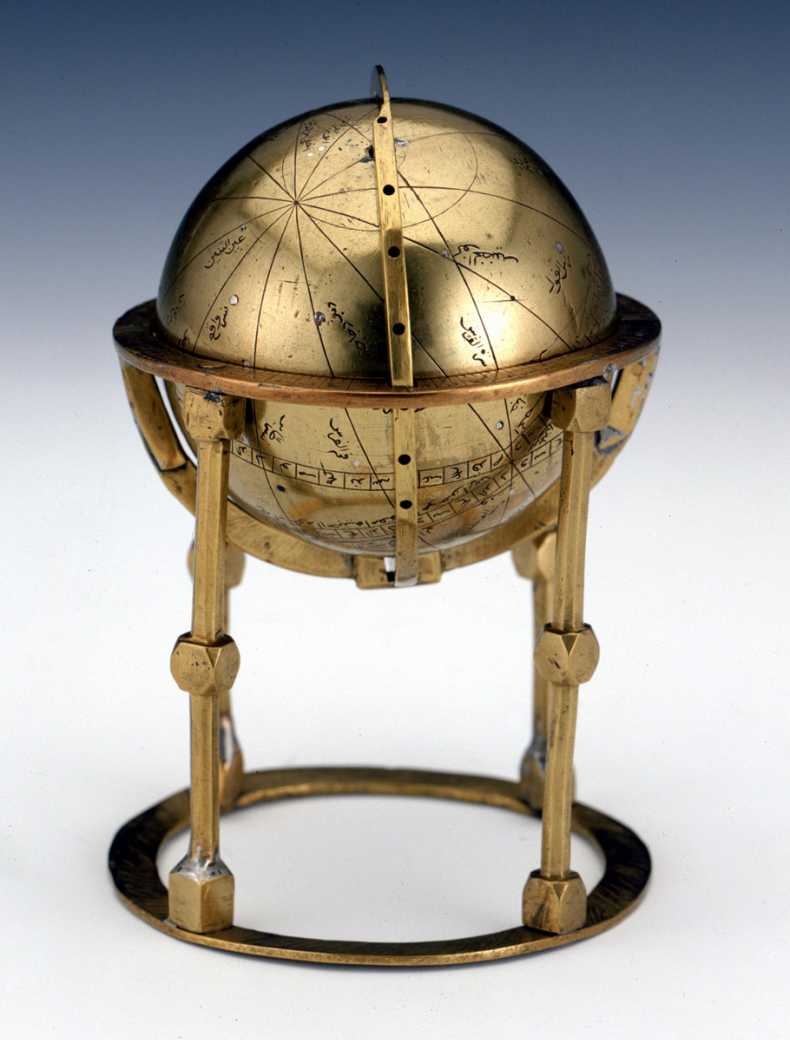
The above image is an ‘Islamic’ Globe dated from the early 1800s.
For those who do not know, follower of the Qur’an Only Religion and translator of the Qur’an, Sam Gerrans believes that in his deep study of the Qur’an that his conclusion is the following:
The Qur’an is clear. We live on a stationary, flat earth, with a solid firmament above us.
You can see his full discussion here:
Sam Gerrans pictured above.
This is the picture that Sam uses in the thumbnail to the video above (with his own modifications).
Now it is not clear if Sam Gerrans believes that we have a universe or if that is also part of the deception. In his thumbnail he puts God “outside” of Creation, or so it seems. On his thumbnail (not included in the picture above) he has the “Heaven of Heavens” and then God is “above” it. Or so it seems. Because if it’s all flat, we don’t really know if God is “above” the Creation or below it.
Theology is not a strong point of those who follow the Qur’an Only Religion; thus, it is hard to glean whether Sam believes that Allah(swt) is outside of space/time.
This was the belief of the ancient people that the Earth that we live on is flat.
“The tree you saw, which grew large and strong, whose top reached the sky and was visible to all the earth.” (Daniel 4:20)
This is the belief of those who believe in a flat Earth. No such tree has existed or ever will exist, because in a spherical world it is impossible to see such an object. Not to mention the fact that objects appear smaller/larger via distance to that object.
“When he had reached the departure of the sun and found it departing in a murky spring, he found people nearby. We said: O Dhu’l-Qarnayn: thou shalt either punish or take concerning them good.” (Qur’an 18:86)
Why Sam feels the need to translate into English “thou shalt” in the 21st century is beyond us.
Now we would personally offer to do this for Sam Gerrans, and we hope others will join in on this fun little project. That we get different people who live in different time zones (unless that too is part of the conspiracy) and as the sun “sets” in our area someone else who is experiencing 1:00pm can tell us if the sun has “departed” or not.
Now, the only place on Earth (with our limited knowledge of topography and geography) that might fit this description would be Iceland, where they experience the “midnight” sun with 6 months of darkness. Yet, we are really hoping that Sam does not believe that, during those 6 months of darkness, that the rest of us who do experience sunlight are under some mass hallucination.
This is how many of the translations of the Qur’an look like when dealing with the verse of the sun “setting in a murky spring.”
“When he had reached the departure of the sun and found it departing in a murky spring, he found people nearby. Allah said, “O Dhul-Qarnayn, either you punish or else adopt among them goodness.” (Qur’an 18:86)
This is side by side with Gerrans translation:
“When he had reached the departure of the sun and found it departing in a murky spring and found people nearby
We said: O Dhu’l-Qarnayn: thou shalt either punish or take concerning them good.” (Qur’an 18:86)
Now either the Qur’an is using language that describes how some human beings perceive their reality (which is very damaging to the claims of Sam Gerrans), or we are confronted with the reality that the Qur’an contradicts observable phenomena. Observable phenomena which is tawatur — continuous mass testimony.
The sun neither sets nor departs. It is part of the language that is used even in the 21st century, unlike “thou shalt”. For example:
For example, it was part of the language of the people when welcoming the Blessed Prophet (saw).
ṭala‘a ‘l-badru ‘alaynā -The full moon rose over us
min thaniyyāti ‘l-wadā‘ -From the valley of Wada‘
The people of Mecca did not believe that the moon rose from the valley of Wada. This was with in the poetic expression of the people. However, from their observable perspective, they likely did believe that the moon literally rose (though not necessarily from the valley of Wada).
Now if we had to choose between the following:
1) 1) There is a massive conspiracy out there to deny the truth about a flat Earth, where the water somehow doesn’t fall off the edge, and there is some ice wall /or barrier we cannot penetrate.
OR
2) Sam Gerrans is part of some psy-op that is out to make the Qur’an look absurd.
If we had to choose between the two, we would say that 2 is more likely. The problem is that science itself is often not very bright, not very intelligent at all when interacting with people who believe the Earth is hallow, or the flat-Earth people like Sam Gerrans.
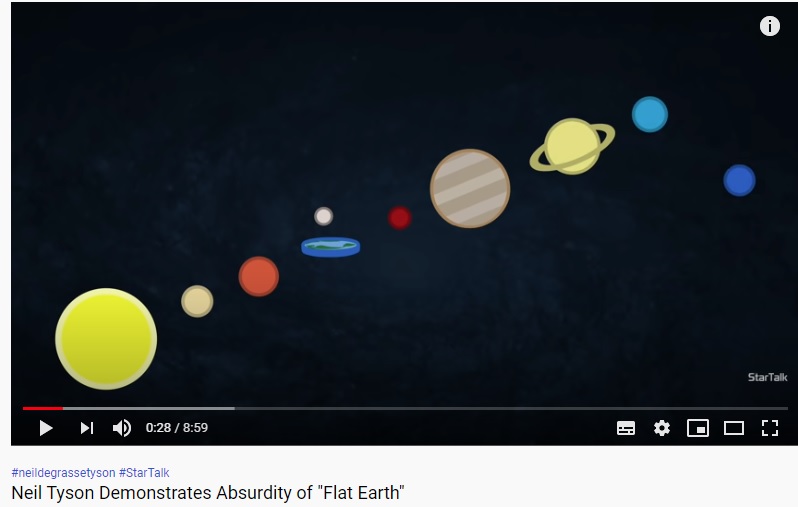
Take, for example, this video by Neil Tyson whose first point is very dumb. So Neil’s first point is that Flat Earthers believe that other planetary bodies are spherical/round. Actually, we know some that don’t believe that at all. They don’t believe in other planets or that we even have a universe! (Not sure Sam Gerrans stance on this.) However, look at this image and study it for a moment. Why do you think it is not very bright to use 2D images of 9 discs pointed one way and one 2D image of a disc pointed another way to prove that all 10 of the discs are spherical?
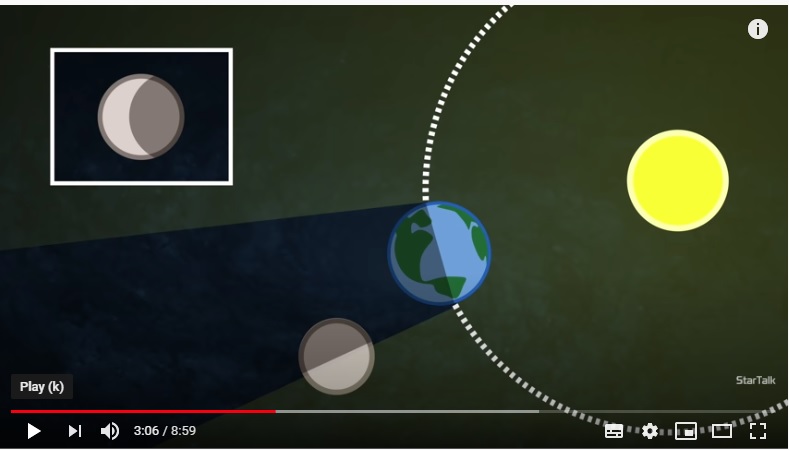
Whereas the next point is more cogent and people like Sam Gerrans really struggle to explain this.
So, yes, we are more likely to believe that Sam Gerrans is a part of a psy-op that wants to make the Qur’an look bad than we are willing to believe there is a massive conspiracy to deny that our Earth is flat. However, one’s beliefs need to stand on the merit of their own claims.
It’s fascinating that the people who claim that the Qur’an alone is sufficient for complete guidance are at the same time making videos for their followers offering ‘guidance’, commentary and responding to doubts or questions about what the Qur’an is saying or teaching, like the Qur’an on its own is actually not sufficient for complete guidance. Or how about the fact that these same individuals then start disagreeing or refuting other ‘Qur’an alone’ teachers due to not considering one another’s understanding and interpretation of certain verses to be correct, despite both sides claiming the Qur’an alone is sufficient.
You may also be interested in reading the following:
“Woe! Unto those who write the Book with their hands then say, This is from Allah; so that they may take for it a small price. So woe! to them for what their hands write and woe! to them for what they earn.” (Qur’an 2:79)
﷽
Question: What does unadulterated mean?
Answer: unadulterated -complete or pure:
Source: (Longman Active Study Dictionary by Addison Wesley Longman pg. 723)
The reason the word ‘unadulterated’ is used is due to possible misunderstanding among both Christians and Muslims.
What is this possible misunderstanding among Muslims and Christians?
For Muslims, the misunderstanding comes from believing that the Bible as a whole should either be accepted or rejected.
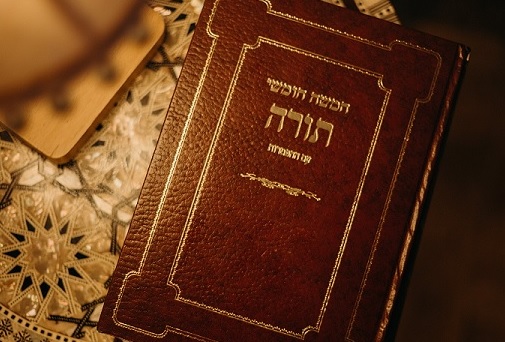
For Christians, the confusion comes from believing that the Injil is equivalent to the ‘New Testament’ and the ‘first five books of Moses‘ are equivalent to the Torah.
According to the Qur’an, is the ‘Bible’ as a whole completely untrustworthy?
Answer: No!
To say that ‘the Bible as a whole‘ is not the word of God is not true.
Question: How do we know?
“Those who follow the Messenger, the Prophet who can neither read nor write, whom they find mentioned with them in the Torah and the Injeel.” (Qur’an 7:157)
Prima Qur’an Comment: It doesn’t say they used to find it. It says whom they find mentioned with them.
This very well could be a reference to:
“If you love me, keep my commandments. And I will pray to the Father, and he shall give you another comforter, that he may abide with you forever” (John 14:15-16)
“Say, He is Allah the absolute One.” (Qur’an 112:1)
This is mirrored in the following: confirmed in
“Hear, O Israel the Lord, your God the Lord is One” (Deuteronomy 6:4)
Prima Qur’an Conclusion: The above passages are enough evidence to show the Qur’an does confirm some of the ‘what is in what could commonly be called in the English vernacular as the ‘Bible’ that came before it.
Thus, Muslims should not say we completely reject all the contents of the ‘Bible’—as a whole.
Does the Qur’an say that the ‘Bible’ as ‘a whole‘ is the word of God?
Answer: No!
How do we know?
“He begets not, nor was he begotten” (Qur’an 112:3)
This conflicts with:
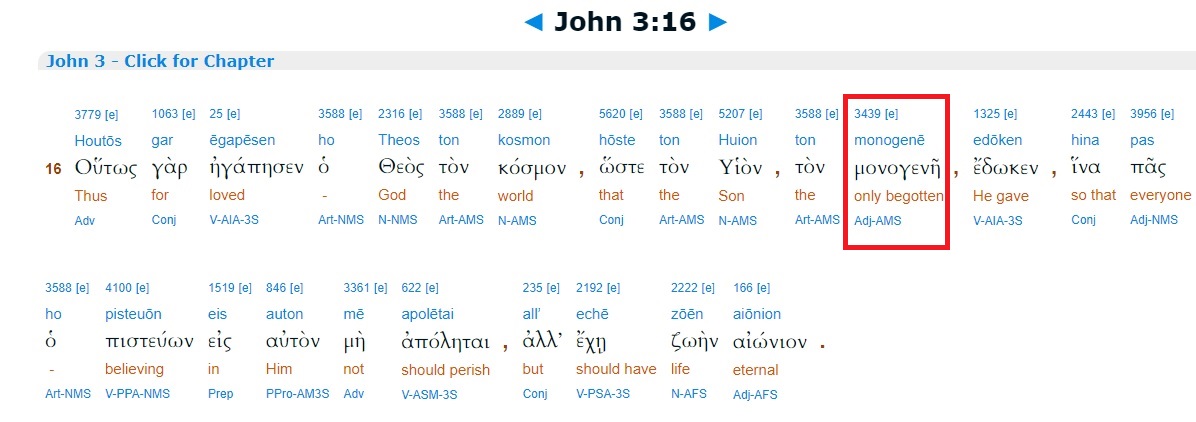
“For God so loved the world that he gave his only-begotten son that whoever believes in him shall not perish but have life everlasting.” (John 3:16)
“Allah, there is no God but He. The Ever-Living, the One Who sustains and protects all that exists. Neither slumber nor sleep overtake him.” (Qur’an 2:255)
This conflicts with:
“And on the seventh day God ended his work which he had made, and he rested on the seventh day from all his work which he had made.” (Genesis 2:2)
“Say not Three (Trinity) desist for it is better for you. Allah is one.” (Qur’an 4:171)
This conflicts with:
“For there are three that bear record in heaven: the Father, the Son, and the Holy Spirit, and these three are one.” (1 John 5:7)
Note: In Latin the word three is Trinitas. This is what the above text would say when rendered in Latin.
Prima Qur’an Conclusion: From the above passages it can clearly be seen that the Qur’an does not accept the ‘Bible’ as ‘a whole‘.
The Qur’an: quality control over the previous revelation
Allah says, in the (Qur’an 5:48)
“And we have sent down to you The Book in truth, confirming the scripture that came before it and MOHAYMINAN over it. So judge by what Allah has revealed, and follow not their vain desires, diverging away from the truth that has come to you. To each among you, We have prescribed a law and a clear way. If Allah willed, He would have made YOU ONE NATION, but that may test you in what He has given you; so strive as in a race in good deeds. The return of you is to Allah; then He will inform you about that in which you used to differ.”
Two major points should be highlighted.
1)Mohayminan, what does it mean? It means having quality control over that which went before it. To assess a thing. If the previous scriptures were intact in Toto, Allah would not need to be a Mohayminan over it.
If Allah willed, He would have made us ONE NATION, with one set of scriptures, one tongue, one color, etc., but Allah says he did not and states clearly it is to test us.
What scripture is discussed in the Qur’an?
Answer: The Qur’an discusses the scripture (revelation) of Abraham, Moses, David, and Jesus.
The Scripture of Abraham.
“Verily! This is in the former scriptures, The SCRIPTURES of ABRAHAM and Moses.” (Qur’an 87:18-19)
Prima Qur’an comments: Do we know where that scripture of Abraham is?
Answer: No.
Question: Do we believe in the principle that he did contain such a scripture?
Answer: Yes, because Allah said so.
Question: Is there evidence of other lost scripture or books within the Bible itself?
Answer: Yes!
Examples of Lost Scripture and Lost Books in the Bible.
“And the sun stood still, and the moon stayed until the nation took vengeance upon their enemies. Is this not written in the book of Jashar?” (Joshua 10:13)
Another example:
“Now the rest of the acts of Solomon, and all that he did, and his wisdom, are they not written in the book of the acts of Solomon?”(1 Kings 11:41)
And yet another example:
“Now the acts of King David, from first to last, are written in the Chronicles of Samuel The Seer, and In The Chronicles Of Nathan The Prophet, and in the Chronicles Of Gad The Seer.” (1 Chronicles 29:29)
Question: Does anyone know where these books are?
Answer: No!
Conclusion:
No one knows where these books are. No one knows where the “Writings of the prophet Nathan” are. However, Allah says in the Qur’an there existed the scripture of Abraham, so we believe in it. So Christians and Jews believe in lost books. I am sure they believe that Allah has some divine wisdom why they cannot go and check the above-mentioned quotes for themselves. Likewise, we do not know where the scrolls of Abraham are.
The Scripture of Moses
“Therefore remind in case the reminder profits. The reminder will be received by anyone who fears him. But it will be avoided by the wretched, Who will enter the Great Fire and make to taste its burning. Wherein he will neither die nor live. Indeed, whosoever purifies himself shall achieve success, And remembers the Name of his Lord, and prays. Nay, you prefer the life of this world, although the Hereafter is better and more lasting. Verily! This is in the former scriptures, The Scriptures of Abraham and Moses.” (Qur’an 87:9-19)
However, a grave misconception exists over what the scripture of Moses is.
It Is not the first five books of the Christian ‘Bible’. Also, it is not the first five books of the Jewish ‘Tanach’. Moses was given the Torah.
It was not something revealed after Him. Traditionally, both Christians and Jews regarded Genesis, Exodus, Leviticus, Numbers, and Deuteronomy as the words of Moses or author Moses.
This has to be rejected in light of the following evidence.
1)(Deuteronomy 34:7)
“Moses was a hundred and twenty years old when he died.”
2) As already mentioned above in (Genesis 2:2)
God rest and needs to be refreshed.
3) A careful reading of the Qur’an quotation above, coupled with a careful reading of the first five books of the ‘Bible‘ fails to show that such things are written there. There is no mention of eternal hellfire, nor mention of the life to come.
4) Internal evidence showing the Torah was lost and has been tampered with.
Point A)
“And Hiil-Kiah, the high priest, said to Shaphan, the scribe, I have found the book of the law in the house of the Lord. And Hil-kiah gave the book to sha phan, and he read it.” (2 Kings 22:8)
“The accession of Josiah and his eagerness to restore the worship of Jehovah led to the renovation of the Temple, and in the course of this, B.C 621, the book of Deuteronomy was discovered. The priest took it to the king, who joyfully welcomed it and set about putting its program of religious reformation into effect. The dramatic story is told in 2 Kings 22 and 23. Josiah put a stop to the idolatrous practice of the people.”
Source: (Edgar J. Godspeed: ‘How came the Bible?’ pgs 22-23)
point B)
“How can you say we are wise, and we have the law of the lord with us when, behold, the lying pen of the scribes have made it into a lie” (Jeremiah 8:8)
Conclusion: The Torah was given to Moses. Not an autobiography of the life of Moses. Moses did not write, “I was 120 years old when I died”. Moses also did not write things that are blasphemous in nature as to the divine might and power of God. The writings of Moses, if it were intact in ‘Toto’, would have had mention of hellfire and a life to come, as the Qur’an says.
Source: (Qur’an 87:9-19)
Lastly, the eternal evidence is that the Torah was lost and that it was also made into a lie by the lying pen of scribes.
The Scripture of David.
As already given above in (Qur’an 21:105), Allah gave David the Zabur…
Zabur is usually thought of as the Psalms of David. The Psalms are those writings contained in the Tanach of the Jews and the Bible of the Christians. There is not much in this collection of writings entitled Psalms that can be understood to be blasphemous or offensive to Islam.
However, we take issue with statements such as…
“I say, “You are gods, Sons of the Most High (GOD), all of you.” (Psalms 82:6)
Also
I will tell the decree of the Lord: He said to me,” You are my son, today I have begotten you.” (Psalms 2:7)
As already mentioned above…
“He begets not, nor was he begotten” (Qur’an 112:3)
Conclusion:
In conclusion, Prophet David never made such statements about Allah. The Psalms in ‘Toto’ are not the Zabur. Allah has no sons. To ascribe to him sons is a monstrous assault on the absolute oneness of God. To call people ‘gods’, even figuratively, has evolved into a lot of problematic theology within Christianity. See: Benny Hinn “Little God Theology.”
The Scripture of Jesus.
“And in their footsteps, We sent Jesus son of Mary confirming the Torah that had come before him, and We gave him The Gospel.” (Qur’an 5:46)
There is also quite a lot of misunderstanding among Muslims and Christians as to what the Injeel (Gospel) is in Islam.
Question: What does the word Gospel mean?
Answer: The Gospel means- the good news from angels.
The Christian missionaries (some honest, some not so) try to equate the Injeel (Gospel) with 22 or 27 books known as the ‘New Testament’. Some Muslims may even believe that the Injeel is the Gospel according to Matthew, Mark, Luke, and John. However, there is good reason to show this again not to be the case.
1) For example:
“And he went about all Galilee, teaching in their synagogues and preaching the gospel of the kingdom.” (Matthew 4:23)
Prima Qur’an comment: Jesus obviously was not walking around with the ‘New Testament’ in his hands.
2) The following as well:
“For God so loved the world that he gave his only-begotten son…” (John 3:16)
Prima Qur’an comments: The Qur’an clearly states that Allah does not beget a son (Qur’an 112:3) So we know that is not the Gospel Allah gave Jesus.
3)Accounts of Jesus in the Qur’an not found in the Christian ‘New Testament’.
“At length she brought the baby to her people, carrying him in her arms. They said: “Oh Mary! Truly an amazing thing have you brought!” “O sister of Aaron! your father was not a man of evil, nor was your mother an unchaste woman!” But she pointed to the baby. They said: “How can we talk to one who is a child in the cradle?”
He said: “ I am indeed a servant of Allah: He has given me revelation and made me a prophet; “And He has made me blessed wherever Ibe, and has enjoined don me Prayer and Charity as long as I live; “He has made me kind to my mother, and not overbearing or miserable; “ So Peace is on me the day I was born, the day that I die, and the day that I shall be raised up to life again” (Qur’an 19:27-33)
“And to appoint him an apostle to the Children of Israel, with this message: “ I have come to you, with a Sign from your Lord, in that I make for you out of clay, as it were, the figure of a bird, and breath into it, and it becomes a bird by Allah’s leave: and I heal those born blind, and the lepers, and I quicken the dead, by Allah’s leave; and I declare to you what you eat, and what you store in your houses. Surely therein is a Sign for you if you did believe;” (Qur’an 3:49)
Prima Qur’an comment: The above-mentioned statements of Jesus are not to be found in any quote “canonical New Testament writings.”
These narratives of Jesus have proximity to ‘The Gospel of Thomas’ and “The Gospel of the Infancy of Jesus Christ”, both of which are 2nd-century apocryphal books. One of these is actually a part of the ‘P52‘ fragment. One of the earliest pieces of evidence that Christians like to boast about.
Why apocryphal? Because the ‘Catholic‘ church does not accept them as cannon. However, let’s look at some interesting statements in the ‘New Testament’.
Apocryphal literature quoted in the New Testament itself.
Jannes and Jambres, for example:
“Now as Jannes and Jambres withstood Moses, so do these also resist the truth: men of corrupt minds, reprobate concerning the faith.” (2 Timothy 3:8)
“There are also many other things that Jesus did, but if these were to be described individually, I do not think the whole world would contain the books that would be written.” (John 21:25)
“Jesus began to preach at about 30 years of age.” (Luke 3:23)
Prima Qur’an comment: It is obvious from these texts that the ‘New Testament’ the Christians have today does not contain everything done or said by Jesus.
For 30 Jesus did not say or do anything? The Qur’an refutes this by saying that Jesus indeed spoke as an infant in defense of his mother’s chastity, long before the age of 30. We personally would want all the evidence possible of his sayings and deeds so we could come to a conclusion about what his Gospel truly was.
4) The Christians, for a very long time, never contained what is now known to be the entire ‘New Testament‘. Many churches only contained some documents. As there was no printing press at the time. The masses did not have access to their scriptures for some time.
There were Christians in the time of Muhammed (saw). for example. who did not believe that the books of James, Jude, Revelation, 1st, and 2nd Peter were to be included as Canon. These include the Syriac Christians among others.
5) Which Gospel: The Gospel of the Circumcision or the Gospel of the Uncircumcision?
Christians also tell us there is but one gospel. Unfortunately, that is not the case as internal evidence within the text of the Bible itself indicates otherwise.
“But Contra wise, When they saw that the Gospel of the Uncircumcision was committed unto me, as the Gospel of the Circumcision was unto Peter.” (Galatians 2:7-9)
“For if someone comes to you and preaches a different Jesus other than the Jesus we preached, or if you receive a different spirit from the Spirit you received, or a different gospel from the one you accepted, you put up with it easily enough.” (2 Corinthians 11:14)
“But even if we or an angel from heaven should preach a different gospel other than the one we preached to you, let them be under God’s curse!” (Galatians 1:8)
These texts all show there was deep early division among Christians. It is also proof to support the Muslim claim that there were indeed various gospels in circulation. Can you imagine if the Blessed Prophet Muhammed (saw) started to talk about a ‘different Qur’ an‘? Christians would have a field day.
Also, note the haughty tone of Paul. Can you imagine if God wanted to send an angel from heaven to preach a gospel different then the one Paul is preaching?
Conclusion: Within the text that Christians call the ‘Gospel‘ or ‘New Testament‘ is self-evident information about Jesus “preaching the gospel (Injeel).” Jesus obviously did not preach from a book or a gospel that came after him, or from an autobiography about him.
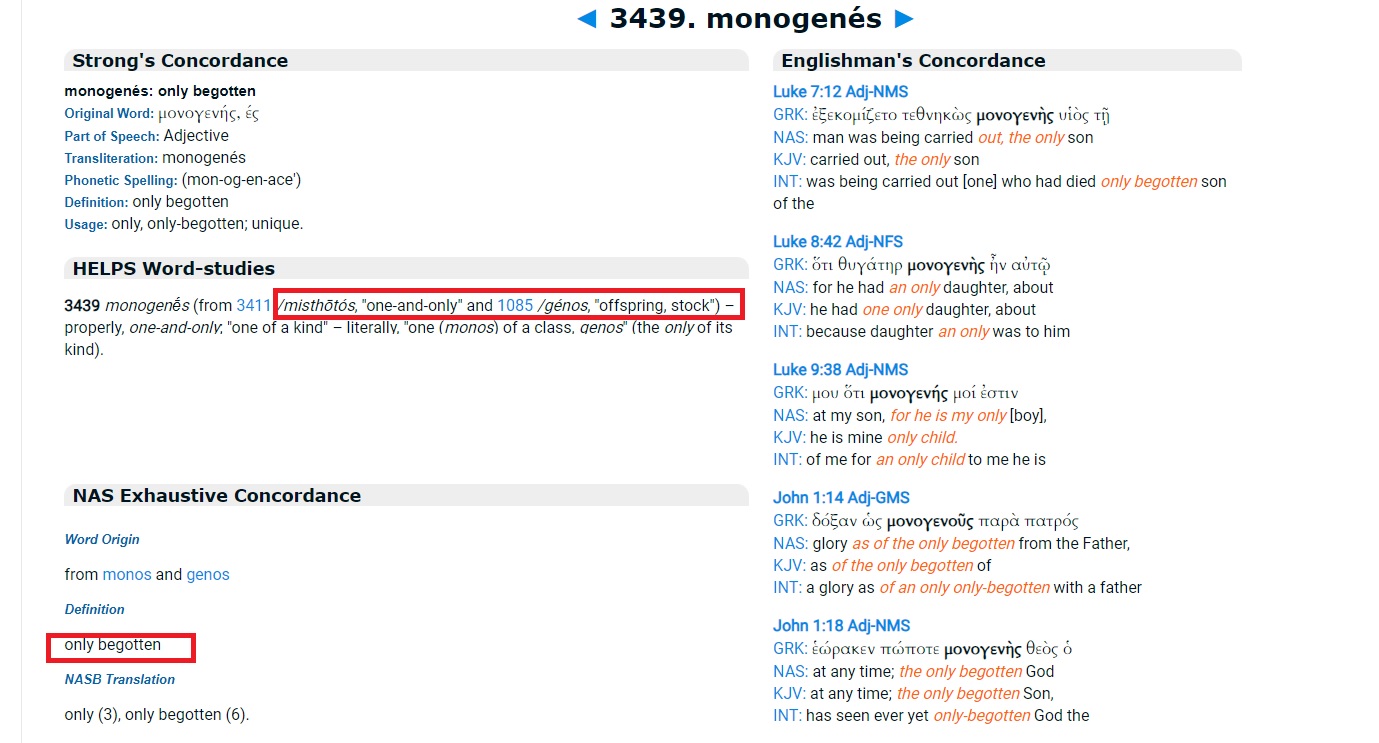
That the message of Jesus, when committed to writing, was not preserved in ‘Toto’ can be seen from references stating that Jesus is the ‘son of God‘ or the ‘begotten son of God‘. However, the Qur’an is emphatic in that Allah does not have a son, rather it is through adoption, ‘monogenes‘ or of any kind.
Another further proof is that the Christians themselves are confused as to what really comprises their ‘New Testament‘ Canon. Insha’Allah, this will be discussed shortly.
Lastly, what Muslims dispute is not that Jesus was given the gospel but what were the contents of that gospel. As can be seen from Biblical internal evidence, there were at least two gospels. Muslims believe the Gospel of Jesus was the one of circumcision.
WHAT ACTUALLY IS THE BIBLE?
Before we delve into the topic of ‘what actually is the Bible‘, let us quote some interesting passages from the Qur’an.
“Say If mankind and jinns were together to produce the like of this Qur’an, they could not produce the like thereof, even if they helped one another.” (Qur’an 17:88)
“And if you are in doubt concerning that which We have sent down to Our slave, then produce a Surah (Chapter) of the like thereof and call your witnesses besides Allah, if you are truthful. But if you cannot do it, and you can never do it, then fear the Fire whose fuel is men and stones prepared for the ungrateful.” (Qur’an 2:23-24)
Now, what actually is the Bible…
Question: What does the word Bible mean?
Answer: The word Bible itself comes from the Greek word Biblious, meaning – A library of books.
Just exactly what is to be constituted in this library is a matter of debate among sincere Christians themselves.
The Bible of the Catholic Church
For example, the Catholic Church, which has 1.1 billion followers worldwide, has 73 books in their Bible that their ‘non-traditionalist’ rivals do not have. Among them are Tobias, Judith, Ecclesiastes, Baruch, Wisdom, 1 Machabees, and 2nd Machabees.
In fact, in direct refutation of Martin Luther (the father of Protestant Christianity) and Protestant affirmations about what is and is not to be in the Bible, the Catholic Church had this to say:
“If any man does not accept sacred and canonical these books entire, with all their parts, as have customarily been read in the Catholic Church and are contained in the ancient common Latin edition… LET HIM BE ANATHEMA!”
Source: (Forth session of the council of Trent, April 8, 1546)
The Bible of the Syrian Church.
You also have the ‘Eastern Christians’ (Nestorian, Syrian) church who believe that there should only be 22 books in the New Testament. Excluding books were Revelation, Jude, 2 Peter, 2 and 3 John, and at times James.
Comments by Martin Luther, the father of Protestant Christianity.
Then you have the father of the Protestant Christians – Martin Luther.
Luther believed that the book of James should not have been included in the New Testament. He concluded it to be ‘an epistle of straw‘. The full quote is here:
Martin Luther writes: “In a word, St. John’s Gospel and his First Epistle, St. Paul’s Epistles, especially Romans, Galatians, and Ephesians, and St. Peter’s First Epistle are the books that show you Christ and teach you all that is necessary and good for you to know, even though you were never to see or hear any other book or doctrine. Therefore, St. James’ Epistle is really an epistle of straw, compared to them; for it has nothing of the nature of the Gospel about it.“
Source: (In “Luther’s Preface to the New Testament,” published in 1522, revised in 1545, in the Works of Martin Luther, Philadelphia: Muhlenberg Press, 1932, copyrighted by the United Lutheran Church in America, vol. 6. pp. 443-444., translated by C.M. Jacobs)
The Letter of James is probably the oldest book in the New Testament, but it has a very poor reputation. Eusebius writes, around 325, that the authenticity of this letter is…
“doubted, since few early writers refer to it, any more than to Jude’s…but the fact remains that these two [James and Jude]…have been regularly used in very many churches.”
Source: (The History of the Church, Book 2.23.17)
Martin Luther writes in the sixteenth century of the letter that “I, therefore, refuse him a place among the writers of the TRUE CANON OF MY BIBLE…
Source: (Preface to the Epistles of St. James and St. Jude).
Why was Luther so adamant? Why shouldn’t this oldest of the Christian books be venerated?
Luther’s first reason is that the message of the letter is “in direct opposition to St. Paul and all the rest of the Bible” in ascribing Abraham’s salvation to his work of offering up Isaac.
The second reason is that “In the whole length of its teaching, not once does it give Christians any instruction or reminder of the passion, resurrection, or spirit of Christ. It mentions Christ once and again, but teaches nothing about Him; it speaks only of a commonplace faith in God.”
This is very interesting, seeing that Sweden, Norway, Denmark, Finland, and Lithuania, along with 35 million Americans belong to the ‘Lutheran denomination’ of Christianity.
The Bibles of Evangelical Christianity.
Surprisingly, the greatest critique of the Bible comes from Evangelical Protestant Christianity!
Baptist, Church of Christ, Pentecostals, Jehovah’s Witness, Methodist, and Lutherans: -you name them. In fact, the following passages and versions are very popular among the mentioned Christian sects. Not to mention the new versions of the Bible cast serious doubt on passages accepted canonical by all the aforementioned groups.
Examples from Evangelical Christian Bibles.
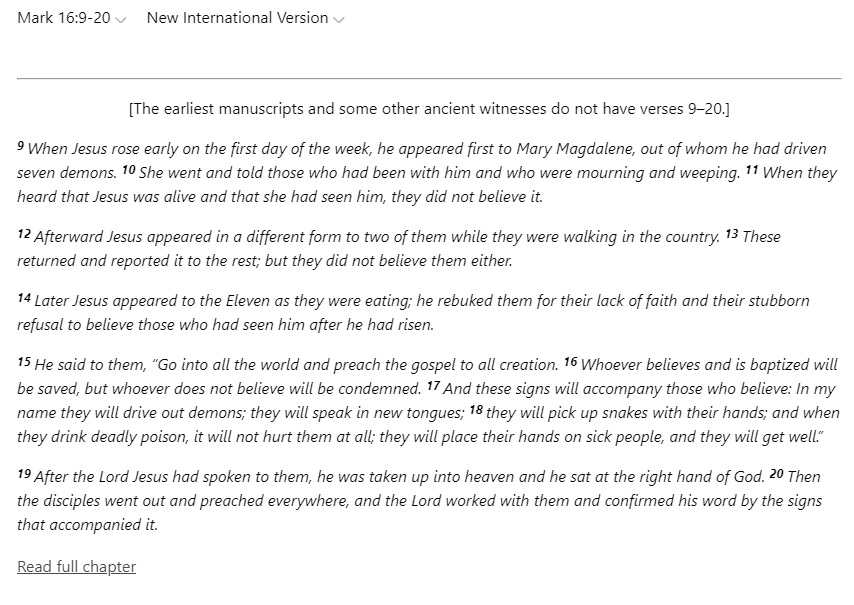
Mark (16:9-20) is contained in the King James Bible as well as many older Bibles.
However, since the discovery of more ancient manuscripts upon which the King James Bible has been based, serious doubt has been cast upon such passages as being spurious or at least very doubtful.
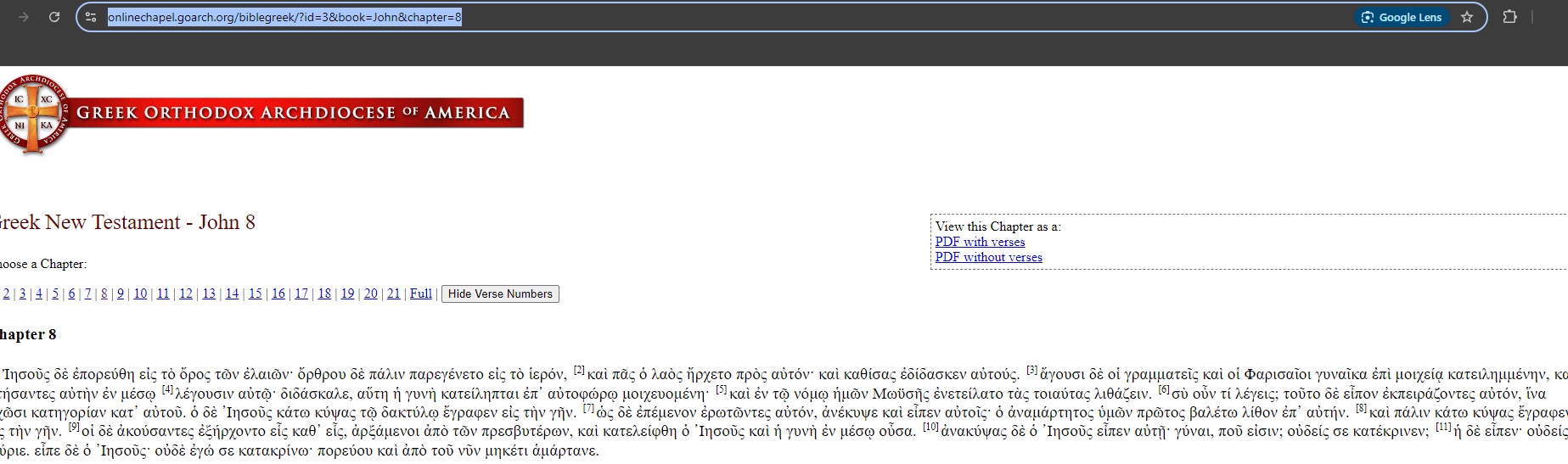
John (8:1-11) is yet another example of such a passage.
The above-mentioned passages are contained in the King James Bible.
Yet in the Revised Version of the Bible 1952, the preface states,
“Yet the King James Version has GRAVE DEFECTS. Pg v(5) of the preface states, “The {King James Version} of the New Testament was based upon a Greek text that was marred by mistakes, containing the accumulated errors of fourteen centuries of manuscript copying.” Pg vi(6) of the preface states, “We now possess many more ancient manuscripts of the New Testament, and are far betterequipped to seek to recover the original wording of the Greek text.”
Question: What are some of these GRAVE DEFECTS?
Answer:
Example 1
In the King James Version you have (1 John 5:7)
“For there are three that bare record in heaven: The Father, The Son, and the Holy Spirit, and these three are one.”
This was a big-time ‘proof-text’ for the Trinity. However, the following Bibles have it removed forever!
{New American Bible}
{Revised Standard Bible 1952}
{Revised Standard Bible 1971}
{New International Version}
Prima Qur’an Comment: They have footnotes that say, “There is no manuscript before the 16th Century that contains such a passage.”
One wonders how many other times commentary ‘slipped’’ into the text during copying.
Example 2
The King James Version has Mark (16:9-20) as part of its word of God.
However, about Mark (16:9-20) Edgar J Goodspeed Bible translator noted:
“The short conclusion connects much better with Mark (16:8) than does the long, but neither can be considered as the original part of the Gospel of Mark.”
Source: (The Goodspeed Parallel New Testament, 1944, p 127)
The following Bible Versions have them removed. If they are not removed, there is usually a (footnote) or a line before and after Mark (16:9-20) showing why it is doubted as the word of God.
{New American Bible}
{Revised Standard Bible 1952}
{Revised Standard Bible 1971}
{New International Version}
Prima Qur’an Comment: The text of Mark 16:9-20 has words attributed to Jesus which Christians for over 1600 years believed to be the words of Jesus. One wonders how many other words attributed to Jesus may be taken out next!
Example 3
The King James Version has John (8:1-11) as part of its word of God.
However, Christian scholars have this to say: “The spurious passages in John (7:53-8:11) have obviously been ADDED TO THE ORIGINAL TEXT of John’s Gospel. They are not found in the Sinaitic Manuscript or the Vatican Manuscript No. 1209, though they do appear in the sixth-century Codex Bezae and later Greek manuscripts. They are omitted, however, by most of the early versions. It is evident that they are not part of John’s Gospel. One group of Greek manuscripts places this passage AT THE END OF JOHN’S GOSPEL; another group PUTS IT AFTER LUKE (21:38), supporting the conclusion that IT IS A SPURIOUS AND UNINSPIRED TEXT.”
Source: (Revised Standard Bible 1971)
The following Bible Versions have them removed. If they are not removed, there is usually a (footnote) or a line before and after John (8:1-11) showing why it is doubted as the word of God.
{New American Bible}
{Revised Standard Bible 1952}
{Revised Standard Bible 1971} This version even has the material about where various manuscripts have placed it.
{New International Version}
Conclusion: We can see that there is no such thing as ‘The Bible’ among Christians. There are Bible(s) according to whose camp you belong to, or what church tradition one follows. We can all see that the Bible does not meet the standards of the Qur’an in the passages given at the beginning of this discussion.
The Christians themselves have been led into believing that certain books or passages are the words of God or inspired by him when they are not. Thus, people have made something like the Bible.
I will leave you with this following quotation from the book of Revelation for Christians to think about…
Revelation (22:18-19)
“I warn everyone who hears the words of the prophecy of this book;if anyone adds to them, God will add to him plaguesdescribed in this book, and if anyone takes away from the words of this Book of Prophecy, God will take away his share in the tree of lifeand in the holy city, which are described in this book.”
THE AUTHENTICITY OF THE BIBLE
One of the reasons we didn’t name this topic “The Authenticity of the Bible” is because to be authentic you have to have a genuine original.
Christians never call their documents ORIGINAL. They call them ANCIENT AND MOST ANCIENT. The reason they do this is that they are simply being transparent. However, some of them make the masses feel that the Bible they have is an exact replica of the original manuscripts. However, when they are confronted with point-blank contradictions in the text, they usually resort to saying, “Well I believe those are not in the original autographs.”
“This is necessary to do with the books of the Bible, as with all literary documents of the ancient world, because the originals are no longer extant. Not only this, but of the more than five thousand manuscript copies of the Greek New Testament, no two of them agree completely. It is essential, therefore, that anyone who expounds the Word of God be acquainted to some degree with the science of textual criticism if he or she is to expound that Word faithfully.”- Daniel B Wallace.
If you look up the word Authentic in any dictionary, it has the following meanings: original, real, true, genuine, pure, accurate, reliable, legitimate, factual, actual, concrete, verifiable, authoritative, trustworthy.
So if, by their own admission, they don’t have an authentic original indeed what are they telling us?
This is unlike the Qur’an, in which states that it will be preserved.
“Verily, It is We Who have sent down the Dhikr (the Qur’an) and surely, We will guard it (from corruption) .” (Qur’an 15:9)
Note: Allah tells us that he will guard the Qur’an. This is unlike the previous scriptures. It was up to human beings to guard them.
“…and the rabbis and the priest (judged according to their Scriptures), FOR TO THEM WAS ENTRUSTED THE PROTECTION OF THE BOOK OF ALLAH, and they were witnesses to it.” (Qur’an 5:44)
So, two things can be seen from the viewpoint of the Qur’an.
1) The protection of the Qur’an is under Allah
2) The protection of the previous scriptures is under the religious establishment.
Does the Bible even claim to be from God?
The Qur’an claims to come from God.
“The Most Beneficent. Has taught the Qur’an. He created man. He taught him speech.” (Qur’an 55:1-4)
Again we have…
“Ha Mim. The revelation of the Book is from Allah, the All-Mighty, the All-Wise.” (Qur’an 46:1-2)
Examining the Doctrine of Inspiration: The claim that it comes from God.
The reason for this investigation is simple. Why should a person consider scripture to have come from Allah if it doesn’t claim to come from him?
When we ask Christians a very pointed question. Does your book (scriptures) even claim to come from Allah? They say yes.
The two texts cited by them to prove that the Bible claims to come from Allah are
“All scripture is given by inspiration of God and is profitable for doctrine, for reproof, for correction, for instruction into righteousness” {King James Version} (2 Timothy 3:16)
“For the prophecy came not in old time by the will of man, but holy men of God spoke as they were moved by the Holy Spirit.” (2 Peter 1:21)
If we look at the first text given of 2 Timothy (3:16) in context, he will see that it only certifies the Hebrew Scriptures.
2 Timothy (3:15), ” And from a child you have known the holy scriptures which are able to make the wise to salvation which is in Jesus Christ.”
We can see clearly in the context that IF this text is making a claim to anything, it’s the ‘Old Testament scriptures’.
Why? Because when Timothy was a child there were no ‘New Testament’ writings at that time.
We also know that this scripture DOES NOT verify everything in the Bible as being from Allah! How do we know?
When we get a correct translation. As already mentioned, the Christians have Bible Versions that are more accurate than those they previously possessed.
In the first {Revision Standard Version} of the Bible, the translation of (2 Timothy 3:16) is very revealing.
2 Timothy (3:16)(Revised Standard Version 1881, 1952)
“Every scripture inspired by God is profitable for teaching, forreproof, for correction, for training into righteousness.”
Also, the Douay Rheims Version and the Revised Standard Version 1971 have an alternative reading of this passage.
We hope that the difference above between ‘all scripture IS-inspired‘ and ‘all scripture inspired’, is understood.
For example, if I say ALL the apples are good, it means ALL the apples are good. However, if I say all the apples that are good it means some of them are not good.
Read the above passage once again…
“Every scripture inspired by God (not that all scripture IS inspired by God) is profitable for teaching, for reproof, for correction, for training into righteousness.”
The Internal Evidence is that “not all scripture is inspired.”
We have internal evidence within the Biblical text that shows the above reading ‘All scripture inspired by God’ is correct.
“And unto the married, I command Yet not I, But the Lord Let not the wife depart from her husband: But if she departs, let her remain unmarried, or be reconciled to her husband: and let not the husband put away his wife. But to the rest speak I, not the Lord: If any brother has a wife that believes not, and she is pleased to dwell with him, let him or put her away.” (1 Corinthians 7:10-12)
“Now concerning virgins, I have no commandment from the Lord: yet I give my judgment as one that obtained the mercy of the Lord to be faithful. I suppose therefore that this is good for the present distress. I say that it is good for a man so to be.” (1 Corinthians 7:25-26)
“But she is happier if she so abides. After my judgment, and I THINK (I’m not sure) I also have the Spirit of God.” (1 Corinthians 7:40)
In the first text, it can be seen that in the first text Paul was going to say something and then catch himself. The second text is crystal clear in that Paul says that he doesn’t feel the Holy Spirit, inspiring him to say anything. However, since he does keep in contact with Paul, Paul feels he can give his own judgment. In the third text, Paul is not even sure if the Spirit of God is with him.
More examples of Uninspired scripture.
“One of themselves, even a prophet of their own said, The Cretians are always liars, evil beasts, slow bellies.” (Titus 1:12)
This is not inspired scripture. Paul is quoting Epimenides, who was a 6th Century soothsayer. He was no prophet of God.
“For in him, we live, and move, and have our being; as certain of your own poets have said, For we are also his offspring.” (Acts 17:28)
This is not inspired scripture. Paul is quoting the poet Aratus from Cilicia Lycia and this guy is talking about the pagan deity ZEUS! He is then making a poem about a pagan deity that applies to God!
“Greater love has no man than this, that a man lay down his life for his friends” (John 15:13)
We know this is uninspired scripture because the teachings of the prophets are perfect. Jesus would never have uttered this statement.
The greater teaching is that ‘a man lay down his life for his enemies‘
A very candid presentation by the ‘author’ Luke.
“Inasmuch as many have undertaken to compile a narrative of the things which have been accomplished among us, Just as they were delivered to us by those who from the beginning were eyewitnesses and ministers of the word, it seemed good to me also, having followed all things closely for some time past, to write an orderly account for you most excellent Theophilus, that you may know the truth concerning the things of which you have been instructed.” (Luke 1:1-4)
There are a lot of things to be said about this.
1) Where are the many accounts Luke is talking about?
2)Note: Luke said he was getting second information from ‘those who were eyewitnesses’ who ‘delivered them to us‘. He isn’t getting his information from God but from oral tradition.
3) Luke says ‘it seemed good to me also‘ to write ‘an orderly account’. If Luke thought the accounts already given were sufficient, he would not have felt the need to write his own account.
4) Finally, if Luke writes an ‘orderly account’’ are the other accounts disorderly? Would the Holy Spirit inspire disorder?
This is clearly different from the apostles of Jesus who said:
“For it seemed good to us AND the Holy Spirit to lay upon you no greater burden than these necessary things:” (Acts 15:28)
The Apostles said it seemed good to ‘us and the Holy Spirit’. However, Luke said it seemed good to him (only)
Prima Qur’an Comments: Because of these and other problems, the Evangelical Christians have adopted their position on inspiration.
We will now examine the four points Evangelicals have now adopted.
1) Everything inspired is not scripture.
2) Everything that is scripture is not inspired.
3) Everything that is scripturally inspired is not preserved.
4) Everything that is preserved is not scripturally inspired.
An example of point number 1
“I have a lot to write to you, but I do not wish to write with pen and ink. Instead, I hope to see you soon, when we can talk face to face.” (3 John 1:13)
Prima Qur’an Comment: This writer is clearly stating that everything inspired need not be written. He feels what he needs to say can be said in person “face to face.”
At the least, it shows that everything that is inspired is not necessarily scripture.
An example of point number 2
“Now concerning virgins, I have no commandment from the Lord: yet I give my judgment as one that obtained the mercy of the Lord to be faithful. I suppose therefore that this is good for the present distress. I say that it is good for a man so to be.” (1 Corinthians 7:25-26)
Two examples of point 3
“I wrote unto you in an EPISTLE not to company with fornicators:” (1 Corinthians 5:9)
Prima Qur’an Comment: Well, if everything Paul wrote was inspired by God, then where is this epistle at?
By the way. this is 1st Corinthians, not 2nd Corinthians.
“Or do you suppose it is in vain that the SCRIPTURE says, “He yearns jealously over the spirit which he has made to dwell in us”? (James 4:5)
Prima Qur’an comment: Where is this Scripture at? So does the Bible contain all of God’s scripture or not?
Examples of point 4
The ‘Catholics‘ would say that the book of Tobit has been preserved, but the Protestants would not agree to it being inspired. Many books of antiquity have come down to us today and Christians would readily agree that this is not necessarily a case for inspiration.
Further thoughts on inspiration. The following is taken from Daniel B Wallace. He is a very conservative Christian and has written an excellent essay on various viewpoints among Evangelicals. It is quite an eye-opening essay.
“Sturz gives some further helpful analogies (Byzantine Text-Type, 38): Preservation of the Word of God is promised in Scripture, and inspiration and preservation are related doctrines, but they are distinct from each other, and there is a danger in making one the necessary corollary of the other. The Scriptures do not do this. God has given the perfect revelation by verbal inspiration, was under no special or logical obligation to see that man did not corrupt it.”
“W.N. Pickering, “Identity of the New Testament Text,” 150. In Pickering’s theological construct, then, the doctrine of inspiration has no significance, for elsewhere he argued. “If we do not have the inspired words or do not know precisely which they be, then the doctrine of Inspiration is inapplicable.” (Burgeon, 88)
“Matthew 24:35 “ Heaven and earth will pass away, but my words will not pass away,” is used in support of preservation. But once again, even though this text has the advantage of referring to Jesus’ words (as opposed to the OT), the context is clearly eschatological; thus, the words of Jesus have certainty of fulfillment. That the text does not here mean that his words will all be preserved in written form is absolutely certain, because (1) this is not only foreign to the context but implies that the written gospels were conceived at this stage in Heilsgeschichte decades before a need for them was apparently felt; (2) we certainly do not have all of Jesus words recorded either in scripture or elsewhere (cf John 20:30 and 21:25)”
“Wilbur Pickering, former president of the Majority Text Society, has continued this type of argument into the present debate. In his 1968 master’s thesis done at Dallas Seminary (An Evaluation of the Contribution of John William Burgon to the New Testament Textual Criticism)”
We have seen that Christians are claiming for the Bible what it does not even claim for itself, namely, that it is the inspired word of God. We have given clear proof text that shows many passages in the Bible are not inspired by God. Above all. Luke himself, a major Gospel writer, does not claim inspiration from God.
The Claims of Allah in the Qur’an about previous scripture.
“Then woe to those who write the Book with their own hands and then say, This is from Allah,” to purchase with it a little price! Woe to them for what their hands have written and woe to them for what they earn thereby.” (Qur’an 2:79)
In the sublime oral tradition we have:
Narrated Ubaidullah: Ibn ‘Abbas said, “Why do you ask the people of the scripture about anything while your Book (Quran) which has been revealed to Allah’s Apostle is newer and the latest? You read it pure, undistorted and unchanged, and Allah has told you that the people of the Scripture (Jews and Christians) changed their scripture and distorted it, and wrote the scripture with their own hands and said, ‘It is from Allah,’ to sell it for a little gain. Does not the knowledge which has come to you prevent you from asking them about anything? No, by Allah, we have never seen any man from them asking you regarding what has been revealed to you!”
“And verily, among them is a party who distort the Book with their tongues (as they read), so that you may think it is from the Book, but it is not from the Book, and they say: “This is from Allah,” but it is not from Allah; and they speak a lie against Allah while they know it.” (Qur’an 3:78)
Narrated Abu Huraira: The people of the Book used to read the Torah in Hebrew and then explain it in Arabic to the Muslims. Allah’s Apostle said (to the Muslims), “Do not believe the people of the Book, nor disbelieve them, but say, ‘We believe in Allah and whatever is revealed to us, and whatever is revealed to you.’
2) Different schools of thought reporting in another language and twisting the meanings of the original wording.
Internal evidence shows that the Bible agrees with Allah on this.
“How can you say we are wise, and the ‘law of the lord'(Torah) is with us’? But BEHOLD, THE FALSE PEN OF THE SCRIBES HAS MADE IT (The Torah) INTO A LIE.” (Jeremiah 8:8)
“And about the ninth hour, Jesus cried with a loud voice, “Eli Eli lama sabach-thani?” which is being interpreted, “My God, My God, why hast thou forsaken me?”(Matthew 27:46)
Prima Qur’an Comments:
1) In the first point, the Bible itself claims the Torah was corrupted by the pen of the scribes. Every time you see ‘law of the lord’ that word there is TORAH!
2) On the second point, this has puzzled scholars of the ‘New Testament‘. Why would someone leave the Aramaic statement of Jesus and then put the translation in Greek?
Why not just translate it?
Also, this is evidence that Jesus spoke Aramaic, not evidence that Jesus spoke Greek. So the ‘New Testament‘ documents are not in the language of revelation that Jesus spoke.
DOES THE BIBLE CONTAIN CONTRADICTIONS?
“Do they not consider the Qur’an carefully? Had it been from any other Allah, they would have surely found therein many contradictions.” (Qur’an 4:82)
Now, when talking with Christians, you may see the following positions taken.
1) The Bible is inerrant (error-free). This means being free from contradictions or problems of any kind. This position is usually taken among Evangelical Christians.
2) When you show them a contradiction (or error) they might say, “Well, it has nothing to do with my doctrine.”
They may say, “Well it’s ONLY ONE!” This position is usually taken by many mainstream churches, such as the Catholic Church.
3) They might even say, well, I BELIEVE in the ORIGINAL AUTOGRAPHS. It was error-free. This position is taken by Evangelical Christians when finally confronted with the daunting reality of a flat contradiction or error.
Let’s respond to the above going from 3 to 1.
3) It should be noted that there are NO ORIGINAL DOCUMENTS. They have ‘ancient‘ and ‘most ancient‘ as already discussed. They are just relying on BLIND FAITH.
The Christians do not have a dual preservation method in which people commit the revelation to memory as well as text.
2) If they say, “It’s only one,” it should be pointed out that their doctrine is that the BIBLE IS INNERANT.
Therefore, it’s a MAJOR PROBLEM.
Alas! How many holes does it take to pop a balloon?
What if you were on an airplane and a window was smashed out? Well, it’s only one!
One hole pops the balloon!
1) The fact is that there are flat contradictions and errors in the Bible. The following will give more than enough proof of that.
Question: Should a contradiction from a translation be sufficient to show the Bible has an error?
Answer: No!
When giving contradictions in the Bible, it should be noted that we should show such contradictions from the Greek and Hebrew Text.
Why? Because we as Muslims would not accept any ‘contradictions‘ from a translation.
The Qur’an is in the Arabic text. So we should not set about a double standard.
So surface (seemingly) contradictions will not do.
Question: What is surface contradiction?
Answer:
Example of a surface contradiction in the Bible.
“And Michael, the daughter of Saul, had no child until the day of her death.” (2 Samuel 6:23)
“The king took the two sons of Rizpah, the daughter of Aiah, whom she bore to Saul, Armoi and Mephiboseth; and the FIVE SONS OF MICHAL.” (2 Samuel 21:8)
Prima Qur’an Comment:
This would be a contradiction except that there is an alternative reading of MICHAL with the Hebrew word MERAB. Thus, as the Hebrew text can read ‘ FIVE SONS OF MERAB‘ we don’t have a contradiction.
Thus, the importance of establishing the evidence from the text in the original language is demonstrated.
EXAMPLES OF CLEAR CONTRADICTIONS IN THE TEXT
“When the evening came, they brought unto him MANY that were possessed with devils: and he cast out the spirits with his word, and healed ALL that were sick.” (Matthew 8:16)
“And at evening, when the sun did set, they brought unto him ALL that were diseased and them that were possessed with devils. And ALL the city was gathered together at the door. And he healed MANY that were sick of diverse diseases, and cast out MANY devils; and suffered not the devils to speak, because they knew him.” (Mark 1:32-34)
Prima Qur’an Comment: The Greek word for many is (pantas) and the Greek word for all is (pollous). Matthew saw some deficiency in a Jesus that only healed many, so he switched the Greek words around.
Another example:
“And there came a voice from heaven, saying YOU ARE my beloved Son, in whom I am well pleased.” (Mark 1:11)
“And lo a voice from heaven, saying, THIS IS my beloved Son, in whom I am well pleased.” (Matthew 3:17)
Prima Qur’an Comment: The Greek word for you is su and the Greek word for this is would be (outos). Mark held that Jesus was the adopted son of God, called adoptionist theology. Matthew felt Jesus already knew who he was because he was the son of God based on the Virgin birth and therefore did not need to be told who he was. He changes the wording of the voice, so the people are addressed.
Another example:
“And when he knew it of the Centurion, he gave the body to JOSEPH. And HE brought fine linen, and took him down, and wrapped him in the linen, and laid him in a sepulcher which was hewn out of a rock, and rolled a stone unto the door of the sepulcher.” (Mark 15:45-46)
“And though THEY found no cause of death in him, yet desired THEY Pilate that he should be slain. And when THEY had fulfilled all that was written of him, THEY took him down from the tree, and laid him in a sepulcher.” (Acts 13:28-29)
Prima Qur’an comments: This goes back to the conflict over whether Jesus died and was then impailed on a Tree or rather he was nailed to a Patibulum (T tau or + cross-shaped fixture). Here it says the same Jews who desired his death put him in the tomb and not Joseph.
Another example:
“Saying unto them, Go into the village over against you, and straightaway you shall find an ASS tied, AND A COLT with her: lose THEM, and bring THEM unto me. And if any man says ought unto you, you shall say, The Lord hath need of THEM and straightway he will send THEM. All this was done, that it might be fulfilled which was spoken by the prophet, saying, Tell the daughter of Zion, Behold, thy King comes to you, meek, and sitting upon an ASS, AND A colt the foal of an ass. And the disciples went, and did as Jesus commanded them, And brought the ASS, AND the COLT, and put on THEM their clothes, and they set him thereon.” (Matthew 21:2-7)
“And said unto them, Go your way into the village over against you: and as soon as you be entered into it, you shall find a colt tied, whereon never sat; lose HIM, and bring him. And if any man says unto you, Why do you do this? Say you that the Lord has need of HIM, and straightaway he will send HIM hither. And they went their way and found the colt tied by the door without It a place where two ways met, and they lose HIM. And certain of them stood there and said, What are you doing losing the COLT? And they said unto them even as Jesus had commanded: and they let them go. And they brought the COLT to Jesus, and cast their garments on HIM, and he sat upon HIM.” (Mark 11:2-7)
“Rejoice greatly, O’ daughter of Zion; shout, O’ daughter of Jerusalem: behold, thy King cometh unto thee: he is just, and having salvation; lowly, and riding upon an ass, even upon a colt the foal of an ass,” (Zechariah 9:9)
Prima Qur’an Comment: The Greek word for a colt (singular) is polos and for it (ayton). The Greek word for them is (vavtos). This contradiction is not really on Mark’s part, as it is Matthew’s lack of understanding of Hebrew or else using the Greek Septuagint. In Zechariah 9:9 the original Hebrew shows only one ass, the term even stressing that. However, Matthew didn’t look into the Hebrew text of the matter.
The New American Bible has the following commentary,
“The ass and the colt are the same animal in the prophecy, mentioned twice in different ways, the common Hebrew literary device of poetic parallelism. Matthew takes them as two is one of the reasons why some scholars think that he was a Gentile rather than a Jewish Christian who would presumably not make the mistake. Upon them: upon the two animals; a peculiar picture resulting in Matthew’s misunderstanding of Zechariah 9:9”
Source: (New American Bible pg 1043 commentary on Matthew 21)
Another example:
“And they arrived at the country of GERGESENES, which is over against Galilee. Then the whole multitude of the country of the GERGESENES round about sought him to depart from them; for they were taken with great fear: and he went up into the ship, and returned back again.” (Luke 8:26,37)
“And when he came to the other side into the country of the GADARENES, there met him two possessed with devils, coming out of the tombs, exceeding fierce, so that no man might pass by that way.” (Matthew 8:28)
Prima Qur’an Comment: This error in the Greek text is more due to a scribal gloss in the Greek text.
Another example:
“And when Jesus was entered into Capernaum, there came unto him A CENTURION, beseeching him,” (Matthew 8:5)
“And a certain centurion’s servant, who was dear unto him, was sick, and ready to die. And when he heard of Jesus, HE SENT UNTO THEM ELDERS OF THE JEWS, beseeching him that he would come and heal his servant.” (Luke 7:2-3)
Prima Qur’an Comment:
The Greek phrase for older men is (presbuteros). The Greek word for centurion is (hekatontarchos). The reason this exists has more to do with oral tradition than the ideas either of the writers had.
Another example:
“While he spoke these things unto them, behold, there came a certain ruler, and worshipped him, saying, My daughter is EVEN NOW DEAD: but come and lay thy hand upon her, and she shall live.” (Matthew 9:18)
“And sought him greatly, saying, My little daughter LIES AT THE POINT OF DEATH: I pray thee, come and lay hands on her, that she may be healed; and she shall live.” (Mark 5:23)
Prima Qur’an Comment:
The Greek term for the deceased is (teleute). Again, Matthew thought that a Jesus who could save a dead person was going to be more illustrious than a Jesus who merely saved a dying person. So this contradiction is the result of the developing theology surrounding the person of Jesus.
Another example:
“The first day of the week comes Mary Magdalene early, when it was yet dark, unto the sepulcher, and see THE STONE TAKEN AWAY from the sepulcher. Then she ran, and came to Simon Peter, and to the other disciples, whom Jesus loved, and said unto them, They have taken away the Lord out of the sepulcher, and we know not where they have laid him.” (John 20:1-2)
“And, behold, there was a great earthquake: for the Angel of the Lord descended from heaven, and came and ROLLED BACK THE STONE from the door, and sat upon it.” (Matthew 28:2)
Prima Qur’an Comment: The reason such an anomaly exists is that the writer John believed in a spiritual resurrection of Jesus in which the stone would be no barrier. However, Matthew believed in a physical resurrection and a stone would be a barrier to that.
“The fathers shall not be put to death for the children, neither shall the children be put to death for the fathers: every man shall be put to death for his own sin.” (Deuteronomy 24:16)
“Samuel said to Saul: “It was I the Lord sent to anoint you king over his people Israel. Now, therefore, listen to the message of the Lord.
This is what the Lord of hosts has to say: “ I will punish the Amelek tribe did to Israel when he barred his way as he was coming up from Egypt. Go, now, attack Amalek, and deal with him and all that he has under the ban Do not spare him, but kill men and women, children and infants, oxen and sheep, camels and asses.” (1 Samuel 15:1-3)
Prima Qur’an Comment: One can make all the excuses they want about how infants took part in harming Israel on the way to Egypt, but it would be a real stretch. God did not command the killing of babies. This text here is a forgery. Bloodlust in the name of God is not scripture, and it contradicts God’s clear command in Deuteronomy that children will not be put to death for their father’s misdeeds.
Conclusion: It should be seen that the Bible has contradictions within the text. These contradictions also show that the Bible is not the word of God according to the criteria the Qur’an gave above.
THOSE AMAZING BIBLE ‘PROPHECIES’
If I had to pick THE reason why I think most Christians believe that the Bible is THE word of God, I would say because of the idea of prophecies.
Most Christians think the Bible is filled with amazing Bible prophecies about the future. ‘
However, what does the Bible say about such ‘prophecies’?
“If a prophet arises among you, or a dreamer of dreams, and gives you a sign or wonder, and the sign or wonder which he tells you comes to pass, and if he says, ‘Let us go after other gods ‘which you have not known,’ and let us serve them,’ you shall not listen to the words of that prophet or to that dreamer of dreams; for the Lord, your God is TESTING YOU, TO KNOW WHETHER YOU LOVE THE LORD YOUR GOD WITH ALL YOUR HEART and all your soul.” (Deuteronomy 13:1-3)
So the Bible admits even FALSE PROPHETS can make accurate prophecy fulfillment. However,We think there are better reasons than that to question the ‘amazing prophecies‘ belief held by Christians. Many Christians are not even aware of the following.
1) In the original CONTEXT, they were not even ‘prophecies‘ awaiting fulfillment!
2) Text quoted as ‘prophecy‘ is not even taken as a HOMOGENEOUS UNIT and the context is ignored.
3) Sometimes even the text supposedly quoted IS NOT EVEN TO BE FOUND.
4) Sometimes text from TWO DIFFERENT PROPHETS is attributed to ONE PROPHET.
5) Most importantly, these ‘proof-texts’ were only ‘prophecies’ in the WILD IMAGINATIONS of those that said so.
AN EXAMPLE OF NUMBER 1
An interpolated statement put in the mouth of Jesus
“He who believes in me, as SCRIPTURE SAID,” out of his heart shall flow rivers of living water.” (John 7:38)
Prima Qur’an Comment:
However, there is NO SUCH SCRIPTURE anywhere in the Tanach (Old Testament)! Yet {footnotes} will have the following passages.
“For I will pour water on the thirsty land, and streams on the dry ground I will pour my spirit upon your descendants.” (Isaiah 44:3)
“Lo, everyone one who thirsts come to the waters; and he who has no money come and buy wine and milk without money and without price.” (Isaiah 55:1)
” And the Lord will guide you continually, and satisfy your desire with good things (Hebrew meaning uncertain) and make your bones strong and you shall be like a watered garden, like a spring of water, whose waters fail not.” (Isaiah 58:11)
All of the above passages are not the STATEMENT OF Jesus in (John 7:38). Their are no ‘prophecies‘ awaiting fulfillment.
AN EXAMPLE OF NUMBER 2
Another interpolated statement is put in the mouth of Jesus.
“The son of man does go as it is WRITTEN OF HIM: but one unto that man by whom the Son of Man is betrayed! it had been good for that man if he had not been born.” (Mark 14:21)
Prima Qur’an Comment:
Again, there is NO SUCH STATEMENT in the Tanach (Old Testament)
However, {footnotes} will have the following passage.
“Even my bosom friend in whom I trusted, who ate my bread, has lifted his heel against me.” (Psalms 41:9)
There are two major points we would like to reflect on regarding this.
1) In CONTEXT this passage CANNOT refer to the life of Jesus. Why? Because of the following text.
“As for me, I said, “O Lord, be gracious to me, heal me, FOR I HAVE SINNED AGAINST THEE!” (Psalms 41:4)
So was Jesus sinless or not?
2) If there was a ‘prophecy‘ about a man betraying Jesus, this would mean Judas’ destiny was marked before the poor fellow was even born! So much for salvation!
“He stayed there until the death of Herod, that what the Lord had said through the prophet might be fulfilled, “Out of Egypt I called my son.” (Matthew2:15)
This is taken from:
“When Israel was a child I loved him, out of Egypt I called my son. The more I called them, the farther they went from me, Sacrificing to the Baals and burning incense to idols.” (Hosea 11:1-2)
Prima Qur’an Comment: This is only a prophetic fulfillment in the wild imagination of Matthew. Anyone can clearly see that Hosea 11:1-2 is no amazing prophecy awaiting fulfillment. Not only that but the context refers to Israel and not Jesus.
Only if you ignore the context could it refer to Jesus. Why?
Because a Muslim would never ever accept that Jesus “sacrificed to the Baals and burned incense to idols.”
AN EXAMPLE OF NUMBER 3
“And he went and dwelt in a city called Nazareth, that what was spoken by the prophets might be fulfilled, “HE SHALL BE CALLED A NAZARENE.” (Matthew 2:23)
Prima Qur’an Comment:
There is no such ‘prophecy‘ anywhere in the Tanach (Old Testament). The scholars of Christianity respond with the following two arguments. |
1) Matthew said SPOKEN not WRITTEN.
Response: Well, how can there be proof of divine inspiration in a ‘prophecy statement’ that may have never been made?
2) Those scholars that know better than to use the above ‘reasoning’
say it is fulfilled in (Isaiah 11:1).
Note: In your Bible it is quite likely that you will find a {footnote} will also have you look at (Isaiah 11:1) which says,
“There shall come forth a shoot from the stump of Jesse, and a branch shall grow out of his roots.”
Response: It does not say, “He shall be called a Nazarene.”
Anyhow, in a last-ditch effort, they will say the word BRANCH (NESTER) is derived from the same Hebrew root as Nazareth, the town.
Wrong!
Branch (NSTR), Nazareth (NZRTH) and worse yet, Nazarene (NZRN) are not the same root words.
Strong’s Concordance says the name Nazareth is of “uncertain derivation.”
“Saying unto them, Go into the village over against you, and straightaway you shall find an ASS tied, AND A COLT with her: lose THEM, and bring THEM unto me. And if any man says ought unto you, you shall say, The Lord hath need of THEM and straightway he will send THEM. All this was done, that it might be FULFILLED WHICH WAS SPOKEN BY THE PROPHET, saying, Tell the daughter of Zion, Behold, thy King comes to you, meek, and sitting upon an ASS, AND A colt the foal of an ass. And the disciples went, and did as Jesus commanded them, And brought the ASS, AND the COLT, and put on THEM their clothes, and they set him thereon.” (Matthew 21:2-7)
“And said unto them, Go your way into the village over against you: and as soon as you be entered into it, you shall find a COLT tied, whereon never sat; lose HIM, and bring him. And if any man says unto you, Why do you do this? Say you that the Lord has need of HIM, and straightaway he will send HIM hither. And they went their way and found the colt tied by the door without It a place where two ways met, and they lose HIM. And certain of them stood there and said, What are you doing losing the COLT? And they said unto them even as Jesus had commanded: and they let them go. And they brought the COLT to Jesus and cast their garments on HIM, and he sat upon HIM.” (Mark 11:2-7)
In light of:
“Rejoice greatly, O’ daughter of Zion; shout, O’ daughter of Jerusalem: behold, thy King cometh unto thee: he is just, and having salvation; lowly, and riding upon an ass, even upon a colt the foal of an ass,” (Zechariah 9:9)
Prima Qur’an Comment:
This was only a ‘prophecy‘ in Matthew’s wild imagination. Here “Matthew” or whoever wrote it did not understand the use of Hebrew poetic parallelism and thus misunderstood the text. Or he was using the Septuagint translation of the Hebrew. In any case, it’s no amazing prophecy awaiting fulfillment.
Matthew’s mistake is unique in that it shows many things.
a) It contradicts Mark who says Jesus rode only one colt.
b) Shows Matthew that even in the most ancient manuscripts they have put words in Jesus’ mouth such as “untie THEM”, and “bring THEM.” Jesus had to ride two asses because Matthew thought this is what ‘prophecy’ fulfillment required from him.
“Then was fulfilled what had been said through Jeremiah the prophet, “ And they took the thirty pieces of silver, the value of a man with a price on his head, a price set by some of the Israelites, and they paid it out for the potter’s field just as the Lord had commanded me.” (Matthew 27:9-10)
Prima Qur’an Comment: This is another example of those prophecies the Christians keep telling us about. Try as one might, this statement is nowhere in Jeremiah.
The New American Bible had the following comment to say,
“Matthew’s attributing this text to Jeremiah is puzzling, for there is no such text in that book, and the thirty pieces of silver thrown by Judas ‘into the temple” recall rather Zechariah 11:12-13”
Source: (New American Bible pg 1058 commentary on Matthew 27)
AN EXAMPLE OF NUMBER 5
In the (King James Version) of the Bible we have.
“As it is WRITTEN IN THE PROPHETS, “Behold, I send My messenger before thy face, which shall prepare the way before thee. The voice of one crying in the wilderness, prepare ye the way of the Lord, make his paths straight.” (Mark 1:2-3)
However, Christians can’t hide this error forever. So now the (Revised Standard Version), which is the (corrected King James Version), has the following.
“As it is WRITTEN IN ISAIAH the prophet, “Behold, I send my messenger before thy, face, who shall prepare thy way” (Mark 1:1)
When you read your {footnotes} to (Mark1:2) it has (Malachi 3:1) meaning THIS IS ACTUALLY IN (Malachi 3:1)!
So there we have someone attributing to Isaiah that which was spoken in Malachi. This is no amazing ‘prophecy‘, just a biblical error!
Conclusion: Making any text of the Tanach (Old Testament) into a ‘prophecy‘ the way the New Testament writers did is not really hard to do.
To show some examples, we will take some text IGNORE THE CONTEXT and make some ‘prophecies‘ of our own.
Ready?
MAKING BIBLICAL “PROPHECIES” IS FUN, CREATIVE AND EASY TO DO!
To show the reader that it is not very difficult to take passages out of context in the “Old Testament” and make them apply to Jesus, we decided to see if we were any good at it. You the reader be the judge.
“And Jesus increased in wisdom and in stature and in favor with God and man, thus fulfilling what was WRITTEN of him.” (Luke 2:52)
Well, we would then have a {footnote} that would say (Proverbs 3:4). You, the Christian wanting to see the amazing ‘prophecy’ fulfillment’ would turn to find.
“And you will find favor and understanding in the sight of God and man.” (Proverbs 3:4)
So that is fulfilled in Jesus. If not, why not?
“And they all forsook him and fled, thus fulfilling what was WRITTEN of him.” (Mark 14:50)
We would then have a {footnote} that would say (Isaiah 53:3). You, the Christian wanting to see the amazing ‘prophecy’ fulfilled, would turn to find:
“He was despised and rejected by men; a man of sorrows and acquainted with grief; and as one from whom men hide their faces he was despised, and we esteemed him not.” (Isaiah 53:3)
So that was fulfilled when the disciples all left Jesus. If not, why not?
“Jesus wept, thus fulfilling what the scripture said concerning him.” (John 11:35)
We would then have a {footnote} giving (Psalms 69:3). You, the Christian wanting to see this amazing ‘prophecy’ fulfilled, would then find:
” I am weary with my crying; my throat is parched. My eyes grow dim with waiting for my God.” (Psalms 69:3)
So this was fulfilled when Jesus wept. If not. why not?
OVERALL CONCLUSION: THE BIBLE HAS BEEN ADULTERATED
The statements by Allah in the Qur’an about the Bible (as a whole) show it does not pass the test! The Bible did not meet the 5 points.
1) Anyone can make something like the Bible. The Christians are not even sure what is or what is not revealed. They have been duped into believing certain passages or books are God’s word(s) when they were not.
2) The Bible has not been preserved. The adding and taking away of books and passages show this. If it had been preserved, none of these arguments would have come up among Christians. The fact they don’t have the ‘authentic‘ Bible but just ‘ancient‘ and ‘most ancient’ proves the point as well.
3) The ‘scriptures‘ do not even claim to be of divine origin. They are very candid about the fact they are not.
4) Any book claiming to be from God should be free from contradictions; even one!
5) On the so-called ‘prophecies’ in the Bible, once again their own ‘scripture‘ indicts them on forging scriptures (Jeremiah 8:8) and making up prophecies (Deuteronomy 13:1-3) and attributing them to God.
Is it not time to look at the glorious Qur’an?
To put the Qur’an through the above criteria?
To consider it’s sublime divine guidance for all of humanity?
To consider, last of all, that it is a divine message for all mankind?
“And when they hear what has been revealed to the Messenger, you see their eyes overflowing with tears because of what they have recognized of the truth. They say, “Our Lord, we have believed, so register us among the witnesses.”(Qur’an 5:83)
May Allah Guide the Christians to the truth so that they do not burn in hellfire.
“So for their breaking of the covenant We cursed them and made their hearts hard. They distort (yuḥarrifūna) words upon delivery (mawāḍiʿihi) and have forgotten(wanasu) a portion of that of which they were (dhukkiru) reminded. And you will still observe deceit among them, except a few of them. But pardon them and overlook [their misdeeds]. Indeed, Allah loves the doers of good.” (Qur’an 5:13)
﷽
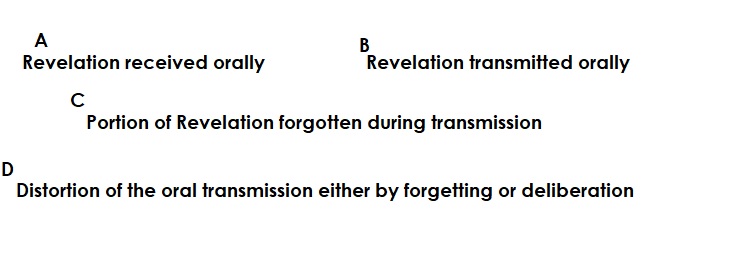
This article we will discuss the forceful argument of the Qur’an about the corruption of the previous revelations during the oral transmission process.
“Have you any hope that they will be true to you when a party of them used to listen(yasma’una) to the word of Allah, then used to (yuharrifunahu)change it, after they had understood(‘aqaluhu) it, knowingly.” (Qur’an 2:75)
This verse is quite explicit in the damnation of these people. That they actually would listen to the words of Allah (auditory hearing), they understood it, confirmed it and knowingly changed it — during the oral transmission process!
Received the revelation from Allah.
Understood it.
Knowingly distorted it during the oral transmission process.
One would have to be extremely vile to do such a thing.
Those Christians who accept the following text to be canon (approved by the Church as acceptable) — have something interesting in the following:
“I warn everyone who hears the words of the prophecy of this scroll: If anyone adds anything to them, God will add to that person the plagues described in this scroll. And if anyone takes words away from this scroll of prophecy, God will take away from that person any share in the tree of life and in the Holy City, which are described in this scroll.” (Revelation 22:18-19)
*note* keep in mind that there are Christian sects who do not accept the above as canon. As their particular Church did not approve of the book of Revelation as authoritative.
” Among the Jews are those who distort(yuḥarrifūna) words upon their delivery(mawadi’ihi) and say, “We hear and disobey” and “Hear but be not heard” and “Ra’ina,” twisting their tongues and defaming the religion. And if they had said [instead], “We hear and obey” and “Wait for us [to understand],” it would have been better for them and more suitable. But Allah has cursed them for their ingratitude, so they believe not, except for a few.” (Qur’an 4:46)
Again Allah (swt) says he has cursed them for their ingratitude. By use of their tongues, they change the truth during the oral transmission process.
“O Messenger, let them not grieve you who hasten into disbelief of those who say, “We believe” with their mouths, but their hearts believe not, and from among the Jews. [They are] avid listeners (sammāʿūna) to falsehood(lil’kadhibi), listening (sammāʿūna) to another people who have not come to you. They distort (yuharrifuna)words upon their delivery (mawadi’ihi), saying “If you are given this, take it; but if you are not given it, then beware.” But he for whom Allah intends fitnah – never will you possess [power to do] for him a thing against Allah. Those are the ones for whom Allah does not intend to purify their hearts. For them in this world is disgrace, and for them in the Hereafter is a great punishment.” (Qur’an 5:41)
Because of their disbelief, Allah (swt) caused them to be in fitnah. There can be no greater fitnah than not having certainty about what Allah (swt) revealed. Note the above text states that they will claim belief by their tongues, because in their hearts there is no belief. That they already listen to those who lie. They take from people who lie. That in turn also distorts the oral transmission.
“So for their breaking of the covenant We cursed them and made their hearts hard. They distort (yuḥarrifūna) words upon delivery (mawāḍiʿihi) and have forgotten(wanasu) a portion of that of which they were (dhukkiru) reminded. And you will still observe deceit among them, except a few of them. But pardon them and overlook [their misdeeds]. Indeed, Allah loves the doers of good.” (Qur’an 5:13)
People think that the above text is speaking about scribal alterations to a text. Not at all! The text speaks about something more sinister. The above text is speaking about the oral corruption of the revelation before it becomes committed to text.
So what we can see from the Qur’an 2:75 is that they received revelation and knowingly distorted it during the oral transmission process. We can also see from the Qur’an 5:13 that many of them forgot (wanasu) through the oral transmission process.
We see this same charge directed pointedly towards the Christians.
“And with those who say ‘We are Christians’ We took a covenant; and they have forgotten (fanasū) a portion(ḥaẓẓan) of that they were reminded of. So We have stirred up among them enmity and hatred, till the Day of Resurrection; and Allah will assuredly tell them of the things they wrought.” (Qur’an 5:14)
You can see that the Christians forgot (fanasu) similar to the Jews (wanasu) through the oral transmission process. In fact, it says immediately after, “So we have stirred up among them enmity and hatred.” — The Christians, due to these errors in their transmission process, became a point of strife among them.
For example:
“See to it that no one takes you captive through hollow and deceptive philosophy, which depends on human tradition and the cosmic spirits of this world rather than on Christ.” (Colossians 2:8)
So, in what has passed, there is nothing in those texts that would even remotely suggest to Muslims that the Jews or Christians possess sacred scripture that would not have been free from this. Every text (including the Qur’an) starts as an oral transmission.
ORAL TRANSMISSION IN THE NEW TESTAMENT.
“Many have undertaken to draw up an account of the things that have been fulfilled[a] among us, just as they were handed down to us by those who from the first were eyewitnesses and servants of the word. With this in mind, since I myself have carefully investigated everything from the beginning, I too decided to write an orderly account for you, most excellent Theophilus, so that you may know the certainty of the things you have been taught. (Luke 1:1-4)
There are a few things to unpack here.
This writer (whom tradition says is Luke) does not claim to be an eyewitness to said events that he is about to write about.
His book was based upon oral transmission that was given to him from those who were eyewitnesses.
He does not state if he is receiving information directly from the eyewitnesses or how many links there are in the chains of transmission. In Islam, such a person who transmitted oral reports from the Blessed Prophet (saw) would be known as Mudallas.
This individual, “Luke”, is aware of other written reports, of which he claims his will be ‘orderly’.
This individual, ‘Luke’, feels that his task in writing his document is to give an orderly account that will let this individual (Theophilus) to have certainty.
Most striking of all, this person is not making any claim to write under the inspiration or authority of God.
“Different ways of reporting, e.g. (he narrated to us), (he informed us), (I heard), and (on the authority of) are used by the reporters of hadith. The first three indicate that the reporter personally heard from his shaikh , whereas the fourth mode can denote either hearing in person or through another reporter.”
Keep in mind that the type of attack against Islam on whether the Qur’an affirms the scriptures of Judaism or any number of competing Christian canons is an attack born of the Protestant tradition.Catholics and Orthodox Christians did not develop this line of attack. Nor do they employ them unless they are among the useful ‘idiots’.
Do note the position of the Roman Catholic Church.
“It is not from sacred Scripture alone that the Church draws her certainty about everything which has been revealed.Therefore both sacred Tradition and sacred Scripture are to be accepted and venerated with the same sense of devotion and reverence” (Dei Verbum 9)
“The first objection creates more questions than it answers. However, nowhere in scripture does Jesus command that all or part of what He said should be written down. Jesus Himself never wrote anything down, except in the sand.”
“Nor do the Scriptures make clear what was transmitted orally, so we have no way to know if some or anything of what was said was ever written down. John, at the end of his Gospel, makes the statement the world could not contain all the books that could be written about Jesus (John 21:25). Surely, there is much that was passed down orally that was never written down. Our Bible is simply too small to contain it all!”
except in the sand
“This they said to test him, that they might have some charge to bring against him. Jesus bent down and wrote with his finger on the ground. And as they continued to ask him, he stood up and said to them, “Let him who is without sin among you be the first to throw a stone at her.” And once more he bent down and wrote on the ground.” (John 8:6-8)
What is striking and fascinating to Muslims is that the one place where Christ Jesus is said to have written anything is in a text that Christians now dispute as being an interpolation!
Your Bible likely has brackets around this story with a note that says something like “The earliest manuscripts do not include 7:53-8:11.” The majority of scholars believe a later Christian scribe inserted the passage into John’s Gospel at John 8:1-8:11
This is also interesting considering the following text:
“Heaven and earth will pass away, but my words will never pass away.” (Matthew 24:35)
So Christians have had to come up with alterative ways of understanding the above text beyond the obvious and apparent meaning.
Also, keep in mind that, according to Christians, Jesus, who is supposed to be God in the Human Flesh, was walking around on Earth for 30 years and the New Testament has very little to say about it at all.
“Now Jesus himself was about thirty years old when he began his ministry. He was the son, so it was thought, of Joseph, the son of Heli.” (Luke 3:23)
So can you imagine that the Holy Spirit (God the Third of Three) is inspiring someone to write like this? That Jesus was ‘about’. That he was the son ‘so it was thought’.
What percent of 33 is 30? The answer: 90.91. So the New Testament leaves out approximately 91% of the life of Christ Jesus!
The New Testament holds oral traditions both in a positive light and not in a positive light. It seems to distinguish between those traditions given by men and those approved of by God.
“In the name of the Lord Jesus Christ, we command you, brothers and sisters, to keep away from every believer who is idle and disruptive and does not live according to the traditions you received from us.” (2 Thessalonians 3:6)
So, here a command is given to this particular audience to actually ostracize and keep away from those people who do not hold fast to the traditions.
“Concerning the coming of our Lord Jesus Christ and our being gathered to him, we ask you, brothers and sisters, not to become easily unsettled or alarmed by the teaching allegedly from us—whether by a prophecy or by word of mouth or by letter—asserting that the day of the Lord has already come.” (2 Thessalonians 2:1-2)
So, here the early community is being warned to be careful of letters falsely penned in Paul’s name or oral transmissions that claim to come from authority but are not.
“So then, brothers and sisters, stand firm and hold fast to the traditions we passed on to you, either by our spoken word of mouth or by letter.” (2 Thessalonians 2:15)
“And we also thank God continually because, when you received the word of God, which you heard from us, you accepted it not as a human word, but as it actually is, the word of God, which is indeed at work in you who believe.” (1 Thessalonians 2:13)
“I praise you for remembering me in everything and for holding to the traditions just as I passed them on to you.” (1 Corinthians 11:2)
“And the things you have heard me say in the presence of many witnesses entrust to reliable people who will also be qualified to teach others.” (2 Timothy 2:2)
“That what was spoken by the prophets might be fulfilled, ‘He shall be called a Nazarene.’” (Matthew 2:23)
There is no such prophecy written any where in the TNCH (what Christians call the Old Testament). Christians have tried and failed to deal with this. The most successful response is what the text says, spoken. In other words this came from an oral tradition.
There are examples where the oral tradition is not held in high esteem.
“They are not to ‘honor their father or mother’ with it. Thus you nullify the word of God for the sake of your tradition.” (Matthew 15:6)
“You have let go of the commands of God and are holding on to human traditions.” And he continued, “You have a fine way of setting aside the commands of God in order to observe your own traditions!” (Mark 7:8-9)
“Their worship is a farce, for they teach man-made ideas as commands from God.” (Mathew 15:9)
So, for example, in the Qur’an we are told concerning the Christian tradition of celibacy and becoming Monks and Nuns.
“Then in the footsteps of these, We sent Our messengers, and We sent Jesus, son of Mary, and granted him the Gospel, and instilled compassion and mercy into the hearts of his followers. As for monasticism, they made it up—We never ordained it for them—only seeking to please Allah, yet they did not observe it strictly. So We rewarded those of them who were faithful. But most of them are rebellious.” (Qur’an 57:27)
This teaching is self-destructive, because if the whole of Christianity was to embrace it, it is quite conceivable that their numbers would diminish.
We can see the destructive cost of having low populations in places like Japan and the alarm bells are ringing in many countries to encourage their people to populate.
This goes against an earlier teaching that they claim is from God, namely: “God blessed them and said to them, “Be fruitful and increase in number; fill the earth and subdue it.” (Genesis 1:28)
Allah says, ‘yet they did not observe it strictly’ and we know this because when suppressing one’s natural sexual urges they end up violating small children, being involved in homosexual relationships etc.
So, when we hear that this is a teaching attributed to Jesus (as) we categorically reject it.
“For there are eunuchs who have been so from birth, and there are eunuchs who have been made eunuchs by men, and there are eunuchs who have made themselves eunuchs for the sake of the kingdom of heaven. Let the one who is able to receive this receive it.” (Matthew 19:12)
“Are you pledged to a woman? Do not seek to be released. Are you free from such a commitment? Do not look for a wife. But if you do marry, you have not sinned; and if a virgin marries, she has not sinned. But those who marry will face many troubles in this life, and I want to spare you this. What I mean, brothers and sisters, is that the time is short. From now on those who have wives should live as if they do not” (1 Corinthians 7:27-29)
“These are they which were not defiled with women; for they are virgins. These are they which follow the Lamb whithersoever he goes. These were redeemed from among men, being the first-fruits unto God and to the Lamb” (Revelations 14:4)
You see how the above verse makes women and sexuality something of the flesh, dirty and vile. Most unfortunate.
How did this tampering of the oral tradition start?
This is a rather straightforward in that tradition itself asserts that John the Baptist (Yahya) and Christ Jesus (Isa ibn Maryam) were killed.
Thus, those that, from the perspective of Muslims (The Prophets themselves) that could exercise authority over the process of what is /is not the Injeel were eliminated.
So, relying upon the oral tradition of which the Qur’an mentioned, there was faulty memory involved. This cannot be a ground upon which one places certainty and /or eternal security.
So, relying upon oral tradition, the Gospels, according to Mark and Luke, say some very embarrassing things about why women went to the tomb of Jesus (as).
“When the Sabbath was over, Mary Magdalene, Mary the mother of James, and Salome bought spices so that they might go to anoint Jesus’ body.” (Mark 16:1)
“On the first day of the week, very early in the morning, the women took the spices they had prepared and went to the tomb.” (Luke 24:1)
Why do Jewish women bring spices to anoint a dead body? This is absolute nonsense.
In Islam and in Judaism, men wash the bodies of men (even your own wife does not wash your body) and women wash the bodies of women (even your own husband does not wash your body).
That being said, the idea that women would be coming to anoint the dead body of Jesus (as) is ludicrous.
Bodies are not anointed or bound AFTER they have been buried or entombed! Bodies are anointed with spice BEFORE they are buried, in order to mask the smell during display.
Can you think of any example in history when a body was anointed with spice or fragrance after burial or entombment?
This is total and utter nonsense.
The TNCH itself gives an example of this:
“They buried him in the tomb that he had cut out for himself in the City of David. They laid him on a bier covered with spices and various blended perfumes, and they made a huge fire in his honor.” (2 Chronicles 16:14)
“And with those who say ‘We are Christians’ We took a covenant; and they have forgotten (fanasū) a portion(ḥaẓẓan) of that they were reminded of. So We have stirred up among them enmity and hatred, till the Day of Resurrection; and Allah will assuredly tell them of the things they wrought.” (Qur’an 5:14)
“And do not be like those who forgot Allah, so He made them forget themselves. It is they who are rebellious.” (Qur’an 59:19)
This word, fanasu -forgotten, comes to us by two meanings:
A type of forgetfulness—like when Adam ate from the tree.
An intentional neglect where you want to avoid something so you pretend to forget.
Those who forgot Allah. They forgot who he really is, did not appraise him with a proper appraisal, so Allah made them forget the straight path.
The Qur’an tells us that the Christians, because of his second type of fanasu in relating the revelation, it became a point of strife and hatred among them.
How many actual words attributed to Jesus are even in the New Testament?
Next you have to take into account, that according to the document of the New Testament (27 book canon and not the 22 book New Testament or the 35 book New Testament that rival Christians hold as canon; that the actual number of words attributed to Christ Jesus are (once you exclude the duplication of Jesus’s speeches in the four accepted gospels), the total number of words spoken by Jesus is 31,426.
So we have about 4 hours of reading the words attributed to Jesus.
In the 27 New Testament book canon accepted by Latin Roman Catholics, the Eastern Orthodox and most Protestants, the following words are attributed to Jesus outside the Four Gospels.
Acts 1:4 And, being assembled together with them, commanded them that they should not depart from Jerusalem, but wait for the promise of the Father, which, saith he, ye have heard of me. 1:5 For John truly baptized with water; but ye shall be baptized with the Holy Ghost not many days hence. 1:6 When they therefore were come together, they asked of him, saying, Lord, wilt thou at this time restore again the kingdom to Israel?1:7 And he said unto them, It is not for you to know the times or the seasons, which the Father hath put in his own power.1:8 But ye shall receive power, after that the Holy Ghost is come upon you: and ye shall be witnesses unto me both in Jerusalem, and in all Judaea, and in Samaria, and unto the uttermost part of the earth.
9:4 And he fell to the earth, and heard a voice saying unto him, Saul, Saul, why persecutest thou me? 9:5 And he said, Who art thou, Lord? And the Lord said, I am Jesus whom thou persecutest: it is hard for thee to kick against the pricks.9:6 And he trembling and astonished said, Lord, what wilt thou have me to do? And the Lord said unto him, Arise, and go into the city, and it shall be told thee what thou must do. 9:7 And the men which journeyed with him stood speechless, hearing a voice, but seeing no man. 9:8 And Saul arose from the earth; and when his eyes were opened, he saw no man: but they led him by the hand, and brought him into Damascus. 9:9 And he was three days without sight, and neither did eat nor drink. 9:10 And there was a certain disciple at Damascus, named Ananias; and to him said the Lord in a vision, Ananias. And he said, Behold, I am here, Lord. 9:11 And the Lord said unto him, Arise, and go into the street which is called Straight, and inquire in the house of Judas for one called Saul, of Tarsus: for, behold, he prayeth, 9:12 And hath seen in a vision a man named Ananias coming in, and putting his hand on him, that he might receive his sight. 9:13 Then Ananias answered, Lord, I have heard by many of this man, how much evil he hath done to thy saints at Jerusalem: 9:14 And here he hath authority from the chief priests to bind all that call on thy name. 9:15 But the Lord said unto him, Go thy way: for he is a chosen vessel unto me, to bear my name before the Gentiles, and kings, and the children of Israel: 9:16 For I will shew him how great things he must suffer for my name’s sake.
11:16 Then remembered I the word of the Lord, how that he said, John indeed baptized with water; but ye shall be baptized with the Holy Ghost.
18:9 Then spake the Lord to Paul in the night by a vision, Be not afraid, but speak, and hold not thy peace: 18:10 For I am with thee, and no man shall set on thee to hurt thee: for I have much people in this city.
20:35 I have shewed you all things, how that so labouring ye ought to support the weak, and to remember the words of the Lord Jesus, how he said, It is more blessed to give than to receive.
22:7 And I fell unto the ground, and heard a voice saying unto me, Saul, Saul, why persecutest thou me? 22:8 And I answered, Who art thou, Lord? And he said unto me, I am Jesus of Nazareth, whom thou persecutest. 22:9 And they that were with me saw indeed the light, and were afraid; but they heard not the voice of him that spake to me. 22:10 And I said, What shall I do, Lord? And the Lord said unto me, Arise, and go into Damascus; and there it shall be told thee of all things which are appointed for thee to do.
22:18 And saw him saying unto me, Make haste, and get thee quickly out of Jerusalem: for they will not receive thy testimony concerning me. 22:19 And I said, Lord, they know that I imprisoned and beat in every synagogue them that believed on thee: 22:20 And when the blood of thy martyr Stephen was shed, I also was standing by, and consenting unto his death, and kept the raiment of them that slew him.22:21 And he said unto me, Depart: for I will send thee far hence unto the Gentiles.
23:11 And the night following the Lord stood by him, and said, Be of good cheer, Paul: for as thou hast testified of me in Jerusalem, so must thou bear witness also at Rome.
26:14 And when we were all fallen to the earth, I heard a voice speaking unto me, and saying in the Hebrew tongue, Saul, Saul, why persecutest thou me? it is hard for thee to kick against the pricks. 26:15 And I said, Who art thou, Lord? And he said, I am Jesus whom thou persecutest. 26:16 But rise, and stand upon thy feet: for I have appeared unto thee for this purpose, to make thee a minister and a witness both of these things which thou hast seen, and of those things in the which I will appear unto thee; 26:17 Delivering thee from the people, and from the Gentiles, unto whom now I send thee, 26:18 To open their eyes, and to turn them from darkness to light, and from the power of Satan unto God, that they may receive forgiveness of sins, and inheritance among them which are sanctified by faith that is in me.
1 Corinthians 11:24 And when he had given thanks, he brake it, and said, Take, eat: this is my body, which is broken for you: this do in remembrance of me. 11:25 After the same manner also he took the cup, when he had supped, saying, This cup is the new testament in my blood: this do ye, as oft as ye drink it, in remembrance of me.
2 Corinthians 12:9 And he said unto me, My grace is sufficient for thee: for my strength is made perfect in weakness. Most gladly therefore will I rather glory in my infirmities, that the power of Christ may rest upon me.
Romans (no words of Jesus) Galatians (no words of Jesus) Colossians (no words of Jesus) 1 Timothy (no words of Jesus) 2 Timothy (no words of Jesus) Ephesians (no words of Jesus) Philippians (no words of Jesus) 1 Thessalonians (no words of Jesus) 2 Thessalonians (no words of Jesus) Hebrews (no words of Jesus) James (no words of Jesus) Titus (no words of Jesus) Philemon (no words of Jesus) 1 John (no words of Jesus) 2 John (no words of Jesus) 3 John (no words of Jesus) Jude (no words of Jesus) 1 Peter (no words of Jesus) 2 Peter (no words of Jesus)
Revelation
If we are to grant a 27 NT Canon as opposed to the 22 or 35 book New Testaments that were in dispute among Christians in the time of the Blessed Prophet (saw). 19/27 have absolutely no words of Jesus in them at all! 1 Cor 11:24 & 2 Cor 12:9 The rest of these two letters nothing.
This means only the Four traditional Gospels, the Apocalypse of John, and the Book of Acts are the only NT books that have words attributed to Jesus in them! (other than the 2 Corinthians citations) Most Christians do not stop to think about this.
So Muslims have very little to work with in terms of what is actually attributed to Christ Jesus. This becomes compounded by the fact that what we have to work with presents us with a plethora of contradictions and errors. The corruption of the revelation that took place during the oral tradition becomes evident.
“Then do they not reflect upon the Qur’an? If it had been from [any] other than Allah , they would have found within it much contradiction.” (Qur’an 4:82)
So how do we know what is from Allah or not? Is to apply for this test. A test that Christians often wish to quickly escape from or divert the topic away from.
We are personally not bothered by the issue of preservation. In the sense that if Christians want to imagine that their text has been preserved intact, we will offer little push back against such a claim.
Christian Circular Reasoning. Where is authority derived from?
Our first contention is that a certain text is actually a revelation to begin with.
“And how from infancy you have known the Holy Scriptures, which are able to make you wise for salvation through faith in Christ Jesus.All Scripture God-breathed and is useful for teaching, rebuking, correcting and training in righteousness, so that the servant of God may be thoroughly equipped for every good work.” (2 Timothy 3:15-17)
Most translations are dishonest and will say something like the following:
“All Scripture is God-breathed.” However, this is not in the Greek text at all.
Lastly, how from infancy you have known the Holy Scriptures or the ἱερὰ -heira γράμματα grammata, could only be a reference to the TNCH. Because there were no New Testament writings when Timothy was an infant.
None of that substantiates the New Testament as authoritatively from God. Not only this, but one of the documents called ‘Hebrews’ the authorship is in dispute, (among Christians themselves!)
Of the 27 books of the New Testament (according to the West), not the 22 books of the New Testament (according to Churches in the East) nor the 35 books of the New Testament (according to the Oriental Orthodox Ethiopian Church), Paul wrote 13/14 of them.
So, according to the 27-book New Testament canon, Paul wrote 48% of the New Testament. According to the 22 book New Testament canon, Paul wrote 59% of the New Testament.
Paul’s Unconfirmed “Conversion”.
Question: Did Paul convert to the teachings of Jesus?
Answer: No!
The only testimony we have that Paul is a ‘disciple’ of Jesus is Paul’s own contradictory accounts in Acts chapters 9, 22 and 26.
Acts 9:7 says:
“The men which journeyed with him stood speechless, hearing a voice, but seeing no man.”
Acts 22:9 says:
“And they that were with me saw indeed the light, and were afraid; but they heard not the voice of him that spoke to me.”
Acts 26:14 says:
“And when we were all fallen to the earth, I heard a voice speaking unto me, and saying in the Hebrew tongue, Saul Saul why persecute me? It is hard for you to kick against the pricks.”
Prima Qur’an Comment: All these instances in which Paul speaks about Jesus speaking to him for the first time are obviously flat lies.
Not only that but in Acts 22:9 it says the same people traveling with him “saw indeed the light“.
This is very strange because Paul also says in Acts 26:23
“At midday, O King, I saw in the way a light from heaven, Above the brightness of the sun, shining around me and Them which journeyed WITH me.”
Besides the above contradictions, Paul said this light was brighter than the sun and that those with him “saw indeed the light“ yet read the following:
“And Saul arose from the earth; and when his eyes were opened he saw no man, but they led him by the hand, and brought him into Damascus. And he was three days without sight, and neither did eat nor drink.” (Acts 9:8-9)
Prima Qur’an Comment: Now this light was “brighter than the sun,” yet his companions were fine! Paul’s whole “conversion” story is a fabrication.
Establishing testimony for yourself according to Christ Jesus.
“But if he will not hear thee, then take with thee one or two more that in the mouth of two or three witness every word may be established.” (Matthew 18:16)
Prima Qur’an Comment: According to the criteria set by Christ Jesus, Paul’s testimony of conversion is blatantly false. The only record we have of Paul’s so-called conversion is from the writer Luke. There is no testimonial of the men who traveled with Paul.
The above contradictory accounts of Paul’s conversion in Acts chapters 9,22 and 26 render his account baseless!
Two important points about Paul.
1) Paul never met the historical Jesus.
2) Paul only claimed to have met Jesus in a vision of light.
Paul’s ‘vision of light’ was none other than Satan?
“For such are false apostles, deceitful workers, transforming themselves into the apostles of Christ And little wonder; for Satan himself is transformed into an angel of light” (2 Corinthians 11:13-14)
Ponder these text:
I must go on boasting. Although there is nothing to be gained, I will go on to visions and revelations from the Lord.I know a man in Christ who fourteen years ago was caught up to the third heaven. Whether it was in the body or out of the body I do not know—God knows. And I know that this man—whether in the body or apart from the body I do not know, but God knows—was caught up to paradise and heard inexpressible things, things that no one is permitted to tell. “I will boast about a man like that, but I will not boast about myself, except about my weaknesses. Even if I should choose to boast, I would not be a fool, because I would be speaking the truth. But I refrain, so no one will think more of me than is warranted by what I do or say or because of these surpassingly great revelations. Therefore, in order to keep me from becoming conceited, I was given a thorn in my flesh, a messenger of Satan, to torment me Three times I pleaded with the Lord to take it away from me. But he said to me, “My grace is sufficient for you, for my power is made perfect in weakness.” Therefore I will boast all the more gladly about my weaknesses, so that Christ’s power may rest on me. (2 Corinthians 12:1-9)
“For I received from the Lord what I also passed on to you.” (1 Corinthians 11:23)
“I want you to know, brothers and sisters, that the gospel I preached is not of human origin.I did not receive it from any man, nor was I taught it; rather, I received it by revelation from Jesus Christ.” (Galatians 1:1-12)
So here Paul has bypassed the disciples and the eyewitnesses. He is claiming direct revelation from Jesus!
Muslims have good grounds to question these assertions of Paul.
My second contention is that what they have that is claimed to be preserved is filled with the errors and contradictions that obviously came from the oral tradition that was relied upon.
The Four Canonical Gospels are works of literary fiction
They are derived from disparate oral traditions, embellishments and outright errors.
Allah (swt) has opened the eyes of some Christians to this. Of recent memory was a Christian who debated many Muslims and skeptics and defended the Christian faith tradition. I am speaking of none other than Mike Licona.
“At that moment the curtain of the temple was torn in two from top to bottom. The earth shook, the rocks split and the tombs broke open. The bodies of many holy people who had died were raised to life. They came out of the tombs after Jesus’ resurrection and went into the holy city and appeared to many people. When the centurion and those with him who were guarding Jesus saw the earthquake and all that had happened, they were terrified, and exclaimed, “Surely he was the Son of God!” (Matthew 27:51-54)
The fact that no one else (outside the New Testament) records this has certainly raised eyebrows. Because Dr. Licona was honest and wrote that he thought that this was basically fiction. His fellow Christians hammered him for it!
“Jesus called out with a loud voice, “Father, into your hands I commit my spirit.” When he had said this, he breathed his last.” (Luke 23:46)
“When Jesus had received the sour wine, he said, “It is finished,” and he bowed his head and gave up his spirit.” (John 19:30)
We cannot know the so-called dying words of Jesus or, in light of these contradictions, that there were any at all.
Who was the father of Joseph, husband of Mary?
“And Jacob begat Joseph the husband of Mary, of whom was born Jesus, who is called Christ.” (Matthew 1:16)
“Now Jesus himself was about thirty years old when he began his ministry. He was the son, so it was thought, of Joseph, the son of Heli.” (Luke 3:23)
Jesus descended from which son of David?
“And Jesse the father of King David. David was the father of Solomon, whose mother had been Uriah’s wife, (Matthew 1:6)
“The son of Melea, the son of Menna, the son of Mattatha, the son of Nathan, the son of David.” (Luke 3:31)
“When the evening came, they brought unto him MANY that were possessed with devils: and he cast out the spirits with his word, and healed ALL that were sick.” (Matthew 8:16)
“And at evening, when the sun did set, they brought unto him ALL that were diseased and them that were possessed with devils. And ALL the city was gathered together at the door. And he healed MANY that were sick of diverse diseases, and cast out MANY devils; and suffered not the devils to speak, because they knew him.” (Mark 1:32-34)
Prima Qur’an Comment: The Greek word for many is (pantas) and the Greek word for all is (pollous).
Matthew saw some deficiency in a Jesus that only healed many, so he switched the Greek words around. A Jesus who can heal all is better than a Jesus that can only heal many.
Another example:
“And there came a voice from heaven, saying YOU ARE my beloved Son, in whom I am well pleased.” (Mark 1:11)
“And lo a voice from heaven, saying, THIS IS my beloved Son, in whom I am well pleased.” (Matthew 3:17)
Prima Qur’an Comment: The Greek word for you is su and the Greek word for this is would be (outos). Mark held that Jesus was the adopted son of God, called adoptionist theology. Matthew felt Jesus already knew who he was because he was the son of God based on the Virgin birth and therefore did not need to be told who he was. He changes the wording of the voice, so the people are addressed.
Another example:
“While he spoke these things unto them, behold, there came a certain ruler, and worshipped him, saying, My daughter is EVEN NOW DEAD: but come and lay thy hand upon her, and she shall live.” (Matthew 9:18)
“And sought him greatly, saying, My little daughter LIES AT THE POINT OF DEATH: I pray thee, come and lay hands on her, that she may be healed; and she shall live.” (Mark 5:23)
Prima Qur’an Comment:
The Greek term for the deceased is (teleute). Again, Matthew thought that a Jesus who could save a dead person was going to be more illustrious than a Jesus who merely saved a dying person. So this contradiction is the result of the developing theology surrounding the person of Jesus.
Another example:
“And when he knew it of the Centurion, he gave the body to JOSEPH. And HE brought fine linen, and took him down, and wrapped him in the linen, and laid him in a sepulcher which was hewn out of a rock, and rolled a stone unto the door of the sepulcher.” (Mark 15:45-46)
“And though THEY found no cause of death in him, yet desired THEY Pilate that he should be slain. And when THEY had fulfilled all that was written of him, THEY took him down from the tree, and laid him in a sepulcher.” (Acts 13:28-29)
Prima Qur’an comment: This goes back to the conflict on whether Jesus killed and was impailed on a tree or rather he was nailed to a Patibulum (T tau or + cross-shaped fixture)-while alive. Here it says the same Jews who desired his death put him in the tomb and not Joseph.
Another example:
“And when Jesus was entered into Capernaum, there came unto him A CENTURION, beseeching him,” (Matthew 8:5)
“And a certain centurion’s servant, who was dear unto him, was sick, and ready to die. And when he heard of Jesus, HE SENT UNTO THEM ELDERS OF THE JEWS, beseeching him that he would come and heal his servant.” (Luke 7:2-3)
Prima Qur’an Comment:
The Greek phrase for older men is (presbuteros). The Greek word for centurion is (hekatontarchos) The reason this exists has more to do with oral tradition than ideas either of the writers had.
“In the prophet Isaiah it stands written: “Here is my herald whom I send on ahead of you, and he will prepare your way. A voice crying aloud in the wilderness, ‘ Prepare a way for the Lord; clear a straight path for him.'” (Mark. 1:2·3)
This quote is not directly the text of Isaiah, for he is clearly unaware that half his quotation, supposedly from lsaiah 40:3, is not from Isaiah at all, but is a misquotation of Malachi 3:1, which actually reads, “I am sending my messenger who will clear a path before me.”
These mistakes are typical for drawling from oral traditions.
On and on and on this goes. It is very clear that what Allah (swt) said about oral transmission being the cause of distortion is factual and indisputable.
If you are interested in reading more, we would recommend:
“For them are good tidings in the worldly life and in the Hereafter. No change is there in the Words of Allah. That is what is the great attainment. “ (Qur’an 10:64)
“Messengers indeed have been denied before thee, and they were patient under the denial and the persecution till Our succor reached them. And no change is there in the Words of Allah. And there has certainly come to you some information about the messengers.” (Qur’an 6:34)
﷽
Does Allah Preserve His Words?
The short answer to this question from a theological perspective is yes. The answer is yes, because all the amr’—meaning commands, edicts, prohibitions, injunctions are from the knowledge of Allah.
Allah does not increase or decrease in knowledge.
The question of Allah preserving his words is usually asked of Muslims by Christian polemicists, and we will address them in this article as well.
You will often find them quoting either of these two verses:
“Your Lord’s word has been fulfilled in truth and justice. No change is there in His Words. He is the All-Hearing, the All-Knowing.” (Qur’an 6:115)
“Recite what has been revealed to you from the Book of your Lord. No change is there in His Words, nor can you find any refuge besides Him.” (Qur’an 18:27)
You will not really find them wanting to quote the following verses:
“For them are good tidings in the worldly life and in the Hereafter. No change is there in the Words of Allah. That is what is the great attainment. “ (Qur’an 10:64)
“Messengers indeed have been denied before thee, and they were patient under the denial and the persecution till Our succor reached them. And no change is there in the Words of Allah. And there has certainly come to you some information about the messengers.” (Qur’an 6:34)
This is because the above verses are clear that what is meant are the decrees of Allah (swt). When he decrees it will be like this or that it will be so.
“And they were patient under the denial and the persecution till Our succor reached them.” (Q 6:34)
“For them are good tidings in the worldly life and in the Hereafter.” (Q 10:64)
Even the above verse indicates this as well:
“Your Lord’s word has been fulfilled in truth and justice.” (Q 6:115)
What is meant by ‘no change is there in his Words’ means basically the decree of Allah. Whatever Allah decrees concerning his Creation. What he promises will occur.
An example being:
“When Allah promised you one of the two groups – that it would be yours – and you wished that the unarmed one would be yours. But Allah intended to establish the truth by His words and to eliminate the disbelievers.” (Qur’an 8:7)
“No calamity befalls on the earth nor from among your selves, without being in a record before We make it (nabr-aha) manifest. This is certainly easy for Allah.S o that you may not grieve for what has escaped you, nor be exultant at what He has given you; and Allah does not love any arrogant boaster (Qur’an 57:22-23)
This word nabr-aha is often difficult to translate into English. You can see a list of disparate translations here:
We went with Maududi’s rendering of the text: to make it manifest as it is the most sensible rendering. Others have it as ‘brought into being’ or ‘brought into existence’.
“And certainly We sent messengers (to mankind) before you, and We appointed for them wives and offspring, and it was not (given) to any messenger that he should bring a portent save by Allah’s leave. For everything there is a time prescribed. Allah effaces what He will, and establishes (what He will), and with Him is the source of ordinance (ummu l-kitabi)” (Qur’an 13:38-39)
Look at what Allah (swt) says here. He will efface what he will, and he will establish what he will. This, for Muslims, is the record that the angels give to mankind. That record is fluid because the human being and their relationship with the Creator can be fluid.
We talked more about that when we refuted this foreign concept that has crept in among Muslims about us being weighed on some scale on the day of judgment.
“As for those who repent, believe, and do good deeds, they are the ones whose evil deeds Allah will change into good deeds. For Allah is All-Forgiving, Most Merciful.” (Qur’an 25:70)
“That is because they followed what angered Allah and disliked [what earns] His pleasure, so He rendered worthless their deeds.” (Qur’an 47:28)
However, let us say that this means the revelation of Allah, which would include the Qur’an, the Torah, the Injeel, the Zabur and the Suhuf of Ibrahim.
First, we know that the Qur’an is preserved in the lawhin mahfuz (preserved tablet). We can assume (though not specifically stated) that this is the case for other revealed revelations..
“In fact, this is a glorious Qur’an, in a Preserved Tablet.” (lawhin mahfuzin) (Qur’an 85:21-22)
What about the revelation when it descends from heaven to the Earthly realm?
At this point, one of two things can happen.
1) Allah (swt) can choose himself to preserve this revelation that is on this Earth.
“It is certainly We Who have revealed the Reminder, and it is certainly We Who will (lahafizuna) guard it.” (Qur’an 15:9)
2) Allah can entrust the revelation to someone other than himself.
“It was We who revealed the law (to Moses): therein guidance and light. By its standard have been judged the Jews, by the prophets who bowed to Allah’s will, by the rabbis and the learned: for to them was (us’tuh’fizua )entrusted the protection of Allah’s book, and they were witnesses thereto: therefore fear not men, but fear me, and sell not my signs for a miserable price. If any do fail to judge by (the light of) what Allah hath revealed, they are (no better than) Unbelievers.” (Qur’an 5:44)
You can see that the word lahafizuna & the word us’tuh’fizua are etymologically from the same root in Arabic.
The problems for the Christian Polemicist are manifold.
1) How do they even determine what scripture is to begin with?
Now, in regard to the Christian polemic, before we even talk about preserving the words of Allah, they have yet to make clear to the world the process by which they even decide what words are Allah’s words and what words are not.
For example, when it comes to the Orthodox (Eastern/Oriental) and the Latin Roman Catholics, we get a very odd circular reasoning. The Protestants do not fair much better.
So this is a conundrum for Christians as a whole. The Latin Roman Catholics, Orthodox (Oriental/Eastern) point out to the Protestants that it was the Church that decided which books were to be considered canon of the New Testament.
However, if you were to ask where did the Church (tradition) get its authority from? It had to take its authority from somewhere?
For example, until this very day, Christians dispute the Canon of the Bible.
Not to mention the dispute among them concerning what they call the Old Testament, just to focus on the New Testament, we have the following proposed canons. A New Testament with 22 books (endorsed by the Assyrian Church of the East—Trichur India). They exclude: II Peter, II John, III John, Jude, Revelation of John. A New Testament with 27 books (which we assume most of the readers would be familiar with). A New Testament with 35 books (endorsed by the Ethiopian Orthodox Tawhedo Church). They include Sera’ata Seyon, Te’ezas, Gessewe, Abtelis, Mashafa Kidan, Mashafa Kidan II, Qalmentos, Dideqelya. Church.
For example: In an exchange between Dr. Bart Ehrman and Reformed Baptist Pastor Dr. James White, there were some thought-provoking questions.
Dr. Ehrman: ” So let me just say—the point is the earlier you go, the more different they are. So you just extrapolate that the earliest were probably the most different. Let me ask about P72 where you resonate with this particular text, you said, that has 2 Peter and Jude in it. What other documents are found in P72?”
Dr. White: “There’s some non-canonical documents in P72 My recollection was that 1,2 Peter and Jude were the only canonical documents in it.”
Dr. Ehrman: “Right, so I’m just wondering about you resonating with this document. Do you think this scribe thought that what he was copying was scripture?“
Dr. White: “Well, I don’t think that you can simply jump to the conclusion that because scribes included books in a single codex that meant that they believed that everything in that codex was necessarily Scripture. There are all sorts of works that were considered to be very beneficial for the reading of people that were included in codices that were not necessarily canonical.”
Dr. Ehrman: “Yeah, I just thought that it was odd that that particular manuscript was one that you resonate with because it’s the earliest attestation we have of the Protoevangelion Jacobi.”
Prima Qur’an comments: So these are the type of questions that need to be asked. What if the transmitter was under the impression that Protoevangelion Jacobi had the same authoritative weight as the other documents he was transmitting?
You can say what you want about the Church Tradition and the disputes had about the canon (that exist until today), but you cannot presume to speak on behalf of the transmitter themselves.
“But as for you, continue in what you have learned and have become convinced of, because you know those from whom you learned it, and how from childhood you have knownthe holy Scriptures, which are able to make you wise for salvation through faith in Christ Jesus.” (2 Timothy 3:14-15)
The conundrum, or the pickle here for the Christian, is that the only scriptures that were around when he was a boy were what Christians call ‘the Old Testament’ and even more problematic is the fact that the version he would have had is Septuagint 2.0. (A Greek translation from the Hebrew).
How are Gods words preserved according to Christians?
This is why, in recent years, Christians have developed an apologetic that the Qur’an asserts (one of their many competing New Testament canons) — why the Qur’an would weigh in on competing Christian claims we are never really told.
However, this claim has given much needed oxygen to the Christians involved in debates with Muslims. It deflects from the one thing they do not want to discuss — the Bible itself.
First, it is fascinating that Christians would bring up these verses of the Qur’an to establish (whichever canon they believe) is the preserved word of God.
It is interesting because Christians themselves do admit that we do not have the original writings. The original writings were not preserved. Why is that?
Listen to what Daniel B Wallace has to say on the matter.
“We don’t have the original manuscripts of the New Testament. They were they all disappeared within a century. I’m pretty convinced by copying and copying and copying copying frequent handling the early church was far more concerned to get the gospel out than they were to do exact copying of the New Testament. And that actually is a blessing. Because they didn’t have those kind of controls and consequently you get copies that are not through just one stream but tons of people all over the place are making these copies so here’s here’s a man who lives in Corinth he’s gonna be visiting Rome and he says hey I I heard Paul Paul wrote a letter to you guys too. I want to write that out. Do you mind if I copy it when I get there? Sure that’s no problem. This happened I’m sure dozens and dozens of times over. And those manuscripts would have lasted as much as 80-90 years but would fall apart from all these copies being made. So we don’t have the originals they disappeared. And all the copies that we have disagree with each other at some point. Sometimes it’s quite a few disagreements. But we have hundreds of thousands of textual variants among our manuscripts. So, a question to ask here is how badly did the scribes corrupt the New Testament? It’s absolutely proven that they did. No two manuscripts are alike, so unless one of them is pristine every single scribe made mistakes. So because the original manuscripts disappeared and because no two copies agree with each other completely we have to do textual criticism we can’t just rely on one it’s imperfect. So scholars have to reconstruct it on that basis. But when you look at the number of textual variants and there are hundreds of thousands of them as Bart Ehrman likes to say there are more textual variants than our words in the original New Testament. That’s actually an understatement. But you have to not just look at the number of variants you have to look at the nature of these variants. And the best estimates are that at least at least 99.8% of them affect nothing. Most are spelling differences, there’s different ways to spell John. There’s different ways to spell Mary. They’re not going to affect anything. But the 1/5th of 1% that do affect things are the one’s that scholars talk about and disagree over on a number of these issues. But the bottom line is it does not matter in some respects which New Testament you use because no essential doctrine is jeopardized by any of these textual variants. Even Bart Erhman who wrote: “Misquoting Jesus” can say the same thing. So that’s true on that end but at the same time we want to know what the original text said in all the details. And so the great majority of scholars have very few disagreements over these passages. For example most scholars would say the long ending of Mark’s Gospel: Mark 16:9-20 is almost surely not authentic. And they still put in their Bibles typically smaller print. Or in brackets or footnote the oldest authorities don’t have this. So there’s a wide consensus on the vast majority of textual variants. And again there’s no essential doctrine that’s jeopardized by any of these textual variants that is extremely comforting. It’s very important to know that.”
Christians, even like Daniel B. Wallace, are deliberately deceitful. We have yet to interact with a Christian that was sincere.
For example: Daniel B. Wallace quotes Erhman as saying:
“But when you look at the number of textual variants and there are hundreds of thousands of them as Bart Ehrman likes to say there are more textual variants than our words in the original New Testament.”
This is a flat lie!
In the debate with Bart Erhman here: https://www.youtube.com/watch?v=MsVWFS9r9DY @25:19 “One thing we can say for certain is that there are more differences in our manuscripts than there are words in the New Testament.”
NOTE: Bart does not say the original New Testament.
In fact, during that very debate, Bart Ehrman took Daniel B Wallace to ask for his crazy assertions that biblical scholarship even speaks of getting back to the original. Something, Erhman mentions scholarship has given up on.
There are some other points that Christians play sleight of hand with their audience when it comes to the manuscript tradition. They don’t like to mention the dates of these manuscripts. So, when they become manic and start going on about thousands and thousands of manuscripts, we interject. “Slow down, take a deep breath. Let’s pause for a moment. Tell me about these manuscripts and their dates. For example, a fragment the size of a credit card dated 100 years after Jesus. What does it tell me about the rest of the contents dated 300 or 400 years later?
About 71% of the Greek New Testament manuscripts date after the 11th century. 84% after the 10th century and around 90% after the 9th century and 94% around the 8th century. So can you imagine that many of the manuscripts date from the Middle Ages, sometimes over 1000 years after what are thought to be the originals?
So Christians console themselves by saying. Alas! Even with us not having the original manuscripts, the manuscripts we do have show marginal differences that affect our core doctrines in insignificant ways. Will see this is not the hot cup of cocoa that Christians think that it is.
As regards what the original manuscripts said. Christians have no way of knowing.
For example, can Christians demonstrate to us that when a person is making a copy that the copy was read back to check it against the master document? How do we know that the manuscripts or copies before this are not changed?
This is what happens in the memorization of the Qur’an. Keep in mind that Muslims pray five times a day. In all five of those prayers, Surah Al Fatiha is read and transmitted from parents/teacher to children/students. In 3 of those five daily prayers, Surah Al Fatiha and any other portion of the Qur’an is read. In the month of Ramadan, the entire Qur’an is read by the Imam.
In Hadith transmission (though not all-inclusive) I will list three primary methods of transmission/reception.
Method of reception (al-Akhdh wa’l-Tahammul)
a) Direct hearing (al-Sama’) — A person hears directly from the Shaykh/Teacher.
b) Recitation or Rehearsal (Al-Qira’a ‘ala’l-Shaykh) — The person hears directly from the Shaykh/Teacher understands what is transmitted to them and repeats it back to the Shaykh/Teacher.
c) Permission (al-Ijaza) -Simply the Shaykh/Teacher trust the student without testing her/him.
By the way, to the Muslims reading this, be careful about your friends that boast about receiving many ijaza. Unless they reveal to you the specifics about what they learned and the level of mastery, Ijaza’s, in many cases today, amount to a ‘pat on the head’. Similar to saying: “Good job Tony!”
In fact, (imo) the most rigorous method of hadith transmission is one in which the student repeats back to the teacher what was said. Which would be transmission by Al-Qira’a ‘ala’l-Shaykh
We could bring a Christian scholar. It could be Oriental Orthodox, Eastern Orthodox, Latin, Roman Catholic, and we could ask them to recite from memory books of the New Testament, and we could check this method against our children.
Can you imagine the modern age when they had (what early Christians did not have) access to. What they imagine is a complete canon, and they still could not compete with our noble sister, Rafia Al Miskry (May Allah cover her with mercy).
Islam can give you demonstrable evidence of a well guarded, well-preserved transmission process. Can Christians do the same?
No major doctrines are affected by the differences in manuscripts?
What about the lynch pin doctrine of the Trinity? 1 John 5:7
For those people who think this is old hat and not important. Well, it is a major issue that divides Eastern Orthodox Christians when weighed against the majority of Protestant Christians.
If a Protestant Christian was weighing the issue of whether to join an Eastern Orthodox Church, they would have to wonder whether the Holy Spirit guided the Eastern Orthodox Church to hang on to 1 John 5:7. Are they truly guided in that decision?
Mark 16:9-20 Are the Churches that Include This Text in the Canon Upon Guidance?
Again, the Eastern Orthodox keep it as part of the canon.
What do the Vatican and the Latin Roman Catholic Church have to say about the text?
[9-20] This passage, termed the Longer Ending to the Marcan gospel by comparison with a much briefer conclusion found in some less important manuscripts, has traditionally been accepted as a canonical part of the gospel and was defined as such by the Council of Trent. Early citations of it by the Fathers indicate that it was composed by the second century, although vocabulary and style indicate that it was written by someone other than Mark. It is a general resume of the material concerning the appearances of the risen Jesus, reflecting, in particular, traditions found in Luke 24 and John 20. The Shorter Ending: Found after ⇒Mark 16:8 before the Longer Ending in four seventh-to-ninth-century Greek manuscripts as well as in one Old Latin version, where it appears alone without the Longer Ending. The Freer Logion: Found after v 14 in a fourth-fifth century manuscript preserved in the Freer Gallery of Art, Washington, DC, this ending was known to Jerome in the fourth century. It reads: “And they excused themselves, saying, “This age of lawlessness and unbelief is under Satan, who does not allow the truth and power of God to prevail over the unclean things dominated by the spirits [or, does not allow the unclean things dominated by the spirits to grasp the truth and power of God]. Therefore reveal your righteousness now.’ They spoke to Christ. And Christ responded to them, “The limit of the years of Satan’s power is completed, but other terrible things draw near. And for those who sinned I was handed over to death, that they might return to the truth and no longer sin, in order that they might inherit the spiritual and incorruptible heavenly glory of righteousness. But . . . .’ “
Which brings us back to Daniel B. Wallace and his statement above:
“For example most scholars would say the long ending of Mark’s Gospel: Mark 16:9-20 is almost surely not authentic. And they still put in their Bibles typically smaller print. Or in brackets or footnote the oldest authorities don’t have this..”
Which Christian is guided by the Holy Spirit in this matter?
In the Red Letter New Testament, where the words are reported to have come from Jesus are in red, we would have: And then he told them, “Go into all the world and preach the Good News to everyone. Anyone who believes and is baptized will be saved. But anyone who refuses to believe will be condemned. These miraculous signs will accompany those who believe: They will cast out demons in my name, and they will speak in new languages. They will be able to handle snakes with safety, and if they drink anything poisonous, it won’t hurt them. They will be able to place their hands on the sick, and they will be healed.”
That is a huge chunk of words being attributed to Christ Jesus.
John 7:53-John 8:11 Are the Churches that Include This Text in the Canon Upon Guidance?
The Vatican, the authority for the Latin Roman Catholic Church states:
[7:53-⇒8:11] The story of the woman caught in adultery is a later insertion here, missing from all early Greek manuscripts. A Western text-type insertion, attested mainly in Old Latin translations, it is found in different places in different manuscripts: here, or after ⇒ John 7:36 or at the end of this gospel, or after ⇒ Luke 21:38, or at the end of that gospel. There are many non-Johannine features in the language, and there are also many doubtful readings within the passage. The style and motifs are similar to those of Luke, and it fits better with the general situation at the end of Luke 21:but it was probably inserted here because of the allusion to ⇒ Jeremiah 17:13 (cf the note on John ⇒ John 8:6) and the statement, “I do not judge anyone,” in ⇒ John 8:15. The Catholic Church accepts this passage as canonical scripture.
So, here you have the Latin Roman Catholic Church telling you that this is dubious in nature, and yet if the Church accepts this as canonical, you are bound to accept it as such too!
In a Red Letter New Testament where the words reported to have come from Jesus are in read we would have:
“Let him who is without sin among you be the first to throw a stone at her.” “Woman, where are they? Has no one condemned you?”
“Neither do I condemn you; go, and from now go and sin no more.”
More words attributed to Jesus and put in his mouth of which he may have not said at all.
The Eastern Orthodox are on board with John 8:1-11 as well.
So, depending upon the type of Christian, these issues should be of major concern to them.
If you are a Christian that believes in the inerrancy of scripture, you have conservative Christian scholars asserting that there are errors. Thus, inerrancy is a major doctrine.
“Heaven and earth will pass away, but my words will never pass away.” (Matthew 24:35)
2. If you are a Christian that believes that the Church guides you into the truth and here (at least the Latin Roman Catholic Church) in front of God and everyone is telling you about the dubious nature of these passages, should that not make you want to reflect further?
What is the correct reading of John 1:18 The unique son or unique God?
.”No man has ever seen God; but now his only-begotten Son, who abides in the bosom of the Father, has himself become our interpreter.”
Some of the best manuscripts here read ‘God, the only-begotten’ instead of ‘the only-begotten Son’
“No one has ever seen God. The only Son, God, who is at the Father’s side, has revealed him.”
The only Son, God: while the vast majority of later textual witnesses have another reading, “the Son, the only one” or “the only Son,” the translation above follows the best and earliest manuscripts, monogenes theos, but takes the first term to mean not just “Only One” but to include a filial relationship with the Father, as at⇒ Luke 9:38 (“only child”) or ⇒ Hebrews 11:17 (“only son”) and as translated at ⇒ John 1:14. The Logos is thus “only Son” and God but not Father/God.
Luke 23:34 Did Jesus really say:Jesus said, “Father, forgive them, for they do not know what they are doing.”
“[Then Jesus said, “Father, forgive them, they know not what they do.”]: this portion of ⇒Luke 23:34 does not occur in the oldest papyrus manuscript of Luke and in other early Greek manuscripts and ancient versions of wide geographical distribution.”
Titus 2:13 Is the Great God, Jesus or are Jesus and the Great God two separate things?
Is it that the “Great God” and “Jesus Christ” are separate beings?
Or
Is that the “Great God” is also “our Saviour Jesus Christ?”
“We were to look forward, blessed in our hope, to the day when there will be a new dawn of glory, the glory of the great God, the glory of our Saviour Jesus Christ; “ (Titus 2:13)
We may, with the Greek Fathers, understand St Paul to have written here ‘the glory of our great God and Saviour Jesus Christ’; or we may, by a slightly less natural interpretation of the Greek, render ‘the glory of the great God, and of our Saviour Jesus Christ’.
“as we await the blessed hope, the appearance of the glory of the great God and of our savior Jesus Christ,” (Titus 2:13)
“The blessed hope, the appearance: literally, “the blessed hope and appearance,” but the use of a single article in Greek strongly suggests an epexegetically, i.e., explanatory sense. Of the great God and of our savior Jesus Christ: another possible translation is “of our great God and savior Jesus Christ.”
Which Latin Roman Catholic Source is Inspired By the Holy Spirit to give us the correct reading of Romans 9:5?
“The patriarchs belong to them, and theirs is the human stock from which Christ came; Christ, who rules as God over all things, blessed for ever, Amen.” (Romans 9:5)
‘Christ, who rules as God’; some commentators would translate, ‘Blessed be God who is above all things, for ever’, making this a distinct sentence; but they have not been able to suggest any plausible grounds for the intrusion of this irrelevant apostrophe, and the order of words in the Greek makes it almost impossible.
“Theirs the patriarchs, and from them, according to the flesh, is the Messiah. God who is over all be blessed forever. Amen.” (Romans 9:5)
Some editors punctuate this verse differently and prefer the translation, “Of whom is Christ according to the flesh, who is God over all.” However, Paul’s point is that God who is over all aimed to use Israel, which has been entrusted with every privilege, in outreach to the entire world through the Messiah.
Notice the disharmony between the two Latin Roman Catholic sources?
Does the Gospel of Luke contain a doctrine of vicarious atonement? Luke 22:19-20
Then he took the bread, said the blessing, broke it, and gave it to them, saying, “This is my body, which will be given for you; do this in memory of me.” And likewise the cup after they had eaten, saying, “This cup is the new covenant in my blood, which will be shed for you.” (Luke 22:19-20)
Which will be given . . . do this in memory of me: these words are omitted in some important Western text manuscripts and a few Syriac manuscripts. Other ancient text types, including the oldest papyrus manuscript of Luke dating from the late second or early third century, contain the longer reading presented here. The Lucan account of the words of institution of the Eucharist bears a close resemblance to the words of institution in the Pauline tradition (see ⇒ 1 Cor 11:23-26). See also the notes on ⇒ Matthew 26:26-29; ⇒ 26:27-28; and ⇒ Mark 14:22-24.
The first and original Septuagint was only of the Torah, and it was translated from Hebrew into Greek to facilitate the needs of the Jewish Community.
Those who follow Judaism never translated the TNCH into Greek for their needs. Let us be clear about this. Among those Children of Israel, you have three types in terms of relationship to what the Christians call “The Old Testament.”
You have the Samaritans. They call themselves: Bene Yisrael (“Children of Israel) or Shamerim (“Observant Ones”). They only accept the Torah.
You Karaite Judaism. They follow the whole of the TNCH, but they do not follow the Oral Torah.
You have what may be termed Orthodox Judaism. They follow the TNCH and the Oral Torah.
Let us be clear. None of those groups accept 1 and 2 Maccabees, Judith, Tobit, Sirach, Baruch and Wisdom as authoritative scripture. Not at all!
The other peculiar feature of the Christian Septuagint 2.0 is that it is written in Koine Greek, and other parts use Classical Greek.
The Christian Septuagint 2.0, which includes the whole of the TNCH and includes 1 and 2 Maccabees, Judith, Tobit, Sirach, Baruch and Wisdom, is deemed authoritative by the Latin Roman Catholics, the Oriental Orthodox Church and the Eastern Orthodox Church.
It is this Septuagint 2.0 that is the basis for the Christian New Testament. It is this Septuagint 2.0 that is referenced above: and how, from childhood, you have knownthe holy Scriptures, which are able to make you wise for salvation through faith in Christ Jesus.” (2 Timothy 3:14-15)
It is this Septuagint 2.0 that Christians believe the Holy Spirit (The Third of Three) inspired the authors of various New Testament texts to quote from. This is folly, as we will see.
The popular Christian version of Isaiah 9:6 is not even in Septuagint 2.0!
“For a child is born to us, a son is given to us. The government will rest on his shoulders. And he will be called: Wonderful Counselor, Mighty God, Everlasting Father, Prince of Peace.” (Isaiah 9:6)
“For a child is born to us, and a son is given to us, whose government is upon his shoulder: and his name is called the Messenger of great counsel: for I will bring peace upon the princes, and health to him.”(Isaiah 9:6 -The Septuagint 2.0 The Holy Spirit’s Fav Version)
Where are all these other names?
So who is upon the truth? Are Latin Roman Catholics, Oriental Orthodox and Eastern Orthodox upon guidance for trusting a text that does not make Christological claims about Jesus, such as calling him (Jesus) ‘The Everlasting Father’? Claims that contradict the idea that Jesus is not the Father?
Or are those Protestants who trust in the Masoretic text (although they still give it a Christological bent). Are they upon the truth?
Only one person in the Jewish scriptures is referred to as “mighty god” and his name is Hizkiyyahu or, Hezekiah (mighty god). Jewish names, like many Muslims’ names, are what one may call a theophoric name. The 1st century Christians did not use Isaiah 9:6 for Christological purposes. Latter ones did though. Changing the Hebrew perfect tense to future tense.
The New Testament, frequently, with malevolent intent, deliberately corrupts the Hebrew Bible to advance Christological claims.
Examples:
“He went to Nazareth, where he had been brought up, and on the Sabbath day he went into the synagogue, as was his custom. He stood up to read, and the scroll of the prophet Isaiah was handed to him. Unrolling it, he found the place where it is written: “The Spirit of the Lord is on me, because he has anointed me to proclaim good news to the poor. He has sent me to proclaim freedom for the prisoners and recovery of sight for the blind, to set the oppressed free, to proclaim the year of the Lord’s favor.” (Luke 4:16-19)
“and the scroll of the prophet Isaiah was handed to him.”
“The Spirit of the Lord is on me, because he has anointed me to proclaim good news to the poor. He has sent me to proclaim freedom for the prisoners and recovery of sight for the blind, to set the oppressed free, to proclaim the year of the Lord’s favor.”
So when we go to this Latin Roman Catholic website here:
The footnote says: [6] Is. 61.1, 2. So, this means this text from Isaiah that Jesus is allegedly reading is Isaiah 61:1-2 right?
So when we check this against the Septuagint 2.0(The Holy Spirit’s Fav Version)
We find the following: “The Spirit of the Lord is upon me, because he has anointed me; he has sent me to preach glad tidings to the poor, to heal the broken in heart, to proclaim liberty to the captives, and recovery of sight to the blind; to declare the acceptable year of the Lord, and the day of recompense; to comfort all that mourn (Isaiah 61:1-2 Septuagint 2.0)
But wait a minute! Hold up! It says: ” He stood up to read, and the scroll of the prophet Isaiah was handed to him. Unrolling it, he found the place where it is written…”
Here is the rub: Jesus did not read from Septuagint 2.0. It says he was reading from the scroll! What would the Hebrew Isaiah 61 look like?
The spirit of the Lord God was upon me, since the Lord anointed me to bring tidings to the humble, He sent me to bind up the broken-hearted, to declare freedom for the captives, and for the prisoners to free from captivity. To declare a year of acceptance for the Lord and a day of vengeance for our God, to console all mourners. (Isaiah 61:1-2)
“The spirit of my Sovereign GOD is upon me, Because God has anointed me. I have been sent as a herald of joy to the humble, To bind up the wounded of heart, To proclaim release to the captives, Liberation to the imprisoned; To proclaim a year of GOD’s favor And a day of vindication by our God; To comfort all who mourn.” (Isaiah 61:1-2)
“To give sight to the blind” That is no where there!
So are the Eastern Orthodox, Oriental Orthodox, Latin Roman Catholics and Protestants justified to maliciously tamper with the text like this? Do they have the right to alter God’s words?
The Malicious tampering of Habakkuk 2:4 by the Christians.
“Behold, it is puffed up-his soul is not upright within him, but the righteous shall live by his faith.” (Habakkuk 2:4)
Another Satanic manipulation by Paul.
“Clearly no one who relies on the law is justified before God, because “the righteous will live by faith.” (Galatians 3:11)
“For in the gospel the righteousness of God is revealed—a righteousness that is by faith from first to last, just as it is written: “The righteous will live by faith.” (Romans 1:17)
Christians are fine with this! Because they are a people who are not sincere and do not mind if God’s scriptures are contorted and manipulated.
An Anonymous New Testament Book Alters the Words of Jeremiah!
The Book of Hebrews—according to church tradition—is ascribed to Paul. However, today, modern Christian scholarship has walked away from this claim.
Nonetheless, why would Christians trust a book by an anonymous author that deliberately and maliciously misquotes the Jewish Scriptures?
“It will not be like the covenant which I made with their fathers, on the day when I took them by the hand, to rescue them from Egypt; that they should break my covenant, and I (says the Lord) should abandon them.” (Hebrews 8:9)
Footnote states: [4] vv. 8 and following: Jer. 31.31.
“It will not be like the covenant which I made with their fathers, on the day when I took them by the hand, to rescue them from Egypt; that they should break my covenant, and I, all the while, their master, the Lord says.” (Jeremiah 31:32)
Jeremiah 31:31 in the Hebrew TNCH (Jeremiah 31:32 in a Christian Bible)
“Not like the covenant that I formed with their forefathers on the day I took them by the hand to take them out of the land of Egypt, that they broke My covenant, although I was a lord over them, says the Lord.” (Jeremiah 31:31)
“It will not be like the covenant I made with their ancestors, when I took them by the hand to lead them out of the land of Egypt, a covenant that they broke, though I espoused them—declares GOD.” (Jeremiah 31:31)
The deliberate and malicious changes to the text are obvious to all those who do not have a veil over their eyes.
A huge difference between saying God abandoned his people or simply disregarded them and saying that God was like a husband or espoused or a watchful master/lord over them.
Another example of this anonymous author maliciously and deliberately altering the text of the Hebrew TNCH is the following:
“As Christ comes into the world, he says, No sacrifice, no offering was your demand; you have endowed me, instead, with a body. You have not found any pleasure in burnt-sacrifices, in sacrifices for sin.” (Hebrews 10:5-6)
“You have done great things, You, O Lord my God. Your wonders and Your thoughts are for us. There is none to equal You; were I to tell and speak, they would be too many to tell. You desired neither sacrifice nor meal offering; You dug ears for me; a burnt offering or a sin offering You did not request.” (Psalms 40:6-7)
“You, O LORD my God, have done many things; the wonders You have devised for us cannot be set out before You; I would rehearse the tale of them, but they are more than can be told You gave me to understand that You do not desire sacrifice and meal offering; You do not ask for burnt offering and sin offering.” (Psalms 40:6-7)
A huge difference between saying God prepared a body (meaning Christ) and saying that God opened up my mind to understanding. Yet, this is a shameful and deliberate misquotation and alteration of the text!
Paul once again deliberately and maliciously alters the understanding of the Hebrew TNCH to make it fit into his Christology.
“Christ has redeemed us from the curse of the law, having become a curse for us for it is written, “Cursed is everyone who hangs on a tree”), that the blessing of Abraham might come upon the Gentiles in Christ Jesus, that we might receive the promise of the Spirit through faith.” (Galatians 3:13-14)
“If any party is guilty of a capital offense and is put to death, and you impale the body on a stake, you must not let the corpse remain on the stake overnight, but must bury it the same day. For an impaled body is an affront to God: you shall not defile the land that your God יהוה is giving you to possess.” (Deuteronomy 21:22-23)
“And all the men of his city shall pelt him to death with stones, and he shall die. So shall you clear out the evil from among you, and all Israel will listen and fear.If a man commits a sin for which he is sentenced to death, and he is put to death, you shall [then] hang him on a pole.” (Deuteronomy 21:22-23)
Notice that Paul is using Deuteronomy 21:-22-23 as an ante-mortem suspension. However, it is very clear that Deuteronomy 21:-22-23 is speaking about a post-mortem suspension.
This is why we, in our school, know that the interpretations held by the Qadiani/Sunni/Nizari Ismail concerning Qur’an 4:157 are wrong. As Qur’an 4:157 does not speak about a cross or patibulum at all. If we believed even for a moment that the Sunni/Qadiani/Nizari Ismaili misunderstanding of Qur’an 4:157 was correct, we would have grounds to doubt the Qur’an. May Allah protect us! That is because Jews do not crucify anyone or put anyone on crosses. The Sunni/Qadiani/Nizari Ismaili misunderstanding makes our Creator ignorant of Jewish law. May Allah protect us!
The Torah explicitly mentions post-mortem suspension by impailment (Qur’an 4:157 “They did not kill him nor did they impail him) wa-ma qataluhu wa ma salabuhu.
If you want to read more on this, we would encourage you to read our article here:
The New Testament belittles the Torah and makes the fallacious claim that Moses received the Torah from the medium of angels rather than directly from God himself!
Where is the proof in the Torah that Moses was given the law by angels or by God while being accompanied by angels? It says God gave the law to Moses. There is no mention of angels being involved at all!
“For if the word spoken by angels was steadfast, and every transgression and disobedience received a just recompense of reward.” (Hebrews 2:2)
“This is he (Moses), that was in the church in the wilderness with the angel which spoke to him in the mount Sinai, and with our fathers: who received the lively oracles to give unto us.”(Acts 7:38)
“Who have received the law by the disposition of angels, and have not kept it.” (Acts 7:53)
“Wherefore then served the law? It was added because of transgressions, till the seed should come to whom the promise was made; and it was ordained by angels in the hand of a mediator.” (Galatians 3:19)
If you enjoyed this article you may find the following beneficial:
“Allah said, O Jesus, I shall cause you to die and will exalt you in my presence and shall purify you of the ungrateful disbelieving people, and shall place those who follow you above those who deny the truth, until the Day of Judgement; then to Me shall all return and I will judge between you regarding your disputes.”(Qur’an 3:55)
“Allah! There is no god but He,-The Ever Living, the Self-Subsisting, Eternal.” (Qur’an 3:2)
﷽
Can God Die?
The answer to this question is the death knell to Christianity.
This is the question that every Christian who thinks he/or she is saved should really know the answer to. This is the question that anyone who is even considering Christianity as a viable faith tradition should be asking themselves.
This is why Christianity fails as a faith tradition on a very basic and fundamental level.
It simply does not reveal the true nature of God. In Islam, God is the Ever-Living God, and as such it is an impossibility for God to die. A dead god would be no God. A God that dies even for a fraction of a nanosecond in time could not by definition be called ‘The Ever Living’ God.
“God, the blessed and only Ruler, the King of kings and Lord of lords, who alone is immortal and who lives in unapproachable light, whom no one has seen or can see. To him be honor and might forever. Amen.”(1 Timothy 6:15-16)
“Incline Your ear, O Lord, and hear; open Your eyes, O Lord, and see; and listen to all the words of Sennacherib, who sent them to reproach the living God.” (Isaiah 37:17)
So now who or what died on the double-cross?
There are serious intra-Christian debates that rage over this issue until this very day. You would think the answer would be simple: “Jesus died on that double cross.” That is until you investigate the debate that rages between Miaphysis, Monophysis, and Dyophysis.
The Dyophysis believe that Jesus has two natures.
The Monophysis believe that Jesus has one nature.
The Miaphysis believe that Jesus has a composite nature.
One group proclaims that Jesus has divinity and humanity continuing in Him without mixture or separation, confusion or change. He is one and the same person both in his eternal pre-existence.
They claim that if you separate the natures after the union and say that Jesus is in two natures, you will be confronted with serious theological problems. For example, you will have to admit that Jesus merely died as a man.
Yet that does not take the Oriental Orthodox off the hook either. Because statements like “without mixture or separation” are really not saying anything at all. Did his one nature that is neither mixed or seperated die?
What is the composite nature composed of? Divinity and humanity.
Did the divinity die? The Miaphysite says no. Only the humanity suffered death, while the divinity remained impassible.
Then what did the composite nature contribute that a mere human nature could not? If the divinity did not die, then the subject that experienced death was still, in its operative reality, the human component. Calling it “composite” does not change the fact that death only touched the human part.
So, you end up with the same problem of Dyophysitism: a mere human death, because the divine contributed nothing to the experience of dying.
Miaphysites often use the pars pro toto principle (attributing to the whole what belongs to a part, e.g., “God died in the flesh”). We would retort:
This is a linguistic trick, not a logical solution. If I say “the king died,” but it was actually his servant who died, I have not told the truth. I have spoken metaphorically.
For the atonement to be infinite, the subject that dies must be divine in its very act of dying. But if the divine nature does not participate in death, then the death is only human, and its value is finite. The “composite” label does not magically make a human death infinite; it only asserts that the human who died was united to God, not that God experienced death.
So, in strict Monophysitism, the crucifixion risks meaning that God’s single nature actually suffers and dies. A view many Christians consider theologically problematic.
If Jesus had only one, divine nature (Monophysis), then He didn’t truly die, as God cannot die. This would make the Crucifixion a sham. In this view people witnessed nothing more than a hologram on the double cross.
If Jesus were two separate persons (called Nestorianism), then only a human person died, and God merely watched. This would mean humanity was not truly saved.
Just as God is not tempted, doesn’t increase in knowledge, doesn’t require sleep, God does not die.
God didn’t die. God’s essence did not die. God the Father did not die. God, the Holy Spirit, did not die. God the Son did not die.
God merely associated Himself with human suffering but did not participate in it. All that happened was that a man was tortured while God watched from within. Untouched, unchanged, and unsacrificed.
That is the end of Christianity. It so frustrates Christians in debates with Muslims that the Christian immediately pushes a panic button and will either introduce a non sequitur, or statements that are not analogous at all.
“Even my Muslim friends don’t believe that death is the cessation of life!” We have heard one of them say. So the Christian tries a diversion tactic. Say something truthful about your opponent that they are forced to agree with and take the tension out of the room.
To our dismay, time and time again, Muslim debaters let Christians off the hook on this.
True, Muslims believe that there is life after death, but the Christian is trying to avoid the subject of death altogether. Muslims also believe that our souls are created; they are not eternal. Muslims believe that we do indeed die.
So that which Christians claim died on the double-cross: Was it created or eternal? And notwithstanding the fact that there is life after death, back to the pointed question:
Who or what died on the double-cross?
If they say a man died on the double-cross, then there was no redemptive sacrifice. After all, what is the point of the incarnation if man alone can atone for the sins of mankind.
Saying the god-man died is also nonsensical, as that would be saying, “that the two natures co-joined died.”
“Do not be afraid of those who kill the body but cannot kill the soul. Rather, be afraid of the One who can destroy both soul and body in hell.” (Matthew 10:28)
Which also begs the question: What did God really sacrifice?
We can’t say God sacrificed his life because God cannot die.
We can’t really say that God sacrificed his son because he got his son back.
We can’t even really say that God sacrificed time, as God exists outside space/time.
Which also still leaves our Christian friends in their sin.
All that happened, in reality, was a cosmic charade. In the end, a man was left to suffer. God didn’t partake in any suffering. It was simply flesh that was abandoned on the double-cross.
Perhaps this is why the writer of this Gospel is making a theological statement.
It says, “About the ninth hour, Jesus cried out with a loud voice,” ‘My God, my God, why have you forsaken me?’” (Matthew 27:46)
Jesus is speaking as flesh here. The Father can never abandon the Son because they are co-eternally joined in one essence.
All that was left was flesh, the same flesh that we are told can’t please God.
“Those who are in the realm of the flesh cannot please God.” (Romans 8:8)
The Creator cannot be overcome by his creation. Both death and life are creations of God.
“Who has created life and death that He may try you which of you is best in conduct; and He is the Mighty, the Forgiving.” (Qur’an 67:2)
It is both blasphemous and nonsensical to think of a God that is one in essence that is shared with three persons, that anyone of those persons could actually be dead. That in and of itself would destroy the Trinity.
The central theme of Christianity is that the Divine entered into his Creation and died for us. It is the very undoing of the Christian faith tradition itself.
“And say: Truth hath come and falsehood hath vanished away. Lo! Falsehood is ever bound to vanish.” (Qur’an 17:81)
“And when they hear what has been revealed to the Messenger, you see their eyes overflowing with tears because of what they have recognized of the truth. They say, “Our Lord, we have believed, so register us among the witnesses.” (Qur’an 5:83)
May Allah Guide them to the truth so that they do not burn in hellfire.
“And remember, Jesus, the son of Mary, said: “O Children of Israel! I am the messenger of Allah (sent) to you.”(Qur’an 61:6)
“And appoint him a messenger to the Children of Israel.” (Qur’an 3:49)
﷽
From cover to cover, the Bible is a book for the Children of Israel, about the Children of Israel, and to the Children of Israel. 95% of the book is all about the Jews and Israel. There is about 0.5% of the entire book that is bothered to be dedicated to Gentiles.
Jesus was the last prophet sent to Israel. His mission and objective was to be threefold.
A) To reach out to the lost sheep of Israel.
B) To instill a spirit of holy resistance against tyranny and oppression.
C) To tell the Children of Israel about the coming of Ahmad- The Praised One
“And he will go on before the Lord, and in the spirit and power of Elijah, to turn the hearts of the parents to their children and the disobedient to the wisdom of the righteous—to make ready a people prepared for the Lord.” (Luke 1:16-17)
Jesus said to him, “Today salvation has come to this house, because this man, too, is a son of Abraham. For the Son of Man came to seek and to save the lost.” (Luke 19:9-10)
“You Samaritans worship what you do not know; we worship what we do know, for salvation is of the Jews.” (John 4:22)
“Do not give dogs what is sacred; do not throw your pearls at pigs. If you do, they may trample them under their feet, and turn and tear you to pieces.” (Matthew 7:6)
This comes under the teaching of judge,and you will be judged. It is clear that this is a reference for how Jews should deal with each other. It is clear because, within this context, Jesus’ attitude towards non-Jews is reflected by referencing them as dogs and pigs.
A Canaanite woman from that vicinity came to him, crying out, “Lord, Son of David, have mercy on me! My daughter is demon-possessed and suffering terribly. Jesus did not answer a word. So his disciples came to him and urged him, “Send her away, for she keeps crying out after us.” (Matthew 15:22-23)
“My daughter is demon-possessed and suffering terribly.” Jesus did not answer a word.
Can you imagine the level of disregard displayed here? The woman came with her daughter whose soul was vexed by a demon, and she was ‘suffering terribly’. Jesus was unmoved by her plight.
Send her away, for she keeps crying out after us.” He answered, “I was sent only to the lost sheep of Israel.” (Matthew 15:24)
Again, there was absolutely no interest in helping a woman whose daughter was suffering terribly and was vexed by a demon.
“The woman came and knelt before him. “Lord, help me!” she said. He replied, It is not right to take the children’s bread and toss it to the dogs.” (Matthew 15:24-25)
The woman comes herself and pleads to Jesus. He again is completely unmoved. Even puts the lady in the company of dogs.
Jesus never taught a non-Jew anything. There may be 4 or 5 examples of him healing someone, but he never taught a non-Jew anything. No time nowhere!
“Yes, it is, Lord,” she said. “Even the dogs eat the crumbs that fall from their master’s table.” (Matthew 15:27)
Then Jesus said to her, “Woman, you have great faith! Your request is granted.” And her daughter was healed at that moment.”(Matthew 15:27-28)
Only once did the woman recognize her place as not being at the table but only as a dog taking the crumbs that her matter was attended to. Her faith or belief was in knowing her place.
THE ONLY COMMISSION OF JESUS: LOST SHEEP OF ISRAEL
These twelve Jesus sent out with the following instructions:
“Do not go among the Gentiles or enter any town of the Samaritans. Go rather to the lost sheep of Israel.” (Matthew 10:5-6)
“My people have been lost sheep; their shepherds have led them astray and caused them to roam on the mountains. They wandered over mountains and hills and forgot their own resting place.”(Jeremiah 50:6)
“Israel is a scattered sheep; the lions have driven him away: first the king of Assyria hath devoured him, and last this Nebuchadnezzar king of Babylon hath broken his bones.”(Jeremiah 50:17)
Israel =Lost Sheep
Gentiles — The Greek word Ethnos, from where we get the word ethnicity and ethnocentric means ‘nations’. The non-Jews.
“Wherefore remember, that you being in time past Gentiles in the flesh, who are called Uncircumcision by that which is called the Circumcision in the flesh made by hands; That at that time you were without Christ, being aliens from the commonwealth of Israel, and strangers from the covenants of promise, having no hope, and without God in the world.” (Ephesians 2:11-12)
“It is not right to take the children’s bread and toss it to the dogs.”(Matthew 15:24)
THERE IS NO GREAT COMMISSION.
There could be no great commission to go out and evangelize the world because Jesus promised the people that the kingdom of God was coming before that very generation died.
Christians will tell us that there is a great commission in Mark 16:15 and as well as Matthew 28:19.
“Verily I say unto you, This generation shall not pass, till all these things be fulfilled.” (Matthew 24:34)
Christian C.S Lewis called this the most embarrassing verse in the Bible.
“But when they persecute you in this city, flee ye into another: for verily I say unto you, You shall not have gone over the cities of Israel, till the Son of man come.” (Matthew 10:23)
“And he said unto them, Verily I say unto you, That there be some of them that stand here, which shall not taste of death, till they have seen the kingdom of God come with power.“ (Mark 9:1)
“For this, we say unto you by the word of the Lord, then we which are alive and remain unto the coming of the Lord shall not prevent them which are asleep. For the Lord, himself shall descend from heaven with a shout, with the voice of the archangel, and with the trump of God: and the dead in Christ shall rise first: Then we which are alive and remain shall be caught up together with them in the clouds, to meet the Lord in the air: and so shall we ever be with the Lord.”(1 Thessalonians 4:15-17)
THE SO-CALLED GREAT COMMISSION IS A FORGERY AND A CONTRADICTION.
First point.
Note that in Mark 16:15, and 20 there is no baptismal formula given.
“And he said unto them, Go you into all the world, and preach the gospel to every creature. He that believes and is baptized shall be saved, but he that believes not shall be damned.” (Mark 16:15-16)
“And they went forth and preached everywhere, the Lord working with them, and confirming the word with signs following. Amen.”(Mark 16: 20)
Second Point: Peter and tall tells.
“And the apostles and brethren that were in Judaea heard that the Gentiles had also received the word of God. And when Peter was come up to Jerusalem, they that were of the circumcision contended with him, saying, You went to men uncircumcised, and did eat with them. But Peter rehearsed the matter from the beginning, and expounded it by order unto them, saying, I was in the city of Joppa praying: and in a trance, I saw a vision, A certain vessel descend, as it had been a great sheet, let down from heaven by four corners; and it came even to me: Upon the which when I had fastened mine eyes, I considered, and saw four-footed beasts of the earth, and wild beasts, and creeping things, and fowls of the air. And I heard a voice saying unto me, Arise, Peter; slay and eat. But I said, Not so, Lord: for nothing common or unclean has at any time entered into my mouth. But the voice answered me again from heaven, What God has cleansed, do not call common. And this was done three times: and all were drawn up again into heaven. And, behold, immediately there were three men already come unto the house where I was, sent from Caesarea unto me. And the Spirit urged me to go with them, do not hesitate. Moreover, these six brethren accompanied me, and we entered into the man’s house: And he showed us how he had seen an angel in his house, which stood and said unto him, Send men to Joppa, and call for Simon, whose surname is Peter; Who shall tell you words, whereby you and all thy house shall be saved. And as I began to speak, the Holy Ghost fell on them, as on us at the beginning. Then remembered I the word of the Lord, how that he said, John indeed baptized with water; but you shall be baptized with the Holy Ghost. Inasmuch then as God gave them the like gift as he did unto us, who believed on the Lord Jesus Christ; what was I, that I could withstand God? When they heard these things, they held their peace, and glorified God, saying, Then has God also to the Gentiles granted repentance unto life.” (Acts 11:1-18)
“Now they which were scattered abroad upon the persecution that arose about Stephen traveled as far as Phenice, and Cyprus, and Antioch, preaching the word to none but unto the Jews only.” (Acts 11:19)
Prima Qur’an Comments
This entire narration of Acts 11:1-18 is sus through and through. Let’s examine why.
First point.
“And the apostles and brethren that were in Judaea heard that the Gentiles had also received the word of God. And when Peter was come up to Jerusalem, they that were of the circumcision contended with him, saying, You went to men uncircumcised, and did eat with them.”
If Jesus gave a great commission to the disciples, why would they be surprised that Gentiles received the word of God? Peter certainly didn’t need to go through some elaborate story to defend himself. He could simply remind them, “Yeah, remember when Jesus said, to go into the world and preach the Gospel to every creature?” And they could have responded, “Oh yeahhhh!”
Second point.
Whereas we also note that, other than this one-off incident, it clearly states others were preaching ‘to none but the Jews only‘
“The word which God sent unto the children of Israel, preaching peace by Jesus Christ.”(Acts 10:36)
Peter himself taught:
He said to them: “You are well aware that it is against our law for a Jew to associate with or visit a Gentile. But God has shown me that I should not call anyone impure or unclean.”(Acts 10:28)
Third point.
How can Peter be stating he had some vision about not eating things unclean when the New Testament itself is replete with the following message:
“You are to abstain from food sacrificed to idols, from blood, from the meat of strangled animals and from sexual immorality. You will do well to avoid these things. Farewell.” (Acts 15:29)
Fourth point.
“Then remembered I the word of the Lord, how that he said, John indeed baptized with water; but you shall be baptized with the Holy Ghost”
Why would Peter recall this and not recall:
“Therefore go and make disciples of all nations, baptizing them in the name of the Father and of the Son and of the Holy Spirit.” (Matthew 28:19) Seems rather odd.
Fifth point.
” they held their peace, and glorified God, saying, Then has God also to the Gentiles granted repentance unto life.”
Again, why would it be a surprise if Jesus did indeed tell them to go into the world and make disciples of all nations?
Jesus never directed his disciples to preach to gentiles.
“And when James, Cephas, and John, who seemed to be pillars, perceived the grace that was given unto me, they gave to me and Barnabas the right hands of fellowship; that we should go unto the heathen and them unto the circumcision.” (Galatians 2:9)
“And when he had found him, he brought him unto Antioch. And it came to pass, that a whole year they assembled themselves with the church, and taught many people. And the disciples were called Christians first in Antioch.”(Acts 11:25)
Christians meant followers of Christ or those who emulate Christ.
Yet, Christians’ don’t keep the sabbath as Jesus did.
They eat pork and Jesus did not.
Jesus prayed with his face to the ground and Christians do not.
“Remember the sabbath day, to keep it holy.” (Exodus 20:8)
Other than the Seventh Day Adventist, Christians in general do not observe the sabbath
“But pray that your flight is not in the winter, neither on the sabbath day: For then shall be great tribulation, such as was not since the beginning of the world to this time, no, nor ever shall be. And except those days should be shortened, there should no flesh be saved: but for the elect’s sake, those days shall be shortened. Then if any man shall say unto you, Lo here is Christ, or there; believe it not. For there shall arise false Christs, and false prophets, and shall shew great signs and wonders; insomuch that, if it were possible, they shall deceive the very elect.”(Matthew 24:20-24)
When Jesus is talking about eschatological or end-time events, he is not imagining that the sabbath is broken, rather, it is being kept.
“Then Paul and Barnabas waxed bold, and said, It was necessary that the word of God should first have been spoken to you: but seeing you put it from you, and judge yourselves unworthy of everlasting life, lo, we turn to the Gentiles!” (Acts 13:46)
This is a direct violation of the commission of Jesus to the lost sheep of Israel as stated in Matthew 10:5-6.
“Do not go among the Gentiles or enter any town of the Samaritans. Go rather to the lost sheep of Israel.” (Matthew 10:5-6)
MATTHEW 28:19 GREAT COMMISSION AND “TRINITY” FORMULAIS AN INTERPOLATION
“And Jesus came and spoke unto them, saying, All power is given unto me in heaven and in the earth. Go you, therefore, and teach all nations, baptizing them in the name of the Father, and of the Son, and of the Holy Ghost: Teaching them to observe all things whatsoever I have commanded you: and, lo, I am with you always, even unto the end of the world. Amen.” (Matthew 28:18-20)
“And he said unto them, Go you into all the world, and preach the gospel to every creature. He that believes and is baptized shall be saved, but he that believes not shall be damned. And they went forth and preached everywhere, the Lord working with them, and confirming the word with signs following. Amen.”(Mark 16:15-16 and 20)
However, John has it that the disciples were already baptizing people.
“After these things came to Jesus and his disciples into the land of Judaea, and there he tarried with them, and baptized.”(John 3:22)
(Though Jesus himself baptized not, but his disciples,)”(John 4:2)
Peter never used the ‘triad’ formula when baptizing.
Peter would baptize in the name of Jesus only.
There is not a single occurrence of the disciples baptizing anyone according to the triad formula!
“Then Peter said unto them, Repent, and be baptized every one of you in the name of Jesus Christ for the remission of sins, and ye shall receive the gift of the Holy Ghost.”(Acts 2:38)
(For as yet he was fallen upon none of them: only they were baptized in the name of the Lord Jesus.)”(Acts 8:16)
“And he commanded them to be baptized in the name of the Lord. Then prayed they him to tarry certain days.”(Acts 10:48)
“When they heard this, they were baptized in the name of the Lord Jesus.”(Acts 19:5)
Bishop Eusebius of Caesarea is known as The Father of Church History.
Book III of his History, Chapter 5, Section 2,which is about the Jewish persecution of early Christians, we read:
“But the rest of the apostles, who had been incessantly plotted against with a view to their destruction, and had been driven out of the land of Judea, went unto all nations to preach the Gospel, relying upon the power of Christ, who had said to them, “Go forth and make disciples of all the nations in my name.”
Again, in his Oration in Praise of Emperor Constantine, Chapter 16, Section 8, we read:
What king or prince in any age of the world, what philosopher, legislator or prophet, in civilized or barbarous lands, has attained so great a height of excellence, I say not after death, but while living still, and full of mighty power, as to fill the ears and tongues of all mankind with the praises of his name? Surely none save our only Savior has done this, when, after his victory over death, he spoke the word to his followers, and fulfilled it by the event, saying to them, “Go forth and make disciples of all nations in my name.”
We know that Luke and John have no great commission formula.
We know that Matthew 28:19 is corrected by Matthew 19:28
“Jesus said to them, “Truly I tell you, at the renewal of all things, when the Son of Man sits on his glorious throne, you who have followed me will also sit on twelve thrones, judging the twelve tribes of Israel.” (Matthew 19:28)
*note* not judging the whole of mankind but judging the 12 tribes of Israel!
We know that the people were expecting the imminent coming of Christ Jesus.
We know that Mark 16 had no baptismal formula.
We know that Mark 16:9-20 has been removed from many of the biblical texts as a spurious addition. A footnote in the New International Version informs us:
[The earliest manuscripts and some other ancient witnesses do not have verses 9–20.]
We know that we have no records of the disciples using the Triad formula.
We know that we do have New Testament evidence of disciples baptizing ‘in the name of Jesus.
We know that the great Bishop Eusebius quoted from Matthew but without the Triad formula.
We know that in the Gospel, according to John, Jesus’ disciples were already practicing baptism.
We know that it is not feasibly possible to preach the gospel to the whole world when the disciples of Jesus were expecting his imminent return.
We know that the earliest and best manuscripts of Christianity all have Matthew 28:19 containing the Triad formula.
What we do not know is if there are manuscripts or evidence dated prior to the Athanasian creed that contain Matthew 28:19 as having a triad formula.
THE NEW JERUSALEM A GLIMPSE OF THE FUTURE: NO DOOR FOR GENTILES!
“One of the seven angels who had the seven bowls full of the seven last plagues; came and said to me, “Come, I will show you the bride, the wife of the Lamb. “And he carried me away; in the Spirit to a mountain great and high, and showed me the Holy City, Jerusalem, coming down out of heaven from God. It shone with the glory of God, and its brilliance was like that of a very precious jewel, like a jasper, clear as crystal. It had a great, high wall with twelve gates, and with twelve angels at the gates. On the gates were written the names of the twelve tribes of Israel. There were three gates on the east, three on the north, three on the south and three on the west. The wall of the city had twelve foundations; and on them were the names of the twelve apostles of the Lamb.” (Revelation 21:9-14)
Prima Qur’an comments: John sees no gentiles in this picture
Where is the gate for Paul and his gentile following?
“Moses then wrote down everything the Lord had said.
He got up early the next morning and built an altar ;at the foot of the mountain and set up twelve stone pillars representing the twelve tribes of Israel.”(Exodus 24:4)
PAUL IS NOT AN APOSTLEACCORDING TO LUKE:
“May his days be few; may another take his place; of leadership.” (Psalms 109:8)
Luke denies the office of apostle to Paul.
For said Peter, “it is written in the Book of Psalms:
“May his place be deserted; let there be no one to dwell in it, ‘and, “‘May another take his place of leadership.’ Therefore it is necessary to choose one of the men who have been with us the whole time the Lord Jesus was living among us, beginning from John’s baptism; to the time when Jesus was taken up from us. For one of these must become a witness with us of his resurrection.”(Acts 1:20-22)
Prima Qur’an comment: Paul does not mean that criteria at all!
Luke contrasts Paul with the apostles.
“This brought Paul and Barnabas into sharp dispute and debate with them. So Paul and Barnabas were appointed, along with some other believers, to go up to Jerusalem to see the apostles and elders about this question.” (Acts 15:2)
“The apostles and elders met to consider this question.” (Acts 15:6)
“Then the apostles and elders, with the whole church, decided to choose some of their own men and send them to Antioch with Paul and Barnabas. They chose Judas (called Barabbas) and Silas, men who were leaders among the believers.”(Acts 15:22)
JESUS WILL REBUKE THOSE WHO CLAIM TO BE CHRISTIANS
“Not everyone who says to me, ‘Lord, Lord,‘; will enter the kingdom of heaven; but only the one who does the will of my Father who is in heaven. Many will say to me on that day,; ‘Lord, Lord, did we not prophesy in your name and in your name drive out demons and in your name perform many miracles?'”(Matthew 7:21-22 KJV)
Whereas the Revised Standard Version 1881 reads:
None of you who says to me, ‘Lord, Lord, ‘will enter the kingdom of heaven; but only the one who does the will of my Father who is in heaven. Many will say to me on that day, ‘Lord, Lord, did we not prophesy in your name and in your name drive out demons and in your name perform many miracles?’(Matthew 7:21-22 RSV 1881)
“Do not think that I have come to abolish the Law or the Prophets; I have not come to abolish them but to fulfill them. For truly I tell you until heaven and earth disappear, not the smallest letter, not the least stroke of a pen, will by any means disappear from the Law until everything is accomplished.” (Matthew 5:17-18)
Conclusion: The evidence is clear that Jesus was only sent to the children of Israel. He has nothing to do with you or me or anyone else on this Earth. He was only sent to the lost sheep of the house of Israel. If Jesus spoke of ‘the elect’ he would be talking about those whom God sent to Jesus as his disciples. There is no evidence that he is talking about some Motley Crue of Christians from all over the world.
The great commission is self-evidently a forgery. The Bible is a book that concerns itself through and through with the history of the Jews and Israel as a whole.
If you are interested in learning about the Blessed Prophet (saw) that was sent to the whole of mankind we would encourage you to read our article here:
“When they hear what has been revealed to the Messenger, you see their eyes overflowing with tears because of what they have recognized of the truth. They say, “Our Lord, we have believed, so register us among the witnesses.” (Qur’an 5:83)
May Allah Guide them to the truth so that they do not burn in hellfire.
“The fornicator marries none but the fornicator and the idolater marries none but the idolatress. This is all forbidden to the believers.” (Qur’an 24:3)
﷽
One of the known positions in the Ibadi schoolis that one cannot marry a person whom they have committed fornication or adultery with. Rather, those people who have done so are to be punished, banished and then only to marry among those who have committed similar acts.
Those who associate partners with Allah or worship other than Allah are to be married among themselves. Those Muslims who have committed adultery/fornication are to only marry those Muslims who have similarly committed acts of adultery/fornication. They are forbidden to marry the ones they have committed fornication/adultery with.
Ad-Darooriyyat Al-Khams—The Five Basic Necessities that are protected and recognized by Islamic law-shari’ah.
The five necessities—religion, life, intellect, lineage, and property are defined.
This ruling would fall under the category of: preservation of lineage.
The following is a presentation put forward by our respected teacher, Shaykh Juma Muhammed al-Mazrui. -May Allah continue to bless him and benefit us by him.
If you notice, many English translations of this text seem convoluted. It gives the impression that if a Muslim man or woman committed fornication that they could marry an idol worshiper. Nothing can be further from the truth.
We do want to comment that we personally feel that all translations and translators of the Qur’an have failed to convey what Qur’an 24:3 means and we have yet to see a translation that translates the meaning accurately. We put this right up there with Qur’an 4:157 as the worst translated text that translations and translators have failed to convey.
One may see for themselves the disparate translations of Qur’an 24:3 here:
The major reason why we loath all translations of Qur’an 24:3 is that when you look at it:
“The fornicator shall not marry any but a fornicatress or idolatress.” It gives the impression that a Muslim male or female or committed fornication has two options for his/her future.
a) marry a believer who has done a similar offense.
b) marry a mushrik who has done a similar offense.
We would translate it as: “The fornicator marries none but the fornicator and the idolater marries none but the idolatress.” The reason that the mushirk is put in this context is to show the level of disdain that Allah (swt) has for people who commit fornication.
Looking at the verse itself:
“T”The fornicator marries none but the fornicator and the idolater marries none but the idolatress. This is all forbidden to the believers” (Qur’an 24:3)
The believer does not marry the mushrik
The believer who commits fornication marries only a believer that similarly has committed fornication.
What becomes very strange is how some will agree to point 1. They will say yes, a believer can never marry a mushrik. Yet, those same people will say, but a believer who has committed fornication can marry a believer who has not done such an act!
This is clearly inconsistent.
We wanted to comment on two sections of this article. The first is the following paragraph.
“There are cases where some men pursuing an illegal sexual relationship, trick and deceive women that resist their sexual advances. The most commonly deceptive trick used by these men is to entice women into fake marriage proposals in order to coerce an unlawful relationship with them. Many women, especially younger women, are duped by these men, so they accept and yield to their seduction only to realize later that it was an utter lie.” -Shaykh Juma Muhammed al-Mazrui
“It is logically conceivable, therefore, that the legalization of post-fornication and post-adultery marriages has been an open invitation for committing adultery among young Muslim men and women. The permissibility of post-fornication and post-adultery marriages has been the reason for moral corruption and carefree attitude among young people when it comes to sexual relationships. In such societies, men see no consequences for their conduct; and a gullible woman thinks she will be rewarded with marriage by succumbing to a pre-marriage sexual relationship. She will have no reason not to believe, since the society she lives in has accepted such marriages. Had the idea of the impermissibility of post-fornication and post-adultery marriages prevailed in Muslim societies and been entrenched in their culture, a Muslim woman would not have been taken advantage of: she could recognize a lie when she heard it. She could respond to it by saying that post-fornication and post-adultery marriages are not allowed in the Islamic religion. So the fact is that there will be no marriage between us after we engage in an illegal sexual relationship.” -Shaykh Juma Muhammed al-Mazrui
Prima Qur’an comments:
The above paragraph are very sound in reasoning. Our respected teacher, Shaykh Juma Muhammed al-Mazrui has made a very forceful argument.
“That is because each of the two partners, in such marriages, is most likely to doubt the other to be an adulterer, since as adulterers they found each other prior to their marriage. The fact that one spouse knows what mischief the other spouse is capable of doing can be utterly destructive to their mutual trust and mutual respect, and eventually to the marriage itself. Thus, it can be conclusively said that mutual trust and mutual respect lead to happiness and tranquility in any marriage. Conversely, the lack of trust and respect between spouses, which could be very much the result of their premarital mating, nourishes the meltdown of love and increases tension in the marriage.” -Shaykh Juma Muhammed al-Mazrui
Prima Qur’an comments:
Here we disagree with our respected teacher because the reasoning is not sound.
It is not explained how a person who has committed fornication/adultery and then marries another person who has similarly committed fornication/adultery would not suspect their spouse of mischief. After all, the reason they know they are able to marry each other is because of the very fact that both are equal for doing the same sin.
Meaning the only reason I have access to you for marriage is because you have been guilty of committing the exact same thing that I have been found guilty of.
Note — this is not an argument against the fiqh position; this is an argument against the use of rai’ (reason) that does not seem to follow through.
By limiting those who have committed fornication/adultery to marrying only those who have similarly done such things, it is one possible safety measure to stop the spread of sexual infectious diseases. Or, perhaps, to allow those who may have contracted an infectious sexual disease to enjoy the fruits of marriage and companionship among themselves.
The position is strong the practical implimentation is wanting.
This particular position in our school is very strong. We do not dispute this point. However, our school would struggle with practical implimentation of this ruling.
No one is saying that a person who committed fornication can never get married, but if the ruling is that they can only marry someone who has similarly committed fornication (not the one they did the deed with), how does this work?
Those in our school who hold this position there is a real disconnect here between the ruling and the practicality. This is especially true when we consider the following.
Islam does not encourage one to broadcast the sins that Allah (swt) has covered.
Islam allows for and encourages the safeguard of one’s honour.
A brother or sister does not necessarily approach friends or respected elders and say: “Excuse me, I have committed fornication. Do you have anyone among your friends or relatives that has committed fornication that is looking to get married?”
There is an encounter that was mentioned to me concerning Shaykh Ahmed Al Khalili (h). He was in the middle of Oman and approached by a man from the Hanafi school. The man said, “Oh Shaykh, I have committed Zina and I really love this woman and I want her to be the mother of our children.” The Shaykh replied to the man: “May Allah give you better than her.”
Though it is not polite to say to the man’s face, we imagine that the Shaykh also thought: “May Allah give her better than you.”
Jabir reported Allah’s Messenger (saw) as saying:
There is a remedy for every malady, and when the remedy is applied to the disease it is cured with the permission of Allah, the Exalted and Glorious.
Do note that this is a widely known position in the school. There are other voices in the Ibadi school that do not agree with the above position. If you are thinking of adopting the school or have questions on this matter, kindly consult a scholar of the school.
“And they say: The Beneficent has adopted a son. Glory be to Him! Nay, they are honored, slaves.”(Qur’an 21:26)
“But the Jews and the Christians say, “We are the children of Allah and His beloved.” Say, “Then why does He punish you for your sins?” Rather, you are human beings from among those He has created. He forgives whom He wills, and He punishes whom He wills. And to Allah belongs the dominion of the heavens and the earth and whatever is between them, and to Him is the [final] destination.” (Qur’an 5:18)
﷽
“They say: “(Allah) Most Gracious has begotten a son!” Indeed you have put forth a thing most monstrous! At it the skies are ready to burst, the earth to split asunder, and the mountains to fall down in utter ruin, That they should invoke a son (like-kind) for (Allah) Most Gracious. For it is not consonant with the majesty of (Allah) Most Gracious that He should beget a (like-kind) son.” (Qur’an 19:88-92)
“Say, He Allah is Absolute. That which is indepenent of all but which all things are dependent upon. He does not bring forth like kind nor was he from like kind. And there is no equivalent to His being Absolute.” (Qur’an 112:1-4)
THE BIBLE’S POSITION
“For God so loved the world that he gave his only begotten son that whosoever shall believe in him will not perish but have everlasting life.” (John 3:16 King James Version)
What does begotten mean? (According to the English language)
Answer: Begotten is a past participle of beget.
Beget begot, begotten: To become the father of: sire
Sire 1: Father 2: The male parent of an animal (as a horse or dog) sired, siring, PRO-CREATE
Source:(The Merriam Webster’s Dictionary For Large Print Users)
Beget – give birth to
Source: (Webster’s Dictionary)
It is indeed blasphemous to ascribe offspring to the Almighty Allah. It is also insulting to the human intellect of any rational person. All Christians of every sect believe Jesus is the ‘Son of God’.
Allah declares that ascribing a son or any offspring to him is a thing most blasphemous.
We as human beings have children to pro-create our species, and to ensure that humanity survives. We will all die; therefore it is a necessity that sons and daughters take our place.
However, Allah is Ever-Living and needs no such means for survival.
Christians will object and say this is a misrepresentation of their beliefs. Yet, they will claim we know it means ‘Sired by God’, but that is not what we believe!
What does begotten mean? (According to the Greek language)
Their own dictionaries describe Christ Jesus as God’s ‘offspring’ and ‘stock’.
We will now walk through the development of this all-important Christian concept. We will show conclusively how an innocuous expression ‘Son of God‘ became Jesus ‘The Son of God’ in the very theologically loaded sense that it is today.
This very belief latter transforms into ‘God the Son’ the second member of the ever infamous Tri-theistic Trinity of the Athanasian Creed.
SONS BY THE TONS
As Sheikh Ahmed Deedat used to say:
The terms ‘Son of God’ and ‘children of God’ are often used throughout the Bible.
EXAMPLES:
“You are children of the Lord your God” (Deuteronomy 14:1)
“He shall build a house for my name, and he shall be my son, and I will be his father.” (I Chronicles 22:10)
“Now there was a day when the sons of God came to present themselves before the Lord, and Satan came also among them.” (Job 1:6)
“I have said, you are gods; and all of you are children of the Most High” (Psalms 82:6-7)
“...For I am a father to Israel, and Ephraim is my firstborn.” (Jeremiah 31:9)
“Have we not one father?” “Has not one God created us?” (Malachi 2:10)
“Blessed are the peacemakers: for they shall be called the sons of God” (Matthew 5:9)
“For unto which of the angels, said he at any time, You are my Son, this day have I begotten you? And again, I will be to him A FATHER, and he shall be tome A SON?” (Hebrews 1:5)
Prima Qur’an Comments:
In none of the above quotations are the terms ‘children of God’ or ‘Son of God’ understood to be non-allegorical. So why in the case of Jesus is he understood to be the non-allegorical ‘Son of God’.
If you will pay special attention to the last quotation of Hebrews 1:5 you will see that Jesus is ‘A’ Son and God is ‘A’ Father unto him. It does not say Jesus is ‘THE’ Son and God is ‘THE’ father of Jesus.
The reason why Jesus is ‘a’ son and God is ‘a’ father has to do with adoptionist theology.
Jesus a righteous man or ‘son of God’?
When the centurion and those with him who were guarding Jesus saw the earthquake and all that had happened, they were terrified, and exclaimed, “Surely he was the Son of God!” (Matthew 27:54)
“The centurion, seeing what had happened, praised God and said, “Surely this was a righteous man.”(Luke 23:47)
So we can see that Matthew and Luke report the centurion saying two different things? So is this a contradiction or an acceptable allegory? We would say that this is not a contradiction it is an acceptable allegory. That ‘son of God’ simply meant a righteous servant, one near to God.
Son of God or Slave of God?
“And they say: The Beneficent has adopted a son. Glory be to Him! Nay, they are honored, slaves.“(Qur’an 21:26)
“Unto you first God, having raised up his Son Jesus, sent him to bless you, in turning away every one of you from his iniquities.” (Acts 3:26 King James Version)
“To you first, God, having raised up His Servant Jesus, sent Him to bless you, in turning away every one of you from your iniquities.” (Acts 3:26 New King James Version)
Notice that the King James Version calls Jesus “his Son”,Whereas the New King James Version calls Jesus “His Servant” and whenever you see that word “servant” in the New Testament, it means slave.
WHAT IS ADOPTIONIST THEOLOGY?
Adoptinonist theology:
Adoptionist refers to a person who believes that Jesus became the Son of God at his baptism, while adoptionism is the theological doctrine that Jesus was born a mere mortal and was later adopted as the Son of God.
What are the text used in the Bible to support this view held by early Christians?
“I will be to him a father, and he shall be to Me a son; so that when he goes astray I will chasten him with the rod of men, and with the stripes of the sons of Adam.” (2 Samuel 7:14)
Prima Qur’an comments:
I am not currently his father but I will be.
He is not currently my son but he will be.
I will be to him ‘a’ father. Not ‘the’ father.
He will be to me ‘a’ son. Not ‘the’ son.
If he goes astray he will be chastened.
Here we have a concept of God appointing someone to be his son, or we may say a righteous servant.
This is also stated in Psalms 2:2 and Psalms 2:7 in a reference to King David.
“The kings of the earth set themselves, and the rulers take counsel together, against the Lord, and against his anointed.” (Psalms 2:2)
“I will declare the decree: the Lord has said unto me, You are my Son; This day have I begotten you.” (Psalms 2:7)
Note: It has this day I have begotten you. It is being said to King David while he is alive and a grown adult. David was appointed by adoption to be the ‘son of God’.
A THEOLOGY TAKES SHAPE
We will now show how ‘Son of God’ in New Testament theology takes a total and complete departure from how ‘Son of God’ was used in the Old Testament.
Now I will give you the proof text which shows how Jesus went from being the adopted ‘Son of God’ to the non-allegorical ‘Son of God’.
ADOPTIONIST THEOLOGY BEHIND THE BAPTISM OF JESUS
“And there came a voice from heaven, saying, YOU ARE my beloved Son, in whom I am well pleased.” (Mark 1:11)
Note: The voice from heaven addressed Jesus. The Greek for YOU is su (SU).
“And there came a voice from heaven, saying, “THIS IS my beloved Son, in whom I am well pleased.” (Mathew 3:17)
Note: The voice from heaven talks about Jesus. The Greek for THIS IS outos (HOUTOS).
Question: Why the change in voice?
Why would one writer deliberately alter the wording of the text?
Answer: The theology!
Mark’s theology held that Jesus became the ‘Son of God’ at baptism, much like David’s coronation in 2 Samuel 7:14
Matthew’s theology held that Jesus was already the ‘Son of God’ based on the virgin birth.
So Jesus does not need to know who he is. Thus, the voice is changed from “You are my son” to an announcement to the ignorant crowd: “This is my son.”
The Qur’an and the Gospel of Luke reject Matthew’s claim.
Note: Look at the Gospel of Luke and Qur’an say in response to Matthew’s claim about Jesus being the ‘son of God’ based upon the virgin birth.
“And they had no child because Elizabeth was barren, and they were now well stricken in years.” (Luke 1:7)
“And Zacharias said unto the angel, how shall I know this? I am an old man, and wife is well stricken in years. And the angel answered said to him, “I am Gabriel who stands in the presence of God; I am sent to speak unto you and to show you glad tidings.” (Luke 1:18-19)
(His prayer was answered): “O Zakariya!” We give you good news of a son: His name shall be Yahya: on none by that name have We conferred distinction before.” He said: “O my Lord”! How shall I have a son, when my wife is barren, and I have grown quite decrepit from old age?” He said: “So (it will be) your Lord says, ‘that is easy for Me: I did indeed create you before when you had been nothing!‘” (Qur’an 19:7-9)
Prima Qur’an Comment: Allah asks Zechariah to reflect upon the fact that he was created indeed before he was nothing
“Relate in the Book (the story of) Mary, when she withdrew from her family to a place in the East. She placed a screen (to screen herself) from them; then We sent her our angel, and he appeared before her as a man in all respects. She said: “I seek refuge from thee to (Allah) Most Gracious: (come not near) if thou dost fear Allah.” He said: ” I am only a messenger from your Lord, (to announce) to you the gift of a holy son. She said: “How shall I have a son, seeing that no man has touched me, and I am not unchaste?” He said: “So (it will be): Your Lord says, ‘that is easy for Me: and (We wish) to appoint him as a Sign unto men and a Mercy from Us’: It is a matter (so) decreed.” (Qur’an 19:16-21)
“The similitude of Jesus before Allah is as that of Adam; He created him from dust, then said to him: “Be”. And he was.” (Qur’an 3:59)
Prima Qur’an Comment: All glory to be to Allah! Allah explains things in a very simple manner for Christians. Allah says that Adam was made from dust(nothingness) and he was simply willed into being. Thus, as Allah (swt) made Adam from nothingness, likewise Christ Jesus, as the word of Allah, is the created word of Allah. Just as all of Allah’s words are created. Jesus, as the kalim of Allah, was created from nothingness.
THE CREATION OF 5 TYPES OF HUMAN BEINGS:
1) Adam was made without a man or a woman and not divine!
2) Eve made without a woman and not divine!
3) Jesus made without a man and not divine!
4) Isaac and John made while their parents were old, infertile, and not divine!
5) The rest of humanity is made of man and woman and not divine!
THE LUKE FACTOR…
Luke’s version of the baptism of Jesus:
“And the Holy Ghost descended in a bodily shape like a dove upon him, and a voice came from heaven, which said, YOU ARE my beloved Son; in you, I am well pleased.” (Luke 3:22)
Note:
1) Luke has the story of the virgin birth
2) Luke has Jesus addressed ‘you are’.
“A few MSS [“D”, “o”, “b”] and Patristic citations representing the “Western” text, have, instead of (You are my beloved Son, in you, I am well pleased), the words of Psalms 2:7, You are my son this day have I begotten you.
“Numerous expositors (e.g. W. Mason, Zahn, Klostermann, Harnack, Moffat, Streeter) accept this variant reading as the original. The majority then explain the alteration of the text from the fact that copyists regarded these words as a contradiction to the reality of the virgin birth.”
Source: [The New International Commentary on the New Testament: The Gospel of Luke by Norval Geldenhuys p. 148]
Prima Qur’an Comment: If we take the above evidence, then the baptism of Jesus (according to Luke) would look like this:
“And the Holy Ghost descended in a bodily shape like a dove upon him, and a voice came from heaven, which said, “You are my son, this day have I begotten you”. (Luke 3:22)
This would mean that Jesus became the ‘son of God’ at his baptism as an adult in the same way David became the ‘son of God’ as an adult.
Let’s continue…
“More important still is the fact that the heavenly voice which greeted Jesus at his baptism hailed him in the opening words of the decree of Psalms 2:7 ‘You are my Son’ Mark 1:11”
“Indeed, the “Western” text of Luke 3:22 represents the fuller wording from Psalms 2:7 which is quoted here by the author of Hebrews 1:5”
“For unto which of the angels said he at any time, You are my Son. “This day have I begotten you?” (Hebrews 1:5)
“The words were evidently in widespread use as a testimonial in the apostolic age, as Acts 13:33 bears witness, and not only these words but the other parts of psalms were given a messianic interpretation, as may be seen from the quotation and explanation of its first two verses in Acts 4:25.
Source: [The New International Commentary on the New Testament: The Epistle to the Hebrews FF. Bruce]
“God has fulfilled the same unto us, their children, in that he has raised Jesus again; as it is also written in the second psalms, You are my Son, this day have I begotten you.” (Acts 13:33)
“Why does the heathen rage, and people imagine a vain thing? “The kings of the earth set themselves, and the rulers take counsel together, against the Lord, and against his ANOINTED.” (Psalms 2:1-2)
“Who, by the mouth of your SERVANT David, has said, Why DID the heathen rage, and the people imagine vain things? “The kings of the earth stood up, and the rulers were gathered together against the Lord, and against his CHRIST.” (Acts 4:25-26)
Note: Some important points need to be made.
David was called ANOINTED (Christ). Also, Luke says David was a SERVANT (Slave) of God. This also means Jesus is like David: He is Anointed, meaning appointed by God. Jesus is also the Servant (slave) of God!
Let’s continue…
“Likewise, certain early manuscripts of Luke quote all of Psalms 2:7: Luke 3:22 in Codex Bezae, and certain old Latin Manuscripts used by Justin, Clement, Origen, and Augustine read, “You are my Son this day have I begotten you.”
But interestingly, Luke also used Psalms 2:7, in a speech composed for Paul.
In Paul’s theology, Jesus was “DECLARED to be the Son of God with power, according to the spirit of holiness, by the resurrection from the dead” (Romans 1:4)
“Luke apparently knew of this Pauline teaching for he has Paul quoting Psalms 2:7 as a speech uttered to Jesus at his resurrection, and not his baptism! Acts 13:32-33
“For Luke and Paul Psalms 2:7 is a RESURRECTION prophecy and not a BAPTISM prophecy.”
LUKE: He sees the water Jesus is baptized in as ‘the grave’. When Jesus comes out of the water, it is his ‘resurrection.’ The water is symbolic: of ‘being washed by the blood’ of Jesus.
MARK: believed Jesus to be the adopted ‘Son of God’. In the same way, David was the adopted ‘Son of God’, Thus Jesus became the ‘Son of God’ at his baptism.
MATTHEW: believed Jesus was the non-allegorical ‘Son of God’ based on the virgin birth.
LUKE AND PAUL: believe Jesus was the non-allegorical ‘Son of God’ based on his resurrection from the dead.
Note: Paul said Jesus was ‘Declared’ to be the ‘Son of God’ not that HE WAS the ‘Son of God’
Source: Romans 1:3
What do Christians mean: Jesus is the ‘Son of God’?
Examination time!
We have already seen what begotten means. Not only this but every modern translation of the Bible does away with the term ‘begotten‘?
Why?
Answer:
1) Because David was called, ‘the begotten Son of God’: in Psalms (2:7). You cannot have Jesus be the ‘only-begotten’ when David is already begotten.
2)Hebrews 11:17
“By faith, Abraham, when he was tried, offered up Isaac; and he that had received the promise offered up his only-begotten son.”
a) This is a flat contradiction because Ishmael was begotten before Isaac was.
b) Or this is not to be understood as allegorical.
We know this is not understood literally. Isaac is not the only-begotten son; just as Jesus is not the non-allegorical ‘son of God’.
Question: Is Jesus ‘eternally begotten’ by the father?
Answer: No!
Hebrews 1:5
For unto which of the angels said he at any time, You are my Son?” This day have I begotten you?”
Prima Qur’an Comment: Jesus cannot be ‘eternally begotten’ by the father when this passage clearly states ‘This day’ have I begotten you. Indeed, one would wonder what day that is.
Tertullian did not believe in the eternality of the son.
For example, to me, it is very clear that Tertullian did not believe in the eternality of the son based upon the following:
“Because God is in like manner a Father, and He is also a Judge; but He has not always been Father and Judge, merely on the ground of His having always been God. For He could not have been the Father previous to the Son, nor a Judge previous to sin. There was, however, a time when neither sin existed with Him, nor the Son; the former of which was to constitute the Lord a Judge, and the latter a Father.”
When the Church decided upon the doctrine of Tri-theism they had to make Jesus co-equal and co-eternal with the father in so doing the doctrine of adoption created huge problems for them. Not only this but if Jesus was indeed begotten ‘this day’ he would not be co-eternal. This is why the Church called Jesus ‘eternally begotten’.
There is no Greek text to support the idea that Jesus is ‘eternally begotten‘ That is why to meet the strong arguments of Bishop Arius his fellow Christians could only respond with two things:
1. Violence.
2. Use an oxymoron ‘eternally begotten‘.
The Greek text is monogenes
How do other Bibles translate John 3:16
“For God so loved the world that he gave his only son (or the unique son of God), that whosoever believes in him shall not perish but have life eternal.” [The Living Bible]John 3:16
“For God so loved the world that he gave his one and only son, that whosoever shall believe in him shall not perish but have everlasting life.” [New International Version] John 3:16
“For God so loved the world that he gave his only son, that whosoever shall believe in him shall not perish but have eternal life.” [Revised Standard Version] John 3:16
“For God so loved the world that he gave his only son that whosoever shall believe in him shall not perish but have eternal life.” [The New American Bible] John 3:16
Note: All of the above translations say something like ‘Only Son’ or ‘Unique Son’.
a) Either this is a flat contradiction because, as shown from Hebrews 1:5 Jesus is ‘A’ Son not ‘Thee’ Son of God.
b) Or this is to be understood as allegorical!
We know this is not to be taken nonallegorically. Jesus is not the only son because, as already proven, God has many ‘sons’.
As far as the ‘Unique Son’ is concerned, every ‘Son of God’ is unique! So, once again, Christians are at a loss to explain how Jesus is the non-allegorical ‘Son of God’.
Remember that Jesus never once claimed to be the ‘only son’ of God!
Christians started to see the problem with John 3:16 translations. In a classic debate between Christian televangelist Jimmy Swaggart and Muslim debater Ahmed Deedat, Swaggart anticipated a possible question of Deedat by saying the following:
@ 8:53 minutes “Now I want to start this off tonight by quoting a passage of scripture that Mr. Deedat and myself disagree somewhat over. But which is one of if not the dearest passage in the word of God to the world of Christendom. Found in St. John 3:16
“For God so loved the world that he gave his only unique Son (Fooled you there Mr. Deedat), his only unique son that whosoever believeth in him should not perish but have everlasting life.”
The Christians should repent to Allah for every ascribing a non-allegorical son to him. Glory be to Allah who has not adopted a son or daughter! It can be seen how Jesus was called the ‘Son of God’ in the same way that previous people were called ‘Sons of God’.
However, this concept slowly evolved from being the adopted son of God into Jesus being the non-allegorical ‘Son of God’ and eventually led to him being ‘eternally begotten God’
May Allah bring the people out of the great darkness into the light. May Allah guide us to the truth!
“And when they hear what has been revealed to the Messenger, you see their eyes overflowing with tears because of what they have recognized of the truth. They say, “Our Lord, we have believed, so register us among the witnesses.”(Qur’an 5:83)
“Also, mention when the angels said, “O Mary, indeed Allah gives you good news of a word from Him, whose name will be the Messiah, Jesus, the son of Mary – distinguished in this world and the Hereafter and among those brought near to Allah. He will speak to the people in the cradle and in maturity and will be of the righteous. “She said, “My Lord, how will I have a child when no man has touched me?” The angel said, “Such is Allah; He creates what He wills. When He decrees a matter, He only says to it, ‘Be,’ and it is. (Qur’an 3:45-47)
﷽
“Also, mention, in the book the story of Mary, when she withdrew from her family to a place toward the east and she took, in seclusion from them, a screen. Then We sent to her Our Angel, and he represented himself to her as a well-proportioned man. She said, “Indeed, I seek refuge in the Most Merciful from you, so leave me, if you should be fearing of Allah. He said, “I am only the messenger of your Lord to give you news of a pure boy. “She said, “How can I have a boy while no man has touched me and I have not been unchaste? “He said, “Thus it will be; your Lord says, ‘it is easy for Me, and We will make him a sign to the people and a mercy from Us. And it is a matter already decreed.” (Qur’an 19:16-21)
As Shaykh Ahmed Deedat (r) has mentioned in his Pamphlet “Is the Bible God’s Word?” page 11:
We do not have the time and space to go into the tens of thousands of — grave or minor —defects that the authors of the Revised Standard Version (RSV) have attempted to revise. We leave that privilege to the Christian scholars of the Bible. Here I will endeavor to cast just a cursory glance at a “half-a-dozen” or so of those “minor” changes.
1. “Therefore the Lord himself shall give you a sign: Behold, a VIRGIN shall conceive, and bear a son, and shall call his name Immanuel.” (Isaiah 7:14 – AV) The indispensable “VIRGIN” in the above verse has now been replaced in the RSV with the phrase “a young woman,” which is the correct translation of the Hebrew word almah. Almah is the word that has occurred all along in the Hebrew text and NOT bethulah, which means VIRGIN. This correction is only to be found in the English language translation, as the RSV is only published in this tongue. For the African and the Afrikaner, the Arab and the Zulu, in fact, in the 1500 other languages of the world, Christians are made to continue to swallow the misnomer “VIRGIN.”
The argument goes (from the Jews) and the atheists, for that matter, that if the Gospel writer ‘Matthew’ had been inspired and directed by the Holy Spirit, then he (Matthew) would not have relied upon the Jewish Septuagint for the source of his quote.
Technically, the word almah more than not was used for a young woman that could be married. Being a young, unmarried woman, it was often understood that she was not married and thus, a virgin.
However, those who argue against this state that the word ‘bethulah’, which actually does mean virgin, should have been used in place of ‘almah’, which has the possibility of being a virgin.
The website: Jews for Jesus has the following to say:
We as Muslims could agree with our Christian apologist and say look, ‘almah’likely means ‘virgin’ and that is good enough.
The reason that it is not good enough is that the author of the ‘Gospel According to Matthew’ had made some huge blunders when being reliant upon the Greek Septuagint.
We will give a clear example: Believe us, there are many!
“When they drew near Jerusalem and came to Bethphage on the Mount of Olives, Jesus sent two disciples, saying to them, “Go into the village opposite you, and immediately you will find an ass tethered, and a colt with her. Untie them and bring them here to me. And if anyone should say anything to you, reply, ‘The master has need of them.’ Then he will send them at once. “This happened so that what had been spoken through the prophet might be fulfilled: Say to daughter Zion, ‘Behold, your king comes to you, meek and riding on an ass, and on a colt, the foal of a beast of burden.’ “The disciples went and did as Jesus had ordered them. They brought the ass and the colt and laid their cloaks over them, and he sat upon them. The huge crowd spread their cloaks on the road, while others cut branches from the trees and strewed them on the road. The crowds preceding him and those following kept crying out and saying: “Hosanna to the Son of David; blessed is he who comes in the name of the Lord; hosanna in the highest.” And when he entered Jerusalem the whole city was shaken and asked, “Who is this? “And the crowds replied, “This is Jesus the prophet, from Nazareth in Galilee.” (Matthew 21:1-11)
This is disastrous. It is disastrous on several accounts. Whoever wrote the Gospel according to Matthew couldn’t have known the original Hebrew text. Instead, the Greek Septuagint was relied upon resulting in the mistaken belief that the so-called “prophecy” was about Jesus riding upon two donkeys!
Again, look at what Christian scholars have had to say about the matter.
4-5] The prophet: this fulfillment citation is actually composed of two distinct Old Testament texts, Isaiah 62:11 (Say to daughter Zion) and Zechariah 9:9. The ass and the colt are the same animal in the prophecy, mentioned twice in different ways, the common Hebrew literary device of poetic parallelism. Matthew takes them as two is one of the reasons why some scholars think that he was a Gentile rather than a Jewish Christian who would presumably not make that mistake (see Introduction).
7] Upon them: upon the two animals; an awkward picture resulting from Matthew’s misunderstanding of the prophecy.
So why could this be a Jewish contention against the Qur’an?
The Core of the Critique.
The criticism, as we’ve laid out, follows this logic:
The Christian Doctrine is Based on a Mistranslation: The Christian belief in a virgin birth prophecy in Isaiah 7:14 relies on the Greek Septuagint’s translation of the Hebrew word almah (young woman) as parthenos (virgin), rather than the more precise Hebrew word for virgin, bethulah.
Matthew’s Error Demonstrates Human Authorship: The author of the Gospel of Matthew (who used the Septuagint) further demonstrates his human fallibility by misreading Zechariah 9:9, thinking it describes two animals (an ass and a colt) instead of one animal described with poetic parallelism.
The Qur’an is Therefore Derivative and Human: Since the Qur’an also affirms the virgin birth, the critic argues that its author simply borrowed this “mistaken” Christian doctrine, which itself is based on a Greek mistranslation of a Hebrew text. This, they claim, proves the Qur’an is a human document from the 7th century, not a divine revelation.
The assumption that the Jew could make is that because Muslims believe in the virgin birth of Mary (May Allah honour her) that the “author of the Qur’an” simply copied the Christian doctrine — which in turn is based upon the Greek Septuagint and has no knowledge of the Hebrew text. Presumably, this makes the Qur’an all too human and not of divine authorship.
The Qur’an is Independent and Authoritative, Not Derivative. This is the most critical point. The Qur’an does not seek to prove the virgin birth by referencing the Hebrew Bible. It does not say, “And this happened to fulfill what was said by the prophet Isaiah…” as Matthew does.
Instead, the Qur’an narrates the event as a direct, fact revealed by Allah.
We as Muslims have a straightforward response to this. That is that whoever wrote the ‘Gospel according to Matthew’ was quote-mining the Jewish sacred text to get legitimacy for Jesus as the Messiah. Whereas, for us as Muslims, the Qur’an stands independent of any justification for the miraculous birth of Christ Jesus.
Muslims could agree with Christian apologists that almah can imply virginity. However, the Islamic position is stronger: We have no theological need to enter that debate. Our belief is not contingent on the interpretation of a single word in a text that could have been altered. Our belief is based solely on the clear, unambiguous words of the Qur’an:
“She said, ‘How can I have a boy while no man has touched me and I have not been unchaste?’ He said, ‘Thus [it will be]; your Lord says, ‘It is easy for Me…”(Qur’an 19:20-21)
The Qur’an uses the phrase “while no man has touched me” (وَلَمْ يَمْسَسْنِي بَشَرٌ), which is an explicit, clear statement of virginity that avoids the ambiguity of the Hebrew almah altogether
In other words, Christ Jesus was born of the Virgin Mary. This is our belief as Muslims who believe in the words of the Qur’an.
This was a real event that took place. Where we part with the Christians is this:
The Christians in particular whoever wrote the ‘Gospel according to Matthew’ felt a need to justify this event by reference to the Hebrew scriptures albeit reliance upon the Greek Septuagint.
More examples:
Contextomy: How New Testament writers quote the Old Testament for prophecies.
To show the reader that it is not very difficult to take passages out of context in the “Old Testament” and make them apply to Jesus, we decided to see if we were any good at it. None of these are prophecies that Christians currently accept. However, we quote mined the Tanach and found things that could be applicable to Jesus. This is known as contextomy. Thus, you could take any real life event of Jesus (as) and then try to find some text in the Tanach to make it applicable to that event.
You the reader be the judge.
“And Jesus increased in wisdom and in stature and in favor with God and man, thus fulfilling what was WRITTEN of him.” (Luke 2:52)
Well, we would then have a {footnote} that would say (Proverbs 3:4). You, the Christian wanting to see the amazing ‘prophecy’ fulfillment’ would turn to find.
“And you will find favor and understanding in the sight of God and man.” (Proverbs 3:4)
So that is fulfilled in Jesus. If not, why not?
“And they all forsook him and fled, thus fulfilling what was WRITTEN of him.” (Mark 14:50)
We would then have a {footnote} that would say (Isaiah 53:3). You, the Christian wanting to see the amazing ‘prophecy’ fulfilled, would turn to find:
“He was despised and rejected by men; a man of sorrows and acquainted with grief; and as one from whom men hide their faces he was despised, and we esteemed him not.” (Isaiah 53:3)
So that was fulfilled when the disciples all left Jesus. If not, why not?
“Jesus wept, thus fulfilling what the scripture said concerning him.” (John 11:35)
We would then have a {footnote} giving (Psalms 69:3). You, the Christian wanting to see this amazing ‘prophecy’ fulfilled, would then find:
” I am weary with my crying; my throat is parched. My eyes grow dim with waiting for my God.” (Psalms 69:3)
So this was fulfilled when Jesus wept. If not. why not?
If Christians object that these examples are ‘taken out of context,’ then they must apply the same standard to their own proof-texts. Context matters, unless it is being used to support a theological agenda.
Conclusion:
The mistakes of Matthew highlight the human process of trying to fit Jesus into Old Testament prophecies, sometimes through forced interpretations and errors from using a translation.
The Qur’an, by contrast, displays none of this. It is entirely self-contained and authoritative. It does not make interpretive errors about Zechariah or Isaiah because it does not reference them in the first place. It simply states the truth of the event as revealed by Allah.
Therefore, the argument that the Qur’an “copied” a mistake actually proves the opposite: its independence from the textual corruptions and human errors that affected the previous scriptures. The Qur’an’s account of the virgin birth is not evidence of its human origin but rather of its divine origin, as it provides a pristine, uncorrupted narrative free from the dilemmas of biblical scholarship.
As Muslims, our belief in this stands apart from needing any proof text or citation from previous scriptures. With Allah is the success!
May Allah (swt) guide the sincere among them so that they do not perish in ever lasting hellfire!
“O People of the Scripture, do not commit excess in your religion or say about Allah except the truth. The Messiah, Isa, the son of Mary, was but a messenger of Allah and His word which He directed to Mary and a soul [created at a command] from Him. So, believe in Allah and His messengers. And do not say, “Three”; desist – it is better for you. Indeed, Allah is but one God. Exalted is He above having a son. To Him belongs whatever is in the heavens and whatever is on the earth. And sufficient is Allah as Disposer of affairs.” (Qur’an 4:171)
﷽
The name of God and the name of Jesus are distinctly different.
“The victor I will make into a pillar in the temple of my God, and he will never leave it again. On him, I will inscribe the name of my God, and the name of the city of my God, the new Jerusalem, which comes down out of heaven from my God, as well as my new name.” (Revelation 3:12)
Prima Qur’an Comment:
From the above text it can be seen that ‘the name of my God‘ AND ‘my new name‘ are distinctly different.
This becomes obvious from the fact that Jesus is a common name, like John, James, or Peter. The above text of Revelation3:12 was taken from a ‘Red Lettered‘ New Testament, where the words of Jesus are in red.
JESUS IS NOT THE NAME OF GOD…
Many times, our Christians tell us that Jesus is the name of God. It is a name ‘above every name’. After all, how can a person have a personal relationship with God if you don’t know the name of God? I guess that sounds reasonable.
However, what most Christians are not aware of is the fact that the Hebrew language does not have a ‘J‘. So, if the Jews spoke Hebrew, you know they didn’t pronounce Jesus with a ‘J‘.
The other point that is not realized so readily by our Christian sisters and brothers is that Jesus is really quite an ordinary name. It has no power in and of itself. It was a very common name then and it’s still a common name.
In fact, seeing that Spanish is ranked as the number 3 language in the world, Jesus, pronounced ‘Hey Zeus,‘ is a very common name among men in the Latin American community.
So, this is a rather uneventful name. It would be the equivalent of calling someone Chaz, or Lester or Herbert in English.
Feel free to go to Google Translate and listen to how the name ‘Jesus’ is pronounced.
Go to Google Translate and just listen to the name “Jesus” as it is pronounced in Spanish and Greek.
Go to Google Translate and just listen to the name “Jesus” as it is pronounced in Spanish and Greek.
Even more revealing is the fact that Jesus is a ‘bastardized’ (apologies for the terminology) Latin version of the name Yehoshua in Hebrew, or in other words, Joshua.
The name Yeshua appears 29 times in the Tanach.
Yehoshua (Joshua) of Nun is called Yeshua in Nechemyah (Nehemiah) 8:17. Yeshua is the name of the Cohain HaGadol (the high priest) in the time of Zerubavel in Ezra 3:2. It is the name of a Levite under King Hizkiyah (Hezekiah) in 2 Chronicles 31:15. There is even a city called Yeshua in the negev of Yehudah in Nechemyah11:26.
Yeshua is also a shortened version of the word Yehoshua, much like Bill is for William.
Before anyone gets angry with us using the word ‘bastardized’ in relationship to Jesus (may Allah’s peace and blessings be upon him), one must realize that the word ‘bastardized’ means—to modify, especially by introducing discordant or disparate elements.
After all, you take a very common name, Joshua, which means — ‘God is my salvation’ and turn it into this Latin that sounds a lot like a former Greek god ‘Zeus’.
Remember when the evangelist screams out in the name of ‘Jeeeee zuuus’. Or the Spanish speaker yells out on stage, “In the name of ‘Hey Zeus’.” Jesus /Zeus.
Hey Zeus. Hail Zeus.
HEY ZEUS! HAIL ZEUS!
In the Qur’an the son of Mary is called ‘Isa‘ or ‘Esau‘.
Recall that Hebrew was a dead language for a long time. It was only when Eliezer Ben Yehuda used the Arabic language to help revive Hebrew that it became a vibrant language again.
“One prominent pioneer was Eliezer Ben-Yehuda, the famed Jewish lexicographer widely hailed as the reviver of modern Hebrew, and whose revivalist legacy rested on a genuine recognition of the essential role of Arabic in the rebirth and resurrection of modern Hebrew.“
It is quite possible that some Christians may find it strange to use the name ‘Esau‘ or ‘Isa‘ in place of ‘Jesus‘ as there is a passage in the Bible that says that ‘God hates Esau‘.
“The oracle of the word of the Lord to Israel by Malachi. “I have loved you,” says the Lord. But you say, “How have you loved us?” “Is not Esau Jacob’s brother?” declares the Lord. “Yet I have loved Jacob, but Esau I have hated.” (Malachi 1:1-3)
God hates Jesus but loves Jacob?
Imagine if in place of the word ‘Esau’ you had the word ‘Joshua’. You would have a very interesting passage in the Bible of God saying, “But Jesus, I hate.”
Let’s continue with Eliezer Ben Yehuda.
Since Hebrew, Aramaic, and Arabic are all based upon the same Semitic vowel system, Eliezer used the Arabic language.
A language that was still living and had wide currency to decipher the pronunciation and understanding of the Hebrew language.
“Jesus” was a common name back in the day. In Acts 13:6 there was a magician named Bar Jesus.
“When they had travelled through the whole island as far as Paphos, they met a magician named Bar-Jesus who was a Jewish false prophet.”
In Colossians 4:11 there was a contemporary of Paul called Jesus-Justus
“And Jesus, who is called Justus, who are of the circumcision; these alone are my co-workers for the kingdom of God, and they have been a comfort to me.”
Another interesting example of two people called “Jesus” side by side in the following text:
So, when the crowd had gathered, Pilate asked them, “Which one do you want me to release to you: Jesus Barabbas, or Jesus who is called the Messiah?” (Matthew 27:17).
So, the people had the choice to have Jesus ‘son of the father‘ or Jesus ‘called Messiah‘ killed.
So, the name “Jesus” was a common name, like John, James or Mary.
This doesn’t sound like a ‘Name Above All Names’ to me. It sounds rather common and uneventful.
Do Christians Feel Power in The Name of Joshua?
We are whether we can call upon the name of Joshua and be saved? It is, however, the same as “Jesus”. Why should only the ‘bastardized‘ form of the Latin version of ‘Yehoshua‘ be the only name for salvation?
In other words, is the Christian mission only done in English? No it is not!
So, if there are Jews, wouldn’t they be screaming out ‘Yehoshua‘ in the congregation?
That being the case, why couldn’t they scream out ‘Joshua‘ as it is the Anglicized form?
Joshua Christ?
Imagine using terms like Joshua Christ! Imagine Christian missionaries asking people to accept faith in Joshua? Imagine Benny Hinn jumping up and down and healing people in the name of Joshua! Or imagine John Hagee being slain in the spirit of Joshua Christ!
What about the name Immanuel?
Immanuel is also a common Jewish name which means ‘God is with us‘.
Maher-shalal-hash-baz was called Immanuel in Isaiah 8:8
“It shall pass into Judah and flood it all throughout up to the neck it shall reach; It shall spread its wings the full width of your land, Immanuel!”
So, for Christians to say, “Hey look, there is a prophecy that says he will be called Immanuel, We can tell them that Maher-shalal-hash-baz was also called Immanuel.”
In Matthew 1:23 we read: “Behold, the virgin shall be with a child and shall bear a Son, and they shall call His name Immanuel,” which translated means, “God with us“.”
That this is an example of a failed prophecy plain pure and simple. It’s amazing the lengths that Christian apologists will go through to make this all add up.
In the end, I think that the position of Islam and the Qur’an is very clear. ‘Isa is an Arabized form of the word ‘Esau’. He was born of a virgin named Mariam (Mary).
There is much to be said about the fact that Christians use a name like Jesus (a common name like John, James, or Mary) when describing the ineffable name of the creator.
Maybe there is a way out of this. Maybe, after all, The Creator is not a person, much less person(s).
Since, after all, the words ‘person’ and ‘personality’ come from the Greek word ‘persona’ which means ‘a mask’. Think about it! Tri-Theist Christians believe in a God that is One Being that wears three masks.
In the end, “Jesus” is just a common name, like Chuck, or Daryl or Lester.
We sincerely hope people will read the Qur’an and learn as much as they can about Islam. We hope that Allah Most High opens the breasts and hearts of humanity and that Allah Most Merciful guides us all to what he loves.
“And when they hear what has been revealed to the Messenger, you see their eyes overflowing with tears because of what they have recognized of the truth. They say, “Our Lord, we have believed, so register us among the witnesses.” (Qur’an 5:83)