“As for those who struggle in Our cause, We will surely guide them along Our Ways. And Allah is certainly with the good-doers.” (Qur’an 29:69)
﷽
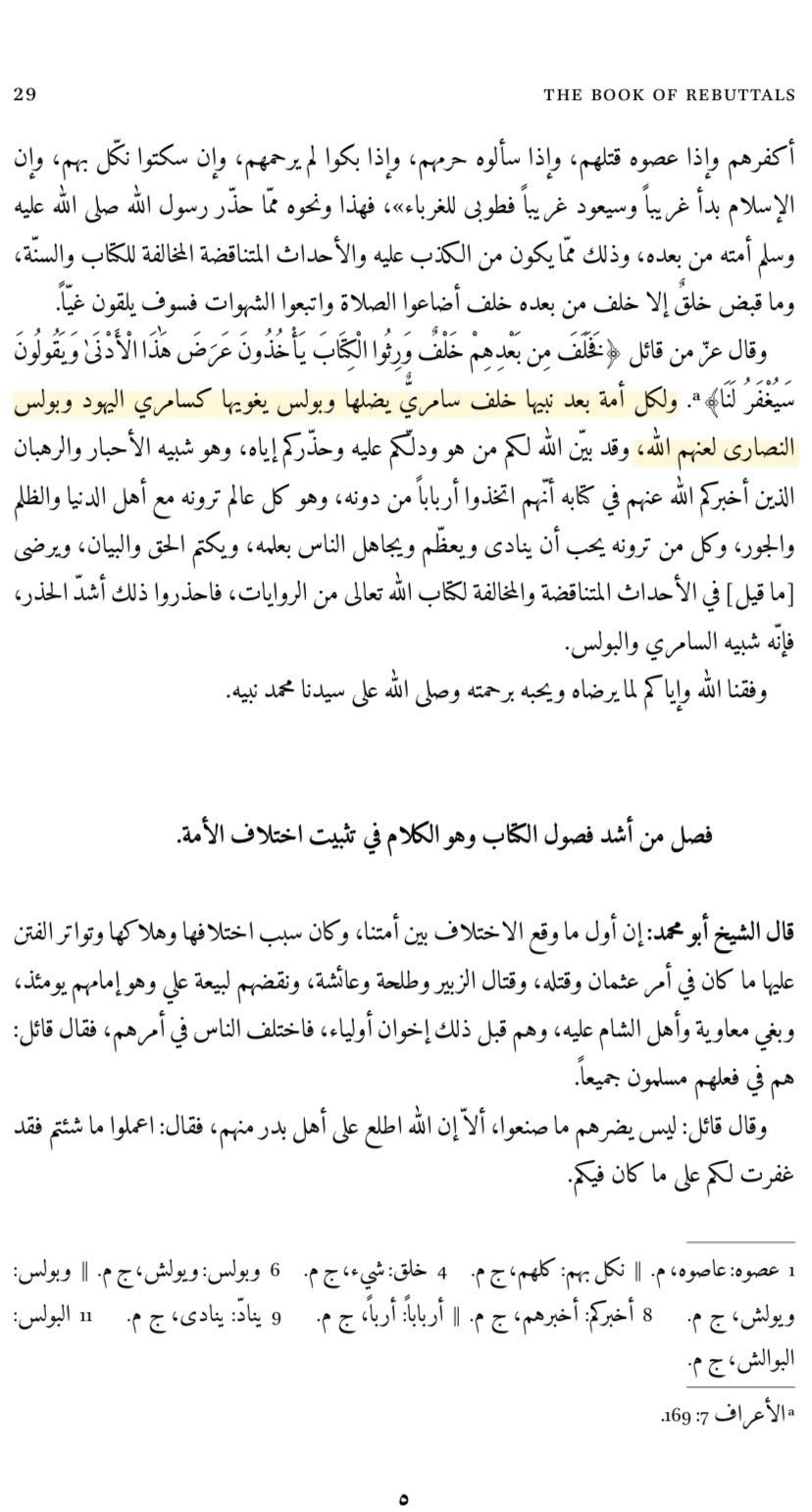
One of the searchers for truth among the Shi’i has had some questions to the Ibadi in regard to the matters of Siffin and Nahrawan.
Question: Why did the people who differed with Ali over the arbitration not continue fighting if Ali had stopped fighting?
Answer: It is not permissible to continue the fighting while they are without an imam, for fear that they will die a death of ignorance. They must be under the banner of an Imam. So, a new imam should have been appointed. It is not reasonable to appoint an imam while they are at war. They must rest a little and agree on a specific person away from the battle front.
The people were angry with him because the consensus of the nation is that he (Ali) is the legitimate caliph and those who rebelled against him are rebels according to the text of the Qur’an and must be fought. But his pledge of allegiance was broken, so how could Imam Ali be a caliph when he submitted to the rule and accepted the two arbitrations, and how could they pledge allegiance to him as caliph when he was not of their opinion and did not join them?
Question: Why didn’t the people of Nahrawan after electing Abdullah ibn Wahb Al-Rasibi press the attack against Mu’awiya and his forces?
Answer: How do we know if the people of Nahrawan wanted to fight Mu’awiya?
Did Ali give them a chance to do as such? He surprised them with his army and caused their deaths through the treachery of al-Ash’ath himself, whom had forced (Ali) into arbitration. Likewise, the people of Nahrawan are innocent because they were never followers of Mu’awiya, otherwise they would not have refused to pledge allegiance to Mu’awiya and they were fought against the Umayyad state. This is well known from history.
You may also be interested in reading the following:
“Certainly will the believers have succeeded “ (Qur’an 23:1)
﷽
Faith is not based on inheritance. We don’t inherit it from a family. You get it through conviction. Through understanding. Through contemplation. You can get rituals from your parents, from your family. However, faith is not an inheritance.
What are the signs that you have faith?
We do not have a device that can measure the faith of others. We do not have the right to measure the faith of others. We do not have a device where we can measure the faith of others. You are a level 10 and your faith is at level 2. No! Faith is in the chest (concealed).
“So whoever Allah wants to guide – He expands his breast to [contain] Islam; and whoever He wants to misguide – He makes his breast tight and constricted as though he were climbing into the sky. Thus does Allah place defilement upon those who do not believe.”(Qur’an 6:125)
However, what are some of the manifest signs that are the signs of faith?
Allah (swt) himself has given each of us a way to check ourselves. Allah (swt) himself has given a unit of measure.
Allah (swt) gave us Qur’an 23:1-9 as a means of self assessment.
Qur’an (23:1-9) The self measurement test.
Certainly will the believers have succeeded:
“They who are during their prayer humbly submissive.”
Question: Are we humbly submissive during our prayers or is it a ritual you seek to get done and over with?
“And they who turn away from ill speech.”
Question: Do we turn away from ill speech? Or do we tolerate it, and indulge in it ourselves?
“And they who are observant of zakah.”
Question: Have we payed our Zakat Fitri and our Zakat Harta? Have we given what is due to others?
“And they who guard their private parts Except from their wives or those their right hands possess, for indeed, they will not be blamed.”
Question: Do we guard our private parts? Do we act modestly with our speech our eyes and our tongues? Are we involved in looking at what we should not be looking at?
“But whoever seeks beyond that, then those are the transgressors.”
Question: If we do beyond what Allah (swt) has enjoined will we not be among the transgressors?
“And those who are to their trusts and their promises attentive.”
Question: Are we keeping our promises? Are we keeping to our commitments?
“And they who carefully maintain their prayers.”
Question: Are we being vigilant about our prayers? Are we constantly missing prayers or not even praying at all? Are we aware of what we need to do to perform our prayers correctly?
This check list is not for us to measure others. This is a self-check list that Allah (swt) has given to each of us to measure ourselves.
“Indeed, Allah only accepts from the righteous [who fear Him].” (Quran 5:27)
﷽
His Eminence, Shaykh Masoud Al Miqbali (h) informs us about a most dangerous matter. It is a false understanding that it is widespread and pervasive among the Muslims today!
We have translated his warning to us below.
“Among the misconceptions that have come to us is that someone tells you, “Do good deeds and bad deeds, and Allah will hold you accountable for this and for that.” But what is more common is the idea that “Allah willing, if your good deeds are many, the bad deeds will not harm you.” This concept is completely incorrect, absolutely false.”
“Take, for example, the narration in Sahih al-Bukhari about one of the Companions, nicknamed the “drunken donkey,” who used to drink wine. They flogged him once, twice, and three times. One of the Companions became very angry with him and said something bad about him. The Prophet (peace be upon him) replied to that person, saying: “Do not say that. For indeed, this drunkard, this addict to wine, loves Allah and His Messenger.”
“If an alcoholic hears this hadith, what would he say? Once, an alcoholic heard people speaking on a ‘Mawlid’ occasion—they were using symbolisms, like Sufi poets. He said: “Only a hero drinks wine.” And this is a person who is immersed in wine 24 hours a day, getting drunk. He said into the microphone: “Only a hero drinks wine.”
“He hears the religious preacher say, “Wine is forbidden, wine is forbidden.” Then he hears what the ‘Mawlid’ speaker says: “Only a hero drinks wine.” They might mean spiritual wine—the wine of remembrance and love of Allah. But he… they raise their banners, and I raise the banner of Najd. Every eye weeps over what grieves it.”
“This is the essence of “La ilaha illa Allah” (There is no god but Allah). It does not permit any person, no matter how high-ranking, even if he were Adam (peace be upon him), to deviate from its requirements. The presence of a sin that a person persists in blocks the acceptance of all his good deeds, even if he says “La ilaha illa Allah.“
“Take the son of Adam (Cain and Abel). The one whose offering was not accepted from him was not a disbeliever, nor was he a monotheist? He was a monotheist, not a disbeliever. Evidence for this is that he offered a sacrifice to Allah. If he had been a polytheist, he would not have drawn near to Allah. If he had been an atheist, he would not have drawn near to Allah. His drawing near to Allah indicates that he believed and affirmed Allah’s existence. So, an offering was presented. One was accepted from one and not accepted from the other. So, the one from whom it was not accepted—he has a problem. Monotheism alone is not sufficient for his deeds to be accepted. It is not enough. He affirms “La ilaha illa Allah.” Where is the flaw? What is the problem? What prevented and barred the acceptance of his deed?
Allah says: “Indeed, Allah only accepts from the righteous [who fear Him].”(Quran 5:27)
“Acceptance is for those who remain within the framework of “La ilaha illa Allah” and do not step outside it. It is for those who make “La ilaha illa Allah” a way of life, not just a phrase muttered on the lips or believed in the heart, then sometimes they act according to its requirements and sometimes they step outside it. “La ilaha illa Allah” entails commitment, belief, application, adherence, and steadfastness upon it.”
“Allah says to His Prophet (peace be upon him): “So be steadfast as you are commanded.” (Quran 11:112)
He says: “So be steadfast towards Him and seek His forgiveness…
“Say, ‘I am just a human being like you. It has been revealed to me that your Allah is the One God. So be steadfast toward Him and plead to Him for forgiveness.’ And woe to the polytheist.” (Qur’an 41:6)
“Indeed, those who have said, ‘Our Lord is Allah,’ and then remained steadfast – no fear will be upon them, nor will they grieve.” (Quran 46:13)
“One cannot take part of the religion and leave part of it.”
“So do you believe in part of the Scripture and disbelieve in part? Then what is the recompense for those who do that among you except disgrace in worldly life; and on the Day of Resurrection they will be sent back to the severest of punishment.” (Quran 2:85)
Allah did not say, “We will reward you for your faith in what you believed in and punish you for your disbelief in what you disbelieved in.” He made that faith as if it were nothing.”
“So, a person must not dare to transgress any of Allah’s boundaries under the pretext that “the statement ‘La ilaha illa Allah’ will intercede for me.”
Do you know about whom the following verse was revealed?
The verse: “O you who have believed, do not raise your voices above the voice of the Prophet or be loud to him in speech like the loudness of some of you to others, lest your deeds become worthless while you perceive not.” (Quran 49:2)
About whom was this verse revealed? It was revealed about Abu Bakr and Umar, as narrated by Al-Bukhari.”
Narrated Ibn Abi Mulaika:
The two righteous persons were about to be ruined. They were Abu Bakr and `Umar who raised their voices in the presence of the Prophet (ﷺ) when a mission from Bani Tamim came to him. One of the two recommended Al-Aqra’ bin Habeas, the brother of Bani Mujashi (to be their governor) while the other recommended somebody else. (Nafi`, the sub-narrator said, I do not remember his name). Abu Bakr said to `Umar, “You wanted nothing but to oppose me!” `Umar said, “I did not intend to oppose you.” Their voices grew loud in that argument, so Allah revealed: ‘O you who believe! Raise not your voices above the voice of the Prophet.’ (49.2) Ibn Az-Zubair said, “Since the revelation of this Verse, `Umar used to speak in such a low tone that the Prophet (ﷺ) had to ask him to repeat his statements.” But Ibn Az-Zubair did not mention the same about his (maternal) grandfather (i.e. Abu Bakr).
(O you who believe! Raise not your voices above the voice of the Prophet,) This contains another kind of favorable behavior. Allah the Exalted is teaching the believers that they should not raise their voices above the voice of the Prophet. It was stated that this Ayah was revealed about Abu Bakr and `Umar. Al-Bukhari recorded that Ibn Abi Mulaykah said, “The two righteous ones, Abu Bakr and `Umar, almost earned destruction when they raised their voices before the Prophet who was receiving the delegation of Bani Tamim. One of them recommended Al-Aqra` bin Habis the member of the Banu Mujashi` while the other recommended another man. Nafi` (a subnarrator) said: “I don’t remember his name.” Abu Bakr said to `Umar, `You only wanted to contradict me,’ while `Umar said, `I did not intend to contradict you.’ Their voices then became loud, thereupon Allah the Exalted sent down this Ayah,يأَيُّهَا الَّذِينَ ءَامَنُواْ لاَ تَرْفَعُواْ أَصْوَتَكُمْ فَوْقَ صَوْتِ النَّبِىِّ وَلاَ تَجْهَرُواْ لَهُ بِالْقَوْلِ كَجَهْرِ بَعْضِكُمْ لِبَعْضٍ أَن تَحْبَطَ أَعْمَـلُكُمْ وَأَنتُمْ لاَ تَشْعُرُونَ(O you who believe! Raise not your voices above the voice of the Prophet, nor speak aloud to him in talk as you speak aloud to one another, lest your deeds should be thwarted while you perceive not.)’‘ `Abdullah bin Az-Zubayr said, “After that, `Umar’s voice was so low that the Messenger of Allah had to ask him to repeat what he said so that he could understand what he was saying to him.” `Abdullah bin Az-Zubayr did not mention the same regarding his father, Abu Bakr, may Allah be pleased with him. Muslim did not collect this Hadith. In another narration collected by Al-Bukhari, he said that a delegation from the tribe of Banu Tamim came to the Prophet and that Abu Bakr recommended Al-Qa`qa` bin Ma`bad to be appointed as their leader, while `Umar recommended Al-Aqra` bin Habis. Muslim did not collect this narration.
“How will you comprehend what the steep ascent is? It is freeing a slave (raqabatin -a neck) or giving of food at the time of famine to an orphan or near of kin or some needy person in distress.” (Qur’an 90:12-16)
“It is not righteousness that you turn your faces Towards east or West; but it is righteousness- to believe in Allah and the Last Day, and the Angels, and the Book, and the Messengers; to spend of your substance, out of love for Him, for your kin, for orphans, for the needy, for the wayfarer, for those who ask, and for the ransom of slaves (l-riqābi) freeing the necks -slaves); to be steadfast in prayer, and practice regular charity; to fulfil the contracts which ye have made; and to be firm and patient, in pain (or suffering) and adversity, and throughout all periods of panic. Such are the people of truth, the Allah-fearing.” (Qur’an 2:177)
“When it is said to them, “Follow what Allah has revealed,” they reply, “No! We follow what we found our forefathers practicing.” (Qur’an 2:170)
﷽
This topic is not a difficult one to address. Especially when we realize some very basic things about human beings and human nature.
Humans have engaged in wars, slavery, marriage, divorce, and trade before the coming of the final revelation, the Qur’an.
The Qur’an comes to address the reality of what was happening in society. It addresses the situation on the ground. The Qur’an did not come to bring slavery but rather to address it. When Allah addresses slavery, He is giving rules to manage an existing situation, not expressing His endorsement of it.
The issue of Raqab (Slave) & Milk Al Yamin (Those whom your right hand possess) is through one means and one means only. That is via the context of war.
Outside the context of war, there is not a single verse in the Qur’an that calls for holding anyone as captive.
The other point that one will not fail to notice is that Raqab (slave) in the Qur’an is never in the context of the Muslims having them. Rather, it is in the context of the disbelievers having them and Muslims are encouraged to free them from the disbelievers.
Raqaba (Those whose necks are bound =under non Muslims) We should clarify that this also does mean Muslims who had slaves prior to embracing Islam. Ma-Malakat Aymanukum (Those whom your right-hand posses /those whom you are your oath of protection/You are a custodian over them)
The decision on what to do after victory over one’s opponent.
This decision affects men, women and children. This decision would be delegated to the commander who is able to best access the situation.
The commander can to decide to:
Kill them all (except women and children), as in the case of Bani Qurayzah, because the Blessed Prophet (saw) explicitly forbade the killing of women and children.*
They could ransom them, as in the case of the battle of Badr, or exchange them for Muslim prisoners.
Or they can take them as Ma-Malakat Aymanukum.
It really depends on the context and the assessment of the commander.
*It is narrated by Ibn ‘Umar that a woman was found killed in one of these battles; so the Messenger of Allah (saw) forbade the killing of women and children.
The first call is not to bring these people in as Ma-Malakat Aymanukum. The following verse demonstrates this:
“So, when you encounter those who disbelieve, then (aim at) smiting the necks, until when you have broken their strength thoroughly, then establish the covenant (or terms). Then choose (to release them) either (as) a favour (shown to them,), or (after receiving) ransom, until the war is over. That (is Our command.) If Allah willed, He would have (Himself) subjected them to retribution, but (Allah ordered you to fight,) so that He may test some of you through some others. And those who are killed in Allah’s way, He will never let their deeds go to waste.” (Qur’an 47:4)
The Muslim commander assesses the situation. If the enemy forces are decimated thoroughly, it is most likely in such a situation that bringing the people in like Ma-Malakat Aymanukum is at that point a mercy to them.
Rather than leave women and children to wonder and roam hoping others would take them in.
“It is not fit for a Prophet that he should take prisoners of war until he has thoroughly subdued the land. You settled with the fleeting gains of this world, while Allah’s aim is the Hereafter. Allah is Almighty, All-Wise.” (Qur’an 8:67)
This verse was sent down as a rebuke to the companions of the Blessed Messenger (saw). The reason is given in the verse itself: “until he has thoroughly subdued the land,” and “You settled with the fleeting gains of this world.” During the battle of Badr, when the enemy was fleeing, many of the companions started to immediately turn their attention to the war booty. However, they should have subdued their enemy completely. Enemies that you let get away are people who regroup, and you have to face another field of battle.
Not everyone would necessarily want to have extra mouths to feed.
Ma’rur b. Suwaid reported:
I saw Abu Dharr wearing clothes, and the slave wearing similar ones. I asked him about it, and he narrated that he had abused a person during the lifetime of Allah’s Messenger (saw) and he reproached him for his mother. That person came to Allah’s Messenger (saw) and made mention of that to him. Thereupon Allah’s Messenger (saw) said: You are a person who has (remnants of) ignorance in him. Your slaves are brothers of yours. Allah has placed them in your hand, and he who has his brother under him, he should feed him with what he eats, and dress him with what he dresses himself, and do not burden them beyond their capacities, and if you burden them, (beyond their capacities), then help them.
Let us think of today’s example of a domestic helper. Not everyone can afford to have a domestic helper even if they want one. Also think of accommodation. We are surprised at all the discussion on this topic. It is not approached from a practical and pragmatic aspect of whether everyone would put their hands up to volunteer to have a slave. Keep in mind, the vast majority of the companions were people who were already under a great deal of duress and many of them were not people of means. It is likely those who took such people were those who handed livestock or fields to tend to. In other words, they saw a practical and pragmatic benefit in taking in and taking care of such people.
The objective of the Muslim man in war.
We also need to bear in mind that the objective of the Muslim man in war is to seek shahada. Why would any Muslim man in their right mind and right state of emaan settle for the paltry gains of this worldly life when the hereafter and all its blessings awaits!
“O believers! Do not be like the unfaithful who say about their brothers who travel throughout the land or engage in battle, “If they had stayed with us, they would not have died or been killed.” Allah makes such thinking a cause of agony in their hearts. It is Allah who gives life and causes death. And Allah is All-Seeing of what you do. Should you be martyred or die in the cause of Allah, then His forgiveness and mercy are far better than whatever ˹wealth˺ those ˹who stay behind˺ accumulate. Whether you die or are martyred—all of you will be gathered before Allah.” (Qur’an 3:156-158)
“Never think of those martyred in the cause of Allah as dead. In fact, they are alive with their Lord, well provided for rejoicing in Allah’s bounties and being delighted for those yet to join them. There will be no fear for them, nor will they grieve.” (Qur’an 3:169-170)
What is ultimately the objective in Islam of having Ma-Malakat Aymanukumfrom wars?
Firstly, Islam and the Muslims would prefer not to have wars to begin with. Let’s establish this.
Secondly, the ultimate objective is the re-integration of such people into society. That is what we need to keep in mind when going forward. Does the Qur’an encourage, allow, or find avenues for this? Does Islam really set about to do this or does it just talk? Let us see.
The Qur’an and the New Testament & TNCH
There is not a single verse in the New Testament encouraging anyone ever to free a slave. Not one.
Jesus, as recorded in the New Testament, had two interactions with slaves. Both of whom he healed. But not once was there a command to set the slave free — which shows, morally speaking, he was quite fine with it as a reality of society.
In fact, Christians have had to turn this Messianic Prophecy into some Christological view about Christ Jesus (as) saving people from sins!
“The spirit of the Lord God was upon me, since the Lord anointed me to bring tidings to the humble, He sent me to bind up the broken-hearted, to declare freedom for the captives, and for the prisoners to free from captivity.” (Isaiah 61:1)
Jesus (as) during his ministry (according to the NT) did nothing of the kind. So the captives here must be interpreted as captives to sins.
Christians will often quote the following verse to claim this abolishes slavery.
“There is neither Jew nor Gentile, neither slave nor free, nor is there male and female, for you are all one in Christ Jesus.” (Galatians 3:28)
This verse says nothing about abolishing slavery. It simply speaks of all being equal in Christ. The proof of that is that this verse has been read down through the ages and Christians had no issues with keeping slaves.
“Slaves, in reverent fear of God, submit yourselves to your masters, not only to those who are good and considerate, but also to those who are harsh.” (1 Peter 2:18)
In fact, in the entire TNCH of Judaism (what Christians call the Old Testament) there were no examples of encouraging the freeing of slaves! What you will find is that if your slave is a Hebrew, he cannot be a slave beyond 6 years, and you must set him free. There is no such law for non-Hebrew people!
“Now these are the rules that you shall set before them. When you buy a Hebrew slave, he shall serve six years, and in the seventh he shall go out free, for nothing. If he comes in single, he shall go out single; if he comes in married, then his wife shall go out with him. If his master gives him a wife and she bears him sons or daughters, the wife and her children shall be her master’s, and he shall go out alone. But if the slave plainly says, ‘I love my master, my wife, and my children; I will not go out free.” (Exodus 21:1-6)
Freeing of slaves was only in relation to their own people.
Then the Holy Trinity (Father, Jesus and The Holy Spirit) commanded:
“When you march up to attack a city, make its people an offer of peace. If they accept and open their gates, all the people in it shall be subject to forced labor and shall work for you. If they refuse to make peace and they engage you in battle, lay siege to that city. When the Lord your God delivers it into your hand, put to the sword all the men in it. As for the women, the children, the livestock and everything else in the city, you may take these as plunder for yourselves. And you may use the plunder the Lord your God gives you from your enemies. This is how you are to treat all the cities that are at a distance from you and do not belong to the nations nearby. However, in the cities of the nations the Lord your God is giving you as an inheritance, do not leave alive anything that breathes. Completely destroy them—the Hittites, Amorites, Canaanites, Perizzites, Hivites and Jebusites—as the Lord your God has commanded you. Otherwise, they will teach you to follow all the detestable things they do in worshiping their gods, and you will sin against the Lord your God.” (Deuteronomy 20:10-18)
The Holy Trinity (Father Jesus and The Holy Spirit) did not chide or stop Moses when he stated:
“And Moses said to them, Have you saved all the women alive? Behold, these caused the children of Israel, through the counsel of Balaam, to commit trespass against the Lord in the matter of Peor, and there was a plague among the congregation of the Lord.Now therefore kill every male among the little ones, and kill every woman that have known man by lying with him. But all the women children, that have not known a man by lying with him, keep alive for yourselves.” (Numbers 31:15-18)
Then the Holy Trinity (Father, Jesus and The Holy Spirit) commanded:
“When you go out to war against your enemies, and the Lord your God gives them into your hand and you take them captive, and you see among the captives a beautiful woman, and you desire to take her to be your wife, and you bring her home to your house, she shall shave her head and pare her nails. And she shall take off the clothes in which she was captured and shall remain in your house and lament her father and her mother a full month. After that you may go in to her and be her husband, and she shall be your wife. But if you no longer delight in her, you shall let her go where she wants. But you shall not sell her for money, nor shall you treat her as a slave, since you have humiliated her.” (Deuteronomy 21:10-14)
Then the Holy Trinity (Father, Jesus and The Holy Spirit) commanded:
“Your male and female slaves are to come from the nations around you; from them you may buy slaves. You may also buy some of the temporary residents living among you and members of their clans born in your country, and they will become your property.You can bequeath them to your children as inherited property and can make them slaves for life, but you must not rule over your fellow Israelites ruthlessly.” (Leviticus 25: 44-46)
Then the Holy Trinity (Father, Jesus and The Holy Spirit) commanded:
If a man happens to meet a virgin who is not pledged to be married and rapes her and they are discovered, he shall pay her father fifty shekels of silver. He must marry the young woman, for he has violated her. He can never divorce her as long as he lives.” (Deuteronomy 22:28-29)
Partus sequitur ventrem or descent-based slavery in Islam, Judaism and Christianity.
What does this mean? In other world views, if a person is born to a slave woman, they too would be born into slavery. This is not the case in Islam. The person born to a slave is a free person. We do not have baby slaves. The first documented recorded example in the history of getting rid of descent-based slavery is in Islam!
Now, what does the Bible (New Testament/TNCH) say in regard to this? Nothing.
ATONE FOR SINS BY FREEING A (RAQAB/NECK) SLAVE.
The first point is what we have already covered in regard to (Qur’an 47:4) above. That is immediate emancipation. Either by a good will gesture, ransom or via prisoner exchange.
Now what we are going to share with you, dear readers, leaves no good options for the haters of Islam.
They will have to admit the (raqab) were not something in abundance among Muslims. Or.
That the Qur’an is a divine revelation as it’s author (Allah), being the All-Knowing, laid out a plan for Muslims to get atonement when no (raqab) would be available: -for example, in the future.
Thie following verses demonstrate that the institution of slavery need not endure.
“Allah will not impose blame upon you for what is meaningless in your oaths, but He will impose blame upon you for [breaking] what you intended of oaths. So its expiation is the feeding of ten poor people from the average of that which you feed your families or clothing them or the liberation of (raqabatin) a slave.” “But if none of this is affordable, then you must fast three days. This is the penalty for breaking your oaths. So be mindful of your oaths. This is how Allah makes things clear to you, so perhaps you will be grateful.”(Qur’an 5:89)
“It is not lawful for a believer to kill another except by mistake. And whoever kills a believer unintentionally must free a believing slave and pay blood-money to the victim’s family—unless they waive it charitably. But if the victim is a believer from a hostile people, then a believing (raqabatin) slave must be freed. And if the victim is from a people bound with you in a treaty, then blood-money must be paid to the family along with freeing a believing slave (raqabatin). Those who are unable, let them fast two consecutive months—as a means of repentance to Allah. And Allah is All-Knowing, All-Wise.” (Qur’an 4:92)
“And those who pronounce thihar from their wives and then [wish to] go back on what they said – then [there must be] the freeing of a slave (raqabatin) before they touch one another. That is what you are admonished thereby; and Allah is Acquainted with what you do.” “But if the husband cannot afford this, let him then fast two consecutive months before the couple touch each other. But if he is unable, then let him feed sixty poor people. This is to re-affirm your faith in Allah and His Messenger. These are the limits set by Allah. And the disbelievers will suffer a painful punishment.” (Qur’an 58:3-4)
Prima Qur’an comments: If you look at the expiation for sin, it is clear from this that Allah (swt) offers several solutions if one is unable to free the neck (of a slave).
Freeing slaves
Freeing slaves along with blood money.
Feeding 60 poor people.
Fasting, depending on the nature of the sin; 3 days or up to 120 days consecutively.
Fasting can only be an option if the person does not have the means to free a neck (slave) or there are simply no slaves (necks) to be freed!
That is to say that freeing a neck (slave) is given priority in terms of expiation of sins!
Zakat — one of the five pillars of Islam and forced tax collection on the Muslim faithful by the Amir is used to set slaves free!
“Zakah expenditures are only for the poor and for the needy and for those employed to collect [zakah] and for bringing hearts together [for Islam] and for freeing captives (l-riqabi) and for those in debt and for the cause of Allah and for the [stranded] traveler – an obligation [imposed] by Allah. And Allah is Knowing and Wise.” (Qur’an 9:60)
Zakah, which comes from an Arabic root word meaning to purify, is one of the five pillars of Islam. In the context of Zakah distribution, it is the purification of one’s wealth. This means that the money that is generated by this forced tax collection is used to free slaves!
There are 8 ahsnaf (beneficiaries of Zakah).
Fakir -One who has no means of livelihood or material possession.
Miskin -One who has insufficient means to sustain their livelihood.
Amil -The person who collects the Zakah, to reward the dutiful.
Muallaf-Assistance for those who recently embraced Islam.
Riqab-Freeing of slaves.
Gharimin-One who is in debt needs assistance to pay off a debt.
Fisabillah-Those who fights in the cause of Allah-or to sustain those who lost bread winners in the war.
Ibnussabil-Those who are travelers or on a journey
At this point, a Muslim should lift his/her head up with pride and say: “Al hamdulillah, I am a Muslim! What other system is there like this in any other faith tradition?”
Islam encourages the freeing of slaves and especially tells us that it is a quick path to righteousness & spiritual elevation.
How will you comprehend what the steep ascent is? It is freeing a slave (raqabatin -a neck) or giving of food at the time of famine to an orphan or near of kin or some needy person in distress.” (Qur’an 90:12-16)
“It is not righteousness that you turn your faces Towards east or West; but it is righteousness- to believe in Allah and the Last Day, and the Angels, and the Book, and the Messengers; to spend of your substance, out of love for Him, for your kin, for orphans, for the needy, for the wayfarer, for those who ask, and for the ransom of slaves (l-riqābi) freeing the necks -slaves); to be steadfast in prayer, and practice regular charity; to fulfil the contracts which you have made; and to be firm and patient, in pain (or suffering) and adversity, and throughout all periods of panic. Such are the people of truth, the Allah-fearing.” (Qur’an 2:177)
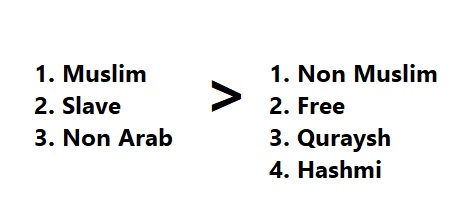
The Qur’an informs us that when it comes to choosing a life partner and whom to continue our lineage with that a believing slave is better than a disbelieving free person.
“And do not marry mushrik women until they believe. And a believing wala-amatun (bondwoman) is better than a mushrik, even though she might please you. And do not marry mushrik men until they believe. And a believing wala-abdun (bondman) is better than a mushrik, even though he might please you. Those invite to the Fire, but Allah invites to Paradise and to forgiveness, by His permission. And He makes clear His verses to the people that perhaps they may remember.” (Qur’an 2:221)
In the scenario above, the slave has a low status before the people.
The free person has a high status before the people.
In both situations, when a believer is to access who to give their son or daughter to for the continuation of their lineage, the believer is always superior to the unbeliever in every scenario. The believing slave is leagues above the unbelieving free person.
The above verse is used by our school, the Ibadi school, as a proof against anyone who states that someone who is Quraysh is, by default, superior to a non-Qurashi. Or, that an Arab is superior to a non-Arab. This verse is definite proof against that position.
Various hadith about slaves
Narrated Al-Miswar bin Makhrama and Marwan:
When the delegates of the tribe of Hawazin came to the Prophet (saw) he stood up amongst the people, Glorified and Praised Allah as He deserved, and said, “Then after: Your brethren have come to you with repentance and I see it logical to return to them their captives; so whoever amongst you likes to do that as a favor, then he can do it, and whoever of you like to stick to his share till we give him his right from the very first Fai (war booty) (1) which Allah will bestow on us, then (he can do so).” The people replied, “We do that (to return the captives) willingly as a favor for your sake.”
Allah’s Messenger (saw) said, “He who has a slave-girl and educates and treats her nicely and then manumits and marries her, will get a double reward.”
I came to Ibn ‘Umar when he set his slave free. He took a stick or something else from the earth and said; for me there is no reward even equivalent to this. I heard the Messenger of Allah (saw) say: If anyone slaps or beats his slave the atonement due from him is to set him free.
The Prophet (saw) said, “Allah says, ‘I will be against three persons on the Day of Resurrection: -1. One who makes a covenant in My Name, but he proves treacherous. -2. One who sells a free person (as a slave) and eats the price, -3. And one who employs a laborer and gets the full work done by him but does not pay him his wages.’ “
Abu Huraira reported Allah’s Messenger (saw) as saying:
None of you should say: My bondman, for all of you are the bondmen of Allah, but say: My young man, and the servant should not say: My Lord, but should say: My chief.
It is also clear from the above hadith that someone who had the status of slave can rise to the ranks of being the commander of the faithful. That is the Amir al-Mu’minin (Commander of the Faithful) of the entirety of all Muslims!
In fact, the above hadith is used by our school; The Ibadi school against the Shi’i and Sunni schools, which state the ruler of the Muslims must only be from the Quraysh (Sunni from any member of Quraysh) and (Shi”i from the Prophet’s lineage which is Quraysh).
Addressing the issue ofMa-Malakat Aymanukum
First, who are the Ma-Malakat Aymanukum?
Recall the definition.
Ma-Malakat Aymanukum (Those whom your right-hand posses /those who you are your oath of protection/You are a custodian over them)
The expression: right-hand posses is an idiom or expression which means those under your authority, custody, care, provision. The right hand is always used as an expression of something noble and good.
“So as for he who is given his record in his right hand, he will say, “Here, read my record!” (Qur’an 69:19)
The Ma-Malakat Aymanukum are never titled as those whom your left-hand posses. As if they were something disposable and ignoble.
They are those who have been taken under the protection of Muslim households (who have the means and capacity to care for them). Not all Muslim households would volunteer for this. So this offered Muslims from different social economic backgrounds an opportunity to receive reward in different ways.
To simply let such people go.
To earn rewards by bringing in these people under the care and provision of a Muslim household.
Also, bear in mind that option 2 was most likely, in many cases, the preferred choice even from the vantage point of those captured. Once your men, husbands, protectors, army have been decimated, where will you go? To whom will you turn to? Also, do keep in mind that Ma-Malakat Aymanukum is not simply women and children as it also includes men.
So let us tackle the first supposed topic of controversy head on.
Can Muslim women /Muslim men rape, molest or sexually exploit their Ma-Malakat Aymanukum against their will?
“Why should you not fight in the cause of Allah when weak men, women, and children are imploring: “Our Lord, deliver us from this community whose people are oppressive, and be You our Lord and Master.” (Qur’an 4:75)
How would this du’a to Allah to send people who deliver them from oppression make sense if Muslims turned around and did the same thing?
“And of His signs is that He created for you from yourselves mates that you may find tranquility in them; and He placed between you affection and mercy. Indeed in that are signs for a people who give though.” (Qur’an 30:21)
One of the means by which a Muslim woman may find her future husband or by which a Muslim man may find his future wife is by means of milk al yamin. Is it really to be believed that this Muslim woman or man can now rape or molest his/her milk al yamin without his/her consent and he/she (the victim) will be among those who are filled with affection and mercy for his wife or her husband?
Remember that Allah (swt) has mentioned that this category of people, as believers, are better for our sons and daughters as future partners than disbelievers, who are free people.
“And do not marry mushrik women until they believe. And a believing wala-amatun (bondwoman) is better than a mushrik, even though she might please you. And do not marry mushrik men until they believe. And a believing wala-abdun (bondman) is better than a mushrik, even though he might please you. Those invite to the Fire, but Allāh invites to Paradise and to forgiveness, by His permission. And He makes clear His verses to the people that perhaps they may remember.” (Qur’an 2:221)
What kind of healthy or wholesome relationship does one think will come out of those who suffered abuse?
Even this day, those of us who have married men and women who have been raped or molested by their mothers, fathers, aunts, uncles, guardians know the trauma and immense challenge it takes building trust with our partners.
Next point:
Zadhan said:
I came to Ibn ‘Umar when he set his slave free. He took a stick or something else from the earth and said; for me there is no reward even equivalent to this. I heard the Messenger of Allah (saw) say: If anyone slaps or beats his slave (mamluka) the atonement due from him is to set him free.
If you are not to slap or beat your slave, how is that you can force them against their will?
The Qur’an commands Chastity.
“You shall maintain chastity, not committing adultery, nor taking secret lovers.” (Qur’an 5:5)
“Tell the believing men to lower their gaze and guard their chastity. That is purer for them. Surely Allah is All-Aware of what they do.” (Qur’an 24:30)
“As for the one who reverenced the majesty of his Lord, and enjoined the self from sinful lusts. Paradise will be the abode.” (Qur’an 79:40-41)
“Worship Allah and associate nothing with Him, and to parents do good, and to relatives, orphans, the needy, the near neighbor, the neighbor farther away, the companion at your side, the traveler, and those whom (malakat aymanukum) your right hands possess. Indeed, Allah does not like those who are stingy and boastful.” (Qur’an 4:36)
Allah (swt) has put the malakat aymankum on the same level, and they should be treated with good as their parents, relatives, orphans, needy, neighbor, traveler, companion and even neighbor not adjacent to you.
Can it be said that if these people are molested against their consent, that they are being treated with good?
“Marry off the singles among you, as well as the righteous of your bondmen and bondwomen(Ibadikum wa-imaikum). If they are poor, Allah will enrich them out of His bounty. For Allah is All-Bountiful, All-Knowing. And let those who do not have the means to marry should (walyyasta’fifi)-show restraint and/or keep themselves chaste until Allah enriches them out of His bounty. And if any of those who your right hand posses (malakat aymanukum) desires a contract, make it possible for them, if you find goodness in them. And give them some of Allah’s wealth which He has granted you. Do not force your girls into prostitution (l-bighai)for your own worldly gains while they wish to remain chaste. And if someone coerces them, then after such a coercion Allah is certainly All-Forgiving, Most Merciful . Indeed, We have sent down to you clear revelations, along with examples of those who had gone before you, and a lesson to the Allah-fearing. (Qur’an 24:32-34)
Prima Qur’ancomments:
1) Allah tells us to marry those who are single among us. As well as marry the bondmen and bondwomen.
2) Those who do not have the means to marry should remain chaste/show restraint. — Not that a Muslim woman can go and rape or molest a man, or that a Muslim man can go and rape and molest a woman. In fact, if they were allowed to do so, there would be no injunction for them to show restraint.
3)If any malakat aymanukum wants to get into a contract to buy their freedom, make it possible for them, in fact give them some of the wealth Allah gave you! (Allah swt is reminding us that, after all, he is the source of all wealth).
4) Do not force your girls into prostitution. If this is done, then Allah forgives this coercion (of the girl), not the one who forces them as some twisted Anti Muslims claim. In fact, if it was fine for them to force them into prostitution, the warning to tell them not to do so when be redundant to begin with.
5) (l-bighai) means more than prostitution it means any type of lewdness. Certainly, having inappropriate relations with someone to whom you are not married constitutes exactly this.
6) You will also see this is why no punishment is meted out to unmarried women from Malakat Aymanukum when we discuss Qur’an 4:25. Because of her social and economic condition, it could be quite challenging to tell if she is being forced to do something because she is doing it of her own volition. This ambiguity in the law is also proof enough that they cannot be coerced into intimacy. As stated, if they were forced the fault is with the one who coerces and not the coerced.
“And whoever among you cannot [find] the means to marry free, believing women, then from those (malakat aymanukum min fatayatikumu l-mu’minati) what your right hands possess that are believers. And Allah is most knowing about your faith. You [believers] are of one another. So marry them with the permission of their people ahlihinna (of their people/family)and give them their due compensation according to what is acceptable. They should be (muh’sanatin ghayra musafihatin) chaste not those who commit immorality) nor those who take [secret] lovers (akhdanin). But once they are in the sacred bond of marriage, if they should commit adultery, then for them is half the punishment for free [unmarried] women. This [allowance] is for him among you who fears sin, but to be patient is better for you. And Allah is Forgiving and Merciful.” (Qur’an 4:25)
Prima Qur’an comments:
1) If you cannot afford to marry free believing women, then you marry those whom your right hand possesses. Due to the social and economic status of free women, it is possible that they may demand a higher dowry, among other things.
2) If they have family or tribe that you, or they know of, then you seek permission from their family or tribe.
3) They should be chaste. One cannot be chaste if it is allowable to be unchaste.
4) They should not have secret lovers.
It should be very clear that these women are not being fondled, molested or raped. Also, the inverse is true; that it should be clear that when Muslim women marry such men that they are not being fondled, molested or raped. Because then they would not be from the category of the chaste; nor are they from those who do not have secret lovers.
By the way, in many cases, in the above scenario, the mahr (the bridal dowry) was to grant her freedom. In other cases, this was not so.
5) But once they are sheltered in marriage, if they should commit adultery, then for them there is half the punishment for free [unmarried] women. This point is something that is quite phenomenal that many people do not ponder over. Usually, in a society, a person of lower socioeconomic status would be treated as a lesser person than those with higher social economic status. Quran 4:25 goes against that norm.
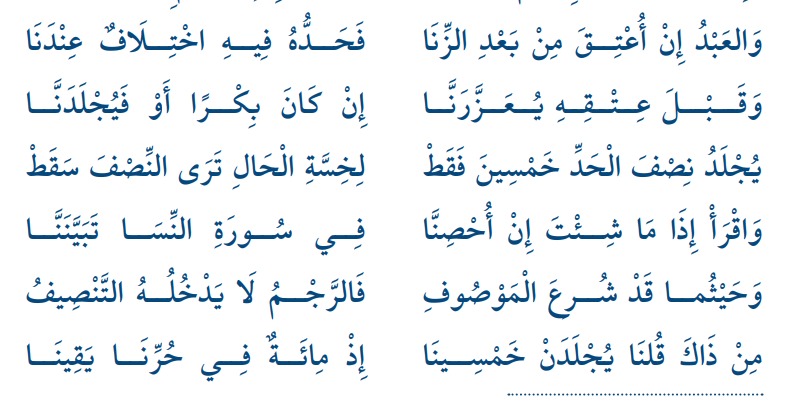
That is why, in our school, the punishments for adultery and pre-marital sex are meted out like so:
Free Woman/Man that are married =Rajm.
Free Woman/Man that are unmarried =100 lashes.
Slave Woman/Man that are married =50 lashes.
Slave Woman/Man that is unmarried = Taazir.
A tazir punishment is when there is nothing explicit from the Qur’an or Sunnah. It is discretionary. It could be corporeal in nature, it could be harsh words of admonishment.
“Do not force your girls into prostitution (l-bighai)for your own worldly gains while they wish to remain chaste.”
Due to the social and economic condition of this person, it would be very difficult to pin anything on them. Especially in light of the fact that they very well could be forced.
We have not found any cases in the Ibadi school of said individuals (category 4) being punished.
“And if you fear that you will not deal justly with the orphan girls, then marry those that please you of [other] women, two or three or four. But if you fear that you will not be just, then one or those your right hand possesses (malakat aymanukum). That is more suitable that you may not incline (ta’ulu)-injustice, oppression. And give the women [upon marriage] their [bridal] gifts graciously. But if they give up willingly to you anything of it, then take it in satisfaction and ease.” (Qur’an 4:3-4)
Prima Qur’ancomments:
1) If you fear that you will not do justice when marrying many orphan women, then marry one from among them (malakat aymanukum). In other words, these women from the malakat aymanukum are there for your consideration.
2) Orphan girls here are still free women. They are simply free women that do not have any known family or guardians.
3) Give them (malakat aymanukum)their bridal gift.
And [also prohibited to you are all] married women except those your right hands possess. (malakat aymanukum)[This is] the decree of Allah upon you. And lawful to you are [all others] beyond these, [provided] that you seek them [in marriage] with [gifts from] your property, desiring chastity, not unlawful sexual intercourse (muh’sinina ghayra musafihina So for whatever you enjoy [of marriage] from them, give them their due compensation as an obligation. And there is no blame upon you for what you mutually agree to beyond the obligation. Indeed, Allah is ever Knowing and Wise. (Qur’an 4:24)
If we Muslims were such immoral people, why would we need to be consoled that it is fine to marry women from those whom our right-hand posses that were already married?
In other words, this verse says that those women who are already married to those whom Islam would not recognize the validity of their marriage contract, you can marry them.
Notice that, again, the malakat aymanukum are spoken of in the context of marriage. That beyond them are other women who are lawful to you provided you desire chastity and not unlawful intercourse.
Let us put it like this. We will use the example of the law of the former United States. The former United States has a law that says if a person is married, and then they seek to get married to another individual, this is called bigamy.
So here is the scenario. A married woman in the former United States converts to Islam and seeks a divorce from her husband. The divorce proceedings are taking a long time. In the meantime, this woman does not live with her husband, nor does she receive sustenance or care from him. Over the course of time, she has been made known of an interest in her by a Muslim man. After meeting up with the suitor in the appropriate settings, they decide to marry. The Imam of the Masjid performs the nikah. Technically, this woman is married to her husband (by U.S. law). However, in Islam, the moment she became a Muslim and her husband did not follow suit, that marriage dissolved. They are married in the sight of Allah (swt) and that is what matters. As long as they do not go and try and register their marriage, the wife would be free from the charge of bigamy in U.S. law.*
*Note as Muslims we have to respect the laws of the nations that we reside in.
If we were an Imam in the former United States, we would officiate such a nikah.
“O you who have believed, when the believing women come to you as emigrants, examine them. Allah is most knowing as to their faith. And if you know them to be believers, then do not return them to the disbelievers; they are not lawful [wives] for them, nor are they lawful [husbands] for them. But give the disbelievers what they have spent. And there is no blame upon you if you marry them when you have given them their due compensation. And hold not to marriage bonds with disbelieving women, but ask for what you have spent and let them ask for what they have spent. That is the judgement of Allah ; He judges between you. And Allah is Knowing and Wise.” (Qur’an 60:10)
So it can be asked is it not inherently morally wrong to marry a woman who is already “lawfully” married to another man according to their custom, beliefs or creed?
Notice we said “lawfully” in quotes. That is because who determines what is or is not lawful marriage? Thus, in the above text, a believing woman is indeed married to a disbelieving man according to the laws, customs and beliefs of his society and his people. Thus, she is in adultery in accordance with them. However, Allah (swt) has made that marriage null and void!
In fact, Allah (swt) is being rather magnanimous by ordering: But give the disbelievers what they have spent. When Allah (swt) could have ordered that they receive nothing!
Now we could turn around and ask the Jews and Christians the following: What do you say on these matters? It is easy to talk the talk, but do you walk the walk? So let us give them a scenario.
Let us say a Muslim woman has now converted to Christianity. She wanted to leave a horrible marriage she was in. Her husband would in no way divorce her. This woman left Islam and became a Christian. She flees to the former United States. What is the position of Judaism and Christianity on her matter?
Does she remain single for the rest of her life or does not the law of the land have the power to nullify or make null her marriage? Technically, she is still married to that man and will be until he divorces her (according to the laws of his land).
“O Prophet, indeed We have made lawful to you your wives to whom you have given their due compensation and those (malakat yaminuka) whom your right hand possesses from what Allah has returned to you [of captives] and the daughters of your paternal uncles and the daughters of your paternal aunts and the daughters of your maternal uncles and the daughters of your maternal aunts who emigrated with you and a believing woman if she gives herself to the Prophet [and] if the Prophet wishes to marry her, [this is] only for you, excluding the [other] believers. We certainly know what We have made obligatory upon them concerning their wives and those their right hands possess,(malakat aymanuhum) in order that there will be upon you no discomfort. And ever is Allah Forgiving and Merciful.” (Qur’an 33:50)
Daughters of paternal uncles.
Daughters of paternal aunts.
Daughters of maternal uncles
Daughters of maternal aunts.
Any believing woman who gives herself to you. If the Prophet wishes to marry her.
Does anyone believe for a moment that the above verse is saying that if the Blessed Prophet (saw) so wished that he could be intimate with his cousins without being married to them?
In fact, category 5 (any believing woman) is explicitly followed up by the desire to marry her.
Thus, those whom your right hand possesses (malakat yaminuka) are also under these categories. That they are among the women the Blessed Prophet (saw) can marry if he so chooses. As he did so with Safiyah (ra).
“You, [O Muḥammed], may put aside whom you will of them or take to yourself whom you will. And any that you desire of those [wives] from whom you had [temporarily] separated – there is no blame upon you [in returning her]. That is more suitable that they should be content and not grieve and that they should be satisfied with what you have given them – all of them. And Allah knows what is in your hearts. And ever is Allah Knowing and Forbearing.” (Qur’an 33:51)
THE MALAKAT YAMIN BECAME THE ONLY OPTION FOR THE BLESSED PROPHET (SAW).
“Not lawful to you, [O Muḥammed], are [any additional] women after [this], nor [is it] for you to exchange them for [other] wives, even if their beauty were to please you, except what your right hand possesses (malakat yaminuka). And ever is Allah, over all things, an Observer.” (Qur’an 33:52)
“Not lawful to you, [O Muḥammed], are [any additional] women after [this], nor [is it] for you to exchange them for [other] wives, even if their beauty were to please you.”
This directly refutes two major accusations that have been leveled against the Blessed Prophet (saw).
The accusation that he made up the revelation to suit himself.
Him having unrestrained and unchecked desires.
Allah (swt) prohibits the Prophet to: a) Marry more free women. Even if he feels a magnetic pull towards them. b) Divorce any of his current wives.
By means of this verse, they were secured from divorce. Allah (swt) decreed that they would be his wives in this world and in the world to come. The very definition of soul mates!
The only exception or clause is: “(malakat yaminuka).” Those captives seized in war. They are permissible for you to marry.
Verses concerning relaxed dress code around malakat aymanukum
“And say to the believing women that they should lower their gaze and guard (wayaḥfaẓna) their modesty(furūjahunna); that they should not display their beauty and ornaments except what must ordinarily appear thereof; that they should draw their veils over their bosoms and not display their beauty except to their husbands, their fathers, their husband’s fathers, their sons, their husbands’ sons, their brothers or their brothers’ sons, or their sisters’ sons, or their women, or (malakat aymanuhuna (their right hands possess), or male servants free of physical needs, or small children who have no sense of the shame; and that they should not strike their feet in order to draw attention to their hidden ornaments. And O you Believers! turn you all together towards Allah, that you may attain Bliss.”(Qur’an 24:31)
Except for: their husbands. Their fathers. Their Father-In-Law. Their Sons. Their husbands sons (other marriages). Their brothers, their brother’s sons. Their Sister’s Sons. Other women. Malakat Aymanukum. The male attendants who have no desire: examples: eunuchs or the very old. Children who are unaware or naive.
Prima Qur’an comments: It should be clear that the malakat aymanukum are treated in a sense as family. They are not locked outside the home in some cold barn. They are part and parcel of the family unit, hence why a relaxation in the dress code. It is almost unavoidable at times.
“O you who have believed, let those whom your right hands possess (malakat aymanukum) and those who have not [yet] reached puberty among (yablughu l-huluma (reached puberty) you ask permission of you [before entering] at three times: before the dawn prayer and when you put aside your clothing [for rest] at noon and after the night prayer. [These are] three times of privacy for you. There is no blame upon you nor upon them beyond these [periods], for they continually circulate among you – some of you, among others. Thus does Allah make clear to you the verses; and Allah is Knowing and Wise.” (Qur’an 24:58)
“No blame will be attached to the blind, the lame, the sick. Whether you eat in your own houses, or those of your fathers, your mothers, your brothers, your sisters, your paternal uncles, your paternal aunts, your maternal uncles, your maternal aunts, houses malakat mafatihahu (those of whom you been granted victory), or any of your friends’ houses, you will not be blamed: you will not be blamed whether you eat in company or separately. When you enter any house, greet one another with a greeting of blessing and goodness as enjoined by Allah. This is how Allah makes His messages clear to you so that you may understand.” (Qur’an 24:61)
“Whether you reveal anything, or whether you conceal it, surely Allah has knowledge of everything. There is no blame on the Prophet’s wives if they should appear before their fathers, their sons, their brothers, their brothers’ sons, their sisters’ sons, their fellow women, and those (malakat aymanuhunna) whom their right hands posses. And be mindful of Allah ˹O wives of the Prophet!˺ Surely Allah is a Witness over all things.” (Qur’an 33:54-55)
“And when the inviolable months have passed, then kill the polytheists wherever you find them and capture them and besiege them and sit in wait for them at every place of ambush. But if they should repent, establish prayer, and give zakah, let them [go] on their way. Indeed, Allah is Forgiving and Merciful.” (Qur’an 9:5)
The hands in the cookie jar verses?
These are the two verses which are often misquoted and misunderstood as allowing violation of the malakat aymanukum.
“And those who guard (hafizuna)) their modesty (lifurujihim) except with their wives or those (malakat aymanuhum (they possess rightfully) for then they are free from blame, but whoever seeks beyond that are the transgressors.” (Qur’an 70:29-31)
“And who guard (hafizuna) their modesty (lifurujihim) – Save from their wives or those their right hands possess (malakat aymanuhum), for then they are not blameworthy.” (Qur’an 23:5-6)
Recall the verse:
“And say to the believing women that they should lower their gaze and guard (wayaḥfaẓna) their modesty(furūjahunna).” (Qur’an 24:31)
hafizuna/wayahfazna & lifurujihim/furjuahunna
These two verses, Qur’an 70:29-31 & Qur’an 23:5-6 likewise speak in the same manner. These verses are not about sex.
They are about guarding modesty. The phrase “except with their wives or those their right hands possess” simply defines the boundaries of what is modest — not permission for sexual activity outside of marriage.
In other words, those verses tell a man what is permissible to look at or be uncovered around, not what he may do sexually. To read them as blanket permission for intercourse without marriage is to confuse the category of modesty with the category of sexual relations.
This becomes reinforced with the following verse:
“Tell the believing men to reduce [some] of their vision and guard (wayaḥfaẓū) their private parts (furūjahum). That is purer for them. Indeed, Allah is Acquainted with what they do.” (Qur’an 24:30)
Now have you ever heard anyone argue that in Qur’an 24:31 that women can molest and rape their male servants?
Read again the above verse:
“And say to the believing women that they should lower their gaze and guard (wayaḥfaẓna) their modesty(furūjahunna); that they should not display their beauty and ornaments except what must ordinarily appear thereof; that they should draw their veils over their bosoms and not display their beauty except to their husbands, their fathers, their husband’s fathers, their sons, their husbands’ sons, their brothers or their brothers’ sons, or their sisters’ sons, or their women, or (malakat aymanuhuna (their right hands possess), or male servants free of physical needs, or small children who have no sense of the shame; and that they should not strike their feet in order to draw attention to their hidden ornaments. And O you Believers! turn you all together towards Allah, that you may attain Bliss.”(Qur’an 24:31)
However, if one wants to have sexual access to their malakat aymanukum, the following verses tell us how this is done:
We get here through marriage to the (malakat aymanuhum)
And whoever among you cannot [find] the means to marry free, believing women, then from those (malakat aymanukum min fatayatikumu l-mu’minati) what your right hands possess that are believers. And Allah is most knowing about your faith. You [believers] are of one another. So marry them with the permission of their people ahlihinna (of their people/family)and give them their due compensation according to what is acceptable. They should be (muh’sanatin ghayra musafihatin) chaste not those who commit immorality) nor those who take [secret] lovers (akhdanin).” (Qur’an 4:25)
“But if you fear that you will not be just, then one or those your right hand possesses (malakat aymanukum). That is more suitable that you may not incline (ta’ulu)-injustice, oppression. And give the women [upon marriage] their [bridal] gifts graciously.” (Qur’an 4:3-4)
We think most people have no idea how simple a nikah really truly is in Islam. Why would any Muslim, much less the Blessed Prophet (saw) rush to the questionable when the established and good is so easy to do and accessible?
What is the status of humanity before Allah?
“O humanity! Indeed, We created you from a male and a female, and made you into peoples and tribes so that you may know one another. Surely the most noble of you in the sight of Allah is the most righteous among you. Allah is truly All-Knowing, All-Aware.” (Qur’an 49:13)
Narrated AbuHurayrah:
“The Prophet (saw) said: Allah, Most High, has removed from you the pride of the pre-Islamic period and its boasting in ancestors. One is only a pious believer or a miserable sinner. You are sons of Adam, and Adam came from dust. Let the people cease to boast about their ancestors. They are merely fuel in Jahannam; or they will certainly be of less account with Allah than the beetle which rolls dung with its nose.”
There were three classes of people when Islam was seeking to be established:
In regard to freedom of movement, there were three social classes of people when Islam was seeking to be established. Free Person Milk Al Yamin -from wars. Raqib (slave) -from the non Muslims. We should clarify that this also does mean Muslims who had slaves prior to embracing Islam.
In regard to freedom of movement, there were two classes of people when Islam was established.
Free Person Milk Al Yamin-from wars against Muslims. (If no wars =no Milk Al Yamin)
Muslims can marry the following:
1) Can marry a free Muslim- (open to men and women) 2) Can marry a Jew or a Christian (under Islamic governance) — open only to men. 3) Can marry the believer from the milk-al-yamin -open to men and women.
Will this system ever come back?
Some people think certain injunctions and guidelines in the Islamic legal code are outdated. We say there is absolutely nothing in the Islamic legal code that is outdated or redundant. It is there when needed.
Some people have this idea that Earth will become a utopia in the near future. We have eliminated racism, tribalism, bigotry, hate, poverty, illiteracy, disease. We colonize Mars, Ceres and one day meet a galaxy spanning alien civilization. MAYBE.
Maybe not.
If you look at what holds a society together, it is basically these five things: access to food, access to drinking water, access to medical treatment, a stable government, A military/police force to enforce laws.
Now if you just take away two of these five things — you can pick any two, and you will see the most so-called civilized country become Mad Max in very little time. People take stable, cohesive government for granted. The reality is what we call ‘civilization’ hangs on a very delicate thread.
We have already shown in Qur’an 5:89 and Qur’an 4:92 and Qur’an 58:3-4 where Allah (swt) anticipates a society or periods of time in human civilization in which there will be no slavery.
However, in case the current order breaks down we would rather have laws on the books that can be utilized when needed than not have that guidance at all.
Five times a day throughout the world there is a beautiful call that goes out. Hayya Al Salah -Come To the Prayer. Hayya Al Falah -Come to Success. This beautiful call was first delivered by a freed slave of Ethiopia. He is one of the most blessed and treasured companions of the Blessed Prophet (saw). His name was Bilal ibn Rabah (ra). The first muezzin.
“And give full measure when you measure out, and weigh with a true balance; this is fair and better in the end.” (Qur’an 17:35)
﷽
The Asymmetry No One Talks About
When Christian apologists attack the Blessed Prophet Muhammed (saw), they have an enormous body of material to work with. They cite the sīrah (biography), the ḥadīth (sayings and actions), and the maghāzī (campaign literature). From his first revelation at age 40 to his death at approximately 63, that is roughly 23 years of public prophetic activity. Even if one includes his life before prophethood, from age 25 (his first marriage to Khadījah-ra) to 40, that adds another 15 years of documented context. In total, critics have 35+ years of recorded material to analyze, critique, and polemicize.
But what about Jesus?
Most Christians have never stopped to ask a simple question: How many actual words attributed to Jesus are even in the New Testament? And more importantly: How much of Jesus’s life is actually recorded?
This article is not an argument for Islam. It is an argument for intellectual honesty. The comparison Christian apologists make between Jesus(as) and Muhammed (saw) is not balanced — not because Islam/Christianity is true/false, but because the evidentiary basis for each figure is radically different.
The Raw Data – How Many Words of Jesus Actually Exist?
According to a detailed analysis from synopticgospel.com, the total number of words attributed to Jesus Christ in the four canonical Gospels (Matthew, Mark, Luke, John) is 31,426.
But that number includes duplicate material. The same speeches and parables appear in multiple Gospels. Once you exclude the duplication of Jesus’s speeches across the Synoptic Gospels (Matthew, Mark, Luke), the total unique words drop significantly.
If you enter 31,426 words into a standard “Convert Words to Minutes” speech calculator, you find that it would take approximately 242 minutes — or about 4 hours — to read all of Jesus’s words aloud.
That is the sum total. Four hours of reading. That is everything Jesus is recorded as saying in the four Gospels.
Beyond the Gospels – Jesus’s Words in the Rest of the New Testament
Most Christians assume the Gospels are where Jesus speaks. That is correct. But what about the rest of the 27-book New Testament canon (the one accepted by Latin Roman Catholics, Eastern Orthodox, and most Protestants)?
Here is the complete inventory of words attributed to Jesus outside the four Gospels.
Acts of the Apostles
Acts 1:4-8 – The risen Jesus commands the apostles to wait for the Holy Spirit.
Acts 9:4-16 – Jesus appears to Saul (Paul) on the road to Damascus: “Saul, Saul, why do you persecute me?” and subsequent instructions to Ananias.
Acts 11:16 – Peter recalls Jesus’s words: “John baptized with water, but you will be baptized with the Holy Spirit.”
Acts 18:9-10 – Jesus speaks to Paul in a vision at Corinth: “Do not be afraid; keep on speaking… I am with you.”
Acts 20:35 – Paul recalls a saying of Jesus not found in the Gospels: “It is more blessed to give than to receive.”
Acts 22:7-10 – Paul’s retelling of the Damascus road experience.
Acts 22:18-21 – Jesus tells Paul to leave Jerusalem: “Go; I will send you far away to the Gentiles.”
Acts 23:11 – Jesus stands by Paul: “Take courage! As you have testified about me in Jerusalem, so you must also testify in Rome.”
Acts 26:14-18 – Paul’s third retelling, with additional detail: “It is hard for you to kick against the goads.”
1 Corinthians
1 Corinthians 11:24-25 – The institution of the Eucharist: “This is my body… This cup is the new covenant in my blood.”
2 Corinthians
2 Corinthians 12:9 – A saying of Jesus to Paul: “My grace is sufficient for you, for my power is made perfect in weakness.”
Revelation
Revelation 1–3 – The risen Christ speaks to the seven churches: “I am the Alpha and the Omega… Write to the angel of the church in Ephesus…” (approximately 20-30 verses of direct speech).
The Rest – Complete Silence
The following New Testament books contain zero direct words attributed to Jesus:
Romans
Galatians
Colossians
Ephesians
Philippians
1 Thessalonians
2 Thessalonians
1 Timothy
2 Timothy
Titus
Philemon
Hebrews
James
1 Peter
2 Peter
1 John
2 John
3 John
Jude
That is 19 books out of 27 with absolutely no direct quotation of Jesus.
The 27-Book Canon – A Closer Look
It is worth remembering that the 27-book New Testament was not the only canon in early Christianity. There were rival Christian communities with 22-book New Testaments and others with 35-book New Testaments. The canon we have today is the result of debates, disputes, and eventual ecclesiastical decisions.
But even granting the 27-book canon as authoritative, the fact remains:
Only 8 books contain any direct words of Jesus: Matthew, Mark, Luke, John, Acts, 1 Corinthians, 2 Corinthians, and Revelation.
19 books (70% of the New Testament by book count) have no words of Jesus in them at all.
Most Christians never stop to think about this. They assume the New Testament is full of Jesus speaking. In reality, the vast majority of the New Testament is written about Jesus — not by him, and not quoting him.
The 90% Problem – Jesus Lived 33 Years. We Have 3.
According to Luke 3:23, Jesus began his public ministry when he was “about thirty years old.” Traditional dating places his birth at approximately 4 BC and his crucifixion around AD 30 or 33. That gives him a lifespan of roughly 33 years.
His public ministry — the period from which we have any recorded words at all — lasted approximately 3 years.
3 years out of 33 = approximately 9% of his life.
That means 91% of Jesus’s life is completely silent in the New Testament.
From birth to age 12: one brief episode in the temple (Luke 2:41-52).
From age 12 to age 30: absolute silence. Nothing. No words. No actions. No teachings.
From age 30 to 33: roughly 4 hours of unique sayings (after excluding Synoptic duplicates).
Think about that. God incarnate, according to Christian theology, walked the earth for 33 years. The Christian record gives us only a handful of episodes from a 3-year window. The rest is silence.
Christian theology has an answer for this: the “hidden years” demonstrate Jesus’s full humanity, his ordinary life, his obedience. But that answer does not solve the historical or polemical problem. It simply explains why the silence is theologically acceptable.
For the purpose of comparing Jesus (as) to Muhammed (saw), the silence is not a theological virtue. It is an evidentiary void.
Age and Life Experience: The Unasked Question
There is another layer to this asymmetry that is almost never discussed: age. Jesus (as) died at approximately 33 years old. Muhammed (saw) died at approximately 63 years old. That is a 30-year difference. A full generation.
Now ask yourself: If Jesus had lived to 63 — if his public ministry had continued for another three decades beyond the brief three years recorded in the Gospels — how much more material would the New Testament contain? How many more sermons? How many more parables? How many more interactions with political authorities, with families, with enemies, with disciples who failed him? How many more decisions under pressure, more moments of moral complexity, more spoken words?
We cannot know, of course. The New Testament does not tell us. But that is precisely the point.
The Christian apologist who contrasts 23 years of prophetic activity (or 35+ years of documented adult life) with Jesus’s 3 years of public ministry is not comparing like with like. They are comparing a life cut short in its early thirties — a life whose longest documented period is measured in hours of speech — with a life that spanned more than six decades and produced enough literature to fill multiple volumes of hadith, sīrah, and tafsīr.
It is entirely possible that a 63-year-old Jesus would have said and done things that a 33-year-old Jesus did not. Perhaps he would have married. Perhaps he would have wielded political power. Perhaps he would have led what looked like military campaigns. Perhaps he would have said more things that later generations found morally uncomfortable. More so even than what we find today. We will never know. Because the claim is he died young. And the Gospels, as they exist, give us almost nothing from the first 30 years of his life and only a sliver from his final three.
To pretend that the silence of the New Testament is a moral or theological victory for Christianity — is to mistake absence of evidence for evidence of moral superiority. That is not scholarship. That is polemics dressed up as piety.
4 Hours vs. 35 Years – The Evidentiary Chasm
Now let us put the two figures side by side.
The data
Jesus (canonical NT)
Muhammed (sīrah, ḥadīth, maghāzī)
Public prophetic ministry
~3 years
~23 years (610-632 CE)
Total documented life
~9% (3 of 33 years)
~100% of prophetic period
Unique spoken words
~4 hours of reading aloud possibly 2 hours without repetitions from the synoptics.
Hundreds of thousands of ḥadīth (of various grades of authenticity)
Narrow: rural Galilee, Jerusalem, Roman occupation
Broad: Medinan state, marraiges, diplomacy, law, economics, community governance
When Christian apologists attack the Blessed Prophet Muhammed (saw), they have an enormous dataset. They can point to specific battles, specific marriages, specific political decisions, specific legal rulings, and specific moments of apparent moral failure — all dated, documented, and debated within Islamic tradition itself.
When Muslims (or anyone) try to respond symmetrically, they cannot. Not because Jesus was morally superior/inferior, but because the New Testament gives us almost nothing to work with outside a handful of sayings and a short public ministry.
The Christian Apologist’s Blind Spot
Here is the uncomfortable question this raises:
If your case against Muhammed (saw) depends on comparing his documented actions to Jesus’s silence, are you truly making a fair argument?
The Christian apologist will often say: “Jesus never married multiple women. Jesus never led raids. Jesus never owned slaves. Jesus never wielded political power.”
All of that is true — if we limit ourselves to the 3 years and 4 hours of material we have.
But the apologist rarely adds the necessary caveat: “And we have almost no information about what Jesus did or said for the other 30 years of his life.”
The comparison is not between two equally documented figures. It is between:
A man with 35+ years of dense, varied, politically and militarily detailed documentation (Muhammed), and
A man whose recorded words can be read aloud in an afternoon, and whose entire public ministry fits into a 3-year window (Jesus).
That is not a level playing field. It is not a fair comparison. And the Christian apologist who pretends it is has either not thought about the asymmetry or is deliberately ignoring it.
Conclusion – Not a Win, Just an Asymmetry
This article is not arguing that Christianity is false. It is not arguing that Islam is true. It is not even arguing that the Blessed Prophet Muhammwd was a better or worse prophet than Jesus.
It is arguing something much simpler — and much more uncomfortable for the Christian polemicist:
You cannot build a fair case against Muhammed (saw) by relying on a Jesus who barely speaks.
The New Testament is 90% silent about Jesus’s life. He spoke for approximately 4 hours of unique material over a 3-year public ministry. The rest of his 33 years are a blank slate.
The Islamic sources for the life of the Blessed Prophet Muhammed (saw) are vastly more detailed, more diverse, and more extensive. That gives the Christian apologist more material. It gives them more material because there is simply more material.
If the Gospels had recorded Jesus from age 12 to 30 — his words, his actions, his relationships, his work, his political views, his family life — the Christian polemic against the Blessed Prophet Muhammed (saw) might look very different. Or it might collapse entirely. We will never know.
Because the New Testament is silent.
And that silence is not the Christian apologist’s ace in the hole. It is the very thing that makes the comparison impossible from the start.
A Note to Christian Readers
If you are a Christian reading this and feeling defensive, ask yourself honestly:
Would you want your case for Jesus to rest on a comparison with the Prophet Muhammed (saw) that requires ignoring 30 years of Jesus’s life and the thinness of the Gospel record?
Or would you rather admit: “We don’t have much from Jesus outside a short ministry. That doesn’t prove Christianity false. But it does mean comparing him to Muhammed (saw) on deeds and sayings is apples to oranges.”
That is all this article asks. Honesty about the data. Just a recognition that the scales are not balanced — and they never were.
May Allah Guide the Jews and the Chrisitians to the truth!
“And one of His signs is the creation of the heavens and the earth, and the diversity of your languages and colours. Surely in this are signs for those of knowledge.” (Qur’an 30:22)
﷽
When a Muslim reads the Qur’an they find that the diversity of human languages is a sign for people of knowledge.
The Tower of Babel: Genesis chapter 11
“Now the whole world had one language and a common speech. As people moved eastward, they found a plain in Shinar and settled there.”
“They said to each other, “Come, let’s make bricks and bake them thoroughly.” They used brick instead of stone, and tar for mortar. Then they said, “Come, let us build ourselves a city, with a tower that reaches to the heavens, so that we may make a name for ourselves; otherwise we will be scattered over the face of the whole earth.”
“But the Lord came down to see the city and the tower the people were building. The Lord said, “If as one people speaking the same language they have begun to do this, then nothing they plan to do will be impossible for them. Come, let us go down and confuse their language so they will not understand each other.”
“So the Lord scattered them from there over all the earth, and they stopped building the city. That is why it was called Babel[c]—because there the Lord confused the language of the whole world. From there the Lord scattered them over the face of the whole earth.” (Genesis 11:1-9)
When a Muslim reads the Biblical account found in Genesis 11 concerning the origin of the various languages the Muslim walks away very dissapointed.
The motive of the god of Genesis 11 to confuse human language.
The people say: “Then they said, “Come, let us build ourselves a city, with a tower that reaches to the heavens, so that we may make a name for ourselves.”
Then the god of Genesis 11 states: The Lord said, “If as one people speaking the same language they have begun to do this, then nothing they plan to do will be impossible for them.”
If that is the case, why has the god in Genesis 11 allowed for even greater achievements? For example, the Statue of Liberty, the pyramids, the Sears Tower in Chicago, the Empire State Building, the Buruj in Dubai. Why allow humans eventually to travel into space even exceeding the height of any human-made structure?
The origin of the different languages of humanity.
“Now the whole world had one language and a common speech.”
Come, let usgo down and confuse their language so they will not understand each other.”
“So the Lord scattered them from there over all the earth, and they stopped building the city. That is why it was called Babel[c]—because there the Lord confused the language of the whole world.”
Does this not go against what modern anthropology has taught us about the origin of language? This text seems to imply that the god of Genesis 11 confused their language. In fact, it directly states that is why the tower is called Babel, which is also an etymological error. As babel means gate of the god(s).
Does Genesis 11 contradict modern anthropology on language origins?
Language diversity is natural, developing through geographic isolation, migration, cultural drift, and time—not from a single divine punitive act.
The world’s language families (Indo-European, Sino-Tibetan, Afroasiatic, etc.) diverged over tens of thousands of years, not in a single generation.
The etymological error about “Babel”
Biblical claim
Linguistic reality
“Babel” (בָּבֶל – Bavel) means “confusion” (balal – בָּלַל, “to mix”) because Elyon and his gods in Genesis 11 confused language there.
In Akkadian (the actual language of Babylon), Bāb-ilim means “Gate of God” (Bāb = gate, ilim = gods).
The god of Gensis 11 has no foresight.
“If, as one people speaking the same language, they have begun to do this, then nothing they plan to do will be impossible for them. Come, let us go down and confuse their language so they will not understand each other.”
This does not show appropriate foresight for a deity that is claimed to be all knowing and knows the future. Why? What is to stop people from learning foreign languages? In fact, we learn foreign languages today with ease. When it says scattered, it does not say permanently scattered. Humans from diverse ethnic groups and tribes frequently travel to diverse regions of the world. If the goal was to keep humans from repeating this mistake by making their languages diverse and scattering them, what is to stop them from learning each other’s languages, meeting up and attempting the whole thing all over again?
If the god of Genesis 11 had the goal to permanently prevent unified human rebellion by confusing language and scattering people, then the intervention fails spectacularly because:
Humans learn foreign languages – Babel didn’t create permanent barriers. It created a temporary inconvenience. People have been learning each other’s languages for millennia. Translators, diplomats, traders, and travelers exist.
Humans reunite across distances – Scattering didn’t prevent migration, trade, conquest, or global communication. The Roman Empire, the Silk Road, the internet, and international air travel prove that scattering is not permanent.
Humans could simply rebuild – Nothing in the text says the god of Genesis 11 will intervene again if they try. Nothing stops future generations from agreeing on a common language (like English as a global lingua franca) and building another tower.
So a literal reading forces this absurd conclusion: Either the god of Genesis 11 didn’t foresee that humans would learn languages and reunite, or the god of Genesis 11 did foresee it and the intervention was pointless.
Possible Christian Responses (and Why They Fail)
Defense 1.
“God confused language permanently by creating irreducible differences.”
Prima Qur’an response:
No. Humans learn second languages constantly. Linguistic difference is a barrier, not an impossibility.
Defense 2.
“God scattered them too far to ever reunite.”
Prima Qur’an response:
History proves otherwise. Humans have circled the globe.
Defense 3.
“God’s goal was not permanent prevention but to slow them down or teach a lesson.”
Prima Qur’an response:
Then the text’s reasoning (“nothing they plan will be impossible”) is overblown. A temporary slowdown doesn’t solve the problem.
Defense 4.
““God was being merciful—scattering prevented worse sin, not the same sin again.”
Prima Qur’an response:
Then why not just say that? And why wouldn’t they just try again later?
Defense 5.
“Learning languages is hard work, and God knew they wouldn’t bother.”
Prima Qur’an response:
They built a giant brick tower with tar mortar. Learning another language is easier than that.
Defense 6.
““This is not a literal history; it’s a story about why the world is divided.”
Prima Qur’an response:
This works! But it abandons literal divine action.
If the god of Genesis 11 is all-knowing (knows the future perfectly) and all-powerful (can do anything), then:
The god of Genesis 11 would have known that confusing language and scattering people would not permanently stop them from reuniting.
Therefore, either:
The god of Genesis 11 was not trying to permanently stop them (so the text’s stated reason is misleading or incomplete), OR
The text is not a reliable account of what an all-knowing deity would actually do (so it’s a human-authored story projecting human concerns onto God), OR
The deity in this story is not the all-knowing, all-powerful God of later theology (but a more limited, anthropomorphic divine being who can be surprised and must improvise).
The last option is actually quite consistent with early Genesis. In Genesis 6, this god regrets making humans and is grieved. In Genesis 11, this god says “Come, let us go down and see” and then “If they have begun this, then nothing will be impossible.” This deity learns, observes, and responds—it does not act with perfect foreknowledge of future human behavior.
If you read Genesis 11 as literal history describing an all-knowing God’s actions, the plan makes no sense. It’s like locking a door but leaving the key in the lock, then being surprised when people open it again.
The Muslim who reads the Qur’an does not need to be at loggerheads with anthropology. Especially when it comes to the study of languages.
“And one of His signs is the creation of the heavens and the earth, and the diversity of your languages and colours. Surely in this are signs for those of knowledge.” (Qur’an 30:22)
The diversity of human languages is not some half-concocted obstacle that was sudden divine punitive act. Rather the diversity of our languages is something to celebrate, and to investigate. It is a sign of Allah (swt).
May Allah (swt) guide the Jews and Christians so they do not end up in the hellfire.
“That is because Allah He is the Truth (Al Haqq) -the Only True God of all that exists, Who has no partners or rival, the ultimate reality, and what they (those who associate) invoke besides Him, it is Batil (falsehood) And verily, Allah He is the Highest, The Most Great.” (Qur’an 22:62)
“No! We hurl the Truth against Falsehood, and it crushes it. Behold, falsehood does perish! Woe to you for the false things you ascribe.” (Qur’an 21:18)
﷽
The Bible claims to be a repository of divine revelation delivered through prophets. Yet within its own pages lie passages that raise a devastating question: How can anyone know, with objective certainty, whether a prophet speaks for God or for a deceiving spirit?
Two passages—1 Kings 22 (the lying spirit sent to deceive Ahab’s prophets) and 2 Kings 3 (the Moabite king’s child sacrifice to Chemosh that apparently succeeded)—demonstrate that the Bible provides no reliable, objective criterion for distinguishing true prophecy from false. Consequently, confidence in the God of the Bible and the reliability of the prophetic tradition is not rationally justified.
The Lying Spirit of 1 Kings 22
In 1 Kings 22, King Ahab of Israel seeks prophetic guidance before attacking Ramoth-gilead. Four hundred prophets unanimously predict victory. King Jehoshaphat of Judah asks for another prophet. Micaiah son of Imlah is summoned. After initial sarcasm, Micaiah delivers a startling revelation:
“I saw the Lord seated on his throne, with the whole host of heaven standing to his right and to his left. The Lord asked: Who will deceive Ahab, so that he will go up and fall on Ramoth-gilead? And one said this, another that, until this spirit came forth and stood before the Lord, saying, ‘I will deceive him.’ The Lord asked: How? He answered, ‘I will go forth and become a lying spirit in the mouths of all his prophets.’ The Lord replied: You shall succeed in deceiving him. Go forth and do this. So now, the Lord has put a lying spirit in the mouths of all these prophets of yours; the Lord himself has decreed evil against you.” (1 Kings 22:19–23)
This Is A Huge Problem.
This passage establishes several disturbing facts:
The Lord initiates deception. He does not merely permit a lying spirit to act; he asks for volunteers to deceive Ahab.
The lying spirit acts with divine authorization. The Lord commands, “Go forth and do this.”
The 400 prophets are sincere but deceived. Nothing in the text suggests they are frauds. They experience genuine prophetic ecstasy. They believe they speak for God. They are wrong.
The deception works. Ahab hears the prophesied victory, believes it, goes to battle, and dies.
The Objective Criterion Problem
If a prophet can be sincerely inspired by a lying spirit sent by the Lord, then the prophet’s subjective experience of inspiration is worthless as a test of truth. The 400 prophets felt exactly as true prophets feel. They spoke with confidence. They may even have performed signs (Zedekiah’s iron horns in verse 11). Yet they were deceived.
This means that any prophet at any time could be in the same position. There is no internal marker—no distinctive feeling, no special certainty, no accompanying miracle—that guarantees the message comes from the Lord rather than from a divinely commissioned lying spirit.
Possible Counter-Arguments and Responses
These objections are usually the response of those Christians who believe in Glossolalia, or speaking in tongues. Often other Christians will ask them how do they (Pentacostal, Evangelical) know that they do not have a lying spirit? These interesting internal Christian debates have helped in what follows.
Counter-argument 1: The lying spirit was sent as judgment against Ahab because he had already rejected the truth. The 400 prophets were not typical prophets; they were court prophets who told Ahab what he wanted to hear.
Prima Qur’an Response: This does not solve the objective criterion problem. Even if the 400 prophets were corrupt, the text says the lying spirit entered their mouths. The deception was real. More importantly, how would an observer know, in advance, which prophets are corrupt and which are true? Ahab had no objective way to know that Micaiah was the true prophet and the 400 were deceived until after the battle—when Ahab was dead. The test of fulfillment (Deuteronomy 18:21–22) works only in hindsight.
Counter-argument 2: Deuteronomy 13 provides a test: even if a prophet’s sign comes true, if he leads people to other gods, he is false. The 400 prophets did not do that.
Prima Qur’an Response: Deuteronomy 13 is a necessary test, but not a sufficient one. It catches only prophets who explicitly advocate idolatry. What about prophets who speak in the name of the Lord but are deceived? What about prophets who give military or political advice that leads to disaster? The lying spirit speaks in the name of the Lord. The 400 prophets say, “The Lord will give it into the power of the king” (verse 6). They do not advocate other gods. Yet they are false. Deuteronomy 13 does not identify them.
Counter-argument 3: The test of fulfillment eventually caught the false prophets. Ahab died. Their prophecy failed. That is the objective criterion.
Prima Qur’an Response: This is true but useless for anyone who must make a decision before the event. Ahab needed to know beforethe battle whether to attack. The 400 prophets gave him confident assurance. Micaiah gave him a warning. Ahab chose the majority. He had no objective way to decide which group was telling the truth. The test of fulfillment only works after the fact—after lives have been lost. A decision-making criterion that only works retroactively is not a criterion for decision-making at all.
The God of Chemosh in 2 Kings 3
In 2 Kings 3, the Moabite king rebels against Israel. Jehoram of Israel, Jehoshaphat of Judah, and the king of Edom form a coalition to attack Moab from the south. They run out of water. The prophet Elisha is consulted. He prophesies:
“Thus says the Lord: Dig ditches in this wadi. For thus says the Lord: You will see neither wind nor rain, yet the wadi will fill with water, and you will drink—you, your cattle, and your pack animals. And this is easy in the Lord’s sight; he will also deliver Moab into your power. You will destroy every fortified city and every choice city, cut down every good tree, stop up all the springs, and ruin every fertile field with stones.” (2 Kings 3:16–19)
The next morning, water comes. The Moabites see the water red in the sunlight, mistake it for blood, assume the allied kings have turned on each other, and rush out to plunder. The Israelites rise up and defeat them, pursuing them into Moab.
Then the text continues:
“When the king of Moab saw that the battle was going against him, he took with him seven hundred swordsmen to break through to the king of Edom, but they failed. Then he took his firstborn son, who was to succeed him, and offered him as a burnt offering on the wall. And great wrath came upon Israel, so they withdrew from him and returned to their own land.” (2 Kings 3:26–27)
Another Massive Problem.
The plain reading of the text is devastating for any claim that the Lord alone is God or that other gods have no real power:
Elisha, a true prophet of the Lord, prophesied total victory. He said Moab would be delivered into Israel’s power. He described complete destruction: every city destroyed, every tree cut down, every spring stopped.
The Moabite king offers his son to Chemosh. This is not a private ritual; it is a public act of desperate propitiation, performed on the wall for both armies to see.
Something happens. The text does not explain the mechanism, but the causal sequence is unmistakable: sacrifice —> great wrath —> Israel withdraws.
Israel does not achieve the prophesied victory. They do not destroy Moab’s cities. They do not cut down its trees. They withdraw. They go home.
The most natural reading is that Chemosh, the Moabite god, was propitiated by the child sacrifice and responded by protecting Moab and driving Israel away.
Score card: Chemosh 1 Yahweh 0.
People May Ask: Does This Mean Chemosh Exists and Has Power?
If the biblical text reports that a sacrifice to Chemosh produced a military victory against an army that had the blessing of the Lord (through Elisha), then one of three conclusions follows:
Chemosh is a real god with real power. The Lord is not the only God, or at least not the only effective God. The Bible contains henotheism (many gods, but Israel must worship only one) rather than monotheism (only one God exists).
The Lord caused the wrath to punish Israel for some unstated sin. But the text does not say this. Elisha’s prophecy was unconditional: “The Lord will deliver Moab into your power.” If the Lord then caused Israel’s defeat, Elisha was a false prophet by Deuteronomy 18’s test. That creates an even larger problem.
The “wrath” was psychological—Israelite morale collapsed at the horror of child sacrifice. But the text does not say that either. It says wrath came upon Israel (qetseph gadol ‘al Yisra’el). The same language is used elsewhere for divine wrath. And psychological collapse is still an effect caused by the sacrifice—an effect that a non-existent god could not produce.
Possible Counter-Arguments and Responses
We have not seen good objectives or responses to the above. However, Christian apologetic is often predictable. Here are some of their possible counters as well as our response.
Counter-argument 1: The withdrawal was temporary. The text does not say Moab won the war. It only says Israel withdrew from that particular siege. Moab remained a vassal or was later subdued.
Priama Qur’an response: This is special pleading. The text presents the withdrawal as a direct consequence of the wrath. Elisha’s prophecy promised total destruction of Moab’s cities. That did not happen. The text does not record any later Moabite subjugation in this campaign. The plain reading is that the sacrifice worked and Israel failed to achieve its objective.
Counter-argument 2: The “great wrath” was from the Lord against Moab, not against Israel. So the wrath came upon Moab, causing the Israelites to withdraw because Moab was now protected by divine wrath.
Prima Qur’an response: The wrath comes after the sacrifice. If the wrath is against Moab, why does Israel withdraw? Israel would press the attack if Moab were under divine wrath. The withdrawal makes sense only if the wrath is against Israel—or if the wrath is Chemosh’s wrath against Israel. The simplest reading remains the most natural: the sacrifice propitiated Chemosh, and Chemosh acted.
Counter-argument 3: Chemosh may have real power, but that power is demonic and subordinate to the Lord.
Prima Qur’an Response: This does not solve the problem; it relocates it. If Chemosh is a demon acting under the Lord’s permission, then the Lord permitted a demon to defeat his own prophet’s prophecy. That means the Lord allows his own true prophets to be publicly humiliated and his people to be defeated by demonic powers. On what basis could anyone then trust a prophetic word? The Lord might have authorized a lying spirit to deceive the prophet (as in 1 Kings 22) or authorized a demon to defeat the army (as in 2 Kings 3). There is no objective way to know.
Counter-argument 4: The story is not about Chemosh’s power but about the horror of child sacrifice. The Israelites withdrew because they were morally repulsed, not because Chemosh did anything.
Prima Qur’an Response: The text does not say this. It says “great wrath came upon Israel.” That is theological language. The author could have written “they were horrified” but did not. Moreover, if the withdrawal was purely psychological, then the Moabite king’s strategy worked—not because Chemosh necesarilyh exists, but because human psychology responded to the horror. That still means the sacrifice was effective. And it means the Lord’s prophet (Elisha) did not foresee this psychological effect, despite having just predicted total victory. That makes Elisha a false prophet by the standard of Deuteronomy 18.
The Real Problem: The Collapse of Objective Criteria
The Bible provides several tests for prophets. Each fails when subjected to the evidence of these passages.
Test One: Fulfillment (Deuteronomy 18:21–22)
“If a prophet speaks in the name of the Lord and the word does not come true, that word was not spoken by the Lord.”
The Problem: This test only works after the fact. Ahab needed to decide before the battle. Moreover, 2 Kings 3 shows that even a true prophet (Elisha) can prophesy victory that does not come to pass. Either Elisha was not a true prophet (contradicting the text’s presentation of him) or the test fails. And if a lying spirit can make false prophets succeed (1 Kings 22), then even fulfilled prophecy is not proof of divine origin. A demon could produce a fulfilled prediction to deceive.
Test Two: Theological Orthodoxy (Deuteronomy 13:1–5)
“If a prophet arises and gives you a sign or wonder, and the sign or wonder comes true, but he says, ‘Let us follow other gods,’ you must not listen.”
The Problem: This test catches only prophets who explicitly advocate idolatry. The 400 prophets in 1 Kings 22 spoke in the name of the Lord. They did not advocate other gods. Yet they were deceived. A lying spirit can speak perfectly orthodox theology while leading people to destruction. Theological orthodoxy is no guarantee of truth.
Think about it. The above text says that a there can be a false prophet who can give signs and wonders.
In fact, they have Jesus say as much here:
“For there shall arise false christs and false prophets and shall show great signs and wonders, insomuch that, if it were possible, they shall deceive the very elect.” (Matthew 24:24)
The only thing that makes that prophet false is that he is doing these things either by the power or in the name of another god. This is no objective criteria at all. It puts both on an even playing field.
Test Three: Track Record and Character
The Problem: Ahab knew that Micaiah had a track record of negative prophecies. He still chose to believe the 400. Track record is probabilistic, not certain. And 2 Kings 3 shows that a prophet with an impeccable track record (Elisha) can prophesy a victory that does not occur. If Elisha can be wrong (or overridden by Chemosh), then no prophet’s track record guarantees future accuracy.
Test Four: The Prophet’s Willingness to Suffer
The Problem: Micaiah was willing to die for his message. So were many false prophets in other religions. Martyrdom proves sincerity, not accuracy. A sincerely deceived prophet (like the 400) might also be willing to suffer if he believed his message was from God.
The Theological Consequences
The arguments above are sound, then the following conclusions follow:
1. There is no objective, reliable criterion for distinguishing true prophecy from false in real time.
A person standing at the gate of Samaria with Ahab has no rational basis to choose between Micaiah and the 400 prophets. Both groups speak in the name of the Lord. Both may be sincere. One group is deceived. There is no external test available before the event that resolves the question.
2. The Lord can and does authorize deception.
The text of 1 Kings 22 is unambiguous: the Lord commissions a lying spirit to deceive prophets. This means that any prophet at any time could be the vehicle of divine deception. The reader of the Bible has no guarantee that any given prophetic book was not produced under the influence of a divinely sent lying spirit.
3. Other gods (or the spiritual entities behind them) have real power.
The plain reading of 2 Kings 3 is that Chemosh responded to child sacrifice with military effect against an army blessed by the Lord’s prophet. Whether Chemosh is a god, a demon, or a literary device, the narrative presents a rival deity successfully opposing the Lord’s plan. This undercuts any strong monotheism that claims the Lord alone acts in history. It also supports henotheism which is presented throughout the Bible.
4. Biblical prophecy is not a reliable basis for knowledge about God.
If prophecy can be deceived by divine design, and if rival deities can thwart prophetic predictions, then the prophetic corpus of the Bible cannot be trusted as a secure foundation for theology. The claims of Isaiah, Jeremiah, Ezekiel, and the minor prophets rest on the same prophetic mechanism that produced the 400 deceived prophets of 1 Kings 22. There is no external verification available to the modern reader that distinguishes true biblical prophets from false ones.
Possible Responses from Believing Scholarship.
Response 1: The Canonical Context
Believing scholars argue that the Bible as a whole provides its own hermeneutic. The lying spirit episode is a judgment on Ahab’s hardness of heart. The Chemosh episode shows the horror of child sacrifice, not Chemosh’s power. When read in the full canon—from Genesis to Revelation—these episodes do not undermine trust but reinforce the sovereignty of the Lord who uses even deception and foreign gods for his purposes.
Prima Qur’an response: This response assumes what it needs to prove—that the canon as a whole is trustworthy. The question at issue is whether the prophetic mechanism itself is reliable. Citing other biblical passages does not solve the problem because those passages come through the same unreliable prophetic mechanism. This is circular reasoning.
Response 2: Divine Accommodation
Some theologians argue that the Bible accommodates itself to ancient Near Eastern ways of thinking. The authors of 1 Kings and 2 Kings believed that other gods existed and that the Lord could use lying spirits.
Prima Qur’an Response: If the Bible accommodates false beliefs (that other gods exist, that the Lord sends lying spirits), then on what basis can any part of the Bible be trusted as accurate? Accommodationism is a slippery slope. If the Bible is wrong about the existence of Chemosh and the mechanism of divine deception, it could be wrong about anything. The reader is left with no objective criterion for deciding which parts are accommodation and which are truth.
Response 3: Existential Trust
Some theologians argue that faith does not rest on objective criteria. Faith is a leap. The absence of certainty is the condition for authentic trust. The objective uncertainty of prophecy is not a bug but a feature.
Prima Qur’an Response: This is an honest attempt at a response but it concedes the argument. If faith requires a leap without objective evidence, then the claim that “the Bible is reliable” is not a rational conclusion but a personal commitment. The skeptic who demands objective grounds for belief is not refuted; they are simply told that faith does not provide what they seek. That is a defensible position on the basis of faith alone, but it abandons any claim to rational demonstration.
Conclusion
The Bible itself provides no objective, reliable criterion for distinguishing true prophecy from false. The lying spirit of 1 Kings 22 demonstrates that sincere prophets speaking in the name of the Lord can be deceived by divine commission. The God of Chemosh in 2 Kings 3 demonstrates that rival deities (or the spiritual powers behind them) can successfully oppose armies blessed by the Lord’s true prophets.
These passages strike at the heart of biblical authority. If the prophetic mechanism is unreliable, then the prophetic books of the Bible are unreliable. If the Bible cannot provide a rational basis for trusting its own prophets, then the God of the Bible cannot be known with certainty through the Bible.
This does not prove that God does not exist. It proves something narrower but still devastating: the Bible does not give its readers a reliable, objective method for knowing that its prophets speak truth rather than a lying spirit. For anyone who demands rational grounds for belief, this is sufficient reason to withhold trust.
May Allah guide the sincere among the Jews and the Christians so that they do not enter the hellfire.
“O People of the Book! Now Our Messenger has come to you, revealing much of what you have hidden of the book and disregarding much. There certainly has come to you from Allah a light and a clear Book. through which Allah guides those who seek His pleasure to the ways of peace, brings them out of darkness and into light by His Will, and guides them to the Straight Path. (Qur’an 5:15-16)
﷽
Henotheism is the worship of a single, supreme deity while acknowledging or accepting the existence of other, lesser gods.
Monotheism is the belief in the existence of only one god, or the oneness of God, distinguishing it from polytheism (many gods) and atheism.
The cypher of The Tetragrammaton revealed.
Tetra =4.
Gramma= letter.
Aton (Aten).
The Bible claims that their god used to be called ‘Baal’.
“And in that day, declares the LORD, you will call me ‘My Husband,’ and no longer will you call me ‘My Baal.’ (Hosea 2:16)
Ba’al (בעל) is the most commonly used in modern Hebrew for husband.
“Eluzai, Jerimoth, Bealiah, Shemariah and Shephatiah the Haruphite…” (1 Chronicles 12:5)
Bealiah which means Jehovah is Baal.
However, because the name Baal had become so associated with the Canaanite deity, there becomes a prohibition that commands Israel to stop using that title for Him altogether . This also proves that Israelites were using the same name for their God prior to this prohibition.
Barnes’ notes on the Bible has the following:
“God says, “so wholly do I hate the name of idols, that on account of the likeness of the word Baal, “my Lord,” I will not be so called even in a right meaning, lest, while she utter the one, she should think on the other, and calling Me her Husband, think on the idol.”
Think of it like this. Maybe there was a woman married to a man named Thomas. This woman received a divorce from Thomas. Now this woman is married to you and your name happens to also be Thomas. So, during intimacy, it is possible that you would not want her to call out your name as it could be awkward.
In the Qur’an Allah (swt) has never once been identified with Baal.
In fact, the two are contrasted and never conflated.
“When he said to his people, “Will you not fear Allah ?”Will you call upon Baal and forsake the Best of Creators.” (Qur’an 37:124-125)
The Bible portrays Jesus as a rebelious son who went away from Elyon (God) and sacrificed to Baals and burned incense to images.
Hosea 11:1-2 in context says:
“When Israel was a child, I loved him, and out of Egypt I called my son. But the more they were called, the more they went away from me.They sacrificed to the Baals and they burned incense to images.” (Hosea 11:1-2)
The Qur’an presents clear monotheism.
“Allah! There is no god except Him, the Ever-Living, All-Sustaining.” (Qur’an 2:255)
Say, He Allah is Absolute. That which is independent of all but which all things are dependent upon. He does not bring for like kind nor was he from like kind And there is no equivalent to His being Absolute. (Qur’an 112:1-4)
This powerful surah is absolutely uncompromising.
We need to explain the reasons why we translate the text as we do.
Say, He Allah is Absolute.
We make a crucial distinction that most English translations obscure. Wāḥid appears throughout the Qur’an (e.g., 2:163, 5:73, 14:48) and means “one” in a numerical, countable sense. Aḥad, by contrast, appears in this surah and carries a different weight.
Wāḥid = one as opposed to two or more (quantitative oneness)
Aḥad = absolute, unique, singular without composition or peer (qualitative oneness)
Our translation of Aḥad as “Absolute” is therefore more precisethan “One,” which conflates Aḥad with Wāḥid. The standard “One and Only” tries to bridge this but still leans on number. “Absolute” correctly captures the mode of oneness rather than the count.
On Al-Ṣamad. That which is independent of all but which all things are dependent upon.
Standard translations (“Eternal,” “Absolute,” “Self-Sufficient,” “The Uncaused Cause”) each capture one facet. Our full clause—“That which is independent of all but which all things are dependent upon”—is arguably the most complete English rendering possible. It combines:
Negative theology (not dependent on anything)
Positive theology (all depend on Him)
Causal primacy (uncaused cause)
Implication: This is not a liability but an advantage. It sacrifices brevity (the Arabic Ṣamad is one word) but gains clarity. For a translation intended for study rather than liturgical memorization, this is defensible.
Why we do not render the text as “begets not nor is begotten”. He does not bring for like kind nor was he from like kind.
If Allah came from something else (was begotten): He would share a genus with that something else (both would be “things that originated from a prior cause”).
If something like Him came from Allah (begets): That something would share a genus with Allah (both would be “beings that produce likenesses”).
Either scenario destroys absoluteness. A truly absolute being has no genus. Genus implies shared properties, limitations, and comparability. An absolute being is sui generis in the literal sense: of its own kind.
Therefore, “does not bring for like kind nor was he from like kind” is theologically superior to “begets not nor is begotten” because:
It explicitly targets category membership, not biological process.
It avoids the English word “beget,” which confuses modern readers.
It closes the door on Neoplatonic emanation (where lower realities come from higher ones “like kind” in a chain of being) as well as Christian Trinitarian generation.
Implication: Our translation is a more universal negation of ontological continuity between Allah and creation than the conventional one. It addresses Christianity, Neoplatonism, certain Hindu cosmologies (e.g., prakriti giving birth to purusha-like realities), and any emanationist or filial model.
And there is no equivalent to His being Absolute.
Absoluteness is a maximal property. If two things were both absolute, each would limit the other’s absoluteness (each would fail to be absolute relative to the other). Absoluteness entails uniqueness necessarily, not accidentally.
Our final line—“no equivalent to his being absolute”—thus correctly implies that the property itself cannot be instantiated in any other subject. The property is self-uniquifying.
It is clear that Islam is monotheistic.
This is unlike the bible where someone could become like the God (Elyon) or like the deities in his assembly.
“And the Lord God said, “The man has now become like one of us, knowing good and evil. He must not be allowed to reach out his hand and take also from the tree of life and eat, and live forever.” So the Lord God banished him from the Garden of Eden to work the ground from which he had been taken.(Genesis 3:22-23)
“And the ETERNAL God said, “Now that humankind has become likeany of us, knowing good and bad, what if one should stretch out a hand and take also from the tree of life and eat, and live forever!” (Genesis 3:22) –Source: (https://www.sefaria.org/Genesis.3.22)
It is interesting that the Jews at Sefaria have translated the text as the Eternal God was worried that Adam may eat from a tree that would give him the property of living forever. This would make him like ‘any of us’.
Paul being the henotheist that he is says:
“For though there be that are called gods, whether in heaven or on earth; as there are gods many, and lords many; yet to us there is one God, the Father, of whom are all things, and we unto him; and one Lord, Jesus Christ, through whom are all things, and we through him.” (1 Corinthians 8:5-6)
“And even if our gospel is veiled, it is veiled in them that perish: in whom the god of this world has blinded the minds of the unbelieving, that the light of the gospel of the glory of Christ, who is the image of God, should not dawn upon them.” (2 Corinthians 4:3-4)
Paul concedes that there’s a “god of this world” separate from his god. He acknowledges that there are many gods. He just simply says that for him and his sect, they only worship one god, whom they call, ‘The Father’.
The TNCH or what the Christians call the Old Testament is replete with henotheistic passages. The Children of Israel went through different phases worshipping different gods at different times and even had a massive civil war over the matter.
You will notice when studying that the names of several deities names pop up time and again. These names are often conflated with the various other deities that the Children of Israel worshipped.
Perhaps the most damning evidence is as follows:
“When the Most High gave the nations thier inheritance, when he divided all mankind, he set up boundaries for the peoples according to the number of the sons of Israel. For the Lord’s portion is his people, Jacob his alloted inheritance.” (Deuteronomy 32:8-9)
“Masoretic Text; Dead Sea Scrolls (see also Septuagint)sons of God.”
How does the New Revised Standard Version render the reading?
“When the Most High gave the nations thier inheritance, when he divided all mankind, he set up boundaries for the peoples according to the number of the gods; For the Lord’s portion is his people, Jacob his alloted inheritance.” (Deuteronomy 32:8-9)
How did the transition from “bene Elohim” (sons of God) to “bene Yisrael” (sons of Israel) occur in Deuteronomy 32:8? The timing remains unknown. Whether this change took place during the intertestamental period or at the time of the text’s standardization around 100 AD — we simply do not know when it happened. But this much is certain: a scribe altered the text. Someone deliberately replaced “sons of God” with “sons of Israel.” The exact date of this change is unknown, but the fact that it occurred is beyond dispute. We know this because the Masoretic Text contains the altered reading, while the Dead Sea Scrolls preserve the original. And the Dead Sea Scrolls predate the Masoretic text by a full millennium. Israel is not even in existence when the nations are divided!
A scribe removed the three letters you see in green and added the two letters you see in red.
What does this mean?
Elyon was to be the god of Jacob and his people. The sons of Elyon. Or the other gods were to be for the other nations. In other words the main God (Elyon) divided Earth up among regional deities.
We see this in the following text:
“Will you not possess whatever Chemosh your god gives you to possess? So whatever the Lord our God takes possession of before us, we will possess.” (Judges 11:24)
It mentions that Chemosh is the god of the Ammonites, just as Israel has their own god.
“You shall have no other gods before/beside me.” (Exodus 20:3)
“You shall not bow down to them or worship them; for I, the Lord your God, am a jealous God, punishing the children for the sin of the parents to the third and fourth generation of those who hate me,” (Exodus 20:5)
“Do not worship any other god, for the Lord, whose name is Jealous, is a jealous God.” (Exodus 34:14)
“You shall have no other gods before/beside me.” (Deuteronomy 5:7)
These text are not a denial of other gods or deities. In fact, the above text describe this god as a jealous god.
This understanding of jealousy is a complex, often unpleasant emotion stemming from fear, insecurity, or a perceived threat to a valued relationship or status. It arises when someone feels threatened by a rival.
The way the Bible portrays this jealousy its as if the god of the children of Israel is in a genus. Even though this god acknowledges that he is superior there is a sort of pathological jealousy at play here.
“God(Elyon) stands in the congregation of the mighty; he judges among the gods.” (Pslam 82:1)
This verse indicates a superior deity presiding over lesser beings. A god among gods.
The Qur’an never describes Allah as a god among gods. Rather it negates any other deity except him.
Insh’Allah we will come back to (Pslam 82:1)
There is an interesting connection between Moloch and the god that the Children of Israel worshipped.
“Then Melchizedek king of Salem brought out bread and wine. He was priest of God Most High, and he blessed Abram, saying, “Blessed be Abram by God Most High, Creator of heaven and earth. And praise be to God Most High, who delivered your enemies into your hand.Then Abram gave him a tenth of everything.” (Genesis 14:18-20)
Prima Qur’an Comments:
Melchizedek is said to be a priest of God Most High, (Elyon). In other words the chief god.
Melchizedek needs to clarify who the (Elyon) Most High is. He is the Creator of heaven and earth.
“The LORD has sworn and will not change his mind: ‘You are a priest forever, in the order of Melchizedek'” (Psalm 110:4)
Prima Qur’an Comments:
Notice that this does not identify or equate the priest as Melchizedek but that he would be priest in his order.
“Without father or mother, without genealogy, without beginning of days or end of life, resembling the Son of God, he remains a priest forever.” (Hebrews 7:3)
Whoever wrote the book of Hebrews must have had some access to extra Biblical data about Melchizedek that we do not know about.
What is interesting is the word translated as Melchizedek: Righteous King can easily be translated as Righteous Moloch.
We also have the following interesting text.
“Adonizedek, the king of Jerusalem, heard that Joshua had captured and totally destroyed Ai and had killed its king, just as he had done to Jericho and its king. He also heard that the people of Gibeon had made peace with the Israelites and were living among them. The people of Jerusalem were greatly alarmed at this because Gibeon was as large as any of the cities that had a king; it was larger than Ai, and its men were good fighters. So Adonizedek sent the following message to King Hoham of Hebron, King Piram of Jarmuth, King Japhia of Lachish, and to King Debir of Eglon. (Joshua 10:1-3)
Adonizedek is an interesting name. It means Adon is Zedek. Adon (Aton/Aten) is Righteous.
However, it can also mean that Adon is Zedek. My Lord is Zedek.
(Moloch) is a god satiated by human suffering. In particular the sacrifice of innocent children.
He is a god of holocaust. However, anyone who is a Christian will understand a deity who is satiated through the suffering of children, in particular one of his own.
“A divinity worshipped by the idolatrousIsraelites. The Hebrew pointing Molech does not represent the original pronunciation of the name, any more than the Greek vocalization Moloch found in the LXX and in the Acts (vii, 43). The primitive title of this god was very probably Melech, “king”, the consonants of which came to be combined through derision with the vowels of the word Bosheth, “shame”. As the word Moloch (A.V. Molech) means king, it is difficult in several places of the Old Testament to determine whether it should be considered as the proper name of a deity or as a simple appellative. The passages of the original text in which the name stands probably for that of a god are Lev., xviii, 21; xx, 2-5; III (A. V. I) Kings, xi, 7; IV (II) Kings, xxiii, 10; Isaiah 30:33; 57:9; Jeremiah 32:35. The chief feature of Moloch’s worship among the Jews seems to have been the sacrifice of children, and the usual expression for describing that sacrifice was “to pass through the fire”, a rite carried out after the victims had been put to death. The special centre of such atrocities was just outside of Jerusalem, at a place called Tophet (probably “place of abomination”), in the valley of Geennom. According to III (I) Kings, xi, 7, Solomon erected “a temple” for Moloch “on the hill over against Jerusalem”, and on this account he is at times considered as the monarch who introduced the impious cult into Israel. After the disruption, traces of Moloch worship appear in both Juda and Israel. The custom of causing one’s children to pass through the fire seems to have been general in the Northern Kingdom [IV (II) Kings, xvii, 17; Ezech. xxiii, 37], and it gradually grew in the Southern, encouraged by the royal example of Achaz (2 Kings 16:3) and Manasses [IV (II) Kings, xvi, 6] till it became prevalent in the time of the prophet Jeremias (Jerem. xxxii, 35), when King Josias suppressed the worship of Moloch and defiled Tophet [IV (II) Kings, xxiii, 13 (10)]. It is not improbable that this worship was revived under Joakim and continued until the Babylonian Captivity.”
“Aaron answered them, “Take off the gold earrings that your wives, your sons and your daughters are wearing, and bring them to me.” So all the people took off their earrings and brought them to Aaron. He took what they handed him and made it into an idol cast in the shape of a calf, fashioning it with a tool. Then they said, “These are your gods,[b] Israel, who brought you up out of Egypt.” When Aaron saw this, he built an altar in front of the calf and announced, “Tomorrow there will be a festival to the Lord.” So the next day the people rose early and sacrificed burnt offerings and presented fellowship offerings. Afterward they sat down to eat and drink and got up to indulge in revelry. Then the Lord said to Moses, “Go down, because your people, whom you brought up out of Egypt, have become corrupt. They have been quick to turn away from what I commanded them and have made themselves an idol cast in the shape of a calf. They have bowed down to it and sacrificed to it and have said, ‘These are your gods, Israel, who brought you up out of Egypt.’” (Exodus 32:2-8)
Prima Qur’an comments:
Prophet Aaron is claimed to have made an idol in the shape of a calf.
The people also said: These are your gods (plural) that brought you (Israel) out of Egypt.
The god that is speaking to moses reaffirms the above two points. Especially: “These are your gods,Israel, who brought you up out of Egypt.”
Notice the translation is not sure if the word should be gods or god. However, it is clarified in what was said to Moses by the god that spoke to him. The people were claiming gods (plural) brought them out of Egypt.
Is it not very odd that it is claimed a prophet and servant of the One True God who witnessed miracles would so quickly go and do something like this in the absence of his brother (Moses)?
No one seems to the object to the idea that gods (not god) brought them out of Egypt.
During the civil war of Israel the following happened.
“After seeking advice, the king made two golden calves. He said to the people, “It is too much for you to go up to Jerusalem. Here are your gods, Israel, who brought you up out of Egypt.” One he set up in Bethel, and the other in Dan. And this thing became a sin; the people came to worship the one at Bethel and went as far as Dan to worship the other.” (1 Kings 12:28-30)
Jewish Rabbis have debates about what type of worship of Molech is acceptable and what is not.
The Mishnah (Sanhedrin 64a):
“HE WHO GIVES OF HIS SEED TO MOLECH INCURS NO PUNISHMENT UNLESS HE DELIVERS IT TO MOLECH AND CAUSES IT TO PASS THROUGH THE FIRE. IF HE GAVE IT TO MOLECH BUT DID NOT CAUSE IT TO PASS THROUGH THE FIRE, OR THE REVERSE, HE INCURS NO PENALTY, UNLESS HE DOES BOTH.”
Observation: The rabbis are parsing the precise act that constitutes a capital offense. Both elements are required: (1) delivering to Molech’s priests, and (2) causing the child to pass through fire.
The Gemara Discussion:
“R. Abin said: Our Mishnah is in accordance with the view that Molech worship is not idolatry. For it has been taught, whether to Molech or to any other idol he is liable. R. Eleazar son of R. Simeon said: If to Molech, he is liable; if to another idol, he is not.”
This is striking. Some rabbis consider Molech worship not to be idolatry — or at least different in kind from other idol worship. Why?
“R. Hanina b. Antigonus said: Why did the Torah employ the word Molech? To teach that the same law applies to whatever they proclaimed as their king, even a pebble or a splinter.”
Molech is not necessarily a specific deity — it is any deity to whom one transfers sovereignty (“king”) over oneself. The rabbis are working hard to define the boundary.
The Critical Question the Rabbis Are Avoiding
If a Jew offered his child as a burnt offering to Yahweh, would that be permitted?
The rabbis do not address this directly. But their silence is telling.
Jephthah in Rabbinic Literature:
The Talmud (Ta’anit 4a) and later rabbinic commentary do address Jephthah — and they are highly critical of him. The general rabbinic view is that Jephthah should have sought to annul his vow through a sage, and that his failure to do so resulted in tragedy. Some rabbis even say he was punished for his foolishness (losing parts of his body, dying unnaturally).
However — and this is crucial — the rabbis never say that what Jephthah did was inherently impossible or categorically forbidden. They criticize his failure to seek annulment, not the act of human sacrifice itself. They also note that his daughter (like Isaac) was willing.
The Nakdimon Connection
One of the most revealing texts appears in the Babylonian Talmud (Nedarim 37a) and is cited in the Soncino commentary on Sanhedrin 64a. Rabbi Dr. Freedman, the translator, notes:
“The offering of children to Molech was not regarded as ordinary idolatry, but as a distinct offence. One reason is that it involved the destruction of one’s seed — an act of cruelty which even pagans normally did not practice. Another is that it was sometimes done in the name of the Lord, as in the case of Jephthah.”
Read that again: “It was sometimes done in the name of the Lord, as in the case of Jephthah.”
The rabbis knew that child sacrifice had been performed in Israel in the name of Yahweh. They were not condemning the practice universally — they were trying to regulate it, to distinguish between “legitimate” (Yahwistic) and “illegitimate” (pagan) contexts.
The god of Israel (Yahweh) is apparently satiated by human suffering. In particular the sacrifice of innocent children.
In (2 Samuel 21), David is king over Judah. A famine oppresses the land; King David learns that LORD God is punishing Israel for King Saul’s sin (Saul attacked the Gibeonites in violation of Joshua’s treaty (Joshua 9:15). Therefore, in order to relieve the famine, David must appease the Gibeonites. On negotiation, the Gibeonites demand to be given seven descendants of Saul to be hanged “unto the LORD.” David picks two of Saul’s sons and five of Saul’s grandsons. Coincidentally, the five grandsons are the children of Michal, the woman David had wanted to marry (see 1 Samuel 18:25). David gives these Israelites to the Gibeonites so the Gibeonites can hang them.
“Then there was a famine in the days of David three years, year after year; and David inquired of the LORD. And the LORD answered, It is for Saul, and for his bloody house, because he slew the Gibeonites. And the king called the Gibeonites, and said unto them; (now the Gibeonites were not of the children of Israel, but of the remnant of the Amorites; and the children of Israel had sworn unto them: and Saul sought to slay them in his zeal to the children of Israel and Judah.) Wherefore David said unto the Gibeonites, What shall I do for you? and wherewith shall I make the atonement, that ye may bless the inheritance of the LORD? And the Gibeonites said unto him, We will have no silver nor gold of Saul, nor of his house; neither for us shalt thou kill any man in Israel. And he said, What ye shall say, that will I do for you. And they answered the king, The man that consumed us, and that devised against us that we should be destroyed from remaining in any of the coasts of Israel, Let seven men of his sons be delivered unto us, and we will hang them up unto the LORD in Gibeah of Saul, whom the LORD did choose. And the king said, I will give them. But the king spared Mephibosheth, the son of Jonathan the son of Saul, because of the LORD’s oath that was between them, between David and Jonathan the son of Saul. But the king took the two sons of Rizpah the daughter of Aiah, whom she bare unto Saul, Armoni and Mephibosheth; and the five sons of Michal the daughter of Saul, whom she brought up for Adriel the son of Barzillai the Meholathite: And he delivered them into the hands of the Gibeonites, and they hanged them in the hill before the LORD: and they fell all seven together, and were put to death in the days of harvest, in the first days, in the beginning of barley harvest.” Source: (2 Samuel 21:1-11)
Prima Qur’an Comments: The God (Elyon) did not explicitly request the hangings. But The God (Elyon) imposed an insufferable famine on the Israelites, The God (Elyon) named the Gibeonites as the people to be appeased, and the Gibeonites named the penalty. When it was done, The God (Elyon) apparently found the human sacrifice to be satisfactory: the chapter continues with accounts of battles, and the famine is not mentioned further. This sequence — an angry god causes a natural disaster, innocent life is slain to appease the god’s anger, and the hardship ceases — this is the same sequence of events found in the human sacrifice rites of other primitive religions.
The God (Elyon) of the Bible did not stop Jephthah from burning his small daughter if the God (Elyon)gave him victory over his enemies.
“Then the Spirit of the Lord came on Jephthah. He crossed Gilead and Manasseh, passed through Mizpah of Gilead, and from there he advanced against the Ammonites. And Jephthah made a vow to the Lord: “If you give the Ammonites into my hands, whatever comes out of the door of my house to meet me when I return in triumph from the Ammonites will be the Lord’s, and I will sacrifice it as a burnt offering.” Then Jephthah went over to fight the Ammonites, and the Lord gave them into his hands. He devastated twenty towns from Aroer to the vicinity of Minnith, as far as Abel Keramim. Thus Israel subdued Ammon. When Jephthah returned to his home in Mizpah, who should come out to meet him but his daughter, dancing to the sound of timbrels! She was an only child. Except for her he had neither son nor daughter. When he saw her, he tore his clothes and cried, “Oh no, my daughter! You have brought me down and I am devastated. I have made a vow to the Lord that I cannot break.” “My father,” she replied, “you have given your word to the Lord. Do to me just as you promised, now that the Lord has avenged you of your enemies, the Ammonites. But grant me this one request,” she said. “Give me two months to roam the hills and weep with my friends, because I will never marry.” “You may go,” He said. And he let her go for two months. She and her friends went into the hills and wept because she would never marry. After the two months, she returned to her father, and he did to her as he had vowed. And she was a virgin. (Judges 11:29-39)
Prima Qur’an Comments: Now there is major major copium from Christians and Jews regarding this.
Copium # 1. They try and put a spin that the sacrifice is to dedicate his daughter to the Lord as a virgin (meaning temple service) and Jephthah bemoaned that due this he would never have any descendants. Response: and I will sacrifice it as a burnt offering & After the two months, she returned to her father, and he did to her as he had vowed The emphasis on her being a virgin is so she would be an unblemished sacrificed.
Copium #2. The God (Elyon) commands against sacrificing Children in the Bible.
Response. No, no he doesn’t!
“You shall not give any of your offspring to offer them to Molech, nor shall you profane the name of your God; I am the Lord.” (Leviticus 18:21)
“I will also set My face against that man and will cut him off from among his people, because he has given some of his offspring to Molech, so as to defile My sanctuary and to profane My holy name.” (Leviticus 20:3)
“You shall not behave thus toward the Lord your God, for every abominable act which the Lord hates they have done for their gods; for they even burn their sons and daughters in the fire to their gods.” (Deuteronomy 12:31)
As well as the related practice of passing the children through the fire and not consuming them by the fire:
“There shall not be found among you anyone who makes his son or his daughter pass through the fire, one who uses divination, one who practices witchcraft, or one who interprets omens, or a sorcerer.” (Deuteronomy 18:10)
“You shall also say to the sons of Israel: ‘Any man from the sons of Israel or from the aliens sojourning in Israel who gives any of his offspring to Molech, shall surely be put to death; the people of the land shall stone him with stones.” (Leviticus 20:2)
Offering your children up as a burnt offering is not against the Torah teachings of the Jews. Nor was it something unacceptable to God. The offence in question was offering them up to Molech and NOT THE GOD (ELYON) OF ISRAEL!
“For I the Lord your God am a jealous God.” (Daniel 5:9)
This god that they worshipped is not against sacrifice or burnt offerings as we have already shown above. Their god
There is no issue with offering up children as a holocaust (burnt offering) to their god. The issue is doing it to false gods.
“They built high places for Baal in the Valley of Ben Hinnom to sacrifice their sons and daughters to Molek, though I never commanded—nor did it enter my mind—that they should do such a detestable thing and so make Judah sin.” (Jeremiah 32:35)
Because the Elyon, The High God of the Bible is jealous.
Did we forget?
“After these things God tested Abraham and said to him, “Abraham!” And he said, “Here I am.” He said, “Take your son, your only son Isaac, whom you love, and go to the land of Moriah, and offer him there as a burnt offering on one of the mountains of which I shall tell you.” (Genesis 22:1-2)
The Angel of the Lord as Satan and one of the gods among gods in the Bible.
In the Hebrew Bible, ha-satan (הַשָּׂטָן) is not a proper name but a title: “the Adversary” or “the Accuser” . This figure appears in the divine council — the assembly of elohim (divine beings) over which Elyon presides as supreme. Ha-Satan is not a rival god or a fallen angel — he is a subordinate being within Elyon’s administration. As one scholar puts it: “The Satan is a member of the divine council, serving as a sort of prosecutor or royal spy” (Peggy L. Day, An Adversary in Heaven).
“I was further shown Joshua, the high priest, standing before the angel of GOD, and the Accuser (Satan) standing at his right to accuse him. But [the angel of] GOD said to the Accuser (Satan), “GOD rebukes you, O Accuser; GOD who has chosen Jerusalem rebukes you! For this is a brand plucked from the fire.”
Here you have Ha-Satan standing at the right hand of the Angel of the LORD to accuse Joshua the high priest. Elyon (the Most High God) rebukes Ha-Satan.
“One day the divine beings presented themselves before GOD. The Adversary came along with them to present himself before GOD. GOD said to the Adversary, “Where have you been?” The Adversary answered GOD, “I have been roaming all over the earth.” GOD said to the Adversary, “Have you noticed My servant Job? There is no one like him on earth, a blameless and upright man who fears God and shuns evil. He still keeps his integrity; so you have incited Me against him to destroy him for no good reason. The Adversary answered GOD, “Skin for skin—all that the man has he will give up for his life. But lay a hand on his bones and his flesh, and he will surely blaspheme You to Your face.” So GOD said to the Adversary, “See, he is in your power; only spare his life.”The Adversary departed from GOD’s presence and inflicted a severe inflammation on Job from the sole of his foot to the crown of his head.”
Here you have Ha-Satan appearing among the bene ha-elohim (sons of God) and acting as a prosecuting attorney, testing Job’s righteousness with Elyon’s permission. He is not an enemy of Elyon but a member of His court.
The Angel of the LORD as a Satan in Numbers 22
This is a fascinating and often overlooked passage.
The Narrative: Balaam is hired by Balak of Moab to curse Israel. He consults God (Elyon) who tells him not to go. Balak sends more prestigious messengers; Balaam asks again; God (Elyon)permits him to go but with conditions. On the way:
“But God’s anger was kindled because he went, and the Angel of the LORD stationed himself in the road as an adversary (satan) against him.” (Numbers 22:22)
Analysis:
The Hebrew word used for “adversary” is precisely לְשָׂטָן (l’satan) — “as a satan.”
The Angel of the LORD — generally understood as a manifestation of God (Elyon) Himself (since the Angel speaks as God and is worshipped as God elsewhere) — functions as an obstructor or adversary to Balaam.
This same Angel later permits Balaam to continue (Numbers 22:35).
What this means: God (Elyon)through His Angel) acts as both a guide and an adversary. The same being who permits Balaam to go also stands in his way as a satan. This shows that the role of “adversary” is not a separate being but a function that even God(Elyon) can perform.
As one commentary notes: “The Angel of the LORD acts as Balaam’s ‘adversary’ (satan)… This is the only place in the Old Testament where the Angel of the LORD is explicitly called a satan” (Gordon Wenham, Numbers).
“O Lord, you have deceived me, and I was deceived; you are stronger than I, and you have prevailed.” (Jeremiah 20:7)
Henotheism is the worship of one primary deity while accepting the existence of other gods within a pantheon. It is sort of a pantheon. As a middle ground between polytheism and monotheism, it allows followers to focus devotion on a single “king god”—such as Zeus, Odin, or in some forms of Hinduism—while recognizing other divine beings.
This is why we can have text like the following:
Again the anger of the Lord was aroused against Israel, and He moved David against them to say, “Go, number Israel and Judah.” (2 Samuel 24:1)
“Now Satan stood up against Israel, and moved David to number Israel.” (1 Chronicles 21:1)
This would seem to be a contradiction but when we realize that they are basically one and the same it makes sense from a henotheistic worldview.
The biblical divine council — with its bene ha-elohim, ha-satan as prosecutor, and the Angel of the LORD as a distinct yet divine figure — is not compatible with Islamic tawhid (radical monotheism). Whether the figure in question is called Baal, Molech, Yahweh, or Ha-Satan, the Qur’an would reject any theology that places other divine beings beside Allah.
Qur’an Surah 112 has been shown to absolutely demolish this framework.
Yahweh seems to be a sort of tribal war deity or war angel as presented in the TNCH. The part of the Bible the Christians call: ‘The Old Testament.’
The term Tzva’ot refers to armies or hosts. (Hebrew: Yahweh Tzva’ot) is a divine title in the Bible appearing over 200 times, primarily in the Old Testament, designating Yahweh as the god over all heavenly and earthly armies.
“Yahweh of Armies is with us. The God of Jacob is our refuge. “ (Pslam 46:7)
“Each year Elkanah would travel to Shiloh to worship and sacrifice to the LORD of Heaven’s Armies at the Tabernacle. The priests of the LORD at that time were the two sons of Eli—Hophni and Phinehas.” (1 Samuel 1:3)
“The Lord is a man of war: the Lord is his name.” (Exodus 15:3)
You even have henotheistic views put in the mouth of the One True God’s Prophets!
“Now this is eternal life: that they know you, the only true God (τὸν μόνον ἀληθινὸν Θεόν), and Jesus Christ, whom you have sent.” (John 17:3)
Here he could have simply said “only God.” By adding “true” (ἀληθινός), he leaves open the possibility that other beings exist who could be called “gods” (elohim) — but they are not the true God.
The Jehovah’s Witness have translated John 1:1 as:
“In the beginning was the Word, and the Word was with God, and the Word was a god.” (John 1:1)
“Who among the gods is like you, Lord?” (Exodus 15:11)
“For the Lord is the great God, the great King above all gods.” (Pslam 95:3)
“All who worship images are put to shame, those who boast in idols—Worship him, all you gods!” (Psalm 97:7)
“For the Lord your God is God of gods and Lord of lords, the great God, mighty and awesome, who shows no partiality and accepts no bribes.” (Deuteronomy 10:17)
This is far from monotheism. This is far from what is presented in the Qur’an.
Is it little wonder we those socities that succumb to these beliefs ridden with demonic forces? Even the innocent among them they have no idea what they are even worshipping! May Allah Guide these people to the truth before the burn in hellfire.
“Say: Whoever is an enemy to Gabriel-for he brings down the (revelation) to your heart by Allah’s will, a confirmation of what went before, and guidance and glad tidings for those who believe. Who is an enemy to Allah, and His angels and His messengers, and Gabriel and Michael! Then, lo! Allah (Himself) is an enemy to the ungrateful.”(Qur’an 2:97-98)
“But though we, or an angel from heaven preach any other gospel unto you than that which we have preached unto you, let him be accursed.” (Galatians 1:8)
﷽
Note: The Angel of revelation is none other than Gabriel. Paul here is foreshadowing the coming of the Blessed Prophet Muhammed (saw) who is the culmination of the ‘Good News‘.
The Ibadi school is the earliest school to warn the people about Paul
8th century Ibāḍī theologian ʿAbd Allāh al-Fazārī writes:
“Every nation after its prophet has a Sāmirī to misguide it and a Paul to deceive it like the Sāmirī of the Jews and the Paul of the Christians, Allāh curse them.”
First, we need to remove two contentions that Christians raise against us as Muslims.
The first is to quote the following verse:
“Allah said, O Jesus, I shall cause you to die and will raise you up to Me and shall purify you of the ungrateful, disbelieving people, and shall place those who follow you above those who deny the truth, until the Day of Judgement; then to Me shall all return and I will judge between you regarding your disputes.” (Qur’an 3:55)
“Those who follow you” is a reference to the believers who followed Jesus in his time and then to the Muslims with the coming of the Prophet Muhammed (saw).
“O believers! Stand up for Allah, as Jesus, son of Mary, asked the disciples, “Who will stand up with me for Allah?” The disciples replied, “We will stand up for Allah.” Then a group from the Children of Israel believed while another disbelieved. We then supported the believers against their enemies, so they are apparent.” (Qur’an 61:14)
The first question to ask is: How did Allah (swt) support the believers against their enemies?
The same way he did Jesus (as).
“Indeed, We gave Moses the Book and sent after him successive messengers. And We gave Jesus, son of Mary, clear proofs and supported him with the holy spirit. Why is it that every time a messenger comes to you ˹Israelites˺ with something you do not like, you become arrogant, rejecting some and killing others?” (Qur’an 2:87)
So Allah (swt) supported Jesus with the Angel Gabriel and with clear proof.
The second question is what does the word ẓāhirīna actually mean?
zahrina (apparent) who is it speaking about? alladhina amanu (those who believed).
What became apparent? Those who believed vs those who disbelieved.
The word actually means apparent. That those true followers of Jesus (as) it became apparent that they were upon the truth. How? By means of the clear proofs that Allah (swt) supplied them with by their Prophet and Teacher, Jesus — alayhi salam.
Not that they became dominant or victorious. This is contrary to the reality. They were killed, wiped out.
What does False or Anti-Christ mean?
Answer: “Antichristos can mean either “against Christ” or “instead of Christ” or perhaps, combining the two, ‘one who, assuming the guise of Christ, opposes Christ” (Westcott)
Pseudo Christos — “one who falsely lays claim to the name and office of the Messiah”
Source: (VINES concourse dictionary of the biblical words W.E. Vine pg.13 and pg.54)
Note: The term ‘Anti‘ is sinister in that it does not necessarily mean opposed to as it means in place of.
THE ANTICHRIST WILL BE A CHRISTIAN ACCORDING TO JESUS
“For many will come in my name, saying, I am (Χριστός) Christ; and shall deceive many.” (Matthew 24:5)
“Not everyone who says to me, ‘Lord, Lord,’ will enter the kingdom of heaven, but only the one who does the will of my Father in heaven. Many will say to me on that day, ‘Lord, Lord, did we not prophesy in your name? Did we not drive out demons in your name? Did we not do mighty deeds in your name?’ Then I will declare to them solemnly, ‘I never knew you. Depart from me, you workers of lawlessness ‘” (Matthew 7:21-23)
Prima Qur’an comments:
Do Hindus make prophecies in the name of Jesus?
Do Buddhists drive out demons in the name of Jesus?
Do Muslims do mighty deeds in the name of Jesus?
The only religion on this planet that does anything in the name of Jesus are Christians!
The Anti-Christ will come in the guise of a follower of Christ.
“For certain men whose condemnation was written about long ago have secretly slipped in among you . They are godless men who change the grace of our God into a license for immorality and deny Jesus Christ our only Sovereign Lord.”(Jude 1:4)
Was Paul historically ever Anti-Christ himself?
Answer: Yes!
“For at the very beginning I was determined that I ought to do many things contrary to the name of Jesus of Nazareth.” (Acts 26:9-10)
Note: “contrary to the name of Jesus” (Contra-Christ /In place of Christ/ Anti-Christ)
“On that day, a great persecution broke out against the church of Jerusalem, and all except the apostles were scattered throughout Judea and Samaria. Godly men buried Stephen and mourned deeply for him. But Saul(Paul) began to destroy the church . Going from house to house, he dragged off men and women and put them in prison.” (Acts 8:1-3)
“Meanwhile, Saul (Paul) was still breathing out murder threats against the Lord’s disciples.” (Acts 9:1)
“And Saul (Paul) was there, giving approval to his (Stephen’s) death.” (Acts 7:61)
Common misconceptions about Anti-Christ
Prima Qur’an Comment: Some common misconceptions about the Anti-Christ are that there is only one anti-Christ. The other misconception is that the anti-Christ will only show up at the end of time. The following text clears this up.
“Dear children, this is the last hour; and as you have heard that The ANTICHRIST is coming, even now , many antichrist have come. This is how we know it is the last hour.” (1 John 2:18)
Note: We can see that there will be many false Christ, and we can see that even in the time of Jesus’ disciples there were antichrist.
Paul’s Unconfirmed “Conversion”.
Question: Did Paul convert to the teachings of Jesus?
Answer: No!
The only testimony we have that Paul is a ‘disciple’ of Jesus is Paul’s own contradictory accounts in Acts chapters 9, 22 and 26.
Acts 9:7 says:
“The men which journeyed with him stood speechless, hearing a voice, but seeing no man.”
Acts 22:9 says:
“And they that were with me saw indeed the light, and were afraid; but they heard not the voice of him that spoke to me.”
Acts 26:14 says:
“And when we were all fallen to the earth, I heard a voice speaking unto me, and saying in the Hebrew tongue, Saul Saul why persecute me? It is hard for you to kick against the pricks.”
Prima Qur’an Comment: All these instances in which Paul speaks about Jesus speaking to him for the first time are obviously flat lies.
Not only that, but in Acts 22:9 it says the same people traveling with him “saw indeed the light.”
This is very strange because Paul also says in Acts 26:23
“At midday, O King, I saw in the way a light from heaven, Above the brightness of the sun, shining around me and Them which journeyed WITH me.”
Besides the above contradictions, Paul said this light was brighter than the sun and that those with him “saw indeed the light” yet read the following:
“And Saul arose from the earth; and when his eyes were opened he saw no man, but they led him by the hand, and brought him into Damascus. And he was three days without sight, and neither did eat nor drink.” (Acts 9:8-9)
Prima Qur’an Comment:Now this light was “brighter than the sun” yet his companions were fine! Paul’s whole “conversion” story is a fabrication.
Establishing testimony for yourself according to Christ Jesus.
“But if he will not hear thee, then take with thee one or two more that in the mouth of two or three witness every word may be established.” (Matthew 18:16)
Prima Qur’an Comment: According to the criteria set by Christ Jesus, Paul’s testimony of conversion is blatantly false. The only record we have of Paul’s so-called conversion is from the writer Luke. There is no testimonial from the men who traveled with Paul.
The above contradictory accounts of Paul’s conversion in Acts chapters 9,22 and 26 render his account baseless!
Two important points about Paul.
1) Paul never met the historical Jesus.
2) Paul only claimed to have met Jesus in a vision of light.
Paul’s ‘vision of light’ was none other than Satan?
“For such are false apostles, deceitful workers, transforming themselves into the apostles of Christ And little wonder; for Satan himself is transformed into an angel of light” (2 Corinthians 11:13-14)
Prima Qur’an Comment: Paul transformed himself into an apostle of Christ Jesus. Because Paul’s conversion story is not confirmed and it is contradictory.
The being of light who was speaking to Paul in the vision was Satan.
Satan is the one who made the seeing blind in the instance of Paul.
Christ Jesus as a prophet of Allah never once made anyone blind! Jesus made the blind to see!
“And lest I should be exalted above measure through the abundance of revelations, there was given me a thorn in the flesh, the MESSENGER OF SATAN, to buffet me lest I should be exalted above measure.” (2 Corinthians 12:7)
Question: What does the word messenger mean in 2 Corinthians 12:7 ?
Answer:
Angelos, “a messenger, an angel, one sent,” of Paul’s “thorn in the flesh,” “a messenger of Satan.”
Source: (VINES concourse dictionary of the biblical words W.E. Vine pg.239)
Comment: Paul keeps talking about this revelation that he is getting from this being of light he met. Yet he also interestingly lets the cat out of the bag by speaking of the ‘angel of Satan‘ sent to him.
Paul’s Gnostic Anti-Christ teachings.
Paul’s belief that we are saved through hidden Gnosis.
What is Gnosis?
Answer:
Gnosis=knowledge
Who are the Gnostics?
Answer:
The Gnostics, headed by Valentius, who lived in Rome for almost 30 years until ca.165 claimed fresh revelations and added to the scriptures. In their antimaterial scheme of things, spiritual knowledge, or gnosis, meant that the pneumatics or people of higher spirit were already saved, the psychics or people of the psyche or living soul could be redeemed, whereas the hylics or people of matter were incapable of deliverance from matter and so remained beyond or rather below redemption.
“My brothers, I could not talk to you as a spiritual people, but as fleshly people , as infants in Christ. I fed you milk, not solid food, because you were unable to take it. Indeed, you are still not able, even now. For you are still of the flesh. While there is jealousy and rivalry among you, are you not of the flesh and behaving in an ordinary human way? Whenever someone says “I belong to Paul,’ and another, “ I belong to Apollos,” are you not merely human?” (1 Corinthians 3:1-4)
Prima Qur’an Comment: The New American Bible had the following to say in its footnote above.
“Spiritual people…fleshly people: Paul employs two clusters of concepts and terms to distinguish what later theology will call the natural and the supernatural. The natural person is one whose existence perceptions and behavior are determined by purely natural principles. The psyche and the sarx ( flesh) a biblical term that connotes creatureliness. Such person are only infants; they remain on a purely human level(anthropo) On the other hand, they are called to be animated by a higher principle, the pneuma, God’s spirit. They are to become spiritual(pneumatikoi) and mature in their perception and behavior. The culmination of existence in the Spirit is described.”
Note: Paul, in the above passage 1 Corinthians 3:1-4 clearly expresses Gnostic belief. He also clearly shows that those he called “brothers” were not on a spiritual (pneumatik) level and therefore not saved because they were not initiated into Paul’s secret doctrines.
Irenaeus insisted on salvation being mediated through the flesh; this cohered with the missions of the Holy Spirit and the Son. “Human beings,” he wrote, are made “spiritual” not by the abolition of the flesh “but by outpouring of the Spirit: (ibid., 5.6.1). Renewal in the image of God comes about “:not by getting rid of the material body but by sharing in the Spirit.” (ibid., 5,8.1)
Paul, himself being a Gnostic, taught that the only way people would gain true salvation was if secret knowledge (gnosis) was imparted to them.
“This is what we speak, not in words taught us by human wisdom but in words taught by the Spirit, expressing spiritual truths in spiritual words.” ( 1 Corinthians 2:13 )
“Howbeit we speak wisdom among them that are perfect, yet not wisdom of this world, nor of the princes of this world, that come to naught: But we speak of the wisdom of God in a mystery ,even the hidden wisdom, which God ordained before the world unto our glory.” ( 1 Corinthians 2:67 )
The apple was a gift of gnosis.
Remember that the apple Satan gave Adam and Eve was a form of hidden gnosis.
“Now the serpent was the most cunning of all the animals that the Lord God had made. The serpent asked the woman, “Did God really tell you not to eat from any of the trees in the garden?” The woman answered the serpent: “ We may eat of the fruit of the trees in the garden; It is about the fruit of the tree in the middle of the garden that God said, “ You shall not eat it or even touch it, lest you die.” But the serpent said to the woman: “ You certainly will not die! No, God knows well that the moment you eat of it your eyes will be opened and you will be like gods who know what is good and what is bad.” The woman saw that the tree was good for food, pleasing to the eyes, and desirable for gaining wisdom. So she took some of it’s fruit and ate it; and she also gave some to her husband who was with her, and he ate it. Then the eyes of both of them were opened, and they realized that they were naked; so they sewed fig leaves together and made loincloths for themselves.” (Genesis 3: 1-7)
What is the hidden wisdom Paul wants to share with you?
“Undeniably great is the mystery of our devotion; which was manifest in the flesh, vindicated by the spirit seen by angels proclaimed to gentiles, believed throughout the whole world and received up into glory.” (1 Timothy 3:16)
The mystery and secret gnosis that Paul is talking about is his concept of a risen crucified Christ revealed in him! That this risen crucified Christ is Paul himself! For those of you unable to see this or recognize it as the truth, well, we will just borrow the words of Paul…
“My brothers, I could not talk to you as a spiritual people, but as fleshly people , as infants (babies that have little comprehension or reasoning skills )in Christ.”
Again, what Christ he is talking about is questionable.
“But when it pleased God, who separated me from my mother’s womb, and called me by his grace, To reveal his Son IN me, that I might preach him among the heathen; immediately I conferred not with flesh and blood:” (Galatians 1:15-16)
Paul denied Christ Jesus as coming in the flesh.
“Have among yourselves the same attitude that is also yours in Christ Jesus,
Who though he was in the form of God, did not regard equality with God something to be grasped. Rather, he emptied himself, taking the form of a slave, coming in human likeness; and found in humanappearance, he humbled himself, becoming obedient to death, even death on a cross. Because of this, God greatly exalted him and bestowed on him the name that is above every name, that at the name of Jesus every knee should bend, of those in heaven and on earth and under the earth, and every tongue confess that Jesus Christ is Lord, to the glory of God the Father.” (Philippians 2:5-11)
Note: Contrary to what others may have told you or statements written in the name of Paul, this is Paul’s concept of Jesus.
Paul claims, in true Gnostic form, Jesus was found in human likeness, not that he was human. Paul claims Jesus was found inhuman appearance, not that he was human.
“Consequently, from now on we regard no one according to the flesh; even if we once knew Christ according to the flesh, yet now we know him so no longer.”(2 Corinthians 5:16)
Note: Bishop Irenaeus also rejected both the Marcionite separation of the NT God the Father from the OT Creator who made all things, and the Gnostic denial of the Son of God being truly made flesh for our salvation.
PAUL’S CRYPTIC GNOSTIC CLAIM TO BEING CHRIST.
Question: Did Paul claim that he was Christ?
Answer: Yes!
“I am crucified with Christ: nevertheless I live; YET NOT I, BUT CHRIST lives in me: and the life which I now live in the flesh I live by the faith of the Son of God, who loved me, and gave Himself for me.” (Galatians 2:20)
Prima Qur’an Comment:
Paul says it is not really “him” that you see, the “he” was crucified, and it is “not I but Christ” living in his body. He is claiming that he is essentially Christ, and for this reason he is superior to all of Christ’s disciples who opposed him at every turn.
“And my temptation which was in my flesh you despised not, nor rejected; but received me as an angel of God, even as Christ Jesus” ( Galatians 4:14)
Prima Qur’an Comment People received Paul as if he was Jesus Christ himself!
“Even as Christ Jesus” This is interesting as Paul is saying that people received him as a person would receive Christ Jesus himself; on that very same level.
Jesus is speaking about bearing a record of one’s self.
“If I bear witness of myself, my witness is not true.” (John 5:31)
Yet Lo, and Behold Paul says:
“I am become a fool in glorying; you have compelled me: for I ought to have been commended of you: for in nothing am I behind the very chief apostles, though I be nothing. Truly the signs of an apostle were wrought among you in all patience, in signs, and wonders, and mighty deeds.” (2 Corinthians 12:11-12)
Note: Paul is bearing testimony of himself. Also, the very thing which Paul says makes him someone worthy of being listened to are his signs and wonders the very thing Jesus warned about in the following:
SIGNS AND WONDERS
Jesus warned about signs and wonders
“For there shall arise false Christ and false prophets, and show great signs (miracles) and wonders; insomuch that, if it were possible, they shall deceive the very elect.” (Matthew 24:24)
Prima Qur’an Comment: Jesus said that when the false christ come they will deceive you by way of signs and miracles. The very thing that Paul uses as a sign of a true apostle, ” signs and wonders”.
Jesus warning about “Signs and Wonders”
Speaking of Paul and other false Christ, Jesus said:
“For there shall arise false Christ and false prophets, and show great signs (miracles) and wonders; insomuch that, if it were possible, they shall deceive the very elect.” (Matthew 24:24)
Note: This is exactly what Paul did in front of the “very elect” at the Jerusalem council!
“Then all the multitude kept silence, and gave audience to Barnabas and Paul, declaring what miracles and wonders God had wrought among the Gentiles by them.” (Acts 15:12)
“And after they had held their peace, James answered, saying, Men and brothers, Listen to me!” (Acts 15:13)
Note: Paul and Barnabas (son of the Father) were busy trying to fool the “very elect” with signs and wonders. When James (the very brother of Christ Jesus) saw what was happening, he said, “Listen to me”!
Jesus said as well,
“I come to you in my Father’s name, and you receive me not: if another shall come in his own name, him you will receive.” (John 5:43)
“And now I am no more in the world, but these are in the world, and I come to thee. Holy Father, I kept them in your own name those whom you have given me, that they may be one, as we are.” (John 17:11)
Again, Paul bears witness of himself, even claiming that God revealed Jesus in him!
“But when it pleased God, who separated me from my mother’s womb, and called me by his grace, To reveal his Son IN me, that I might preach him among the heathen; immediately I conferred not with flesh and blood:” (Galatians 1:15-16)
Prima Qur’an Comment: Paul once again referring to himself. Paul did not immediately consult with James, the brother of Jesus (flesh and blood), i.e. other disciples of Christ Jesus.
Paul’s gnostic teaching that God’s plan was revealed through Gnosis (secret knowledge) to him is worthy of note.
Paul and his divisions: sowing tears among the wheat.
“Beware of false prophets, which come in sheep’s clothing, but inwardly they are ravening wolves.” (Matthew 7:15)
“Another parable put he forth unto them, saying, The kingdom of heaven is like unto a man which sowed good seed in his field:But while men slept, his enemy came and sowed tears among the wheat, and went his way.” (Matthew 13:24-25)
The Gospel of Christ Jesus vs. the Gospel of Paul.
“And there had been much disputing, Peter rose up , and said unto them, Men and brothers, you know how that a good while ago God made choice among us, that the Gentiles by my mouth should heard the word of the gospel, and believe.” (Acts 15:7)
“But contra wise, when they saw that the gospel of the un circumcision was committed unto me (Paul), as the gospel of the circumcision was unto Peter.” (Galatians 2:7)
Prima Qur’an Comments: Here we are confronted with a major contradiction because Peter teaches that he was to go and teach to the gentiles. However, Paul teaches that he actually was to go to the uncircumcised (Gentiles), and Peter was to go to the circumcision (Jews).
Not only that, but here we can plainly see there were two gospels! So which one is true? The gospel of circumcision or the gospel of uncircumcision?
Paul continues bashing Peter…
“But when Peter was come to Antioch, I rebuked him to his face! He was to be blamed. For before that certain came from James, he did eat with the Gentiles: but when they were come, he width drew and separated himself, fearing them which were of the circumcision. And the other Jews dissembled likewise with him; insomuch that Barnabas also was carried away with their dissimulation. But when I saw that they walked not uprightly according to the truth of the gospel, I said unto Peter before them all, If you, being a Jew,live in the manner of Gentiles, and not as do the Jews, why compel you the Gentiles to live as do the Jews?” (Galatians 2:11-14)
Note: Paul is not shy in writing that he rebuked Peter to his face for being a hypocrite. Paul is clearly distinguished from James (The brother of Jesus) and the Jerusalem council in the above remarks!
“Some who had come down from Judea were instructing the brothers, ” Unless you are circumcised according to the law of Moses, you cannot be saved.” Because there arose little dissension and debate by Paul and Barnabas (Son of the Father)with them, it was decided that Paul, Barnabas and some of the others should go up to Jerusalem to the apostles and presbyters about this question.” (Acts 15:1-2)
“And Barnabas was determined to take with them John, whose surname was Mark. But Paul thought not good to take him with them, who departed from them from Pamphylia, and went not with them to the work. And the contention was so sharp between them, that they departed asunder one from the other: and so Barnabas took Mark, and sailed unto Cyprus:” (Acts 15:37-39)
The “Great Commission”
Paul’s great commission is a forgery and a lie.
Prima Qur’an Comment: Jesus came only for the Jews. Jesus mission was to “seek and to save that which was lost”: namely the 12 tribes of Israel. Jesus foretold the coming of Ahmad who was to be a universal messenger.
Paul, who wanted to destroy the teachings of Christ Jesus, at first went to the Aramaic Christians, who turned away from him and his theology.
Little wonder Paul made the following comment,
“This, you know, that all those who are in Asia be turned away from me; of whom are Phygellus and Germogenes”. (2 Timothy 1:15)
The Aramaic Christians knew of Christ Jesus warning of anti-christ. The early Christian community turned away from Paul and his secret gnosis teachings. Paul, in his frustration, turned to the Greek-speaking Gentiles.
“Then Paul and Barnabaswaxed bold, and said, It was necessary that the word of God should first have been spoken to you: But seeing ye put it from you, and judge yourselves unworthy of everlasting life, Lo, We turn to the Gentiles.” (Acts 13:46)
Note: Paul was upset that the early Aramaic Jews were turning from his theology. So he and Barnabas (the son of the Father) ‘waxed bold’, and clearly stated that their mission now was to win over the gentiles to his theology. The Mediterranean world that Paul lived in was full of tri-theistic theologies, inundated with Greek philosophy, in particular Neoplatonic thought, and gods who incarnated for the salvation of mankind. Paul definitely had an audience.
The Gospel of Jesus was the gospel of circumcision
In Matthew 15:24 we have Jesus saying:
“I am not sent but unto the lost sheep of the house of Israel.” (Matthew 15:24)
Luke 22:29-30 He says to his apostle:
“And I appoint unto you a kingdom, as my father has appointed unto me: “That you may eat and drink at my table in my kingdom, and sit in thrones judging the twelve tribes of Israel.” (Luke 22:29-30)
Note: What Paul did was a direct violation of the commandments of Jesus. (MATTHEW 15:22-24), and (MATTHEW 10:5-6) quoted above.
Jesus commissioned his 12 apostles:
These twelve Jesus sent forth, and commanded them, saying, go not into the way of the Gentiles, and into any city of the Samaritans enter ye not. But go rather to the lost sheep of the house of Israel.” (Matthew 10:5-6)
Note: There was no admitting even a Samaritan into the kingdom, much less uncircumcised gentiles. Being with a gentile was often considered as sinful behavior.
“You worship what you know not: we know what we worship: For salvation is of the Jews.” (John 4:22)
Note: Jesus, when he tells the woman that “salvation is of the Jews”
He is insisting on the right of the Pharisaic Sanhedrin to legislate for all Israelites, including descendants of the ten northern tribes.
“For the Son of man is come to save that which was lost”. (Matthew 18:11)
The Healing of the Canaanite Girl:
“And Behold, A Woman of Canaan came out of the same coast, and cried unto him, saying have mercy on me, O Lord, thou son of David: My daughter is grievously vexed with the devil. “But He (Jesus) answered her not a word. And his disciples came and besought him, saying, send her away; for she cries after us.” “But he answered and said, I am not sent but unto the lost sheep of the house of Israel.” (Matthew 15:22-26)
Note: In verse 24 Jesus’ response was to his apostles.
“Then she came and worshipped him, saying, Lord Help Me.”
“But he answered and said, It is not suitable to take the children’s bread and cast it to the dogs.”
Note: Verse 26 was Jesus’ response to the woman with the Jewish custom of referring to gentiles as “dogs” is reflected in the reaction of Jesus to the Syrophoenician woman who requested help from Jesus.
“But Jesus said unto her, Let the children first be filled: for it is not suitable to take the children’s bread and to cast it unto the dogs.” (Mark 7:26)
Note: The woman was a Greek, a Syrophoenician by nation. Again Jesus says in
“Give not that which is holy unto the dogs, neither cast your pearls before swine, lest they trample them under your feet, and turn again and rend you.” (Matthew 7:6)
“But contra wise, when they saw that the gospel of the un circumcision was committed unto me (Paul), as the gospel of the circumcision was unto Peter.” (Galatians 2:7)
Christians tell us that the parting command of Jesus to his apostles was:
Mark 16:15 & 20:
“Go you into the world and preach the Gospel to every creature…”
“And they went forth and preached everywhere…”
This is totally irreconcilable with early church history; for some ten years after Jesus, Peter is accused and condemned by the apostles and brethren because they had heard that Gentiles had also received the word of God:
Acts 11:1-19
1. “And the apostles, and brethren that were in Judea heard that the Gentiles had also received the word of God.
2. “And when Peter was come up to Jerusalem, they that were of the circumcision contended with him.”
3. “Saying, you went unto men uncircumcised, and didst eat with them.”
4. “But Peter rehearsed the matter from the beginning, and expounded it by order unto them saying,”
5. “I was in the city of Joppa praying: And in a trance I saw a vision, a certain vessel descended, as it had been a great sheet, let down from the heavens by four corners; and it came even to me.”
6. “Upon the which when I had fastened mine eyes, I considered and saw four footed beasts of the Earth, and wild beast, and creeping things, and fowls of the air.”
7. “And I heard a voice saying unto me, arise Peter slay and eat.”
8. “But I said, not so, Lord: For nothing common or unclean has at any time entered into my mouth.”
9. “But the voice answered me again from heaven, what God has cleansed, do not call common.”
10. “And this was done three times: And all were drawn up again unto heaven.
11. “And, behold, immediately there were three men already come unto the house where I was, sent from Caesarea to me.”
12. “And the spirit bade me go with them, nothing doubting. Moreover these six brethren accompanied me, and we entered into the man’s house:”
13. “And he showed us how he had seen an Angel in his house, which stood and said unto him, send me to Joppa, and call for Simon, whose surname is Peter;”
14. ” who shall tell thee words, whereby you and all your house shall be saved.
15. “And as I began to speak, the Holy Ghost fell on them, as on us at the beginning.”
16. “Then remembered I the word of the Lord, how that he said, John indeed baptized with the Holy Ghost.”
17. “Forasmuch then as God gave them the like gift as he did unto us, who believed on the Lord Jesus Christ; what was I, that I could withstand God?”
18. “When they heard these things, they held their peace, and glorified God saying, then has God also to the Gentiles granted repentance unto life.”
19. “Now they which were scattered abroad upon the persecution that arose about Stephen traveled as far as Phenice and Cyprus, and Antioch, preaching the word to none but the Jews only.”
Consider also Peter’s statement in Acts 10:28
“You know how that it is an unlawful thing for a man that is a Jew to keep company, or come unto one of another nation;…”
Prima Qur’an Comment: If Christ Jesus really gave the command above in Mark 16:16 to preach to the whole world all would have known about it.
It would not be unlawful for a Jew to be with a Gentile. Thus, to have the Jerusalem council say, “You went into men uncircumcised, and didst eat with them.” would be a very strange thing indeed!
Not only this but the concept that Christ Jesus came to die for the sins of mankind is also a doctrine of Paul.
If Christ Jesus’ mission was to die for the sins of all mankind as Paul and his followers teach, then the following comment would be quite strange as well:
“When they heard these things, they held their peace, and glorified God, saying, then has God also to the Gentiles, granted repentance unto life.”
Paul’s method of deception is exactly like the snake in the garden.
“But I fear, lest by any means as the serpent BEGUILED Eve, through his subtlety, so your minds should be corrupted from the simplicity that is in Christ. For if he that comes preach another Jesus, whom we have not preached, or if you receive another spirit, which you have not received, or another gospel, which you have not received, you might as well bear with him.” (2 Corinthians 11:3-4)
Prima Qur’an Comment: Here Paul is worried people will be beguiled into accepting another spirit (prophet). They will accept another Gospel. They will accept another Jesus.
It is likened to being in the very presence of God and hearing things explicitly stated by God and then turning around and doing something in place of that.
In this case, something Anti Christ because Christ teachings came from God.
Question: Could this be an analogy of what Paul did with Jesus’ teachings? By initiating Greeks into a secret doctrine concerning Christ Jesus.
Answer: Yes!
Paul beguiled the early followers of Christ Jesus.
Question: What does the word Beguile or Guile mean?
Answer: (Greek) – Dolos means Evil, cunning, treachery, deceit.
Source: (VINES concourse dictionary of the biblical words W.E.Vine pg.167 )
A Look at how the word Guile/Beguiled is used in the Bible.
“Jesus saw Nathaniel coming to him and said, Behold an Israelite indeed in whom is no GUILE” (John 1:47)
“Blessed is the man unto whom the Lord, imputed not iniquity, and in whose spirit there is no GUILE.” (Psalms 32:2)
“For he that will love life, and see good days, let him refrain his tongue from evil, and his lips that they speak no GUILE.” (1 Peter 3:10)
“Now the SERPENT was more CRAFTY than any of the wild animals the Lord God had made.” (Genesis 3:1)
“For our exhortation was not in deceit nor of uncleanliness, nor in GUILE” (1 Thessalonians 2:3)
Note: Paul was speaking above, yet, lo and behold, what he says now…
“But be it so, I did not burden you: nevertheless, being CRAFTY, I caught you with GUILE.” (2 Corinthians 13:16)
Prima Qur’an Comment:
So this beguiling Paul was afraid people would fall into, is the same beguiling he used. Paul, who was receiving secret revelations from an unidentified ‘being of light’, was using craft to ensnare people with his theology.
Paul didn’t burden people with laws, he caught them with DOLOS (GUILE) -treachery, deceit, evil etc…
THE CHARACHTER OF PAUL.
Paul: The Scriptural distorter
“Wherefore he says, When he ascended up on high, he led captivity captive, and gave gifts to men.” (Ephesians 4:8)
“You have ascended on high, you have led captivity captive: you have received gifts for men; yes, for the rebellious also, that the Lord God might dwell among them.”(Psalms 68:18)
Prima Qur’an Comment: Paul misquoted the scripture by saying that God “gave gifts to men” when it says that God has “received gifts for men”.
Paul: The thief
“I robbed other churches, taking wages of them, to do you service.” (2 Corinthians 11:8)
Prima Qur’an Comment: Where do all these Christian evangelists get their inspiration from when they steal money from the masses? They get it from Paul, of course!
Paul: Mocks commands of God for his own theological points.
“For it is written in the Torah, You shall not muzzle the mouth of the ox that treaded out the corn. Does God really take care of oxen?” (1 Corinthians 9:9)
“You shall not muzzle the ox when he treaded out the corn.” (Deuteronomy 25:4)
Prima Qur’an Comment:
“A righteous man regards the life of his beast: but he that follows vain persons is void of understanding”. (Proverbs 12:10)
Paul: The Liar
“For if the truth of God has more abounded through my lie unto his glory; why yet am I also judged as a sinner?” (Romans 3:7)
Prima Qur’an Comment: Paul was accused by others of doing “evil that good may come“. For example above he claims he ‘robbed churches’ to do people service. He also claimed that he didn’t burden anyone but caught them with guile. Paul’s concept of lying for the greater glory of God to advance his theology is anything but noble.
Paul: Calls Jesus accursed.
“Christ has redeemed us from the curse of the law by becoming a curse for us, for it is written: “Cursed is everyone who is hung on a tree.” (Galatians 3:13)
“Therefore I tell you that no one who is speaking by the Spirit of God calleth Jesus accursed: and that no man can say that Jesus is the Lord, but by the Holy Spirit.” (1 Corinthians 12:3)
Note: I wonder what spirit motivates Paul to say that Jesus is a curse?
Paul: The not so sure
“But if she is happier if she so abide, after my judgment: and I think I have the Spirit of God.(1 Corinthians 7:40)
Prima Qur’an Comment: If Paul was a man of God he would know.
Paul’s uncertainty is quite interesting and disturbing.
Paul: The hypocrite
“Behold, I Paul, say unto you, that if you be circumcised, Christ shall profit you nothing.” (Galatians 5:2)
However, look at what Paul did in the following verses…
“Him would Paul have to go forth with him; and took and circumcised him because of the Jews which were in those quarters: for they knew all that his father was a Greek.” (Acts 16:3)
“Then Paul took the men, and the next day purifying himself with them entered into the temple, to signify the accomplishment of the days of purification, until that an offering should be offered for everyone of them.” (Acts 21:26)
Paul Above the law
“Because the law works wrath: for where no law is, there is notransgression.” (Romans 4:15)
“All things are lawful unto me, but all things are not expedient: all things are lawful for me, but I will not be brought under the power of any.” (1 Corinthians 6:12)
“All things are lawful unto me, but all things are not expedient: all things are lawful for me, but all things edify not.” (1 Corinthians 10:23)
THE ANTICHRIST TEACHINGS OF PAUL.
Remember what the term anti/false christ means….
Antichristos can mean either “against christ” or “in place of Christ”
Christ Jesus verses Paul the false Christ: Mono Y Mono.
Question: Are we to live by faith (a feeling) or by our faith (a code set of laws)?
What Christ Jesus teaches:
“But Jesus turned him. about, and when he saw her, he said, Daughter, be of good comfort; thy faith hath made thee whole. And the woman was made whole from that hour.” (Matthew 9:22)
Prima Qur’an Comment: Jesus didn’t say that faith made the woman whole. He said that her faith made her whole.
What Paul teaches:
“For therein is the righteousness of God revealed from faith to faith: as it is WRITTEN, The just shall live by faith.” (Romans 1:17)
Paul directly misquoted from where this was WRITTEN in Habakkuk 2:4
“Behold, his soul which is lifted up is not upright in him: but the just shall live by his faith.” (Habukkuk 2:4)
Prima Qur’an Comment: Christ Jesus and the TNCH teach that we are to live by our faith (set code of laws).
However, Paul’s antichrist teaching is that we are to live by faith(feeling).
Question: Who is our Father according to Christ Jesus?
What Jesus teaches:
“And do not call anyone on earth ‘father’ for you have one Father, and he is in HEAVEN.” (Matthew 23:9)
What the TNCH teaches:
“Have we not all one father? Did not one God create us?” (Malachi 2:10)
What Paul teaches:
“Even though you have ten thousand guardians in Christ, you do not have many fathers, for in Christ Jesus I became your father through the gospel.” (Corinthians 4:15)
Prima Qur’an Comment: Christ Jesus teaches that only one should be called father and that is ‘God in heaven’. However, Paul’s Antichrist teaching is that he(Paul) is now a father!
Question: Can we eat any type of food?
What Christ Jesus teaches:
“Nevertheless, I have a few things against you: You have people there who hold to the teachings of Balaam, who taught Balak to entice the Israelites to sin by “eating food sacrificed to idols, and by committing sexual immorality.” (Revelation 2:14)
“It seemed good to the HOLY SPIRIT and to US not to burden you with anything beyond the following requirements: You are to abstain from food sacrificed to idols, from blood, from the meat of strangled animals from sexual immorality. You will do well to avoid these things.” (Acts 15:28-29)
What Paul teaches:
“As one who is in the Lord Jesus, I am fully convinced that no food is unclean itself.” (Romans 14:14)
Note: Paul should have known better than to say, “I am fully convinced no food is unclean” when he was at the Jerusalem council when James The Brother Of Jesus gave the edict.
Comment: Christians in every country EAT BLOOD PRODUCTS and things such as ‘blood puddings‘ and pork meats. Why? Because of this anti christ teaching of Paul’s. However, there is a group of Christians called the ‘Seventh day Adventist” that are a little more sensible in the way they approach food.
Question: Can you call people fools? (Greek: Moron)
What Christ Jesus teaches:
“But I tell you that anyone who is angry with his brother will be subject to judgment. Again, anyone who says to his brother Raca is answerable to the Sanhedrin. But anyone of you who says, ‘you fool!” will be in danger of the hell fire.” (Matthew 5:22)
What Paul teaches:
“But someone will ask, “How are the dead raised? With what kind of body do they come?” “You Fool, What you sow does not come to life unless it dies.” (1 Corinthians 15:35-36)
Prima Qur’an Comment: Apparently Paul was the fool, because if a seed does indeed die there can be no sprouts and thus no plant life.
“You foolish Galatians, who has bewitched you? It was before your eyes that Jesus Christ was publicly exhibited as crucified.” (Matthew Galatians 3:1)
Prima Qur’an Comment: Christ Jesus taught that to call someone a fool would put them in danger of ‘hell fire‘. However, Paul’s anti christ behavior taught him to call people ‘fool’ in a most unhumble manner!
Question: Is it important for one to be circumcised?
What Christ Jesus teaches:
“Think not that I have come to destroy the laws of the Torah or what the prophets said: I am not come to destroy, but to observe. For verily I say unto you. Till heaven and earth pass, one jot or one tittle shall in on wise pass from the Torah, till all be fulfilled, Whosoever therefore shall break one of these least commandments, and shall teach men so, he shall be called the least in the kingdom of heaven: but whosoever shall do and teach them, the same shall be called great in the kingdom of heaven.” (Matthew 5:17-19)
“And when eight days were accomplished for the circumcising of the child, his name was called JESUS, which was so named of the angel before he was conceived in the womb.” (Luke 2:21)
“And God said unto Abraham, Thou shall keep my covenant therefore, you , and your seed after thee in their generations. This is my covenant, which you shall keep, between me and you and your seed after you, Every man child among you shall be circumcised, And you shall circumcise the flesh of your foreskin; and it shall be a token of the covenant between me and you. And he that is eight days old shall be circumcised among you , every man child in your generations, he that is born in the house, or bought with money of any stranger, which is not of your seed. He that is born in your house, and be that is bought with your money, must needs be circumcised: and my covenant shall be in your flesh for an EVERLASTING COVENANT.” (Genesis 17:9-13)
What Paul teaches:
“Behold, I Paul say unto you, that if you be circumcised, Christ shall profit you nothing. For I testify again to every man that is circumcised, that he is a debtor to do the whole law. Christ is become of no effect unto you ,whosoever of you are justified by the law; you are fallen from grace.” (Galatians 5:2-4)
Prima Qur’an Comment: Christ Jesus observed the Torah and taught the everlasting covenant of circumcision. However, Paul’s anti christ teaching is that it will ‘profit you nothing’. Remember he said, “I Paul say unto you”
Question: Is the Law (Torah) a curse?
What Christ Jesus teaches:
“For I say unto you, That except your righteousness shall exceed the righteousness of the scribes and Pharisees, You shall in no case enter into the kingdom of heaven.” (5:20)
“Then spoke Jesus to the multitude and to his disciples, Saying: The scribes and the Pharisees sit in Moses seat: All therefore whatsoever they bid you observe, that observe and do; but do not you after their works: for they say , and do not.” (Matthew 23:1-3)
“But the people who know not the law are cursed.” (John 7:49)
What Paul teaches:
“For as many as are of the works of the law are under the curse: for it is written, Cursed is every one that continue not in all things which are written in the Torah to do them. But that no man is justified by the law in the sight of God, it is evident : for, The Just shall live by faith.” (Galatians 3:10-11)
“Christ has redeemed us from the curse of the law, being made a curse for us: for it is written, Cursed is everyone that hangs on a tree:” (Galatians 3:13)
Prima Qur’an Comment: Paul above mentions that the law is a curse. However’ Jesus said that EXCEPT our piety is more than that of scribes and Pharisees we will in NO CASE enter heaven. Jesus also pointed out before Paul made this statement, “” That there will be such hypocrites but it does not take away that they SIT IN MOSES SEAT, so be not like them for they SAY, AND DO NOT.
Question: Is it fine to be without works of the law?
James, the brother of Jesus says:
“Was not Abraham our father justified by works, when he had offered Isaac his son upon the altar? See you how faith wrought with his works, and by works was faith made perfect.” (James 2:21-23)
What Christ Jesus says:
“Not everyone who says to me, ‘Lord, Lord,’ will enter the kingdom of heaven, but only the one who does the will of my Father in heaven. Many will say to me on that day, ‘Lord, Lord, did we not prophesy in your name? Did we not drive out demons in your name? Did we not do mighty deeds in your name?’ Then I will declare to them solemnly, ‘I never knew you. Depart from me, you workers of LAWLESSNESS (anomian).'” (Matthew 7:21-22)
What Paul teaches:
“But that no man is justified by the law in the sight of God, it is evident: for, The just shall live by faith.” (Galatians 3:11)
Priam Qur’an Comment: Christ Jesus taught that we should follow the scribes and pharisees in that they have knowledge. Christ Jesus also taught that he would tell the Christians on the day of judgment to depart from him for being workers of lawlessness. James, the very brother of Jesus, also wrote that Abraham was justified by works. However, Paul’s anti Christ teaching is that this new Christ he is preaching is the Christ of grace and thus being justified by the law is not necessary.
Question: Do we need a blood sacrifice to forgive our sins?
What Christ Jesus taught
“But go you and learn what that means, I desire mercy, and not sacrifice: for I am not come to call the righteous, but sinners to repentance.” (Matthew 9:13)
Jesus quotes from:
“For I desire mercy and not sacrifice; and the knowledge of God more than burnt offerings.”(Hosea 6:6)
“By Loving kindness and truth iniquity is atoned for.” (Proverbs 16:6)
What Paul teaches:
“And almost all things are by the law purged with blood; and without the shedding of blood there is no forgiveness.” (Hebrews 9:22)
Prima Qur’an Comment: Christ Jesus as well as the entire TNCH taught that God desires mercy and not sacrifice that what he really wants is his people to be obedient to him with their heart and not doing outward rituals devoid of spirit.
Paul’s anti christ teaching is that, contrary to the tnch and Christ Jesus, he believes “without shedding blood there is no forgiveness.”
What he means by that is that there is no forgiveness of any sins or faults!
Question:is there anyone righteous?
What Christ Jesus taught
“But go you and learn what that means, I desire mercy, and not sacrifice: for I am not come to call the righteous, but sinners to repentance.” (Matthew 9:13)
“And they were both righteous before God, walking in all the commandments and ordinances of the Lord blameless.” (Luke 1:6)
What Paul teaches.
“There is none righteous, no not one.” (Romans 3:10)
Prima Qur’an Comment: Jesus taught that the righteous were on the right track. Jesus came so that the sinners could be called away from their sins. Zechariah and Elizabeth were two great examples of God-fearing righteous people before God. They obeyed “all the commands of God blameless.” However, Paul’s anti christ teaching is that everyone is a sinner and there is no one righteous, including Zechariah and Elizabeth. Paul’s anti christ theology is that everyone is doomed unless they accept his christ of grace teaching.
Question:Is everyone a sinner?
Christ Jesus taught
“And as Jesus passed by, he saw a man which was blind from his birth. And his disciples asked him, saying, Master, who did sin, this man or his parents, that he was born blind? Jesus answered, neither has this man sinned, nor his parents: but that the works of God should be made manifest in him.” (John 9:1-3)
What Paul teaches.
“All have sinned and come short of the glory of God.” (Romans 3:23)
Prima Qur’an Comment: Christ Jesus did not teach original sin. Christ Jesus also clearly distinguished that he came for ” sinners and not the righteous”. However, Paul’s anti christ teaching is that all have sinned.
PAUL: The founder of modern ‘Christianity’.
Question: Whose Gospel was it that Jesus would raise from the dead?
Answer: Paul’s
“Remember that Jesus Christ of the seed of David was raised from the dead, according to My Gospel.“(2 Timothy 2:8)
“I marvel that you are so soon removed from him that called you unto the grace of Christ unto another gospel which is not another; but there be some that trouble you and would pervert the gospel of Christ.” (Galatians 1:6-7)
Prima Qur’an Comment: Paul is claiming that his gospel is the only true gospel. However, we can see that his gospel radically differs from that taught by Christ Jesus.
Paul is truly anti christ in that he opposed christ teachings. Paul is also truly anti christ in that he taught things in place of what Christ Jesus came to teach.
Question: Who wrote the majority of today’s accepted New Testament?
Answer: Paul
Out of 27 books of the ‘New Testament’ Paul is said to have written the following 14!
Romans-written by Paul
1 Corinthians-written by Paul
2 Corinthians-written by Paul
Galatians- written by Paul
Ephesians-written by Paul
Philippians-written by Paul
Colossians-written by Paul
1 Thessalonians-written by Paul
2 Thessalonians-written by Paul
1 Timothy-written by Paul
2 Timothy-written by Paul
Titus-written by Paul
Philemon-written by Paul
Hebrews-writer disputed but usually said to be Paul
Question: What does Michael H. Hart in his book-“The 100” say about Paul?
Answer:
“Since there are probably roughly twice as many Christians in the world, it may initially seem strange that Muhammed has been ranked higher than Jesus.
There are two principal reasons for that decision.
First, Muhammed played a far more important role in the development of Islam than Jesus did in the development of Christianity.
Although Jesus was responsible for the main ethical and moral precepts of Christianity(Insofar as these differed from Judaism),
St. Paul was the main developer of Christian theology, it’s principal proselytizer, and the author of a large portion of the New Testament.“
Source: (Michael H. Hart “The 100” pages 38-39)
A bold statement by Paul
“But though we,or an angel from heaven preach any other gospel unto you than that which we have preached unto you, let him be accursed.” (Galatians 1:8)
Note: The Angel of revelation is none other than Gabriel.
Question: What does the Qur’an say in response to Paul?
Answer:
“Say: Whosoever is an enemy to Gabriel- for he brings down the revelation to thy heart by Allah’s will; a confirmation of what went before, and guidance and glad tidings for those who believe, Whoever is an enemy to Allah and His angels and apostles, To Gabriel and Michael-Lo! Allah is an enemy to those who are ungrateful.” (Qur’an 2:97-98)
Prima Qur’an Comment: What if God wants to send an angel from heaven to the Prophet Muhammad (saw) 700 years after the Gnostic Paul made his comments above? What if that angel came to restore the true good news of Christ?
Namely, the following:
“If you love me, keep my commandments, and I will pray the Father, and he shall give you ANOTHER comforter, that HE may abide with you forever”. (John 14:15-16)
Little wonder Paul made the following comment,
“This you know, that all they which are in Asia be turned away from me; of whom are Phygellus and Germogenes.” (2 Timothy 1:15)
Prima Qur’an Comment:
This statement of Paul can not be easily overlooked. Paul is stating the very early Churches of Jesus (those speaking Aramaic) turned away from him. These early Christians knew of the prophecy of Jesus concerning the coming of Ahmed ( Muhammed)
This is why Paul turns his attention and evangelizes the Greek-speaking Romans!
“And when they hear what has been revealed to the Messenger, you see their eyes overflowing with tears because of what they have recognized of the truth. They say, “Our Lord, we have believed, so register us among the witnesses.” (Qur’an 5:83)
“We have sent you only as a mercy for the whole world.” (Qur’an 21:107)
﷽
Face to Face with the Blessed Prophet (saw): How Oman Preserved Pure Islam Through Unbroken Transmission.
This will be a translation of the talk given by Shaykh Hilal Al Barwani (h) below:
The school of reciters: A starting point in Omani History -Shaykh Hilal Al Barwani (h).
Allah-Willing this lecture will establish a few key points.
The Islam of Oman was not a late or secondary arrival. It was taken directly, face-to-face, from the Prophet Muhammed (saw) through multiple delegations (wufud), and preserved through an unbroken, mutawatir (mass-transmitted) chain of transmission. Due to Oman’s geographical remoteness, this Islam remained pure, uncorrupted by foreign influences (Persian, Roman, Greek, Indian).
The Delegations (Wufud): The Shaykh lists at least 12 delegations from Oman to the Prophet (saw), including:
Mazin bin Ghadhub Al-Ta’i (three separate visits: pre-Hijra, 3 AH, 7 AH). The Prophet (saw) famously prayed for Oman: “O Allah, guide them and reward them… grant them chastity, sufficiency, and contentment… do not empower an outsider enemy against them.”
Delegations from Bani Nabhan, Bani Tahiyeh (including Ka’b bin Bursha’, who recognized the Prophet’s description in the Torah and Gospel), Bani Al-Haddan, Bani Thamalah, Bani Al-Farahid, Al-Atiq, Abdul Qais, Bani Rasib (Abdullah bin Wahb Al-Rasibi), and even a delegation of Omani women who met Aisha (ra).
Early Mosques and Qiblas: The existence of mosques in Oman oriented toward two qiblas (first Jerusalem, then Mecca) proves that prayer was established before the Prophet’s migration to Medina.
The School of the Reciters (Qurra’): After the Blessed Prophet’s school at Dar Al-Arqam in Mecca, the “School of the Reciters” was established in Medina. These Qurra’ (who memorized Quran, knew Sunnah, and reasons for revelation) were the elite missionaries, judges, and army leaders. Their tragic martyrdom at Bi’r Ma’unah and later at Nahrawan (alongside Abdullah bin Wahb Al-Rasibi) is highlighted.
Imam Jabir bin Zaid (18-21 AH – c. 93-103 AH): The central figure in preserving Omani Islam. A Tabi’i (Follower), he met 70 Companions who fought at Badr, traveled 40 times for Hajj to collect narrations, and copied the Blessed Prophet’s letter on sadaqat from the sons of Amr bin Hazm. He founded the school of Ahl al-Haqq wal-Istiqamah (People of Truth and Righteousness). His students included Abu Bilal Mirdas, Abdullah bin Ibadh, and Salim bin Dhakwan.
Codification (Tadwin): The lecture argues that Imam Jabir bin Zaid was the first to codify the Blessed Prophetic Sunnah, before any other school. This codification passed through Abu Ubaidah Muslim bin Abi Karimah → Al-Rabi’ bin Habib → then to Oman (Mahbub Al-Rahil in Sohar, Abu Al-Mundhir in Nizwa, Abu Ali Al-Azri in Izki).
Al-Khalil bin Ahmad Al-Farahidi (d. 175 AH / 791 CE): An Omani scholar who founded Arabic prosody (‘arud), diacritical marks, grammar (nahw), and authored the first Arabic dictionary (Kitab Al-‘Ayn), all in service of the Quran.
Reasons for Marginalization: Economic blockades, famine, migration to Africa, lack of enduring institutions (unlike Al-Azhar or Qayrawan), focus on tribal wars, and the burning of libraries by Abbasid forces (e.g., Ibn Bur). Over 12,000 Omani manuscript titles exist but lack publication and institutional support.
Lost Heritage: The repeated references to lost or unprinted manuscripts (Jami’ Abi Safrah, Musnad of Al-Rabi’, Diwan Al-Muarad, Jabir bin Zaid’s original books) point to a rich but endangered scholarly tradition.
Praise be to Allah, Lord of the worlds. We praise Him, the Exalted, seek His help, His guidance, and His forgiveness for all sins, and repent to Him. We send prayers and peace upon our Master Muhammed, and upon all his family and companions. Allah, the Glorified and Exalted, sent him as a mercy to the worlds. He delivered the message, fulfilled the trust, advised the nation, removed distress, and strove in the way of his Lord until certainty came to him. We ask Allah, the Glorified and Exalted, to make us among those who listen to the saying and follow the best of it. So, peace be upon you, and the mercy and blessings of Allah.
In this pleasant and blessed meeting, in a house among the houses of Allah, and in this gathering, we wish to present some of what concerns us from the history of our nation. That is the period during which the Messenger (saw) was sent, how it happened, and how our forefathers transmitted this Islam to us, and their relationship with the Messenger (saw). This is because historical references need someone to read and review them, and they need someone to study them. Also, much of what was written in the Omani biographical literature (Siyar) has not seen the light of day. Many of these Siyar still need verification, printing, and study.
Because people have not fully grasped this history, nor have they known it, if someone were to ask them: “How did Islam reach you? From whom did you take the religion? The Messenger (saw) was sent in Mecca and Medina, so how did you (in Oman) receive it? Who transmitted Islam to you from there to here?” In this phase, meaning in this context of historical understanding, we must know about the delegations that came from the people of Oman to the Messenger of Allah (saw).
And also the second point: the role of the scholars from the people of Oman in establishing the principles of Islam by establishing various schools, the codifications (mudawwanat) they wrote, the books they authored, and through which they preserved Islam. Islam remained with them in a strong context, untouched by alteration, substitution, or distortion. With Allah’s will, I will address two points.
The First Point: The delegations (Wufud) that came from the people of Oman to the Messenger of Allah (saw).
Of course, history mentions that a number of people from Oman came as delegations to the Messenger of Allah (saw). I will mention some of these delegations to make it clear to everyone that your fathers and forefathers took Islam through continuous transmission (mutawatir) from the Messenger of Allah (saw), generation after generation, group after group, so that it becomes firmly established in every person’s mind that the Islam our fathers and forefathers preserved was pure and correct, originating from the Messenger of Allah (saw).
These are the delegations that set out to the Messenger of Allah (saw) when they heard of his mission. As you know, only Mazin bin Ghadhub Al-Ta’i is studied in the school curricula, and his meeting with the Messenger (saw) is studied as if he was an individual who visited the Messenger (saw). However, in history books like the history of Ibn Kathir’s Al-Sirah Al-Nabawiyyah and books on the biographies of the Companions, it is mentioned that Mazin had three delegations.
It is mentioned in the book Subul Al-Huda wal-Rashad that a narration from Mazin bin Ghadhub says: “We arrived to the Messenger of Allah (saw) in Mecca Al-Mukarramah.” This narration indicates that Mazin met the Messenger (saw) in Mecca before his migration to Medina. He said: “We found Abu Bakr Al-Siddiq (RA), and he guided us to the Messenger of Allah (saw.” This indicates that there was a meeting between the people of Oman and the Messenger (saw). This view is supported by the fact that when Prophet Ibrahim (AS) built Mecca, he supplicated to his Lord: “My Lord, I have settled some of my descendants in an uncultivated valley near Your sacred House, our Lord, that they may establish prayer. So make hearts among the people incline toward them…” Thus, visitors to the Sacred House have come since the time of Prophet Ibrahim, so there were necessarily people from the tribes of Oman and the land of Oman who came to Mecca. This is evidence that they met the Messenger before his migration to Medina.
A second piece of evidence supporting this view is the existence of some mosques in Oman oriented towards the two Qiblas, such as one with us in Ibra, one mentioned in Nizwa, or some other mosques. This also indicates that they established prayer… What? Before the Messenger’s (saw) migration to Medina, and therefore they used to face Al-Aqsa Mosque.
The third piece of evidence is found in some graves indicating that, before Islam, they used to bury their dead facing Al-Aqsa Mosque, not facing the Qibla of the Kaaba. All these pieces of evidence support the view that the people of Oman met the Messenger (saw) in Mecca before his migration to Medina.
The second matter: After the migration, it is also narrated that Mazin came to the Messenger (saw). This is mentioned in the books of Companions’ biographies (those who met the Messenger). Mazin met the Messenger a second time in the third year of the Hijra. The books of Companions’ biographies detail this journey: he set out to the Messenger (saw). Of course, as you know, in that past time, it was not possible for a person to travel alone from these remote, distant areas to Medina due to the distance and the danger of the road. Therefore, they would travel in a caravan, a group, or a delegation. Also, as was the custom of the Arabs when meeting with rulers and princes, one would not go alone but rather in a delegation or a caravan with his group and family. So, they set out in a delegation.
It is also mentioned that among the delegation with Mazin bin Ghadhub in the sixth year was his student and servant, Abu Al-Kathir Salih bin Al-Mutawakkil. They arrived to the Messenger of Allah (saw) in Medina, stood before him, and recited verses found in history books and Companions’ biography books, saying: “To you, O Messenger of Allah, my mount wearily travels, crossing deserts from Oman to Al-Arj, so that you may intercede for me, O best of those who tread the earth, and my Lord forgives me, and I return with success.”
Out of love, honor, and reverence for the Messenger of Allah (saw), he recited the poem. It is narrated that the Messenger (saw asked him, “Who is this who is with you?” – referring to his young servant. He said, “This is my servant, Abu Al-Kathir Salih bin Mutawakkil.” The Messenger (saw) said, “Take good care of him,” so Mazin set him free in the presence of the Messenger (saw), out of love, reverence, and honor for the Messenger of Allah (saw).
As you know, when Mazin bin Ghadhub went out the first time he met him, and now the second time with those from Oman, what were they carrying? They were the nation (Ummah), wanting to save the nation from the ignorance (Jahiliyyah) they were upon. Mazin said to the Messenger (saw): “Supplicate to Allah for the people of Oman.” The Messenger (saw) said: “O Allah, guide them and reward them.” Mazin said, “More, O Messenger of Allah.” He said: “O Allah, grant them chastity, sufficiency, and contentment with what You have given them.” Mazin said, “More, O Messenger of Allah. The sea splashes next to us, so supplicate to Allah regarding our sea produce, our footwear (khuff), and our livestock (dhalf).” He (saw) said: “O Allah, increase the good from their sea for them, and bless them in their footwear and livestock.” Mazin said, “More, O Messenger of Allah.” The Messenger (saw) said: “O Allah, do not empower an outsider enemy against them. Say ‘Ameen,’ O Mazin.” So he said ‘Ameen,’ and then the supplication is answered.
Of course, after that, Mazin requested supplication for himself. The rest of the narration or story is known to you. In it, Mazin said upon returning to Oman, as mentioned in Ibn Kathir’s Al-Sirah Al-Nabawiyyah: “Then my people rebuked me, blamed me, and treated me harshly. They ordered their poet to satirize me. I said, ‘If I satirize them, I satirize myself.’ So I withdrew to one side, built a mosque, and stayed there…” The mosque upon his return in the sixth year after (meeting) the Messenger. He established the mosque and raised the call ‘Hayya ‘ala as-Salah’ (come to prayer) in it, and established the congregation. At that time, in Mecca, the Adhan had not been raised, nor was prayer established. So the Adhan was raised and prayer was established in Oman before Mecca, because Mecca was conquered in the eighth year of the Hijra, while Mazin established the mosque and raised the call to prayer there from the sixth year.
He says: “Then my people said… This mosque, no one in need would come and supplicate to Allah except that Allah answered him, nor would a sick person come and supplicate to Allah except that He cured him. He says: Then my people blamed themselves and came to me saying, ‘Yours is your religion, and you are the one in charge of our affairs, so return to us.’ So I returned to them.” Then he says: “Then Allah guided a people from Oman, and they entered Islam.” He says: “And in the following year, i.e., the seventh year of the Hijra, those whose souls yearned (for the Prophet) also came, accompanied by people from Oman, when he had told them about the Messenger’s (saw) conduct. They went to the Messenger of Allah (saw), and the Messenger (saw) gave them glad tidings, saying: ‘O pure one from the pure ones, O most generous from the most generous ones, Allah has guided a people from Oman, and they have entered Islam. Allah has made Oman prosperous and increased profits and abundant goodness from the land and sea.’ The Messenger (saw) said: ‘My religion is the religion of Islam, and Allah will increase the people of Oman in Islam. So blessed (Tuba) is he who believes in me and sees me, and blessed is he who believes in me but does not see me, and blessed, and then blessed is he who believes in me but does not see me, nor sees the one who saw me.'”
So here are three delegations with Mazin: before Mecca, the third year, and the seventh year.
Likewise, it is also mentioned – and you know that Mazin bin Ghadhub is from Bani Tayy, from As-Sa’di, from Sa’d Tayy in Samail – that there was another delegation. Perhaps it was with Mazin, before, or after – Allah knows best – but history does not mention it. They were from Bani Nabhan of Tayy, led by Khalid bin Sadus bin Asma’ Al-Nabhani, accompanied by Yazid bin Jabir bin Asma’ Al-Nabhani. They came to the Messenger of Allah (saw), embraced Islam, and took Islam directly from him.
So, how many delegations now? Four delegations. Also, in the sixth year when the Messenger concluded the Treaty of Hudaybiyyah, and in the seventh year he began writing to the leaders and kings of the world. The Messenger (saw) sent a letter to Kisra Shiroweih, the king of Persia. When the letter reached the Persian king, he tore it up. He wrote to his governor… so Allah empowered his son Shiroweih over him, who killed his father Kisra and Shiroweih and seized control of the Persian lands. Then Shiroweih wrote to some of his governors in Oman, called the Marzaban, saying: “Select for me a man, Arab-Persian (i.e., fluent in both languages), and send him to investigate the matter of this man (Muhammed).” So he selected Ka’b bin Bursha’ Al-Tahi from Bani Tahiyeh of the desert… So they formed a delegation – as you know, one cannot travel alone – and they came to the Messenger of Allah (saw). This was the first delegation from Bani Tahiyeh.
Ka’b bin Bursha’ Al-Tahi had read the scriptures of the People of the Book, the Torah and the Gospel, leaving nothing, and recognized what was in them. He knew the descriptions of the promised Prophet who would be sent at the end of time. When he arrived in Medina, he threw down his riding stick (signifying travel gear) before the Messenger (saw), sat with him, and began to learn from him, asking him about Islam and what he calls to. The Messenger (saw) clarified for him. He found those descriptions mentioned in the books of the People of the Book applied to the Messenger (saw). The proof was established for him, he entered Islam, and brought those with him into the religion. He returned to Oman and informed the Marzaban there of the truth of the Messenger’s (saw) prophethood. The Marzaban said, “Give me time until I return to Persia.” Ka’b began to inform the people of the truth of the Messenger’s (saw) prophethood, of the evidence and proofs he saw, and that the descriptions in the Torah and Gospel applied to the Messenger (saw). The souls of the people of Oman, the people of Sohar (Ka’b was sent from Sohar), yearned for the meeting with the Messenger (saw).
It is narrated that the Messenger, in the sixth year of the Hijra, sent Abu Zaid Al-Ansari (whose name was Thabit bin Qais bin…) to the people of Oman to call them to Islam. He sent Abu Zaid Al-Ansari in the sixth year, and he remained until the eighth year when Amr bin Al-Aas came, calling them to Islam and managing their affairs.
Also, after the return of the delegation of Bani Tahiyeh, the Messenger (saw) sent Al-Ala’ bin Al-Hadrami as governor over Oman and Bahrain. At that time, Bahrain was part of Oman. He sent him as governor over Oman and Bahrain. When Al-Ala’ Al-Hadrami arrived – and the Messenger (saw) had written a letter for him, a letter that exists in the Omani Sirah, printed but without verification, in the book Al-Muntakhab by the Ministry of Heritage – it is the Sirah of the Messenger of Allah (saw) by Al-Ala’ bin Al-Hadrami, which is the oldest Sirah. So the people of Oman formed a delegation led by Asad bin Yabraḥ Al-Tahi. They came to the Messenger of Allah (saw), met him, and took Islam directly from him, face to face. The Messenger taught them directly, and they took it by word and deed. They stayed with him, studied under him, and were honored by his companionship. When they wanted to return, they said, “O Messenger of Allah, send with us someone to teach us the matters of our religion.” Mukharrib Al-Abd (whose name was Mudrik bin Khowt) stood up and said, “O Messenger of Allah, send me with them, for they have a favor upon me. They captured me on the day of Janoub and then freed me as a favor.” So the Messenger (saw) sent them with him to Oman.
How many delegations now? Mazin’s three, the delegation of Bani Abban is four, the delegation of Ka’b bin Bursha’ Al-Tahi is five, and the delegation of Asad bin Yabraḥ Al-Tahi is six. All of them were from the desert region. So, six delegations.
When they came to Oman, Islam began to spread, and they themselves spread Islam. It is said that the Azd of Oman formed a delegation led by Salamah bin Iyadh Al-Azdi. They came to the Messenger of Allah (saw) – these delegations are mentioned in Ibn Sa’d’s Al-Tabaqat Al-Kubra – they met with him, learned from him, and took Islam directly from him, face to face. Then, when they wanted to return, they said, “O Messenger of Allah, supplicate to Allah to unite us.” The Messenger (saw) said: “O Allah, unite us.” So they returned to Oman, Islam spread among the people of Oman, and began to spread among the tribes.
Then the people of Oman formed two more delegations: the delegation of Bani Al-Haddan and the delegation of Bani Thamalah. As you know, there are mountains called the Haddan mountains, belonging to Bani Shams, Ma’awil bin Shams, and Tahi bin Shams, all from the Azd of Oman. The author of Al-Tabaqat says that they had already entered Islam in Oman (meaning they were Muslims when they left Oman, but they wanted to be honored by the company of the Messenger). The delegation of Bani Al-Haddan was led by Musalliyah bin Hazzan Al-Haddani, and the head of the delegation of Bani Thamalah was Abdullah bin Illas Al-Thamali. They came to the Messenger (saw), stayed with him, sat by his side, and sought blessings from his company. The Messenger (saw) wrote a letter for them when they wanted to return to Oman, which included: “In the name of Allah, the Most Gracious, the Most Merciful, from Muhammed, the Messenger of Allah (saw), to the dwellers of the coasts and the valleys of Sohar…” It is a letter regarding charity (Sadaqat), also found in Al-Tabaqat Al-Kubra, written by Thabit bin Qais bin Shammas, witnessed by Sa’d bin Ubadah and Muhammed bin Maslamah. They came to Oman, established themselves, and Islam spread throughout Oman, and they began teaching the people.
How many delegations now? With Allah’s will: Mazin’s two (or three), Bani Abban is four, the two Bani Tahiyeh delegations are six, the Azd of Oman delegation is seven, Al-Haddan delegation is eight, Bani Thamalah delegation is nine. Also, the delegation of Bani Al-Farahid.
Ibn Duraid, who is from Sohar and a famous scholar of the Arabic language, author of Al-Jamharah and Al-Ishtiqaq, lived in the third century (AH). He met Imam Al-Salt bin Malik in Nizwa and stayed with him. Ibn Duraid said: “I went out to Nizwa during days of rain and fertility. Imam Al-Salt bin Malik (may Allah have mercy on him) said to me, ‘Listen to us tomorrow, insha’Allah. We will pray two rak’ahs and supplicate to Allah to remove the rain from us,’ due to the heavy rainfall that had damaged houses. So he sat with him. In the morning, Imam Al-Salt prayed two rak’ahs and supplicated to Allah to place it on the mountains, hills, and tree growths – meaning he supplicated to Allah to lighten the rain for them. Ibn Duraid said: ‘The first one from the people of Oman to come to the Messenger of Allah (saw) was my grandfather Hammam bin Jarw bin Wasi’ Al-Farahidi, along with some people from his tribe.’ He said ‘with some people from his tribe,’ indicating it was a delegation, but it’s not specified whether it was before or after these other delegations. He said ‘the first,’ so perhaps it is among the earliest delegations that came to the Messenger (saw), perhaps even in Mecca – and Allah knows best. Because his phrasing is ‘The first from the people of Oman to come to the Messenger of Allah (saw) was my grandfather Hammam… with some people from his tribe.’ So it wasn’t just one individual, but they stayed with him, learned from him, and returned to Oman.
So, how many delegations now? Ten. The eleventh delegation is the delegation of Al-Atiq, led by Abu Safrah Sarif bin Dhalim from Sohar and also Dibba. He came to the Messenger (saw) wearing a yellow turban dragging behind him by a forearm’s length, with dignity and awe. The Messenger (saw) asked, “Who are you?” He said, “My name is Sarif bin Dhalim” (in one narration, ‘Sariq bin Dhalim’). The Messenger (saw) said… in a narration, ‘Ibn Al-Halqan, Ibn Al-Julanda, Ibn Al-Mustakbir, who seizes every ship by force’… narrations vary. The Messenger said, “Leave ‘Sarif’ or ‘Sariq’ and ‘Dhalim’ (names implying theft and injustice); you are Abu Safrah.” He said, “I bear witness that there is no god but Allah and that you are the Messenger of Allah, truly, truly. Allah blessed me with 18 children, and the last of them was a daughter, so I named her Safrah.” They stayed with him. However, it is mentioned that this delegation might have been after the eighth or ninth year of the Hijra.
So, delegations so far: 11.
The delegation of Abdul Qais: The author of Al-Tahdheeb (in the biography of the Companions) said that the delegation of Bani Abdul Qais came to the Messenger (saw). Their leader or chief was Al-Mundhir bin Al-Harith bin Abdul Qais. He was from Oman. He came to the Messenger (saw) and sat with him, wearing his best clothes. When they sat with the Messenger (saw) and he looked at them, he said: “There are two qualities in you that Allah and His Messenger love: forbearance (Hilm) and deliberation (Anah).” The author of Al-Tahdheeb said he was from Oman.
So, delegations now: 12.
The delegation of Bani Rasib, led by Abdullah bin Wahb Al-Rasibi. Sheikh Salim bin Hamud (Al-Siyabi) mentions in his book that he came as a delegation to the Messenger (saw) with his group and people from Oman. He stayed with the Messenger (saw), and his companionship was established. It is also mentioned in his biography that afterwards, perhaps they participated in the conquests during the time of Umar bin Al-Khattab (RA). When Umar (RA) wrote to his governor in Oman, Uthman bin Abi Al-Aas Al-Thaqafi, to advance to fight the Persians, crossing the sea, and after they were victorious, Al-Khattab gave them a part of Basra. They settled there. Later, when Sa’d bin Abi Waqqas needed help during the conquest of Persia, he wrote a letter to Umar bin Al-Khattab (RA) requesting assistance, so Umar wrote to Abdullah bin Wahb Al-Rasibi to come to him. He was the right-hand man in the conquests of Iraq. He participated twice: with the people of Oman and in the conquest of Iraq.
Also, the delegation of the women of Oman. As you know, women also used to go for Hajj. In Lawahaq Al-Musnad, Abu Sufyan (may Allah have mercy on him) said: “Azwar (the best I met from Oman) told me that some women from Oman entered upon Aisha (RA) during the days of Hajj… They entered upon Aisha (RA), and she asked them, ‘Who are you?’ They said, ‘From the people of Oman.’ She said, ‘I heard my beloved (saw) say: “Many people from Oman will come to my Basin (Hawd).”‘”
These are some of the delegations mentioned. See, even the women of Oman – from where did we take Islam? From the very heart of the Messenger’s (saw) house. We met the Mothers of the Believers and learned from Aisha (RA). Also, when the Messenger (saw) passed away to the Highest Companion, the news reached Oman. The people of Oman formed a delegation led by Abdul Janda, the ruler of Oman, accompanied by Amr bin Al-Aas. Seventy people from Oman went out with him. They came to Abu Bakr Al-Siddiq (RA), expressed their condolences regarding the Messenger (saw), and pledged allegiance to his Caliphate. They accompanied Amr bin Al-Aas and said, “This is a trust that the Messenger (saw) sent to us, and we return your trust to you.” So, see, 70 people from Oman stayed with Abu Bakr, with Al-Khattab, and with the senior Companions. They sat among them and took Islam directly from them, meeting the senior Companions.
Also, during the time of Abu Bakr Al-Siddiq (RA), the issue of the Dibba incident occurred. Khalaf bin Ziyad Al-Bahrani (a scholar from Oman around the 2nd century AH) wrote a letter (Sirah) explaining that when the Zakat collector came to Dibba to a woman there, he was supposed to take a mature (Musinnah) sheep, but she gave him a young one (Saghirah). He forcibly took a mature sheep from her. She sought help from her people. Hudhayfah bin Mihsan Al-Ghalfani thought she and her people had apostatized, so he surrounded them, captured them, and took them to Medina. The people of Dibba formed a delegation of three: Al-Hadid, Al-Hamhami… They came to Umar bin Al-Khattab (RA), explained the issue to him, clarified it, and met with senior Companions. Al-Khattab (RA) returned their wealth and offspring to them and gave each of them 300 dirhams.
The conclusion is that the people of Oman – your forefathers and fathers – had a meeting with the Messenger of Allah (saw). They took Islam directly from the Messenger (saw), face to face. They also took it through continuous transmission (mutawatir), meaning group from group, not individual from individual. Therefore, transmitted knowledge is the most authentic form of transmission – group from group, making it impossible for them to agree on a lie. They preserved it from the time of the Messenger (saw) in their lands. They were far from other civilizations. Because of this, when they preserved it, Roman, Persian, Greek, or Indian ideas did not mix with it. Thus, they preserved it correctly and purely. Consequently, the people of Oman did not have unusual religious rituals like others, because they were not influenced by other civilizations. They were far away and preserved Islam correctly as they transmitted it from the Messenger (saw). So, this removes any doubt: we took it directly from the Messenger.
This is the first path.
The Second Path: The matter of codification (Tadwin) and the precise control of codification. (But time is short, the lesson would be long and people might get bored).
The second phase is the phase of codification. After the Messenger (saw) began his call, every individual entering Islam had to learn the matters of the religion, especially those related to creed and faith in Allah. The Messenger established the first school for them: Dar Al-Arqam bin Abi Al-Arqam. He began to instill Islam and the foundations of the religion in them. In summary, the Messenger instilled in the souls of the Companions that Islam is a complete, integrated reality that does not accept partition, half-solutions, equality (with falsehood), or compromises. The Messenger alone was the ideal model and practical application of Islam. As you know, wealth and status were offered to the Messenger – did he agree? He was asked to compromise on the matter of Islam when they gathered with his uncle Abu Talib. He said his famous statement: “O uncle, by Allah, if they put the sun in my right hand and the moon in my left to leave this matter, I would not leave it until Allah makes it victorious.” A firm creed with no compromise, and it affected the Companions.
Similarly, in the second situation when Utbah bin Rabi’ah came to him and said, “Muhammed, if you want wealth by this matter, we will gather wealth for you; if you want leadership or sovereignty, we will make you our master,” etc. The Messenger recited the beginning of Surah Fussilat to him, and Utbah saw no sign of compromise from him. Then they came with half-solutions, saying, “Alright, you worship your god one day, and we will worship our god one day.” Then Allah revealed: “Say, O disbelievers, I do not worship what you worship…” Finally, they said, “Keep your religion, but stop criticizing our gods.” The Messenger said: “Say, ‘It is not for me to change it on my own accord. I only follow what is revealed to me. Indeed, I fear, if I disobey my Lord, the punishment of a tremendous Day.'” He told them all: Islam is a complete, integrated creed that does not accept partition. If part collapses, the whole collapses.
This creed selected the men who led this nation. Allah tested them. An example of a test: the boycott of Banu Hashim lasted three years. But the Messenger instilled the creed, and it bore fruit; they did not compromise their faith or creed, despite the hardship and suffering during that boycott. Sa’d bin Abi Waqqas (RA) said: “I went out one day to relieve myself. I heard a crunching under my feet. It was a camel hide. I took it, washed it, burned it, ground it, and subsisted on it for three days.”
In short, the school of Al-Arqam produced in the Companions the correct creed that the Messenger (saw) instilled. They never compromised their religion and sacrificed themselves for Islam. Later, when the Islamic call spread and the number of Muslims increased, and the harm from Quraysh intensified, the Messenger (saw) permitted them to migrate first to Abyssinia, but it was far. Then, after Allah blessed him with the second pledge of Aqabah from the people of Medina, who promised him victory, he permitted the weak Muslims to migrate to Medina. When they migrated, the Companions who graduated from the school of Al-Arqam established a school called the School of the Reciters (Qurra’). At that time, terms like exegetes, jurists, hadith scholars didn’t exist. Anyone who memorized the Quran or part of it, studied under the Messenger, preserved the Sunnah, and knew the reasons for revelation was called a Reciter (Qari’).
They built a school in Medina called the School of the Qurra’. The Companions would migrate to it and stay. These Qurra’ would go out in the morning, gather firewood, sell it, and bring food to the Qurra’. Every new convert to Islam would come to that school and sit there, and they would teach him the Quran and prayer matters. This school remained a beacon until the Messenger came to Medina and beyond. The Messenger relied on the graduates of this school for calling to Islam (Da’wah). He would send those who were proficient, had memorized the Quran, knew the Sunnah, and knew the reasons for revelation. Many Muslims in Medina, but he didn’t send just anyone. An example is the story of the companions of Ar-Raji’ when the delegations of Adal and Qarah came to the Messenger. They said, “Send with us those who will teach us the matters of our religion.” He sent with them seven or ten of the Qurra’. Also, when Al-Amir (Amr bin Malik) came to the Messenger and asked him to send a group to the people of Najd. The Messenger said, “I fear for them.” He said, “I guarantee their safety.” It is said he sent 40 or 70 of the Qurra’. He used the Qurra’ for Da’wah. They were the ones who led the army, presided over judgments, and upon them revolved the affairs of Islam and the Muslims. But the people of Najd betrayed them and killed them at Bi’r Ma’unah. This is called the Expedition of the Qurra’ or the Expedition of Bi’r Ma’unah.
The school remained in Medina, and then after the Messenger, Abu Bakr As-Siddiq (RA) relied on the Qurra’. In the battle of Al-Yamamah, the Companions said: “When the heat of battle intensified, we would seek refuge with the Qurra’,” as they stood firm on the battlefield because they sought death more than life and loved martyrdom. Umar bin Al-Khattab (RA) came to Abu Bakr and said, “O Caliph of the Messenger of Allah, preserve the memorizers of the Quran, for nearly 70 of the Qurra’ were killed in Al-Yamamah.” Abu Bakr ordered the Qurra’ to review the noble Mushaf written during the time of the Messenger and teach the people, so that the Qurra’ would not all be killed in battle, as they were the ones who stood firm.
Then came the era of Umar bin Al-Khattab (RA). He relied on them, brought them close in his gatherings, they were his army leaders and callers to Islam. So, during the time of Abu Bakr and Umar, the state was strong by relying on the scholars, the Qurra’. Then came the time of Uthman (RA). In the early years, he relied on them, but in later years, he brought his relatives closer, and the state began to show weakness. A rebellion occurred in Medina against Uthman, leading to his assassination. Then Ali bin Abi Talib (RA) assumed power, and the Qurra’ gathered around him. Some Muslims rebelled against him in the Battle of the Camel, and he defeated them. Then Muawiyah staged a military coup against Ali bin Abi Talib at Siffin. The Qurra’ gathered with him and fought with him, until victory was near for Ali, were it not for the trickery of Amr bin Al-Aas. What happened, happened.
When the Qurra’ advised Ali bin Abi Talib not to accept arbitration and that Muawiyah was a transgressor, and that he should fight them, but Ali did not listen to their opinion. The Qurra’ withdrew themselves. When the arbitration occurred and Ali was removed from the Caliphate, they said to him: “You have removed yourself from the Caliphate.” So they withdrew from him. Those people who withdrew were called the “Muhakkamah” (those who declare ‘Judgment belongs to Allah’). This Muhakkamah pledged allegiance to Abdullah bin Wahb Al-Rasibi as their imam. They considered Abdullah bin Wahb Al-Rasibi as the fifth of the Rightly Guided Caliphs after Ali bin Abi Talib. Then what happened between Ali and the Muhakkamah at the Battle of Nahrawan occurred. Abdullah bin Wahb Al-Rasibi was killed, along with many of the Qurra’ and those who remained with him. Among them were Abu Bilal Mirdas bin Hudayr, his brother Urwah bin Udiyyah, and others.
Those who remained gathered around Jabir bin Zaid (may Allah have mercy on him). Discussions took place among them. Imam Jabir bin Zaid established his school. When was that? Imam Jabir bin Zaid was born in 18 AH (or 21 AH). He abandoned fighting and that affair and returned to Da’wah. He began to establish this school, meaning he codified and wrote it down. Imam Jabir bin Zaid (may Allah have mercy on him) began to collect authentic narrations from the Companions from the Messenger of Allah (saw). Abu (?) Jabir bin Zaid traveled from Basra to Medina and Mecca in 40 journeys, during 40 Hajj seasons, to meet as many Companions as possible, ask them about the Messenger (saw), the situations they experienced with him, the events they witnessed, what they heard from the Messenger, and what he told them. It is narrated that Imam Jabir said: “I met 70 of the Badriyyun (those who fought at Badr) and took from their knowledge.” (He meant Abdullah bin Abbas was considered young on the day of Badr…). Imam Jabir bin Zaid would codify what he heard from those narrations. He said, “I met a number of Companions of the Messenger of Allah (saw),” and “A number of Companions narrated to me,” indicating the many he met. It was said to him, “The Messenger (saw) wrote a letter on Sadaqat to Amr bin Hazm Al-Ansari when he sent him as governor over Yemen.” So he traveled specifically from Basra to Medina, went to the house of Amr bin Hazm Al-Ansari, knocked on the door of his sons, and asked them to show him the letter the Messenger (saw) had written to their father. They gave him the letter, he saw it, and he copied it. It is said he wrote it down and transmitted it. Imam Jabir was extremely keen on transmitting these narrations.
Imam Jabir was not alone; with him were Abu Bilal Mirdas bin Hudayr, Abdullah bin Ibadh, Salim bin Dhakwan Al-Hilali, and Salim bin Hatti. Imam Jabir bin Zaid began to codify the narrations with those with him.
Firstly, the school of Imam Jabir bin Zaid and his followers was called the School of the People of Truth and Righteousness (Ahl al-Haqq wal-Istiqamah). The founders were some Companions, like Abdullah bin Wahb Al-Rasibi, Zaid bin Husn Al-Ta’i, and other Companions – the Qurra’ who were martyred at Nahrawan. The Followers (Tabi’un) met the senior Companions. Imam Jabir bin Zaid met all the Companions. He met the leaders who participated with Ali bin Abi Talib during the days of turmoil: the Day of the House (siege of Uthman), the Day of the Camel, the Day of Siffin, the Day of Nahrawan, the Day of Nakhlah. He met all of them and asked them in detail. He asked the Companions about these events. It is said that Imam Jabir bin Zaid and Abu Bilal Mirdas bin Hudayr (may Allah have mercy on him) entered upon Aisha (RA) – who was one of the Prophet’s wives well-acquainted with events – sat with her, and asked her in detail about the life of the Messenger (saw), what she heard, about the events, including the era of Abu Bakr, the events of Umar, the Day of Uthman, and the Battle of the Camel (in which she participated). She repented and sought Allah’s forgiveness. Imam Jabir and Abu Bilal had vast knowledge of the complex political events.
So, the summary: Firstly, the school of Imam Jabir bin Zaid met the Companions who met the Messenger (saw), so their transmission was correct and firmly established from the Messenger (saw). Secondly, they met the leaders who participated in those complex political events and battles, starting from the Day of the House, the Day of the Camel, Siffin, Nahrawan, Nakhlah. They met the leaders and knew who was correct and who was in error, so their understanding of the events was clear. Thirdly, they were residents of Basra, Iraq, and most of these events occurred in Iraq – they were present. So, they had a wide understanding of these matters. For example, Abdullah bin Ibadh wrote a letter (still extant, needing explanation and commentary) in which he says he met Uthman, Ali bin Abi Talib, and Muawiyah, and knew these events in detail. It is one of the oldest Siyar. Also, there is a Sirah by Salim bin Dhakwan Al-Hilali, a contemporary of Imam Jabir bin Zaid. The manuscript still exists, not yet printed, needing verification. There is also a Sirah by Salim bin Hilal, I don’t know if it exists or not. These Siyar were written in the first half of the first century AH or shortly after. They are codifications proving they were correct and on the right path because they witnessed the events, knew those who participated in them, met their leaders, took it directly from the correct sources, had full detail, and codified it. Therefore, their beliefs and narrations are truthful. It is not narrated that they fabricated a single narration attributed to the Messenger (saw).
Then, after Imam Jabir bin Zaid came Abu Ubaidah Muslim bin Abi Karimah, who further clarified and expanded the school. Then after Abu Ubaidah came Al-Rabi’ bin Habib. Then the school divided: to Oman, to Yemen, and to North Africa. In Oman, during the time of Imam Al-Rabi’ bin Habib, he came to Oman and settled there. He had students of knowledge (or bearers of knowledge) with him. Mahbub Al-Rahil established a school in Sohar. Scholars from the Al-Rahili family and others emerged from Sohar. Upon this school revolved the learning of this family and scholars, as you read in Omani history: the 2nd, 3rd, 4th, 5th centuries AH. Also, Abu Al-Mundhir Bashir bin Al-Mundhir was in Nizwa, established a school, built a mosque (later the Great Mosque), and was given the title ‘Sheikh’ in Omani heritage. He established his school, which continued. Also, Abu Ali Musa bin Ali Al-Azri in Izki. These schools branched from the school of Al-Rabi’. So, the chain connects: Al-Rabi’ from Abu Ubaidah, Abu Ubaidah from Jabir, Jabir from the senior Companions from the Prophet (saw). It is said that the books written by Imam Jabir bin Zaid were transmitted to Oman with Mahbub Al-Rahil, then Muhammed bin Mahbub carried them to Mecca. From Mecca, the people of the Maghrib (North Africa) copied them. But, by Allah, the books of Imam Jabir bin Zaid are still lost. What remains is what the students of Al-Rabi’ recorded from Abu Ubaidah or from some sheikhs from Imam Jabir bin Zaid. These were collected by Maghribi scholars in a book called Al-Diwan Al-Muarad ‘ala Al-Ashyakh (The Anthology Presented to the Sheikhs), consisting of 22 books. It is a compilation authored by scholars of Ahl al-Haqq wal-Istiqamah in the first and second centuries AH.
Among them is the Jami’ Abi Safrah, which are narrations of Al-Rabi’ from Dhamam from Jabir bin Zaid from the Companions. The second book is the Musnad of Imam Al-Rabi’, which are narrations of Al-Rabi’ from Abu Ubaidah from Jabir bin Zaid. The difference is that the narrations of Al-Rabi’ from Dhamam are one type, and his narrations from Abu Ubaidah are another. This book also contains the Book of Marriage (Nikah al-Shighar) by Imam Jabir bin Zaid, as well as the Fatwas of Al-Rabi’, narrations of his fatwas, his effects (Athar), letters from scholars of Basra, letters from scholars of Medina, Mecca, Mosul, and Kufa. This book is still a manuscript, not printed. May Allah provide someone to review it, publish it, and bring it to light. This is a very brief summary of the codification of this period.
Thus, we realize fully that the Companions codified it before others. The arrangement of the Noble Quran – the arrangement of the surahs (Alif-Lam-Mim, Al-Baqarah, An-Nisa’, Aal-Imran) – this arrangement according to the narration of Imam Jabir bin Zaid was written down. The first to codify the Prophetic Sunnah was Imam Jabir bin Zaid. Al-Khalil bin Ahmad Al-Farahidi (may Allah have mercy on him), who was from Oman, was the one who established the science of Arabic prosody (Al-Farahidi), the science of diacritical points (dotting), as writing was without dots. He established the vowel marks (fatha, damma, kasra, shadda). He established the dictionary (lexicon) – his first dictionary is Kitab Al-Ayn. He established the science of grammar (Nahw). All of this was in service of the Quran. The people of Oman were the foremost in serving the Noble Quran.
…Does anyone have a question about the topic? Discussions, comments, or a point not understood? Please, go ahead.
(The speaker continues)
The arrangement of the Mushafs (written copies of the Quran)… Al-Aswad. It is said – and Allah knows best – that some books mention this point. I have found references to it. But it is also said regarding Al-Khalil bin Ahmad, though they do not make explicit the favor of the people of Oman. I even found that Al-Khalil bin Ahmad Al-Farahidi (may Allah have mercy on him) used to make this supplication: “My Lord, forgive me and grant me knowledge that no one after me will need, for You are the Bestower.” He always made this supplication, so Allah opened for him the science of the Arabic language; he was the one who founded and established its principles.
Excellent.
Glory be to You, O Allah, and with Your praise.
Questioner: Shaykh, the reasons for marginalizing this history – ancient and modern Omani history – are there reasons that have led to its marginalization among many of the people, in their books or in their Siyar?
Shaykh Hilal Al Barwani: There are many reasons. The people of Oman themselves neglected it. A period came upon the people of Oman during the days of economic blockade, famine, and drought. They were preoccupied with earning a living. They migrated, and many went to Africa. At that time, so much history was lost because no one studied it or taught it. Also, the neglect of history, lack of reading, lack of study, and no institutions existed for them. For example, if we look at Egypt, they have Al-Azhar, which codified that jurisprudence and took charge of education, teaching, and instruction. It has been like a university since the time of the Fatimids. In the Maghrib (North Africa), the University of Qayrawan also played this role. In Iraq, Karbala and Najaf Al-Ashraf have their own Hawzas (religious seminaries), strong institutions supported by funds, and there are those who take on (the role). All of them have students of knowledge. As for us, we have absolutely nothing. Add to that our love for tribal histories and wars, and so on. It was all lost. And none of our Imams tried, except Imam Al-Arab bin Sultan (may Allah have mercy on him), who built Jabrin Fort as the first university for students of knowledge. But later, due to division and disagreement, it was lost, and no one followed up after that. The hope now is that history is being investigated, the Siyar are being printed, reviewed, and so on.
Questioner: Shaykh, are there existing (manuscripts) or effects of our companions?
Shaykh Hilal Al Barwani: In Rustaq? In Nizwa? We mean great libraries. But due to war… due to the Abbasid wars and the (campaigns) of (the Abbasid general) Ibn Bur? They burned these libraries. Our companions truly had large libraries… However, some of them are in the forts. But they were burned. Some remain in the private collections of individuals. For example, in Oman, more than 12,000 titles of manuscripts, documents, and Siyar have been discovered. The Omani Siyar contain more than 300 Sirah (singular of Siyar), which need verification and review – they exist. Many manuscripts exist now, but there is no institution to print them, publish them, review them, nor anyone to support them. Nor are there people to buy them. Even if someone prints the books, no one buys from him. So all circumstances pressure the reality, preventing publication. We truly call upon the Omani people and the scholars to do something, even a small thing, so that people can access it.
Questioner: (Insha’Allah, we will write, Mr. Shaykh Ahmad?) I understand.
Shaykh Hilal Al Barwani: Insha’Allah.
Questioner: Alright.
Shaykh Hilal Al Barwani: Excellent. Glory be to You, O Allah, and with Your praise. I bear witness that there is no god but You. I seek Your forgiveness and repent to You. O Allah, make this gathering of ours a blessed gathering, and make our dispersal after it a protected dispersal. Do not let there be among us or with us any wretched or deprived person. O Allah, make us doers of good with knowledge and avoiders of indecency. Remove from us the injustice of the oppressors. And may Allah send prayers and peace upon our Master Muhammed, and upon his family and all his companions.