“And for their saying, “Indeed, we have killed the Messiah, Jesus, the son of Mary, the Messenger of Allah.” And they did not kill him nor did they impale (ṣalabūhu) him; (وَمَا قَتَلُوهُ وَمَا صَلَبُوهُ وَلَٰكِنْ شُبِّهَ لَهُمْ)but it was made to appear to them so. Those who differ therein are full of doubts. They have no certain knowledge of it, but only follow conjecture. For certainly, they did not kill him.” (Qur’an 4:157)
﷽
As mentioned before we do a tight textual analsysis of the Qur’an in order to reach the correct understanding. This is done by comparing a word with all other instances of that word in the Qur’an. This is done by also comparing the context of verses with their surrounding verses. This is known as Tafsir al-Quran bi-l-Quran. (Interpreting the Qur’an by the Qur’an)
In a discussion on Blogging Theology titled: “Jesus was not crucified: the evidence with Dr. Ali Ataie.” Dr. Ali Ataie made some very interesting assertions. Assertions which move him closer to our position.
@40:28 Dr. Ataie states: “But I do believe that myth and legend has probably soo permeated the gospel accounts of Jesus passion narratives that it is not at all beyond reason to dismiss them completely as historical fiction!”
Prima-Qur’an comments: Allahu Akbar! there you go Dr. Ataie now that is the ticket! Than the idea that someone was “crucified” is likely based upon what? Myth and legend.
Dr. Ataie gets into his understanding of: Qur’an 4:157 “It was made to appear to them so.“
@53:38 “They did not have information. It did not come from a reliable source.” @54:11 “Jews and Christians ended up following hearsay reports about some crucifixion event from non eye-witnesses….”
Prima-Qur’an comments: Dr. Ataie state: ” “Jews and Christians ended up following hearsay reports about some crucifixionevent from non eye-witnesses….”
I would replace some words in the above sentence: “Jews and Christians ended up following hearsay reports about some imaplement event from non eye-witnesses….
“Christ has redeemed us from the curse of the law, having become a curse for us (for it is written, “Cursed is everyone who hangs on a tree”), (Galatians 3:13)
Paul is quoting from a text that mentions a post mortem suspension punishment. The individual is killed first and while dead then supsended. Christians understand the Crucifixion as an ante mortem suspension punishment where the person is killed via asphyxiation while alive and being suspended.
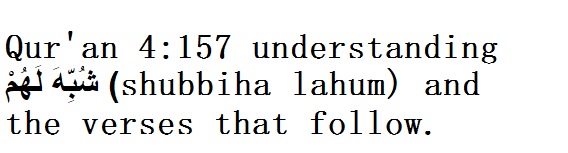
This is exactly what shubbiha lahum means. It is not shubi ha alayhim!
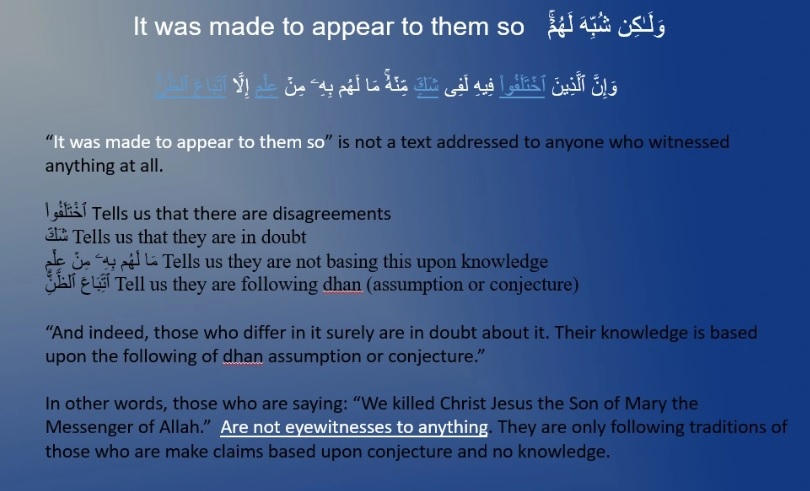
In fact because we love you the readers insh’Allah I will give you a sneak peak at one of the slides that Shaykh Hilal and I are working on.
No pay wall and no gate keeping information!
This is the critical linguistic and contextual refinement. This is a far more precise reading of the phrase شُبِّهَ لَهُمْ (shubbiha lahum) and the verses that follow.
From the Ibadi perspective and reading of the verse the point fundamentally shifts the understanding of the verse from a narrativeabout a visual illusionin real-time toa critique of a historical claim based on unreliable transmission. Let’s integrate this correction.
The Correct Understanding of Point 4:167
The phrase وَ لٰكِنْ شُبِّهَ لَهُمْ (“but it was made to appear so to them”) does not describe a miraculous event witnessed by onlookers in real time. Instead, it critiques the oral tradition and historical narrative that the Jewish community subsequent to the event had come to believe and propagate.
The Qur’an’s own subsequent words completely invalidate the possibility of this being an eye-witness account:
إِنَّ الَّذِينَ اخْتَلَفُوا فِيهِ لَفِي شَكٍّ مِنْهُ – “Indeed, those who differ over it are surely in doubt about it.” (4:157)
Doubt (شَكٍّ – shakk) is impossible for someone who witnessed an execution firsthand.
مَا لَهُمْ بِهِ مِنْ عِلْمٍ – “They have no knowledge of it.” (4:157)
Knowledge (عِلْمٍ – ‘ilm) is exactly what an eye-witness would claim to have.
Assumption (الظَّنَّ – al-ẓann) is the antithesis of eye-witness testimony.
A Hadith that is classified as الظَّنَّ (al-ẓann), meaning “conjectural” or “of presumptive status,” and comes from a lone narrator (or a single strand of transmission) is known as a Khabar al-Āḥād (خبر الآحاد).
Here’s a detailed breakdown:
Definition: A Khabar al-Āḥād is a report (Hadith) that does not reach the highest level of mass transmission (Mutawātir). It is narrated by one or a few individuals at any stage of its chain of narration (isnad), such that the number of narrators does not generate absolute, certain knowledge (ilm al-yaqīn) in the listener. Instead,it generates presumptive knowledge (ilm al-ẓannī), which is sufficient for action but is theoretically open to doubt.
Therefore, the Qur’an is not describing a supernatural trickery of the senses that happened in the past. It is describing the state of the received narrative in the present tense of its revelation.
The chain of meaning, according to this corrected interpretation, is:
The Claim: A specific Jewish community (contemporary to the Prophet Muhammed or just prior) boasts, “We killed the Messiah, Jesus son of Mary, the messenger of Allah.” This is their historical claim.
The Denial: The Qur’an flatly denies this: “And they did not kill him, nor did they impale him (وَ مَا صَلَبُوهُ).”
The Explanation for the False Claim: How did this false claim arise? The event was “made to appear to them (شُبِّهَ لَهُمْ)” in their oral traditions and historical accounts. The truth was obscured within their own narrative.
The Proof of the Falsehood: The proof that this claim is a baseless tradition and not established fact is that those who argue over it are in doubt, devoid of certain knowledge, and following only assumptions about what truly happened. True eye-witnesses to a capital punishment would not be in a state of doubt and conjecture; they would be certain.
Ha-Mim By the Book that makes things clear,-We have made it a Qur’an in Arabic, that you may be able to understand and learn wisdom. And verily, it is in the Mother of the Book, in Our Presence, high in dignity, full of wisdom. Shall We then take away the Message from you and repel (you), for that you are a people transgressing beyond bounds? (Qur’an 43:15)
“Nay! it is a Glorious Qur’an, In a guarded tablet” (Qur’an 85:21-22)
﷽
This is an entry that discusses the problematic theological position held by those who call themselves ‘Salafi’ or ‘Athari. That is the belief that the Qur’an is the eternal uncreated word of Allah.
Now this is a belief of those who ascribe to Ahl Sunnah in general. However, there is an aberrant and bizarre perspective held by those who call themselves as ‘Salafi’ or ‘Athari’.
That is what this article will focus on.
I want to say from the outset that the Ibadi school does not make takfir of any Muslim who believes the Qur’an is created. This issue was not addressed by the Blessed Prophet (saw) nor by his companions. Takfir of other Muslims is not something that our school is known for.
This is a matter of dispute between the scholars. Each side will bring thier proofs and justifications for the position that they hold.
It is truly unfortunate that some of the Muslim intelligentsia and academics would feel so threatened by any discussion on this subject that it would incur a death penalty.
For example in one of the great works that are praised by the Sufi Muslims, Qadi Iyad we find
He said about someone who said that the Qur’an is created, “He is an unbeliever, so kill him.” He said in the version of Ibn Nafi’, “He should be flogged and painfully beaten and imprisoned until he repents.” In the version of Bishr ibn Bakr at-Tinnisi we find, “He is killed and his repentance is not accepted.”
Source: (Qadi ‘Iyad Musa al-Yahsubi, Muhammed Messenger of Allah (Ash-Shifa of Qadi ‘Iyad), translated by Aisha Abdarrahman Bewley [Madinah Press, Inverness, Scotland, U.K. 1991; third reprint, paperback], p. 419)
In fact, Muhammed ibn Isma’il Al-Bukhari (of Sahih Bukhari oral collection fame) was persecuted by a group of those from the Hanbali school of jurisprudence for a remark he made.
“Al-Dhuhli was fierce (shadîd) in his adhesion to the Sunna. He confronted Muhammed ibn Isma‘il [al-Bukhari] because the latter had alluded, in his Khalq Af‘al al-‘Ibad, to the fact that the reader’s utterance of the Qur’an was created. Bukhari made it understood without explicitly saying it, but he certainly made it clear. On the other hand, Ahmad ibn Hanbal flatly refused to explore the question, as well as Abu Zur‘a and al-Dhuhli, or indulge in the terminology of dialectic theologians (al-mutakallimûn), and they did well – may Allah reward them excellently. Ibn Isma‘il had to travel from Naysabur undercover, and he was pained by what Muhammed ibn Yahya [al-Dhuhli] had done to him.”
Source: (Al-Dhahabi, Siyar (10:207)
Also:
Al-Hakim [narrated with his chains]: Muhammed ibn Yahya [al-Dhuhli] said: “This Bukhari has openly subscribed to the doctrine of ‘pronunciationists’ (al-lafziyya), and for me those are worse than the Jahmiyya.” . . . Ahmad ibn Salama visited Bukhari and told him: “O Abu ‘Abd Allah, this is a respected man [i.e. al-Dhuhli] in Khurasan, especially in this town [Naysabur], and he has thundered with this speech until none of us can say anything to him about it, so what do you think we should do?” Bukhari grasped his beard then he said: (I confide my cause unto Allah. Lo! Allah is Seer of His slaves.) (40:44) He continued: “O Allah! You know that I did not want for one moment to settle in Naysabur out of arrogance, nor in quest of leadership, but only because my soul would not let me return to my own country [Bukhara] because of my opponents; and now this man intends harm for me out of jealousy, only because of what Allah gave me and for no other reason.” Then he said to me: “O Ahmad, tomorrow I shall leave and you will be rid of his talk which I caused.” . . . Muhammed ibn Ya‘qub the hadith master said: “When al-Bukhari settled in Naysabur Muslim ibn al-Hajjaj took to visiting him frequently. When the affair of the pronunciation of Qur’an took place between al-Bukhari and [al-Dhuhli] and the latter roused people against him and forbade them to visit him, most people stopped visiting him, but not Muslim. Then al-Dhuhli said: ‘Anyone that subscribes to the pronunciation [being created], it is not permitted for them to attend our gathering.’ Whereupon Muslim placed a cloak on top of his turban, stood up in front of everyone, and sent back to al-Dhuhli what he had written from him carried by a camel-driver, for Muslim openly subscribed to the pronunciation and made no attempt to conceal it.” . . . Ahmad ibn Mansur al-Shirazi also narrated it from Muhammed ibn Ya‘qub, adding: “And Ahmad ibn Salama stood up and followed him.” (See Al-Dhahabi, Siyar (10:314-315). Cf. Bayhaqi’s al-Asma’ wa al-Sifat (al-Hashidi ed. 2:20-21 #591).
As Hamza Yusuf correctly remarked. if you follow this line of reasoning you eventually end up with
@ 1:32 Listen carefully people. Shaykh Hamza Yusus if a public orator and a supremely articulate man. Listen very carefully to the doctrine you are being asked to subscribe to.
@ 3:00 “It definitely doesn’t mean though the mushaf you have in your house. Because that would then…I mean some of the Christians argue that well the Qur’an is imbibliation. Like we believe in incarnation of the logos the Muslims believe in imbibliation of the logos. That God became book and so we don’t we don’t see that as valid. That view of it so.” -Hamza Yusuf.
Salafi Da’wah hooks you with the transcendence of Allah (swt). Most people who are introduced to Islam through the street preachers who hold Salafi doctrine are intrigued by concepts such as: Allah being one. What seems to look like a simplistic creed. That Allah has no parents or no children or no partners. Allah is neither black nor white. Allah is not male or female.
However, once you have taken your Shahadah or delcaration of faith how much longer until you are taught ‘Kitab Al Tawhid’ and here come the bizarre concepts. Allah has two right hands, and one of those right hands is a left hand, Allah occupies space, has a shin, a foot, chuckles at people’s despair, comes down the third part of the night, appears to the disbelievers in forms and shapes that they knew and then appears to the disbelievers in forms and shapes they do not know.
SaidNO ONE EVER!
Yasir Qadhi, Salafis and Atheist.
Unfortunately Yasir Qadhi has come under fire from people who seemingly do not understand what he has been saying as of late.
Atheist and Agnostics have a different epistemology and world view when evaluating history then do believers. This also should not come as a shock or a surprise to anyone.
Agnostic/Skeptic: “We have not found any evidence of X.”
Believer: “They have yetto find any evidence of X.” The believer takes note that the Agnostic/Skeptic did not claim “We will neverfind.”
However, in one of his books he has given a very powerful argument to the atheist and agnostics to dismantle Salafi theology.
In reality I should not fault Yasir Qadhi for this as if it was some novel idea that he came up with. Rather, he is parroting the learned polemic that he would have picked up from his teachers.
Yasir Qadhi says:
“These Attributes are understood literally (in the case of the Attributes of kalam, that Allah, Speaks, whenever He wishes, with a sound, in different languages, and this Speech is composed of words and letters and is not created), but the actuality and ‘how-ness’ of these Attributes are not delved into, and any negative similarity be-tween these Attributes and the attributes of the creation are negated (in the case of this Attribute, that the speech of the creation is created, but the Speech of Allah is not.) Understanding these Attributes ‘literally’ does not mean understanding them in the manner that they are found in the creation, or comparing them with the attributes of the creation; rather, it means affirming the linguistic meaning of that Attribute in a manner that befits the Creator, and will never completely be understood by mankind.”
Source: (An Introduction to the Sciences of the Qur’an pg 52)
We are told that the ‘how-ness‘ is not delved into and yet this whole paragraph does exactly that! When you negate comparison you are comparing and contrasting ‘how‘ something is unlike something else.
When speaking of prophet Ibrahim (a.s) and the story of the idols Shaykh Yasir Qadhi says:
“In these verses, Ibrahim showed his people that their idols were not worthy of worship, primarily because they could not speak. After they themselves acknowledged this, Ibrahim rebuked them, and asked them, “Have you no sense?!” meaning, “How can an object that cannot even speak be worthy of worship?” Notice that Ibrahim was referring to a speech that could be heard, for Ibrahim’s people did not answer Ibrahim with the belief of the Ash’arees, “Our god speaks, but a speech that is not heard-an internal speech of the mind!” for they understood what Ibrahim meant!! This is why they turned to themselves, and realized the foolishness of their actions, and could only reply with the feeble response that everyone knew that their idols could not speak!”
Source: (An Introduction to the Sciences of the Qur’an pg 46)
Yasir Qadhi thinks that he has the goods on the Ash’ari Sunnis latter making a quote that in effect turns the Ash’ari Sunnis into idol worshipers.
Yet, look at the quotation above where he says:
“‘literally’ does not mean understanding them in the manner that they are found in the creation.”
Rather than help Islam, Yasir Qadhi and his Salafist-Athari creed and those who think like him have handed over to skeptics of their position a devastating argument.
So like Ibrahim (as) demands above the atheist has the right to demand from him speech from his Creator.
They have the right to demand “a speech that could be heard”
A typical discussion between an Atheist-Agnostic/Skeptic and one who follows Salafist theology could go something like this:
Atheist/Agnostic/Skeptic: “Does your god, Allah speak? Let’s hear it then!”
Salafi: “Of course and here is the proof!” (pulls out Qur’an).
Atheist/Agnostic/Skeptic: “Ibrahim didn’t ask the idols for a book; he asked if they can speak!”
Salafi:
Yet Yasir Qadhi is not done with the Ash’ari.
Yasir Qadhi thinks he has the goods on the Ash’ari when he says,
“1) If the kalam of Allah is without sound, then what did Musa hear when Allah spoke to Him? If they respond that Allah created a sound, and caused Musa to hear that created sound, then this means that this created object stated, “O Musa, verily, I am your Lord…Verily, I am Allah, there is no God save Me, so worship Me… [ Qur’an 20:12-14]
Therefore, if they state this, it implies that this created object claimed to be Allah, and asked Musa to worship it! However, if they stated that it was the actual kalam of Allah, then it must be asked, “How then did Musa hear it if you claim that Allah’s kalam is without sound? ” The scholars of the Ash’arees have not been able to provide a satisfactory response for this.”
Source: (An introduction to the Sciences of the Qur’an pg 44)
Prima Qur’an Comments:
So Yasir Qadhi thinks that it was the object cried out ‘I am Allah, there is no God save Me, so worship Me’. Yet, obviously, we know that Moses (as) did not perform any act of worship towards the direction of the voice. Or at least no act of worship is recorded.
Yasir Qadhi and those who agree with his position have to wonder the following:
What did Rasul Allah (saw) think when Angel Gabriel (as) said. ” Indeed this, your religion, is one religion, and I am your Lord, so worship Me.” (Qur’an 21:92)
Did the Blessed Messenger (saw) fall down and worship Gabriel? Obviously not!
Gabriel(as) was used as a medium in the same way the burning bush was.
As regards if Musa (as) heard audible sounds from the burning bush you ask yourself, did the companions hear audible sounds as the Qur’an was being revealed to the Blessed Messenger (saw)?
“And [We sent] messengers about whom We have related [their stories] to you before and messengers about whom We have not related to you. And Allah spoke to Moses with [direct] speech.” (Qur’an 4:164)
“When he saw a fire and said to his family, “Stay here; indeed, I have perceived a fire; perhaps I can bring you a torch or find at the fire some guidance.” And when he came to it, he was called, “O Moses, Indeed, I am your Lord, so remove your sandals. Indeed, you are in the sacred valley of Tuwa. And I have chosen you, so listen to what is revealed [to you] Indeed, I am Allah. There is no deity except Me, so worship Me and establish prayer for My remembrance.” (Quran 20:10-14)
“And when Moses had completed the term and was traveling with his family, he perceived from the direction of the mount a fire. He said to his family, “Stay here; indeed, I have perceived a fire. Perhaps I will bring you from there [some] information or burning wood from the fire that you may warm yourselves.” But when he came to it, he was called from the right side of the valley in a blessed spot – from the tree, “O Moses, indeed I am Allah, Lord of the worlds.” (Qur’an 28:29-30)
“Has there reached you the story of Moses? When his Lord called to him in the sacred valley of Tuwa” (Qur’an 79:15-16)
Likewise, since the Qur’an acts as a guardian of the previous scriptures let us see what is claimed to be the Torah has to say as well.
“There the angel of the LORD appeared to him in flames of fire from within a bush. Moses saw that though the bush was on fire it did not burn up. So Moses thought, “I will go over and see this strange sight–why the bush does not burn up.”When the LORD saw that he had gone over to look, God called to him from within the bush, “Moses! Moses!” And Moses said, “Here I am.””Do not come any closer,” God said. “Take off your sandals, for the place where you are standing is holy ground.” (Exodus 3:2-5)
Allah (swt) created a sound and caused Moses (as) to hear that created sound. In fact, if you go on further the whole context shows how Allah (swt) is the creator of perception. Moses (as) was made to perceive a burning fire, it did not indicate if anyone saw it or not. He (as) was made to perceive his hand becoming white. He (as) was made to perceive a voice from a tree. He (as) was made to perceive his staff move like a snake.
“And it is not for any human being that Allah should speak to him except by revelation or from behind a partition or that He sends a messenger to reveal, by His permission, what He wills. Indeed, He is Most High and Wise.” (Qur’an 42:51)
Unless our respected Yasir Qadhi wants to say that the Qur’an contains a flat contradiction he will need to understand ‘Allah spoke to Moses with direct speech‘ in light of the above verses.
Coming back to Ibrahim:
First of all notice that there are different approaches that the Prophets of Allah take when dealing with different groups.
“Say: “Do you see what it is you invoke besides Allah? Show me what it is they have created on earth, or have they a share in the heavens bring me a book (bikitabin) before this, or any remnant (atharatin) of knowledge (you may have), if you are telling the truth!” (Qur’an 46:4)
Why do people worship at all?
What is the motivation for worship?
A) Either derive from benefit. These deities bring fortune, or blessings.
B) Either to avoid some harm. These deities will bring misfotune, or wrath.
Now comes the question: What is the authority for this worship!
Notice that in the Qur’an 46:4 The Blessed Prophet (saw) is asking if these people have some authority for doing what they do. Do they have a revelation or an athar (report, hadith from a previous athority).
Ibrahim (as) and his approach is very logical and methodical.
There is no prophet or oracle from these people he needs to consult or contend with.
There is no claim of sacred revelation that he needs to consult or contend with.
It is obvious that Ibrahim (as) is trying to trigger these people. He is getting them to reflect on the basis for dong what they do.
They said, “Have you done this to our gods, O Ibrahim?” He said, “Rather, this – the largest of them – did it, so ask them, if they should speak.” (Qur’an 21:62-63)
“Ibrahim asked, “Can they hear you when you call upon them? Or can they benefit or harm you?” (Qur’an 26:72-73)
There is nothing in these text that even remotely suggest that it is the personal belief of Ibrahim (as) that in order for Allah to exist and be real, then He must communicate via audible sounds that can be perceived by the ear.
It would be great if we had the response of these idol worshippers.
Wait..we do!
In reply to Qur’an 26:72-73 we have:
“They replied, “No! But we found our forefathers doing the same.” Ibrahim responded, “Have you considered what you have been worshipping, you and your ancestors?” (Qur’an 26:74-76)
Now we get to the justification. They are simply following what the people who came before them did. At least here they are forthcoming.
In reply to (Qur’an 26:72-73) we have:
“So they came back to their senses, saying, “You yourselves are truly the wrongdoers. Then they regressed to their mind -set. “You already know that they cannot speak.” He said “Do you then worship besides Allah, what can neither benefit nor harm you? (Qur’an 21:64-66)
What can neither benefit nor harm you. This is proven by the previous episode of the idols being smashed to pieces. If they cannot benefit or protect themselves then what guarantee do you have that they can benefit or protect you.
People should really think carefully before they set up a whole generation of young people to be demolished in an age of Atheist, Agnostics and Skeptics.
“Behold, you received it on your tongues, and said out of your mouths things of which you had no knowledge; and you thought it to be a light matter, while it was most serious in the sight of Allah.” (Qur’an 24:15)
For those interested the book: “An Introduction to the Sciences of the Qur’an” by Yasir Qadhi is still the best book in the English language on the topic. Nothing else comes close.
“The faculties of seeing (tudriku) cannot grasp Him, and He grasp all–seeing (yudriku), He is the All-Subtle and All-Aware.” (Qur’an 6:103)
﷽
Dear Muslim Ummah.
This is a collection of articles on the issue of Seeing Allah (swt) in the hereafter. May Allah (swt) guide you to the path and way of the Muslims. May Allah (swt) guide you to the doctrine of transcendence. The way of the Qur’an and the Sunnah. Because this is the safest and secure road.
Among those who profess to be Sunni Muslims, you see such a division among them on this matter. One will claim that their lord has a shape and a form. The other side, realizing the problematic nature of such a position, will claim a sort of ‘beatific vision’. All sides come with their proofs and evidence.
Among them are those who say both believers and disbelievers will see Allah and others say seeing Allah is a reward exclusive to the believers.
For example: what form or shape did the disbelievers see Allah in?
On Seeing Allah: The following article breaks down a video from a brother upon the Ashʿarī theology giving our critical analysis from the Ibadi perspective.
The following section deals with a fringe group who call themselves ‘Salafi;: They claim that they are upon the belief of the early generation of Muslims. In reality they are those who have very eccentric and bizarre views.
According to Sahih Bukhari what Form/Shape of Allah did the disbelievers see? What Every Christian Should Ask Every Muslim. Christians believe that God took upon himself a form or a shape. The Salafi sect also believes that Allah took upon a form or a shape.
And of no effect is the repentance of those who continue to do evil deeds until death faces one of them and he says: ‘Now I repent;’ NOR of those who die while they are ungrateful disbelievers. For them We have prepared a painful torment” (Qur’an 4:17-18)
﷽
What about all those hadiths that say if you do this or that you will be GUARANTEED PARADISE?
So for example there are a great many hadith that say that if a person does this act or says this statement they will be guaranteed paradise.
Examples:
It is narrated on the authority of ‘Uthman that the Messenger of Allah (saw) said. He who died knowing (fully well) that there is no god but Allah entered Paradise.
The Prophet, (saw) said, “Whoever recites ten times, ‘Say: He is Allah, the One,’ a palace will be built for him in Paradise. Whoever recites it twenty times, two palaces will be built for him. Whoever recites it three times, three palaces will be built for him.”
Abu Umamah reported: The Messenger of Allah, peace and blessings be upon him, said, “Whoever recites the ‘verse of the Throne’ after every prescribed prayer, there will be nothing standing between him and entry into Paradise but his death.”
The first response to the above hadith is that they have to be all taken into account with many other hadith. Because the singular narrations (ahad) put a few strokes on the canvas they do not paint the whole picture.
Hadith that do not guarantee Muslims paradise.
Narrated Abu Huraira:
Allah’s Messenger (saw) said, “All my followers will enter Paradise except those who refuse.” They said, “O Allah’s Messenger (saw)! Who will refuse?” He said, “Whoever obeys me will enter Paradise, and whoever disobeys me is the one who refuses (to enter it).”
How to reconcile these contradictory hadith? A simple solution and one that even Sunni schools of theology are forced to acknowledge.
All of those ahadith that guarantee paradise for a Muslim based upon this action or this statement have to be taken into context with all those hadith that says if a Muslim does this or that they will not enter paradise. Those hadith about the guarantee for paradise is for a Muslim who stays the course, who practices their Islam who is diligent in all matters of their faith.
Otherwise we run into the following logical problems. Examples:
Question: What happens if that person was to miss the verse of the throne recitation even after just one prayer?
Would they now not be guaranteed paradise?
The Prophet, (saw) said, “Whoever recites ten times, ‘Say: He is Allah, the One,’ a palace will be built for him in Paradise. Whoever recites it twenty times, two palaces will be built for him. Whoever recites it three times, three palaces will be built for him.
Question: What happens if I recite surah ikhlas ten times today 7/7/2024 but decide to stop praying, fasting paying zakat?
Am I guaranteed paradise then?
Also what happens if I recite surah ikhlas ten times and then I become a backbiter and I break the ties of kinship?
So it is not logical that one statement or one action is going to get a person into paradise. Especially when all the ahadith are taken as a whole.
What happens to the one leaves Islam completely?
Do their deeds, and statements of creed effect their salvation?
Do the murtad become the people of paradise?
There is no verse in the Qur’an that says Kafir will enter paradise! None!
There is no verse in the Qur’an that states you can sin and continue sinning without repentance without restitution and you will enter paradise! None.
“Allah accepts only the repentance of those who do evil in ignorance and foolishness and repent SOON afterwards; it is THEY WHOM Allah will forgive and Allah is Ever All-Knower, All-Wise.
And of no effect is the repentance of those who continue to do evil deeds until death faces one of them and he says: ‘Now I repent;’ NOR of those who die while they are disbelievers. For them We have prepared a painful torment” (Qur’an 4:17-18)
Truly, Allah loves THOSE who turn unto Him in repentance and loves those who purify themselves” (Qur’an 2:222)
“But whosoever repents AFTER his crime and does righteous good deeds (by obeying Allah), then verily, Allah will pardon him (accept his repentance). Verily, Allah is Oft Forgiving, Most Merciful.” (Qur’an 5:39)
“O you who believe! Turn to Allah with sincere repentance! It may be that your Lord will expiate from you your sins, and admit you into Gardens under which rivers flow (Paradise)” (Qur’an 66:8)
“Say to those who have disbelieved, if they cease (from disbelief), their past will be forgiven” (Qur’an 8:38)
“Your Lord has written (prescribed) Mercy for Himself, so that if any of you does evil in ignorance, and thereafter repents and does righteous good deeds (by obeying Allah), then surely, He is Oft-Forgiving, Most Merciful” (Qur’an 6:54)
“Allah wishes to accept your repentance, but those who follow their lusts, wish that you (believers) should deviate tremendously away (from the Right Path).” (Qur’an 4:27)
“Say: Oh my slaves who have transgressed against themselves (by committing evil deeds and sins)! Despair not of the Mercy of Allah, verily, Allah forgives all sins. Truly, He is Oft-Forgiving, Most Merciful” (Qur’an 39:53)
“And whoever does evil or wrongs himself but afterwards seeks Allah’s forgiveness, he will find Allah Oft Forgiving, Most Merciful” (Qur’an 4:110)
Islam is salvation through repentance. Islam is NOT salvation simply because I am Muslim.
All of those verses explicitly tell us as Muslims that we have an incredibly Merciful, Compassionate, Loving and Forgiving Creator. The verse even says that Allah wishes to accept your repentance. It doesn’t get more clear than this!
Yet, if we do not care about our own selves, and our own salvation, if we do not even have a modicum of decency and awareness to turn towards Allah (swt) and repent for our sins. Make restitution, reform our conduct, than we have absolutely no one to blame if we end up in hellfire forever.
The point we can make is that even if all such hadith are 100% correct, chains hold up etc. It shows the extent of Allah’s mercy. His readiness to accept us into paradise.
Yet as mentioned they need to be interpreted in light of all such hadith that say the polar opposite.
A logical problem if one takes those hadith in isolation.
Also, logic as mentioned I say Shahahada with sincerity guarantees me paradise but then I decide not to practice the deen?
Surely they see it as problematic.
If one takes those hadith that promise a person paradise in isolation without considering all the other hadith evidence that clearly state if one does such and such as well as the clear text of the Qur’an we will end up with serous logical contradictions.
Likewise, this is an issue of morals and ethics.
Has Islam really come to teach that a person can take the declaration of fast and afterwards not pray, not fast, not purify our wealth, and that one can lie, cheat, steal, commit fornication and adultery and will be among the people of paradise?
We are to do our level best to control our based desires, restrain our tongues and hands from harm. We are NOT to be the very devils Allah tells us to seek refuge from.
So it is very clear that Sunni Muslims have to agree with us on these points. They are crystal clear. That the kafir does not enter paradise.
We are upon the model of Adam (alayi salam) One who sinned and repented and was forgiven.
To sin and to never seek forgiveness. What is that except the model of Iblis.
Choose wisely dear truth seekers.
The only difference that now remains between us is as follows:
Our school states that no disbeliever enters into the paradise and no believer enters into the hellfire. Such a belief about the believer entering into hellfire has no basis in the primary source of Islam, the Qur’an.
So the differences are:
Do some believers go to hell for a while (as Sunni schools claim).
Or.
Do believers all go to paradise without any sojourn in hell (as the Ibadi school claims).
Does Allah replace some Jews and Christians (destined to paradise) and swap them for (Muslims destined to hell) as some Sunni claim?
Does Allah grant polytheist salvation (as the case of Ibrahim’s father) and place in his stead a goat or sheep?
“And they say, “Never will the Fire touch us, except for a few days.” Say, “Have you taken a covenant with Allah? For Allah will never break His covenant. Or do you say about Allah that which you do not know?” Yes, whoever earns evil and his sin has encompassed him – those are the companions of the Fire; they will abide therein eternally.” (Qur’an 2:80-81)
﷽
This is by no means an exhaustive list. However, this should suffice. Yet there is much much more hadith evidence.
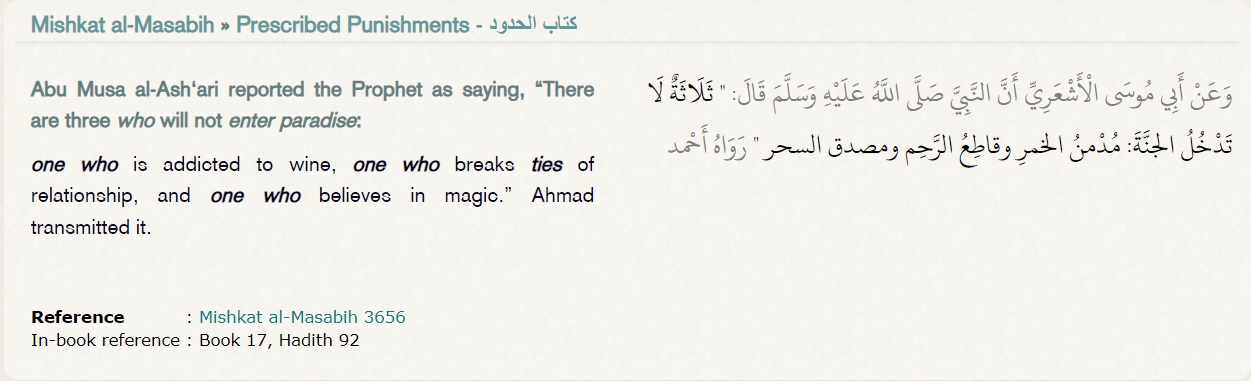
Abu Musa al-Ash’ari reported the Prophet as saying, “There are three who will not enter paradise: one who is addicted to wine, one who breaks ties of relationship, and one who believes in magic.” Ahmad transmitted it.
“But the Children of Israel certainly knew that whoever purchased the magic would not have in the Hereafter any share. And wretched is that for which they sold themselves, if they only knew.” (Qur’an 2:102)
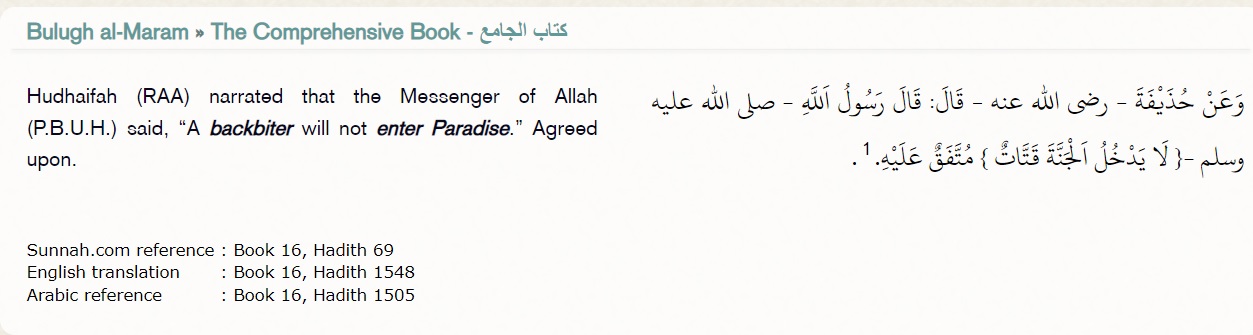
Hudhaifah (ra) narrated that the Messenger of Allah (saw) said:
“A backbiter will not enter Paradise.” Agreed upon.
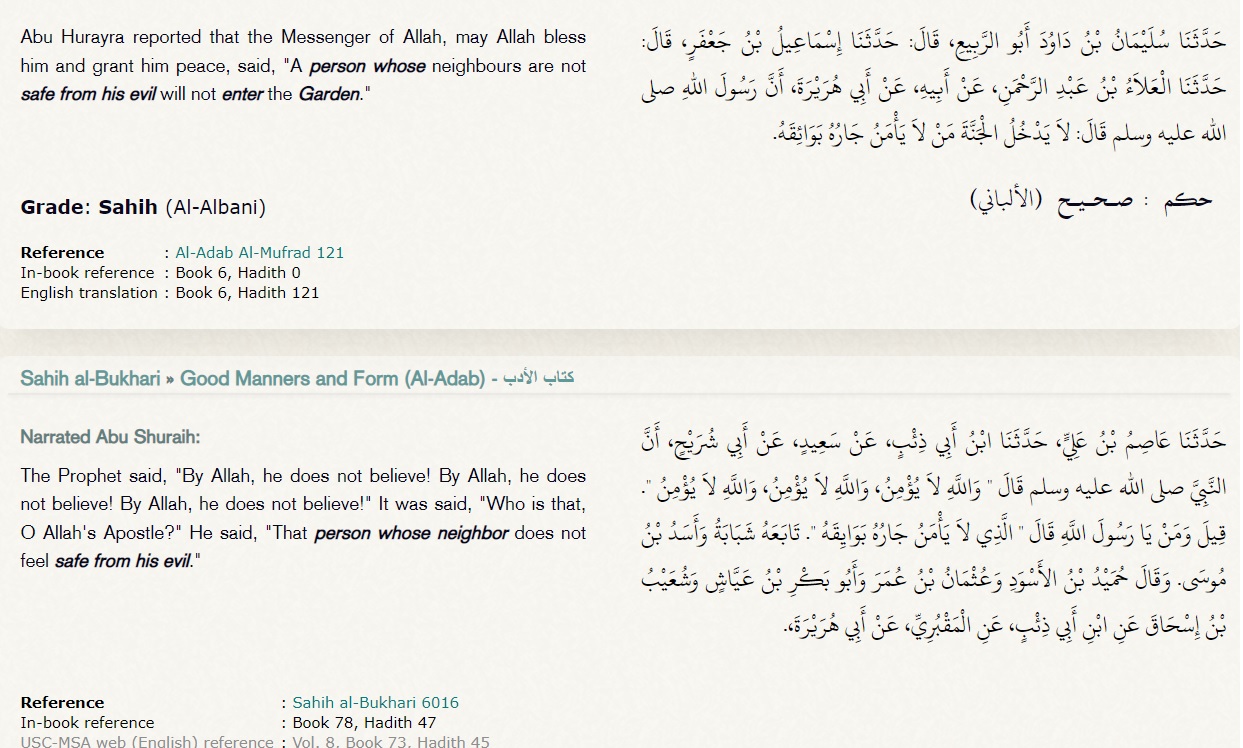
Narrated Abu Shuraih:
The Prophet (saw) said, “By Allah, he does not believe! By Allah, he does not believe! By Allah, he does not believe!” It was said, “Who is that, O Allah’s Messenger (saw)?” He said, “That person whose neighbor does not feel safe from his evil.”
Abu Hurayra reported that the Messenger of Allah, may Allah bless him and grant him peace, said, “A person whose neighbors are not safe from his evil will not enter the Garden.”
“Worship Allah and associate nothing with Him, and to parents do good, and to relatives, orphans, the needy, the near neighbor, the neighbor farther away, the companion at your side, the traveler, and those whom your right hands possess. Indeed, Allah does not like those who are self-deluding and boastful.” (Qur’an 4:36)
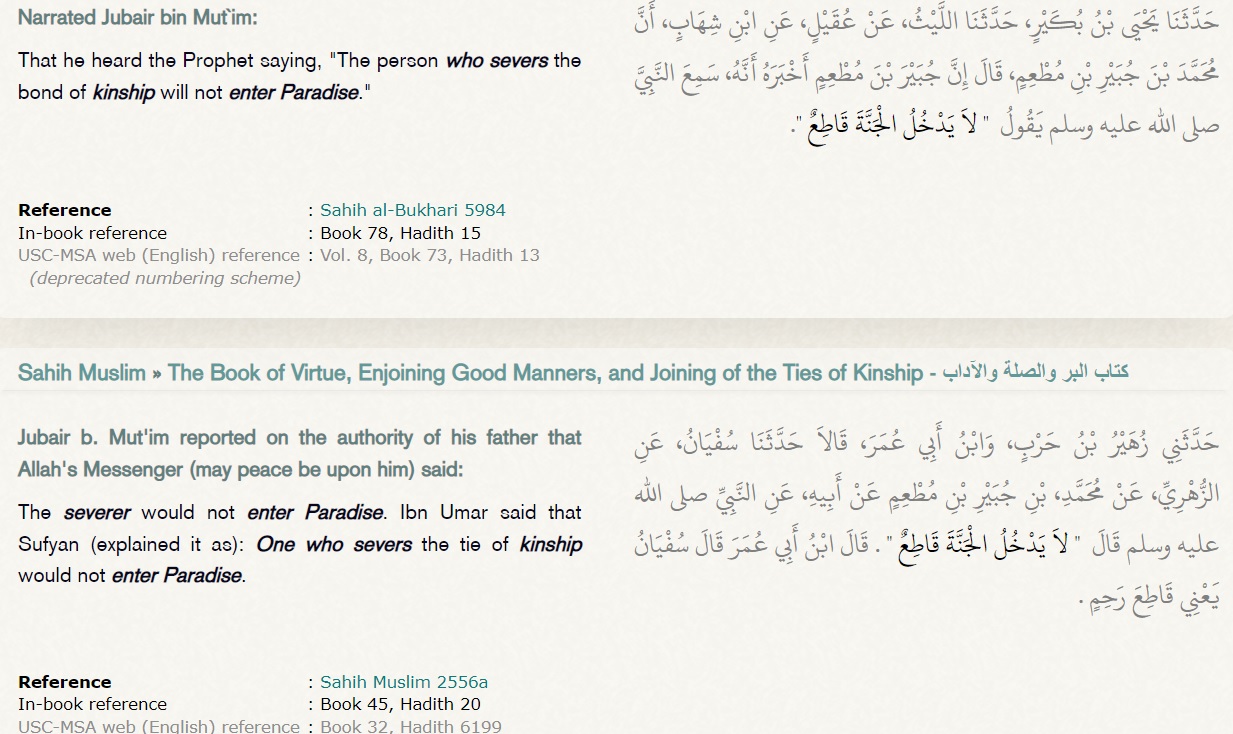
Jubair bin Mut’am (RAA) narrated that the Messenger of Allah (saw) said: “The one who severs the ties of kinship will not enter Paradise.” Agreed upon.
Jubayr ibn Mu’tim reported that he heard the Messenger of Allah, may Allah bless him and grant him peace, say, “The one who severs ties of kinship will not enter the Garden.”
Jubair b. Mut’im reported on the authority of his father that Allah’s Messenger (saw) said:
The severer would not enter Paradise. Ibn Umar said that Sufyan (explained it as): One who severs the tie of kinship would not enter Paradise.
Narrated Jubair bin Mut`im:
That he heard the Prophet (saw) saying, “The person who severs the bond of kinship will not enter Paradise.”
“So would you perhaps, if you turned away, cause corruption on earth and sever your ties of relationship.” (Qur’an 47:22)
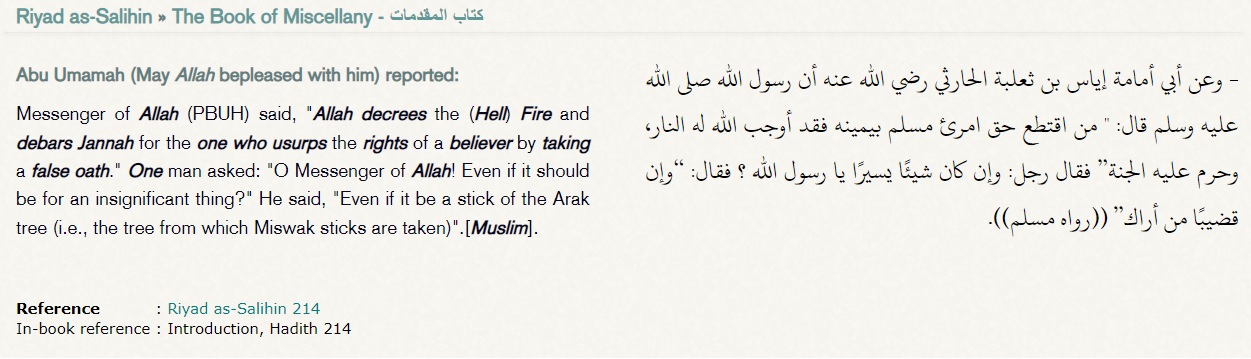
Abu Umamah (May Allah bepleased with him) reported:
Messenger of Allah (saw) said, “Allah decrees the (Hell) Fire and debars Jannah for the one who usurps the rights of a believer by taking a false oath.” One man asked: “O Messenger of Allah! Even if it should be for an insignificant thing?” He said, “Even if it be a stick of the Arak tree (i.e., the tree from which Miswak sticks are taken)”.
“They took their false oaths as a cover, so they averted people from the way of Allah , and for them is a humiliating punishment.” (Qur’an 58:16)
Narrated Ma’qil:
Allah’s Messenger (saw) said, “If any ruler having the authority to rule Muslim subjects dies while he is deceiving them, Allah will forbid Paradise for him.”
Narrated Ma’qil:
I heard the Prophet (saw) saying, “Any man whom Allah has given the authority of ruling some people and he does not look after them in an honest manner, will never feel even the smell of Paradise.”
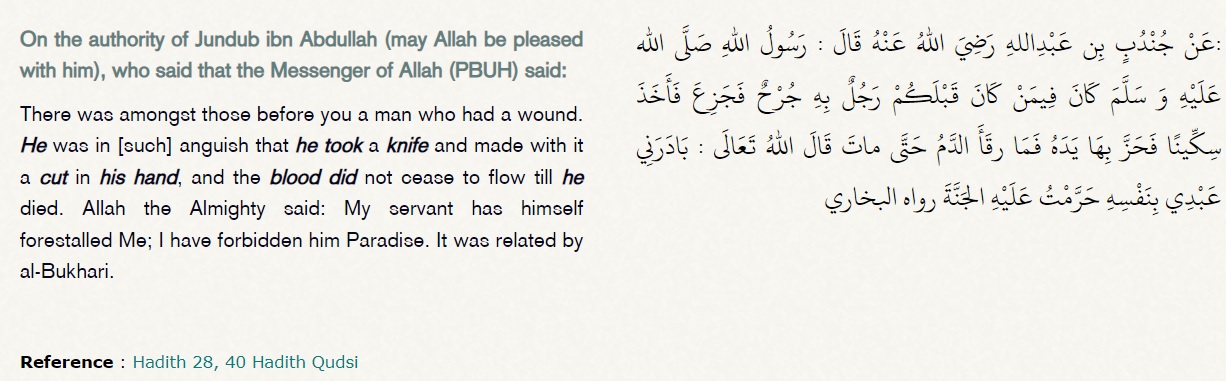
On the authority of Jundub ibn Abdullah (may Allah be pleased with him), who said that the Messenger of Allah (peace be upon him) said: There was a among those before you a man who had a wound. He was in [such] anguish that he took a knife and made with it a cut in his hand, and the blood did not cease to flow till he died. Allah the Almighty said: My servant has himself forestalled Me; I have forbidden him Paradise. It was related by al-Bukhari.
May Allah (swt) protect us and guide and keep us on a path that is straight. We seek the forgiveness of Allah (swt) and turn in repentance to Allah (swt).
“And they say, “Never will the Fire touch us, except for a few days.” Say, “Have you taken a covenant with Allah? Allah will never break His covenant. Or do you say about Allah that which you do not know?” Yes, whoever earns evil and his sin has encompassed him – those are the companions of the Fire; they will abide therein eternally(khaliduna).”(Qur’an 2:80-81)
﷽
For those of you familiar with the parker brothers board game, monopoly one of the cards one could draw is the ‘get out of jail free card’. Thus, if you landed on the spot that says, ‘go to jail’ you could play this card. The card name is a bit of a misnomer as you don’t go to jail to begin with. You bypass going completely.
Well, believe it or not because of these interpretations and influences upon our faith, there are Muslims who believe in the ‘hadith of the card’. The ‘get out of hell free card!
Narrated ‘Abdullah bin ‘Amr bin Al-‘As:
that the Messenger of Allah (saw) said: “Indeed Allah will distinguish a man from my Ummah before all of creation on the Day of Judgement. Ninety-nine scrolls will be laid out for him, each scroll is as far as the eye can see, then He will say: ‘Do you deny any of this? Have those who recorded this wronged you?‘ He will say: ‘No, O Lord!’ He will say: Do you have an excuse?’ He will say: ‘No, O Lord!‘ So He will say: ‘Rather you have a good deed with us, so you shall not be wronged today.” Then He will bring out a card (Bitaqah); on it will be: “I testify to La Ilaha Illallah, and I testify that Muhammad is His servant and Messenger.” He will say: ‘Bring your scales.’ He will say: ‘O Lord! What good is this card next to these scrolls?’ He will say: ‘You shall not be wronged.’ He said: ‘The scrolls will be put on a pan (of the scale), and the card on (the other) pan: the scrolls will be light, and the card will be heavy, nothing is heavier than the Name of Allah.'”
This means that there are No Muslims who will go to hell at all (even briefly) as the Sunni believe. That is if Allah (swt) is fair and just, as every Muslim has said this statement!
Are we going to invite the world to Islam and inform the world of the moral decline of society and then present to them a model of so called justice in which a person who claims to be a Muslim did rape, killed a person without right, molested their relatives, committed adultery and/or fornication and died without any repentance for these things?!
All the horrific things that Zionist are currently doing to Palestinians that disgust each and everyone of us would be absolutely fine as long as they said: la ilaha illallah
The above hadith is absolutely destroyed by the following verse of the Qur’an.
“And those who do not invoke with Allah another deity or kill the soul which Allah has forbidden [to be killed], except by right, and do not commit unlawful sexual intercourse. And whoever should do that will meet a penalty. Multiplied for him is the punishment on the Day of Resurrection, and he will abide therein humiliated –Except for those who repent, believe and do righteous work. For them Allah will replace their evil deeds with good. And ever is Allah Forgiving and Merciful.” (Qur’an 25:70)
Emaan or faith is uttered by the tongue , takes root in the heart and is affirmed by the limbs by either doing the actions one is required to do and/or restraining the limbs from doing what is prohibited.
If the Emaan by the tongue or heart is enough than why are there are so many verses and ahadith that exhort the believers to make tauba (repentance)?
This type of belief makes repentance ineffectual and renders it of no consequence. May Allah (swt) protect and guide the ummah!
Mu`adh bin Jabal (May Allah be pleased with him) reported:
The Messenger of Allah (saw) said, “He whose last words are: `La ilaha illallah’ (There is no true god except Allah) will enter Jannah.”
This can only mean He was living his life in accordance with this and righteousness, and finally he end his life like this. In this condition.
THE GET OUT OF HELL FREE CARD!
It is reported on the authority of Abu Huraira:
We were sitting around the Messenger of Allah (saw). Abu Bakr and Umar were also there among the audience. In the meantime, the Messenger of Allah got up and left us. He delayed coming back to us, which caused anxiety that he might be attacked by some enemy when we were not with him; so, being alarmed, we got up. I was the first to be alarmed. I, therefore, went out to look for the Messenger of Allah (may peace and blessings be upon him) and came to a garden belonging to the Banu an-Najjar. A section of the Ansar went round it looking for a gate but failed to find one. Seeing a rabi’ (i.e. streamlet) flowing into the garden from a well outside, I drew myself together, like a fox, and slinked into (the place) where Allah’s Messenger was. He (the Holy Prophet) said: Is it Abu Huraira? I (Abu Huraira) replied: Yes, Messenger of Allah. He (the Holy Prophet) said: What is the matter with you? You were among us but got up and went away and delayed for a time, so fearing that you might be attacked by some enemy when we were not with you, we became alarmed. I was the first to be alarmed. So when I came to this garden, I drew myself together as a fox does, and these people are following me. He addressed me as Abu Huraira and gave me his sandals and said: Take away these sandals of mine, and when you meet anyone outside this garden who testifies that there is no god but Allah, being assured of it in his heart, gladden him by announcing that he shall go to Paradise. Now the first one I met was Umar. He asked: What are these sandals, Abu Huraira? I replied: These are the sandals of the Messenger of Allah with which he has sent me to gladden anyone I meet who testifies that there is no god but Allah, being assured of it in his heart, with the announcement that he would go to Paradise. Thereupon ‘Umar struck me on the breast and I fell on my back. He then said: Go back, Abu Huraira, So I returned to the Messenger of Allah (saw), and was about to break into tears. ‘Umar followed me closely and there he was behind me. The Messenger of Allah (saw) said: What is the matter with you, Abu Huraira? I said: I happened to meet ‘Umar and conveyed to him the message with which you sent me. He struck me on my breast which made me fall down upon my back and ordered me to go back. Upon this the Messenger of Allah (saw) said: What prompted you to do this, ‘Umar? He said: Messenger of Allah, my mother and father be sacrificed to thee, did you send Abu Huraira with your sandals to gladden anyone he met and who testified that there is no god but Allah, and being assured of it in his heart, with the tidings that he would go to Paradise? He said: Yes. Umar said: Please do it not, for I am afraid that people will trust in it alone; let them go on doing (good) deeds. The Messenger of Allah (saw) said: Well, let them.
In the above hadith we are told that Abu Huraira gets this information from the Blessed Prophet (saw) and he is met by Umar and than Umar is basically telling the Blessed Prophet (saw) please do not do it as the people will trust in it alone.
Abu Huraira receives the information.
Umar is the one who is startled by this information.
The Prophet (saw) wants this information to be known.
Narrated Anas bin Malik:
“Once Mu`adh was along with Allah’s Messenger (saw) as a companion rider. Allah’s Messenger (saw) said, “O Mu`adh bin Jabal.” Mu`adh replied, “Labbaik and Sa`daik. O Allah’s Messenger (saw)!” Again the Prophet (saw) said, “O Mu`adh!” Mu`adh said thrice, “Labbaik and Sa`daik, O Allah’s Messenger (saw)!” Allah’s Messenger (saw) said, “There is none who testifies sincerely that none has the right to be worshipped but Allah and Muhammed is his Apostle, except that Allah, will save him from the Hell-fire.” Mu`adh said, “O Allah’s Messenger (saw) ! Should I not inform the people about it so that they may have glad tidings?” He replied, “When the people hear about it, they will solely depend on it.”Then Mu`adh narrated the above-mentioned Hadith just before his death, being afraid of committing sin (by not telling the knowledge).
.In the above hadith Mu’adh ibn Jabal receives the information.
The Blessed Prophet (saw) apparently does not want the information broadcasted.
Now we can reconcile the issue of who the Blessed Prophet (saw) told the information to. Because him telling Mu’adh ibn Jabal does not preclude him telling Abu Huraira. Likewise him telling Abu Huraira does not preclude him telling Mu’adh ibn Jabal.
What does raise an eye brow are the following points.
In the first narration it is Umar who makes the statement: Please do it not, for I am afraid that people will trust in it alone
Where as in the second narration it is the Blessed Prophet (saw) who makes the statement:
“When the people hear about it, they will solely depend on it.”
In the first narration the Blessed Prophet (saw) seems to not mind if this information is distributed in fact he tells Abu Huraira to inform all those he meets along the way.
In the second narration the Blessed Prophet (saw) seems to not want the information disclosed.
The information that the sub narrator provides is also a bit concerning.
Then Mu`adh narrated the above-mentioned Hadith just before his death, being afraid of committing sin (by not telling the knowledge).
How does Mu ‘adh know better than the Prophet (saw)?!
How is Mu’adh portrayed as someone who is afraid of the sin of not disclosing knowledge but apparently the Prophet (saw) is fine with the sin of not disclosing knowledge?
May Allah (swt) protect us from perversion of the pure faith!
“O Messenger, announce that which has been revealed to you from your Lord, and if you do not, then you have not conveyed His message. And Allah will protect you from the people. Indeed, Allah does not guide the disbelieving people.” (Qur’an 5:67)
“Those who hide the clear proofs and guidance that We have revealed—after We made it clear for humanity in the Book—will be condemned by Allah and ˹all˺ those who condemn.” (Qur’an 2:159)
“And do not conceal testimony, for whoever conceals it – his heart is indeed sinful, and Allah is Knowing of what you do.” (Qur’an 2:283)
Not to mention…
You can see just a handful of these hadith here:
There is the whole issue of rather or not there are scales to begin with!
“And give full measure whenever you measure, and weigh with a balance that is true” (Qur’an 17:35)
﷽
It was narrated that ‘Uqbah bin ‘Amir said:
“I heard the Messenger of Allah (saw) say: ‘The Muslim is the brother of another Muslim, and it is not permissible for a Muslim to sell his brother goods in which there is a defect, without pointing that out to him.”‘
That the Messenger of Allah (saw) passed by a pile of food. He put his fingers in it and felt wetness. He said: ‘O owner of the food! What is this ?’ He replied: ‘It was rained upon O Messenger of Allah.’ He said: ‘Why not put it on top of the food so the people can see it?’ Then he said: ‘Whoever cheats, he is not one of us.'”
He said: There are narrations on this topic from Ibn ‘Umar, Abu Al-Hamra’, Ibn ‘Abbas, Buraidah, Abu Burdah bin Niyar, and Hudhaifah bin Al-Yaman.
[Abu ‘Eisa said:] The Hadith of Abu Hurairah is Hasan Sahih Hadith. This is acted upon according to the people of knowledge. They dislike cheating and they say that cheating is unlawful.
A Muslim is one who does not cheat others. We do not cheat our employers by looking for short cuts or by not giving them the best of our efforts. We do not cheat our employees by not giving them what is due to them. Or by trying to extract more from them then what is fair.
We do not cheat others by being inconsistent. We have one measure for one group and another measure for another group. We do no cheat others by being dishonest about what we sell to them in terms of products or services.
One of our dear brothers from Turkey mentioned to us about a person in Germany who approached a man selling trinkets. (Neither the seller nor the buyer are Muslim).
The buyer says to the one selling, “I do not have this amount can you lower the cost of the item as it is for my mother?” The seller agreed to this and lowered the amount substantially. He is under no obligation to do so.
However, the buyer was someone who was looking out for people who would be generous. Thus, the buyer wanted to give the seller 1000 Euros for his act of generosity. Even then the seller said, “If you have the amount I am selling the item for simply give me that amount!”
Subhan’Allah. This is from the non-Muslims. May Allah (swt) guide them both.
Yet, our dear brother from Turkey informed us that if you are a foreigner in Istanbul and the driver knows you are a foreigner they will extract from you an exorbitant amount.
This is unfortunately true in many countries where Muslims are the majority. This is bad because not only are you committing a big sin, you are giving Islam a bad name and by extension due to your greed and not looking at the bigger picture you can ruin the economic opportunity of your respective country.
Stealing is certainly a sin.
But this all becomes problematic when there are certain schools of jurisprudence that have problematic rulings when it comes to Non-Muslims. Thus, many Muslims may feel encouraged to do the things that they do by these rulings.
May Allah (swt) straighten our affairs.
Again, the problematic thinking of certain Muslims who think if they proclaim the testimony of faith or they simply proclaim themselves to be Muslims that they can go on living and doing as they please.
“Those who do good will have the finest reward and more. Neither gloom nor disgrace will cover their faces. It is they who will be the residents of Paradise. They will be there forever.” (Qur’an 10:26)
﷽
Those who believe that we will see Allah (swt) in the afterlife believe that the above verse is a proof of it.
“Those who do good will have the finest reward and (waziyādatun) more. Neither gloom nor disgrace will cover their faces. It is they who will be the residents of Paradise. They will be there forever.” (Qur’an 10:26)
We can see this زَادَ – yazīdu which basically means to ‘increase in something’. It is used throughout the Qur’an.
“That Allah may reward them the best of what they did and increase them (wayazīdahum) from His bounty. And Allah gives provision to whom He wills without account.” (Qur’an 24:38)
“And as for those who believed and did righteous deeds, He will give them in full their rewards and grant them extra (wayazīduhum) from His bounty.” (Qur’an 4:173)
“That He may give them in full their rewards and increase for them (wayazīdahum) of His bounty. Indeed, He is Forgiving and Appreciative.” (Qur’an 35:30)
” And He answers those who have believed and done righteous deeds and increases them (wayazīduhum)from His bounty.” (Qur’an 42:26)
“And those who are guided – He increases them (zādahum) in guidance and gives them their righteousness.” (Qur’an 47:17)
Their understanding is simply based on an exotic interpretation and not one based upon the meaning in the Arabic language.
We can see that every time they are increased from the genus or genre of what they are already being given. They are guided and guidance is increased. The finest reward and more of it. For example, in Arabic grammar it is fine to say I will give you 10,000 Euros and I will give you an additional 500 Euros, like this. Some people may scratch their heads wondering why there is a picture of an ice cream cone getting an additional scoop. The picture is to indicate what I mean in this point 2.
The following verse makes it abundantly clear that we will not see him:
“The faculties of seeing (tudriku) cannot grasp Him, and He grasp all–seeing (yudriku), He is the All-Subtle and All-Aware.” (Qur’an 6:103)
This indicates the description of the divine changes. What was once not true of Allah (swt) is now true of Allah (swt).
” Neither drowsiness nor sleep overtakes Him. To Him belongs whatever is in the heavens and whatever is on the earth.” (Qur’an 2:255)
So now it is possible that what is not currently true of Allah (swt) not being drowsy nor overtaken by sleep becomes possible.
If one can be gone then another attribute can be gone as well.
4. Not in the scope of this article but often those who believe that we will see Allah (swt) in the next life bring a number of hadith. This is an evidence for them. For us, as well as the majority of the Muslim Ummah, lone narrator reports (ahad) are not an evidence for us.
Zanni Hadith (الحديث الظني) refers to a narration that provides probable knowledge (ظن – Zann) rather than absolute certainty (يقين – Yaqeen)
Linguistically: Derived from “ظن” (Zann), meaning “assumption,” “probability,” or “conjecture.”
Technically: A Hadith that does not reach the level of definitive proof (Qat’i) but is still considered reliable enough for practical rulings.
For the Ibadi we do not build our belief upon the ahad. This is so even if we find the hadith to be sahih. That is because creedal matters are not based upon what is probable but what is certain.
Shaykh Massoud bin Mohammed Al Miqbali (h) explains this to us concerning a debate he had with one of the Salafi in Egypt. (A debate that they pulled offline).
The Shaykh also went on to explain that even in the case of an ayat of the Qur’an that is certain we may not build creedal matters upon it. That is because it could be from the mutashabih; and Allah (swt) has warned us:
“While other verses may have several possibilities. Those whose hearts are perverse, follow the unclear statements in pursuit of their own mischievous goals by interpreting them in a way that will suit their own purpose.” (Qur’an 3:7)
Thus the Qur’an itself can be certain and yet present verses that are multifaceted. How much more for the hadith?
Not to mention if they bring hadith we too can bring hadith.
Hadith like the following:
Narrated Abu Sa`id Al-Khudri:
The Prophet (saw) said, “Allah will say to the people of Paradise, “O the people of Paradise!” They will say, ‘Labbaik, O our Lord, and Sa`daik, and all the good is in Your Hands!’ Allah will say, “Are you satisfied?’ They will say, ‘Why shouldn’t we be satisfied, O our Lord as You have given us what You have not given to any of Your created beings?’ He will say, ‘Shall I not give you something better than that?’ They will say, ‘O our Lord! What else could be better than that?‘ He will say, ‘I bestow My Pleasure on you and will never be angry with you after that.’
Allah’s Messenger (saw) said, “Allah will say to the people of Paradise, ‘O the people of Paradise!’ They will say, ‘Labbaik, O our Lord, and Sa`daik!’ Allah will say, ‘Are you pleased?” They will say, ‘Why should we not be pleased since You have given us what You have not given to anyone of Your creation?’ Allah will say, ‘I will give you something better than that.’ They will reply, ‘O our Lord! And what is better than that?’ Allah will say, ‘I will bestow My pleasure and contentment upon you so that I will never be angry with you after for-ever.’ “
“Those who do good will have the finest reward and (waziyādatun) more. Neither gloom nor disgrace will cover their faces. It is they who will be the residents of Paradise. They will be there forever.” (Qur’an 10:26)
Recall what is stated above in point 2 above. That is to say that the more’ can be from the same genre or genus. This is what we have from Ali Ibn Abi Talib:
17634- حدثنا به يحيى بن طلحة قال ، حدثنا فضيل بن عياض، عن منصور، عن الحكم، عن علي رضي الله عنه: (للذين أحسنوا الحسنى وزيادة) ، قال: ” الزيادة “، غرفة من لؤلؤة واحدةٍ لها أربعة أبواب.
“Narrated to us by Yahya ibn Talha, who said: Narrated to us Fudayl ibn ‘Iyad, from Mansur, from Al-Hakam, from Ali regarding the verse: ‘For those who do good is the best reward and an increase.’ He said: ‘The “increase” is a chamber made of a single pearl with four doors.'”
Sources that cite the above narration include: Tafsir al-Tabari, Tafsir Ibn Abi Hatim, Tafsir al-Baghawi, Tafsir Ibn Kathir.
For those who are interested you may wish to see the following articles:
“And each one hath a goal toward which he turns; so contend with one another in good works. Wheresoever you may be, Allah will bring you all together. Lo! Allah is Able to do all things.” (Qur’an 2:148)
“Allah will judge between you on the Day of Resurrection concerning that over which you used to differ.” (Qur’an 22:69)
“So after the truth, what else can there be, save error? How then are you turned away?” –(Qur’an 10:32).
﷽
Insh’Allah the following section in the future will be found under the section above: Ahl Al-Qibla/Ahl Al-Khilaf.
Those of you who are used to seeing these people all over the internet and present on every social media platform available may come to the conclusion that their dawah is dominant. However, those of you who have access to the Arabic language, speak, read and write it will see that in the Arabic sphere these people (Wahhabis and Madkhalis) get absolutely pummelled by the Ibadi school. You will almost pity them (Wahhabis & Madkhalis). Though one should pity them and pray for their deliverance from the corruption and misguidance that they are upon.
The success of those who call themselves Salafi, Athari or those upon the Salafi Manhaj lies primarily in their ability into duping the masses to think that what they are upon is the view of the first three generation of Muslims.
They also feign the idea of taking the text by what they claim is the apparent meaning of a particular text. In fact, they apply ta’wil (interpretation) as do their opponents. Their opponents among Sunni Muslims (The Ash’ari & Maturidi) make the colossal mistake by granting a ‘default meaning’ to said words. Then turn around and say that they apply taʾwīl (interpretation). Where as we say that if a word has a range of meanings and the context determines the meaning, then it becomes dishonest to claim the word can only have one possible meaning. The context based upon use of the Arabic language itself, and the culture that the revelation was revealed in.
Understand that not everyone who goes by the title of Salafi, Athari is adversarial or antagonistic to the Ibadi school. Many of them we can cooperate with on many issues of concern to our communities and respective countries that we live in. Cooperation is always a good thing for the Muslim Ummah.
The inconsistency and flawed theology can readily be seen by the inconsistency that it deploys. Examples abound but the following should suffice:
Demanding a default location for Allah (swt). Where neither the Qur’an or Sunnah give a ‘default’ location for Allah (swt). The Qur’an and Sunnah ascribe to Allah (swt) many locations.
Using kalaam to speculate that Allah (swt) has two real eyes when we have no firm text on the matter.
The inconsistency in denying a gender for Allah (swt) when the apparent text clearly states: “There is nothing like Him, for He is the All-Hearing, All-Seeing.” (Qur’an 42:11) They say the language determines the characteristic without realizing that Allah (swt) is the one that chose the rules for the language to begin with.
Their bidʿah disclaimer when referencing what they claim are attributes of Allah (swt) with their bid’ah disclaimer “in a way that befits his majesty” as if there would be anything un-majestic about Allah (swt) having this or that to begin with!
The inconsistency in telling the people to believe in the attributes of Allah (swt) without asking ‘how’ and then the same people saying that the attributes of Allah (swt), are neither identical to the essence of Allah and yet not other than Allah! A deep dive into kalaam to speculate about the Creator what they have no evidence from the Qur’an or Sunnah.
The inconsistency in affirming Allah as the All-Hearing(Qur’an 42:11) without having to have ears; while simultaneously demanding that if Allah exist it must be in a place.
Allah (swt) himself gave mankind the faculty of reasoning and the ability to understand majaaz (metaphor) when He (swt) says:
so I become his sense of hearing with which he hears, and his sense of sight with which he sees, and his hand with which he grips, and his leg with which he walks; and if he asks Me, I will give him, and if he asks My protection (Refuge), I will protect him; (i.e. give him My Refuge) and I do not hesitate to do anything as I hesitate to take the soul of the believer, for he hates death, and I hate to disappoint him.”
But these people would have us to believe that the text is taken by the apparent and Allah (swt) does in some way becomes our hearing, our sight, our hand and our leg!
We have exposed the corruption in their misguided mis-understanding of the primary and secondary sources here:
Since they call us Ibadi as “Khawarij” let us see what Ibn Taymiyya has to say about the so called “Khawarij”.
“No one among the people who follow their desire, the more truthful and more just than the Khawarij. They do not intend to invent lies, indeed they are very famous for truthfulness to the extent that it has been said that the traditions narrated by them are the most authentic of all.”
Source: (Ibn Taymiyya Minhaj Al Sunnah Vol 3. p 3. Dr. Al-Sib’i Al-Sunna Wal Makanatuha Fii Al-Tashrii Al-Islami p. 99-101)
“No one of them has ever been known for lying.” Source: (Ibn Taymiyyah Al Tafsiru Al Kabir Vol. 1, p. 124)
“Their religion is more correct because they do not say lies.” Source: (Ibn Taymiyya Mukhtasar Minhaji Al-Sunna Vol.2, p. 197)
“The Khawarij never says lies, indeed they are more truthful braver and more promise-keeping then the (Shi’ia)” Source: (Ibid Vol. 1 p. 393)
“The Khawarij are truthful, so their accounts are among the most correct ones.” Source: (Ibn Taymiyyah Al Furqan p. 227)
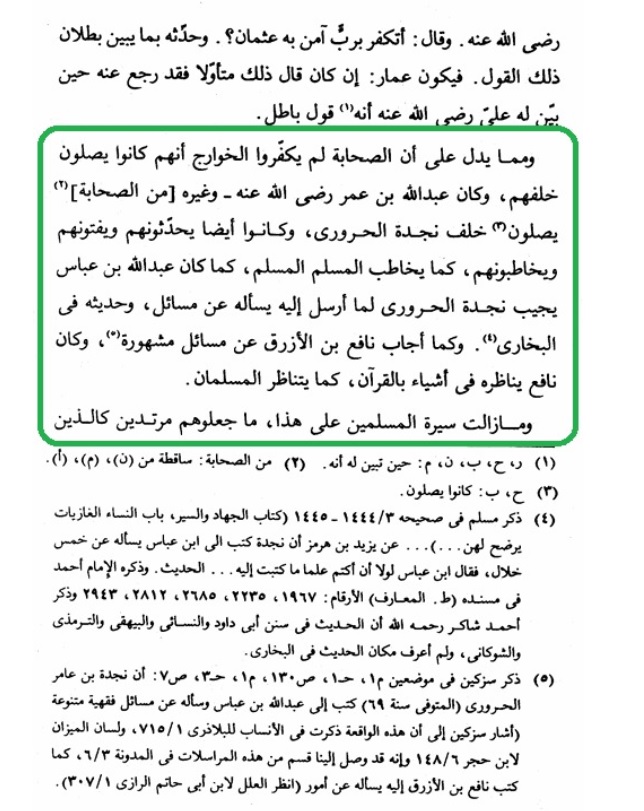
“And what indicates that the Companions did not consider the Khawarij to be disbelievers is that they used to pray behind them. Abdullah ibn Umar -RA- and others[companions] used to pray behind Najda al-Haruri. They also used to engage in debates with them, as the Muslim would debate with a Muslim, as Abdullah ibn Abbas debated with Najda al-Haruri when he was sent to him to ask about certain issues, and his hadith is in Al-Bukhari. Likewise, Nafi’ ibn Al-Azraq debated on famous issues. Nafi’ used to debate on matters in the Quran, as any two Muslims would debate among themselves”
Source: (The Path of the Prophetic Sunnah-In Refutation of the Shiite Qadariyyah Doctrine By Ibn Taymiyya Abu Al Abbas Taqi al Din Ahmad ibn Abd al-Halim.-Edited by Dr. Muhammed Rashad Salim Volume 5)
This entry will be split into three sections:
Section one: This will be aimed at refuting the lies, deception and outright propaganda that they aim at Ahl al-Haqq wal-l istiqama (The Ibadi school).
Section two: This will be the Ibadi school exposing the bizarre beliefs and strange views of those who call themselves: Salafi, Athari etc..
Section three: Those who may loosely identify as Salafi, Athari etc that have had and do have cordial relations with our school. Because they simply see us as Muslims. Muslims perhaps they disagree with but Muslims none the less. Articles in relation to them will be posted under section three.
SECTION ONE: REFUTING THE LIES, DECEPTION AND OUTRIGHT PROPAGANDA THAT IS AIMED AT AHL AL-HAQQ WAL-ISTIQAMA (THE IBADI SCHOOL)
A REPLY TO THE CLAIMS OF THE SALAFI: MUHAMMED BIN SHAMS AL-DIN
SALAFI-SAUDI SHAYKH DR. SAAD AL-HUMID PROFESSOR OF HADITH SCIENCES IN MEDINA FLEES FROM DEBATE WITH SHAYKH SAEED AL QANOUBI: IBADI HADITH MASTER, ON THE CREATION OF THE QUR’AN
MAJOR DIFFERENCE BETWEEN IBADIS AND SALAFIS/ATHAIRS: IBADIS BELIEVE WE HAVE THE ENTIRE QUR’AN. SALAFIS/ATHARIS BELIEVE WE ONLY HAVE THE QUR’AN ALLAH INTENDED FOR US TO HAVE.
THE CLAIM THAT THE IBADIS CURSE AND REVILE THE COMPANIONS.THIS FALSE ALLEGATION IS TURNED ON IT’S HEAD! THE WAHHABI/MADHKALI/SALAFIYYA RELY UPON THOSE WHO SAY VILE THINGS ABOUT ALI
HADITHS THE SALAFIYYA AND AHL SUNNAH IN GENERAL RELY UPON TO CALL HUGE SWATHES OF THE PROPHET’S COMPANIONS DOGS OF HELLFIRE! (THE IBADIS RIP APART THESE CHAINS)
SECTION THREE: THOSE WHO MAY LOOSELY IDENTIFY AS SALAFI, ATHARI ETC THAT HAVE HAD AND DO HAVE CORDIAL RELATIONS WITH OUR SCHOOL. ARTICLES IN RELATION TO THEM WILL BE POSTED UNDER HERE.
MY EXPERIENCE WITH SALAFIS AND SUFIS (NOT ALWAYS CHALK AND CHEESE)
“They made not a just estimate of Allah such as is due to Him. ” (Qur’an 39:67)
﷽
So Shaykh Uthaymeen was asked about Allah’s blanket.
The questioner says, can we say it is a metaphor?
Uthaymeen is agitated. “Will you say to Allah on judgement day that he doesn’t have a blanket?!”
If you want to perfect your aqidah (your creed) in accordance with this bizarre sect then if it is affirmed that Allah (swt) has a blanket are you going to deny this?!
You may also be interested in reading the following:
















 Prima Quran