“My Lord! Increase me in knowledge.” (Qur’an 20:114)
﷽
To those in the United Kingdom in and or around the London area Shaykh Al Muatasim will be giving a lecture titled: Musnad al Arabi: An Authentic Source of Hadith.
The above article shows us how Islam is a very cohesive, coherent and robust understanding of dealing with those people (that are claimed) not to receive a Messenger/Prophet.
We also have shown that Allah (swt) clearly mentioned that he set rites up for all peoples and that he has indeed sent a Prophet to all peoples.
Christianity, the religion that has a vision of God wherein Prophets and Messengers were not sent to all mankind has very often struggled to deal with this.
They have no concept of the fitra, instead all mankind is fallen, (We know you are not on board with this interpretation Church of Christ-Campbellites) so, We will make the exception.
To us this very question exposes the theological and philosophical mess of Christianity.
As regards Christianity. Is this a huge theological problem for Christianity?
Well, this would depend on the type of Christian that you ask. Not Surprising many Christians have a very straight forward response to this. That is that if God wanted the message of the Gospel of Christ Jesus to reach those people he would have. Therefore if they are damned to eternity in hellfire this is the will of God.
Mostly Christians of the Calvinist persuasion are quite o.k with the idea of people in hellfire forever for never even hearing about Jesus. When Christians ask these questions to their teachers it is because they are struggling with the justice of God in such scenarios.
For example:
John MacArthur whom is a believer in hard determinism was very to the point. You can’t receive salvation except through the name of Christ. Yet he goes on to describe the self evident nature of God, but stops short of telling us how exactly this connects a person to the Gospel?
Let’s think for example people who lived all over the world con-current to the first 15 minutes after the alleged death of Jesus on a Patibulum. It is not conceivable that the gospel reached these people.
Than John MacArthur goes on to categorically rebuke other Christian views that would try to claim such people are saved (a part from Christ Jesus) in the same way people were in the TNCH (Christians call it -the Old Testament).
McArthur also quoted the following text:
“In the past God overlooked such ignorance, but now he commands all people everywhere to repent. For he has set a day when he will judge the world with justice by the man he has appointed. He has given proof of this to everyone by raising him from the dead.” (Acts 17:30-31)
So now we will see how top Christian Apologist William Lane Craig deals with this question.
Now for those who do not know William Lane Craig does not believe that God wills and makes people to do evil (like Calvinist do); rather, he is a Molinist.
We will link to Dr. Craig’s article so you can get an understanding of this view:
Skip to 0:10 seconds to avoid hearing music in the intro.
“Now that does not mean that someone can be saved apart from the work of Christ. What it would mean is that the benefits of Christ death could be applied to someone without his conscious knowledge of Christ.” -William Lane Craig
Prima Qur’an comments: So just let that sink in! WoW! You really wonder how this camp will deal with things like:
“If you declare with your mouth, “Jesus is Lord,” and believe in your heart that God raised him from the dead, you will be saved.” (Romans 10:9)
Now, we could counter by mentioning the mute. However, even than it can be seen that this is a conscious choice.
Than William Lane Craig gives the store away to atheist when he proclaims:
“Rather than live up to his moral law they plunge themselves into immorality and degeneracy and so find themselves condemned before God just on the basis of his general revelation in nature and conscious.” -William Lane Craig
No Craig, stop trying to sell Sam Harris’ book, the Moral Landscape. God is known via reason but moral code and moral law is not known except via revelation! -i.e revealed scriptures, prophets, messengers. Tell us do you believe that morality is known a part from these?
Natural revelation never tells them that God came as a man, lived a sinless perfect life and fulfilled all the righteous demands of the Law, died upon a cross to atone for His people’s sins, and rose from the dead three days later for their justification.
“For God’s wrath is revealed from heaven against all godlessness and unrighteousness of people who by their unrighteousness suppress the truth, since what can be known about God is evident among them, because God has shown it to them. For his invisible attributes, that is, his eternal power and divine nature, have been clearly seen since the creation of the world, being understood through what he has made. As a result, people are without excuse.” (Romans 1:18-20)
So Craig did not really answer that woman’s question at all. He waffled. It is possible but in reality not likely at all.
So the question of God’s justice in regard to the Ahl Al Fatrah remains.
We have heard a pastor once say, “If someone can get into heaven without knowing Christ, then the worst thing you can do to them is tell them about Jesus.”
This same logic applies to the Ash’ari creed who believe that people who never heard about Islam enter into heaven no questions asked.
The last thing on Earth we would want would be the spread of the teachings of Islam, if that were the case!
In one conference of Calvinist it seems one of the Pastors had a heightened sense of the racial distributions of God’s mercy.
In other words why are certain demographics seemingly favoured by God to hear the truth?
People groups , Native Americans, Polynesian peoples, Sub Sahara Africans, Chinese pretty much most of them died not knowing Christ Jesus at all. So surely God has shown great mercy to Hebrews, Caucasians, and People of the Middle East in general.
We could have titled this article: The Scandal of Christian Exclusivism: God’s Favor or Geographic Lottery?
Calvinists have no satisfying answer for why God’s sovereign will seems to align so neatly with geography and ethnicity.
“I have no answer to the question why uh vast numbers and not just in very definable people groups that we mentioned in this question but there are people in your street who’ve actually never heard of Christ. Never heard a presentation of the Gospel. It’s not just people groups. There are people who live in contemporary America.”
@7:03 “And I think we need to be very careful about approaching any issue and in particularly this one with a premise that God must act in this way. God is not bound to show mercy to any individual or any collection of individuals. So.So God is not bound to show mercy to an individual but he’s not bound to show mercy to a particular people group either.”
As Muslims we can agree that God is not bound to show mercy to anyone for that matter but what Muslims would assert is that God has asserted that he sent a messenger to every people.
Muslims would also assert that God would not expect every to make a fist with their hand and than punish someone born without hands for failing to do so. This is essentially the Christian view. The Christian view is essentially God creating goats with no wings and than cursed them for not flying.
Christians do have text like the following:
“Who will have all men to be saved, and to come unto the knowledge of the truth.” (1 Timothy 2:4)
Well it would stand to reason he would have some type of system to deliver on this. Eventually to deal with this dilemma some Christians had to come up with a belief in God having three different wills.
Decretive will: What God actually decrees (not all saved)
Prescriptive will: What God commands (all should believe)
Permissive will: What God allows (people to reject)
Such a doctrine is not Sola scriptura. It is theological gymnastics to avoid the plain meaning of the text.
This is theological gymnastics to avoid the plain meaning of the text.
“Indeed, Allah does not wrong the people at all, but it is the people who are wronging themselves.” (Qur’an 10:44)
“Indeed, Allah does not do injustice, [even] as much as an atom’s weight; while if there is a good deed, He multiplies it and gives from Himself a great reward.” (Qur’an 4:40)
So, as we have seen Christians will quote their sources to support their various positions.
“Whoever believes in him is not condemned, but whoever does not believe stands condemned already because they have not believed in the name of God’s one and only Son.” (John 3:18)
“Jesus said to him, “I am the way, and the truth, and the life. No one comes to the Father except through me.” (John 14:6)
“As the Lord said to Nicodemus, Truly I say to you, unless one is born of water and the spirit, a person will not enter into the kingdom of heaven.” (John 3:5)
Or is the above statement not so true?
Because this is flatly contradicted by the information we receive in Luke:
“Jesus answered him, “Truly I tell you, today you will be with me in paradise.” (Luke 23:43)
So some would argue that an exception is made, or there are situations where there are exceptions. So which one is truly the truth?
But than you have to wonder about the debate around unbaptized babies?
The Catholic Church had to go into a full retreat on this issue, because after further reflection the doctrine is quite dark. Secondly Islam was absolutely demolishing the Catholic Church and continues to do so in the Philippines and in South America over this very doctrine!
The Catholic Church & The Doctrine of Invincible Ignorance. Jesus is not the only way to heaven.
As such it is defined as:
“Invincible ignorance” is a state in which people — such as pagans, non-Christians and children — are ignorant of Christ’s message as laid out in the Gospels not because they refuse to believe, but rather because they’ve not yet had an opportunity to hear and experience it
The Position of the Catholic Church?
847 This affirmation is not aimed at those who, through no fault of their own, do not know Christ and his Church: Those who, through no fault of their own, do not know the Gospel of Christ or his Church, but who nevertheless seek God with a sincere heart, and, moved by grace, try in their actions to do his will as they know it through the dictates of their conscience – those too may achieve eternal salvation.
This teaching is crystal clear that Jesus is not the only way to heaven!
This is extremely devestating in two ways.
First it contradicts much of their sacred text or writings.
It Contradicts Jesus’ Own Words
“I am the way, and the truth, and the life. No one comes to the Father except through me.” (John 14:6)
“Whoever believes in him is not condemned, but whoever does not believe stands condemned already.” (John 3:18)
Second it makes mission work dangerous.
If people can be saved through “invincible ignorance,” then:
Those who never hear the Gospel are safer than those who do.
Missionaries are potentially damning people by removing their ignorance.
The Great Commission (Matthew 28:19-20) becomes a curse rather than a blessing.
It definitely contradicts what Augustine had stated on the matter.
Right under the section that explitly states:
Chapter 2 [II.] Faith in Christ Not Necessary to Salvation, If a Man Without It Can Lead a Righteous Life
…before the actual preaching of the gospel reaches the ends of all the earth — because there are some remote nations still (although it is said they are very few) to whom the preached gospel has not found its way — what must human nature do…but believe in God who made heaven and earth, by whom also it perceived by nature that it had been itself created, and lead a right life, and thus accomplish His will, uninstructed with any faith in the death and resurrection of Christ? Well, if this could have been done, or can still be done, then for my part I have to say what the apostle said in regard to the law: Then Christ died in vain. Galatians 2:21 For if he said this about the law, which only the nation of the Jews received, how much more justly may it be said of the law of nature, which the whole human race has received, If righteousness come by nature, then Christ died in vain. If, however, Christ did not die in vain, then human nature cannot by any means be justified and redeemed from God’s most righteous wrath— in a word, from punishment — except by faith and the sacrament of the blood of Christ (St Augustine, On Nature and Grace, Chapter 2).
There are very deep divides in the Orthodox Church on the issue of people being saved a part from the redeeming nature of Jesus.
God is not the author of confusion, but of peace” (1 Corinthians 14:33)
Some will argue that no one is saved by “ignorance”, meaning that they will be harmed by the additional knowledge of Christ Jesus, or some how saved by the law of nature.
“No one is condemned on the ground of not believing in something they never heard, but on the ground of their sinfulness.”
To which we reply on what consistent basis of justice are they not given the same opportunity to hear the saving gospel?
Indeed why are entire tribes and ethnic groups given over to ruin because of this?
Even than those advocates in the Orthodox Church make exception to this so called “Law of Nature.” Those against Invincible Ignorance will make exception when it comes to the Theotokos (Mother of God) whom they mean to be Mary the Mother of Jesus. The Roman Catholics are with them on the sinless nature of Mary.
They do this to avoid the issue of sin being inherited. Protestants do not make Mary an exception. But then we get into an infinite loop issue that if Mary did not inherit sin, than why not make her father sinless for her to escape the conundrum in the same way Mary is made sinless to escape the conundrum for Jesus.
Protestants have avoided this altogether; namely because little baby fetus Jesus was receiving nourishment from a ‘sinful’ woman. It was her ‘sinful’ body that providing for his sinless body.
The Belief of Jesus descending into hell to save the Old Testament prophets.
“After being made alive, he went and made proclamation to the imprisoned spirits-to those who were disobedient long ago when God waited patiently in the days of Noah while the ark was being built. In it only a few people, eight in all, were saved through water.” (1 Peter 3:19-20)
Peter once wrote of Paul’s letters:
“There are some things in them that are hard to understand” (2 Peter 3:16).
Meaning Jesus did not keep good on his promise.
“But when he, the Spirit of truth, comes, he will guide you into all the truth. He will not speak on his own; he will speak only what he hears, and he will tell you what is yet to come.” (John 16:13)
Meaning that the Holy Spirit did not make these scriptures clear.
However, we can say the same thing of Peter’s letters and especially the above text.
This rather ambiguous text of ((1 Peter 3:19-20) is used by many to say that this is how the Old Testament Prophets eventually were saved. In spite of what you heard about the Prophets in the Old Testament they all went to hell. They have to if everyone who does not believe in Jesus is to be saved. So this doctrine came about.
Even though we have many other text that would contradict this point blank.
“Noah was a righteous man, blameless among the people of his time, and he walked with God” (Genesis 6:9)
Roman Catholics and Eastern Orthodox believe a Non Christian who never confessed faith in Jesus Christ is saved!
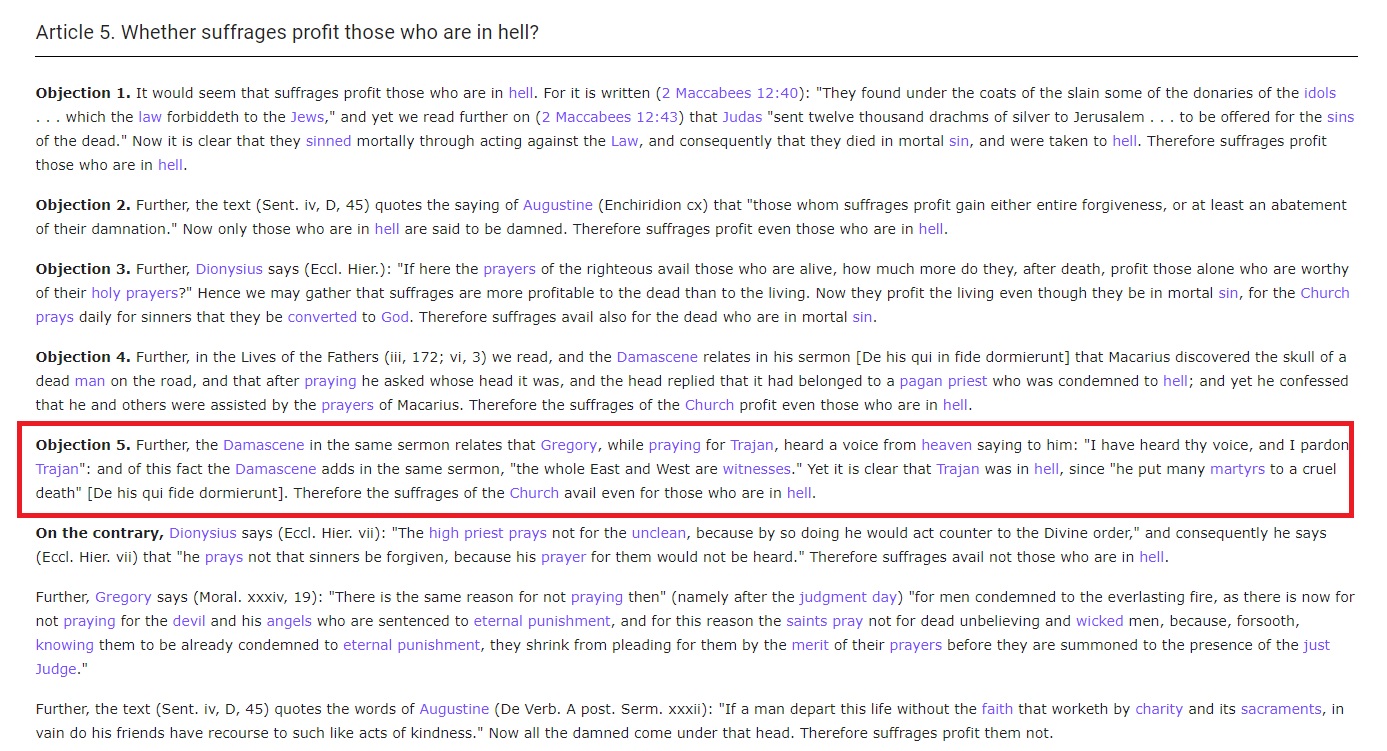
John of Damascus said that God freed Trajan from Hell after the prayers of Saint Gregory the Great!
“Further, the Damascene in the same sermon relates that Gregory, while praying for Trajan, heard a voice from heaven saying to him: “I have heard thy voice, and I pardon Trajan; : and of this fact the Damascene adds in the same sermon, “the whole East and West are witnesses. ” Yet it is clear that Trajan was in hell, since “he put many martyrs to a cruel death” [De his qui fide dormierunt]. Therefore the suffrages of the Church avail even for those who are in hell.”
This particular incident comes to us by different ways with some interesting omissions and additions. In one rendition Trajan is physically resurrected since without physical baptism, one who lived after Christ can be saved.
Another view is that a soul can be in hell and be quit of all pain (maybe just roaming around watching everyone else suffer for their sins) who knows what he does in his spare time).
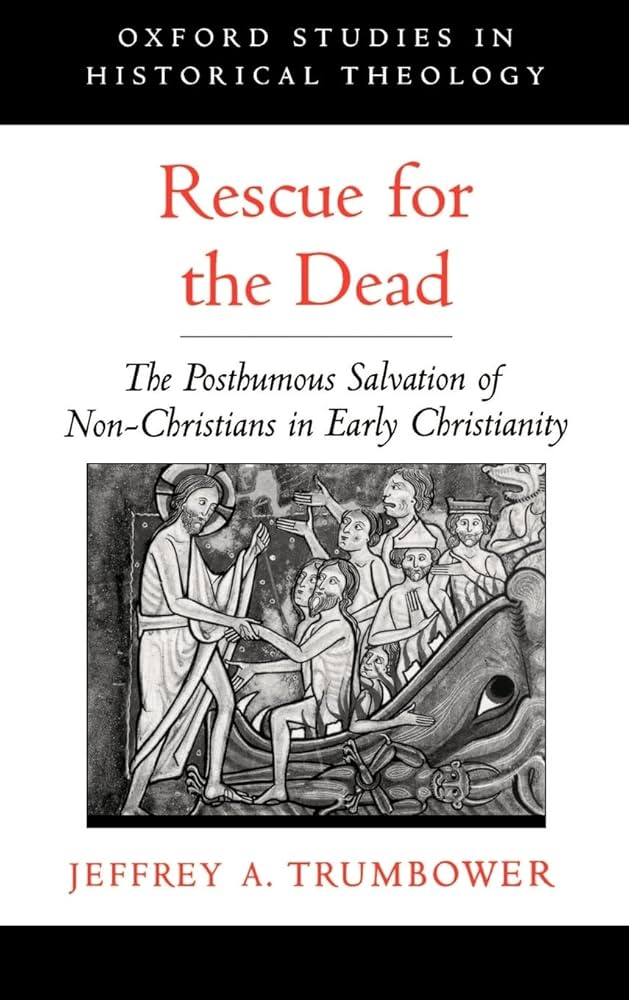
There is a whole book one can read about this idea of Christians saints that could pray for people to be released from hell!
To us it is clear that Christianity does not have a cohesive position on this very important question. The Orthodox, Catholics, & Protestants each seem to have views that once probed ends up causing problems for other doctrinal positions.
The morewe explore and look into the disparate views of the Christian tradition we can’t help but to see how chillingly distant and dark their vision of the divine truly is.
We would not be surprised if one of them ever wrote a treaties entitled: “The Unloved Parts of God.”
“Or like the darkness in a deep sea, covered by waves upon waves, topped by clouds. Darkness upon darkness! If one stretches out their hand, they can hardly see it. And whoever Allah does not bless with light will have no light!” (Qur’an 24:40)
If you think the above is a mess wait until you read how much of a mess their doctrine of salvation is!
Thanks are due to Allah, Al Aziz Al Hakim (the Might & the Wise) and prayers and peace be upon the Prophet Muhammed who has followed the righteous path and had the purist mind, and upon all his companions and followers till the Day of Judgment.
The Ibadis as a school have contributed greatly to the Islamic ‘Aqidah studies as they share schools with Sunnah, Shi’ah and Mu’tazilah. Even though many consider Ibadism as a Fiqh or a political movement, what make Ibadis so special are their “Aqidahh foundations and principles. All their political and Fiqh opinions are only reflections of their ‘Aqidah and convictions that have been established long ago on a solid ground. The disagreements between classic and modern scholars and between the Mashariqa and Maghariba (Ibadies of the east and west) are minor; most of these disagreements fall under the second or third degree ‘Aqidah issues such as the torment of the grave or Createdness of the Quran. Moreover, in many cases these disagreements stem from linguistic choices and do not touch core principles.
In the 18th and 19th centuries AD, a number of Omani scholars emerged with a qualitative shift in ‘Aqidah writing be it in presentation or content. Most notably of these scholars are four: Shaykh Abu Nabhan Ja’ed bin Khamis Al Kharousi, Al Mohaqiq Said bin Khalfan Al Khalili,Shaykh Nasser bin Abi Nabhan Al Kharousi and Shaykh Nasser Abu Muslim Nasser bin Salim bin Adai’em Al Rawahi. The writings of those scholars were relatively contemporary in terms of the ‘Aqidah issues they tackle and the interrelated sciences they use. Their predecessors would not have touched on such issues or if they did, they would do that superficially. The efforts of those four led to an intellectual movement that remained strong till today, even if with less momentum.
In this brief paper, the researcher will try to highlight the role of those scholars in renovating the intellectual movement of the late centuries. The researcher will try to highlight the impact of their movement and how they were influenced by and did in turn influence the ‘Aqidah and intellectual principles of the Ibadi School in general.
Preface: Introduction of the scholars:
1.Shaykh Abu Nabhan Jai’ed bin Khamis bin Mubarak Al Kharousi (1147-1237 AH/ 1734-1822 AD)1, also known as Al Rais (the president). He was born in Al Aliya town in Wadi Bani Kharus, and was responsible for an intellectual revolution by writing more than twenty books in different disciplines:Tafseer, Fiqh, ‘Aqidah, Nahw & Saraf (interpretation, jurisprudence, faith, syntax and morphology). He mentored a number of famous scholars such as his son Nasser bin Ja’ed and Shaykh Said bin Khalfan Al Khalili. Most notable of his books are: Maqaleed AlTanzeel, Al Diqqaq li’Ahl AnNifaq, Sharh Hayat Al Muhaj & Kitab Al Haj. He passed away mid-day Thursday 3rd of Thi Al Hija 1237, aged more than 90 years, and was buried in his hometown Al Aliya.
2.Shaykh Nasser bin Abi Nabhan Ja’ed bin Khamis bin Mubarak Al Kharusi (1192-1262 AH/ 1778-1847 AD)2. He was born in Al Aliya town, Al Awabi, to an educated family; his father is a well-known figure in Islamic studies. He wrote many well-known books such as: Kitab Al Ikhlas, Mubtada Al Asfar an AtTahtheeb and has a good question-answer collection in different issues mentioned by the author of Oamoos Al Sharia. He also wrote Tarf Al Altaf and Diwan Al Mustafa, a poetic piece organized in the chronology of the dictionary alphabet, and touches on philosophy and the wisdom of the Almighty Allah.
3. Shaikh Said bin Khalfan bin Ahmed bin Saleh Al Khalili (1231-1287 AH/ 1816-1870 AD)3, whose lineage goes back to Imam Al Khalil bin Shathan bin Al Imam Al Salt bin Malik Al Kharusi. He is considered one of the most well-known figures in the 13th century AH in religion and politics. He lived in Izki then moved to Baushar and finally settled in Samail. He was best known as Al Muhaqiq, for his dedication to Tahqeeq and assigning evidence and principle to different issues. He was a key member of the cabinet of Imam Azzan bin Qais in his revolution (1869-1871 AD), along with Saleh bin Ali Al Harthi and Muhammed bin Saleem Al Gharbi. He wrote many books and combined poetry with science and thus was known as the most knowledgeable of poets and the most poetic of scholars. Some of his key books are: Orjoozat Ilm AsSarf and he wrote a commentary for it called Al Maqaleed. He wrote another poem in Aroodh called Al Madhar Al khafi fil Arood wal Qawafi, another orjooza in Zakat, Al Nawamees Al Rahmaniya fi Tasheel Al Turuq Ela Al Olum Al Rabbaniyya, Al Saif Al Muthaker fil Amer bil Maroof wan Nahi anl Munkar, and a collection of Fatwa. He was killed together with his son in 1287 AH.
4. Scholar and poet Abu Muslim Nasser bin Salim bin Adai’em Al Rawahi (1273-1339 AH/ 1867-1920 AD). He grew up initially in Mahram town, where he studied at the hands of Shaykh Ahmed bin Said bin Khalfan Al Khalili. He later moved to Zanzibar with his father who was appointed judge at that time. He returned to Oman for five years and went back again to Zanzibar to take up his father’s role. In Zanzibar he dedicated his time to teaching and authoring. He combined mastery of Sharia sciences, literature and poetry. He was considered a genius of his time and deserved the title “The poet of scholars and the scholar of poets”. He died in Zanzibar in 1339 AH/ 1920 AD. He wrote many books most notably of which are: Nithar Al Jawhar fi Ilm Al Shara Al Zahar, Al Nashat Al Mohamadiya, Al Noor Al Mohammadi and Al Nafs Al Rahmani. He has a big collection of poetic works4.
The Development in the Ibadi Theology during the 18th and 19th Centuries can be summed up in the following:
First: Development in Authoring:
The eighteenth and nineteenth centuries AD witnessed a considerable development in Ibadi ‘Aqidah authoring and writing in Oman. This development can be summed up in the following:
Writing style: A considerable development has been witnessed in the style of scientific writing in general and more notably in ‘Aqidah issues. ‘Aqidah writing featured more expressive force and attention to rhetoric, especially when refuting opposing opinions. A closer look at the Ajwiybah (Questions-Answers) of AlMohaqia Al Khalili will notice a great deal of rhetoric styles, especially Saj’a (rhymed phrase endings).
Use of poetry in authoring: The time of those scholars saw a new trend of authoring in different ‘Aqidah issues using poetry as a vehicle. A good example of this trend is the poem written by Abu Muslim Al Bahlani in the issue of seeing Allah, in which he starts with:
Realize Allah’s Transcendence from being seen to know Him. Would you be able to know Him and prove so?
Know your capacity in what you are attempting. What you are attempting is what will hurt you.
In fact, Abu Muslim used poetry a lot in expressing his ‘Aqidah and political opinions, whether for contemporary or classic issues. One famous example of classic political issues is the Nahrawania poem in which he expressed his opinion in the battles of Sifeen and Al Nahrawan.
Another common way of using poetry in authoring is the question-answer books, a trend which expanded on later stages5. The aim was to use a rhetoric appealing way of expressing Fiqh opinions. Full fiqh books were written in this style such as Kitab Bahjat Al Majalis by Shaykh Khlfan bin Jumayel Al Siyabi and Al Fiqh fi Itar Al Adab by Abi Surour Abdullah bin Humaid Al Jami’e.
Commentary expansion in ‘Aqidah issues: It is found that those four scholars (Shaykh Ja’ed bin Khamis, his son Nasser, Al Mohaqiq Al Khalili and Abu Muslim Al Bahlani) expanded commentary in some ‘Aqidah issues as a response to the Wahabi invasion of Oman and the conversion of many Omanis to Wahabism as a result of fear and desire. A lot of debates took place and much skepticism was casted on the foundation of Ibadi ‘Aqidah principles. Those four scholars took it on them to explain and counter the sceptics of Ibadi ‘Aqidah principles.
ShaykhSaid bin Khalfan Al Khalili for example expanded commentary on the issue of seeing Allah and his commentary runs to about thirty pages. He stated the evidences used by the opposition from the Quran and Sunnah and refuted every single claim of them6. Shaykh Abu Muslim Al Bahlani on the other hand expanded commentary on the issue of Quran createdness in his Nithar Al Jawhar using many Quranic and Hadith evidence to support his opinion that the Quran is created.7
Second: Tendency toward Rationalism:
There is no doubt that Islamic Sharia, especially in ‘Aqidah issues, is based on conclusive evidence from Quran and Sunnah. Rational is used only on what is perceivable such as knowing the existence of Allah and His attributes. Sheikh Al Khalili emphasized this opinion and said: “One thing that must be believed in once it occurs to the mind is knowing the existence of Allah and knowing His attributes after knowing His existence . . .”.8
During the 18th and 19th centuries AD, those scholars expanded on the use of rational evidence ‘Aqidah issues driven and supported by extensive reading in philosophical sciences, besides their strong mental capabilities. They critically read and scrutinized what other Muslim philosophers wrote such as Abu Hamid Al Gazali. Al Khalili for example after reading Al Gazali’s book rejected al-Gazali’s attempt to prove the possibility of seeing Allah by using a claimed incident of angel Jibril being seen in the picture of Dihyat Al Khalbi, and said: “This man compared Allah with angels which is wrong, as Allah is not a comparable entity”9.
This rational trend helped those scholars to reject some stories that were attributed to the Prophet (MPBUH) whenever they felt they contradict logic reasoning. Shaykh Nasser bin Abi Nabhan for example denied the idea of the torment of the grave and blessings10 despite many evidences from the Sunnah. In fact, the abundance of evidence on the torment of the grave led some scholars to categorize the idea as Mutawatir Manawi (successive reporting of the same concept over time), and one of those was Al Imam Noor Al Deen Al Salmi in his Anwar Al ‘Uqul, where he said:
“and then the torment of the grave, you shall understand that stories have been successfully reported . . . and you shall believe in it as a truth and do not look at other possibilities”1 1
Shaykh Nasser’s denial of the torment of the grave, besides being difficult to imagine, was the absence of evidence from the Quran or absolute evidence from the Sunnah. Furthermore he thinks that Quranic evidence actually says the opposite; a dead person is resurrected only on the Day of Judgment as per the verse: “They will say, “Our Lord, You made us lifeless twice and gave us life twice, and we have confessed our sins. So, is there to an exit anyway?” Ghafer:11. The common opinion of Ibadi scholars though is that the torment of the grave is true, but they don’t shun opposing opinions12.
Another example of rational justification is Shaykh Nasser bin Abi Nabhan’s rejection of the Hadith that says some Prophets are alive in the heavens and that Adam is alive in the heaven of this life and is presented with the deeds of his descendants. Shaykh Nasser said: “This is not possible. They are dead in this earth and they are not different than the prophet Mohammed MPBUH”.
Shaykh Nasser also rejected the story of prophet Issa’s (Jesus) second coming at the end of time, and the Mahdi’s prophecy, despite the narrated hadiths such as the one narrated by Al Bukhari and others from Abu Huraira that the Prophet Muhammed (saw)said:
“The Hour will not be established until the son of Mary (i.e. Jesus) descends amongst you as a just ruler, he will break the cross, kill the pigs, and abolish the Jizya tax. Money will be in abundance so that nobody will accept it (as charitable gifts).”13
There is also another Hadith narrated by Abi Said Al Khudari that the Prophet Muhammed (saw) said: “The Hour shall not be established until the earth is filled with injustice and tyranny, and then a man from my house will rise up and fill the earth with as much justice as there was injustice”14.
However, ShaykhNassr rejected these Hadiths casting doubt on their credibility and said: “I believe that the second coming of Jesus and the rise of the Mahdi are not true and there is no explicit or implicit evidence on that from the Quran, Sunnah or logic. After all, why would they be resurrected? Why would they be resurrected together?
The teachings of the prophet are clear like the sun. If the resurrection is meant to distinguish between the right and the wrong and if the right is not possible to be identified without their guidance, how would Allah leave the followers of Prophet Mohammed (saw) in their divide and chaos since the day the companions disagreed till the day of Jesus and Mahdi resurrection?
Many of Allah’s servants want to worship Him with the right religion and Allah leaves them in their aberrance. The benefit of resurrecting the prophet Mohammed (saw) becomes pointless except for himself and his companions who died before the divide of the companions. And if the right truth is clear and known why would Jesus and the Mahdi be resurrected?
From whatever angle you look at it, you find it wrong. And Allah knows better.15
Third: Tendency toward Sufism:
Sufism emerged in the second century after Hijra as an independent and established movement with its own principles and terminology, focusing on cleansing one’s self, drawing closer to Allah and dedicating worship for Him. Like most widespread movements, Sufism branched out to other sub-schools and despite sharing common objectives; some practices were overtaken by extremism.
There is no doubt that Sufism’s ultimate goal is the cleansing of the soul and dedication of self to Allah, which is the essence of Islam that has been narrated in both Quran and Sunnah. For example, in the Hadith Qudsi: “…And the most beloved thing with which My slave comes nearer to Me, is what I have enjoined upon him; and My slave keeps on coming closer to Me through performing Nawafil (voluntary prayers or doing extra deeds besides what is obligatory) until I love him, (so much so that) I become his hearing with which he hears, and his sight with which he sees, and his hand with which he strikes, and his leg with which he walks; and if he asks Me something, I will surely give him, and if he seeks My Protection (refuge), I will surely protect him …”l6, and this Hadith is at the core foundation of Sufism.
If we also go back to what the prophet’s (saw) companions were described with, we find that they were described as “monks of the night”, apart from being knights of the day, and this became the essence of Sufism. Ibadis however define Sufism in a different original way such as what Abu Hamza AI Shari described his companions: “… young but followed the path of the wise elders, their eyes blinded from evil, their feet are heavy to walk the path of wrong doings, dedicated to worship and in love with late hours of the night. They gave away their souls that may die tomorrow in exchange for eternal souls. Allah looks upon them in the hollowness of the night and sees their bodies leaning over their copies of the Quran, and if they happen to read any verse about heaven, they would cry longing for it, and if they read a verse bout hell they would gasp as if the hellish fires are breathing in their ears. Earth has eaten their knees, hands, noses and foreheads, and they know no rest whether at day or night, their bodies have turned yellow and withered from long standing and fasting. They do all this for the sake of their promise to Allah. However, if they see the arrows, spears and swords of the enemy approaching and the thunder of war calls out, they take the fear of legions lightly for the sake of their reward from Allah; they never take the promise of Allah lightly in fear of legions of the enemy. They take spears and arrows heads on with their chests and faces. A young man (such as them) moves ahead with his head high and when he falls down and the earth dirties his handsome face and the birds and predators prey on his body …”17
However, the relation between Ibadis and Sufism was barely notable with the early Ibadi scholars; there are no books on Sufism and they didn’t use Sufi terminology in their books. This relationship thrived though in the 18thcentury with many scholars such as Shaykh Ja’ed and his son Nasser, Al Mohaqiq Al Khalili and Abu Muslim Al Bahlani embracing Sufism and producing some of the most influential and hard-core writings on Sufism. The contributions of those scholars can be summed up in the following:
Books: Those four scholars added a number of rich books in Sufism and behavioral science (‘ilm al-suluk), most famous of which are:
1. Commentary on Hayat Al Mohaj poem and the poem itself by Shaykh Ja’ed bin Khamis Al Kharusi: Hayat Al Mohaj poem is a lengthy poem in Sufism and behaviors, and starts with:
My brothers in Allah listen to me,
as I am always advising for the Sake of Allah till He is pleased.
2. Other poems of Shaykh Ja’ed: He wrote other poems in Sufism, and one of them starts with:
The sun of the enlightened is above all,
and they are abstinent from the love of anything but Allah
3.Al Nawamees Al Rahmaniya fi Tasheel Turuq Ela oloum ArRabaniya, a book by Shaykh Said bin Khalfan Al Khalili. This book was described by Shaykh Khalfan Al Harthi as: “This book tackles issues of knowledge acquisition tools. He started by talking about the brain and the beneficial food and drugs. After that the book talks about the secrets of verses, prayers and divine names of Allah. In doing so, Shaykh Said quotes Al Antaki, Al Ghazali Al Bani and others18.
4.Lydah Nudum AsSoluk Ela Hadarat Malik AlMolok by Shaykh Nasser bin Ja’ed Al Kharusi in which he gives extensive commentary on Ibn Al Faridh’s “T rhyming” poem in Sufism, a lengthy poem that runs to about 759 lines, and starts with:
Yes, my heart has longed for my beloved…
This book was printed in 2011 in 786 pages with an introduction by Dr. Waleed Mahmood Khalis. This is a valuable and unique book that reflects deep understanding and knowledge of ShaykhNasser.
5.Poems of Shaykh Said bin Khalfan Al Khalili in Sufism and behavior: Shaykh Said Al Harthi says: “He wrote many poems in the divine love, supplication, prayer, motivation and guidance to the path of the enlightened”19. Some of the poems are very lengthy; one of them runs to 220 lines. Shaykh Abu Muslim Al Bahlani did Takhmis (extension of a poem line by adding one and a half line to an existing line) of one of those poems.
6. Poems of Abu Muslim Al Bahlani in Sufism: Lengthy poems that can reach to 1000 lines. The total number of lines in prayer poems of Abu Muslim reached about 5500 lines20, which can be considered a full book on their own. Dr. Mohamed Nasser says about these poems: “All these poems can be categorized under the supplication, because they were simply written for this purpose as can be seen in the introductions. The author puts forward a certain behavior before and during the poems which means he used to practice a certain ritual. He would prepare himself by Ablution, supplication and prayer at midnight. The poem lines would flow in his tongue and he uses them to call upon his creator in moments of spiritual highness and emotional fulfillment”21
Uniqueness of Ibadis Sufism: Despite embracing, practicing and writing in Sufism, those scholars did not follow that path blindly without critique. In fact, they created their own Sufism as Dr. Waleed Khalis says: “It is important to note that, in embracing Sufism, those Omani scholars and poets chose only what aligns with their ‘Aqidah and their sects principles. We did hint to this earlier. That is why they used the concept of Soluk not Holol or Wihdat AlWojood (unity of existence) or other concepts embraced by some Sufis. Ibn Al Faridh in fact himself falls under a conservative group that keeps the Quran and Sunnah always as a super guide. Omani scholars and poets expressed interest in Al Faridh’s works because they share common foundations objectives”22
This uniqueness can be summed up in the following:
Their definition of Ibadi Sufism: Those scholars defined Sufism in a unique way that moves away from extremism, trying to repel the stereotype that had become a norm. They stressed that Sufism in its essence calls for good and virtue, and all impurities have to be ruled out. Shaykh Nasser bin Ja’ed said: “A person shall not overlook Sufism; even if he couldn’t reach its peak he should pray and supplicate with whatever is possible to him. Sufism cannot be achieved by roaming the lands, but by the dedication to Allah in everything and following the straight path. Then a person needs to ask Allah and supplicate by abandoning bad habits and traits and embracing the steps of Iman after completing the mandatory prayers and worships…”23
Sufism doesn’t mean solitude and escape from other religious duties, and it doesn’t mean monasticism; it is rather a state of the heart that a Muslim tries to deepen by drawing closer to Allah through prayers and supplications. This is clearly noted by Shaykh Nasser bin Abi Nabhan when he said: “You should know that supplications to Allah is the tool of Sufism and it works even if a person sleeps with four women at night, righteously fight the infidels during the day, helps people and works in Sharia; all of this can’t spoil Sufism. No one knows that a person is Sufi without a revelation from Allah or by direct hearing from the mouth of a Prophet as Sufism is a hidden state in the heart. Naming someone ‘Sufi’ on the basis of outlooks is allowed …”24
This precise understanding of the essence of religion and Sufism is what is clearly referred to by many verses of the Holy Quran and many Hadiths. In the days of the Prophet Mohammed (saw) some people misunderstood religion for monasticism but the prophet explained to them that religion is not about solitude and worship only. Anas bin Malik said: “Thus, it has been narrated that a group of three men came to the houses of the wives of The Prophet (saw) asking how the Prophet (MPBUH) worshipped (Allah), and when they were informed about that, they considered their worship insufficient and said: “Where are we in comprise to The Prophet as his past and future sins have been forgiven.” Then one of them said: “I will offer the prayer throughout the night forever.” The other said: “I will fast throughout the year and will not break my fast.” The third said: “I will keep away from the women and will not marry forever.” Allah’s Messenger (saw) came to them and said: “Are you the same people who said so-and-so? By Allah, I am more submissive to Allah and more afraid of Him than you; yet I fast and break my fast, I do sleep and I also many women. So, he who does not follow my tradition in religion, is not from me (not one of my followers).”25
This definition and conception of Sufism by these scholars is not theoretical but had been their way of living, despite having been very active in political, social and intellectual life. Sufism didn’t restrain them from engaging in life activities. Shaykh Said bin Khalfan AI Khalili was the strongest pillar of the Imamate of Azzan bin Qais AI Busaidi; he was the one backing the Imam, the one who appointed him and the one who fought his wars and battles until he got killed for the sake of his principles.
Shaykh Ja’ed bin Khamis and his son were very active in political, social and intellectual life in their days. This is evident in their multidisciplinary books; Shaykh Ja’ed himself left behind more than 20 books.
On the other hand, Abu Muslim Al Bahlani played a critical role in the intellectual renaissance in Zanzibar and his newspaper (Al Falaq) was one of the first Arabic newspapers at that time. He printed a number of books and his deep devotion to Sufism didn’t withhold him from writing poetry in other fields such as praise, ghazal, humor and obituary.
Sufism terminology: Those four scholars used in their books and poems many Sufi terms. Dr. Sharifa Al Yahyai said: “The pioneering of Al Khalili in Sufi poetry made his poems a reservoir of Sufi terminology, a rich pool for research on Sufi language. Moreover, his poems acquired some linguistic alienness as a result of the deep connection with Sufi literature and this influence is demonstrated in complex structures, a common feature of Sufi poetry. He was also influenced by Ibn Al Faridh, one of the most prominent Sufi poets”26. However, they also tried to avoid misleading terms, such as the word ‘Sufi’ itself and replaced it with ‘Soluk’ which denotes the objective of this movement, to reach to the ultimate understanding of Allah and His attributes and get His blessings.
Holding on to the Ibadi ‘Aqidah: The Sufi movement emerged and grew in non-Ibadi cultures and no Ibadi scholar wrote on this field before those four who remained rooted and firmly holding their Ibadi ‘Aqidah principles. Whenever they felt something contradicting the Ibadi ‘Aqidah, they would promptly reject it and rectify it. Two examples of this are:
The meaning of (unity) with Allah in Sufism: One of the extreme thoughts of Sufism is the actual unity between the creator and the created, which is claimed to happen when a person rises high in love and closeness to Allah. However, Shaykh Nasser bin Ja’ed explains that Sufism (or the correct Sufism) doesn’t actually mean so27. What it actually means is not a unity of entities but rather of attributes, as a believer takes on the attributes of Allah when he draws closer to Him. With this explanation, ShaykhNasser may be referring to the hadith: “And the most beloved thing with which My slave comes nearer to Me, is what I have enjoined upon him; and My slave keeps on coming closer to Me through performing Nawafil (voluntary prayers or doing extra deeds besides what is obligatory) until I love him, (so much so that) I become his hearing with which he hears, and his sight with which he sees, and his hand with which he strikes, and his leg with which he walks; and if he asks Me something, I will surely give him, and if he seeks My Protection (refuge), I will surely protect him”28
Seeing Allah: Ibadis believe that Allah cannot be seen by the eye sight in this world or in the afterlife. The common Sunni opinion is that Allah can be seen, and most of them agree that this seeing happen only in the afterlife as a reward for believers. When Ibadis faced the paradox of seeing Allah with the eye sight, they were firm about their opinion and emphasized that whatever revelation happens is only a revelation of His attributes. Shaykh Nasser bin Ja’ed said in the context of explaining the concept of seeing Allah in this life and the life after: “It is not Allah’s entity that will be seen, it is only His attributes. In the afterlife, paradise dwellers will have Allah always with them, and they will feel His mighty presence and His attributes, but they won’t be seeing His entity. In the same context, Shaykh Abu Nabhan said: “they feel His attributes in their hearts. In the afterlife the sighting of Allah’s attributes is conceived by the mind just like the Prophet (saw) sees Allah in his mind by His attributes not His entity… and some people believe in seeing Allah’s entity which is not possible and not right to believe. Allah’s entity is and will not be conceived or seen by anyone but Allah only, and not even prophets or angels can do that. It is just impossible and believing otherwise is a delusion”29.
·And he also said: “I swear that ultimate joy in paradise is to comprehend the attributes of Allah not seeing Him by the eye. Seeing Allah is something that we reject anyway. When we say ‘seeing’ we mean the presence of the mind with Allah and seeing his attributes”30.
Conclusion
This paper concludes with the following findings:
1.A considerable development has been witnessed in theology (‘Ilm Al Kalam) with the Ibadis in the 18th and 19th centuries AD, in terms of the style or writing and expansion in the issues that have not been touched by other Ibadi scholars in Oman before.
2. The authoring style in Ilm Al Kalam saw some development with the use of more expressive and rhetoric force.
3. Poetry was used to refute the opinions of the opposition in ‘Aqidah issues.
4. Some scholars expanded their commentary in some ‘Aqidah issues and in response to opposing opinions.
5. Many scholars wrote on Ilm Al Suluk (Sufism) whether in poetry or in prose.
6. The writing on Suluk (Sufism) was done with due consideration of Ibadi ‘Aqidah principles, and without deviating from the founding principles of the Ibadi school.
_________________________
1 See his biography: Mujam Alaam Al Ibadiyah (Mashriq Scholars) p. 43-44, Daleel Alam Oman 45, Al Khusaibi, Shaqaiq Al Numan 1/139-154.
See his biography: Al Salmi, Abdullah, Tuhfat Al Aayan 2/172-175, Daleel Aalam Oman p.159, Al Sadi, Fahad, Muajam Al Fuqaha wal Mutaklmeen Al Ibadia 3/240-247.
3 See his biography: Daleel Alaam Al Ibadiay (Mashriq Scholars) p. 132-133, Al Harthi, Khalfan, Fiqh of Shaykh Said bin Khalfan Al Khalili p.35-60, Al Yahyaiya, Sharifa, Shaykh Said bin khalfan Al Khalili, Pioneer of Sufi Poetry in Oman p1.
Shariaf bin Khalfan AI Yahyai Al Saadi, Fahad, Mujam AI Fuqaha wal Mutaklmeen Al Ibadiay 3/240-247.
4 See his biography in Daleel Alam Oman 159-160, Al Khusaibi, Shaqaiq Al Numan 2/347, Al Bahlani, Nithar Al Jawhar 1/15-20, Al Sadi, Fahad, Mujam AI Fuqaha AI Mutaklmeen AI Ibadiay 3/252-259.
5 See for example: Al Khalili, Said, Ajwibat AI Mohaqiq AI Khalili 1/165, 1/187.
6 Al Khalili, Said, Ajwibat Al Mohaqiq Al Khalili 1/165, 1/187. See also: Al Khalili, Said, Tamheed Qawa’ed Al lyman, 1/262-286.
7 Al Bahlani, Abu Muslim, Nithar Al jawhar, 1/92-98.
8 Al Kkalili, Said, Ajwibat Al Mohaqiq Al Khalili, 1/79.
9 Al Khalili, Said, Ajwibat Al Mohaqiq Al Khalili, 1/163.
10 Al Khalili, Said, Ajwibat Al Mohaqiq Al Khalili, 1/216.
11 Al Salmi, Noor Al Deen, Mashariq Anwar AI Oqool, p.355.
12 See: Al Salmi, Noor Al Deen, Mashariq Anwar Al Oqool, p.358, Al Khalili, Said, Ajwibat Al Mohaqiq Al Khalili 1/220.
13 Al Bukari, Mohammed, Sahih Al Bukhari, Hadith No. 2476.
14 Ibn Habban, Abu Hatim, Sahih Ibn Habban, Hadith No. 6823.
15 Al Khalili, Said, Ajwibat Al Mohaqiq Al Khalili, 1/202.
16 Al Bukhari, Mohammed, Sahih Al Bukhari, Hadith No. 6502.
17 Safwat, Ahmed Zaki, Jamharat Khutab Al Arab, 2/469-476.
18 AI Harthi, Khalfan, Fiqh Said bin Khalfan AI Khalili p.56.
19 Al Harthi Khalfan, Fiqh Said bin Khalfan Al Khalili p.69.
20 Nasser Dr Mohammed, Abu Muslim AI Rawahi Hassan Oman p.39.
21 Nasser, Dr. Mohammed, Abu Muslim Al Rawahi Hassan Oman p.39-40.
22 Khalis, Dr. Waleed, Iydah Nudum Al Soluk, p.32.
23 Al Kharusi, Nasser, Iydah Nudum Al Soluk, p.482.
24 Al Kharusi, Nasser, Iydah Nudum AI Soluk, p.485.
25 Al Bukhari, Mohammed, Sahih Al Bukhari, Hadith No. 5063.
26 Al Yahyaiya, Sharifa, Al ShaykhSaid bin Khalfan AI Khalili, Doyen of Sufi Poetry in Oman,p.3
Sharifa bint Khalfan Al yahiyai for Saidi, Fahad, Mujam AI Fuqaha wal Mutaklmeen AI Ibadia 3/240-247.
27 Al Kharusi, Nasser, Iydah Nudum AI Soluk, p.315.
28 Al Bukhari, Mohammed, Sahih Al Bukhari, Hadith No. 6502.
29 Al Kharusi, Nasser, Iydah Nudum Al Soluk, p.328-329.
30 Al Kharusi, Nasser, Iydah Nudum AI Soluk, p.136.
“Blessed is the One Who sent down the Decisive Authority to His servant, so that he may be a warner to the whole world.” (Qur’an 25:1)
﷽
“Blessed is the One Who sent down the Decisive Authority to His servant, so that he may be a warner to the whole world. (Qur’an 25:1)
The Qur’an is the primary source of guidance for Muslims. It is the revelation sent by Allah (swt) to his Blessed Messenger (saw). The Qur’an calls itself, the Furqan -which has been translated above as the Decisive Authority.
It is this decisive authority that the Ibadi school uses to determine it’s stance and matters on issues of jurisprudence, belief and all matters in relation to Islam.
The second authority is the Sunnah of the Blessed Messenger (saw). The sunnah are the words, deeds, actions and treaties of the Blessed Messenger (saw). This than often gets captured in sound bites which we call the hadith. Some times a particular sound bite contains all the relevant information one needs to be informed on in a particular matter. However, what the scholars of Islam in situations where there are many sound bites (lone narrator reports) that speak on the same or similar topic is to bring them altogether and compare them. Having more data often gives one a bigger picture.
Now when it comes to this second body of legislation or guidance. The Sunnah of the Blessed Messenger (saw) encapsulated in these sound bites. The Ibadi school arguably is among the most zealous and fiercest in regards to preserving the authentic sunnah of the Blessed Messenger (saw). Thus, we are arguably among the strictest in the decision making process of passes as an acceptable sound bite (lone narrator report), also known as hadith.
The chain of narrators has to check out. This is called the sanad. This itself is subject to various criteria. Everyone in the chain needs to name their source, have met the person they received the information from, have been noted for honesty and piety.
The information the chain presents has to undergo rigorous scrutiny. The information the reporters give is called the matn. An analysis of the speech of the Blessed Messenger (saw). He had the most eloquent speech and if the report words things in a way that betrays this it would be rejected. That information cannot first and foremost conflict with the Qur’an. It cannot contradict a hadith that is stronger than it. It cannot go against reason. It cannot contradict reality, for example: 100% established scientific fact.
“The worst of living creatures before Allah are the deaf and dumb, those who do not use their reason.” (Qur’an 8:22)
So as highlighted above: That information cannot first and foremost conflict with the Qur’an.
This is what brings us to our first objection to this belief. Not only do we not find any evidence for the some second coming of Jesus (as) in the Qur’an. The idea of a second coming of Jesus (as) would conflict with information in the Qur’an.
We are quite confident that the situation among Muslims would be very different when approaching the hadith on this matter if we could sort out the misunderstanding and misgivings that some Muslims have in relation to text of the Qur’an concerning the following:
Proper understanding of Qur’an 4:153-159
Proper understanding of Qur’an 43:61
Consistency with the word tawaffā throughout the Qur’an.
We will have links to articles dealing with these at the end of this article:
“The Messiah, son of Mary, is no more than a messenger, certainly the messengers before him have passed away. And his mother was a saintly woman. And they both used to eat (earthly) food. See how We make the revelations clear for them, and see how they are turned away!”(Qur’an 5:75)
This text is in reference to prophet ‘Isa, -Christ-Jesus. If you read this text it does not occur in your mind to think that Moses, David, and Solomon are alive. You have no reason to think that. The text is explicit in that it says, the messengers before him have passed away.
There is no reason to believe that Idris commonly identified as Enoch [Akhnukh] in the Judeo-Christian tradition is alive.
There is no reason to believe that Khidr has been alive since the time of Moses. The above text indicates the opposite of it. That is to say that Jesus is not divine, expect him to pass away like those before have.
However, if Jesus did not pass away like those before him then perhaps the people of that time have credible evidence to suggest divine-like qualities.
“And Muhammed is no more than a messenger; certainly the messengers before him have passed away; if then he dies or is killed will you turn back upon your heels? And whoever turns back upon his heels! he will by no means do harm to Allah in the least and Allah will reward the grateful”. (Qur’an 3:144)
This same text that is used of Jesus above is also used of the Blessed Messenger (swt).
In fact, if Jesus had not already passed away this text would make little to no sense. It could be objected that, ‘Jesus, Khidr, and Idris are still alive; and we expect the same for Muhammed‘.
Why would the All-Wise Creator open himself up to such an obvious counter-argument?
If an objection is raised that this means ‘some prophets and not all prophets‘ the text would lose the thrust of its argument. “is no more than a messenger“.
How does it argue that he is no more than a messenger? It does this by asserting the fact that those before him have died. Thus, we should expect the same of the Blessed Prophet Muhammed (saw).
In fact, if those before him have not died then it can be argued that they [Khidr, Idris, and Jesus] are something other than just prophets.
Again if the objection is raised that this means ‘some prophets and not all prophets‘ than think about the emotional state of the loss of the Blessed Messenger (saw) and Abu Bakr (ra) had quoted from the Qur’an. No one raised any objections to Abu bakr (ra) saying, “Well what about Khidr what about Jesus, what about Idris?”
Further proofs.
“Muhammed is not the father of any man among you, but he is the messenger of Allah and the Seal of the Prophets, and Allah is ever Aware of all things.” (Qur’an 33:40)
wakhatama l-nabiyina This seal is a barrier in which nothing can penetrate or go beyond. The term alone completely turns to ash any argument that prophets come non-sequentially.
The non-sequential argument is often used by Sunni Muslims. Though they have dissenting voices in their community.
Not only that but all messengers were prophets but not all prophets were messengers. If the term used here was messenger than one could have scope to argue that more prophets would come. However, as the term used here is prophet it is inclusive and final.
Not only this but often the crucial statement ‘not the father of any man among you‘ is overlooked.
There are many Father-Son prophets that have come and gone. Abraham was the father of Ishmael and Isaac. Isaac was the father of Jacob. Nathan was the father of David and David was the father of Solomon.
Even though being a son of a Prophet does not guarantee that one will become a prophet. An example of this is Adam’s son Cain.
However, the fact that the Blessed Messenger (swt)has not left behind any sons and the phrase ‘not the father of any man among you‘ make it abundantly clear that he (swt) is the last.
The Blessed Messenger (swt) message is not meant for one tribe or nation but to the whole of mankind. His message is universal in scope.
“Blessed is He who has revealed the criteria (for discerning truth from falsehood) to His servant so that He could warn all beings.” (Qur’an 25:1)
Verses 33:40 and 25:1 form a powerful one-two combination that knocks out any concept or idea that any prophet will come after the Blessed Messenger (swt). This includes the prophet Jesus or any misguided sects that have claimed prophets after the Blessed Messenger [saw].
“And therefore uh we can say that the Quran strongly suggests the Quran seems to have a very strong indication that Isa is coming. However, it is not definitive and it is not conclusive in and of itself. Just from the language of the Quran and just from the context of the Quran, we give it the presumption but not the certainty. And that’s the first evidence, the Quran.” – Shaykh Yasir Qadhi
Why do the Christians need Jesus to return?
The reason Christians need a second coming is that he (Jesus) really didn’t do much the first time he came.
That is the truth.
Imagine your mother called the store and confirmed that they had the following items in stock: eggs, bread, milk, flour, cheese, spaghetti sauce, broccoli, avocados and mangoes. So Jesus goes to the store and upon his return home, it was found that he had only brought back the Avocados. Mom would be very disappointed.
These are the things the Jews claim the Messiah was to bring about.
1. World Peace. 2. Universal Knowledge of God. 3. The gathering of the exiles. 4. The building of the temple.
In the time of Jesus, there was no temple built. It was destroyed. There was no peace, there was war. There was no gathering of the children of Israel. There was exile.
“Now, fellow Israelites, I know that you acted in ignorance, as did your leaders. But this is how God fulfilled what he had foretold through all the prophets, saying that his Messiah would suffer. Repent, then, and turn to God, so that your sins may be wiped out, that times of refreshing may come from the Lord, and that he may send the Messiah, who has been appointed for you even Jesus. Heaven must receive him until the time comes for God to restore everything, as he promised long ago through his holy prophets. For Moses said, ‘The Lord your God will raise up for you a prophet like me from among your own people; you must listen to everything he tells you. Anyone who does not listen to him will be completely cut off from their people.’ (Acts 3:17-23)
When he returns he has anyone who does not accept him to be executed.
“But those mine enemies, who would not that I should reign over them, bring them hither and slay them before me.” (Luke 19:27)
By the way, according to Acts 3:17-23, the Prophecy of Deuteronomy 18:18 awaits fulfillment.
The building of the temple. <<< This is very important for Zionists. Both Zionist Jews and Zionist Christians. So many Christians who hold what is known as the Dispensational View held by Evangelicals, Pentecostals, and Baptists hate Muslims becuase they believe we are ‘holding up the lunch line‘ so to speak.
As regard the view of the early companions on the return of Jesus.
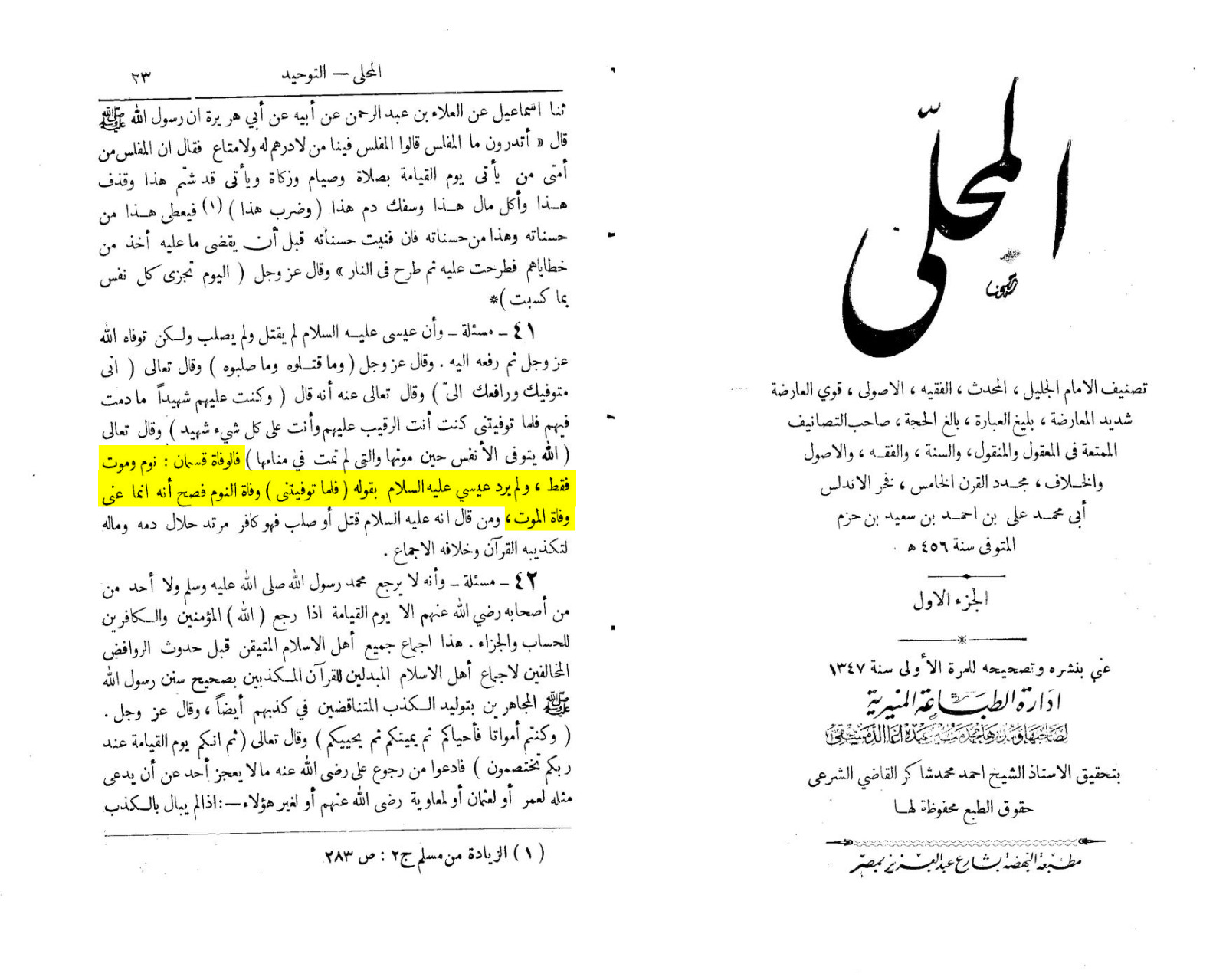
In Al-Muḥallā bi’l-ĀthārIbn Ḥazm mentioned the following:
“إلا أنهم اختلفوا في عيسى عليه السلام أيأتي قبل يوم القيامة أم لا” (“except that they differed concerning Jesus, peace be upon him, whether he will come before the Day of Resurrection or not.”)
Given that the book is about scholarly consensus (ijmā’) and the preceding discussion is about what the ulamā’ (scholars) have agreed upon it refers to the scholars (the jurists and theologians of the early generations). He is not specifically saying the Companions (ṣaḥābah) differed on this point, but rather that the body of authoritative scholars (which would include the Companions, their successors, and later jurists) held differing opinions on whether Jesus would return before the Day of Resurrection.
This is historically and theologically significant for several reasons:
Evidence of Early Disagreement: It confirms that among the early generations of Muslims (the Companions and their followers), there was not a unanimous consensus on the specific issue of Jesus’s second coming. This nuance is often overlooked in later, more standardized theological formulations.
Ibn Ḥazm’s Methodology: Ibn Ḥazm is famous for his strict and literalist approach to consensus. He only counts something as ijmā’ (consensus) if he can verify that all early scholars agreed upon it without any reported difference. By stating they “differed,” he is demonstrating that this particular point does not meet his rigorous criteria for consensus.
Contrast with Later Sunni Orthodoxy: While the belief in Jesus’s return later became a widely accepted and mainstream Sunni doctrine, Ibn Ḥazm’s report shows that its status as a universally agreed-upon tenet was not absolute in the earliest centuries of Islam.
From Al-Muḥallā bi’l-Āthār Ibn Ḥazm states:
The translation of the above text is:
2. Issue (Mas’alah): “And that Jesus (peace be upon him) was not killed nor crucified, but Allah Almighty caused him to die (tawaffāhu) and then raised him up to Himself. And Allah Almighty said: “And they did not kill him nor impailed him…” [Qur’an 4:157], and “O Jesus, I will cause you to die (mutawaffīka) and raise you to Myself…” [Qur’an 3:55], and He said about him [Jesus] that he said: “And I was a witness over them as long as I remained among them; but when You caused me to die (tawaffaytanī), You were the Watcher over them…” [Qur’an 5:117]. And Allah Almighty said: “Allah takes the souls (yatawaffā) at the time of their death, and those that do not die during their sleep…” [Qur’an 39:42]. So wafāh (death/dying) in our language means sleep and death only. And the word of Jesus (peace be upon him) — “When You caused me to die” — does not mean the death of [ordinary] dying, so it is established that he was made to die a true death [i.e., he died a natural death]. And whoever says that he (peace be upon him) was killed or crucified is a disbeliever, an apostate, whose blood and property are deemed lawful [to take], due to his falsification of the Qur’an and his contravention of the consensus (ijmā’).”- Ibn Ḥazm
3. Issue (Mas’alah): “And that Muhammed, the Messenger of Allah (saw), will not return [to this world], nor will any of his Companions (may Allah be pleased with them), except on the Day of Resurrection, when Allah brings the believers and the disbelievers for reckoning and recompense. This [view] is agreed upon by all the people of Islam, with certainty, before the emergence of the Rāfiḍah [Shi’ah] — those who oppose the people of Islam, who reject the Qur’an, who deny the authentic Sunnah of the Messenger of Allah (saw), who fabricate lies, and who are contradictory even in their falsehood. And Allah Almighty said: “And you were dead, and He gave you life; then He will cause you to die; then He will give you life [again]; then to Him you will be returned” [Qur’an 2:28]. And He said: “Then indeed, on the Day of Resurrection, you will be brought to dispute before your Lord” [Qur’an 39:31]. So whoever claims a return for ‘Ali (may Allah be pleased with him) — or makes a similar claim for ‘Umar, or for ‘Uthman, or for anyone else, may Allah be pleased with them, or for others — then such a claim is no more than falsehood.”-Ibn Ḥazm
Prima Qur’an comments: Just a note for the readers. The quotes from Ibn Ḥazm contradict the claims made by the Qadiani movement, (either split among them) as well as contradicts the claims made by Todd Lawson and/or the Nizari Ismaili.
“And whoever says that he (peace be upon him) was killed or crucified is a disbeliever, an apostate.”
The hadith evidence.
Let us look at the hadith evidence that justifies our position. Muhammed (saw) is the last and final prophet. He is the seal of all prophets and no one will come after him.
Narrated ‘Aisha:
(the wife of the Prophet) Allah’s Messenger (saw) died while Abu Bakr was at a place called As-Sunah (Al-‘Aliya) ‘Umar stood up and said, “By Allah! Allah’s Messenger (saw) is not dead!” ‘Umar (later on) said, “By Allah! Nothing occurred to my mind except that.” He said, “Verily! Allah will resurrect him and he will cut the hands and legs of some men.” Then Abu Bakr came and uncovered the face of Allah’s Messenger (saw), kissed him and said, “Let my mother and father be sacrificed for you, (O Allah’s Messenger (saw), you are good in life and in death. By Allah in Whose Hands my life is, Allah will never make you taste death twice.” Then he went out and said, “O oath-taker! Don’t be hasty.” When Abu Bakr spoke, ‘Umar sat down. Abu Bakr praised and glorified Allah and said, No doubt! Whoever worshipped Muhammed, then Muhammed is dead, but whoever worshipped Allah, then Allah is Alive and shall never die.” Then he recited Allah’s Statement.:– “(O Muhammed) Verily you will die, and they also will die.” (39.30) He also recited:
“And Muhammed is no more than a messenger; certainly the messengers before him have passed away; if then he dies or is killed will you turn back upon your heels? And whoever turns back upon his heels! he will by no means do harm to Allah in the least and Allah will reward the grateful.” (Qur’an 3:144)
Allah’s Messenger (saw) said, “My similitude in comparison with the other prophets before me, is that of a man who has built a house nicely and beautifully, except for a place of one brick in a corner. The people go about it and wonder at its beauty, but say: ‘Would that this brick be put in its place!’ So I am that brick, and I am the last of the Prophets.”
* Note* that the Blessed Messenger (saw) is the completion of the house and the final brick. That would not be so if Jesus (as) was to come again in the future. In fact if any other Prophet were to come than the Blessed Messenger (saw) would not be that final brick. More work would need to be done.
Narrated Abu Huraira:
The Prophet (saw) said, “The Israelis used to be ruled and guided by prophets: Whenever a prophet died, another would take over his place. There will be no prophet after me, but there will be Caliphs who will increase in number.” The people asked, “O Allah’s Messenger (saw)! What do you order us (to do)?” He said, “Obey the one who will be given the pledge of allegiance first. Fulfil their (i.e. the Caliphs) rights, for Allah will ask them about (any shortcoming) in ruling those Allah has put under their guardianship.”
Thawban narrated that the Messenger of Allah(saw) said:
“The Hour shall not be established until tribes of my Ummah unite with the idolaters, and until they worship idols. And indeed there shall be thirty imposters in my Ummah, each of them claiming that he is a Prophet. And I am the last of the Prophets, there is no Prophet after me.”
“Allah’s Messenger (saw) said, “I have five names: I am Muhammed and Ahmed; I am Al-Mahi through whom Allah will eliminate infidelity; I am Al-Hashir who will be the first to be resurrected, the people being resurrected there after; and I am also Al-`Aqib (i.e. There will be no prophet after me).”
“Blessed is the One Who sent down the Decisive Authority to His servant, so that he may be a warner to the whole world.” (Qur’an 25:1)
Due to our belief that the Qur’an is the divine revelation from Allah (swt) and the belief that it is the decisive authority that is sufficient for us.
We are a Muhammedan faith.
Our testification of faith is: I bear witness that there is no god but Allah and Muhammed is the Messenger of Allah. This is what a person says to enter into Islam. If we lived in the time of Jesus (as) we replace Muhammed (saw) with Jesus (as).
In our call to prayer we say: I bear witness that Muhammed is the Messenger of Allah.
Our The Tashahhud in the prayer itself contains invocation of Muhammed (saw) and the sending of blessings and peace upon him.
Sunni Muslims have a very challenging time with the statements of the Qur’an and wrestle with the text. So how do they try and convince people that Muhammed (saw) is the last prophet and yet another prophet will come after him?
We cannot count the times that we have encountered people of incredible intelligence and with formidable intellects that will look you straight in the face and tell you that Muhammed (saw) is the last Prophet and yet Jesus (as) is a Prophet that will come after Muhammed (saw).
The red line below represents Jesus (as). The green line below represents Muhammed (saw).
According to the majority Sunni view (with dissenting voices) Jesus (as) was taken bodily alive to heave where he remains. That means he was there during the time of the Blessed Prophet Muhammed (saw).
After the Prophet Muhammed (saw) has died, Jesus (as) as represented by the red line endures. He lives on. It is clear that this belief is that Jesus (as) is the last Prophet and not Muhammed (saw).
The non sequential argument. Basically Jesus (as) is A in the diagram below and the Muhammed (saw) is B in the diagram below.
It is clear that if A comes before B and comes again after B that A is last in the sequence, and thus the last Prophet. The haqq, the truth on this is so clear that we could ask a small child. Which of the letters appears last. A or B?
Others try to work around this by saying that what it means is that Muhammed (saw) is the last Prophet, but Jesus (as) was granted the title of Prophet before the coming of Muhammed (saw) and not after. Some have even claim that Jesus (as) is stripped of his title of Prophet when he returns. This should show you the utterly desperate situation they find themselves in.
The fact that they have to come up with these various interpretative devices shows you the weakness of their position. These interpretative devices help them to keep the falsehood alive. Repeat it enough and it becomes true.
You will be surprised at the multitudes of people that will accept this line of convoluted thinking. We believe many people realizing all the explaining away does not resolve the glaring contradiction but to be accepted they will silently nod their heads and move on.
Now what has sufficed for us is sufficient. As mentioned the hadith cannot clash with the Qur’an. In our school we do not come up with various scenarios to try and see how we can makes the masses accept the hadith concerning the coming of Jesus (as) conform with the clear teachings of the Prophet (saw) being the last prophet.
So let us recap something that was stated earlier:
Not only do we not find any evidence for the some second coming of Jesus (as) in the Qur’an. The idea of a second coming of Jesus (as) would conflict with information in the Qur’an.
So now let us share with you the view of the overwhelming vast majority of Muslims. Yes, the vast majority of Muslims believe what we are about to share with you. Remember truth is not a democracy. Alas, the majority of people across the world believe what they do as this is what they were taught to believe.
The vast majority believe that the Qur’an 4:157 teaches that Jesus (as) was not put on an ecclesiastical Cross and that instead Allah (swt) made another person look like Jesus (as) and that person was put to death on the ecclesiastical Cross.
The vast majority believe that the Qur’an 4:158 teaches that Jesus ascended in his body into the heavens.
The vast majority believe that Jesus (as) will descend in that body at some point in the future.
To be clear points 1 & 2 have absolutely no proof in the Qur’an. Not only this but we do not have a hadith of the Prophet (saw) that categorically state either belief 1 or 2 above.
Now let us look at the evidences from the Qur’an that are used to advance this idea that Jesus (as) will come back at some unspecified time in the future.
You will see that these so called evidences are inconclusive, weak and require some imaginative reading into the text in many cases.
“When Allah will say, “O Jesus, Son of Mary, remember My favor upon you and upon your mother when I supported you with the Pure Spirit and you spoke to the people in the cradle and in maturity.” (Qur’an 5:110)
“And there is none from the People of the Scripture but that he will surely believe in Jesus before his death. And on the Day of Resurrection he will be against them a witness.” (Qur’an 4:159)
After looking at the arguments from the Qur’an that are used as a justification to try and say that Jesus (as) is coming back in the second article we will be looking at the ahadith that are used. Again, as mentioned in the article before this one concerning the JuJ(Gog) and Majuj (Magog) our scholars are clear that we do not accept that those hadith are tawatur nor are they a proof for us. Nonetheless we will have an article with some discussion concerning it.
In the meantime for those interested you may wish to read:
“Say, “You will not be accountable for our misdeeds, nor will we be accountable for your deeds.” (Qur’an 34:25)
“Allah will judge between you on Judgment Day regarding your differences.” (Qur’an 22:69)
﷽
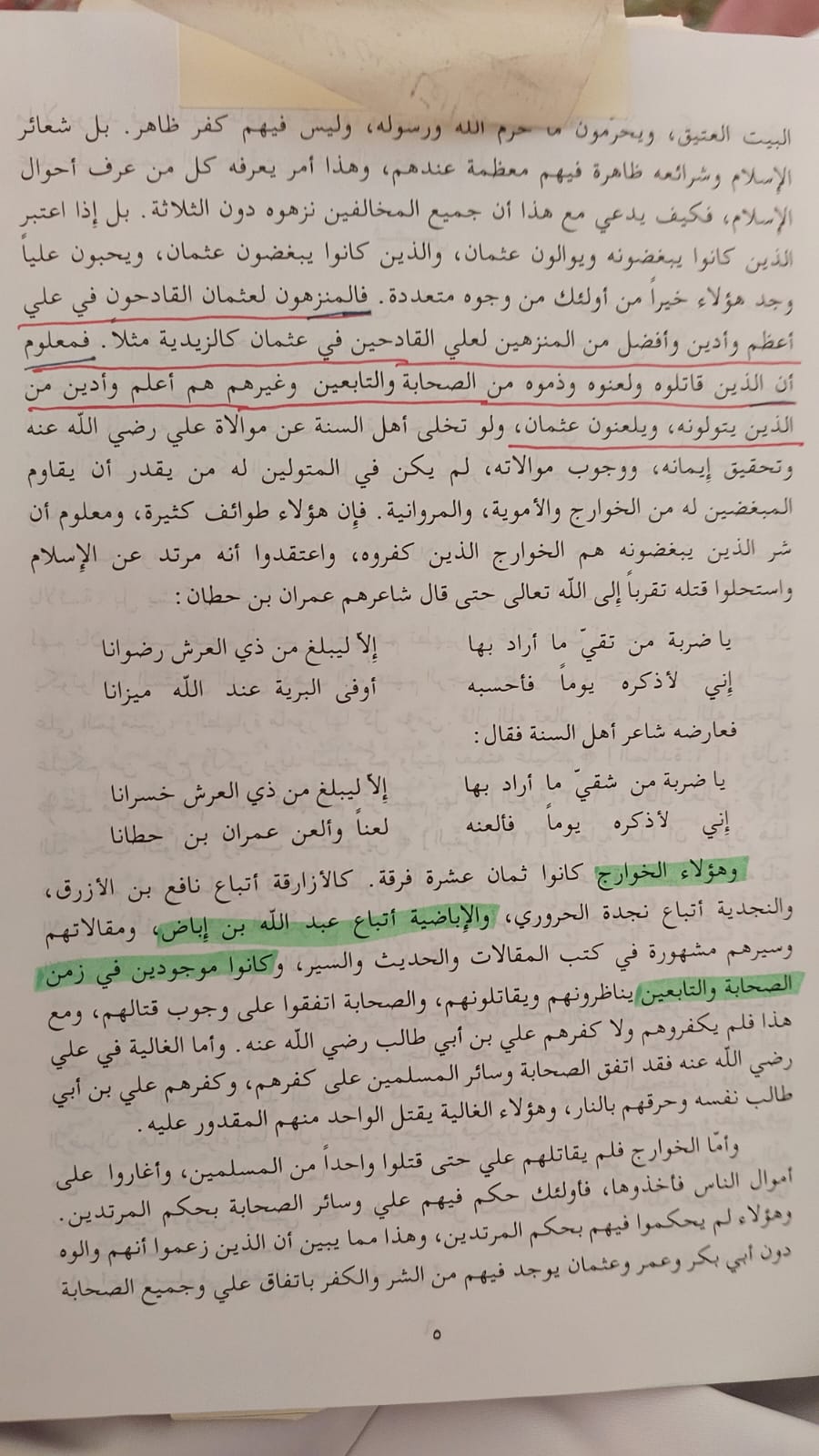
Some people ask what our view or understanding of Ibn Muljam is. Before understanding the positions that may exist concerning Ibn Muljam it is important for one to be familiar with various positions in regard to Ali ibn Abu Talib.
You can find the three stances that are found in the school here:
How can an individual be both in walayah and bara’ah with the righteous?
Possible scenario.
Person A left Gwadar Port. The people of that place know person A to be upright and fair dealing. However, Person A, when he arrives in Port Bell, is known to swindle and cheat people.
The righteous people at Gwadar port judge based upon his outward actions. The righteous at Port Bell judge based upon his outward actions.
The actions of the person in Port Bell never reach the people of Gwadar port.
The Ibadi and Ibn Muljam.
First, one has to realize that the early community of Muslims who differed with Ali’s decision at Siffin were not very fond of the Umayyads. Thus, it is not difficult to imagine that every grievance one had with the Umayyads would most likely would have implicated Ali in some way shape or form.
In a recent interview, Shaykh Sassi Ben Yahyateen from Tunisia (h) mentioned Ibn Muljam.
Interviewer: In my research, I found a historical accusation I don’t want to believe, so I will ask you about it. It is said that the Ibadis venerate and sanctify Abdul Rahman ibn Muljam, who killed Imam Ali (may Allah be pleased with him). What is your response?
Shaykh Sassi: You will not find in any reliable, respected book the sanctification of Abdul Rahman ibn Muljam.
Interviewer: What is the stance of Ibadis…
Shaykh Sassi:and Abdul Rahman ibn Muljam is not Ibadi. They say he was Sufri.
Interviewer: So, what is your stance on this figure?
Shaykh Sassi: We do not attack or sanctify any person in our books. If the accusations of murder are proven, he will be held accountable for it. We do not exonerate anyone. Conversely, you will not find cursing of any person in our books.
Interviewer: So, the murder is not proven in your narrations?
Shaykh Sassi: The murder is proven. But who killed? Who incited? Who planned? This is found in Hisham Ja’it and found in other books that explain it.
Prima Qur’an comments: “and Abdul Rahman ibn Muljam is not Ibadi. They say he was Sufri.“
With due respect to the esteemed Shaykh, Ibn Muljam was neither Ibadi nor Sufri. That is because these political/juristic distinctions did not happen until later.
One of our teachers Shaykh Hilal Al Wardi when asked about Abdur-Rahman Ibn Muljam gave a fair and balanced perspective concerning him (Abdur-Rahman Ibn Muljam).
As the Shaykh said, in general, no one speaks well or ill of him However, out of the thousands of Ibadi scholars that existed down through the ages there are some exceptions to the general rule.
Two examples of those exceptions.
Example one:
Abdullah ibn Muhammed ibn Barakah (r), a major scholar of the Ibadi school. He explicitly states in it the disavowal (al-bara’ah) of Ali, disavows Ali, and the allegiance (walayah) to Abd al-Rahman ibn Muljam, and being pleased with him, and praying for mercy on him (tarahhum).” Meaning “May Allah have mercy on Ibn Muljam, and may Allah be pleased with him”, and disavows Ali ibn Abi Talib.
So this is the view of the respected Shaykh. It is not a view that all Ibadi scholars agree with.
The second example.
In The book Al-Siyar wa-l-Jawabat li-‘Ulama’ wa-A’immat ‘Uman which was compiled and edited by Sayyidah Ismāʻīl Kāshif, who published the collection of these historical Ibadi text we find a view that states:
“We said to them: Likewise, Allah commanded Ali to fight them, so it is not permissible for him to abandon that nor to consider it forbidden to kill them until they fulfill the command of Allah.” This is evidence of the disbelief and misguidance of Ali, and the correctness and justice of the people of Nahrawan. “Then Ali (Allah scattered his command) was killed by Abd al-Rahman ibn Muljam out of anger for Allah, and that was permissible for him because he killed him.” Allah! “Those who command justice from the people. May Allah have mercy on Abd al-Rahman.”
This is the view of those who put Ali in bara’ah. When you see the word ‘disbelief’ yes you can read that as kufr. You have to understand that kufr can be of two types. One that expels form the millat of Islam and one that does not. The example for Ali ibn Abu Talib is the example of that which does not expel from the millat of Islam.
So there are three things in relation to Abdur-Rahman ibn Muljam.
That he took the right of the people of Al Nahrawan. Ali killed them with injustice and Abdur-Rahman was applying Qisas. *
That Abdur-Rahman Ibn Muljam fell in love with a woman named Qatam bint Shajna and that he chanced upon her while she was broken with grief over the loss of loved ones at Al Nahrawan. Abdur-Rahman Ibn Muljam proposed to marry her at which she wanted as dowry the head of Ali Ibn Abu Talib.
That Al-Ash’ath bin Qais, the double agent was not done sabotaging Ali. That Mu’awiya received word of what happened at Nahrawan and how people were deeply displeased with Ali’s actions (we saw the cooling in relation between Ali and Ibn Abbas-ra) and we also noted that Ibn Abbas (ra) was with Ali at the battles of Jamal and Siffin but absent at Nahrawan. Mu’awiya received word of the people’s displeasure sent Al-Ash’ath bin Qais who chanced upon Abdur-Rahman Ibn Muljam and hatched the plot to kill Ali.
*Note* There are historical reports that Abdur Rahman Ibn Muljam was with Ali in the killing of the people of Al Nahrawan, felt guilt and remorse and wanted to make amends by extracting vengeance upon Ali. The other is that he was with the people of Al Nahrawan all the while.
Other information is that he migrated during the Caliphate of ‘Umar (ra) And that he had received knowledge of Islam at the hands of Mu’aath ibn Jabal (ra) he was among the people of piety, and jurisprudence and among the and he was among the qurrā and the people of Fiqh and worship.
So for us in the Ibadi school we don’t have this view that the blood of the people of Nahrawan is cheap and Ali’s blood is expensive. Just like we do not say the blood of a white man is exspensive and the blood of a blackman is cheap. Just like we do not say the blood of an Arab is expensive and the blood of the Non Arab is cheap.
Justice is blind to status, lineage, or political allegiance.
No one is above the law.
We remind the people of what Allah (swt) says:
“That is why We ordained for the Children of Israel that whoever takes a life unless as a punishment for murder or mischief in the land—it will be as if they killed all of humanity; and whoever saves a life, it will be as if they saved all of humanity.” (Qur’an 5:32)
If anyone has an issue with Shaykh Hilal’s comments then this person would take issue with the Blessed Prophet (saw) himself who said:
Narrated `Aisha:
Usama approached the Prophet (saw) on behalf of a woman (who had committed theft). The Prophet (saw) said, “The people before you were destroyed because they used to inflict the legal punishments on the poor and forgive the rich. By Him in Whose Hand my soul is! If Fatima (the daughter of the Prophet (saw) did that (i.e. stole), I would cut off her hand.”
No one from among the Muslims is exempt from the justice of Islam, regardless of their status, clan, heritage etc.
So it could simply be that Abdul Rahman Ibn Muljam wanted revenge for the death of his loved ones, friends, and family who fell to Ali’s army. There are some people who among Muslims that believe that the blood of Ali is expensive and the blood of other Muslims is cheap. No, this is not the case at all.
Nonetheless Allah (swt) is the final judge. In regard to Abdul Rahman Ibn Muljam acting as some type of lone wolf. The last he knew is that the people of Nahrawan were unjustly attacked by Ali’s forces. To his (Ibn Muljam’s) knowledge there was no peace treaty or terms reached with Ali or his forces. Thus, being in a state of war he continued to act as a person in a state of war whose last legitimate authority was attacked and killed.
“Two years later Seyyidina Ali was murdered by one Ibn Muljam in 40H (661 CE) to avenge the massacre of the relatives of his wife at the battle of Nahrawan. The conspiracy to kill him was hatched, according to Jalaluddin Assyuti, In Mecca, not in Basra where there was a large concentration of the people of Nahrawan. The identity of Ibn Muljam is not known but some historical sources allege that he was a Khariji, and so they accuse the Khawarij including the Ibadhis, of having murdered Seyyidna Ali. Today some Muslim leaders bitterly complain that the Western media unjustifiably accuse Muslims in general of terrorism because of the tragedy which happened in the World Trade Center in New York on 11th of September, 2001 and perpetrated by a group of young men belonging allegedly to the Islamic faith. But the same Muslim leaders had been in the forefront in accusing Ibadhis today for a crime which was committed by one man almost 1400 years ago. Allah will punish the individual who murdered Seyyidna Ali but not all future generations belonging to a particular sect or madh-hab.”
Source: (pg.152 Ibadhism The Cinderella of Islam by Shaykh Soud H. Al-Ma’awaly)
Prima Qur’an comments: So you can see by the title of Seyyidina in front of the name Ali that Shaykh Soud H. Al-Ma’awaly is among those who believe that Ali repented for his actions. Though, we do not know on what basis he says that Allah (swt) will punish Ibn Muljam for his actions if the news of Ali’s repentance did not reach Ibn Muljam or as stated above no news of a cessation in hostilities reached him (Ibn Muljam). Allah knows best.
Lastly, Nahrawan & Karbala. Can you imagine if those of our school commemorated the atrocity of Nahrawan in the way that many Shi’i do with Karbala. Think about it. Imagine if every year people from the Ibadi school commemorated the massacre of the Muslims of al Nahrawan with poems, and wailing, and public displays of anger and sadness. How is that helpful to the unity of Muslims to commemorate such historical tragedies?
And a large majority of those killed from Ahl Nahrawan were companions and thousands of Muslims and the majority of those killed from Ahl Nahrawan that day were from the best of people on the earth that day and the most ascetic. Amongst them were those who fought the battle of Badr; those who gave allegiance under that tree and reciters and the best of the tabi’un.
Indeed, Allah Almighty purified them and praised them in the Quran, where He said: “Certainly was Allah pleased with the believers when they pledged allegiance to you, [O Muhammed], under the tree” (Qur’an 48:18)
And it is a known position that whomever Allah purifies becomes among the people of wilaya (divine allegiance/guardianship). No one specific is mentioned in the above verse. It simply says: “pleased with the believers.”
So how is it that, in the end, they label the Ibadiyya as Kharijites, as if they are challenging Allah by passing a judgment upon those whom Allah (swt) is possibly pleased with?!!
So as regard Ibn Muljam and the killing of Ali rather it was done with justice or not done with justice. It is best to leave it to history. However, if people want to be emotional about it we can propose the following.
We can say to those filled with emotion: “You make du’a that if Ali was not killed with justice that the one who killed him will be dealt justly by Allah and we will say ‘Amin’ along with you.
Likewise make the following du’a: “If the people of Nahrawan were not killed with justice that the one’s who killed them be dealt justly by Allah and we will say ‘Amin’ along with you.”
That is both reasonable and fair.
“If some of you do believe in what I have been sent with while others do not, then be patient until Allah judges between us. He is the Best of Judges.” (Qur’an 7:87)
Simple. No one from our school has any reason to be uncomfortable. So that is that, and let us move forward as an Ummah.
Our way is to be civil and to move on from the issues of the past.
This is unlike those Sunni Muslims on social media who come to the defense of the Umayyads dynasty and they frequently post pictures of Ali with his head severed. Or those Shi’i who made an entire film disparinging Umar ibn Al Khattab (ra) or who frequently insult Lady Aisha (ra).
If you have found this post educational you may enjoy the following:
This section will be miscellaneous information on a wide range of topics. This section does not necessarily reflect the views or attitudes of either the Ibadi school or adherents of the school.
Do note some links are broken. We are in the process of restoring those links.
Allah willing we will continue to update this section and organize it accordingly as well:
“The Jews and Christians each claim that none will enter Paradise except those of their own faith. These are their desires. Reply, “Produuce your proof if what you say is true.” (Qur’an 2:111)
﷽
In this blog post we look into the fascinating eyewitness testimony of the Christian faith as well as its historical corraboration.
First we start with what Christians call the apostle Paul.
“This is the third time I am coming to you. “In the mouth of two or three witnesses shall every word be established.” (2 Corinthians13:1)
“One witness is not enough to convict anyone accused of any crime or offense they may have committed. A matter must be established by the testimony of two or three witnesses.” (Deuteronomy 19:15)
The context and intention behind his application are specific:
The Original Context: In Deuteronomy, this law was designed to protect the accused in an Israelite court from false accusations, requiring physical or corroborating human witnesses for a criminal conviction.
Paul’s Application: Paul is applying this principle to establish the validity of his apostolic authority.
Paul’s biodata.
He has no provable biography.
We have no idea who Paul’s parents are.
Was Paul recorded in a Roman census?
We have no record of this.
Paul has no provable connection to Prophet Abraham alayhi s-salām
Paul has no provable connection to the tribe of Benjamin.
“I ask then: Did God reject his people? By no means! I am an Israelite myself, a descendant of Abraham, from the tribe of Benjamin.” (Romans 11:1)
“Circumcised on the eighth day, of the people of Israel, of the tribe of Benjamin, a Hebrew of Hebrews; in regard to the law, a Pharisee.” (Philippians 3:5)
This is a claim without evidence.
No genealogy is provided.
No Benjaminite registry exists to verify it.
No contemporary document outside his letters corroborates it.
In the Hebrew Bible, tribal identity was patrilineal and documented. Paul gives no father’s name, no clan, no ancestral town in Benjaminite territory (e.g., Gibeah, Mizpah). It is an unverifiable claim.
Ask a Christian, Oriental Orthodox, Eastern Orthodox, Roman Catholic, Presbyterian, Anglican to give you Paul’s genealogy traceable back to Benjamin. They can’t!
Paul and his name.
“Then Saul, who was also called Paul, filled with the Holy Spirit, looked straight at Elymas and said,…” (Acts 13:9)
If we say, “Paul says his name is Paul,” that proves nothing. Anyone can name themselves. Without external verification (e.g., Roman census records, contemporary letters from others, a tombstone, etc.), it’s just self-testimony.
“Studied under Gamaliel” – no evidence from Gamaliel.
“I am a Jew, born in Tarsus of Cilicia, but brought up in this city. I studied under Gamaliel and was thoroughly trained in the law of our ancestors. I was just as zealous for God as any of you are today.” (Acts 22:3)
Gamaliel was a famous rabbi (Acts 5:34–40). He is mentioned in later Jewish tradition (Mishnah). But:
Gamaliel never mentions Paul.
No rabbinic text lists Paul as a student of Gamaliel.
No contemporary records from Gamaliel’s academy name Paul.
Acts 22:3 is the only source for this claim. Again, Paul (or Luke writing for Paul) is the sole witness. By the legal principle Paul cited, this is inadmissible.
What is the proof that anyone met the ‘historical’ Paul?
Paul mentioned outside of his own writings?
“Bear in mind that our Lord’s patience means salvation, just as our dear brother Paul also wrote you with the wisdom that God gave him. He writes the same way in all his letters, speaking in them of these matters. His letters contain some things that are hard to understand, which ignorant and unstable people distort, as they do the other Scriptures, to their own destruction.” (2 Peter 3:15-16)
Beyond the fact that the authorship of 2 Peter is highly disputed there is no mention about meeting Paul here.
If we grant that it was indeed written by Peter, the passage doesn’t mention anything about meeting Paul in person, it just mentions Paul’s letters. So it’s a possible witness that Peter believed a person named Paul wrote some letters.
Then we have the following claim in Acts.
“When he came to Jerusalem, he tried to join the disciples, but they were all afraid of him, not believing that he really was a disciple. But Barnabas took him and brought him to the apostles. He told them how Saul on his journey had seen the Lord and that the Lord had spoken to him, and how in Damascus he had preached fearlessly in the name of Jesus.” (Acts 9:26-27)
This is contradicted by the following:
“I did not go up to Jerusalem to see those who were apostles before I was, but I went into Arabia. Later I returned to Damascus.” (Galatians 1:17)
So in this instance you have Paul’s own testimony versus a statement made about him some many years later.
Christianity demands I bet my soul on ONE guy, who claims to have met Jesus on the road to Damascus, with an undisclosed number of anonymous witnesses, witnesses who never wrote anything. That is a hard pass!
Paul’s own letters—which are our primary sources—never mention the Damascus road experience with companions present at all. He speaks of his encounter in intensely personal terms, and the elaborate narrative with Ananias, the blinding, and the companions only appears in Acts, written by someone else decades later.
No one witnessed Paul’s “vision”.
In Acts 9, the men traveling with Paul heard a voice but saw no one (Acts 9:7). In Acts 22, Paul says they saw the light but did not hear the voice (Acts 22:9). These are contradictory accounts of what the witnesses experienced. But crucially:
None of those men saw Jesus.
None of them testified to Paul’s claim that Jesus appeared to Paul.
They never wrote anything, and we don’t even know their names.
Who witnessed Paul receiving revelation from Jesus Christ?
“I did not receive it from any man, nor was I taught it; rather, I received it by revelation from Jesus Christ.” (Galatians 1:12)
Paul claims that he is receiving his revelation direct from Jesus rather than from human teachers who actually knew Jesus.
Who witnessed this?
Who witnessed Paul receving his revelation?
What condition did these witnesses describe?
1 Corinthians 15:3–8 :The testimony of Paul under the microscope.
3 For what I received I passed on to you as of first importance: that Christ died for our sins according to the Scriptures, 4 that he was buried, that he was raised on the third day according to the Scriptures, 5 and that he appeared (ōphthē – ὤφθη) to Cephas, and then to the Twelve. 6 After that, he appeared (ōphthē) to more than five hundred of the brothers and sisters at the same time, most of whom are still living, though some have fallen asleep. 7 Then he appeared (ōphthē) to James, then to all the apostles, 8 and last of all he appeared (ōphthē) to me also, as to one abnormally born.
Christians often quote this section of the New Testament as if it is some impressive tour de force, about historical Christianity often do not realize how historically weak the following claims are.
Paul claims“That he was buried, that he was raised on the third day according to the Scriptures.” That is not eye witness testimony. That is an appeal to contested interpretations of the Tanakh.
Paul claims “and that he appeared (ōphthē) to Cephas (Peter), then to the twelve.” The New Testament contains two letters attributed to Peter (1 Peter and 2 Peter). In these writings, he (Peter) does not explicitly claim to have seen the resurrected Jesus.
Then to the twelve.
Douay-Rheims (Catholic): “And that he was seen by Cephas, and after that by the eleven.” (Note: eleven, not twelve)
King James Version: “And that he was seen of Cephas, then of the twelve.”
Codex Bezae & some Old Latin manuscripts: Also read “eleven” instead of “twelve.”
“then to the twelve” is also incorrect. There was no living group called “the Twelve” at that time. After Judas’s suicide and before Matthias, they were eleven. after Judas died and before Matthias was chosen (Acts 1:15–26), the group was technically eleven.
Some manuscripts (Codex Bezae, some Old Latin) -Douay Rheims says eleven. So if you are Catholic we can let you off the hook (this time).
“After that, he (ōphthē) appeared to more than five hundred of the brothers and sisters at the same time, most of whom are still living, though some have fallen asleep”
More than 500! Most of whom are still living?!!
What are their names Paul?
What did they write?
Where is their testimony?
Ask a Christian, Oriental Orthodox, Eastern Orthodox, Roman Catholic, Presbyterian, Anglican to give you the names of these 500. Ask them to tell what those 500 wrote?
No early church father ever cites a single one of these 500 by name.
No hostile witness (e.g., Celsus, Porphyry, Lucian) ever says: “I checked with those 500 and they denied it.”
It’s an unfalsifiable claim, not a verifiable one. In any court of law, “I have 500 witnesses but I won’t tell you who they are” would be laughed out of the room.
“Then he (ōphthē)appeared to James, then to all the apostles, 8 and last of all he appeared to me also, as to one abnormally born.”
Where does James claim in his book to have seen the resurrected Jesus?
“and last of all he (ōphthē) appeared to me also, as to one abnormally born” Paul uses that same word “ὤφθη (ōphthē) Paul uses the same verb for his own “vision” on Damascus road (1 Cor 15:8 – “as to one abnormally born”) and for the appearances to Peter, the Twelve, 500, James.
Paul uses the identical verb for his own visionary experience and for the others he mentioned. In Greek, no distinction is made in the text between a physical, bodily resurrection appearance and a visionary one. That is a theological inference, not a linguistic one.
Seeing that Paul did not meet the historical Jesus but only claimed to have saw him in a vision then Paul had no way of distinguishing his vision from theirs, so we cannot trust that theirs was physical either!
If Paul’s appearance was visionary, and he uses the same verb for the others, the burden is on the apologist to prove theirs was physical—not on us to prove it wasn’t. And they cannot, because no independent witness describes what Peter or James or the 500 saw in physical terms!
We have no independent attestation from any of those 500, no names, no writings. Paul’s appeal to “most are still alive” is rhetorically powerful but historically unverifiable!
There are no independent witnesses to the resurrection appearance Paul claims. Paul is bearing witness for himself — which Deuteronomy 19:15 and 2 Corinthians 13:1 explicitly forbid as sufficient evidence.
After wading through the works of apologists like Gary Habermas, Josh McDowell, William Lane Craig, Norman Geisler, Lee Strobel, and Gleason Archer, one comes to realize that the entire enterprise is nothing but gobbledygook.
Major Premise (Paul’s own stated rule).
“A matter must be established by the testimony of two or three witnesses.” (Deuteronomy 19:15, quoted by Paul in 2 Corinthians 13:1)
Formalized: For any claim to be accepted as legally or factually established, there must be at least two independent, corroborating witnesses who are not the accused or the sole interested party.
Minor Premise (Paul’s claim)
Paul claims that Jesus appeared to him (1 Corinthians 15:8), that he received his gospel by revelation from Jesus (Galatians 1:12), and that this establishes his apostolic authority and the truth of Jesus’ resurrection.
Unnamed, unverifiable “500” witnesses (1 Corinthians 15:6) who left no written testimony.
No independent, identifiable, contemporaneous witness who saw what Paul claims.
(Applying the rule to Paul’s case)
Requirement
Does Paul meet it?
Two or more witnesses
No. Paul is the primary witness for his own vision/revelation.
Witnesses not identical with the accused
No. The accused (Paul) is testifying for himself.
Witnesses who can be named, examined, or cross-referenced
No. The 500 are unnamed. Acts’ author is anonymous and not contemporaneous.
Independent corroboration of the claimed event
No. No one else claims to have seen Jesus appear to Paul.
Testimony consistent across witnesses
No. Acts 9 vs. Acts 22 disagree on what the companions heard/saw. Galatians contradicts Acts on the Jerusalem visit.
Conclusion.
P1: According to Paul (citing Deuteronomy 19:15 and 2 Corinthians 13:1), no matter is to be established except on the evidence of two or three witnesses.
P2: A witness, to be valid, must be independent of the person making the claim, identifiable, and capable of providing corroborating testimony.
P3: Paul’s claim to have received revelation from the risen Jesus is supported only by:
P4: None of these constitute two or three independent, identifiable, corroborating witnesses under the standard Paul himself invokes.
C: Therefore, by Paul’s own stated legal principle, his testimony is insufficient to establish the matter of Jesus’ resurrection appearance to him, his divine revelation, or his apostolic authority.
This is the historicity and eye witness testimony that the Christian faith hinges upon.
The belief in Paul and his testimony hinges upon self claims. Christians inform us that Jesus is reported to have said:
“If I alone bear witness about myself, my testimony is not true.” (John 5:31)
The theological trap for Christians.
If a Christian accepts John 5:31 as Scripture they now face an insoluble problem:
Either John 5:31 applies universally (including to Paul), in which case Paul’s self-witness is invalid.
Or John 5:31 does not apply universally, in which case Jesus’ own saying is not a binding principle—undermining the authority of the Gospel of John itself!
There is no consistent position where:
John 5:31 is true,
Paul’s self-witness is sufficient,
And the standard is applied fairly.
If Christianity’s central resurrection claim depends on Paul’s testimony, and Paul’s testimony fails his own test, then the honest inquirer cannot be faulted for rejecting Christianity outright.
You may also be interested in reading the following:
“That is from the news of the unseen which We reveal to you. And you were not with them when they cast their pens as to which of them should be responsible for Mary. Nor were you with them when they disputed.”(Qur’an 3:44)
﷽
“This is the Book in which there is no doubt, a guide for the righteous. Those who believe in the unseen, and perform the prayers, and give from what We have provided for them. And those who believe in what was revealed to you, and in what was revealed before you, and are certain of the Hereafter.” (Qur’an 2:3-4)
The Qur’an is a book of which there is no doubt. It is for those who believe in the unseen. It is for those who are certain in the life to come. It is for those who believe in what was revealed before the Blessed Prophet (saw).
Those who are skeptical of those points will quite naturally arrive at different conclusions. So that is of no consequence for the believer.
“As for those who persist in disbelief, it is the same whether you warn them or not—they will never believe. Allah has sealed their hearts and their hearing, and their sight is covered. They will suffer a tremendous punishment.” (Qur’an 2:6-7)
Now, historians and orientalists cannot speak of the supernatural as these are matters of belief. They are beyond their point of historical investigation. However, we are always thrilled when we find historians and Orientalists corroborating the testimony of narratives in the Qur’an by finding manuscripts or parchments of information that, though not verbatim, closely mimic what Allah (swt) has revealed before. This is the understanding of the believer.
Do we find some information from various cultures that preceded the coming of the Blessed Prophet (saw) that seems to corroborate the beliefs of Islam? Yes! That is not scary! That is exciting!
Recall what Allah (swt) himself informed us of:
“We surely sent a messenger to every community, saying, “Worship Allah and shun false gods.” But some of them were guided by Allah, while others were destined to stray. So travel throughout the land and see the fate of the deniers!” (Qur’an 16:36)
Remember we are not responsible for the conclusions or perceptions of others.
If we look at the above graph. We can see that in block B the apparent (the dhahir) is that there are parchments, manuscripts, scrolls, oral traditions, inscriptions etc. that come before the Qur’an. However, when we look at block B, the haqiqah (the reality) is that Allah’s knowledge of what really happened precedes the information in B.Because of that reality, what is in C (The Qur’an) actually precedes the information in B. This is precisely why this hobbyhorse of orientalist and those who use the historical critical method is of absolutely no consequence for the believing Muslim.
We Muslims have been the first critics of our own sources. The clash of historical narratives between the Ibadi, Sunni and Shi’a is proof positive of this. The grading of the ahadith and the mention of variants in the transmission of the Qur’an have not come from people who lost faith, agnostics or atheists. They came from us, as believers. Subhan’Allah!
These other Johnny Come Lately types, HCM, etc., welcome to the party!
History and Miracles.
We don’t believe that miracles are historical. This does not mean that we do not believe that miracles did not happen. We just don’t believe that history can capture them.
Case in point: An Indian king, Cheraman Perumal, was reported to have seen the moon split. History can report such data, but it does not necessarily confirm nor interpret the data.
This particular entry is directed towards Christians. It is rather shameful that they have taken the approach that they have in these matters. Given that they too claim to believe in the unseen. They claim to believe in a Creator that can narrate past events that present people were not privy to.
“Then she brought him to her people, carrying him. They said, “O Mary, you have certainly done a thing unprecedented. O sister of Aaron, your father was not a man of evil, nor was your mother unchaste.”But she pointed to the babe. They said: “How can we talk to one who is a child in the cradle?” He said: “I am indeed a servant of Allah: He has given me revelation and made me a prophet; And He hath made me blessed wheresoever I will be and has enjoined on me Prayer and Charity as long as I live; He has made me kind to my mother, and not overbearing or miserable; So peace is on me the day I was born, the day that I die, and the day that I shall be raised up to life (again)”! Such (was) Jesus the son of Mary: (it is) a statement of truth, about which they (vainly) dispute.”(Qur’an 19:27-34)
“When Allah will say, “O Jesus, Son of Mary, remember My favor upon you and upon your mother when I supported you with the Pure Spirit and you spoke to the people in the cradle and in maturity; and [remember] when I taught you writing and wisdom and the Torah and the Gospel; and when you designed from clay like the form of a bird with My permission, then you breathed into it, and it became a bird with My permission, and you healed the blind and the leper with My permission; and when you brought forth the dead with My permission; and when I restrained the Children of Israel from [killing] you when you came to them with clear proofs and those who disbelieved among them said, “This is not but obvious magic.”(Qur’an 5:110)
“And a messenger to the Children of Israel, who will say, ‘Indeed I have come to you with a sign from your Lord in that I design for you from clay like the form of a bird, then I breathe into it and it becomes a bird by permission of Allah. And I cure the blind and the leper, and I give life to the dead – by permission of Allah. And I inform you of what you eat and what you store in your houses. Indeed in that is a sign for you, if you are believers.” (Qur’an 3:49)
Prima Qur’an comments:
In this article, we will give a response to those Christians who use as a polemic against Muslims the claim that the Qur’an contains apocryphal material in it and therefore cannot be a revelation from Allah (swt).
Now, of course, they will claim that there are more than the three verses of the Qur’an we quoted above as being from apocryphal material. However, we have chosen to focus on these three, as they are most often used by Christian polemicists in debates with Muslims.
Now, personally, we find this particular line of Christian attack against Islam amusing. However, they have to eventually come up with something, right?
Now let’s look at and listen carefully to what these Christians are actually disputing with us about.
*Note*
They are not raising the issue of “healing the blind.“
They are not raising issues against “curing people affected by leprosy.”
They are not raising issues against “give life to the dead.”
They are not disputing these points because they are miracles attributed to Christ Jesus that they find in their accepted canonical text. We will come to the term canonical in a moment.
What they are disputing is:
Jesus speaking as an infant
Jesus creating birds out of clay
Why do they dispute about these miracles?
Because they are not in what they accept to be their canonical text.
So what do the terms apocryphal and canonical mean?
Canonical in relation to Christian scriptures means:
“A biblical canon or canon of scripture is a set of texts (or “books”) which a particular religious community regards as authoritative scripture. … Believers consider canonical books as inspired by God or as expressive of the authoritative history of the relationship between God and his people.”
Apocryphal in relation to Christian scriptures means:
“Biblical or related writings not forming part of the accepted canon of Scripture; or writings or reports not considered genuine.”
So, if a Christian were to come to us and say that these statements in the Qur’an are found in apocryphal sources, the first thing you have to keep in mind that what they are actually saying isthat it is apocryphal according to their particular sect of Christianity!
The reason that is important is as follows: As we write this to you on 11/4/2024, Christendom has still not settled the issue of what is and is not apocryphal for the whole of Christianity.
Glaring examples are the following:
Depending on how you want to word it, you could say that the Protestants have 7 fewer books in their version of the Old Testament. Or you could say that the Roman Catholics have 7 extra books in their Old Testament that they accept to be inspired and not apocryphal.
Yet the Orthodox Church has additional Old Testament texts (or if you want to be neutral, the Protestants and Catholics have less). The same can be said for the Ethiopian Orthodox Church.
The same goes for the New Testament.
What is canonical is an issue that is still not settled among them.
The Chaldean Syrian Church does not accept the following as canon:
In fact, many Protestant Christians have declared Mark 16:8-20, & John 7:53–8:11 to not be canonical.
You have to wonder about the Protestant Christian theologians like John Calvin, Martin Luther, and others who most likely held such passages to be canonical. Yet there are Christians who do not agree with the idea that such passages are non-canonical. These Christians very much believe that Mark 16:8-20, &John 7:53–8:11 are inspired scripture.
So what is the point that is being made?
The point is that when a Christian says to us that those verses in the Qur’an are allegedly taken from apocryphal sources, it is important to understand that:
That though it may be apocryphal for that particular Christian, we can’t say for certain that it was apocryphal for the other Christians.
To keep in mind that what is and is not apocryphal has been and continues to be an internal dispute among Christians.
If the Christian is to counter by saying, “Can you name for me any Christian denomination today that accepts such and such text as canonical?”
The answer to that is: “No we can’t.” Many Christian sects and denominations over time have long perished. Most often the information we do have about them comes from their opponents.
What is also interesting, and we hope Muslims reading this bear in mind, is that no Christian committed to a consistent world view in which the supernatural happens can tell us that:
Jesus did not speak as an infant.
Jesus did not create birds out of clay.
This assertion is also supported by the text they accept as canon. Namely, the following:
“And Jesus did many other miracles in the presence of his disciples which are not written in this book: But these are written that you might believe that Jesus is the Christ, the Son of God; and that believing you might have life through his name” (John 20:30-31).
Prima Qur’an comments:
Now this writer, apparently inspired by Allah, felt that it was necessary to inform his readers that Jesus did many other miracles that are not contained within this book.
“There are many more things that Jesus did. If all of them were written down, I suppose that not even the world itself would have space for the books that would be written.” (John 21:25)
Prima Qur’an comments: Though we can all agree this statement is hyperbole, yet it is obvious that the writer knew that there was much more information about Jesus that could be shared.
Now, a possible Christian objection to our understanding of John 20:30-31 is that ‘the many other miracles that are not present in this book‘ could only be a reference to the miracles listed in Matthew, Mark, Luke that are not in the Gospel according to John.
The response to this is that it is simply an assumption.
It could be that:
It could be a reference only to the miracles present in Matthew, Mark, Luke that are not in the Gospel, according to John.
It could be a reference to miracles that are not present in any of those Gospel accounts.
It could be a reference to miracles present in Matthew, Mark, Luke as well as those not present in any Gospel accounts.
Christians could well ask: “Why wouldn’t these accounts of Jesus speaking as an infant or making birds out of clay make it into any of the Four Gospels commonly accepted among all of Christendom?”
Well, we have a clue about that from a text we have already mentioned.
“And Jesus did many other miracles in the presence of his disciples, which are not written in this book: But these are written, that you might believe that Jesus is the Christ, the Son of God; and that believing you might have life through his name” (John 20:30-31).
Prima Qur’an comments: This Gospel writer is telling us that he is informed about other miracles, but the seven particular miracles that he has selected is so that we may believe that Jesus is:
The Christ
The Son of God
Having eternal life through his name.
So, in the example of this Gospel writer, we have the reasons plainly stated why some miracles were chosen over others. Whereas for the other Gospels it’s hard to discern why they may have left out certain miracles.
For example, John’s Gospel includes the story of Lazarus rising from the dead. I’m puzzled why such an awesome event is not recorded by the other Gospels. Or Jesus turning water into wine is only included in the Gospel, according to John.
Equally puzzling is the following awesome account, which is not recorded by any ancient documents outside of Matthew itself.
“And behold, the curtain of the temple was torn in two, from top to bottom. And the earth shook, and the rocks were split. The tombs also were opened. And many bodies of the saints who had fallen asleep were raised, and coming out of the tombs after his resurrection they went into the holy city and appeared to many. When the centurion and those who were with him, keeping watch over Jesus, saw the earthquake and what took place, they were filled with awe and said, ‘Truly this was the Son of God’” (Matthew. 27:51-54).
There are no extra-biblical sources that mention this awesome event. Surely witnessing such an event would have been worthy of mention somewhere. In fact, this particular text created controversy even among conservative Christians when New Testament scholar and associate professor of theology Michael Licona raised questions about this text.
You can read about where Christians have done some damage control concerning this at the following:
So, again, going back to the Christian inquiry into why some awesome and miraculous events are recorded by some sources and not others, we can only surmise as to the motives behind this.
Why is it that Jesus speaking as an infant is recorded in some sources and not others?
Why is that Jesus making birds out of clay recorded in some sources and not others?
Why is it that the Gospel of Mark is now considered not to have a resurrection narrative, but other sources have it?
Why is it that Jesus raised Lazarus from the dead from some sources and not others?
Why is it that Jesus turned water into wine from some sources and not others?
Why is that only the Gospel of Matthew has this narrative about the mass resurrections of people appearing to many in the city?
Another interesting point to note is that, in the case of the Christian tradition that many of us will encounter today, Roman Catholics, Orthodox, and Protestants of many types, we have 30 years of the life of Christ Jesus that is completely missing altogether!
“Now Jesus himself was about thirty years old when he began his ministry. He was the son, so it was thought, of Joseph, the son of Heli.” (Luke 3:23)
So imagine all the people who needed to be healed, those who needed salvation, and what does the current Christian canon tell us about the early life of Jesus? Its silence about the early life of Jesus is awkward, to say the least.
It is honestly both shocking and disappointing that Christians would use these types of arguments against the Qur’an. It absolutely reeks of atheism, smacks of radical skepticism, and is stepped in a worldview bereft of the supernatural.
For us, as Muslims, we are informed about what happened concerning Jesus through divine revelation. As Allah (swt) says to the Blessed Messenger (saw):
“That is from the news of the unseen which We reveal to you. And you were not with them when they cast their pens as to which of them should be responsible for Mary. Nor were you with them when they disputed.” (Qur’an 3:44)
Also, notice that when the Christians make their particular claim about the Qur’an, they more often than not do present the sources which they claim the Qur’an takes the following from:
Speaking as an infant.
Creating birds out of clay.
We also find it interesting that Muslims don’t ask them for their sources.
The Christian polemicist usually has two sources in mind for this:
Those sources are: The Infancy Gospel of Thomas & The Protoevangelium of James.
“This little child Jesus when he was five years old was playing at the ford of a brook: and he gathered together the waters that flowed there into pools, and made them straightway clean, and commanded them by his word alone. 2 And having made soft clay, he fashioned thereof twelve sparrows. And it was the Sabbath when he did these things (or made them). And there were also many other little children playing with him.
“And a certain Jew when he saw what Jesus did, playing upon the Sabbath day, departed straightway and told his father Joseph: Lo, your child is at the brook, and he has taken clay and fashioned twelve little birds and has polluted the Sabbath day. 4 And Joseph came to the place and saw: and cried out to him, saying: Why are you doing these things on the Sabbath, which it is not lawful to do? But Jesus clapped his hands together and cried out to the sparrows and said to them: Go! and the sparrows took their flight and went away chirping. 5 And when the Jews saw it they were amazed, and departed and told their chief men that which they had seen Jesus do.”
Source: (Infancy Gospel of Thomas Chapter 2:1-5)
Prima Qur’an Comments:
This narrative speaks about Jesus creating 12 birds. The emphasis on the number 12 is there twice. This must relate to the 12 disciples. Whereas in the Qur’an we find no mention of this.
“Indeed I have come to you with a sign from your Lord in that I design for you from clay like the form of a bird, then I breathe into it and it becomes a bird by permission of Allah.” (Qur’an 3:49)
There is no mention of Jesus doing this act on the Sabbath Day. There is no mention of Jesus creating 12 birds. It is interesting to note that the Qur’andoes not name the number of Jesus’ disciples. Christians have not addressed this.
It would be interesting to know where the writer(s) of the ‘Infancy Gospel of Thomas’ got their information from. The earliest possible date of authorship is 80 A. D to 250 A. D. This is also roughly the time that the date of authorship is ascribed to ‘The Epistle to Titus‘, which is considered canonical by Christians today. These scholars date the epistle from the 80 A. D up to the end of the 250 A. D.
Source: (Raymond E. Brown, An Introduction to the New Testament. New York: Anchor Bible, p. 662)
“And when Jesus was five years old, there fell a great rain upon the earth, and the boy Jesus walked up and down through it. And there was a terrible rain, and He collected it into a fish-pond, and ordered it by His word to become clear. And immediately it became so. Again He took of the clay which was of that fish-pond, and made of it to the number of twelve sparrows. And it was the Sabbath when Jesus did this among the boys of the Jews. And the boys of the Jews went away and said to Joseph His father: Behold, thy son was playing along with us, and he took clay and made sparrows, which it was not lawful to do on the Sabbath; and he has broken it. And Joseph went away to the boy Jesus, and said to Him: Why have you done this, which is not lawful to do on the Sabbath? And Jesus opened His hands, and ordered the sparrows, saying: Go up into the air and fly; nobody shall kill you. And they flew, and began to cry out, and praise God Almighty. And the Jews seeing what had happened, wondered, and went away and told the miracles which Jesus had done.”
Source: (Infancy Gospel of Thomas Chapter 4)
Prima Qur’an Comments:
This story is very similar to the one in the ‘Infancy Gospel of Thomas’. What becomes apparent is that both of these sources are relying upon some oral tradition–one in which does not have a chain of transmission.
Now here is what is interesting about the Protoevangelion Jacobi or Infancy Gospel of James. One of the Christian polemicists that used this type of attack upon the Qur’anwas himself put in a difficult position in relation to this text.
@19:20 Ehrman asks: “What other documents are found in P72 as this is a document that resonates with you?”
James responds, “There are some non-canonical documents in P72 …
Ehrman replies, “Right, so I am just wondering about you resonating with this document”. Do you think that the scribe thought what he was copying was scripture?“
James, “Well, I don’t think you can simply jump to the conclusion that, because scribes included books in a single codex that they believed that everything within that codex was necessarily scripture.” There are sorts of works that were considered to be beneficial to people that were included in codices that were not necessarily canonical.”
Ehrman, “Yeah, I just think that it was odd that that particular manuscript was one that you resonated with because it’s the earliest attestation that we have of the protoevangelium jacobi.” (The Infancy Gospel of James) ..
Prima Qur’an Comments:
In other words, you can’t know for certain if the scribe who was copying this text (obviously from an even earlier source) was transcribing what he thought was divine writing! Especially in light of the fact that it is in the same genre of manuscripts that are generally described as “the most significant” papyrus of the New Testament to be discovered so far.
“Now, when the Lord Jesus had completed seven years from His birth, on a certain day He was occupied with boys of His own age. For they were playing among clay, from which they were making images of asses, oxen, birds, and other animals; and each one boasting of his skill, was praising his own work. Then the Lord Jesus said to the boys: The images that I have made I will order to walk. The boys asked Him whether then he was the son of the Creator, and the Lord Jesus made them walk. And they immediately began to leap; and then, when He had given them leave, they again stood still. And He had made figures of birds and sparrows, which flew when He told them to fly, and stood still when He told them to stand, and ate and drank when He handed them food and drink. After the boys had gone away and told this to their parents, their fathers said to them: My sons, take care not to keep company with him again, for he is a wizard: flee from him, therefore, and avoid him, and do not play with him again after this.”
Source: (The Arabic Infancy Gospel of Jesus)
Prima Qur’an Comments:
This text has Jesus not only making birdsbut apparently donkeys, oxen, and other (undisclosed) animals out of clay. There is an inquiry about him being the son of the Creator. There is no mention of the sabbath or any mention of the animals being of any number.
It’s thought that this Gospel has its origins in Syriac sources in the 5th or 6th century.
“We find what follows in the book of Joseph the high priest, who lived in the time of Christ. Some say that he is Caiaphas. He has said that Jesus spoke, and, indeed, when he was lying in His cradle, said to Mary His mother: “I am Jesus, the Son of God, the Logos, whom you have brought forth, as the Angel Gabriel announced to you; and my Father has sent me for the salvation of the world.”
Source: (The Arabic Infancy Gospel of Jesus).
Prima Qur’an Comments:
There is no mention of Mary carrying Jesus as a baby. There is no mention of the people asking Mary where this baby came from. This text has Jesus addressing his mother, the Qur’an has him addressing the people. The text above is filled with Christian doctrine: Jesus is the Son of God, he has a ‘Father’ and he was sent for the salvation of the world.
None of this is found in the account of the Qur’an.
Conclusion:
The attacks that Christian polemicists have leveled towards the Qur’anare the kind one would expect from radical skepticism, and a worldview bereft of the supernatural.
We can see that these sources the Christians point to have important details and radically different theological statements that we do not find at all within the Qur’an.
More telling is that Christians do not even quote these sources, or give the details of the accounts. Many of the people they speak to will not go and double-check the sources for themselves.
The fact that some Christians find these sources apocryphal is of no concern to us as Muslims. We as Muslims do not rely upon them or accept them as revelation either. Our acceptance of what is stated in the Qur’an comes from our faith in it as divine revelation and in what Allah (swt) himself has stated:
“That is from the news of the unseen which We reveal to you. And you were not with them when they cast their pens as to which of them should be responsible for Mary. Nor were you with them when they disputed.” (Qur’an 3:44)
Just as our faith in Jesus as the Messiah, the Word of Allah, and the Son of Mary are not dependent upon any book of the New Testament (even if the whole of Christendom) accepts it as canonical.
Christians themselves cannot totally rule out the possibility of Jesus having spoken as an infant or having given life to the clay birds based upon the following evidence:
“And Jesus did many other miracles in the presence of his disciples, which are not written in this book: But these are written, that you might believe that Jesus is the Christ, the Son of God; and that believing you might have life through his name” (John 20:30-31).
As well as the fact that the Gospel writers themselves have admitted to leaving out particular miracles that did not suit their desired goals.
“The truth is from your Lord, so never be among the doubters.”(Qur’an 2:147)
“And when they hear what has been revealed to the Messenger, you see their eyes overflowing with tears because of what they have recognized of the truth. They say, “Our Lord, we have believed, so register us among the witnesses.” (Qur’an 5:83)
May Allah (swt) guide the truth seekers!
If you enjoyed this article you may enjoy the following:
“You do not guide someone you love, but God guides anyone He wishes. He is quite Aware as to who are guided.” (Qur’an 28:56)
﷽
These are hadith that are brought against the Ibadi. They will say to us, how can some in your school put him in bara’ah when you have hadith like this?! The man was loved by Allah and his Messenger.
We do appreciate the passion as well as the question. Now this question is not directed to those in the Ibadi school who put Ali in walayah. Rather, it is directed towards those who have him in bara’ah.
As the majority are layman and people who have not delved into historical matters, the majority position is wuqoof.
So insh’Allah, we will examine the claims made in these hadith and respond to them.
The claim begins by quoting one of these hadith. In fact, if we are to be truthful, often our opponents are not honest people or they themselves innocent of the situation. Some of the dishonest will try and quote one hadith and hope you do not look at all the hadith being transmitted.
The first that can be said is that these hadith are ahad. They cannot be used to establish matters of aqidah for us. The majority view of our scholars is that none of the companions are in wilayat al-haqiqah-the real guardianship other than the wives of the Blessed Prophet (May Allah be pleased with them all and may the peace and blessings be upon our Prophet).
The hadith on the flag of Khaibar.
Narrated Sahl:
On the day (of the battle) of Khaibar the Prophet (saw) said, “Tomorrow I will give the flag to somebody who will be given victory (by Allah) and who loves Allah and His Apostle and is loved by Allah and His Apostle.” So, the people wondered all that night as to who would receive the flag and in the morning everyone hoped that he would be that person. Allah’s Messenger (saw) asked, “Where is `Ali?” He was told that `Ali was suffering from eye-trouble, so he applied saliva to his eyes and invoked Allah to cure him. He at once got cured as if he had no ailment. The Prophet (saw) gave him the flag. `Ali said, “Should I fight them till they become like us (i.e. Muslim)?” The Prophet (saw) said, “Go to them patiently and calmly till you enter the land. Then, invite them to Islam, and inform them what is enjoined upon them, for, by Allah, if Allah gives guidance to somebody through you, it is better for you than possessing red camels.”
Suhail reported on the authority of Abu Huraira that Allah’s Messenger (saw) said on the Day of Khaibar:
I shall certainly give this standard in the hand of one who loves Allah and his Messenger and Allah will grant victory at his hand. Umar b. Khattab said: Never did I cherish for leadership but on that day. I came before him with the hope that I may be called for this, but Allah’s Messenger (saw) called ‘Ali b. Abu Talib and he conferred (this honour) upon him and said: Proceed on and do not look about until Allah grants you victory, and ‘Ali went a bit and then halted and did not look about and then said in a loud voice: Allah’s Messenger, on what issue should I fight with the people? Thereupon he (the Prophet) said: Fight with them until they bear testimony to the fact that there is no god but Allah and Muhammad is his Messenger, and when they do that then their blood and their riches are inviolable from your hands but what is justified by law and their reckoning is with Allah.
`Ali happened to stay behind the Prophet (saw) and (did not join him) during the battle of Khaibar for he was having eye trouble. Then he said, “How could I remain behind Allah’s Messenger (saw)?” So `Ali set out following the Prophet (saw) , When it was the eve of the day in the morning of which Allah helped (the Muslims) to conquer it, Allah’s Messenger (saw) said, “I will give the flag (to a man), or tomorrow a man whom Allah and His Apostle love will take the flag,” or said, “A man who loves Allah and His Apostle; and Allah will grant victory under his leadership.” Suddenly came `Ali whom we did not expect. The people said, “This is `Ali.” Allah’s Messenger (saw) gave him the flag and Allah granted victory under his leadership.
“Tomorrow I will give the flag to somebody who will be given victory (by Allah) and who loves Allah and His Apostle and is loved by Allah and His Apostle.”
This indicates that Ali loves Allah (swt) and His Blessed Messenger (saw). It also indicates that this love is reciprocal.
“I shall certainly give this standard in the hand of one who loves Allah and his Messenger.”
This text indicates that Ali loves Allah (swt) and His Blessed Messenger (saw). However, it does not indicate that the love is reciprocal. In other words it does not indicate that Allah (swt) or his Messenger (saw) love him.
““I will give the flag (to a man), or tomorrow a man whom Allah and His Apostle love will take the flag,” or said, “A man who loves Allah and His Apostle.”
This text indicates confusion on what was actually stated.
This indicates to us that the hadith is muḍṭarib .
What is a muḍṭarib Hadith?
In Islamic Hadith sciences, a hadith is classified as muḍṭarib (meaning “shaky,” “agitated,” or “inconsistent”) when:
It is transmitted in multiple, contradictory ways (either in the chain of narrators or the text itself).
The opposing versions are of equal strength.
Because they are equally weighted, scholars cannot easily choose one version as the “correct” one over the other, leaving the absolute wording in doubt.
Applying the Concept to the Khaibar Text
If we look closely at the phrasing of the Prophet’s prophecy on the eve of Khaibar across all compiled sources, there is a clear textual Idtirab (inconsistency) regarding who loves whom:
Because these chains are all sound(narrated by premier companions and recorded in the Sahihayn), textually they clash with each other. They are of equal weight.
Why This Matters Theologically
This is exactly why your previous point carries so much weight. If a researcher isolates the Abu Hurairah variant (Muslim 2405), the theological conclusion is completely different from the standard narrative.
If the wording is unilateral (“he loves Allah”), the text only proves outwardly the companion’s intense loyalty and faith. It leaves the question of whether Allah reciprocated that love completely unstated.
Does this indicate that Ali is in wilayat al haqiqah (the real guardinship)? No. Because wilayat with the Prophets (peace be upon them all) is also in the dhahir (apparent).
“Ibrāhīm’s plea for his father’s forgiveness was only because of a promise he had made. But when it became clear that his father was an enemy of Allah, he (tabarra-a) disassociated from him. Indeed, Ibrāhīm was tender-hearted and forbearing.” (Qur’an 9:114)
This hadith is weak. One of the evidences that we use to establish that it is weak is that it contradicts the Qur’an. It has the Blessed Prophet (saw) displaying behavior in his prophecy that makes him as being one negligent of Allah (swt). May Allah (swt) forgive us.
“Tomorrow I will give the flag.”
“I shall certainly give this standard.”
“I will give the flag (to a man.”
“AndNever say(lā taqūlanna)about anything, “Behold, I shall do this tomorrow,”Without adding, “if Allah so wills!” But if you forget, then remember your Lord, and say, “I trust my Lord will guide me to what is more right than this.” (Qur’an 18:223-24)
This hadith goes against history.
Unless one wants to say the correct version is that Ali loved Allah (swt) and the Blessed Prophet (saw) and that is what the companions and the generation after them understood from the above narration. That is because if it is understood from the other way meaning , ‘Allah (swt) and his Blessed Prophet (saw) loved him’. It means the companions were completely oblivious to this or they simply didn’t care and attacked Ali anyway.
Different wordings.
The Prophet (saw) did not say if Allah wills and this hadith goes against the Qur’an.
It has the Prophet (saw) going against what Allah (swt) commands.
This hadith should be Mutawātirbut it is only ahad.
Logically, if the Blessed Prophet (saw) gathered his entire army on the eve of a major military victory and made a sweeping public declaration about who would receive the flag tomorrow, that event should have been witnessed and transmitted by hundreds, if not thousands, of people. It should be textually Mutawātir(mass-transmitted in identical wording across every single generation).
But structurally, it isn’t. It is classified as Ahad (solitary/isolated), split into narrow, competing chains of transmission (Isnad) that trace back to only a handful of individual Companions (mainly Sahl bin Sa’d, Salama bin Al-Akwa, and Abu Hurairah).
This reality presents two massive historical and structural problems:
1. The Bottleneck Problem (Why isn’t it Mutawātir?)
To be Mutawātir, a report needs a large volume of narrators at every single level of the chain. Even if 1,500 companions heard the Prophet say those words at Khaibar, the transmission immediately bottlenecked.
Only a few individuals actively chose to quote it to the next generation (Tabi’un). Because the vast majority of the army went home and didn’t formally establish a teaching chain for this specific sentence, the text legally lost its Tawatur status and fell into the Ahad category.
2. The Inevitable Result: Idtirab (Inconsistency)
Because the text relies on a few solitary paths (Ahad), it was stripped of the self-correcting safety net that a mass-transmitted Mutawātir text enjoys.
When hundreds of people repeat a sentence, memory errors get filtered out by the majority. But when only three or four narrow lines carry a quote down through the decades, any slight slip in a narrator’s memory, any paraphrasing, or any theological bias stands out immediately. This is precisely why we see the Idtirab we discussed earlier:
One line says: “Who loves Allah…”
Another says: “Whom Allah loves…”
Another says: “Both…”
The Critical Takeaway
By realizing that this hadith is Ahad and not Mutawātir, we have exposed the exact vulnerability that allows for these theological contradictions.
The hadith contradicts historical data.
Ibn Taymiyya said the following:
“Similarly, his statement: “Hating him (Ali) is a sin that no good deed can outweigh,” if someone hates him (Ali) and is an unbeliever, then his unbelief is what makes him miserable, and if he is a believer, then his faith benefits him even if he hates him (Ali).”
Source: (Minhaj As-Sunnah by Ibn Taymiyya Volume 3 page 26)
“Those who exonerate Uthman while criticizing Ali are greater, more devout, and better than those who exonerate Ali while criticizing Uthman, such as the Zaydis. It is well known that those among the Companions, the successors, and others who fought, cursed, and condemned Ali were more knowledgeable and devout than those who support him and curse Uthman.“
Source: (Minhaj As-Sunnah by Ibn Taymiyya Volume 3 page 5)
Prima Qur’an Comments: So given the historical data and the historical facts this also tells us that Ali was certainly not among some group of ten promised paradise.
Also, this does not mean that the incident at Khaibar itself was not historical but the historical reality afterwards can only indicate the following:
a) With the companions Ali only had the outward wilayah. Also known as Walāyah al-Ẓāhir(The apparent friendship).
b) The statement in the transmission “who loves Allah and his Messenger” must have been deemed more authentic by them. Meaning that Ali did indeed outwardly display love for Allah (swt) and his Blessed Messenger (saw) but it was not reciprocal.
This is the only explanation that makes sense of the historical data. Given the fact that they as Ibn Taymiyya stated, ‘who fought, cursed, and condemned Ali ‘. Also given the statement of Ibn Taymiyya that hate towards Ali does not harm one’s faith.
Hypothetical scenario
Let us say the hadith concerning the flag of Khaibar was Mutawātir. Let us say that they did not contain any variant. The wording was: Tomorrow, by the will of Allah, I will give the flag to somebody who will be given victory (by Allah) and who loves Allah and His Apostle and is loved by Allah and His Apostle.
This could mean that those Ibadi who hold Ali in walayah would be correct. That is to say that Ali repented for his actions in Siffin and Nahrawan. That he had a good ending. Allah knows best.
If you have enjoyed this article you may find the following beneficial.
“Say, “I am not the first messenger ever sent, nor do I know what will happen to me or you. I only follow what is revealed to me. And I am only sent with a clear warning.” (Qur’an 46:9)
“Whoever does an evil deed will not be recompensed except by the like thereof; but whoever does righteousness, whether male or female, while he is a believer – those will enter Paradise, being given provision therein without account.” (Qur’an 40:40)
“And whoever kills a believer intentionally, their reward will be Hell—where they will stay indefinitely. Allah will be displeased with them, condemn them, and will prepare for them a tremendous punishment.” (Qur’an 4:93)
﷽
The Hadith of the Ten Promised Paradise: A Critical Examination of Conflicting Narrations, Qur’anic Tensions, and Historical Evidence.
Many have heard of a narration that is attributed to the Blessed Prophet (saw) which seems to indicate that there are ten individuals whom the Blessed Prophet (saw) had promised Paradise.
Sometimes some Muslims seem so certain of a particular companion’s status. Wasn’t he known as the one who opened Khaybar? Wasn’t he the one who married the daughter of the Prophet (saw)? In fact, did he not marry two of the Prophet’s (saw) daughters?
And so forth. These same people tend to forget the following hadith:
Narrated Anas:
The Prophet (saw) said, “Some of my companions will come to me at my Lake Fount, and after I recognize them, they will then be taken away from me, whereupon I will say, ‘My companions!’ Then it will be said, ‘You do not know what they innovated in the religion after you.”
This indicates that after the death of the Blessed Prophet (saw), he was unaware of the affairs and conditions of the companions.
Being married to righteous people does not indicate righteousness for oneself.
“Allah sets forth an example for the disbelievers: the wife of Noah and the wife of Lot. Each was married to one of Our righteous servants, yet betrayed them. So their husbands were of no benefit to them against Allah whatsoever. Both were told, “Enter the Fire, along with the others!” And Allah sets forth an example for the believers: the wife of Pharaoh, who prayed, “My Lord! Build me a house in Paradise near You, deliver me from Pharaoh and what he does, and save me from the wrongdoing people.” (Qur’an 66:10-11)
We would expect that any divine source that would want to regulate and legislate the lives of human beings would be in harmony with itself. It would be consistent with all of its parts.
The 10 Companions Promised Paradise (al-ʿashara al-mubashsharūn)?
Here are the various ‘matn’ or text of the hadith and you can see the obvious conflict.
It should be noted that it is quite telling that this hadith is not to be found in Bukhari or Muslim, both of which have been regarded by the Sunni sect as the most authentic compilations of hadith.
The first thing that should be noted about the hadith is that it is ahad. These hadith have never been claimed to be mutawatir. Therefore they do not bring certainty in matters of (aqidah) creed.
Hadith A.
Narrated Sa’id ibn Zayd:
AbdurRahman ibn al-Akhnas said that when he was in the mosque, a man mentioned Ali . So Sa’id ibn Zayd got up and said:
I bear witness to the Apostle of Allah (peace be upon him) that I heard him say: Ten persons will go to Paradise:The Prophet (saw) will go to Paradise (1), Abu Bakr will go to Paradise (2), Umar will go to Paradise (3), Uthman will go to Paradise (4), Ali will go to Paradise (5), Talha will go to Paradise (6): az-Zubayr ibn al-‘Awwam will go to paradise (7), Sa’d ibn Malik will go to Paradise (8), and AbdurRahman ibn ‘Awf (9) will go to Paradise. If I wish, I can mention the tenth. The People asked: Who is he: So he kept silent. The again asked: Who is he: He replied: He is Sa’id ibn Zayd (10).
Total companions (excluding Prophet): 9 (since Prophet is #1).
Hadith B.
Narrated Sa’id ibn Zayd ibn Amr ibn Nufayl:
Abdullah ibn Zalim al-Mazini said: I heard Sa’id ibn Zayd ibn Amr ibn Nufayl (10) say: When so and so came to Kufah, and made so and so stand to address the people, Sa’id ibn Zayd caught hold of my hand and said: Are you seeing this tyrant? I bear witness to the nine people that they will go to Paradise. If I testify to the tenth too, I shall not be sinful. I asked: Who are the nine? He said: The Messenger of Allah (saw said when he was on Hira’: Be still, Hira’, for only a Prophet, or an ever-truthful, or a martyr is on you. I asked: Who are those nine? He said: The Messenger of Allah (saw) (1), Abu Bakr(2), Umar(3), Uthman (4), Ali (5), Talhah (6), az-Zubayr (7), Sa’d ibn AbuWaqqas (8) and AbdurRahman ibn Awf (9). I asked: Who is the tenth? He paused a moment and said: it is I(10).
Abdul Rahman bin `Awf said: The Prophet (saw) said: Abu Bakr in Paradise (1), Umar in Paradise (2), ‘Uthman in Paradise (3), Ali in Paradise (4), Talha in Paradise (5), al-Zubair bin al-‘Awwam (6) in Paradise, Abdul Rahman bin `Awf in Paradise (7), Sa’d bin Abi Waqqas (8) in Paradise, Sa’id bin Zayd (9), and Abu ‘Ubaida bin al-Jarrah (10) in Paradise.”
Sa’id bin Zayd narrated that the Prophet (saw) said to a number of people, “Ten are in Paradise.: Abu Bakr (1) in Paradise, Omar (2) in Paradise, ‘Uthman (3) , Ali (4), al-Zubair (5), Talha (6), Abdul Rahman (7), Abu ‘Ubaida (8), and Sa’d bin Abi Waqqas (9). He counted these nine and was quiet about the tenth. They said: By Allah, Abu-al Aawar (i.e. Sa’id), who is the tenth? He said: You swore by Allah – Abu-al Aawar (10)is in Paradise.” al-Tirmithi commented that Abu-al Aawar is Sa’id bin Zayd bin Amr bin Nawfal (10).
Total companions: 10 (including Saʿīd as the tenth).
The Flat Contradictions Between These Reports
Problem 1: Inclusion/exclusion of the Prophet (saw).
A & B explicitly include the Prophet as #1 of the ten.
C & D do not mention the Prophet at all; the list begins with Abū Bakr.
If the Prophet is one of “the ten,” then C and D are missing him → contradiction about who the ten are.
If the Prophet is not one of “the ten,” then A and B are wrong (or misreported) because they count him as #1.
And if we remove the Prophet from A & B, each has only 9 companions, not 10.
Problem 2: Numerical mismatch (9 vs. 10 companions)
After removing the Prophet from A & B → 9 companions.
C and D have 10 companions each.
Same “ten” cannot be both 9 and 10 people.
Problem 3: Inclusion/exclusion of Abū ʿUbaydah.
A & B: No Abū ʿUbaydah. The nine companions (after removing Prophet) are: Abū Bakr, ʿUmar, ʿUthmān, ʿAlī, Ṭalḥah, al-Zubayr, Saʿd, ʿAbd al-Raḥmān, and Saʿīd.
C: Abū ʿUbaydah is #8, and Saʿīd is #9. Actually, C includes both Saʿīd and Abū ʿUbaydah, totaling 10. That means compared to A&B (after removing Prophet), C adds Abū ʿUbaydah but keeps all nine from A&B? A&B’s nine: Abū Bakr, ʿUmar, ʿUthmān, ʿAlī, Ṭalḥah, al-Zubayr, Saʿd, ʿAbd al-Raḥmān, Saʿīd. C’s ten: Abū Bakr, ʿUmar, ʿUthmān, ʿAlī, Ṭalḥah, al-Zubayr, ʿAbd al-Raḥmān, Saʿd, Saʿīd, Abū ʿUbaydah. So C has all nine from A&B plus Abū ʿUbaydah → that would be 10 if the nine were correct. But A&B had exactly nine (excluding Prophet). So C has 10 distinct companions. Contradiction: A&B say the ten (including Prophet) = 9 companions; C says ten companions without Prophet = 10 companions. Different sets.
Problem 4: Saʿīd as the tenth (or not).
In A & B, Saʿīd is the tenth after counting the Prophet as first.
In D, Saʿīd is the tenth after nine others (excluding Prophet), and Abū ʿUbaydah is #8.
In C, Saʿīd is #9, Abū ʿUbaydah is #8, and there is no “tenth” issue — they are all named.
So Saʿīd’s position and role as “the tenth” differs across narrations, and in C he is not the tenth at all (he is ninth).
Conclusion.
Either the Blessed Prophet (saw) contradicted himself (which is impossible), or the narrations cannot all be factually correct reports of what he (saw) said about the same group.
If you look at the Arabic, you will notice something: the people behind sunnah.comdo not translate the chain of transmitters, and very often they do not translate the valuable comments.
Chain of transmission for Hadith A.
Muḥammed ibn al-ʿAlāʾ ← Ibn Idrīs ← Ḥuṣayn ← Hilāl ibn Yasāf ← ʿAbd Allāh ibn Ẓālim And Sufyān ← Manṣūr ← Hilāl ibn Yasāf ← ʿAbd Allāh ibn Ẓālim al-Māzinī Then Sufyān mentioned a man (unnamed) between him and ʿAbd Allāh ibn Ẓālim. Then Saʿīd ibn Zayd ibn ʿAmr ibn Nufayl narrates the main report.
Chain of transmission for hadith B.
Ḥafṣ ibn ʿUmar al-Namarī ← Shuʿbah ← al-Ḥurr ibn al-Ṣayyāḥ ← ʿAbd al-Raḥmān ibn al-Akhnas ← Saʿīd ibn Zayd.
Chain of transmission for hadith C.
Qutaybah ← ʿAbd al-ʿAzīz ibn Muḥammed ← ʿAbd al-Raḥmān ibn Ḥumayd ← his father (Ḥumayd) ← ʿAbd al-Raḥmān ibn ʿAwf (Companion).
Tirmidhī himself says at the end:
“This hadith has also been narrated from ʿAbd al-Raḥmān ibn Ḥumayd, from his father, from Saʿīd ibn Zayd, from the Prophet — similar to this. And this (the version from Saʿīd ibn Zayd) is more authentic than the first hadith. “
So Tirmidhī explicitly says the version through Saʿīd ibn Zayd is more authenticthan the version through ʿAbd al-Raḥmān ibn ʿAwf. That means the chain through ʿAbd al-Raḥmān ibn ʿAwf (the one provided) is weaker in Tirmidhī’s judgment.
Second chain mentioned (Abū Muṣʿab): Abū Muṣʿab ← ʿAbd al-ʿAzīz ibn Muḥammed ← ʿAbd al-Raḥmān ibn Ḥumayd ← his father ← the Prophet — without mentioning ʿAbd al-Raḥmān ibn ʿAwf in between. That means this version is mursal (missing the Companion link). A mursal hadith is weaker.
Chain of transmission for hadith D.
Ṣāliḥ ibn Mismār al-Marwazī ← Ibn Abī Fudayk ← Mūsā ibn Yaʿqūb ← ʿUmar ibn Saʿīd ← ʿAbd al-Raḥmān ibn Ḥumayd ← his father ← Saʿīd ibn Zayd narrated to him (Saʿīd ibn Zayd) in a group of people that the Prophet said…
Tirmidhī’s own comment: “I heard Muḥammed (al-Bukhārī) saying: ‘This (hadith) is more authentic than the first hadith.'”
So Tirmidhī (quoting Bukhārī) says this version is more authentic than the previous one (Ḥadīth 3). But that doesn’t mean it’s ṣaḥīḥ — just that it’s stronger than the weaker one.
Summary.
The version that aligns with the popular doctrine (10 companions, no Prophet, including Abū ʿUbaydah) is the weakestchain (Tirmidhī 3747).
The strongest chains (Abū Dāwūd) give a different list: Prophet + 9 companions, which is not the popular doctrine.
Bukhārī, the most trusted hadith collector, does not include any version of this report — a telling silence.
The political climate and context of these hadith.
First, it is important to note that both Abu Dawud and Tirmidhi lived during the Abbasid Caliphate.
Go back and take a look at Hadith A and Hadith B.
Notice immediately the politically charged climate of the hadith:
Hadith A.
“AbdurRahman ibn al-Akhnas said that when he was in the mosque, a man mentioned Ali. So Sa’id ibn Zayd got up and said: I bear witness to the Messenger of Allah (saw) that I heard him say: …”
Hadith B.
“When so and so came to Kufah, and made so and so stand to address the people, Sa’id ibn Zayd caught hold of my hand and said: Are you seeing this tyrant?”
What is not told to us is what was mentioned about Ali. It had to have been something severe in order for Sa’id ibn Zayd to stand up and then retell a narration. What this hadith tells us is that there was an anti-Ali sentiment. Also, the narrator is very careful about what he says. He cannot name the one who comes to Kufah — the one whom Sa’id ibn Zayd called a tyrant.
It is just very bizarre that such a hadith that could have diffused so much violence between Muslims becomes a sacred gem in the hands of the few. The few who seemingly only appeal to it in very odd circumstances.
Talha and Imam Ali fought each other in the Battle of the Camel. How can they both be people of Paradise?
This is further substantiated by the following hadith:
Narrated Al-Ahnaf bin Qais:
I went to help that man (i.e., `Ali), and on the way I met Abu Bakra who asked me, “Where are you going?” I replied, “I am going to help that man.” He said, “Go back, for I heard Allah’s Messenger (saw) saying, ‘If two Muslims meet each other with their swords then (both) the killer and the killed one are in the (Hell) Fire.’ I said, ‘O Allah’s Messenger (saw)! It is alright for the killer, but what about the killed one?’ He said, ‘The killed one was eager to kill his opponent.”
I set out with the intention of helping this person (Hadrat ‘Ali) when Abu Bakra met me. He said: Ahnaf, where do you intend to go? I said: I intend to help the cousin of Allah’s Messenger (saw), viz. ‘Ali. Thereupon he said to me: Ahnaf, go back, for I heard Allah’s Messenger (saw) as saying: When two Muslims confront one another with swords (in hand) both the slayer and the slain would be in Fire. He (Ahnaf) said: I said, or it was said: Allah’s Messenger, it may be the case of one who kills. but what about the slain (why he would be put in Hell-Fire)? Thereupon he said: He also intended to kill his companion.
The above hadith indicates that the Blessed Prophet (saw) did not interpret Qur’an 49:9 as it is being taught to the majority today.
“And if two partiesfrom among the believers engage in fighting make peace between them. But if one of them transgresses against the other, then fight against the transgressing group until they submit to the rule of Allah. If they do so, then make peace between both in all fairness and act justly. Surely Allah loves those who uphold justice.” (Qur’an 49:9)
Is there anywhere in the Qur’an where Allah (swt) addresses the believers by these words baghat and tabghī?
Can it be attributed to Allah (swt) that the transgressor takes life with right and with justice?
If one takes the life of the believer intentionally and without right what does Allah (swt) says?
“And whoever kills a believer intentionally, their reward will be Hell—where they will stay indefinitely. Allah will be displeased with them, condemn them, and will prepare for them a tremendous punishment.” (Qur’an 4:93)
Which brings us to another point. Where is this hadith during all these conflicts among the companions?
If this hadith were indeed true, then why did one not see Uthman use it in protest against those who found it lawful to murder him? Nor did any of his companions come to his aid, protesting the unlawfulness of killing someone who was guaranteed Paradise
The answer we get: He was being humble!
Umar (ra) is uncertain about his position before Allah.
“May Allah reward you with goodness and benefit others through you.
Is it true that Hudhayfah ibn al-Yaman (may Allah be pleased with them both) was present in Medina when the Commander of the Faithful, Umar (may Allah be pleased with him), was assassinated? Did the story of the Commander of the Faithful asking Hudhayfah if he was one of the hypocrites happen after he was stabbed? Did the Commander of the Faithful say he wanted to be buried beneath the feet of the Messenger of Allah (saw), or next to him? And who led the funeral prayer for the Commander of the Faithful after his death?
Hudhayfah narrated:
“Umar was invited to a funeral procession, so he went out for it or intended to go. I caught up with him and said, ‘Sit down, O Commander of the Faithful, for the deceased is one of them [the hypocrites].’ Umar said, ‘I adjure you by Allah, am I one of them?’ Hudhayfah replied, ‘No, and I will not clear anyone after you.'”
Al-Haythami stated in Majma al-Zawa’id: “Narrated by Al-Bazzar, and its narrators are trustworthy (Thiqat).”
Dr. Abd al-Salam Al-Isa, in his thesis (A Critical Study of Narrations Concerning the Personality of Umar ibn al-Khattab), attributed this to Ibn Abi Shaybah in Al-Musannaf, Al-Fasawi in Al-Ma’rifah wal-Tarikh, Waki’ in Al-Zuhd, and Al-Kharai’ti in Masawi al-Akhlaq. He concluded: “The chain of transmission with Waki’ is connected (Muttasil) and its narrators are trustworthy… therefore, the report is authentic (Sahih).”
Furthermore, this question was not unique to Hudhayfah. Umar also asked Umm Salamah (the Prophet’s wife) when she said: “I heard the Messenger of Allah (saw) say: ‘Among my Companions are those who will never see me again after I part from them.’ Umar asked her, ‘By Allah, am I one of them?’ She replied, ‘O Allah, no. And I will never clear anyone after you.'” (Narrated by Ahmad, Ibn Rahwayh, Abu Ya’la, Al-Bazzar, Al-Tabarani, and others).
Umar ibn Al-Khattab found out that Hudhayfa Al-Yaman was informed of the names of twelve hypocrites by the Prophet (saw). Umar asked Hudhayfa, “I adjure you by Allah! Tell me, am I one of them? Hudhayfa replied, “No, and I will not tell anyone anything further after this.”
Source: Sh. Gibril Haddad, Sunna Notes, p. 126, from Tabari in his Tafsir (11:11), Al-Bazzar through trustworthy narrators according to Al-Haythami (3:42), Al-Bayhaqi in Sunan Al-Kubra (8:200).
We are told that this is the mark of sincerity. Actually, it is not. These people are accusing Umar (ra) of being a hypocrite. If the Blessed Prophet (saw) had told him that he would be in Paradise, he would have no cause to doubt his status. So the only logical conclusion is that he was not informed of such.
Did Sa’d Ibn Abi Waqqas (ra) ever hear about the hadith of the 9/10 companions promised paradise?
Hadith 1.
“Narrated Sa`d bin Abi Waqqas:
I have never heard the Prophet (saw) saying about anybody walking on the earth that he is from the people of Paradise except`Abdullah bin Salam. The following Verse was revealed concerning him: “And a witness from the children of Israel testifies that this Qur’an is true” (46.10)”
“‘Amir b. Sa’d reported that he heard his father (Sa’d b. Abi Waqqas) say: never heard Allah’s Messenger (saw) say unto one living and moving about that he was in Paradise except to ‘Abdullah b. Salim.”
No Contradiction: Scholars like Ibn Hajar al-Asqalani explain that Sa’d made this statement before the Blessed Prophet Muhammed (saw) explicitly listed the 10 Companions.
Prima Qur’an response: We have already established that there is a contradiction in the list. Second what is the evidence that it was before the alleged statement?
Individual vs. Collective Glad Tidings: Sa’d’s statement refers to the Prophet (saw) singling out a random, specific individual while they were casually walking by. He noted that apart from Abdullah ibn Salam, the Prophet (saw) did not generally go about pointing at people and saying “this person is going to heaven.”
Prima Qur’an response: There is nothing in the hadith that indicates that Sa’d b. Abi Waqqas (ra) made any type of distinction.
Abdur Rahman Ibn Awf and Umar Ibn Al Khattab are uncertain about their position before Allah
Abdur Rahman ibn Awf entered upon ‘Umm Salamah and said: “O Mother of the Believers! I fear that I have been ruined; I am the wealthiest of the Quraysh [and recently] sold a piece of land of mine for forty thousand dinars.” She replied: “O my son, spend it! For indeed, I heard the Messenger of Allah (saw) say: ‘Indeed, among my companions are those who will never see me again after I separate from them.‘” [Abdur Rahman said]: “So I went to Umar and informed him. Umar then went to her and asked: ‘By Allah, am I among them?’ She answered: ‘O Allah, no. And I will not clear anyone after you.'”
Sunni response: This is also answered by saying, ‘Oh, this was revealed before the Prophet mentioned the ten in paradise.’
Prima Qur’an response: No, this is not the case. The reason this is not the case is because, in a matter of such gravity and severity, if the Prophet (saw) is still living, Abdur Rahman ibn Awf doesn’t need to go to Umar at all. Umar also doesn’t need to go back to Umm Salamah because he can verify the information directly with the Prophet (saw).
The Prophet (saw) himself was not in any position to gurantee anyone paradise.
Say, “I am not the first messenger ever sent, nor do I know what will happen to me or you. I only follow what is revealed to me. And I am only sent with a clear warning.” (Qur’an 46:9)
Now latter the Prophet (saw) received the following revelation from Allah (swt).
“So that Allah may forgive you for your past and future shortcomings, perfect His favour upon you, guide you along the Straight Path.” (Qur’an 48:2)
Some Sunni Muslims were seemingly not happy that (Qur’an 48:2) did not grant a special status to companions. So in their frustration they translated the above verse as follows:
“So that Allah forgives, for your sake, all the earlier and later sins (of all those people) of your Umma ([Community]* who struggled, fought and sacrificed by your command), and (this way) may complete His blessing on you (outwardly and inwardly) in the form of Islam’s victory and forgiveness for your Umma (Community), and may keep (your Umma) firm-footed on the straight path (through your mediation).” (Qur’an 48:2 Dr. Mohammed Tahir-ul-Qadr).
Narrated ‘Um Al-`Ala:
An Ansari woman who gave the pledge of allegiance to the Prophet (saw) said that the Ansar drew lots concerning the dwelling of the Emigrants. `Uthman bin Maz’un was decided to dwell with them (i.e. Um Al-`Ala’s family), `Uthman fell ill and I nursed him till he died, and we covered him with his clothes. Then the Prophet (saw) came to us and I (addressing the dead body) said, “O Abu As-Sa’ib, may Allah’s Mercy be on you! I bear witness that Allah has honored you.” On that the Prophet (saw) said, “How do you know that Allah has honored him?” I replied, “I do not know. May my father and my mother be sacrificed for you, O Allah’s Messenger (saw)! But who else is worthy of it (if not `Uthman)?” He said, “As to him, by Allah, death has overtaken him, and I hope the best for him. By Allah, though I am the Apostle of Allah, yet I do not know what Allah will do to me,”By Allah, I will never assert the piety of anyone after him. That made me sad, and when I slept I saw in a dream a flowing stream for `Uthman bin Maz’un. I went to Allah’s Messenger (saw) and told him of it. He remarked, “That symbolizes his (good) deeds.”
The above hadith that is attributed to the Blessed Messenger (saw) was from the very early period of Islam, because Uthman bin Maz’un was the first companion to be buried in Al-Baqi’. So when you consider the statement, “By Allah, I will never assert the piety of anyone after him,” this means that for the hadith of ‘The 10 promised Paradise’ to be true, it should have been saidbeforethis event.
So this means this knowledge was in circulation before. However, that would contradict the statement of the Blessed Prophet (saw): “By Allah, though I am the Apostle of Allah, yet I do not know what Allah will do to me.” Also, the hadith of ‘The 10 promised Paradise’ cannot come later than this event because it would be contradicted by the statement: “By Allah, I will never assert the piety of anyone after him.” What is calling 10 people the people of Paradise if not asserting their piety?
Even with this mountain of evidence one may still claim that the Prophet (saw) was informed by Allah who the 9 or 10 companions were.
“I swear by the star when it goes down. Your Companion is neither astray nor being misled. nor does he speak out of (l-hawa) desire. It is an inspiration (wahyun) that is inspired (yuha).” (Qur’an 53:1-4)
The problem with this is the evidence from what we have already established. We do not have anything definitive from the Blessed Prophet (saw) — not a definitive list. Such a list would contradict the information in a stronger hadith like the one presented above.
Why 10 promised Paradise? Why not 14? Why not 5?
Other companions of the Blessed Messenger (saw) were said to have been promised Paradise, such as Bilal bin Rabah, Ammar bin Yassir, Salman al-Farsi, Hamza bin Abdul Muttalib, Hassan, Hussein, Sa’d ibn Mu’adh, and Mu’adh ibn Jabal.
So what is the rhyme or the reason to clump these particular 9 or 10 together?
Many verses in the Qur’an and other hadiths promise Paradise to all early companions (Muhajirun and Ansar), the people of Badr, and the people of the Pledge of Ridwan. Critics argue that establishing a specific list of just ten implies exclusivity, making the rest of the companions seem inferior or unassured of their salvation despite their sacrifices.
The Qur’an and The Redundancy Problem.
“And the vanguard among (min al) the emigrants and the helpers, and those who followed them in goodness, Allah is well pleased with them and they are well pleased with Him, and He has prepared for them gardens beneath which rivers flow, to abide in them forever; that is the mighty achievement. And among (min al) those around you of the Bedouins are hypocrites, and also from the people of Madinah…” (Qur’an 9:100-101)
Key points:
The (vanguard) of early Muhājirūn and Anṣār is promised Paradise — not just ten individuals.
The verse explicitly contrasts them with hypocrites among the Bedouins and people of Madinah.
The phrase min al (among) indicates that within these groups there are hypocrites — but the sincere vanguard are promised Paradise.
If the Qur’an already promises Paradise to the entire vanguard of Muhājirūn and Ansar, then what is the purpose of the “ten promised Paradise” hadiths?
They are not adding new information. The ten are all from the vanguard of Muhājirūn. They are already included in the broad Qur’anic promise. So the hadiths are either:
Redundant (merely specifying examples of a larger category), or
Contradictory (if they imply that only these ten are promised Paradise, or that they have a special status not shared by other equally sincere Companions).
The Qur’an remains consistent: belief and righteousness determine Paradise, not association with any particular person or political faction.
If you have enjoyed this article, you may find the following articles beneficial.