“Joseph responded, “It was she who tried to seduce me.” And a witness from her own family testified: “If his shirt is torn from the front, then she has told the truth and he is a liar.” (Qur’an 12:26)
﷽
As Allah (swt) says, “washahida shāhidun min ahlihā” and a witness has witnessed from among themselves/folk/family.
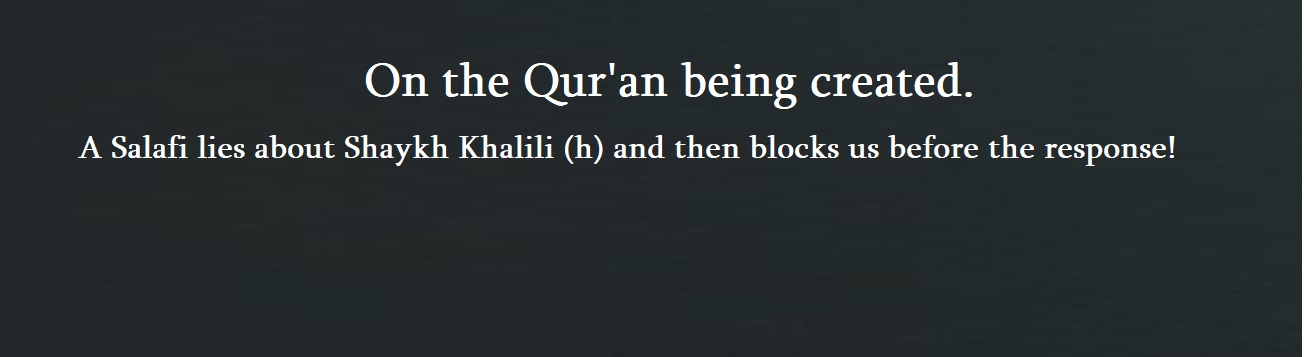
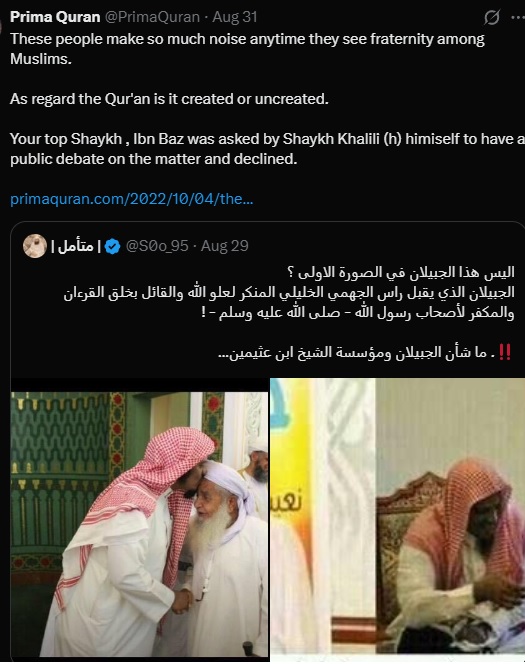
One of the more insolent of the claimants of Salafiyya were visibly upset at the love and camaraderie that is often shown between the people of Oman and the people of Saudi Arabia. This individual is from among those who like the division and fighting among the people. So this individual had posted once more attacking the noble Shaykh Ahmed Al Khalili as well as the good people of the Ibadi school.
So our reply was to remind this one that Ibn Baz himself was asked by Shaykh Khalili to have a public debate on the matter. This was in response to the interrogation and methods of Ibn Baz. It was pointed out to this man that he had his chance to prove the error of our creed and Ibn Baz backed down!
This is the link that was put in the reply to this individual:
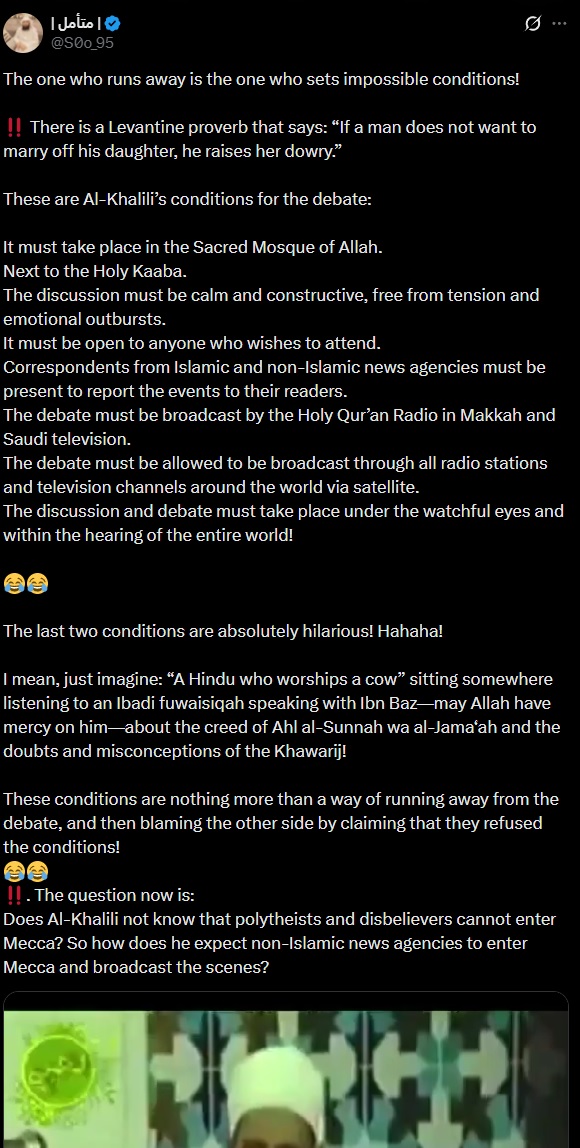
Sometimes when you see these laughing emoji you pray within yourself that you are not dealing with a teenager. This is not something from serious individuals. Yet, the part he seemed most tickled about the following:
“Does Al-Khalili not know that polytheist and disbelievers cannot enter Mecca? So how does he expect non-Islamic news agencies to enter Mecca and broadcast the scenes?”
This shows you that this individual did not even bother to read the initial link for if he had he would have already found something quite shocking.
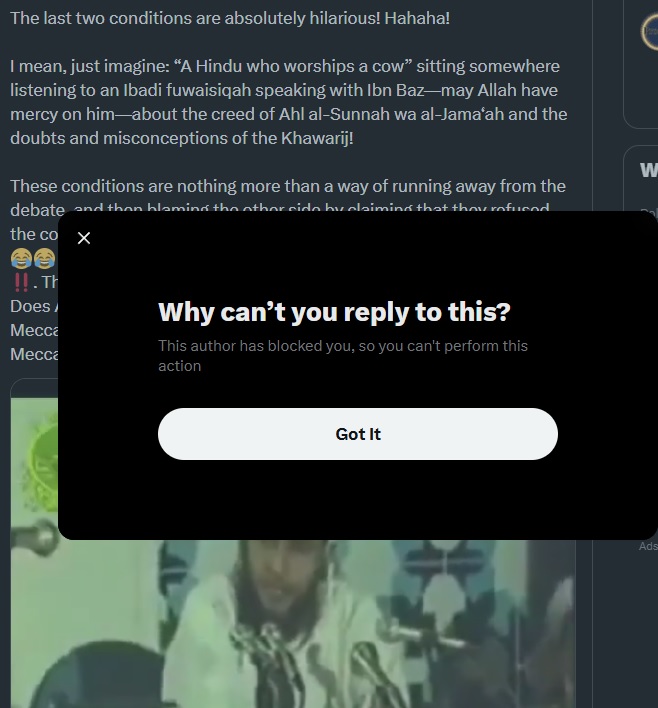
To our dismay the following showed up.
This ‘warrior’ of the supposed correct doctrine tucked tail and ran away. However, there is a day of reckoning in which we all be held accountable. For everything that our hands sent forth.
So let us address the part that tickled this individual.
“Does Al-Khalili not know that polytheist and disbelievers cannot enter Mecca? So how does he expect non-Islamic news agencies to enter Mecca and broadcast the scenes?”
Hmm. So the Mufti of a Muslim nation is not aware that polytheist and disbelievers cannot enter Mecca. How likely is this? This man must be unaware of the fact that Muslims themselves can be employed have been employed by Non Muslim media such as CNN and BBC.
Like how this non Muslim network documented the hajj?
The presence of world media does not equal to the presence of the world itself. Likewise the presence of non Muslim media does not equate to the presence of Non Muslims themselves.
But the deathblow to this rabble-rouser came not from Prima Qur’an, nor from any of the other Ibadi students or laypeople. The deathblow to this rabble rouser came from one of the students of Ibn Baz himself.
الشيخ عبد العزيز بن باز رحمه الله هذا الامام العجيب ارسل احد كبار المفتين في دوله عربيه وهو على مذهب الخوارج على مذهب الخوارج وهو مفتي تلك البلاد وهم ينكرون رؤيه الله جل وعلا كما تعلمون في الاخره ينكرون رؤيه الله كالمعتزلة [موسيقى] ولا نعلم في زمنه اعلم منه فقال لا لا ما ناقش قيل له لماذا يا شيخ قال طيب لما اناقشه قد يكون الحم بحجته مني فاكون سببا لضلال بعض الناس قد يكون الحم مني بالحجه والنقاش فيكون سبب يكون سبب لاظ بعض الناس فرفض الشيخ ناقش فان صاحب الحق لا يكون هيابا ولا جبانه بل صاحب الحق يجر على اظهار الحق الذي يعتقد
Which is translated:
“Shaykh Abdul Aziz ibn Baz, may Allah have mercy on him. This remarkable imam. Once received a message from one of the senior muftis in an Arab country, who follows the doctrine of the Khawarij. Yes, he follows the doctrine of the Khawarij, and he is the mufti of that country. They deny the seeing of Allah, may He be glorified and exalted, in the Hereafter. They deny the seeing of Allah, just like the Mu’tazila. And we do not know of anyone in his time more knowledgeable than him. So he said, “No, no,” and did not engage in debate. He was asked, “Why, O Shaykh?”He said, “Well, if I debate him, it might be that he overcomes me with his argument,and I would then be a cause for the misguidance of some people. Or it might be that I overcome him with argument and de bate, and that would be a cause for the misguidance of some people.” So the Shaykh refused. Debate, for the one who is upon the truth, should not be timid or cowardly; rather, the one upon the truth should be eager to manifest the truth that he believes in.”
Nothing in there at all about Non Muslim media networks! Just a simple admission that Shaykh Ibn Baz felt that Shaykh Khalili could have strong arguments!
As Allah (swt) says, “washahida shāhidun min ahlihā” and a witness has witnessed from among themselves/folk/family.
If you would like to read more about the issue of the Qur’an being created and other aqidah matters we encourage you to read the following:
“We sent them with clear proofs and the Zabur. And we revealed to you the message that you may make clear to mankind what was sent down to them and that they might give thought.” (Qur’an 16:44)
﷽
This section will be on engaging the Pseudo-Islamic.
In particular this section of the blog will have all articles related to two Pseudo-Islamic movements.
The first being the Hafs Qur’an Only Religion.
THE HAFS QUR’AN ONLY RELIGION
It is important to understand that we believe that the adherents of the Hafs Qur’an only movement are a distinct religion in much as we respect the way the Baha’i movement is a distinct religion from Islam.
Insh’Allah this section will deal with common arguments among the federation of sects that are known collectively as the ‘Qur’anist’.
This section will be refuting their many bold assertions; as well as showing why this particular attempt to re-interpret Islam and make it altogether different religion is deeply flawed.
Now why are they called the Hafs Qur’an only view? These people will either out of ignorance about the transmission and textual history of the Qur’an refer to their platform as ‘Qur’an Only’ or Quraniyoon. However, the Hafs Qur’an did not fall out of the sky. Thus, is important for them to reflect on why so much foundational trust is put into the men that transmittedthe Hafs Qur’an to the exclusion of all other transmissions of the Qur’an.
At the core of this religion of theirs is a massive epistemological problem.
In regard to approving comments from followers of the Hafs Qur’an Only Religion we have taken seriously the verse of the Qur’an: “And cooperate in righteousness and piety, but do not cooperate in sin and aggression. And fear Allah ; indeed, Allah is severe in penalty.” (Qur’an 5:2)
Thus, they would do well to read the article listed below: Is the Qur’an a detailed explanation of all things? to understand the policy on this website that keeps them as well as us from sinning and keeps them consistent with in their worldview. Insh’Allah.
THE QADIANI MOVEMENT Also known as AHMADIYYA MOVEMENT is a divided movement, split into two competing jama’at or congregations. That is the LAHORI whom we refer to as The Ahmadiyya A and the QADIANI whom we refer to as the Ahmadiyya B.
As the Qadiani or Ahmadiyyah B believe that Mirza Ghulam Ahmad is a Prophet after The Blessed Prophet Muhammed (saw), they have been marked as being outside the millat of Islam. Likewise, they (the Ahmadiyyah B) or Qadiani have made anyone outside of their jama’at to be kafirs. Though, their is some tongue in cheek wordplay see their website. Source: (https://www.alislam.org/articles/are-non-ahmadis-muslim-or-non-muslim-ahmadiyya-muslim-perspective/)
To the dismay of the Muslim Ummah, The Qadiani have a Khalifa, named MIrza Masroor Ahmed, he lives in Tilford, United Kingdom, where he pays taxes to the United Kingdom. Abu Bakr, Umar, Uthman and Ali were not known to have paid taxes to a Non Muslim government.
For future reference all articles addressed to either of the above movements will be found under: AHL AL-QIBLA / AHL AL-KHILAF under: Engaging with the Pseudo-Islamic:
Refutation that oral traditions came 300 years after the Prophet.
Even though they used to say that the hadith -oral traditions came some 300 years after the Blessed Messenger (saw). Praise be to Allah the more educated among them have backed away from that claim. However, this article is here because many in that movement may be unaware.
See Harold Motzki (a Non-Muslim orientalist and academic) who made short work of that Quranist claim
Does the Qur’an itself tell us to reject all hadith?
This article is a nail in the coffin for the entire movement. Some from their movement have commented but ended up leaving in frustration. It looks at their arguments and misquotations of the Qur’an. Also given in this article is an irrefutable example of Allah confirming a hadith to the Blessed Messenger [saw].
Did the Blessed Prophet Muhammed (saw) write the Qur’an?
Our colleague had written a refutation like this many years ago on the ‘Qur’an only‘ web site known as http://www.ourbeacon.com/ or it used to be known as ‘GalaxyDastak‘. Dr. Shabbir Ahmed founder of the forum had me banned. This was also the last our colleague heard from their former teacher Hamza AbdulMalik. Hamza AbdulMalik used to be the director of IPCI international until he dropped off the radar and re-emerged as a Quranist.
Well, our colleague may have been removed from the forum but here is the refutation of their arguments for all to see here:
A pre-eminent argument used by ‘Quranist’ ripped to shreds By Dr. Jeffery Lang.
The most oft-quoted verse used by Quranist is analyzed and ripped apart by a Muslim convert, academic, and professor of math, Dr. Jeffery Lang.
This is a centerpiece argument used by Edip Yuksel, Sam Gerrans, “Joseph Islam”, Rashad Khilafa, Shabir Ahmed and the lot of them. The reason why this argument is especially devastating coming from someone like Dr. Jeffry Lang is that Dr. Lang is critical of the hadith corpus as we have it today.
The following is a look how Quranist have both misunderstood the word hikma as a reference to the Qur’an and how they do not understand that it is something that Allah gives his messengers to deal with situations and context not immediately addressed by the revelations they were given.
Hating a hadith just for the sake of hating a hadith.
This article a hypothetical question is posed. What if a particular ahad hadith turned out to be correct? Especially one that is of a scientific nature? What would the Quranist do in such a scenario?
Salaat in the Qur’an is not ritual prayer? Examining the claim of some Quranist.
This article looks at one Quranist claim that salat is not ritual prayer. This is what happens when you abandon the understanding of the Blessed Messenger and follow the ‘every man for himself’ approach of the Quranist.
“Surely your Lord is Allah Who created the heavens and the earth in six Days, then established Himself on the Throne, conducting every affair. None can intercede except by His permission. That is Allah—your Lord, so worship Him. Will you not then be mindful?” (Qur’an 10:3)
“He knows what is ahead of them and what is behind them. They do not intercede except for whom He approves, and they tremble in awe of Him.” (Qur’an 21:28)
“Allah! There is no god except Him, the Ever-Living, All-Sustaining. Neither drowsiness nor sleep overtakes Him. To Him belongs whatever is in the heavens and whatever is on the earth. Who could possibly intercede with Him without His permission? He knows what is ahead of them and what is behind them, but no one can grasp any of His knowledge—except what He wills . His Throne encompasses the heavens and the earth, and the preservation of both does not tire Him. For He is the Most High, the Greatest.” (Qur’an 2:255)
“It is You we worship and You we ask for help.” (Qur’an 1:5)
“And he entered the city at a time of inattention by its people and found therein two men fighting: one from his faction and one from among his enemy. And the one from his faction called him for help ( fa-is’taghathahu)against the one from his enemy, so Moses struck him and killed him. said, “This is from the work of Satan. Indeed, he is a manifest, misleading enemy.” (Qur’an 28:15)
﷽
Seems there has been a great deal of heated debate and discussion on this topic as of late. However, this has been the case with the Muslim Ummah for quite some time.
Tawassul is asking Allah for help through an intermediary. This has it’s types and conditions.
Istigatha is asking for urgent help in times of distress. This too has it’s types and conditions.
First point.
Note that all three of the text (Qur’an 10:3) & (Qur’an 21:28) & (Qur’an 2:255) that are quoted above are speaking about third parties that may be in a position to to ask something on behalf of others.
None of the above three text speak about a first person party (a petitioner) seeking something from Allah (swt) via an intermediary, be it an angel, a wali of Allah (swt) or even his Blessed Prophets (upon them all be peace).
Second point.
None can intercede except by what Allah (swt) grants permission or approves.
If a righteous person like the Blessed Prophet (saw) for example prays for his Uncle to enter into heaven and his Uncle did not repent or enter into Islam, then the intercession of the Blessed Prophet (saw) is of no use.
“You surely cannot guide whoever you like, but it is Allah Who guides whoever He wills, and He knows best who are guided.” (Qur’an 28:56)
“Praying or not praying for their forgiveness will make no difference. Even if you (O Prophet) were to pray seventy times for their forgiveness, Allah would not forgive thembecause they reject Allah and His Messenger. Allah does not guide those who are defiantly disobedient people.” (Qur’an 9:80)
Or for example if the Prophet (saw) tried to intercede with Allah (swt) for those Muslims who died without repenting from taking the life without right, shirk, fornication or adultery and they did not seek repentance from Allah (swt). The Prophet’s intercession would be null and void!
“And those who do not invoke with Allah another deity or kill the soul which Allah has forbidden [to be killed], except by right, and do not commit unlawful sexual intercourse. And whoever should do that will meet a penalty. Multiplied for him is the punishment on the Day of Resurrection, and he will abide therein humiliated –Except for those who repent, believe and do righteous work. For them Allah will replace their evil deeds with good. And ever is Allah Forgiving and Merciful.” (Qur’an 25:68-70)
This is the world of asbab (أَسْبَابْ) a world of cause, means and occasions.
The Muslim understands that this is the world of cause, means and occasions. We are 3D carbon based platforms and this is how we understand and perceive things. However, we are also informed:
la hawla wala quwwata illa billah -there is no power or no strength except with Allah.
“If only you had said, upon entering your property, ‘This is what Allah has willed! There is no power except with Allah!’ Even though you see me inferior to you in wealth and offspring.” (Qur’an 18:39)
That is to say that if we believe that we can type this very text independent of Allah’s power, we are either making a claim to divinity or asserting a share of divine power.
A Muslim does not believe that a knife in and of itself has the ability to cut but that Allah (swt) grants it that quality and ability.
“It is You we worship and You we ask for help.” (Qur’an 1:5)
So if a Muslim seeks a doctor for a cure, or builds a shelter from the rain are they seeking or depending upon other than Allah (swt) for help? Of course not. The recognition is that we live in the world of causes, means and occasions. That is what is immediately perceptible to us.
Take the example of Mary (as) she was pregnant with Jesus (as) and was hungry.
The Angel directs Mary (as) towards a creation of Allah (swt).
“And shake the trunk of this palm tree towards you, it will drop fresh, ripe dates upon you.” (Qur’an 19:25)
The Angel could have directed Mary (as) to a dead tree, or a dead branch or a log. However, she (as) was directed towards a living tree.
جَزَاكَ ٱللَّٰهُ خَيْرًا or Jazak Allahu Khayran is a common Arabic expression among Muslims. It is said when receiving some good, service or benefit from another person.
It is a way of showing gratitude in a dual manner, by immediately thanking the person (he/she) that brought the good but also realizing that ultimately it is Allah (swt) whom used this person (he/she) to bring the khayer (goodness) to you.
Tawassul in the Qur’an?
First what is Tawassul?
Basically it means to use something to arrive to something else. As a path.
Tawassul is the act of seeking help from Allah (swt) via an intermediary. In relation to this we have the Arabic word Al-Wasila.
You can find derivates of the word twice in the Qur’an.
The first text ((Qur’an 5:35)is the one the usual champions of tawassul are quick to quote.
The second text (Qur’an 17:57) is the one the champioins of tawawassul are not so quick to quote. Insh’Allah you will see why.
1st instance of wasila.
“O you who believe! Be careful of (your duty to) Allah and seek means of nearness (l-wasilata) to Him and strive hard in His way that you may be successful.” (Qur’an 5:35)
This is the text that usual champions of Tawassul would prefer you rather not quote.
Note that the text says to seek a means of nearness and it could have easily mentioned the Blessed Prophet (saw) exclusively but it did not.
Seeking the means of nearness is not exclusive to asking the pious to pray for us.
We know that praying in a group (Jamaat) is more beloved to Allah (swt) then praying alone. We know that praying in a Masjid is more beloved to Allah (swt) then not praying in the Masjid.
We know that praying in Mecca or Medina is more beloved to Allah (swt) then not praying in either of those two cities. Prayer in Mecca is more preferable then prayer in Medina.
Now the usual advocates of tawassul would have to prove that a singular individual praying to Allah (swt) via the station of the Blessed Prophet (saw) would be superior to a whole congregation of people doing dhikr of Allah (swt).
They would have to prove that a singular individual praying to Allah via the station of the Blessed Prophet (saw) would be superior to an individual praying to Allah (swt) in Mecca without mentioning the Blessed Prophet (saw).
In other words there are a plethora of acts and actions in Islam that are more meritorious then praying to Allah (swt) and beseeching Allah (swt) via the station of the Blessed Prophet (saw).
2nd instance of wasila.
“Say, “Invoke those you claim besides Him. They do not have the power to undo harm from you or transfer it.” “˹Even˺ the closest ˹to Allah˺ of those invoked would be seeking a way (l-wasilata) to their Lord, hoping for His mercy, and fearing His punishment. Indeed, your Lord’s torment is fearsome.” (Qur’an 17: 56-57)
Shaykh Dr. Kahlan Al Kharousi (h) speaks on three types of Tawassul.
First type: Asking Assad to make du’a and thinking that it will be accepted because Assad has got the power to do so. This is clearly shirk. We are very clear about this.
The evidence from this is from the Qur’an:
“If only you had said, upon entering your property, ‘This is what Allah has willed! There is no power except with Allah!’ Even though you see me inferior to you in wealth and offspring.” (Qur’an 18:39)
“How powerless are those who invoke and those invoked!“ (Qur’an 22:73)
For example if as a Muslim one were to believe that they could type this very text independent of the power of Allah (swt) this would be a claim to divinity and shirk.
Second type: (which all madhabs classify as Mubaah Halaal-meaning neutral or permissible.) -This includes the Ibadis.
This is the request of means and reason. Not a request of response and refuge.
That is to let someone who’s considered righteous amongst of people make du’a.
For example: Ridael and Assad and Hakki just had some food, Assad asked Ridael to make du’a; however, Ridael believes that Assad (at least what it apparent) is a better Muslim than him, so he says to Assad to make the du’a instead.
Examples of this in the Qur’an:
“They begged, “O our father! Pray for the forgiveness of our sins. We have certainly been sinful.” (Qur’an 12:97)
“And We did not send any messenger except to be obeyed by permission of Allah. And if, when they wronged themselves, they had come to you, [O Muhammed], and asked forgiveness of Allah and the Messenger had asked forgiveness for them, they would have found Allah Accepting of repentance and Merciful.” (Qur’an 4:64)
“Take from their wealth ˹O Prophet˺ charity to purify and bless them,and pray for them. Surely your prayer is a source of comfort for them. And Allah is All-Hearing, All-Knowing.” (Qur’an 9:103)
Or when we as believers pray on behalf of all believers no less than 17 times a day:
“Guide us to the straight path.” (Qur’an 1:6)
The third type: Is that when you mention someone’s name (in this case Assad) thinking by doing so your du’a gets accepted.
For example: In a battle and one were to say: “Oh Allah Assad is with us grant us victory.” Some say this is shirk and some say it is not. This has lead to allot of fighting among the Muslims.
Our school’s position is to leave these doubtful matters. Stick with what is firm from the Qur’an & Sunnah.
In the case of the person above a simple gentle reminder from the Qur’an and the history of the Blessed Prophet (saw) may suffice to set their thinking on the right course.
For example, having the Blessed Prophet (saw) with the Muslims was not a guarantee of victory. In fact, they lost conflicts when he (saw) was among them; and this was a test for the believers.
“Do you think you will be admitted into Paradise without being tested like those before you? They were afflicted with suffering and adversity and were so ˹violently˺ shaken that ˹even˺ the Messenger and the believers with him cried out, “When will Allah’s help come?” Indeed, Allah’s help is ˹always˺ near.” (Qur’an 2:214)
It was narrated that Abu Al-Hawra’ As-Sa’di said:
“I said to Al-Hasan bin ‘Ali, may Allah be pleased with him: ‘What did you memorize from the Messenger of Allah (saw) ?’ He said: I memorized from him: ‘Leave that which makes you doubt for that which does not make you doubt.'”
Because there is dispute it is best to leave that which is doubtful. The Muslim is one who practices wara’ and it is best to leave the doubtful. That is also because this act is not wajib. The side that is very vocal for their practices have labeled it as mustahab, which is merely recommended.
So there is no harm in sticking with the clear formula of the Qur’an and Sunnah.
Our way is the moderate way and the safe passage. Let us turn to the Qur’an.
All duas in the Qur’an are just Allahumma, Rabbi or Rabbana. So what is wrong if the believer sticks with that sort of formulation and puts their trust solely in Allah (swt)?
“Your Lord has proclaimed, “Call upon Me, I will respond to you. Surely those who are too proud to worship Me will enter Hell, fully humbled.” (Qur’an 40:60)
“When My servants ask you ˹O Prophet˺ about Me: I am truly near. I respond to one’s prayer when they call upon Me. So let them respond ˹with obedience˺ to Me and believe in Me, perhaps they will be guided ˹to the Right Way˺.” (Qur’an 2:186)
As Allah (swt) is the Sovereign Lord of all creation.
Surely a Muslim can’t go wrong by calling upon Allah (swt) alone and trusting in Allah (swt) to answer us in the time and manner that Allah (swt) deems fit.
One can make du’a for others and when requested also have friends and family make du’a for them. This is very clearly sanctioned in the Qur’an because we see examples of Prophets praying for others as has already been mentioned.
So if we stick with the du’a formulations in the Qur’an and preserved Sunnah we are safe.
Who better than Allah (swt) and his Messenger (saw) to teach us?
So yes why not direct all supplication , du’a , petition and request to Allah (swt) knowing full well that Allah (swt) can respond to that du’a, petition and request by using this world of asbab to send to you a person(s), angel(s), Muslim Jinn(s), or any of His (swt) creation to aid you.
In the Qur’an we find the following formulations when addressing Allah (swt).
Rabbi Rabbanaa A’udhu billahi Rabbanaghfir Rabbihkum Rabbighfir Rabbanaa Bismillahi (Qur’an 11:41) Ma’adhallahi (Qur’an 12:23) Inni a’udhu bir-Rahmani (Qur’an 19:18) Inni maghloobun fantasir (Qur’an 54:10) In all these passages: (Qur’an 7:155- 7:156), (Qur’an 7:189), (Qur’an 10:22) it is clear that the one being addressed is Allah (swt). Qul a‘ūdhu birabbil-falaq (Qur’an 113:1) Qul a‘ūdhu birabbin-nās (Qur’an 114:1)
So in conclusion on the issue of Tawassul is that for the Ibadi school asking the pious to make du’a for us is permissible.
We should ask each other to make du’a for one another all the time.
“Guide usto the straight path.” (Qur’an 1:6)
Allah (swt) for example, encourages us to make du’a for our parents.
“And be humble with them out of mercy, and pray, “My Lord! Be merciful to them as they raised me when I was young.” (Qur’an 17:24)
The woman who pleaded her path went direct to Allah (swt) for help even bypassing the Blessed Prophet (saw).
“Indeed,Allah has heard the argument of the woman who pleaded with you ˹O Prophet˺ concerning her husband, and appealed to Allah. Allah has heard your exchange. Surely Allah is All-Hearing, All-Seeing.” (Qur’an 58:1)
In the above case in was Allah (swt) who was the refuge and succor of this woman and not Prophet Muhammed (saw). In fact, the above verse is one of those that let us know the Qur’an is not from the Blessed Prophet (saw), His, Sunnah is a form of guidance,-when not overruled by Allah (swt) and that the Prophet (saw) is genuine and authentic.
If it was good enough for the woman to appeal directly to Allah (swt) in her life time (by passing the Prophet -saw) while he (saw) was alive, it is good enough for us to go directly to Allah (swt) after the death of the Blessed Prophet (saw).
“Tawassul is not an obligation or a necessary matter, neither is the response to the supplication conditional upon it, Rather, the basis for the supplication is to call upon Allah, the Exalted, as Allah said: And if my servants ask you concerning me, then say that I am close (al-Baqara: 186) and: Say, “Call upon Allah or call upon al-Rahman: Whatever you call him by -to Him belong the best names.”
Source: (pgs. 74-75 Notions that must be corrected by Shaykh Muhammed b. Alawi al-Maliki al-Hasani)
ISTIGATHA
Istigatha is asking for urgent help in times of distress.
Those who are in favour of Istigatha themselves put it in the category of mustahab (مُسْتَحَبّ) meaning something that is recommended. However, it is not something that is fard or wajib.
An example of this from the Qur’an.
“And he entered the city at a time of inattention by its people and found therein two men fighting: one from his faction and one from among his enemy. And the one from his faction called him for help (fa-is’taghathahu)against the one from his enemy, so Moses struck him and killed him. said, “This is from the work of Satan. Indeed, he is a manifest, misleading enemy.” (Qur’an 28:15)
The example in the Qur’an of istigatha is of someone who is physically alive calling out to other people who are physically alive.
CAN AN ACT OR ACTION GO FROM NOT BEING SHIRK TO BEING SHIRK?
There have been those who claim that something is in a category of shirk or non shirk and these categories do not change.
This is absolutely not true.
If one has animals that they use and even call out to while alive. They call out to these animals after they have died. This is clearly shirk.
Another example is the following:
Fight those who do not believe in Allah or in the Last Day and who do not consider unlawful what Allah and His Messenger have made unlawful and who do not adopt the religion of truth from those who were given the Scripture – [fight] until they give the jizyah willingly while they are humbled. The Jews say, “Ezra is the son of Allah “; and the Christians say, “The Messiah is the son of Allah .” That is their statement from their mouths; they imitate the saying of those who were kafara (ungrateful disbelievers [before them]. May Allah destroy them; how are they deluded? They have taken their scholars and monks as lords besides Allah , and [also] the Messiah, the son of Mary. And they were not commanded except to worship one God; there is no deity except Him. Exalted is He above whatever they associate (yush’rikuna) with Him. They want to extinguish the light of Allah with their mouths, but Allah refuses except to perfect His light, although the (ungrateful disbelievers) dislike it. It is He who has sent His Messenger with guidance and the religion of truth to manifest it over all religion, although they who associate others (l-mush’rikuna) with Allah dislike it. (Qur’an 9:29-33)
Narrated ‘Adi bin Hatim:
“I came to the Prophet (saw) while I had a cross of gold around my neck. He said: ‘O ‘Adi! Remove this idol from yourself!’ And I heard him reciting from Surah Bara’ah: They took their rabbis and monks as lords besides Allah (9:31). He said: ‘As for them, they did not worship them, but when they made something lawful for them, they considered it lawful, and when they made something unlawful for them, they considered it unlawful.'”
So if you previously followed a command of Allah (swt) and then abandoned it in favour of what the monks and rabbis said that would be an act of worship and thus shirk.
Likewise, if you previously abstained from a prohibition of Allah (swt) and then indulged in that prohibition in favour of what the monks and rabbis have said that would be an act of worship, and thus shirk.
CAN THE DEAD (THAT WHICH WAS BIOLOGICALLY ALIVE) BENEFIT OTHERS AFTER IT’S DEATH?
We know this from direct empirical data. We benefit from the meat of an animal after it has been slaughtered, the hide or wool from animals after they have died. The Inuit Eskimos have shown us how to essentially use virtually all parts of a whale after it has died.
We as human beings are living testimony that we continue to benefit by the knowledge of those who have died. From every facet of knowledge, to mathematics, to architecture to cherished recipes. We continue to benefit from from those who have long since passed.
Just as we benefit from them, what ever benefit we receive from them is accredited to them as well. So for example, when you teach someone to read the Qur’an you benefit from every time that person reads the Qur’an, even after you have long since died.
ISTIGATHA OF THE DEAD AND SCANT EVIDENCE.
Calling out to those who have died for aid and assistance.
There are some cold hard facts that stare in the face of those who advocate for Istigatha.
There are 25 Prophets mentioned by name in the Qur’an. We don’t have a single example of any of those Prophets doing Istigatha to a prophet that proceeded him that has died.
Considering that the Blessed Prophet Muhammed (saw) is the best example for us and considering that he is the last of the Prophets we do not have a single example of the Blessed Prophet (saw) making Istigatha of any of those prophets that proceeded him that has died!
Point 2 is extremely important considering there are 124,000 prophets and he did not consider to call upon any of them!
If the reply to point 2 is that the Blessed Prophet (saw) is the supreme prophet and the seal he is not in need of them to ask it still does not take away from point 1.
Narrated Anas:
Whenever drought threatened them, `Umar bin Al-Khattab, used to ask Al-Abbas bin `Abdul Muttalib to invoke Allah for rain. He used to say, “O Allah! We used to ask our Prophet to invoke You for rain, and You would bless us with rain, and now we ask his uncle to invoke You for rain. O Allah ! Bless us with rain.” And so it would rain
قوله : ( أن عمر بن الخطاب كان إذا قحطوا ) بضم القاف وكسر المهملة أي أصابهم القحط ، وقد بين الزبير بن بكار في الأنساب صفة ما دعا به العباس في هذه الواقعة والوقت الذي وقع فيه ذلك ، فأخرج بإسناد له أن العباس لما استسقى به عمر قال : اللهم إنه لم ينزل بلاء إلا بذنب ، ولم يكشف إلا بتوبة ، وقد توجه القوم بي إليك لمكاني من نبيك ، وهذه أيدينا إليك بالذنوب ونواصينا إليك بالتوبة فاسقنا الغيث . فأرخت السماء مثل الجبال حتى أخصبت الأر
Translation:
His statement: (That ‘Umar bin al-Khattab used to say that when they were parched) with the addition of the qāf and the kasra of the neglected one, that is, they were afflicted with drought. Al-Zubair ibn Bakkar explained in the genealogies the description of what Al-Abbas called for in this incident and the time in which it occurred, so he narrated with his chain of transmission that when Al-Abbas asked for rain with it, ‘Umar said: “Oh Allah, no affliction has descended except due to sin, and it has not been removed except with repentance, and the people have turned to me in place of your Prophet, and these are our hands to you for sins.” And We enjoined upon you repentance, and We poured rain. Then the sky fell like the mountains until the trees became fertile
Source: (Ibn Hajar Al Asqalani Fath al-Bari Sharhu Sahih Al Bukhari)
“And O my people! Seek your Lord’s forgiveness and turn to Him in repentance. He will shower you with rain in abundance, and add strength to your strength. So do not turn away, persisting in wickedness.” (Qur’an 11:52)
The above example, often brought up by proponents of tawassul and istigatha realize just how deadly the above example is to their doctrines. In particular the doctrine of calling out to those who are in their graves or seeking a means by those who are now in their graves.
O Allah! We used to ask our Prophet to invoke You for rain, and You would bless us with rain, and now we ask his uncle
This is crystal clear. We used to (past tense) this of course is when the Blessed Prophet (saw) was alive.
However, NOW (in this time) we are asking his uncle.
To add insult to injury to proponents of tawassul and istigatha the formula of the du’a used by Ibn Abbas (ra) looks like this:
“Oh Allah, no affliction has descended except due to sin, and it has not been removed except with repentance, and the people have turned to me in place of your Prophet, and these are our hands to you for sins.”
Notice there is no ‘Oh Allah by the status of the Prophet’.
Notice there is no ‘Oh Allah by your love of the Prophet’.
These formulas are not used by Ibn Abbas (ra) !!
Now there have been some weak sauce replies by those who are clearly overwhelmed in the face of such evidence. It is clear that copium is the only reply in the face of such powerful evidence.
They will offer meekly. Umar Ibn Al Khattab (ra) has choice. So he choose Ibn Abbas (ra). Yes, but why not choose the best of Creation? Especially if that was an option?
The Prophet Muhammed (saw) is he (currently) dead or alive in his grave?
The central point of the controversy surrounding the issue is rather or not one can do istigatha to the Blessed Prophet (saw) after he died.
Narrated `Aisha:
All sides of the debate have agreed that the Blessed Prophet (saw) has died.
Abu Bakr came riding his horse from his dwelling place in As-Sunh. He got down from it, entered the Mosque and did not speak with anybody till he came to me and went direct to the Prophet, who was covered with a marked blanket. Abu Bakr uncovered his face. He knelt down and kissed him and then started weeping and said, “My father and my mother be sacrificed for you, O Allah’s Prophet! Allah will not combine two deaths on you. You have died the death which was written for you.” Narrated Abu Salama from Ibn `Abbas : Abu Bakr came out and `Umar , was addressing the people, and Abu Bakr told him to sit down but `Umar refused. Abu Bakr again told him to sit down but `Umar again refused. Then Abu Bakr recited the Tashah-hud (i.e. none has the right to be worshipped but Allah and Muhammed is Allah’s Messenger (saw)) and the people attended to Abu Bakr and left `Umar. Abu Bakr said, “Amma ba’du, whoever amongst you worshipped Muhammed, then Muhammed is dead, but whoever worshipped Allah, Allah is alive and will never die. Allah said: ‘Muhammed is no more than an Apostle and indeed (many) Apostles have passed away before him ..(up to the) grateful.‘ “ (Qur’an 3.144) (The narrator added, “By Allah, it was as if the people never knew that Allah had revealed this verse before till Abu Bakr recited it and then whoever heard it, started reciting it.”)
The interesting point about the above hadith is why would such shock over come the believers and why would Allah (swt) need to remind them that the Prophet (saw) will die as other humans have died if it was firmly planted in their (the companions) hearts that they would have a direct line of communication with the Prophet (saw) after his earthly life?
This verse would constitute an unnecessary redundancy.
The other point to be noted is that often proponents of those who say we can do istigatha to the Blessed Prophet (saw) after he died is to compare the situation of the Blessed Prophet (saw) to that of martyrs.
But this begs the question: How did the Prophet (saw) die?
Are we prepared to believe that The Prophet (saw) was indeed poisoned by a Jewish woman -thus making the Prophet (saw) a martyr?
One evidence brought forward to try and claim that the Prophet (saw) is alive in his grave is the following:
“And ˹remember˺ when they prayed, “O Allah! If this is indeed the truth from You, then rain down stones upon us from the sky or overcome us with a painful punishment.” But Allah would never punish them while you ˹O Prophet˺ were in their midst. Nor would He ever punish them if they prayed for forgiveness.” (Qur’an 8:32-33)
Some have used this as a proof text to try and say that the Blessed Prophet (saw) is still alive and the context shows that this misunderstanding of theirs is certainly in error.
The context is the disbelievers and not the believers.
However, when one looks into this matter it can be seen that the Muslim Ummah can be seen to have reached a sort of stalemate on the matter.
Rather or not the Blessed Prophet (saw) is dead or alive in his grave (currently) seems to be a secondary matter to the issue of rather or not we can call out to him, that is to say, making Istigatha to him, after he has died.
ISTIGATHA OF THE DEAD SIFTING FOR GOLD AND TRYING TO FIND ANYTHING!
The above video is apt when we are talking about proofs and evidences for calling out to the dead after they are deceased.
One should not be surprised to see when looking into this matter that there is a dearth of evidence from the Qur’an and Sunnah that advocates of calling out to an individual after they have deceased can produce.
The book to your left: Islamic Concept of Intermediation (Tawassul) by Dr. Muhammed Tahir-ul-Qadri. The book to your right: Notions that must be corrected by Shaykh Muhammed b. Alawi al-Maliki al-Hasani.
Both books are in our colleagues personal library and both books in their estimation failed to deliver.
In the book: Islamic Concept of Intermediation (Tawassul) by Dr. Muhammed Tahir-ul-Qadri. You would think that a book that is 389 pages excluding the glossary, bibliography and general index would be teaming with evidences.
This is simply not the case at all.
On page 197 of the book we have: Intermediation through the Blessed Holy Prophet (saw) after his death. This section runs until page 253.
So one of the arguments advanced on page 208 is the following verse of the Qur’an.
“And We did not send any messenger except to be obeyed by permission of Allah. And if, when they wronged themselves, they had come to you, [O Muhammed], and asked forgiveness of Allah and the Messenger had asked forgiveness for them, they would have found Allah Accepting of repentance and Merciful.” (Qur’an 4:64)
There is no indication that this verse is a reference to people calling upon the Blessed Prophet (saw) after he has died. In fact, the Qur’an has not given a single example of any of the former people calling upon any of the earlier prophets that have died. If the Qur’an recorded such incidents then these proponents would be quick to quote it. However, the Qur’an does not indicate any one doing this.
The other text often quoted: (Qur’an 8:32-33) has already been addressed above.
Taking a look at the evidence from the traditions to call out to the Prophet (saw) after he has died
Now, keep in mind dear reader you are reading from the perspective of an Ibadi.
We take a different approach to these matters as we are different kettle of fish.
The sanad-the chains are important to us. Equally important to us is the matn -the actual text. Are the text consistent with one another, do they present to us any anomalies or inconsistencies?
We ask you dear reader to ask Allah (swt) for guidance and to use the brain he has given you to reflect on what you are about to read.
The anonymous Bedouin and the dream of ‘Utbi.
“In this Qur’anic verse Allah is exhorting the sinners and evildoers that when they commit sins and errors they should call on the Messenger of Allah (saw) and ask forgiveness from Allah. They should also request the Messenger of Allah (saw) to pray for them. When they do so, Allah will turn to them and forgive them and He will show mercy to them. That is why He used the words la-wajadullaha tawwaban-rahima (they (on the basis of this means and intercession) would have surely found Allah the Granter of repentance, extremely Merciful). Many have stated this tradition. One of them is Abu Mansur Sabbagh who writes in his book al-Hikayat-ul-mashhurah that, according to ‘Utbi, once he was sitting beside the Prophet’s grave when a Bedouin came and he said, “Peace be on you, O Allah’s Messenger. I have heard that Allah says: ‘(O beloved!) And if they had come to you, when they had wronged their souls, and asked forgiveness of Allah, and the Messenger also had asked forgiveness for them, they (on the basis of this means and intercession) would have surely found Allah the Granter of repentance, extremely Merciful.’ I have come to you, asking forgiveness for my sins and I make you my intermediary before my Lord and I have come to you for this purpose.” The he recited these verses: “O, the most exalted among the buried people who improved the worth of the plains and hillocks! May I sacrifice my life for this grave which is made radiant by you, (the Prophet,) the one who is (an embodiment) of mercy and forgiveness.” Then the Bedouin went away and I fell asleep. In my dream I saw the Holy Prophet (saw). He said to me: O ‘Utbi the Bedouin is right, go and give him the good news that Allah has forgiven his sins.”
Source: (pg. 209-211. Islamic Concept of Intermediation (Tawassul)by Dr. Muhammed Tahir-ul-Qadri)
You will not fail to note in these narrations that the individual is an unnamed or undisclosed person.
Why the redundancy on behalf of the Prophet (saw)?
Why not just show up in that unnamed man’s dream and tell him directly?
Next, why can’t the Prophet (saw) name the individual?
In other words why say: “O ‘Utbi the Bedouin is right.” Why not say O ‘Utbi, Abdullah bin Marwan ibn Khalid etc…”
On page 212 we are given another tradition by Imam Qurtubi in his famous exegesis al-Jami li-ahkam-il-Qur’an (5:265-6) similar to the ‘Utbi tradition. It states:
The anonymous villager and ‘Ali.
“Abu Sadiq has reported it from ‘Ali, A villager came to see us three days after the burial of the Holy Prophet (saw). He placed himself near the Prophet’s grave, sprinkled its earth over his body and said : ‘O Messenger of Allah, you said and we have heard it from you. You received commands from Allah and we received commands from you, and one of these divine commands is wa law annahum idh zalamu anfusahum. It is true that I have wronged myself, therefore, you should pray for my forgiveness.” (In response o the villager’s act of imploring) he was called out from the grave: ‘there is no doubt that you have been forgiven.’”
Source: (page 212 Islamic Concept of Intermediation (Tawassul)by Dr. Muhammed Tahir-ul-Qadri)
What is quite eye opening is that these traditions, one can imagine if being circulated on their own may have passed in many circles as credible.
Yet, when we have them juxtaposed together the questions start to arise.
This time we have an anonymous villager. This anonymous villager unlike the anonymous Bedouin gets an immediate response from the grave.
Why in this case does the anonymous villager get an immediate response where as the anonymous Bedouin has be told via an intermediary via a dream at that?
Now in regard to the second report Dr. Muhammed Tahir-ul-Qadri is displeased that Shaykh Muhammed b. Alawi al-Maliki al-Hasani does not find it reliable.
Dr. Qadri states:
“Muhammed bin ‘Alawi al-Maliki expresses in his review an ambivalent attitude towards the tradition as he cannot positively, certify its authenticity,but in spite of its lack of certainty, most of the traditionalist have relied on its credibility.” Source: (pg. 213 Islamic Concept of Intermediation (Tawassul) by Dr. Muhammed Tahir-ul-Qadri)
Actually what Shaykh Muhammed bin ‘Alawi al-Maliki says in his book is as follows:
“So, this is the story of al-‘Utbi, and these are the (scholars) who quoted it. It is irrelevant if this report is authentic or weak. We inquire: Did these (scholars) quote something that is idolatry and misguidance? Did they quote from something that invites to idol worship and grave worship? If that is indeed the case, then what reliability is there to be found in tehm or their books? Glorified are You my Lord this is manifest slander!”
Source: (pg. 119 Notions that must be corrected by Shaykh Muhammed b. Alawi al-Maliki al-Hasani)
In reality. Dr. Qadri basically re-words Shaykh ‘Alawi al-Malki’s words as his own so it is not wholesale plagiarism.
But these are eye opening statements.
“It is irrelevant if this report is authentic or weak.”
“but in spite of its lack of certainty, most of the traditionalist have relied on its credibility.”
As Allah (swt) states:“They have taken their scholars and monks as lords besides Allah”
Apparently this only applies to Jewish and Christian scholars and never to Muslim scholars!
The tradition concerning rain through the means of the Prophet (saw) after his death.
“The people of Medina were in the grip of a severe famine. They complained to ‘Aisha (about their terrible condition). She told them to go towards the Prophet’s grave and open a window in the direction of the sky so that there is no curtain between the sky and the grave. The narrator says they do so. Then it started raining heavily; even the lush green grass sprang up (everywhere) and the camel’s had grown so fat (it seemed) they would burst out due to their over piling of blubber. So the year was named as the year of greenery and plenty.”
Source: (pg. 215-216 Islamic Concept of Intermediation (Tawassul) by Dr. Muhammed Tahir-ul-Qadri.)
The chain of transmission for this hadith is: Abu an-Nu’man heard it from Sa’id bin Zayd, he from ‘Amr bin Malik an-Nukri and he from Abu al-Jawza Aws bin Abdullah who has reported it.
Abu an-Nu’man ‘Arim was Muhammed bin al-Fadl Sadusi. He was Imam Bukhari’s teacher, and memorizer of traditions and they (Ahl Sunnah)claim he was a very truthful person.
This man who would say about Imam Ali ibn Abu Talib – “The son of the prostitute.” – This Abu an-Nu’man /Muhammed ibn Al-Fadl Sadusi he is the reliable and truthful one with these people?!
Nonetheless objections have been made against virtually the entire chain of transmitters. Against Abu an-Nu’man.
Against Sa’id bin Zayd. He has been classified as weak.
Against ‘Amr bin Malik and Abu al-Jawza.
At the end of the day let us say that this tradition had no one who disputed it. What does it say? It shows that Allah (swt) honoured the grave of the Blessed Prophet (saw) as he does till today.
There is nothing in the above narration about people either making tawassul or istigatha to the Blessed Prophet (saw) after his death.
In fact, we have the right to ask what would be the advise of the advocates of those who say we can do istigatha to the Blessed Prophet (saw) after he has died, if for example a similar situation happened any where else in the world that doesn’t have the grave of the Blessed Prophet (saw) near by?
A) If they can get similar results by doing istigatha to the Blessed Prophet (saw) after he died without needing to do any action at the grave; then why do people need to perform some action with the grave in order to receive the blessing?
I know the response is that it is not because of the grave but the person in the grave.
However, if my question in A) above is not answered the impression is that it is not the Prophet (saw) alone but a combo of Grave + Prophet that the people did istigatha to receive rain.
Thus, if people in remote parts of the world can do istigatha of the Blessed Prophet (saw) to receive rain and they do not have to do any action to his grave why did the people of Medina need to do so?
In other words, these people instead of trying to sell the Muslim masses a combo meal, inclusive of fries and a drink, they want to give us a Combo Istigatha Grave + Prophet.
B) If the teaching of istigatha by calling out to the Blessed Prophet (saw) after he died or making means of his burial site was a known thing among the people why did Aisha (ra) have to inform them what to do to begin with?
After all the text does say: “The people of Medinawere in the grip of a severe famine.” Among the people of Medina are heavy weights of knowledge concerning the Qur’an and Sunnah.
Intermediation through the Prophet’s grave during ‘Umar’s tenure?
Malik ad-Dar has related:
“The people were gripped by famine during the tenure of ‘Umar (bin al-Khattab), Then a Companion walked up to the Prophet’s grave and said, “O Messenger of Allah, please ask for rain from Allah for your Community who is in dire straights.” Then the Companion saw the Prophet (saw) in a dream. The Prophet (saw) said to him, “Go over to ‘Umar, give him my regards and tell him that the rain will come to you. And tell ‘Umar that he should be on his toes, he should be on his toes. (he should remain alert).” Then the Companion went over to see ‘Umar and passed on to him the tidings. On hearing this, ‘Umar broke into a spurt of crying. He said, “O Allah, I exert myself to fall until I am completely exhausted.”
Source: (pg. 229 to 230 Islamic Concept of Intermediation (Tawassul) by Dr. Muhammed Tahir-ul-Qadri.)
What can be said about this. There are some people that the truth comes out of their own mouths and they do not stop to think about it! Allah is our refuge.
In this chain of narration is A’mash.
“A’mash is regarded a second-grade impostor, and this is a class of impostors from whom our religious leaders recorded traditions in their authentic books. Therefore, it is proved that this tradition narrated by A’mash is accepted.”
Source: (pg. 231 Islamic Concept of Intermediation (Tawassul) by Dr. Muhammed Tahir-ul-Qadri)
What can we say people? Admitted imposters inform of us our faith! Do people have no hayya?
Also, this whole narration is flatly contradicted by the narration above!
O Allah! We used to ask our Prophet to invoke You for rain, and You would bless us with rain, and now we ask his uncle
This is crystal clear. We used to (past tense) this of course is when the Blessed Prophet (saw) was alive.
Take a close look at the above report and then go back and compare/contrast it with the two above ( The anonymous villager and ‘Ali & The anonymous Bedouin and the dream of ‘Utbi)
The anonymous Bedouin who ask himself has yet ‘Utbi (the one who did not even ask) is the one who has the dream.
“Then the Bedouin went away and I fell asleep. In my dream I saw the Holy Prophet (saw). He said to me: O ‘Utbi the Bedouin is right, go and give him the good news that Allah has forgiven his sins.”
The anonymous Villager who ask himself gets called out to directly from the grave.
(In response o the villager’s act of imploring) he was called out from the grave: ‘there is no doubt that you have been forgiven’
The anonymous companion who ask himself has a dream to go inform Umar (who did not even ask)
“Then the Companion saw the Prophet (saw) in a dream. The Prophet (saw) said to him, “Go over to ‘Umar, give him my regards and tell him that the rain will come to you.”
What on Earth is going on?!
The hadith of ‘Uthman bin Hunayf.
When it comes to this hadith I found it very curious as to why the Arabic was rendered into English the way that it was by Dr. Tahir-Ul-Qadri.
“By God! I did not say this, but once I was in the company of the Messenger of Allah (saw) that a blind man came over to see him and complained t him about the loss of his eyesight. The Prophet (saw) asked him to be patient, but he said: “O Messenger of Allah! I don’t have any servant and I am in great trouble. The Prophet (saw) said: fetch an earthen pot and perform the ablution, then offer two cycles of prayer and implore Allah with these praying words.‘ Then ‘Uthman bin Hunayf said: ‘By God! We had neither gone out far away from the meeting nor had the conversation among us stretched out that the man came running to us as if he had never been blind.”
Source: (pg. 242 Islamic Concept of Intermediation (Tawassul) by Dr. Muhammed Tahir-ul-Qadri)
Two things to take note.
The first point to take note of.
The Prophet (saw) asked him to be patient. This is quite sly and I will tell you why this is.
`Uthman bin Hunaif narrated that a blind man came to the Prophet (saw) and said:
“Supplicate to Allah to heal me.” He (saw) said: “If you wish I will supplicate for you, and if you wish, you can be patient, for that is better for you.” He said: “Then supplicate to Him.” He said: “So he ordered him to perform Wudu’ and to make his Wudu’ complete, and to supplicate with this supplication: ‘O Allah, I ask You and turn towards You by Your Prophet Muhammed (saw), the Prophet of Mercy. Indeed, I have turned to my Lord, by means of You, concerning this need of mine, so that it can be resolved, so O Allah so accept his intercession for me (Allāhumma innī as’aluka wa atawajjahu ilaika binabiyyka Muḥammedin nabi-ir-raḥmati, innī tawajjahtu bika ila rabbī fī ḥājatī hādhihī lituqḍā lī, Allāhumma fashaffi`hu fīyya).’”
Why leave out the fact that the Blessed Prophet (saw) himself told the man that being patient with what Allah (swt) decreed would be better than the Prophet (saw) supplicating or interceding on his behalf?!!
In fact, the Qur’an mentions the action in which Allah (swt) rewards us without measure and it is not tawassul or istigatha.
“Say ˹O Prophet, that Allah says˺, “O My servants who believe! Be mindful of your Lord. Those who do good in this world will have a good reward. And Allah’s earth is spacious.Only those who endure patiently will be given their reward without limit.” (Qur’an 39:10)
The second point to take note of.
The text quoted does not give you the formula of the prayer. “with these praying words.” Well, what are those praying words?
Shaykh Muhammed Alawi al-Maliki does the same thing!
We read:
“From ‘Uthman b. Hunayf (ra) who said: “When a blind man came to the Messenger of Allah (saw) complaining from his loss of sight, he said: ‘O Messenger of Allah! I have no one to lead me and things are difficult for me. The Messenger of Allah (saw) said: ‘Go perform wudu’, pray two units of ritual Prayer, then supplicate: ‘O Allah, I ask you and turn to you through Your Prophet, the Prophet of Mercy, O Muhammed, I turn to your Lord through you so that He returns to me my sight. O Allah, grant him intercession for me, and grant me intercession for myself.” ‘Uthman said: “By Allah, we did not part company or speak for a very long, before the man came to us as if there was nothing wrong with him.”
Source: (pg. 87 Notions that must be corrected by Shaykh Muhammed b. Alawi al-Maliki al-Hasani)
Where is the statement: “be patient, for that is better for you” ?!!
Why leave out this key text?
For the record we (as Ibadis would have no issue) with the narration in Tirmidhi. This happened while the Blessed Prophet (saw) was still alive. No problem.
Yet,
The above hadith of ‘Uthman bin Hunayf comes under a section that is titled:Tawassul through the Prophet (saw) in his life and after his death. In Shaykh Muhammed b. Alawi al-Maliki’s book.
It is also is quoted by Dr. Muhammed Tahir-ul-Qadri is under a section titled:
“Intermediation through the holy Prophet (saw) after his death.”
So why would they include a hadith that is talking about an action of the Blessed Prophet (saw) while he was still alive in a section about intermediation after his (saw) death?
Because they both go on to provide another narration where ‘Uthman bin Hunayf teaches a man to pray the following formula after the Prophet (saw) died:
O Allah, I ask you and turn to you through Your Prophet, the Prophet of Mercy, O Muhammed, I turn to your Lord through you so that He returns to me my sight. O Allah, grant him intercession for me, and grant me intercession for myself.”
Remember this clashes with what we know from Umar Ibn Al Khattab (ra) who stated:
O Allah! We used to ask our Prophet to invoke You for rain, and You would bless us with rain, and now we ask his uncle
This is crystal clear. We used to (past tense) this of course is when the Blessed Prophet (saw) was alive.
Umar Ibn Al Khattab (ra) is using the plural form “We” this means a collective understanding and this trumps an individual understanding.
On what consistent basis can it be argued that we can’t ask the Prophet (saw) for rain now that he is dead but we can invoke him for other purposes?
In summary about 5 different traditions are cited by those who propose that we call upon the Prophet (saw) after his death. These traditions are either fraught with challenges to their chains of transmissions or out right contradict other transmissions that are stronger or have no challenges to their chains of transmissions.
I have been in circles and gatherings before that practice istigatha and tawassul to not only the Blessed Prophet (saw), but to scholars, people deemed saints or awilya (friends of Allah) and the frequency to which it occurs among them was really what put this whole thing into perspective.
Given the frequency of this occurrence among them and the fact that you would think that if such a practice was really going on in the early Muslim community then these people would not need to be like pan handlers or gold prospectors trying to sift and find anything, anything at all to support their claims.
So recall that the side that is saying that to call upon the Prophet (saw) even after he has died it is mustahab -recommended, not that it is wajib or fardh.
Also recall the quote from Shaykh Muhammed b. Alawi al-Maliki
“Tawassul is not an obligation or a necessary matter, neither is the response to the supplication conditional upon it, Rather, the basis for the supplication is to call upon Allah, the Exalted, as Allah said: And if my servants ask you concerning me, then say that I am close (al-Baqara: 186) and: Say, “Call upon Allah or call upon al-Rahman: Whatever you call him by -to Him belong the best names.”
Source: (pgs. 74-75 Notions that must be corrected by Shaykh Muhammed b. Alawi al-Maliki al-Hasani)
Thus, given the extremely contentious nature of this issue, it is best to keep to that tawassul which the scholars and the Muslims are in agreement upon. Leave that tawassul in which the scholars and the Muslims dispute about. It also would be best to keep to that istigatha which the scholars and the Muslims are in agreement upon. Leave that istigatha which the scholars and the Muslims dispute about.
Narrated Abu Huraira:
When Allah revealed the Verse: “Warn your nearest kinsmen,” Allah’s Messenger (saw) got up and said, “O people of Quraish (or said similar words)! Buy (i.e. save) yourselves (from the Hellfire) as I cannot save you from Allah’s Punishment; O Bani `Abd Manaf! I cannot save you from Allah’s Punishment, O Safiya, the Aunt of Allah’s Messenger (saw)! I cannot save you from Allah’s Punishment; O Fatima bint Muhammed! Ask me anything from my wealth, but I cannot save you from Allah’s Punishment.”
I heard the Prophet (saw) saying, “Do not exaggerate in praising me as the Christians praised the son of Mary, for I am only a Slave. So, call me the Slave of Allah and His Apostle.”
“Praise be to Allah, the Lord of the Universe” Allah (swt) is the Rabil alamin.
Allah (swt) is not once addressed in the entire Qur’an as: “The Lord of Muhammed (saw)”, as if that was some exclusive title.
Allah takes pleasure in not simply being The Rabb of Muhammed but “The Rabb of all mankind”.
“We have sent you ˹O Prophet˺ only as a mercy for the whole world.” (Qur’an 21:107)
And the Blessed Prophet(saw) continues to be a mercy for the whole of mankind by leaving behind his examples, his Sunnah, his beautiful and noble character.
Summary:
Aqidah principles have to be based upon that which is certain.
Tawassul 1st Type: Asking Assad to make du’a thinking it will be accepted because Assad has the power to make it accepted. -This is shirk.
2nd Type: Asking Assad to make du’a thinking it will be accepted because of his closeness and proximity to Allah. -This is acceptable.
3rd Type: Thinking Allah will assit us simply by mentioning the name of someone in your du’a. Exampe: “Oh Allah Assad is with us, so grant us victory!” This seems to occupy a place between the 1st and 2nd type. Some say it is shirk some say it is not. We leave the doubtful so we abstain from this.
Istigatha.
Calling out to someone or something that is alive and has the abilty to aid you. Examples: Your friend, your brother, your parents, your children. -This is acceptable
Calling out to those who have died. Some say it is shirk and some say it is not shirk. We leave the doubtful so we abstain from this.
“When My servants ask you about Me: I am truly near. I respond to one’s prayer when they call upon Me. So let them respond ˹with obedience˺ to Me and believe in Me, perhaps they will be guided.” (Qur’an 2:186)
Some people say they call upon others to bring them closer to Allah (swt). However, Allah (swt) said that he is truly near.
“Your Lord has proclaimed, “Call upon Me, I will respond to you. Surely those who are too proud to worship Me will enter Hell, fully humbled.” (Qur’an 40:60)
Calling upon other than Allah. Any Muslim that says your du’a or prayer is defective if you don’t call upon other than Allah should cause alarm bells. How can you be faulted for calling upon or worshipping Allah alone?
Conclusion: A believer cannot go wrong by leaving the doubtful.
We maintain our connection via the Blessed Prophet (saw) via following his Blessed Sunnah.
Surely those who say, “Our Lord is Allah,” and then remain steadfast, the angels descend upon them, “Do not fear, nor grieve. Rather, rejoice in the good news of Paradise, which you have been promised.” (Qur’an 41:30)
﷽
The Prophet (saw) said to Ali: Lā yadkhulu al-jannah illā nafs muʾminah” (لَا يَدْخُلُ الْجَنَّةَ إِلَّا نَفْسٌ مُؤْمِنَةٌ)
Zaid bin Yathi’ said: We asked Sayyiduna Ali: With what message did the Messenger of Allah (saw) send you? He replied: I was sent with four things. First, that only a believing soul will enter Paradise.
Belief in Islam is composed of three major elements.
To proclaim with the tongue there is no God except Allah and Muhammed (saw) is his Messenger.
Sincerity with Allah.
Actions. To do righteous deeds and to avoid evil deeds.
Surely those who say, “Our Lord is Allah,” and then remain steadfast, the angels descend upon them, “Do not fear, nor grieve. Rather, rejoice in the good news of Paradise, which you have been promised.” (Qur’an 41:30)
Does anyone understand from the above verse that a person can enter paradise simply by believing in Allah and Muhammed is his Messenger without the need to perform any actions?
Have you ever pondered on the message delivered in one of the shortest chapters in the Qur’an?
Surah Al-‘Asr.
By the time! Surely humanity is in loss, except those who have faith, do good, and enjoin on each other the truth, and enjoin on each other patience. (Qur’an 103:1-3)
Can you imagine, based upon your own understanding of this previously quoted chapter, that people are entitled to receive that great reward of paradise, of Al Jannah, without doing good deeds?
This chapter of the Qur’an delivers a clear message. The salvation of mankind is linked to both faith and actions. Good deeds are inseparable from true faith. True faith is necessarily linked to good deeds. The two are interlocked.
If we want to know the correct Islamic creed, the correct Islamic aqidah as taught by the Blessed Prophet (saw), make sure first and foremost you base your creed on the verses of the Qur’an that are clear with clear meanings. If you do so, you will be able to differentiate between the authentic traditons of the Blessed Prophet (saw) from the fabricated ones.
Muslims the world over, in all their denominations, believe that on the day of judgement no one will enter paradise without the intercession of the Blessed Prophet (saw).
The debate comes down to the following:
Is this intercession for all those who testify that there is no god except Allah and Muhammed (saw) is his Messenger ?
A special honour and privilege for the Muslims who fear Allah.
“He knows what is before them, and what is behind them, and they cannot intercede except for him, with whom He is pleased. And they stand in awe for fear of Him.” (Qur’an 21:28)
Imagine an individual who, their whole life they miss the prayers, they commit fornication and adultery, and they die unrepentant.
Is Allah content or pleased with this person? The answer is no!
The above verse provides clear-cut evidence that whatever Shafa’at that there will be, it will be for those with whom Allah (swt) is pleased.
In Christianity, they have a theological position that Christ Jesus is their intercessor on the day of judgement.
“My dear children, I write this to you so that you will not sin. But if anybody does sin, we have an advocate with the Father—Jesus Christ, the Righteous One.” (1 John 2:1)
“Who then is the one who condemns? No one. Christ Jesus who died—more than that, who was raised to life—is at the right hand of God and is also interceding for us.” (Romans 8:34)
“For, There is one God and one Mediator who can reconcile God and humanity—the man Christ Jesus.” (1 Timothy 2:5)
In Christianity, Faith in Jesus is enough. It is sufficient to enter into paradise.
In Islam, true faith is accompanied by righteous living, righteous action, and righteous deeds.
“He knows what is before them, and what is behind them, and they cannot intercede except for him, with whom He is pleased. And they stand in awe for fear of Him.” (Qur’an 21:28)
“Those who carry the Throne and those around it glorify the praises of their Lord, have faith in Him, and seek forgiveness for the believers, Our Lord! You encompass everything in mercy and knowledge. So forgive those who repent and follow Your Way, and protect them from the torment of Hellfire.” (Qur’an 40:7)
From this verse we can understand that there are three major pre-conditions for Allah (swt) to forgive your sins.
To believe in Islam.
To actually want to be forgiven. This happens via repentance.
Follow the way Allah (swt) has set out for us.
One of the most important methods of interpreting the Qur’an is to apply to it the rules and the principles of the Arabic language. As the Qur’an itself was sent down in Arabic.
Consider, for example, the following verse:
“And warn them, [O Muhammed], of the Approaching Day, when hearts are at the throats, filled [with distress]. For the wrongdoers there will be no devoted friend and no intercessor [who is] obeyed.” (Qur’an 40:18)
When you look at this verse you will see the مَا (mā) which is used in the Arabic language to negate. And then come two nouns. The first is ḥamīmin and the other is shafīʿin. Both are indefinite nouns. This means that this verse implies a general sense. Meaning that all intercessors and all friends will not be acceptable on the day of judgement to intercede for the wrong doers.
So there is a principle in the Arabic language and fundamentals of Islamic jurisprudence known as uṣūl al-fiqh saying that if an indefinite noun is found in a negative context or prohibitive context or conditional context, it will produce a general sense.
So what we get from this is that no one will intercede for a person who did not repent in this temporal world.
We have seen that one of the most damnable articles of faith held by some Muslims is the belief that the sinners who died unrepentant will be admitted into paradise on the day of judgement.
Now contrast this belief with the following authentic tradition of the Blessed Prophet (saw).
Narrated Abu Huraira:
When Allah revealed the verse: “Warn your nearest kinsmen,” Allah’s Messenger (saw) got up and said, “O people of Quraish (or said similar words)! Buy (i.e. save) yourselves (from the Hellfire) as I cannot save you from Allah’s Punishment; O Bani `Abd Manaf! I cannot save you from Allah’s Punishment, O Safiya, the Aunt of Allah’s Messenger (saw)! I cannot save you from Allah’s Punishment; O Fatima bint Muhammed! Ask me anything from my wealth, but I cannot save you from Allah’s Punishment.”
“Believe then in Allah and His Messenger, and in the light which We have sent down. Allah is fully aware of all that you do.”(Qur’an 64:8)
﷽
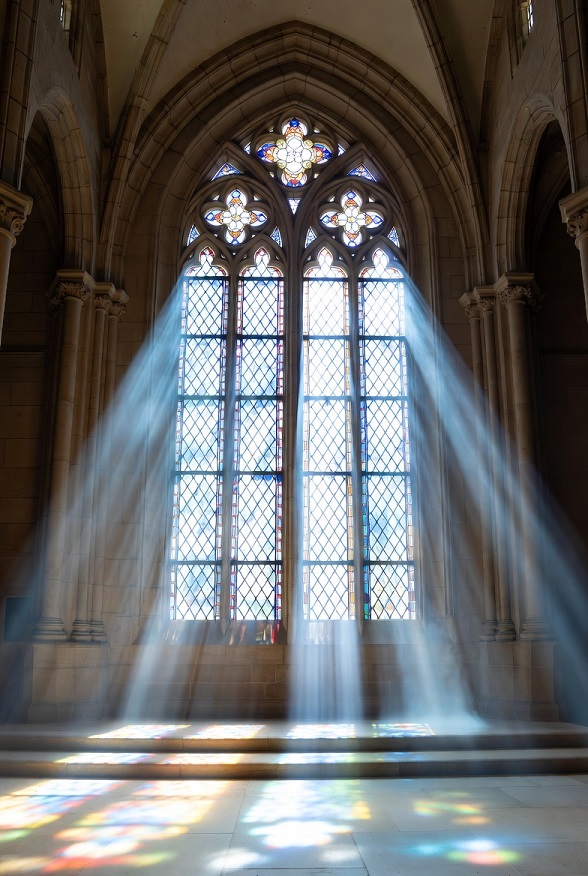
There is no denying the light that cascades across the floor. Indeed, many cathedrals are beautiful and breathtaking. Yet, no Muslim would deny that the teachings that take place in such buildings are teachings that mix light with darkness. It mixes haqq with batil. It mixes truth with falsehood.
“Do not mix truth with falsehood or hide the truth knowingly.” (Qur’an 2:42)
“They say, The Most Compassionate has offspring. You have certainly made an atrociousclaim, by which the heavens are about to burst, the earth to split apart, and the mountains to crumble to pieces. in protest of attributing children to the Most Compassionate.” (Qur’an 19:88-91)
There is a shared conceptual structure between Christian Logos theology, Neo-Platonic emanationism and the Sufi/Shi’i doctrines of Nūr i Muḥammed.
This is something alien to Islam.
Nūr i Muḥammed is a concept primarily within Sufi and some Shi’i traditions, designating Prophet Muhammed (saw) as the first creation and the primordial light from which the universe was created. It represents his inner, transcendent reality and spiritual essence rather than his physical humanity.
We see in the sacred text of the Christians the following beliefs.
Part of the Nicene Creed reads as follows:
“God from God, Light from Light, true God from true God, begotten not made, one in being with the Father. Through him all things were made. For us and for our salvation he came down from heaven.”
“For in him all things were created: things in heaven and on earth, visible and invisible, whether thrones or powers or rulers or authorities; all things have been created through him and for him. 17 He is before all things, and in him all things hold together.” (Colossians 2:16-17)
“In the beginning was the Word, and the Word was with God, and the Word was God. 2 He was with God in the beginning. 3 Through him all things were made; without him nothing was made that has been made. 4 In him was life, and that life was the light of all mankind. 5 The light shines in the darkness, and the darkness has not overcome it. There was a man sent from God whose name was John. 7 He came as a witness to testify concerning that light, so that through him all might believe. 8 He himself was not the light; he came only as a witness to the light. (John 1:1-8)
Contrary to what people think that the Qur’an being created is from Greek philsophy far from it. It is quite the opposite.
The position of the Sunni/Neo-Platonists. The Monad & the Logos
An uncreated ‘Kun’ by which everything else is created. The ‘kun’ acts as the intermediary between Allah, the transcendant and the material world.
However, the Sunnis believe that this uncreated ‘kun’ is not identical to the essence of Allah nor other than Allah’s essence. In our view, this is a step away from monotheism and a bridge towards Christology and logos theology.
“In the beginning was the Word, and the Word was with God, and the Word was God.” (John 1:1)
“Through him all things were made; without him nothing was made that has been made.” (John 1:3)
In our article here, we have shown that Jesus is not the eternal word of Allah. Jesus is the created word of Allah. Created from nothing “dust” and that which is created from dust or nothingness is not an attribute of Allah at all.
It is historically accurate to say that Christian theology has been heavily influenced by Platonic philosophy. We know this was the downward road in regard to their creed. So we now want to look at how such beliefs influenced certain strands of Islam.
As a reminder, our aqidah needs to be built upon the verses of the Qur’an. Those that are clear. Or it needs to be built upon the tawatur from the hadith.
And it dazzles the mind how those Muslims get accosted who say that Muhammed (saw) is only a man. They get accosted by those who hold fast to batini and esoteric doctrines. Well, if Muhammed (saw) is not only a man, then what is he? An angel? A demigod? A deity?
The same people do not seem to mind when we say about Jesus (as) that he is only a man. Even though Jesus (as) was born without a father.
“Say, “I am only a (basharun) man (mith’lukum)like you, to whom has been revealed that your god is one God. So whoever would hope for the meeting with his Lord – let him do righteous work and not associate in the worship of his Lord anyone.” (Qur’an 18:110)
“But now you seek to kill me, a man (anthropos) who has told you the truth which I heard from.” (John 8:40)
Question: What does the word Anthropos mean?
Answer: It means a mortal human being, full man. It distinguishes man from the animal kingdom on one hand and distinguishes man from a deity and divine essence on the other.
Anthropos is where we get the word anthropology, which means the study of man.
So this has not deterred those who wanted to bring Platonic Philosophy into Islam. In fact, it emboldens them. They reason well, Jesus (as) is anthropos, but he pre-existed as the word. So they reason that even if Muhammed (saw) is bashar, they can make him pre-exist as some eternal light.
What is interesting to note here is that nowhere in the New Testament does Jesus (as) say: “I am a man like you.” However, the text of the Qur’an is explicit. Muhammed (saw) is a man like us.
“And We sent not before you except (rijalan) men to whom We revealed [Our message]. So ask the people of the message if you do not know.” (Qur’an 16:43)
And We sent not before you, except men(rijalan) to whom We revealed [the message], so ask the people of the message if you do not know. We gave them not bodies that would not eat food, nor were they (khālidīna)immortals. (Qur’an 21:7-8)
khālidīna -this also means eternal. Jesus (as) is not the eternal word. Muhammed (saw) is not eternal light. Neither of them is eternal.
“The Messiah, son of Mary, was no more than a messenger. messengers had gone before him. His mother was a woman of truth. They both ate food. See how We make the signs clear to them, yet see how they are deluded!” (Qur’an 5:75)
“And they say, “What is this messenger that eats food and walks in the markets? Why was there not sent down to him an angel so he would be with him a warner?” (Qur’an 25:7)
In fact, if we do not accept the fact that Muhammed (saw) is a man like us, then we are accepting the belief of the Mushriks, who are surprised that Allah (swt) sends a man that eats food and walks among them.
“They say, “Why has no angel come with him?” Had We sent down an angel, the matter would have certainly been settled, and they would have never been given more time. And if We had sent an angel, We would have certainly made it a man—leaving them more confused than they already are.” (Qur’an 6:8-9)
The verse above has the Mushrik asking why no angel was sent with Muhammed (saw). So they are making a contrast between the two.
If Allah (swt) sent an angel, there would be no more room to debate about anything. This clearly tells us that Muhammed (saw) is not an angel. Angels are those beings which are created from light.
And nothing has prevented people from believing when guidance comes to them except their protest: “Has Allah sent a (basharan) human as a messenger?” (Qur’an 17:94)
“They challenge, “We will never believe in you until you cause a spring to gush forth from the earth for us, or until you have a garden of palm trees and vineyards, and cause rivers to flow abundantly in it. Or you should cause the heaven to come down upon us in pieces as you think, or bring Allah and the angels face to face (with us). Or you have a house of gold or you ascend into the sky. And [even then], we will not believe in your ascension until you bring down to us a book we may read.” Say, “Exalted is my Lord! Was I ever but a human messenger?” (Qur’an 17:90-93)
They asked Muhammed (saw) the following:
Bring a spring to gush forth from the earth.
Bring forth gardens, palm trees and vineyards.
Cause rivers to flow.
Bring the heavens down.
Bring Allah and the angels face to face.
Have a house made of guild.
Ascend into the sky. -it is clear that Jesus did not do this either.
Bring us down a book.
Muhammed (saw) replied to this by saying: He was only a human (basharan) messenger.
“Say: I am no (bid’an)new thing among the messengers (of Allah), nor know I what will be done with me or with you. I do but follow that which is inspired in me, and I am but a plain warner.”(Qur’an 46:9)
If Muhammed (saw) is the first creation and primordial light, then he certainly is a new thing among the messengers, as this cannot be said about any of the messengers who have come before him.
Verses from the Qur’an that are used to try and prove Nūr Muḥammed.
“O People of the Scripture, there has come to you Our Messenger making clear to you much of what you used to conceal of the Scripture and overlooking much. There has come to you from Allah a light and a clear Book.” (Qur’an 5:15)
mina l-lahi nurun wakitabun mubinun yahydi bihi from Allah a light and a book clear guides with it
The Qur’an is the light and a clear book. Allah guides with it, not with them(plural)
You may see how disparate translations render the Arabic into English.
“O mankind, there has come to you a conclusive proof from your Lord, and We have sent down to you a clear light.” (Qur’an 4:174)
bur’hanum min rabbikum wa-anzalna ilaykum nuran mubinan convincing proof from your Lord sent down to you a light clear
The Qur’an never references nazzala (sending down) to a human being ever! For example:
“Indeed, We have anzalna sent down to you the Book, in truth. So worship Allah , [being] sincere to Him in religion.” (Qur’an 39:2)
Rather, when speaking about prophets as messengers, Allah (swt) uses the word arsala (sent).
See: Qur’an 21:07Qur’an 33:45 and Qur’an 47:2
Allah (swt) tells us that the Qur’an is that light from Allah.
“And thus We have revealed to you an inspiration of Our command. You did not know what is the Book or [what is] faith, but We have made it a light by which We guide whom We will of Our servants. And indeed, you guide to a (siratin mus’taqimin) straight path.”(Qur’an 42:52)
“Believe then in Allah and His Messenger, and in the light which We have sent down. Allah is fully aware of all that you do.”(Qur’an 64:8)
Notice the text says believe in Allah and his Messenger and in the light. The text does not say believe in Allah and his Messenger, who is the light! Just as the wa distinguishes the Messenger from Allah, the wa also distinguishes the nur from the Messenger!
First it should be said that the Qur’an is sufficient in this regard. Anything that one would bring from the hadith would come to clash with the overwhelming flood of evidence that the Qur’an has established.
Secondly, it should also be stated that none of the evidence brought from the hadith amounts to tawatur and, therefore, it cannot be established as an aqidah point.
Nonetheless, we will look at the evidence one tries to establish from the hadith for Nur-Muhammed. The idea of Muhammed (saw) as the first creation and/or the primordial light from which the universe was created.
It would also clash with other lone narrator reports.
Umm Salamah narrated that the Messenger of Allah (saw) said:
“Indeed you come to me with your disputes, and I am only a human being, perhaps one of you is more eloquent at presenting his argument than the other. If I judge for one of you, giving him something from the rights of his brother, then it is only a piece of the Fire that I am giving him, so do not take anything from it.”
The Messenger of Allah (saw) said prayer and he omitted or committed (something). Ibrahim (one of the narrators of this hadith) said: It is my doubt, and it was said: Messenger of Allah, has there been any addition to the prayer? He (the Holy Prophet) said: Verily I am a human being like you. I forget just as you forget so when any one of you forgets, he must perform two prostrations, and he (the Holy Prophet) was sitting and then the Messenger of Allah (saw) turned (his face towards the Qibla) and performed two prostrations.
It also contradicts other information from the Blessed Prophet (saw) about what was the first created thing.
Abdul-Wahid bin Sulaim narrated:
“I arrived in Makkah and met ‘Ata bin Abi Rabah. I said to him: ‘O Abu Muhammed! The people of Al-Basrah speak about Al-Qadar.’ He said: ‘O my son! Do you recite the Quran?’ I said: ‘Yes.’ He said: ‘Then recite Az-Zukhruf to me.’” He said: ‘So I recited: Ha Mim. By the manifest Book. Verily, We have made it a Qur’an in Arabic that you may be able to understand. And verily, it is in the Mother of Book with Us, indeed exalted, full of wisdom. Then he said: ‘Do you know what Mother of Books is?’ I said: ‘Allah and His Messenger know better.’ He said:’It is a book that Allah wrote before He created the Heavens, and before He created the earth. In it, it is (written): Fir’awn is among the inhabitants of the Fire, and in it is: Perish the two hands of Abu Lahab, and perish he!’Ata said: ‘I met Al-Walid the son of ‘Ubadah bin As-Samit the Companion of the Messenger of Allah (saw) and asked him:’What was your father’s admonition when he died?” He said:”He called me and said: ‘O my son ! Have Taqwa of Allah, and know that you will never have Taqwa of Allah until you believe in Allah, and you believe in Al-Qadar- all of it-its good and its bad. If you die upon other than this you shall enter the Fire. Indeed I heard the Messenger of Allah (saw) saying: “Verily the first of what Allah created was the Pen. So He said: ‘Write.’ It said : ‘What shall I write?’ He said : ‘Write Al-Qadar, what it is , and what shall be, until the end.’”
The Pen is presented as a created instrument for recording destiny. That is all.
The very first of what Allah created was the Pen.
None of the information that has been supplied mentions anything about spatiality.
So this leaves us with some points of discussion.
If spatiality is not a creation but something that co-exists with Allah. Then who or what creates spatiality? How do we square this with the belief that Allah creates all things?
If spatiality is a creation and the first thing that was created before spatiality was either the Pen or the Throne. This means that the Pen or the Throne existed prior to spatiality. Since we do not posit a place for Allah (swt), then one could conclude the Pen is like Allah (swt) in existing without a place.
The unresolvable tension in Neo-Platonic emanationism.
Neo-Platonic emanationism: The One is absolutely transcendent, beyond being, beyond space, beyond time. The first emanation (the Nous/Intellect) is the first thing that has being, but it exists in a framework of emanation that presupposes the One’s transcendence.
The Islamic doctrine of tawhid: “There is nothing like unto Him” (Qur’an42:11). Allah alone is eternal, uncreated, without beginning. Everything else is created, contingent, and shares no attributes of divinity.
If the Muhammedan Light or the Pen was created before space and time, then:
It exists in a state of non-spatial, non-temporal existence.
This is precisely the definition of divine transcendence. Existing without being located in space or time.
Something now shares this attribute with Allah.
“There is nothing like unto Him” is compromised.
When the Nūr Muḥammed doctrine claims:
“The first thing Allah created was the light of Muhammed”
It must then answer: Where did this light exist before space and time?
There are three possible responses, all of them problematic.
It existed in Allah. Something created existed within the divine.
It existed in a place. Which mean space is either uncreated (co-eternal with Allah) or the light created its own container (nonsensical).
It existed in no place and no time. The light shares with Allah the attribute of existing without spatial or temporal location. There is nothing like unto him now has an exception. The light is, in this crucial respect, like Allah.
There is no escape.
The Neo-Platonic Framework Collapses Under Islamic Premises
Neo-Platonism works because:
The One is beyond being, beyond even the category of “existence”
The Nous is the first being However, being is already a category that the One transcends.
The Nous is divine, and the system is not radically monotheistic.
But Islam does not allow:
Degrees of divinity.
A hierarchy of being where the first emanation shares in transcendence with that which is beyond being.
When Sufi metaphysicians attempted to import the Neo-Platonic structure while claiming to preserve tawhid, they created an unstable hybrid.
Evidences from the hadith that are used to try and prove Nūr Muḥammed.
The first hadith evidence that is used.
Narrated Abu Hurairah:
“They said: ‘O Messenger of Allah (saw)! When was the Prophethood established for you?’ He said: ‘While Adam was between (being) soul and body.'”
This above hadith mentions nothing about when the Prophet (saw) was created or what he was created from. It simply establishes that the office of Prophethood was ordained for him. This the more straightforward and textually responsible reading. The plain sense of the text is about foreknowledge and divine decree, not ontological pre-existence.
The second hadith that is used.
He relates from Jabir ibn Abdullah who stated:“I said, ‘O Messenger of Allah (saw)! May my mother and father be sacrificed for you, tell us of the first creation which Allah created before everything?’ The Prophet saw answered, ‘O Jabir! Indeed Allah created before everything the light of your Prophet from His light.”
Source: (Al-Musannaf Abdur Razzaq, pp. 63, Hadith 18)
This hadith is fabricated (mawḍū’)
The consensus is that it has no sound chain of transmission (sanad) and was falsely attributed to the Prophet (saw).
Bring us an authentic chain for this hadith.
The most dangerous aspect of the above hadith is the wording, “from His light” (min nūrihī). This can be dangerously understood to imply that the Prophet (saw) is a part of Allah or that Allah’s essence is divisible. A concept fundamentally opposed to Islamic monotheism (tawhid).
It is challenging to take seriously the claims of anyone who says they defend (tawhid) and expresses the above view.
Such groups who advocate this are like the mysterion cults. They hold that such sacred truths are revealed but cannot be fully understood by reason. They need esoteric (obscure) explanations or can only be explained via esoteric rituals that are not within the grasp of the uninitiated. The contradictory nature is laid bare for all to see. If that is the case, then you do need recourse to proof text. You simply need aprior convictions.
One of our team members was introduced to a Sufi Tariqa in which one of its members approached them asking about how they understood Nur i Muhammed. The follower of this Tariqa said: “The light of Allah is Allah!”
So how does this Nur of Muhammed (saw) actually work?
If you are involved in Sufism or Sufi Metaphysics, it is usually taught that this light enters into Adam.
Then it is passed from Adam to his son Seth. It goes all the way to Nuh. Then, at this point, something crucial happens. The light is passed onto Nuh’s son Sam (Shem). The Semetic people and his other son, Ham (Hamitic) people, receive a curse. Physically portrayed by being black-skinned.
It continues until it reaches Abrahams son (Isma’il). Now we get into a conundrum here. It cannot go through the son Ishaq because this line stops at Jesus (as) who had no children.
So it now passes through (Isma’il). But now we face another problem.
Historically speaking, there is a span of approximately 2,500 to 2,700 years between Isma’il, peace be upon him (born c. 2000s B.C.E.) and Muhammad, peace and blessings be upon him(born 570 C.E.). While Islamic tradition holds that Muhammed is a direct descendant of Isma’il, historians and early genealogists note that there is no continuous, verified, or documented written record for this connection.
Also, on top of that, it must be affirmed that for that span of 2,500 years, that entire line maintained a belief in perfect monotheism.
Critique of Esoteric Cults and Genealogy
Where this becomes a source for cults and manipulation. If you continue to hold that this nur i muhammed travels through his descendants, then not only are the descendants superior to you via bloodline, but they are metaphysically superior to you based upon this esoteric reality.
This has become a source of manipulation and abuse in many circles. A person who is claimed to possess such attributes becomes a deity in their circle. Unchallenged and unquestioned. The least infraction can bring wrath and damnation down upon one. If the Imam, Qutb (or Ghawth) is caught up in sexual impropriety, molestation, physical abuse and or squandering of funds, any whistleblowers would be shamed into silence.
The Ibadi school shuts the doors to these esoteric beliefs which have no firm basis in the Qur’an and Sunnah. Exploitation of people cannot come about through presumed superior metaphysical personages.
Put yourself for a moment in the position of a 7th century Bedouin hearer, the idea that Muhammed (saw) pre-existed as a cosmic light, or that there exists a “Muhammedan Reality” that is the first emanation and the instrument of creation, would have sounded unfamiliar. Perhaps dangerously close to what they had just been taught to reject about Arab polytheism (where lesser deities mediated between the high God and the world) and Christianity (where the Logos became flesh).
In the end, what is needed for the Muslims is a return to purity in creed. A creed based upon the firm and clear text of the Qur’an and the mass transmitted testimony of the Blessed Prophet (saw).
You may also be interested in reading the following:
“We sent thee not, but as a Mercy for all creatures.” (Quran 21:107)
﷽
The Mufti of Oman, Shaykh Ahmed Al Khalili (H) has informed us:
“Celebrating the birth of the Prophet ﷺ was not practiced during the time of the Companions (may Allah be pleased with them), nor during the time of the Successors (tābi‘īn), nor during the time of the successors of the Successors (atbā‘ al-tābi‘īn). Most likely, this celebration began during the era of the Fatimids. It is said that their intention behind this celebration was to deflect accusations that they were not truly Muslims. There is much discussion about the Fatimids. Some even refer to them as the “ʿUbaydīs”. Though they attributed themselves to Fāṭimah (may Allah be pleased with her) and thus were called “Fāṭimids.” Yet, many exaggerations surrounding them go so far as to take them outside the fold of Islam. For example, some said about al-Muʿizz al-Fāṭimī: “Whatever you will happens, not what fate decrees; you rule, for you are the One, the Subduer.” This is evidence that those people were far from Islam and from the oneness of Allah, as this is deification of human beings.”
“They were the first to introduce the celebration, and Muslims later adopted it from them. Perhaps the desire to celebrate the Prophet’s birthday was in order to remind people of this great blessing. The blessing of Allah sending His Messenger ﷺ to us. However, we must consider several important factors. Among these is that people, in commemorating the Prophet’s birth, have attributed sanctity to human-authored texts recounting the story of the noble birth. They came to revere such writings as if they were the Qur’an itself, and this is impermissible. Nothing is sacred except the words of Allah. As for the words of the Prophet ﷺ, when we read them, it is for the sake of deriving benefit and guidance; reading them in itself is not an act of worship. If someone who does not understand the Prophet’s words were to recite them thinking it was an act of devotion, it would not count as worship. Unlike the Qur’an, whose recitation is worship whether one understands it or not.”
“Therefore, attributing sacredness to anything other than the words of Allah is problematic. If the celebration is meant to remind people of this great blessing, then one should not be bound to a single text authored by a person centuries ago as though it were a chapter of the Qur’an. Rather, the occasion can be connected to present-day circumstances. What the community needs to draw from this remembrance, such as reviving the call to Islam and renewing the message. This can be done by giving lectures, enlightening people about this blessing, and renewing the spirit of the message according to the needs of the time.”
“At the same time, all that contradicts the Sharīʿah in such celebrations must be avoided. Gatherings involving drums, dancing by men and women, and similar practices are contrary to Islamic teachings. These must be avoided. Likewise, the extravagant spending of large amounts of money on such occasions does not please the Messenger of Allah ﷺ. These funds would be better spent on things that benefit the Muslim community. Excessive decoration and lavish displays are also not a proper way of honoring the Prophet. These are matters that must be carefully avoided.” -The Mufti of Oman, Shaykh Ahmed Al Khalili (H)
Prima Qur’an comments:
So there is no need for people to try and justify this practice to the people on the basis of what the early generation did or what the Blessed Prophet (saw) ordered us to do.
If people celebrate to remember the blessings of the Blessed Prophet (saw), by giving lectures etc then this is not something in our estimation that is totally forbidden.
Celebrating the birth of the Blessed Prophet (saw) with speech, and poems has become ‘urf (culture/custom). -It does not violate Islamic Principles.
Do we become the beloved of Allah (swt) by following the beloved of Allah (swt).
Celebrating the birth of our noble Prophet (saw) Say, “If you ˹sincerely˺ love Allah, then follow me; Allah will love you and forgive your sins. For Allah is All-Forgiving, Most Merciful.” (Qur’an 3:31)
We do not believe such celebrations should be done with haram music, dancing or free mixing. This time is used to send abundant blessings down upon the Blessed Prophet (saw) and used as a time to reflect on rather or not we become the beloved of Allah (swt) by following the beloved of Allah (swt).
#متابعات أحيت منارة الاستقامة لتعليم القرآن الكريم وعلومه بمدينةنالوت بالأمس ذكرى #المولد_النبوي_الشريف ضمن البرنامج الذي أعلن عنه مكتب أوقاف #نالوت حيث ألقيت بعض الكلمات بمناسبة هذه الذكرى الجميلة كما تخلل هذه الأمسية بعض القصائد والأناشيد والمدائح النبوية. @Taha_Asker12 pic.twitter.com/kMeVcCZDvp
Often in Oman, Sunni and Ibadi come together to celebrate the Maulid
“Indeed, in the Messenger of Allah you have an excellent example for whoever has hope in Allah and the Last Day, and remembers Allah often.” (Qur’an 33:21)
و كان نبينا صلى الله عليه وسلم يتسابق في طاعته القرشي والحبشي و الفارسي و الرومي يذكر اسمه فتفيض العيون بالدمع، وتورد أحاديثه فتجيش الارواح بالشوق، له في كل مكان أتباع، وفي كل بلد أنصار، وفي كل قطر محبون، يدوي اسمه في الأذان وفي المنائر، ويذكر على المنابر، ويدرس في الدفاتر،… pic.twitter.com/3HQWoiCazd
Some of the justifications that we use to allow the practice are as follows:
“And as for the blessings of your Lord, speak of them” (Qur’an 93:11)
Is not the birth of the Blessed Prophet (saw) a blessing to humanity?
It heralds the arrival of Allah’s beloved.
It is a way to convey the message of Muhammed (saw).
It is a way to send blessings and peace upon him.
A way to adhere to his love and follow what he (saw) brought.
This entry is quite short because it is not a hair splitting issue for us. Our scholars are very clear that we do not have records of the early generations celebrating this. This is something from ‘urf that the people love to do out of their burning love for Allah’s beloved.
Those who do not participate are not looked down upon. Those who wish to participate are received warmly.
“But My mercy encompasses everything. I will ordain mercy for those who shun evil, pay alms-tax, and believe in Our revelations.” (Qur’an 7:156)
“And He is the All-Forgiving, All-Loving.” (Qur’an 85:14)
“Do you not love to be forgiven by Allah? And Allah is All-Forgiving, Most Merciful.” (Qur’an 24:22)
﷽
I will begin this article by sharing a perspective that may seem counter intuitive to the very article that I am writing.
For me one of the biggest signs of Allah’s Love and Mercy is the Creation of Hellfire and the Creation of the Worst Possible Planets for any life to exist.
I was reading this article on the worst possible planet and it certainly made me very thankful to be on Earth!
“Leah Crane: The planet I think is the worst also happens to be my least favourite planet, which is Mercury. It’s really close to the sun, and when we think about a planet being bad for life, a lot of the time we think about it either being very hot or very cold. Mercury is both. It is tidally locked, so one side always faces the sun, and that side, which we call the day side, is about 800° Fahrenheit, which is 430° Celsius, all the time – absolutely awful.”
Leah Crane: A little too hot. Also, you’d get a lot of cancers from all of the radiation. And then there’s the other side which always faces away from the sun, which is -290° Fahrenheit or -180° Celsius, equally unpleasant.
From the diversity and beauty of the animal kingdom to the various landscapes on Earth the first thought that certainly does not come to my mind is: “This Creator wants the absolute worst for us.”
From left to right: Kirkjufell Mountain located in Iceland. Credit to David Stanfield. Moraine Lake Banff National Park Canada. Credit to Nicole Seidl. Maya Bay Phi Phi Leh Thailand. Credit to Silent Sightseer. All photos taken from pexels.com
One of the means of knowing something is through contrast.
We know when something is unpleasant and thus we know what is pleasant. We know what it is to not to love and not to receive love. We know what it is not to be merciful or to receive mercy. We know what it is not to forgive or to be forgiven.
So in order to truly know Allah’s love, mercy and forgiveness we are shown its opposite.
“If Allah should take men to task for their injustice, He would not leave on the earth one single living creature; but He is deferring them to a term stated; and when their term is come they shall not put it back by a single hour nor put it forward.” (Qur’an 16:61)
This is to be contrasted with the Biblical characterization of the Creator.
“And the LORD repented of the evil which he thought to do unto his people.” (Exodus 32:14)
“The Lord regretted making human beings on the earth, and his heart was grieved. So the Lord said: I will wipe out from the earth the human beings I have created, and not only the human beings, but also the animals and the crawling things and the birds of the air, for I regret that I made them.” (Genesis 6:6-7)
The clear distinction here is that in the Qur’an where Allah (swt) is simply telling us that if he were to give us our just desserts (what we really deserve) the extent of his wrath would essentially be scorched earth.
Where as in the Bible we are presented with a being who thinks to do evil to his creation, and even regrets making them.
Another huge difference between the portrayal of the divine in the two faiths is that in Christianity God is never sated or satiated unless there is pain or suffering. The running of a blade across the throat of an animal satiates God’s wrath.
“And without the shedding of blood there is no forgiveness.” (Hebrews 9:22)
Where as in Islam a contrite human heart is what is needed before a Loving and Merciful Creator.
“The Day when neither wealth will be of any use nor sons, except to one who will come to Allah with a sound heart.” (Qur’an 26:88-89)
The blueprint for forgiveness was initiated by our Creator let us not forget this!
In Islam Allah forgives the first human being who erred and it was Allah who initiated the reproach between Creator and created!
Allah did not wait for Adam to approach him, in fact Allah inspired and taught him the words to seek forgiveness.
“Then Adam received from his Lord [some] words, and He accepted his repentance. Indeed, it is He who is the Accepting of repentance, the Merciful.” (Qur’an 2: 37)
a) Allah taught Adam the very words to seek reconciliation with him.
b) He accepted those words; because they are from him to begin with.
c) Allah accepts repentance.
Allah loves those who repent and purify themselves.
“Surely Allah loves those who always turn to Him in repentance and those who purify themselves.” (Qur’an 2:222)
Seeking forgiveness for our sins is an act of obedience and worship itself!
“Turn to Allah in repentance all together, O believers, so that you may be successful.” (Qur’an 24:31)
“O you who believe! Turn unto Allah in sincere repentance! It may be that your Lord will remit from you your evil deeds and bring you into Gardens underneath which rivers flow, on the day when Allah will not abase the Prophet and those who believe with him. Their light will run before them and on their right hands; they will say: Our Lord! Perfect our light for us, and forgive us! Lo! You have power over all things.” (Qur’an 66:8)
Allah (swt) has promised that he will forgive your sins.
“And whoever does evil or acts unjustly to his soul, then asks forgiveness of Allah, will find Allah Forgiving, Merciful.” (Qur’an 4:110)
“The Forgiver of sin and Accepter of repentance, the Severe in punishment, and Infinite in bounty. There is no god except Him. To Him is the final return.” (Qur’an 40:3)
Your sins are not greater than Allah’s mercy.
Disbelieving in Allah’s mercy and/or willingness to forgive sins is a major sin. A trap of Shaitan.
“He said, “And who despairs of the mercy of his Lord except for those astray?” (Qur’an 15:56)
“”O my sons! go and enquire about Joseph and his brother, and never give up hope of Allah’s Soothing Mercy: truly no one despairs of Allah’s Soothing Mercy, except those who ungrateful disbelievers.” (Qur’an 12:87)
“Say, ˹O Prophet, that Allah says,˺ “O My servants who have exceeded the limits against their souls! Do not lose hope in Allah’s mercy, for Allah certainly forgives all sins. He is indeed the All-Forgiving, Most Merciful.” (Qur’an 39:53)
“O believers! Do not follow the footsteps of Satan. Whoever follows Satan’s footsteps, then he surely bids immorality and wickedness. Had it not been for Allah’s grace and mercy upon you, none of you would have ever been purified. But Allah purifies whoever He wills. And Allah is All-Hearing, All-Knowing.” (Qur’an 24:21)
Allah (swt) forgives all sins via repentance. This includes shirk as shirk is a sin.
Please see our article here that explains this. Al hamduillah our school is upon the haqq concerning this matter. May Allah (swt) guide the ummah to the truth.
We have no one else to turn to or efface our sins except Allah. Only Allah forgives Sins.
“Those who, upon committing an evil deed or wronging themselves, remember Allah and seek forgiveness for their sins—and who forgives sins except Allah?—and they do not knowingly persist in wrongdoing?” (Qur’an 3:135)
“Once you make a decision, put your trust in Allah. Surely Allah loves those who trust in Him.” (Qur’an 3:159)
Allah (swt) loves those who trust and rely upon him. Are we not trusting and relying upon Allah -alone when we ask him and him alone to forgive us? The answer is yes. Therefore in that condition we are among those who Allah (swt) loves!
How do I know that my repentance is sincere?
“O you who have believed, repent to Allah with sincere repentance.” (Qur’an 66:8)
“And whoever repents and does good has truly turned to Allah properly.” (Qur’an 25:71)
The fact that you desired to repent in and of itself is an act of sincerity. Second that you follow up your incorrect conduct with correct conduct.
Remorse is repentance.
Leaving the sin
Having remorse after committing the sin, which can only happen if our nature is not sinful to begin with.
Resolve to not return to the sin
If you sinned against Allah ask Allah to forgive you.
If you sinned against another person return their rights or seek reconciliation.
If you sinned against yourself, forgive yourself.
How do we know that our repentance is accepted?
“But whoever repents after his wrongdoing and reforms, indeed, Allah will turn to him in forgiveness. Indeed, Allah is Forgiving and Merciful.” (Qur’an 5:39)
“As for those who repent, mend their ways, and let the truth be known, they are the ones to whom I will turn tofor I am the Accepter of Repentance, Most Merciful.” (Qur’an 2:160)
“But I am truly Most Forgiving to whoever repents, believes, and does good, then persists on guidance.” (Qur’an 20:82)
“As for those who repent, believe, and do good, it is they who will be admitted into Paradise, never being denied any reward.” (Qur’an 19:60)
“Only for those who do wrong. But if they later mend evil with good, then I am certainly All-Forgiving, Most Merciful.” (Qur’an 27:11)
The act of repentance in and of itself is a good. Than you follow up your repentance by continuing to do good deeds and trusting in Allah (Qur’an 3:159) by doing such is a sign that you have truly repented. It is also a sign that Allah has forgiven you.
Allah actually wants to accept our repentance!
“Allah wants to make clear to you [the lawful from the unlawful] and guide you to the [good] practices of those before you and to accept your repentance. And Allah is Knowing and Wise.” (Qur’an 4:26)
“Allah wants to accept your repentance, but those who follow their passions want you to digress into a great deviation.” (Qur’an 4:27)
“And it is He who accepts repentance from his servants and pardons misdeeds, and He knows what you do.” (Qur’an 42:25)
When we do a sin repent and start on the course of good we can know that Allah (swt) loves us.
“And do good, for Allah certainly loves the good-doers.” (Qur’an 2:195)
“And Allah loves the good-doers.” (Qur’an 3:134)
Allah loves those who are a doers of good.
Repentance is an act of worship and obedience.
Repentance is an act of good.
Therefore Allah loves us.
The angels keep a record of all our actions. For those who die upon faith and die upon Islam all the good is kept. The minor sins they are turned into good.
“This, Our record, speaks about you in truth. Indeed, We were having transcribed whatever you used to do.” (Qur’an 45:29)
A HUGE MISUNDERSTANDING. ALLAH’S FORGIVENESS IS NOT ARBITRARY.
To Allah belongs whatever is in the heavens and whatever is on the earth. He forgives whoever (liman) He wills, and punishes whoever He wills. And Allah is All-Forgiving, Most Merciful. (Qur’an 3:129)
First of all. If you take this verse in isolation of other verses it means that those people who sincerely repent Allah (swt) may not forgive them. Then those people whom Allah (swt) says he would not forgive it means Allah (swt) would might them. Far above Allah (swt) to ascribe to him a capricious nature.
Second of all. There is no such thing as Allah can forgive your sins but not 100% otherwise it would be vain. Allah is far above this!
What is the benefit of Allah forgiving a servant of some of his sins and then leaving them alone? We accuse Allah (swt) of fooling around, while Allah Almighty is far above this.
You will often note that those verses that have the phrase: “He forgives whoever (liman) He wills, and punishes whoever He wills.” are in connection to asserting Allah’s authority over the claim of Jews or Christians who claim salvation is solely for them. Or, even in the context of Allah (swt) asserting authority over that of the Blessed Prophet (saw).
Some examples:
“The Jews and the Christians each say, “We are the children of Allah and His most beloved!” Say, “Why then does He punish you for your sins? No! You are only humans like others of His Own making. He forgives whoever He wills and punishes whoever He wills. To Allah belongs the kingdom of the heavens and the earth and everything in between. And to Him is the final return.” (Qur’an 5:18)
“You ˹O Prophet˺ have no say in the matter. It is up to Allah to turn to them in mercy or punish them, for indeed they are wrongdoers. To Allah belongs whatever is in the heavens and whatever is on the earth. He forgives whoever He wills, and punishes whoever He wills. And Allah is All-Forgiving, Most Merciful.” (Qur’an 3:128-129)
Allah (swt) put conditions on receiving forgiveness.
“But indeed, I am the Perpetual Forgiver of whoever (liman) repents and believes and does righteousness and then continues in guidance.” (Qur’an 20:82)
Whoever dies without repenting from shirk, unlawful sexual intercourse, killing a soul without right. Allah will not forgive them.
“And those who do not invoke with Allah another deity or kill the soul which Allah has forbidden [to be killed], except by right, and do not commit unlawful sexual intercourse. And whoever should do that will meet a penalty. Multiplied for him is the punishment on the Day of Resurrection, and he will abide therein humiliated -Except for those who repent, believe and do righteous work. For them Allah will replace their evil deeds with good. And ever is Allah Forgiving and Merciful.” (Qur’an 25:68-70)
Anyone who sincerely repents will be like one who did not do any sins. This is correct. However, will that person recover and repent before the Angel of Death surprises him? This is a huge risk!
“Say, “What would my Lord care for you if not for your supplication?” For you have denied, so your denial is going to be adherent.” (Qur’an 25:77)
SINS CAN BE FORGIVEN FOR YOUR AFTERLIFE YET HAVE EFFECTS FELT IN THIS LIFE.
Another point is that there are effects of the sins and transgressions that we have done. For example if we sincerely repent this means that Allah (swt) has forgiven us in the afterlife. However, you will suffer from the effects of your sins in this world. May Allah (swt) forgive us in this life and the afterlife. So let us not take risk!
In other words Allah (swt) may hasten your punishment in this life and forgive you in the afterlife if you are sincere in your repentance.
This does not necessarily apply to every time you sin or every type of sin and Allah knows best. Some of the scholars mention that Allah (swt) says he is Forgiving and Forgiving. Why did he simply not say Forgiving? They say that forgiveness means pardoning you for the effects of this sin in this world and forgiveness means erasing the sin itself!
This is seen in Allah’s name: Al-Afuww -The one who not only forgives sins but also eliminates their negative impact, as if they never occurred.
Two examples:
Example A: Person is forgiven but the effects of sin are felt.
A person commits illicit sexual intercourse. This person is very remorseful and turns in sincere repentance to Allah. Allah (swt) forgives them. No punishment awaits them in the next life. However, the person finds out they have contracted HIV. This will impact the person for the rest of his/her life. Even knowingly being intimate with a person whom is unaware of your HIV status can lead to criminal charges, such as attempted murder.
Example B: Person is forgiven but the effects of sin are not felt.
A person was in a rush and was negligent in their wudhu. Not having a proper wudhu nullifies and invalidates the prayer. The person then realizes this. They do their wudhu with care and consideration and pray with devotion and sincerity. They ask Allah (swt) to forgive them. They are forgiven. No punishment awaits them in the next life nor are there any negative effects felt from the sin.
“As for those who repent, believe, and do good deeds, they are the ones whose evil deeds Allah will change into good deeds. For Allah is All-Forgiving, Most Merciful.” (Qur’an 25:70)
“Surely good deeds wipe out evil deeds. That is a reminder for the mindful.” (Qur’an 11:114) -how you know your sins are forgiven.
“IF (but) eschew the evilest of the things which you are forbidden to do, We shall expel out of (Saiyiatikum) YOU ALL THE EVIL IN YOU, and admit you to a gate of great honor.” (Qur’an 4:31)
Allah loves those who purify themselves.
“Surely Allah loves those who always turn to Him in repentance and those who purify themselves.” (Qur’an 2:222)
Repentance itself is an act of purification. It is the initial process to cleanse the heart and soul of the sin committed and therefore Allah loves those who initiate this process.
Allah loves those who are just.
“And whoever does evil or acts unjustly to his soul, then asks forgiveness of Allah, will find Allah Forgiving, Merciful.” (Qur’an 4:110)
“Surely Allah loves those who uphold justice.” (Qur’an 49:9)
When you sin you act unjustly to your soul -you are condemning yourself to possible damnation. Therefore when you seek forgiveness to Allah (swt) you are doing justice to yourself, to your own soul and as you are upholding justice via your repentance your among those beloved to Allah (swt).
The Sunnah of the Prophet (saw) is to seek forgiveness as instructed by Allah (swt).
“And seek Allah’s forgiveness. Surely Allah is All-Forgiving, Most Merciful.” (Qur’an 73:20)
“So be patient ˹O Prophet˺, ˹for˺ Allah’s promise is certainly true. Seek forgiveness for your sin. And glorify the praises of your Lord morning and evening.” (Qur’an 40:55)
“We sent no messenger save that he should be obeyed by Allah’s leave. And if, when they had wronged themselves, they had but come to you and asked forgiveness of Allah, and asked forgiveness of the messenger, they would find Allah Forgiving, Merciful.” (Qur’an 4:64)
“If you should love Allah, then follow me, Allah will love you and forgive you your sins. And Allah is Forgiving and Merciful.” (Qur’an 3:31)
The Blessed Messenger (saw) used to ask Allah (swt) to forgive him. That is part of his Sunnah. It is a major part of his Sunnah to ask Allah (swt) to forgive him, have mercy and compassion upon him.
By doing this we to follow and emulate the Blessed Messenger (saw) thus becoming the people mentioned in (Qur’an 3:31). Allah will love us and forgive us -1) for following the sunnah in general. 2) especially for following the sunnah of asking for forgiveness.
Allah responds to our prayers!
This simple fact is above all else. It in and of itself is the cause for the elation of the soul and the hope for the penitent.
When My servants ask you ˹O Prophet˺ about Me: I am truly near. I respond to one’s prayer when they call upon Me. So let them respond ˹with obedience˺ to Me and believe in Me, perhaps they will be guided ˹to the Right Way˺ (Qur’an 2:186)
“Your Lord has proclaimed, “Call upon Me, I will respond to you. Surely those who are too proud to worship Me will enter Hell, fully humbled.” (Qur’an 40:60)
“To the tribe of Thamud We sent their brother Salih. He said, “My people, worship God. You have no God other than Him. He created you out of the earth and made you inhabit it. Ask Him to forgive your sins, and turn towards Him in repentance. My Lord is near, and ready to answer.” (Qur’an 11:61)
Holy Angels That Are Beings of Pure Light Pray Constantly and Continuously for your Forgiveness and Guidance!
“Those (angels) who carry the Throne and those around it glorify the praises of their Lord, have faith in Him, and seek forgiveness for the believers, (praying) “Our Lord! You encompass everything in (your) mercy and knowledge. So forgive those who repent and follow Your Way, and protect them from the torment of Hellfire. Our Lord! Admit them into the Gardens of Eternity which You have promised them, along with the righteous among their parents, spouses, and descendants. You (alone) are truly the Almighty, All-Wise. And protect them from (the consequences of their) evil deeds. For whoever You protect from the evil of their deeds on that Day will have been shown Your mercy. That is the ultimate triumph.” (Qur’an 40:7-9)
Prima Qur’an comments:
Imagine that Allah (swt) created a group of angels that specifically are tasked with praying for the forgiveness and protection of the believers. Those who follow the way of Allah. Not only are they praying for you specifically, they are praying for your parents , and the wife or husband that you have not even met or married yet! The one who is currently your parent and for the children you have not even had born yet! As well as those who currently are your children!
There is tremendous amount of love and mercy that is directed towards the believers! That is why those who reject all this love and mercy are kafir (ingrates) -(ungrateful) such a people are without question and without doubt deserving of the hellfire because it is the path they pro actively choose.
NOT TO MENTION THE MONTH OF RAMADAN.
This can be a whole entry in and of itself. However, in particular this is to the Muslim reader. You know the amount of mercy and forgiveness and spiritual upliftment that is contained with in the month of Ramadan! It is an entire month that comes every year that is a means of spiritual training and gaining proximity and closeness to Allah (swt).
Imagine if in Ramadan you were to continuously pray to Allah (swt) for forgiveness and protection from the hellfire. Imagine even if you prayed that du’a with sincerity even once and it was granted!
A WARNING TO THE BELIEVERS.
Dear brothers and sisters, respected ummah of Muhammed (saw). All that has gone before is to show you that the deck has not been stacked against us. Quite the opposite. The fact that we are have been commanded to pray five times a day. That those five daily prayers are a continuous means for us to draw night and ask forgiveness from the Supreme Sovereign of this Universe. The gift of the month of Ramadan. Angelic beings of light praying for us and our spouses and children that we ourselves potentially haven’t even met! This is supreme love, supreme grace, supreme care and supreme mercy.
That being said we have to want this mercy and this love and this grace. In light of all that has been said those who end up going to hellfire are those among us who are actively participating in our own self destruction. You actually have to want to go to hellfire. How does one want this? By disobeying Allah (swt), by avoiding the commands of a Sovereign Creator and indulging in that which The Creator has prohibited. Most of all by shunning repentance
Ask Allah to forgive you quickly.
“Allah only accepts the repentance of those who commit evil ignorantly ˹or recklessly˺ then repent soon after Allah will pardon them. And Allah is All-Knowing, All-Wise.” (Qur’an 4:17)
“And hasten towards forgiveness from your Lord and a Paradise as vast as the heavens and the earth, prepared for those mindful ˹of Allah˺” (Qur’an 3:133)
Delaying repentance is a sign of arrogance and ingratitude. Here you have a Lord that wants to forgive you and you shun this forgiveness. It is an act of disobedience. It is a sign that you are not recalcitrant and that you deem your action or style of living as something of light consequence.
Very sobering verse from the Qur’an.
Why should we not delay repentance?
“However, repentance is not accepted from those who knowingly persist in sin until they start dying, and then cry, “Now I repent!” nor those who die as disbelievers. For them We have prepared a painful punishment.” (Qur’an 4:18)
Are you guaranteed to live after reading this very sentence? Are you guaranteed to live the next few minutes or even the next hour? So considering that repentance is not accepted by the one who waits to be besieged by the angel of death when is the best time to repent?
Now!
“Indeed, whoever commits misdeeds, and becomes besieged by his iniquities—these are the inmates of the Fire, wherein they will dwell forever.” (Qur’an 2:81)
Any Muslim who sins it is the duty of the believing Muslim to admonish his brother/sister in a good way. Help them to save face. Do not humiliate them. Advise them in a good manner.
However, if a Muslim continues to persist in sin that person is to be shunned. To continue to walk in fellowship with them is walking in fellowship to the one who insults Allah (swt) , shuns his mercy and forgiveness and guidance.
“Cooperate with one another in goodness and righteousness, and do not cooperate in sin and transgression. And be mindful of Allah. Surely Allah is severe in punishment.” (Qur’an 5:2)
Remember that Allah (swt) only accepts from those of us who do our level best to live a righteous a life.
“Indeed, Allah only accepts from the righteous [who fear Him]” (Qur’an 5:27)
If any person Muslim or not dies as a fasiq (a person committing major sins), does not repent, is unjust Allah will refuse his/her all his deeds and that one will be in hell.
“That is because they followed what angered Allah and disliked [what earns] His pleasure, so He rendered worthless their deeds.” (Qur’an 47:28)
“Those who disbelieved, and prevented (others) from Allah’s way, He (Allah) has rendered their deeds vain.” (Qur’an 47:1)
“And those who do not invoke with Allah another deity or kill the soul which Allah has forbidden [to be killed], except by right, and do not commit unlawful sexual intercourse. And whoever should do that will meet a penalty. Multiplied for him is the punishment on the Day of Resurrection, and he will abide therein humiliated –Except for those who repent, believe and do righteous work. For them Allah will replace their evil deeds with good. And ever is Allah Forgiving and Merciful.” (Qur’an 25:70)
The question has been put forward to you dear brothers and sisters and sincere truth seekers.
“Will, they not turn with repentance to Allah and ask His forgiveness? For Allah is Oft Forgiving, Most Merciful” (Qur’an 5:74)
“And He is the All-Forgiving, All-Loving (Qur’an 85:14)
The second group are the Sunni Muslims (in general). There have always been dissenting voices. In fact, in our article above. Ibn Hazm mentions that there has been no consensus among the Muslims in regard to this issue.
First and foremost try and understand something if you can. When we have established from the Qur’an that there is no text that mentions the coming of Jesus (as). That the consistent exegesis and interpretation of the term Tawaffā which appears in twenty-five passages in the Qur’an, and twice in relation to Christ Jesus (Q 5:117 and Q 3.55) means to die.
Secondly any reading of the Qur’an that even remotely suggest that Jesus (as) went up into heaven body and soul would flatly contradict the following verse.
“or until you have a house of gold, or you ascend into heaven and even then we will not believe in your ascension until you bring down to us a book that we can read.” Say, “Glory be to my Lord! Am I not only a human messenger?” (Qur’an 17:93)
When this is established the obligation is not upon us to deal with the hadith. The obligation is upon those who assert these hadith and how they make sense of them in light of the above information.
Qur’an 5:116–117 decisively closes the case
“And when Allah will say: O Jesus, son of Mary! did you say to men, Take me and my mother for two gods besides Allah, he will say: Glory be to You, it did not befit me that I should say what I had no right to (say); if I had said it, You would indeed have known it; You know what is in my mind, and I do not know what is in your mind, surely you are the great Knower of the unseen things. I did not say anything to them except what you commanded me with: That worship Allah, my Lord and your Lord, and I was a witness over them as long as I was among them, but when you caused me to die (Arabic: Tawafaytani), you were the watcher to them, and you are witness of all things.”(Qur’an 5:116-117)
There are several things to take from the above passage:
1) This dialogue takes place on the Day of Judgment, where Prophet Jesus (as) suggests that he has no knowledge of what has happened since his demise on Earth and after his ministry ended. “I was a witness to them as long as I was among them.”
2) From the discussion, it is clear that Prophet Jesus only came to Earth once, acting as a witness to his people. If indeed there was a ‘second coming’ before the Day of Judgment, he would have full knowledge of what had happened since his first departure. After all, he abolished the Jizya and forced the Christians and Jews to convert to Islam. This conversation with Allah (swt) would make little to no sense.
3) For the sake of the argument, let us imagine that those hadith that are claimed to have been spoken by the Blessed Prophet (saw) were true for a moment. So now Jesus (as) comes back and everyone becomes a Muslim. The Dajjal is defeated. Jesus (as) gets married. Then Allah (swt) causes Jesus (as) to die.
Then we have Jesus (as) saying after he dies to Allah (swt) “I was a witness to them as long as I was among them, but when you caused me to die, you were the watcher over them, and you are witness of all things.”
A rather bizarre understanding, it seems.
Especially, if we take the following text into consideration: “And there is none from the People of the Scripture but that he will surely believe in Jesus before his death.” (Qur’an 4:159)
A rather bizarre situation the ‘traditional‘ and ‘dominant‘ position leaves us in.”
Jesus says on the Day of Judgment:
“I was a witness to them as long as I was among them, but when You caused me to die (tawaffaytanī), You were the Watcher over them.”
This statement is incompatible with:
A second earthly mission
A global enforcement of Islam
A forty-year reign
If such events occurred, Jesus could not truthfully say this.
The verse only works if:
Jesus lived once
Died once
And never returned
Here are the facts.
The idea of the Messiah coming a second time has produced for the Jews and the fundamentalist Christians the state of Israel for them, while our belief in the return of the Messiah has produced backwardness, injustice, and poverty for us.
This leads to the nullification of action. It means that we cannot change evil, rebel against injustice, or advance unless Messiah or the awaited Mahdi (according to the Sunni & Shi’i) comes to save us from that.
Imagine the rhetoric in the United Kingdom and the United States they fear that Islam will be implemented in those lands! What?! Even when Islam has not been implemented in the lands where Muslims are an overwhelming majority? How will we implement Islam in lands where we are 2 or 3% of the population?!
Now we come to the hadiths, upon which they rely heavily. All these hadiths are ahad (solitary) reports, and we know that ahad hadiths are not used in matters of creed.
Volumes have been written on the hadiths about the return of the Messiah and the awaited Mahdi. By Allah, can a hadith like this occupy Muslims so much that volumes are written about it, while not a single verse, explicitly or implicitly, mentions it? Unfortunately, Muslims busied themselves with this and became passive, abandoning action and every attempt at reform and advancement, waiting for the Messiah to come.
As mentioned these hadith about the return of Jesus (as) are ahad. For us they do not come under the category of mutawatir.
Abu Huraira reported
Allah’s Messenger (saw) as saying, “In the last days there will be lying dajjals who will bring you traditions of which neither you nor your fathers have heard, so beware of them. They will neither lead you astray nor seduce you.” Muslim transmitted it.
This above is an interesting hadith from Abu Huraira.
Many of these hadith have as their source Abu Huraira (ra). The hadith from him in regard to the Israʼiliyyat are problematic. Those who transmitted from him would mix up his reports from the Blessed Messenger (saw) with those of his reports from the Israʼiliyyat.
عن بسر بن سعيد ، قال : اتقوا الله ، وتحفظوا من الحديث ; فوالله لقد رأيتنا نجالس أبا هريرة ; فيحدث عن رسول الله – صلى الله عليه وسلم- ويحدثنا عن كعب ثم يقوم ، فأسمع بعض من كان معنا يجعل حديث رسول الله عن كعب ، ويجعل حديث كعب عن رسول الله ،
صلى الله عليه وسلم .
“On the authority of Busr ibn Sa’id , said: Fear God, and be careful with hadith; for by God, I saw us sitting with Abu Hurayrah ; and he would narrate on the authority of the Messenger of God (peace and blessings be upon him) and he would narrate to us on the authority of Ka’b , then he would get up, and I would hear some of those who were with us attributing the hadith of the Messenger of God to Ka’b , and attributing the hadith of Ka’b to the Messenger of God (peace and blessings be upon him).”
In other words people were mixing up what was being narrated from Ka’b (ra) and what was being narrated from the Blessed Messenger (saw)!
This is from Imam al-Dhahabi in his ‘Siyar A’lam al-Nubala’ under the section talking about Abu Huraira.
This is one of many reasons why we in the Ibadi school are very careful when it comes to narrations from Abu Huraira concerning the Israʼiliyyat.
However we take from him in matters of jurisprudence.
What you the reader need to know and understand from the very beginning is that these lone narrator reports are distributed throughout hadith collections. When you often hear from your Shaykh and/or teacher is a narrative about Jesus (as) coming back and the rise of this figure known as the Mahdi. They will than give you a narrative that seems like a sequence of events. They will inform you that this happens and than this will happen followed by this.
The truth is for much of what they say they are piecing together a narrative because the information is scattered and often contradictory.
The other issue that is problematic and causes people to stop thinking about what is being reported is that once the label ‘sahih’ is given to a report people are mistaken to think that the Blessed Messenger (saw) definitely said this. The word ‘sahih’ has been translated into English as ‘authentic’. However, a better translation would be ‘sound’. This means that it has met the rigorous scrutiny of hadith masters; however, there is still the possibility of an error.
Think for a moment about assembly line production in a factory. Have you ever received a product or an item and found that it was faulty or had a defect in it? This is even after rigorous criteria are applied to ensure that the item reach you without defects.
Often times elaborate interpretations are offered to save what apparently looks like conflicting data. So this is up to you the truth seeker to weigh the information and see if the explanations given to you are sensible and rather or not the data adds up.
“When would the Last Hour come? Thereupon Allah’s Messenger (saw) kept quiet for a while. Then looked at a young boy in his presence belonging to the tribe of Azd Shanu’a and he said: If this boy lives he would not grow very old till the Last Hour would come to you. Anas said that this young boy was of our age during those days.”
Interpretations of this hadith say that “the Hour” here means the hour of these people, but the hadith is clear. The question is about the Hour, and the Prophet (saw) does not know it, while Allah Almighty says the Hour will come suddenly and says to the Prophet: “You have no knowledge of it.” This hadith contradicts these verses, telling them that the age of this young boy will not reach senility before the Hour comes. This boy lived and Allah knows best when he died but the Hour did not come.
“People ask you about the Hour. Say, “That knowledge is only with Allah. You never know, perhaps the Hour is near.” (Qur’an 33:64)
“They ask you regarding the Hour, “When will it be?” But it is not for you to tell its time. That knowledge rest with your Lord.” (Qur’an 79:42-44)
Narrated Abu Huraira:
Allah’s Messenger (saw) said, “By Him in Whose Hands my soul is, surely (Jesus,) the son of Mary will soon descend amongst you and will judge mankind justly (as a Just Ruler); he will break the Cross and kill the pigs and there will be no Jizya (i.e. taxation taken from non Muslims). Money will be in abundance so that nobody will accept it, and a single prostration to Allah (in prayer) will be better than the whole world and whatever is in it.” Abu Huraira added “If you wish, you can recite (this verse of the Holy Book): — ‘And there is none Of the people of the Scriptures (Jews and Christians) But must believe in him (i.e Jesus as an Apostle of Allah and a human being) Before his death. And on the Day of Judgment He will be a witness Against them.” (4.159)
The most famous hadith about breaking the cross killing the swine and abolishing the jizya.
“I swear by Allah that the son of Mary will certainly descend as a just judge and he would definitely break the cross, and kill swine and abolish Jizya and would leave the young she-camel and no one would endeavor to (collect Zakat on it). Spite, mutual hatred and jealousy against one another will certainly disappear and when he summons people to accept wealth, not even one would do so.”
Even though this hadith has been given a grading of ‘sahih’ it is problematic for many reasons.
A) The first type of issue is that this hadith has is that the riwayat-the narration comes down to us through different wordings and some of it has additional or missing information that others do not have.
B) The second issue and more serious issue is that this particular hadith has information that contradicts what Allah (swt) revealed in the Qur’an.
“Spite, mutual hatred and jealousy against one another will certainly disappear.”
“And the Jews say, “The hand of Allah is chained.” Chained are their hands, and cursed are they for what they say. Rather, both His hands are extended; He spends however He wills. And that which has been revealed to you from your Lord will surely increase many of them in transgression and disbelief. And We have cast among them animosity and hatred until the Day of Resurrection. ” (Qur’an 5:64)
“And from those who say, “We are Christians” We took their covenant; but they forgot a portion of that of which they were reminded. So We caused among them animosity and hatred until the Day of Resurrection. And Allah is going to inform them about what they used to do.” (Qur’an 5:14)
C) The phrase: “Break the Cross” is problematic as it is indefinite. It is not specific. Christians do not have ‘A’ Cross, rather they have crosses. And some Christians -like the Jehovah’s Witness do even hold it to be sacred at all.
D) The phrase: “Kill swine” is problematic as it too is indefinite. It is not specific. Most of the Muslims we speak to on this matter understand that Jesus (as) will kill all the species of Sus scrofa, family Suidae (pigs, swine, hogs, wild boars).
These animals are creations of Allah (swt) and Allah (swt) has simply ordered us not to eat them (unless dire need). What is the reason to kill them?
They cover a wide geographical range and they play a beneficial role in the spreading of seeds in nature. Jesus (as) if it is to be believed that he will literally kill the pigs such adventures would take him to Guam, Samoa Islands, the Caribbean, Papua New Guinea, Sri Lanka, and various diverse geographical regions.
Malik related to me from Yahya ibn Said that Isa ibn Maryam encountered a pig on the road. He said to it, “Go in peace.” Somebody asked, “Do you say this to a pig?” Isa said, “I fear lest I accustom my tongue to evil speech.”
*note* that this chain above does not go beyond Malik and thus it is not sure how he obtained this information.
E) The phrase: “abolish Jizya” is problematic as discussed in other articles. This is not a problematic issue for most Sunni Muslims as they do believe in concepts of abrogation.
Narrated Abu Hurayrah:
The Prophet (saw) said: There is no prophet between me and him, that is, Jesus (as). He will descent (to the earth). When you see him, recognise him: a man of medium height, reddish fair, wearing two light yellow garments, looking as if drops were falling down from his head though it will not be wet. He will fight the people for the cause of Islam. He will break the cross, kill swine, and abolish jizyah. Allah will perish all religions except Islam. He will destroy the Antichrist and will live on the earth for forty years and then he will die. The Muslims will pray over him.
Look at this part of the hadith: Here is the specific clause from the hadith that addresses this:
“وَيُهْلِكُ اللَّهُ فِي زَمَانِهِ الْمِلَلَ كُلَّهَا إِلاَّ الإِسْلاَمَ” “And Allah will cause all other religions to perish during his time except Islam.”
The Arabic word used here is “الْمِلَلَ” (al-milal), which means “all creeds, faiths, or religious communities.” This is a sweeping, all-encompassing term that explicitly includes Christianity and Judaism alongside every other religion.
Yet what did Allah (swt) says?
“And the Jews say, “The hand of Allah is chained.” Chained are their hands, and cursed are they for what they say. Rather, both His hands are extended; He spends however He wills. And that which has been revealed to you from your Lord will surely increase many of them in transgression and disbelief. And We have cast among them animosity and hatred until the Day of Resurrection. ” (Qur’an 5:64)
“And from those who say, “We are Christians” We took their covenant; but they forgot a portion of that of which they were reminded. So We caused among them animosity and hatred until the Day of Resurrection. And Allah is going to inform them about what they used to do.” (Qur’an 5:14)
The above hadith says: and abolish jizyah
This goes against the Qur’an.
“There shall be no compulsion in [acceptance of] the religion. The right course has become clear from the wrong. So whoever disbelieves in exceeding the limits and believes in Allah has grasped the most trustworthy handhold with no break in it. And Allah is Hearing and Knowing.” (Qur’an 2:256)
There are three interpretations of ”abolish Jizya”
The first is more believable and less of an interpretation. It is the view that outright people will be asked to become a Muslim and if they refuse they will be killed.
The second one is that it actually means he will enforce the Jizya. Yet that interpretation seems strange considering the very same hadith claims that Judaism and Christianity will cease to exist as faiths.
The last interpretation is that their is such an abundance of wealth that the Jizya need to be enforced. Yet, the amount of wealth has nothing to do with rather or not a Jizya is enforced as per the Qur’an.
In fact, many Muslims have tried a half and half approach to this hadith. What do we mean by this? They offer interpretations of parts of it but others are to be taken literal. You can see that in the video we are posting here:
Listen to the brief exegesis of the hadith about Jesus returning breaking the cross, killing pigs and abolishing the Jizya with Dr. Abdullah bin Hamid Ali in his discussion with Paul Williams of Blogging Theology.
Now you listen to this and come up with your own conclusions.
Prima-Qur’an comments: *Note* the above hadith states: ”He summons people to accept wealth, not even one would do so.”
Please compare this with another hadith:
Narrated Abu Huraira:
Allah’s Messenger (saw) said, “The Hour will not be established until the son of Mary (i.e. Jesus) descends amongst you as a just ruler, he will break the cross, kill the pigs, and abolish the Jizya tax. Money will be in abundance so that nobody will accept it (as charitable gifts).
There is another religion that broke away from Sunni Muslims they too believe in a Prophet after Muhammed (saw). Also, like the Sunni they use often bizarre and fanciful interpretations of the hadith to get themselves out of embarrassing situations. So because this particular religion claims that Jesus (as) has already came back how on earth do we understand “Money will be in abundance so that nobody will accept it.”
So, sincere apologies for the hundreds of millions of people living in abject poverty in India, Pakistan, Bangladesh, Indonesia, Ghana, the United States, and other places you will have to settle for: “and he will spread insightful pearls through his teachings and writings, so much so that no one will accept them.”
What slippery evasion! What an absolute abandonment of the text!
Well, one of the things the so called “Khilafa” of this religion does is that he himself pays property taxes to the British government for a house he has there! Can any Muslim imagine Abu Bakr, Umar, Uthman or Ali paying property taxes to a Non Muslim polity?
So back to the point. They interpret or abandon the text in the same way that many Sunni Muslims do as well.
“abolish Jizya” itself goes against the idea of Jesus (as) coming back. The very idea of Jesus (as) abolishing the Jizya and giving people the choice of the sword or Islam in and of itself refutes the idea of him coming back and uniting the Jews and Christians upon haqq (truth).
Why? The very presence of Jesus (as) should be enough to convince the Jews and Christians that Jesus (as) is who the Muslims say he is. The fact he abolishes the jizya and gives them the choice of Islam or the sword belies that point.
Think about it like this. Your mother is put in a room with four other women and you are told you need to recognize your mother from a group of women as they come out of a room. Your mother is the 4th woman out of the room and you immediately recognize her. However, would it not be strange that your mother comes to you with a sword and presses the issue? “Accept that I am your mother or die.”
If this is some attempt to fulfil some misguided understanding of the verse: “Every one of the People of the Book will definitely believe in him before his death.” (Qur’an 4:159) it is not necessary for Jesus (as) to come back.
In fact, imposing such an ultimatum (Islam or death) could be done by the so called “Mahdi” or even the Amir of the Muslims. That is if they wanted to go against the Qur’an 2:256 as quoted above.
Everyone will all believe in Islam?
Another Sahih hadith about the end of times that contradict flatly contradict the Qur’an.
Narrated Abu Huraira:
“Allah’s Messenger (saw) said, “The Hour will not be established (1) till two big groups fight each other whereupon there will be a great number of casualties on both sides and they will be following one and the same religious doctrine, (2) till about thirty Dajjals (liars) appear, and each one of them will claim that he is Allah’s Messenger (saw), (3) till the religious knowledge is taken away (by the death of Religious scholars) (4) earthquakes will increase in number (5) time will pass quickly, (6) afflictions will appear, (7) Al-Harj, (i.e., killing) will increase, (8) till wealth will be in abundance —- so abundant that a wealthy person will worry lest nobody should accept his Zakat, and whenever he will present it to someone, that person (to whom it will be offered) will say, ‘I am not in need of it, (9) till the people compete with one another in constructing high buildings, (10) till a man when passing by a grave of someone will say, ‘Would that I were in his place (11) and till the sun rises from the West. So when the sun will rise and the people will see it (rising from the West) they will all believe (embrace Islam)but that will be the time when: (As Allah said,) ‘No good will it do to a soul to believe then, if it believed not before, nor earned good (by deeds of righteousness) through its Faith.’ (Qur’an 6.158) And the Hour will be established while two men spreading a garment in front of them but they will not be able to sell it, nor fold it up; and the Hour will be established when a man has milked his she-camel and has taken away the milk but he will not be able to drink it; and the Hour will be established before a man repairing a tank (for his livestock) is able to water (his animals) in it; and the Hour will be established when a person has raised a morsel (of food) to his mouth but will not be able to eat it.”
There will never come a time in the future when the Jews as a whole will enter Islam in mass.
“We have stirred among them hostility and hatred until the Day of Judgment.” (Qur’an 5:64)
” So We caused among them (Christians) animosity and hatred until the Day of Resurrection. And Allah is going to inform them about what they used to do.” (Qur’an 5:14)
The Jews and Christians remain divided until the day of judgement/resurrection.
What is the point of Jews and Christians embracing Islam if it doesn’t benefit them?
Read the above hadith again.
“but that will be the time when: (As Allah said,) ‘No good will it do to a soul to believe then, if it believed not before, nor earned good (by deeds of righteousness) through its Faith.” (Qur’an 6.158)
“On the Day your Lord’s signs arrive, belief will not benefit those who did not believe earlier or those who did no good through their faith.1 Say, “Keep waiting! We too are waiting.” (Qur’an 6:158)
If everyone embraces Islam where do all the evil wicked people come from after realizing the haqq (truth)?
Also, even if all the people from the Earth did embrace Islam after very obvious signs and a continuation of very obvious signs the return of Jesus narrative leaves us with something very anticlimactic; namely, that huge swaths of Muslims totally apostate from Islam and become the worst of people and the last on the face of the Earth!
“and at that time Allah would send a pleasant wind which would soothe (people) even under their armpits, and would take the life of every Muslim and only the wicked would survive who would commit adultery like donkeys and the Last Hour would come to them.”
The return of Jesus (as) doesn’t even benefit the Ahl Kitab!
As we have already mentioned.
Narrated Abu Hurairah:
That the Prophet (saw) said: “There are three, for which when they appear, a soul will not benefit by its faith, if it did not believe before the Signs: Ad-Dajjal, the Beast, and the rising of the sun from its setting place” – or “from the west.”
So those converts (forced or not) get nada, zip, zilch, nothing. They get absolutely jack!
Imagine, if someone had access to a tome that they possessed that said rather or not you accept what they propose you still perish.
Couldn’t that person who had access to that information reject your proposal on the grounds that they didn’t want to be disingenuous?
Remember that according to the hadith that Jesus (as) comes after the Dajjal has appeared.
Al-nawwas b. Sim’an al-Kilabi said:
The Messenger of Allah (saw) mentioned the Dajjal (Antichrist) saying: If he comes forth while I am among you I shall be the one who will dispute with him on your behalf, but if he comes forth when I am not among you, a man must dispute on his own behalf, and Allah will take my place in looking after every Muslim. Those of you who live up to his time should recite over him the opening verses of Surat al – Kahf, for they are your protection from his trial. We asked: How long will he remain on the earth ? He replied : Forty days, one like a year, one like a month, one like a week, and rest of his days like yours. We asked : Messenger of Allah, will one day’s prayer suffice us in this day which will be like a year ? He replied : No, you must make an estimate of its extent. Then Jesus son of Marry will descend at the white minaret to the east of Damascus. He will then catch him up at the date of Ludd and kill him.
“Allah’s Messenger (saw) said, “The Hour will not be established (1) till two big groups fight each other whereupon there will be a great number of casualties on both sides and they will be following one and the same religious doctrine, (2) till about thirty Dajjals (liars) appear, and each one of them will claim that he is Allah’s Messenger (saw), (3) till the religious knowledge is taken away (by the death of Religious scholars) (4) earthquakes will increase in number (5) time will pass quickly, (6) afflictions will appear, (7) Al-Harj, (i.e., killing) will increase, (8) till wealth will be in abundance —- so abundant that a wealthy person will worry lest nobody should accept his Zakat, and whenever he will present it to someone, that person (to whom it will be offered) will say, ‘I am not in need of it, (9) till the people compete with one another in constructing high buildings, (10) till a man when passing by a grave of someone will say, ‘Would that I were in his place (11) and till the sun rises from the West. So when the sun will rise and the people will see it (rising from the West) they will all believe (embrace Islam) but that will be the time when: (As Allah said,) ‘No good will it do to a soul to believe then, if it believed not before, nor earned good (by deeds of righteousness) through its Faith.’ (Qur’an 6.158) And the Hour will be established while two men spreading a garment in front of them but they will not be able to sell it, nor fold it up; and the Hour will be established when a man has milked his she-camel and has taken away the milk but he will not be able to drink it; and the Hour will be established before a man repairing a tank (for his livestock) is able to water (his animals) in it; and the Hour will be established when a person has raised a morsel (of food) to his mouth but will not be able to eat it.”
Who actually leads the people in prayer when Jesus (as) descends? Is it Jesus (as) or someone else?
Jabir b. ‘Abdullah reported:
I heard the Messenger of Allah (saw) say: A section of my people will not cease fighting for the Truth and will prevail till the Day of Resurrection. He said: Jesus son of Mary would then descend and their (Muslims’) commander would invite him to come and lead them in prayer, but he would say: No, some amongst you are commanders over some (amongst you). This is the honour from Allah for this Ummah.
Abu Huraira reported Allah’s Messenger (saw) as saying:
The Last Hour would not come until the Romans would land at al-A’maq or in Dabiq. An army consisting of the best (soldiers) of the people of the earth at that time will come from Medina (to counteract them). When they will arrange themselves in ranks, the Romans would say: Do not stand between us and those (Muslims) who took prisoners from amongst us. Let us fight with them; and the Muslims would say: Nay, by Allah, we would never get aside from you and from our brethren that you may fight them. They will then fight and a third (part) of the army would run away, whom Allah will never forgive. A third (part of the army) which would be constituted of excellent martyrs in Allah’s eye, would be killed and the third who would never be put to trial would win and they would be conquerors of Constantinople. And as they would be busy in distributing the spoils of war (amongst themselves) after hanging their swords by the olive trees, the Satan would cry: The Dajjal has taken your place among your family. They would then come out, but it would be of no avail. And when they would come to Syria, he would come out while they would be still preparing themselves for battle drawing up the ranks. Certainly, the time of prayer shall come and then Jesus (peace be upon him) son of Mary would descend and would lead them. When the enemy of Allah would see him, it would (disappear) just as the salt dissolves itself in water and if he (Jesus) were not to confront them at all, even then it would dissolve completely, but Allah would kill them by his hand and he would show them their blood on his lance (the lance of Jesus Christ).
Jesus (as) from the children of Israel totally eclipses the Mahdi -the descendant of the Prophet (saw).
Narrated Umm Salamah, Ummul Mu’minin:
The Prophet (saw) said: The Mahdi will be of my family, of the descendants of Fatimah. Abdullah ibn Ja’far said: I heard AbulMalih praising Ali ibn Nufayl and describing his good qualities.
When one compares what Jesus (as) is going to accomplish as compared/contrasted to what a Syed, a descendant of the Prophet (saw) is supposed to accomplish the Mahdi’s resume is a bit thin. Jesus (as) a descendant of Isaac (as) absolutely outshines, outclasses, and outperforms the Mahdi a descendant of Ishmael (as).
Seriously do yourself a favour. Go and read those two handfuls of hadith that mention the Mahdi. Look at those that specifically mention “Mahdi” not allusions, or interpretations but the very word “Mahdi”. Go and look at them. That is right go and take a look. Don’t go and read some lengthy commentaries about things he is suppose to do that are not explicitly stated in the hadith but read the hadith themselves. It is certainly underwhelming.
According Jesus (as). Whom has been alive for 2000+ years descends upon the Earth and kills the Dajjal, he informs people of their ranks in paradise, he rules as a just ruler, he fights the Gog and Magog and performs supplication that sends plagues upon them (gog and magog) and vanquishes them. He converts all the Jews and Christians to Islam, He lives among the Muslims for 40 years and gets married. Mahdi is basically background noise at this point.
Are Jesus (Isa) and this “Mahdi” one and the same or are they two different individuals?
It was narrated from Anas bin Malik that the Messenger of Allah (saw) said:
“Adhering to religion will only become harder and worldly affairs will only become more difficult, and people will only become more stingy, and the Hour will only come upon the worst of people, and the only Mahdi (after Muhammed (saw)) is Isa bin Maryam.”
“Even if this hadeeth were saheeh – but it is not saheeh – the meaning would be that there is no one who is perfectly guided (mahdi) or protected from sin and error except Isa ibn Maryam (peace be upon him). This was stated by al-Qurtubi, Ibn al-Qayyim and Ibn Katheer. ”
Now earlier we mentioned this other religion that broke away from Islam and believes that Jesus (as) has already come and he was born in India. They want their cake and eat it to. Thus, they take a rather straight forward hadith speaking highly of the faith among future Muslims, from among the Persians ,they blatantly ignore the text of the Qur’an, as well as the hadith itself.
Narrated Abu Hurairah:
“We were with the Messenger of Allah (saw) when Surat Al-Jumu’ah was revealed, so he recited it until he reached: ‘And others among them who have not yet joined them (62:3).’ A man said to him: ‘O Messenger of Allah! Who are these people who have not yet joined us?’ But he did not say anything to him.” He said: “Salman Al-Farisi was among us.” He said: “So the Messenger of Allah (saw) placed his hand upon Salman and said: ‘By the One Whose Hand is my soul! If faith were on Pleiades then men among these people would reach it.'”
Even though in that particular text of the Qur’an 62:3 nor in the above hadith do we have the word “Mahdi” or “Messiah” or “Jesus” at all. Yet some people will be desperate to try to prove the unprovable.
Even if the idea of a coming Mahdi was true (which it is not) the hadith declare that the Mahdi will be a descendant of the Blessed Messenger (saw). This is proven through well kept and documented lineages and not through private dreams. Some are absolutely desperate.
Dajjal the biggest fitna? Hardly!
‘Imran bin Hussain reported:
“I heard the Messenger of Allah (saw) saying, “Between time of the creation of Adam and the Resurrection Day, there is nothing greater than the mischief of Dajjal (the Antichrist).”
“No one asked the Messenger of Allah (saw) more about Dajjal than I asked him. He said to me, “He will not harm you.” I said: “O Messenger of Allah, it is reported that he will have with him a mountain of bread and a river full of water.” Thereupon he said, “He (Dajjal) is far too worthless and insignificant near Allah (to let him deceive the believers).“
“The Messenger of Allah (saw) came out to us when we were discussing Dajjal (False Christ) and said: ‘Shall I not tell you of that which I fear more for you than Dajjal?’ We said: ‘Yes.’ He said: ‘Hidden polytheism, when a man stands to pray and makes it look good because he sees a man looking at him.’”
“The Messenger of Allah (saw) mentioned Dajjal, one morning, as something despised but also alarming, until we thought that he was in the stand of date-palm trees. When we came to the Messenger of Allah (saw) in the evening, he saw that (fear) in us, and said: ‘What is the matter with you?’ We said: ‘O Messenger of Allah, you mentioned Dajjal this morning, and you spoke of him as something despised but also alarming, until we thought that he was in the stand of date-palm trees.’ He said: ‘There are things that I fear more for you than the Dajjal. If he appears while I am among you, I will contend with him on your behalf, and if he appears when I am not among you, then each man must fend for himself, and Allah will take care of every Muslim on my behalf.”
“The Messenger of Allah (saw) mentioned the Dajjal (Antichrist) saying: If he comes forth while I am among you I shall be the one who will dispute with him on your behalf, but if he comes forth when I am not among you, a man must dispute on his own behalf, and Allah will take my place in looking after every Muslim. Those of you who live up to his time should recite over him the opening verses of Surat al – Kahf, for they are your protection from his trial. We asked: How long will he remain on the earth ? He replied : Forty days, one like a year, one like a month, one like a week, and rest of his days like yours. We asked : Messenger of Allah, will one day’s prayer suffice us in this day which will be like a year ? He replied : No, you must make an estimate of its extent. Then Jesus son of Marry will descend at the white minaret to the east of Damascus. He will then catch him up at the date of Ludd and kill him.”
Abu Huraira reported Allah’s Messenger (saw) as saying:
“And as they would be busy in distributing the spoils of war (amongst themselves) after hanging their swords by the olive trees, the Satan would cry: The Messiah has taken your place among your family. They would then come out, but it would be of no avail. And when they would come to Syria, he would come out while they would be still preparing themselves for battle drawing up the ranks. Certainly, the time of prayer shall come and then Jesus (peace be upon him) son of Mary would descend and would lead them. When the enemy of Allah would see him, it would (disappear) just as the salt dissolves itself in water and if he (Jesus) were not to confront them at all, even then it would dissolve completely, but Allah would kill them by his hand and he would show them their blood on his lance (the lance of Jesus Christ).”
Prima-Qur’an comments: This hadith is both interesting and strange. It mentions that even if Jesus (as) did not kill the false Messiah even then he would dissolve like salt in water. That Allah (swt) would kill this Dajjal by his lance. Though in brackets above it says (the lance of Jesus Christ)
Jesus (as) confronts the Dajjal and how is Gog and Magog dispatched?
It was narrated that ‘Abdullah bin Mas’ud said:
“On the night on which the Messenger of Allah (saw) was taken on the Night Journey (Isra’), he met Ibrahim, Musa and ‘Eisa, and they discussed the Hour. They started with Ibrahim, and asked him about it, but he did not have any knowledge of it. Then they asked Musa, and he did not have any knowledge of it. Then they asked ‘Eisa bin Maryam, and he said: ‘I have been assigned to some tasks before it happens.’ As for as when it will take place, no one knows that except Allah. Then he mentioned Dajjal and said: ‘I will descend and kill him, then the people will return to their own lands and will be confronted with Gog and Magog people, who will: “swoop down from every mound.”[21:96] They will not pass by any water but they will drink it, (and they will not pass) by anything but they will spoil it. They (the people) will beseech Allah, and I will pray to Allah to kill them. The earth will be filled with their stench and (the people) will beseech Allah and I will pray to Allah, then the sky will send down rain that will carry them and throw them in the sea. Then the mountains will turn to dust and the earth will be stretched out like a hide. I have been promised that when that happens, the Hour will come upon the people, like a pregnant woman whose family does not know when she will suddenly give birth.'” (One of the narrators) ‘Awwam said: “Confirmation of that is found in the Book of Allah, where Allah says: “Until, when Gog and Magog people are let loose (from their barrier), and they swoop down from every mound (21:96).”
So while he is doing that, ‘Eisa bin Mariam, peace be upon him, will descend in eastern Damascus at the white minaret, between two Mahrud, with his hands on the wings of two angels. When he lowers his head, drops fall, and when raises it, gems like pearls drop from him.’ He said: ‘His (the Dajjal’s) breath does not reach anyone but he dies, and his breath reaches as far as his sight.‘ He said: ‘So he pursues him(the Dajjal) and he catches up with him at the gate of Ludd where he kills him.’ He said: ‘So he remains there as long as Allah wills.’ He said: ‘Then Allah reveals to him: “Take my slaves to At-Tur, for I have sent down some creatures of Mine which no one shall be able to kill.'” He said: ‘Allah dispatches Ya’juj and Ma’juj, and they are as Allah said: They swoop down from every mount.’ “He said: ‘The first of them pass by the lake of Tiberias, drinking what is in it. Then the last of them pass by it saying: “There was water here at one time.” They travel until they reach a mountain at Bait Al-Maqdis. They will say: “We have killed whoever was in the earth. Come! Let us kill whoever is in the skies.” They will shoot their arrows into the Heavens, so Allah will return their arrows to them red with blood. Eisa bin Mariam and his Companions be surrounded, until the head of a bull on that day would be better to them than a hundred Dinar to one of you today.’ “He (s.a.w) said: “Eisa will beseech Allah, as will his companions.’ He said: ‘So Allah will send An-Naghaf down upon their necks. In the morning they will find that they have all died like the death of a single soul.’ He said: ” ‘Eisa and his companions will come down, and no spot nor hand-span can be found, except that it is filled with their stench, decay and blood. So ‘Eisa will beseech Allah, as will his companions.’ So Allah will send upon them birds like the necks of Bukht(milch)camels.’ They will carry them off and cast them into an abyss.
While they are like that, Allah will send ‘Eisa bin Maryam, who will come down at the white minaret in the east of Damascus, wearing two Mahrud[garment dyed with Wars and then Saffron], resting his hands on the wings of two angels. When he lowers his head, beads of perspiration will fall from it. Every disbeliever who smells the fragrance of his breath will die, and his breath will reach as far as his eye can see. Then he will set out and catch up with him (the Dajjal) at the gate of Ludd, and will kill him. Then the Prophet of Allah ‘Eisa will come to some people whom Allah has protected, and he will wipe their faces and tell them of their status in Paradise. While they are like that, Allah will reveal to him: “O ‘Eisa, I have brought forth some of My slaves whom no one will be able to kill, so take My slaves to Tur in safety.” Then Gog and Magog will emerge and they will, as Allah describes, “swoop down from every mound.”[21:96] The first of them will pass by lake Tiberias and drink from it, then the last of them will pass by it and will say: “There was water here once.” The Prophet of Allah, ‘Eisa and his companions will be besieged there until the head of an ox would be dearer to any one of them than one hundred Dinar are to any one of you today. Then, the Prophet of Allah, ‘Eisa and his companions will supplicate Allah. Then Allah will send a worm in their necks and the next morning they will all die as one. The Prophet of Allah ‘Eisa and his companions will come down and they will not find even the space of a hand span that is free of their stink, stench and blood. They will pray to Allah, and He will send birds with necks like the necks of Bactrian camels, which will pick them up and throw them wherever Allah wills.
Prima-Qur’an comments: It is very clear that this great fitna or trial of this so called “Dajjal” is treated by Jesus (as) as nothing more than an after thought. Sure there are other hadith that have vague mention of him having fire and water and doing this or that. Yet, when all is said and done Jesus (as) just kills him, the end.
The hadith transmitters are confused as to who has the ability to kill people with their breath
“Every disbeliever who smells the fragrance of his breath will die, and his breath will reach as far as his eye can see.” -The Breath of Jesus (as)
“ He said: ‘His (the Dajjal’s) breath does not reach anyone but he dies, and his breath reaches as far as his sight.“-The Breath of the Dajjal
Who/What dispatches Juj (Gog) and Majuj(Magog) and where are they dispatched to?
(Where does the Juj (Gog) and Majuj (Magog) end up?)
“They will pray to Allah, and He will send birds with necks like the necks of Bactrian camels, which will pick them up and throw them wherever Allah wills.”
“So Allah will send upon them birds like the necks of Bukht(milch)camels.’ They will carry them off and cast them into an abyss.”
“The earth will be filled with their stench and (the people) will beseech Allah and I will pray to Allah, then the sky will send down rain that will carry them and throw them in the sea.”
The very strange thing about these reports is that Jesus (as) sets out to kill the Dajjal seemingly of his own strength. Yet, when it comes to Gog (Juj) and Magog (Majuj) Jesus (as) needs to supplicate to Allah (swt) for divine intervention. It is odd given that the Dajjal is a foe we are told slays a man/child and brings him back to life.
Was the Prophet (saw) given a false dream in regards to Jesus (as) and the Dajjal in Mecca?
Narrated `Abdullah:
The Prophet (saw) mentioned the Masih Ad-Dajjal in front of the people saying, Allah is not one-eyed while Masih Ad-Dajjal is blind in the right eye and his eye looks like a bulging out grape. While sleeping near the Ka`ba last night, I saw in my dream a man of brown color the best one can see amongst brown color and his hair was long that it fell between his shoulders. His hair was lank and water was dribbling from his head and he was placing his hands on the shoulders of two men while circumambulating the Ka`ba. I asked, ‘Who is this?’ They replied, ‘This is Jesus, son of Mary.’ Behind him I saw a man who had very curly hair and was blind in the right eye, resembling Ibn Qatan (i.e. an infidel) in appearance. He was placing his hands on the shoulders of a person while performing Tawaf around the Ka`ba. I asked, ‘Who is this? ‘They replied, ‘The Masih, Ad-Dajjal.‘ “
Allah’s Messenger (saw) said. “While I was sleeping, I saw myself (in a dream) performing Tawaf around the Ka`ba. Behold, I saw a reddish-white man with lank hair, and water was dropping from his head. I asked, “Who is this?’ They replied, ‘The son of Mary.’Then I turned my face to see another man with a huge body, red complexion and curly hair and blind in one eye. His eye looked like a protruding out grape. They said (to me), He is Ad-Dajjal.” The Prophet (saw) added, “The man he resembled most is Ibn Qatan, a man from the tribe of Khuza`a. “
The Prophet (saw) said, “Ad-Dajjal will come to Medina and find the angels guarding it. So Allah willing, neither Ad-Dajjal, nor plague will be able to come near it.”
An-Nawwas b. Sam`an reported that Allah’s Messenger (saw) made a mention of the Dajjal one day in the morning.
He (Dajjal) would be a young man with twisted, contracted hair, and a blind eye. I compare him to `Abd-ul-`Uzza b. Qatan. He who amongst you would survive to see him should recite over him the opening verses of Sura Kahf (18). He would appear on the way between Syria and Iraq and would spread mischief right and left.
Does he come from the same place as Mahdi and his armies -aka-Khorasan?
It was narrated that Abu Bakr Siddiq said:
“The Messenger of Allah (saw) told us: ‘Dajjal will emerge in a land in the east called Khorasan, and will be followed by people with faces like hammered shields.'”
Other issues surrounding Gog & Magog (Juj & Majuj)
It was narrated from Abu Hurairah that the Messenger of Allah (saw) said:
“Gog and Magog people dig every day until, when they can almost see the rays of the sun, the one in charge of them says: “Go back and we will dig it tomorrow.” Then Allah puts it back, stronger than it was before. (This will continue) until, when their time has come, and Allah wants to send them against the people, they will dig until they can almost see the rays of the sun, then the one who is in charge of them will say: “Go back, and we will dig it tomorrow if Allah wills.’ So they will say: “If Allah wills.” Then they will come back to it and it will be as they left it. So they will dig and will come out to the people, and they will drink all the water. The people will fortify themselves against them in their fortresses. They will shoot their arrows towards the sky and they will come back with blood on them, and they will say: “We have defeated the people of earth and dominated the people of heaven.” Then Allah will send a worm in the napes of their necks and will kill them thereby.'” The Messenger of Allah (saw) said: “By the One in Whose Hand is my soul, the beasts of the earth will grow fat on their flesh.”
“Until he reached ˹a pass˺ between two mountains. He found in front of them a people (qawman) who could hardly understand ˹his˺ language.” (Qur’an 18:93)
“They pleaded, “O Ⱬul-Qarnain! Surely Gog and Magog are spreading corruption throughout the land. Should we pay you tribute, provided that you build a wall between us and them?”(Qur’an 18:94)
“He said: “(The power) in which my Lord has established me is better (than tribute): Help me therefore with strength (and labour): I will erect a strong barrier between you and them.” (Qur’an 18:95)
The Qur’an is referencing the Gog and Magog a qawm (people) that could be stopped by a well fortified barrier (at least for a time). There is nothing extra-ordinary or mythical assigned to these Gog and Magog people. Now the hadith comes along and assigns to the Gog and Magog people such ferocious power that the dajjal is little more of an afterthought. Now the majority of Muslims believe that these Gog and Magog people are some where IN the earth. Yet, we do not have any records of people coming out from the Earth and laying seize to anyone in history. Nor, do we have any records of a people being sealed up. Unless it can be proven beyond a shadow of a doubt that the saddan (barrier) was erected over a passage that led dwellings IN the earth rather than a saddan (barrier) that stopped/halted passage from one area to the other OVER the earth; than this hadith remains problematic.
One well known Sunni Muslim scholar in the United States went so far as to interpret Gog (Juj) and Magog (Majuj) as zombies. However, after further reflection this is what his position seems to be now.
The Dajjal comes after Muslims conquer constantinople.
“Narrated Mu’adh ibn Jabal:
“The Prophet (saw) said: The flourishing state of Jerusalem will be when Yathrib is in ruins, the ruined state of Yathrib will be when the great war comes, the outbreak of the great war will be at the conquest of Constantinople and the conquest of Constantinople when the Dajjal (Antichrist) comes forth. He (the Prophet) struck his thigh or his shoulder with his hand and said: This is as true as you are here or as you are sitting (meaning Mu’adh ibn Jabal).”
Abu Huraira reported Allah’s Messenger (saw) as saying:
The Last Hour would not come until the Romans would land at al-A’maq or in Dabiq. An army consisting of the best (soldiers) of the people of the earth at that time will come from Medina (to counteract them). When they will arrange themselves in ranks, the Romans would say: Do not stand between us and those (Muslims) who took prisoners from amongst us. Let us fight with them; and the Muslims would say: Nay, by Allah, we would never get aside from you and from our brethren that you may fight them. They will then fight and a third (part) of the army would run away, whom Allah will never forgive. A third (part of the army) which would be constituted of excellent martyrs in Allah’s eye, would be killed and the third who would never be put to trial would win and they would be conquerors of Constantinople. And as they would be busy in distributing the spoils of war (amongst themselves) after hanging their swords by the olive trees, the Satan would cry: The Dajjal has taken your place among your family. They would then come out, but it would be of no avail. And when they would come to Syria, he would come out while they would be still preparing themselves for battle drawing up the ranks. Certainly, the time of prayer shall come and then Jesus (peace be upon him) son of Mary would descend and would lead them. When the enemy of Allah would see him, it would (disappear) just as the salt dissolves itself in water and if he (Jesus) were not to confront them at all, even then it would dissolve completely, but Allah would kill them by his hand and he would show them their blood on his lance (the lance of Jesus Christ).
Constantinople was conquered in 1453 CE, and we are now in 2026, which is about six centuries later. Why has Jesus (as) not descended, and why has the Dajjal not appeared, six centuries after the conquest of Constantinople?
Those who cling to this hadith after the conquest of Constantinople say: “No, because Constantinople will return to the Christians (Crusaders) and then be conquered again, and then Jesus will come.”
CONCLUSION: “Do not cloak Truth with falsehood nor hide the Truth while you realize it.” (Qur’an 2:42)
Many of you may walk away with the conclusion that those of us in the Ibadi school do not believe any signs of the day of judgement or end of times and nothing can be further from the truth. The Qur’an makes mention of signs. Just because we find problematic the idea of the coming of a Mahdi, or Jesus (as), it does not mean we discount all the information that has been transmitted. Such as people competing to build high buildings, more death and dishonesty. Parents becoming the slaves of their children. Earthquakes and more. Or that we do not make du’a seeking protection any and all types of Dajjals-which in reality means deceivers and liars. The biggest Dajjal for us is one who lies about religious truth.
The idea of Jesus (as) coming back is highly problematic even from the hadith that are given in this article. We can see from hadith that:
“And if he (Jesus) were not to confront them at all, even then it would dissolve completely.” Thus, Jesus(as) is not a necessity to fight some entity known as “Dajjal” We find that Jesus (as) is not even necessary to convert the Jews and Christians to Islam via abolishment of the Jizya. It is something anyone could do (provided they wanted to violate the teachings of the Qur’an.) We find out that it doesn’t even matter if Jesus (as) manages to convert the Jews and Christians as their faith will be for nothing. So you have to ask yourself what really is the reason/purpose for Jesus (as) to come again?
If people say it is to give the Jews and Christians yaqin (certainty) again it is soo problematic from so many angles.
1. As mentioned their faith amounts to nothing anyway as it is already too late.
2. Many Jews and Christians have been convinced of the veracity of Islam and what Allah (swt) informed us about the truth concerning Jesus (as) without Jesus (as) being present. What is deficient about the Qur’an and the Sunnah that Jesus (as) provides?
3. What is so special about that group of Christians/Jews that they get to recognize Jesus (as) -which benefits them nothing in the end as opposed to the Christians/Jews who have lived for the last 2000 plus years?!
So, dear truth seekers all these hadiths, as you have seen, are highly contradictory, and they are ahad narrations that cannot be used in matters of creed. Of course, we should not be discussing this, but when Muslims rely on and become passive, waiting for the return of the Messiah, not moving a finger, not changing evil, not rebelling against injustice, waiting for the Messiah then this is the greatest tragedy.
The return of the Messiah among the Jews and among the fundamentalist Christians produced Israel for them, while our belief in the return of Messiah produced backwardness, injustice, poverty, and ignorance for us. All nations exploit us and our resources, while we remain waiting for the savior the Messiah who will come and save us — and he will never come. And peace be upon you.
In the end Allah (swt) knows the truth about such matters and he will judge between us where in we differ. We ask Allah (swt) to guide us to that which is beloved to Allah (swt). May Allah (swt) empower us to stand with our brothers in Palestine and all suffering Muslims world wide in Somalia, Chad, Sudan, Libya, Rohingya in Myanmar, the Uigurs in China, the increasing hostility towards the believers in India.
We have scholars telling us to just wait for the Messiah. They tell us that Imamate did not stop the conquest of Andalusia. They tell us that Imamate did not stop the Mongol destruction of Baghdad. While all this is true it does not mean that Muslims do not have an obligation to restore the Imamate.
May Allah (swt) grant us all strong eman and resolute determination.
“And each one hath a goal toward which he turns; so contend with one another in good works. Wheresoever you may be, Allah will bring you all together. Lo! Allah is Able to do all things.” (Qur’an 2:148)
“Allah will judge between you on the Day of Resurrection concerning that over which you used to differ.” (Qur’an 22:69)
“So after the truth, what else can there be, save error? How then are you turned away?” –(Qur’an 10:32).
﷽
Insh’Allah the following section in the future will be found under the section above: Ahl Al-Qibla/Ahl Al-Khilaf.
Those of you who are used to seeing these people all over the internet and present on every social media platform available may come to the conclusion that their dawah is dominant. However, those of you who have access to the Arabic language, speak, read and write it will see that in the Arabic sphere these people (Wahhabis and Madkhalis) get absolutely pummelled by the Ibadi school. You will almost pity them (Wahhabis & Madkhalis). Though one should pity them and pray for their deliverance from the corruption and misguidance that they are upon.
The success of those who call themselves Salafi, Athari or those upon the Salafi Manhaj lies primarily in their ability into duping the masses to think that what they are upon is the view of the first three generation of Muslims.
They also feign the idea of taking the text by what they claim is the apparent meaning of a particular text. In fact, they apply ta’wil (interpretation) as do their opponents. Their opponents among Sunni Muslims (The Ash’ari & Maturidi) make the colossal mistake by granting a ‘default meaning’ to said words. Then turn around and say that they apply taʾwīl (interpretation). Whereas we (The Ibadi)say that if a word has a range of meanings and the context determines the meaning, then it becomes dishonest to claim the word can only have one possible meaning. The context based upon use of the Arabic language itself, and the culture that the revelation was revealed in.
Understand that not everyone who goes by the title of Salafi, Athari is adversarial or antagonistic to the Ibadi school. Many of them we can cooperate with on many issues of concern to our communities and respective countries that we live in. Cooperation is always a good thing for the Muslim Ummah.
The inconsistency and flawed theology can readily be seen by the inconsistency that it deploys. Examples abound but the following should suffice:
Demanding a default location for Allah (swt). Where neither the Qur’an or Sunnah give a ‘default’ location for Allah (swt). If one was to follow their literalist approach the Qur’an and Sunnah ascribe to Allah (swt) many locations. The Muslims believe that Allah exist without a place.
Using kalaam to speculate that Allah (swt) has two real eyes when we have no firm text on the matter.
The inconsistency in denying a gender for Allah (swt) when the apparent text clearly states: “There is nothing like Him, for He is the All-Hearing, All-Seeing.” (Qur’an 42:11) They say the language determines the characteristic without realizing that Allah (swt) is the one that chose the rules for the language to begin with. The Muslims believe Allah has no gender.
Their bidʿah disclaimer when referencing what they claim are attributes of Allah (swt) with their bid’ah disclaimer “in a way that befits his majesty” as if there would be anything un-majestic about Allah (swt) having this or that to begin with!
The inconsistency in telling the people to believe in the attributes of Allah (swt) without asking ‘how’ and then the same people saying that the attributes of Allah (swt), are neither identical to the essence of Allah and yet not other than Allah! A deep dive into kalaam to speculate about the Creator what they have no evidence from the Qur’an or Sunnah.
The inconsistency in affirming Allah as the All-Hearing(Qur’an 42:11) without having to have ears; while simultaneously demanding that if Allah exist it must be in a place.
Allah (swt) himself gave mankind the faculty of reasoning and the ability to understand majaaz (metaphor) when He (swt) says:
so I become his sense of hearing with which he hears, and his sense of sight with which he sees, and his hand with which he grips, and his leg with which he walks; and if he asks Me, I will give him, and if he asks My protection (Refuge), I will protect him; (i.e. give him My Refuge) and I do not hesitate to do anything as I hesitate to take the soul of the believer, for he hates death, and I hate to disappoint him.”
But these people would have us to believe that the text is taken by the apparent and Allah (swt) does in some way becomes our hearing, our sight, our hand and our leg!
We have exposed the corruption in their misguided mis-understanding of the primary and secondary sources here:
Since they call us Ibadi as “Khawarij” let us see what Ibn Taymiyya has to say about the so called “Khawarij”.
“No one among the people who follow their desire, the more truthful and more just than the Khawarij. They do not intend to invent lies, indeed they are very famous for truthfulness to the extent that it has been said that the traditions narrated by them are the most authentic of all.”
Source: (Ibn Taymiyya Minhaj Al Sunnah Vol 3. p 3. Dr. Al-Sib’i Al-Sunna Wal Makanatuha Fii Al-Tashrii Al-Islami p. 99-101)
“No one of them has ever been known for lying.” Source: (Ibn Taymiyyah Al Tafsiru Al Kabir Vol. 1, p. 124)
“Their religion is more correct because they do not say lies.” Source: (Ibn Taymiyya Mukhtasar Minhaji Al-Sunna Vol.2, p. 197)
“The Khawarij never says lies, indeed they are more truthful braver and more promise-keeping then the (Shi’ia)” Source: (Ibid Vol. 1 p. 393)
“The Khawarij are truthful, so their accounts are among the most correct ones.” Source: (Ibn Taymiyyah Al Furqan p. 227)
“And what indicates that the Companions did not consider the Khawarij to be disbelievers is that they used to pray behind them. Abdullah ibn Umar -RA- and others[companions] used to pray behind Najda al-Haruri. They also used to engage in debates with them, as the Muslim would debate with a Muslim, as Abdullah ibn Abbas debated with Najda al-Haruri when he was sent to him to ask about certain issues, and his hadith is in Al-Bukhari. Likewise, Nafi’ ibn Al-Azraq debated on famous issues. Nafi’ used to debate on matters in the Quran, as any two Muslims would debate among themselves”
Source: (The Path of the Prophetic Sunnah-In Refutation of the Shiite Qadariyyah Doctrine By Ibn Taymiyya Abu Al Abbas Taqi al Din Ahmad ibn Abd al-Halim.-Edited by Dr. Muhammed Rashad Salim Volume 5)
This entry will be split into three sections:
Section one: This will be aimed at refuting the lies, deception and outright propaganda that they aim at Ahl al-Haqq wal-l istiqama (The Ibadi school).
Section two: This will be the Ibadi school exposing the bizarre beliefs and strange views of those who call themselves: Salafi, Athari etc..
Section three: Those who may loosely identify as Salafi, Athari etc that have had and do have cordial relations with our school. Because they simply see us as Muslims. Muslims perhaps they disagree with but Muslims none the less. Articles in relation to them will be posted under section three.
THE MORE ONE LEARNS SALAFI AQIDAH THE MORE CHRISTIANITY MAKES SENSE.
SALAFI-SAUDI SHAYKH DR. SAAD AL-HUMID PROFESSOR OF HADITH SCIENCES IN MEDINA FLEES FROM DEBATE WITH SHAYKH SAEED AL QANOUBI: IBADI HADITH MASTER, ON THE CREATION OF THE QUR’AN
MAJOR DIFFERENCE BETWEEN IBADIS AND SALAFIS/ATHAIRS: IBADIS BELIEVE WE HAVE THE ENTIRE QUR’AN. SALAFIS/ATHARIS BELIEVE WE ONLY HAVE THE QUR’AN ALLAH INTENDED FOR US TO HAVE.
THE CLAIM THAT THE IBADIS CURSE AND REVILE THE COMPANIONS.THIS FALSE ALLEGATION IS TURNED ON IT’S HEAD! THE WAHHABI/MADHKALI/SALAFIYYA RELY UPON THOSE WHO SAY VILE THINGS ABOUT ALI
HADITHS THE SALAFIYYA AND AHL SUNNAH IN GENERAL RELY UPON TO CALL HUGE SWATHES OF THE PROPHET’S COMPANIONS DOGS OF HELLFIRE! (THE IBADIS RIP APART THESE CHAINS)
SECTION THREE: THOSE WHO MAY LOOSELY IDENTIFY AS SALAFI, ATHARI ETC THAT HAVE HAD AND DO HAVE CORDIAL RELATIONS WITH OUR SCHOOL. ARTICLES IN RELATION TO THEM WILL BE POSTED UNDER HERE.
MY EXPERIENCE WITH SALAFIS AND SUFIS (NOT ALWAYS CHALK AND CHEESE)
“The Jews and Christians each claim that none will enter Paradise except those of their own faith. These are their desires. Reply, “Produce your proof if what you say is true.” (Qur’an 2:111)
﷽
This above verse encapsulates the Qur’anic approach to interfaith debate, which is not limited to textual proofs, but reasoned proof. This is sensible considering huge swathes of the population were illiterate. Illiteracy does not mean one could not reason or one could not think.
What is striking and deeply ironic is that the ‘Islamic Dilemma’ is not merely a Protestant argument against Islam. It is a veiled attack on traditional Christianity itself. Roman Catholics, Eastern Orthodox, Oriental Orthodox, and Assyrian Christians who adopt this argument are unwittingly fighting on Protestant ground, using Protestant weapons, against their own ecclesial principles.
The “Islamic Dilemma” is a very specific form of argument. It is a logical, text-based trap: if it is assumed that the Qur’an says the Bible is true, and the Bible contraditcts Islam, then Islam is false. However, If the Bible is unreliable and corrupted, then it is assumed that Islam is still false because of the claim that the Qur’an repeatedly affirms the divine authority, inspiration, and preservation of the very same scriptures.
The trap is clever, but it rests on a fatal assumption: that the Qur’an is referring to the Protestant canon, and that it commands the laity to consult it directly. Neither assumption is true.
For the Protestant this is a debate about the accuracy and authority of written texts.
For a Catholic, Orthodox, or Assyrian Christian, this framing is a false start as well as a betrayal of their own tradition. The ‘dilemma’ demands that the Bible be treated the way Protestants imagine Muslims treat the Qur’an: as a direct, self-interpreting, accessible text for the laity. Yet this is a caricature of both traditions.
Muslims have always had direct access to the Qur’an through recitation and prayer. It is memorized, recited, and heard. Yet like Christians before the Reformation, they have never approached it as a text for private interpretation. The Shi’i have their Imams; the Sunni and Ibadi have their scholars and jurists. The Church, not the text, is the pillar of truth for traditional Christians. And the community of scholars, not the individual, is the pillar of interpretation for Muslims. Both traditions are built on communal, mediated authority. Only Protestantism is built on the chaos of the individual.
The Protestant ‘Islamic Dilemma’ is demonstrablyhistorically fallacious.
It posits that Christians in the 7th century engaged with their scriptures rather than defer to Church authority.
It posits that Muslims in the 7th century accept books that Protestants themselves today do not accept.
It posits that Muslims and Christians engaged in cross referencing Bible canons with the Qur’an.
It posits that people in the 7th century have a high degree of literacy.
It posits that Bible canons were widely availabe to every Christian household.
The Qur’an engages communities and their learned.
“We did not send before you except as men to whom We revealed. Ask the People of the Reminder if you do not know.” (Qur’an 16:43)
(And We sent not (as Our messengers) before thee other than men whom We inspired…) [16:43]. This verse was revealed about the idolaters of Mecca who denied the prophethood of Muhammed, Allah bless him and give him peace. They said: “Allah is too great to have a human being as His messenger; could He not have sent an angel?”
Notice that the people are being told to ask the people. They are not being told to consult the gospel or the torah.
“So “if you are in doubt concerning that which We have revealed unto you, then ask those who are reciting the Book before you. Verily, the truth has come to you from your Lord. So be not of those who doubt (it).” (Qur’an 10:94)
Notice it says ask those who are reciting the book. The one(s) being addressed are not being told to consult the gospel or the torah.
As regard the ‘if’ Arabic grammar has conditionals that are similar to what we find in English.
The zero conditional is used for universal truths or general facts. Example: If water reaches 100°C, it boils.
The second conditional is used for unlikely or hypothetical scenarios. Example: If I won a million dollars, I would travel the world.
So the example used above is the conditional used for universal truths and general facts.
The zero conditional in Arabic (as in English) is not a genuine hypothetical. When the Qur’an says ‘If you are in doubt…’ it is not suggesting that doubt is possible. Rather, it is establishing a universal principle: when in doubt (and the Prophet -peace be upon him, was not), the remedy is to ask the learned. The ‘if’ is rhetorical. To make a point, not to suggest a real possibility.
Examples in the Qur’an:
“Say, “If The Most Merciful had a son, I would certainly have been the first one to worship him.” Exalted is the Lord of the heavens and the earth, Lord of the Throne, above what they describe.”(Qur’an 43:81-82)
The if here is not one of a hypothetical but rather a universal truth. Allah does not have a son.
“Say, “If there had been with Him gods, as they say, then they would have sought to the Owner of the Throne a way.” (Qur’an 17:42)
The if here is not one of a hypothetical but rather a universal truth. There are no other gods.
Also, let us take a look at a key part of the text. “Ask those who are reciting the book.” It doesn’t say ask the Jews or Samaritans. It doesn’t say ask the Oriental Orthodox, the Assyrian Christian, or the Eastern Orthodox. It says, ‘those who are reciting the book‘. So, if Muhammed (saw) asked ‘those who are reciting the book, he would receive some common themes but also a cacophony of discordant voices.
This confirms the following:
“Do not be like those who became divided and differed after the clear proofs had come to them.” (Qur’an 3:105)
“The Jews and Christians each claim that none will enter Paradise except those of their own faith. These are their desires. Reply, “Produce your proof if what you say is true.” (Qur’an 2:1111)
Notice the text says ‘produce your proof’ it does not say ‘let us consult the torah and the gospel’.
Another example.
“Or have they taken gods besides Him? Say, “Produce your proof. This is the message for those with me and the message of those before me.” But most of them do not know the truth, so they are turning away.” (Qur’an 21:24)
In both examples with the idolaters of mecca, the jews and the christians all are being told to ‘produce their proofs’ what are your arguments.
Why do the rabbis (l-rabaniyuna) and religious scholars (ahbaru) not forbid them from saying what is sinful and devouring what is unlawful? How wretched is what they have been practicing.” (Qur’an 5:63)
This is a clear appeal to authority. The rabbis and scholars could only be faulted if it was known that they had authority over thier people. The verse presupposes that the religious leaders have authority and that they are failing in their duty. This is a direct parallel to the traditional Christian model, where bishops and councils, not laypeople, are the authority.
This is not accidental. The Protestant project has always sought to undermine ecclesiastical authority. By recruiting traditional Christians to fight the ‘Islamic Dilemma,’ Protestants are achieving what centuries of polemics could not: getting Catholics and Orthodox to abandon their own ecclesial principles and adopt the Protestant method of direct textual engagement.
It is bad enough that Protestant Evangelicals are ignorant of the context of 7th century Arabia, as well as the reality of the Pagan Arabs, as well as the Jewish and Christian communities.
What is extremely shocking is that representatives of traditional churches are willingy to drink from the same cup of ignorance.
Sola Scriptura (scripture alone) has never been the position of any traditional church.
Jesus claims that neither he nor the Bible guide you into all truth.
“I have many things to say unto you, but you cannot bear them now. Howbeit when HE, the Spirit (Pneuma)Πνεῦμα of truth comes HE will guide you into all truth: (HOW?) For HE shall not speak of HIMSELF; But whatsoever HE shall hear (from God) that shall HE speak: and HE will show you things to come.” (John 16:12-13)
The problem for the Protestant: If the Spirit guides into all truth, then the Scripture can’t be the only infallible authority. This means The Bible alone does not contain all truth. It is only a partial revelation at bests and awaiting the Spirit of Truth and his guidance.
The problem for Catholics/Orthodox: If the Church (tradition) is the vehicle of the Spirit’s guidance, then the Church’s authority is self-referential and circular.
This is circular because:
The Church’s authority depends on the Bible The Bible’s authority depends on the Church Neither can independently validate the other.
So here we are. The real issue is we were promised someone who would SPEAK but in reality all we have are church councils (EO/Catholic) or private interpretations (1001 Protestant denominations). Stalemate.
The problem for the Catholics/Orthodox is that Protestants have unwittingly recruited them into an argument that undermines them and their authority.
The layman did not go directly to the text in the 7th century Arabia.
There are number of reasons historically why this is not the case.
1) Literacy, one cannot assume that the average person could read and write, Arabic, Amharic, Ge’ez, Aramaic, Greek. For example the reference in Qur’an 10:94. This has to obviously be a reference to those who can read. This brings us to the next point.
2) Not only does Qur’an 10:94 have to be a reference to those who can read but those who would have access to a text. So this brings us to the lack of accessibility to the text. Today a Bible can be found in your average hotel. In that time people were not walking around with full canons.
3) It is a Protestant approach to go direct to the scripture and not a Traditional Church perspective. If one was Oriental Orthodox, Eastern Orthodox or Assyrian Church of the East, it was not the habit of laypeople to go directly to the text.
Thus, the Qur’anic command to ‘judge by what Allah has revealed’ cannot mean ‘read the Bible for yourself.’ It would have been historically impossible for the vast majority of Christians to comply. The command must mean something else entirely something consistent with both the traditional model of authority and the lived reality on the ground.
The Protestant use of the Islamic Dilemma is actually a full frontal attack on traditional Christianity (be it Eastern Orthodox, Oriental Orthodox, Roman Catholic, Assyrian Church of the East). Imagine Protestants telling Muslims to go direct to the Torah or the Injeel without the medium of the Holy Spirit or the guidance of the Church!! This is very mischievous and very cunning proposition propagated by the Protestants (esp evangelicals).
There were no Protestant churches nor a Protestant canon in the 7th century.
*Note*
The Roman Catholic and Eastern Orthodox Church did not split until 1054. Therefore the above graph should have them united as: Orthodox Catholic Church.
The following verse is often used by Protestant Christians.
“Do you believe in some of the book and reject the rest? Is there any reward for those who do so among you other than disgrace in this worldly life and being subjected to the harshest punishment on the Day of Judgment? For Allah is never unaware of what you do.” (Qur’an 2:285)
For the sake of argument let us say that Muslims understand this verse in the way that Protestants do.
What objective basis do the Protestants have for determing what is part of the book and what is not?
What objective basis do the Protestants have for determing what is scripture and what is not?
If a Muslim in the 7th or 8th century were to listen to the children of Israel, in particular the tribes of the tribes of Ephraim and Manasseh what would the Samaritans advise in regard to following which scriptures?
The Muslim would find that the Samaritans reject all parts of the Bible except what they consider the Torah. That is to say they only accept Genesis, Exodus, Leviticus, Numbers and Deuteronomy. They reject the rest.
If a Muslim in the 7th or 8th century were to listen to the children of Israel, in particular those who are called Jews, what would be the advise in terms of scripture?
The Muslims would find that the bulk of Jews follow more than the five books that the Samaritans follow. They also follow an oral torah.
If a Muslim in the 7th or 8th century were to embrace Christianity they would join any number of traditional churches that accepted the following books: Tobit, Judith, Wisdom, Sirach, Baruch, 1 & 2 Maccabees.
The Protestant canon of 66 books did not exist in the 7th century. It was a 16th-century invention. The Qur’an could not possibly be endorsing a canon that did not yet exist. This alone destroys the ‘Islamic Dilemma’.
If a Muslim in the 7th or 8th century were to embrace Christianity they would join any number of traditional churches that differ on the canon of the New Testament as well.
“By the beginning of the 5th century, or slightly earlier, the Syrian Church’s version of the Bible, the Peshitta (‘simple’ translation) was formed. For the New Testament it represented an accommodation of the Syrian canon with that of the Greeks. It contains 22 books – all of the present New Testament except:
II Peter, II John, III John, Jude, Revelation of John.”
“For the eastern part of the Syrian Church this constituted the closing of the canon, for after the Council of Ephesus (431 CE) the East Syrians separated themselves as the Nestorians. There are many surviving manuscripts of the Peshitta, the oldest of which bears the date 442. For much more on Peshitta history, see the article at The Encyclopedia of New Testament Textual Criticism. It is noteworthy that exactly these 22 books are cited by John Chrystosom (~347-407) and Theodoret(393-466) from the School of Antioch. For a visual summary of these 22 books see the Cross Reference Table.”
Thus, even if we assume the Qur’an is endorsing the Peshitta canon, it would be endorsing a Bible that lacks five books the Protestant considers canonical. Which canon did the Qur’an endorse? The answer: none. The Qur’an does not endorse any canon. It endorses the original revelation, which is now lost or corrupted.
The Protestants imagine that the Qur’an is somehow endorsing a tangible canon.
What tangible canon would that be? Especially seeing that the Christians themselves were/are in dispute over it?
This is the same question that Christians who follow a traditional Church pose to those who espouse ‘anti-Islamianity’. That is why their whole preaching is against Islam, but they don’t have anywhere for Muslims to go after they apostate from Islam. It’s just anti-Islam teaching, but they (those preachers) do not reveal which church they are affiliated with. That is if they are affiliated with one at all.
This is also known as ‘churchless apologetic’.
This is why the ‘Islamic Dilemma’ is promoted primarily by ‘churchless apologists’. Grifters and independent evangelicals with no affiliation to any traditional Church. They have no stake in defending a particular ecclesiastical tradition. They simply want to tear down Islam, with no thought to where the Muslim convert would go. They are a law unto themselves, accountable to no one but their own whims and private interpretations. And this, ironically, is precisely what the traditional Churches have always warned against i.e The chaos of sola scriptura without the anchor of ecclesiastical authority.
Let us reflect on what Pope Benedict XVI said in his ‘What Is Christianity?’
“All of this means that the Christian faith is not a religion of the Book (see Catechism of the Catholic Church n. 108 and the Post Synodal Apostolic Exhortation Verbum Domini of 2008). Holy Scripture speaks only in the living community of the Church. There is a double exchange here, a relationship of subordination and superordination. On the one hand, the Church clearly submits to the Word of God, always having to let itself be guided and judged by it, on the other hand, however, Scripture, starting from its whole, can only be adequately interpreted in the living Church. This position, adopted by the whole Church until the 16th century, was rejected in the Reformation with the principle of sola scriptura . Christianity now appears as a religion of the Book.
Source: (Benedetto XVI Che Cos’e il Cristianesimo quasi un testamento spirituale).
Here we have the Pope himself affirming that the Catholic Church does not treat the Bible as a self-interpreting text. The Qur’an says the same thing: ‘Ask the People of the Reminder.’ The Protestant ‘Islamic Dilemma’ is not just unhistorical it is anti-Catholic, anti-Orthodox, and anti-Assyrian.
Holy Scripture speaks only in the living community of the Church. -Pope Benedict.
Example.
The doctrine of Invincible Ignorance.
The Roman Catholic Church teaches that not everyone necessarily needs to confess Jesus Christ as their lord and saviour simply becuase not everyone is able to do so.
“Salvation is found in no one else, for there is no other name under heaven given to mankind by which we must be saved.” (Acts 4:12)
“But what does it say? “The word is near you, in your mouth and in your heart” (that is, the word of faith which we preach): That if you confess with your mouth the Lord Jesus and believe in your heart that God has raised Him from the dead, you will be saved.” (Romans 10:8-9)
“Whoever believes in him is not condemned, but whoever does not believe stands condemned already.” (John 3:18)
These text seem very clear that one needs to confess their faith in Jesus to be saved. However, the Roman Catholic Church via it’s doctrine of ‘Invincible Ignorance’ says not so fast.
The concept of invincible ignorance allows for the salvation of young children, the mentally disabled, and others who never heard the gospel.
St Augustine has a whole chapter title called: Chapter 2 [II.]— Faith in Christ Not Necessary to Salvation, If a Man Without It Can Lead a Righteous Life.
He states:
“Therefore the nature of the human race, generated from the flesh of the one transgressor, if it is self-sufficient for fulfilling the law and for perfecting righteousness, ought to be sure of its reward, that is, of everlasting life, even if in any nation or at any former time faith in the blood of Christ was unknown to it. For God is not so unjust as to defraud righteous persons of the reward of righteousness, because there has not been announced to them the mystery of Christ’s divinity and humanity, which was manifested in the flesh. 1 Timonty 3:16 For how could they believe what they had not heard of; or how could they hear without a preacher? Romans 10:14 For faith comes by hearing, and hearing by the word of Christ. But I say (adds he): Have they not heard? Yea, verily; their sound went out into all the earth, and their words unto the ends of the world. Romans 10:17-18. Before, however, all this had been accomplished, before the actual preaching of the gospel reaches the ends of all the earth — because there are some remote nations still (although it is said they are very few)”
The doctrine of invincible ignorance even allows for pagans who persecuted and killed Christians to enter heaven if the Pope prays for their deliverance. There is no need for the person to confess Christ even if they are able.
John of Damascus said that God freed Trajan from Hell after the prayers of Saint Gregory the Great.
“Further, the Damascene in the same sermon relates that Gregory, while praying for Trajan, heard a voice from heaven saying to him: “I have heard thy voice, and I pardon Trajan; : and of this fact the Damascene adds in the same sermon, “the whole East and West are witnesses. ” Yet it is clear that Trajan was in hell, since “he put many martyrs to a cruel death” [De his qui fide dormierunt]. Therefore the suffrages of the Church avail even for those who are in hell.”
The Roman Catholic Church can appeal to scripture but it is not necessay.
“And Jesus said, “Father, forgive them, for they know not what they do.” (Luke 23:34)
“In the past God overlooked such ignorance, but now he commands all people everywhere to repent.” (Acts 17:30)
So Catholics argue that God cannot issue commands that people can’t obey.
If the Catholic Church can interpret away the seemingly clear words of Acts 4:12 and Romans 10:9, then on what basis do Protestants claim that the Bible is self-iexplanatory? The very existence of the doctrine of invincible ignorance proves that the Church and not the text is the final authority.
Catholics like Sam Shamoun and Cameron Bertuzzi stand ready to debate Protestants like Anthony Rogers and Samuel Green on Invincible Ignorance.
The Protestant project has always sought to undermine church authority.
In Mainz, Germany, in the mid-1450s, Johann Gutenberg and his partner Johann Fust published more than 150 large-format copies of the Bible in Latin. This is the book known today as the Gutenberg Bible. That was in the 1450s, and there were 150 copies.
Up until that point, imagine all the Christian souls scattered throughout the Earth; they lived and died without once having or holding an individual Bible in their possession. Hopefully, some Christians will be more appreciative of this fact.
For over a millennium, Christians had no personal Bibles. They relied on the Church. They relied upon its liturgy, its priests, its bishops, its councils. The Protestant idea that the Bible is for the laity is a 16th-century invention. The Qur’an, revealed in the 7th century, could not have been commanding Christians to do what was historically impossible.
Books in those times were luxury items reserved exclusively for the ultra-wealthy, ruling elites, and church communities.
Ordinary Christians experienced the scriptures orally. They would gather together at church services to hear a literate priest or bishop read the letters and gospels aloud.
That Christian laity did not rely upon the Bible to receive their guidance. They relied upon their respective church, whether it was the Latin Roman Catholic, Assyrian Church, Oriental or Eastern Orthodox Church. The Church, and not scripture, was the source of guidance and inspiration for the average Christian.
We can clearly see that the Qur’an has never endorsed the entirety of any Biblical canon or text.
The Protestant ‘Islamic Dilemma’ has two horns both of which rest on an assumption. The assumption is that the Qur’an claims the Bible is true.
Does the Qur’an claim the Bible is true?
The word Bible has its etymological root in the Greek ta biblia, which means “small books”.
Possibly the closest equivalent would be the following:
“The Messenger believes in what has been revealed to him from his Lord, and so do the believers. They believe in Allah, His angels, His Books (kutubihi), and His messengers.” (Qur’an 2:285)
This particular verse does not clarify which books are to be believed. Only that Muslims are to believe in ‘His Books’.
As we have demonstrated that historically speaking, Protestants cannot prove that the Qur’an 2:285 is identical to a 66 book canon.
One thing is certain. The Gospel is not included in the text of Qur’an 2:285. Hoever, Jesus is included in Qur’an 2:285.
The Qur’an never describes the Gospel as a book given to Jesus.
“And He will teach him the Scripture and wisdom, and the Torah and the Gospel.” (Qur’an 3:48)
An interesting note on the above. If the Torah was intact there would be no need for Allah to teach the Torah to Jesus.
“And We sent, following in their footsteps, Jesus , the son of Mary, (ma bayna yadayhi) having authority over the Torah; and We gave him the Gospel, in which was guidance and light and having authority over that which preceded it of the Torah as guidance and instruction for the righteous.” (Qur’an 5:46)
“So let the people of the Gospel judgeby what Allah has revealed in it. And those who do not judge by what Allah has revealed are the rebellious.” (Qur’an 5:47)
If the Gospel was in pristine condition the verse would have simply stated:
“And let the Christians judge by the Gospel.”
Yet, it is drawing attention to the ‘People of the Gospel’ (ahlul l’injili) to judge by what Allah has revealed therein.
The people who have the nomenclature ‘People of the Gospel’ are to judge.
Again keep in mind this is not a call for Christian laity to engage directly with their text.
Recall that we have already established two unassailable points. 1. Literacy was not widespread among all people. 2. Even it were not everyone had access to a text.
“Those who follow the Messenger, the unlettered prophet, whom they find written in the Torah and the Gospel (which are) with them(ʿindahum).” (Qur’an 7:157)
If a person possesses a heavily edited or condensed version of a historical document, it is still legally and conversationally “with them” (ʿindahum).
Example.
“And those who disbelieve say, ‘Why was the Qur’an not revealed to him all at once?” (Qur’an 25:32)
This is a reference to the Qur’an but the entirety of the Qur’an was not revealed at this time. Yet the text is still calling it the Qur’an.
The Qur’an debunks the Protestant claim of preservation.
“There are some among them who distort what is in the Book(bil-kitabi) with their tongues to make you think this is from (l-kitabi) the Book but it is not what the (l-kitabi) Book says. They say, “It is from Allah”—but it is not from Allah. And they attribute lies to Allah knowingly.” (Qur’an 3:78)
The Protestants sweep this accusation aside by affirming that the text doesn’t say anything about textual corruption. It is about people who twist the words and meanings of their sacred text. However, as pointed out in a society where illiteracy was common place, the laity did not go directly to the text and many of them did not have the requisite language skills to acces it. This was already quite poisonous.
However, the next text are not so easily swept aside.
“Have you any hope that they will be true to you when a party of them used to listen(yasma’una) to the word of Allah, then used to (yuharrifunahu)change it, after they had understood(‘aqaluhu) it, knowingly.” (Qur’an 2:75)
This verse is quite explicit in the damnation of these people. That they actually would listen to the words of Allah (auditory hearing), they understood it, confirmed it and knowingly changed it during the oral transmission process!
Received the revelation from Allah.
Understood it.
Knowingly distorted it during the oral transmission process.
One would have to be extremely vile to do such a thing.
‘Then woe to those who write the Book (l-kitaba) with their own hands, and then say: “This is from Allah,” to traffic with it for miserable price!- Woe to them for what their hands do write, and for the gain they make thereby.’ (Qur’an 2:79)
This is what we find “with them” (ʿindahum).
“How can you say, ‘We are wise, and the (תּוֹרַת יְהֹוָהTorat YHWH) law of the LORD is with us’? But behold, the lying pen of the scribes has made it into a lie. (Jeremiah 8:8)
Notice the text of Qur’an 2:79 says they make gain by what they wrote.
The following says that Jews can give interest to non-Jews but not to one another.
“Unto a foreigner you may lend interest; but not unto your brother you shall not lend interest, that Jehovah your God may bless you in all that you put your hand on, in the land wherever you go into possess it. When you shall vow a vow unto Jehovah your God, you shall not be slack to pay it: For Jehovah your God will surely require it of you; and it would be sin in you.” (Deuteronomy 23:20-21)
The Protestant ‘Islamic Dilemma’ uno verse card.
The Qur’an claims that the Gospel, Zabur and Torah are revelation from Allah. If one claims they have the Gospel, Zabur or Torah and those contents do not claim it is from Allah then it should be rejected.
For example, let us imagine that the Gospel is equivalent to any number of competing New Tesatament canons (35 books, 22 books or 27 books) this in and of itself raises questions how one objectively comes to the correct number of books.
However, is there anywhere where the New Testament claims that it is from God?
Many Christians will point to 2 Timothy 3:16.
Let us examine the text.
“Every writing inspired by God is profitable for teaching, for reproof, for correction, and for instruction which is in righteousness.”
Well, this doesn’t say much. Every writing (graphé)inspired by God is profitable. This begs the question. On what objective basis does the Protestant determine which writings are inspired by God?
Predicative: All scripture (as a category) is inspired
ASV / RSV / NEB
“Every writing inspired by God is also profitable…”
Restrictive: Only inspired scripture is profitable
The Grammatical Issue
The Greek construction πᾶσα γραφὴ θεόπνευστος (pasa graphē theopneustos) is ambiguous:
Predicative Reading: “All writing is God-breathed” (the adjective describes the entire category)
Restrictive Reading: “Every writing that is God-breathed” (the adjective limits the category)
The Critical Point:
The absence of the verb “is” (ἐστιν – estin) in the Greek makes the translation a matter of interpretation. There is no explicit “is” in the text. The translator must decide whether to supply it as a predicative or a restrictive statement.
By the way, most of your translations will translate graphé as ‘scripture’ to give you the indication that it is somehow sacred.
Look how the various translations render the Greek into English.
The restrictive reading makes the most sense. That is because there is no Christian on Earth that believes that every writing is God -breathed. That would also make the Qur’an God-breathed and we would not be having this conversation.
The problem for the Protestant. (Every Christian must ask this in reality).
If only some writings are God-breathed, then:
Who determines which writings are inspired?
What is the criterion for inspiration?
How do we know which graphē are God-breathed?
This leads to the question of canon.
The Circular Problem:
Protestant Claim: 2 Timothy 3:16 proves that all Scripture is inspired.
Problem: The verse does not tell us which writings are Scripture.
Result: We must have a canon to know which writings are inspired.
But: The canon is determined different competing apostolic Churches, not by the text itself.
This is circular because:
The Church’s authority depends on the Bible. The Bible’s authority depends on the Church. Neither can independently validate the other.
So here we are. In reality all we have are church councils (EO/Catholic) or private interpretations (1001 Protestant denominations). Stalemate.
The Protestant ‘Islamic Dilemma’ undermines Jesus teachings and becomes a Satanic Dilemma for themselves.
“If Satan drives out Satan, he is divided against himself. “How then will his kingdom stand?” (Matthew 12:26)
The context of Matthew 12:26 is Jesus’ response to the Pharisees, who accused him of driving out demons by the power of Beelzebul (Satan). Jesus used logical reasoning to expose the flaw in their claim, explaining that a divided kingdom or household cannot survive. Therefore, it would make no sense for Satan to cast out his own demons, as that would mean working against himself and destroying his own kingdom
The Protestant claim is that the spiritual force behind the Qur’an is none other than Satan.
If Satan inspired the Qur’an, why would he command people to follow the Torah and Gospel?
The Bible says Satan is the father of lies.
“You belong to your father, the devil, and you want to carry out your father’s desires. He was a murderer from the beginning, not holding to the truth, for there is no truth in him. When he lies, he speaks his native language, for he is a liar and the father of lies.” (John 8:44).
If he is the father of lies, he would not inspire a book that tells people to follow the truth (the Bible).
Therefore, the Qur’an cannot be from Satan. It must be from God.
The Christian cannot escape this without admitting that the Qur’an is either:
A) From God (which they deny), or
B) A bizarre, self-defeating satanic book that commands people to follow the very scripture that would lead them to Jesus and save them from Satan. This ultimately debunks Jesus logic given in Matthew 12:26.
C) The Christian must admit that the Qur’an does not confirm the totality of what Christians call the Gospel and what Jews call the Torah. This would mean the Qur’an’s confirmation is selective, conditional, and discriminatory. But this undermines the entire foundation of the ‘Islamic Dilemma’.
The Christian cannot say the Qur’an is entirely false (because it commands people to follow the Bible) and cannot say it’s entirely true (because that would mean accepting Islam). The only logical exits are:
Admit the Qur’an is from God (conversion).
Admit that Satan sometimes commands people to follow God (which is theologically absurd)
Admit the Muslim position is true (the Qur’an does not confirm the totality of what Christians call the Gospel and what the Jews call the Torah -which undermines both faiths.) < This would be what Satan would do. Satan would obfuscate a matter not lead people to God.
This is why traditional Christian Churches such as the Eastern Orthodox, Oriental Orthodox, Roman Catholic, Assyrian Church of the East did not use these type of arguments against Islam.
They recognized the logical fallacy of such arguments. However, many catechumens of both the Roman Catholic and Eastern Orthodox tradition have fallen for the Protestant approach. They have brought shame and disrepute towards their respective churches.
The ‘Islamic Dilemma’ is a Protestant invention. It is historically ignorant, theologically shallow, and logically self-defeating. It betrays the very traditions it purports to defend. Traditional Christians who embrace it are unwittingly abandoning their own principles and fighting a battle on Protestant ground. The Qur’an invites a different approach: reasoned argument, consultation with the learned, and a return to the original revelation that it confirms and clarifies. The question is not ‘Which text is true?’ but ‘Where is the truth?’ And the Qur’an answers: it is in the Reminder that Allah has sent down. It is clear, preserved, and accessible to all who seek it.
To fully appreciate the Qur’anic message, we must imagine the religious landscape of the 7th century. it was a world of competing factions, warring sects, and conflicting claims to truth.
Consider the scene. The Jews and Samaritans were at odds with one another. The Samaritans accepted only the Pentateuch, rejected the Prophets and Writings, and worshipped on Mount Gerizim. The Jews accepted the entire Tanakh and worshipped in Jerusalem. Both claimed to be the true heirs of Abraham. Both anathematized the other neither accepting Jesus as the Messiah, each claiming to possess the true Torah. The Samaritans had their own version of the Torah, their own Mount Gerizim, their own priesthood. The Jews had their own Torah, their own Temple Mount, their own rabbinic traditions.
Then you had the Christians. But which Christians? The Oriental Orthodox, the Assyrian Christians, the Eastern Orthodox all arguing with one another over the nature of Christ, the number of his natures, the proper way to calculate Easter, the veneration of icons. Each claimed to be the true Church. Each claimed to have the true faith. Each anathematized the others.
These Christians practiced baptism as a death and resurrection ritual.
Then you had the Sabeans, also known as the Mandeans. They accepted John the Baptist but not Jesus. They practiced ritual baptism, but it carried a different meaning than what the Christians claimed. They had their own scriptures, their own prophets, their own traditions. They were a living witness to the fact that baptism was not the exclusive property of Christianity.
And among all these groups, there was no unified voice. The Pope in Rome claimed authority over the West. The Patriarch of Constantinople claimed authority over the East. The Patriarch of Alexandria claimed authority over Egypt and Ethiopia. The Patriarch of Antioch claimed authority over Syria and beyond. Each claimed to be the successor of Peter, the guardian of the true faith.
There was no single Bible. There were multiple canons: the 27-book canon of the West, the 22-book canon of the Syrian Church, the longer canons of the Ethiopian and Coptic Churches. There were multiple languages: Greek, Syriac, Coptic, Ge’ez, Armenian. There were multiple traditions: the Latin Rite, the Byzantine Rite, the Syriac Rite, the Alexandrian Rite.
Into this chaos came Muhammed, peace be upon him, with a single, powerful, unifying voice. He did not claim to bring a new religion. He came to restore the ancient faith of Abraham. The faith that all the prophets had taught. He did not speak from his own authority. He recited what was revealed to him by Allah, through the Angel Gabriel. He did not claim to be a new pope or patriarch. He claimed to be the final Messenger, confirming what was true in the previous revelations and correcting what had been corrupted.
The message was simple, clear, and cohesive:
There is no god but Allah, and Muhammed (saw) is His Messenger.
Allah is One. Not three, not incarnate.
All the prophets from Adam to Jesus (upon them be peace) taught the same message: submission to the One God.
The Qur’an is the final, preserved, and clarifying revelation.
Judgment is coming. Believe and do good. Or reject it and face the consequences.
For a truth-seeker in the 7th century, the choice was clear. On one side, a cacophony of competing sects, conflicting canons, and anathematizing councils. On the other side, a single, powerful, unifying voice calling all people to submit to the One God. Which message was more cohesive? Which message was more compelling? Which message would you follow?
Allah/God addresses this very scene:
‘So He has made the religion straight and simple. And do not be divided over it.’ (Qur’an 42:13)
‘And hold firmly to the rope of Allah all together and do not become divided.’ (Qur’an 3:103)
‘And those who have been given the Book did not differ except after knowledge had come to them—out of jealousy among themselves.’ (Qur’an 42:14)
The Qur’anic message of unity was not just theological it was a lived reality. It offered clarity in a world of confusion. It offered authority in a world of division. It offered access to revelation in a world where the layperson was excluded from the text. And it offered a single, unified community in a world of warring sects.
“O humanity! What has emboldened you against your Lord, the Most Generous?” (Qur’an 82:6)
May Allah guide the sincere Christians who are longing for the truth. Those who have a hunger in their heart for guidance.