“Call people to the pilgrimage. They will come to you on foot and on every lean camel from every distant path.” (Qur’an 22:27)
﷽
Eid Mubarak! May this blessed occasion fill your heart with joy, your home with warmth, and your life with countless blessings. May Allah grant you peace, love, and unity in the company of family and friends. 🌙✨Please forgive our many short comings and faults. While we celebrate let us not forget those who can’t due to war and oppression. Let us not forget the converts, often alone and isolated. 🌹❤️
Congratulations the many hundreds of thousands who have fulfilled thier obligation of Hajj. May Allah bless you all and may it be a witness for you on the day of judgement.
May this be a very blessed and joyous Eid for all of you!
We give you the Eid Khutbah from Shaykh Dr. Kahlan Al Kharusi assistant Mufti of Oman. May Allah have mercy on him.
In the name of Allah, the Most Gracious, the Most Merciful. Indeed, all praise is due to Allah. We praise Him, seek His help, and ask for His forgiveness. We seek refuge in Allah from the evils of our souls and the wickedness of our deeds. Whomever Allah guides, none can lead astray, and whomever He allows to stray, none can guide. I bear witness that there is no deity worthy of worship except Allah, alone, without any partner. And I bear witness that Muhammed is His servant and His Messenger. O Allah, bestow Your blessings and peace upon him, upon his family, his companions, and all those who follow his guidance until the Day of Judgment. Allah is the Greatest, Allah is the Greatest, Allah is the Greatest. There is no deity worthy of worship except Allah, and Allah is the Greatest, infinitely great. Allah is the Greatest, Allah is the Greatest, Allah is the Greatest. There is no deity worthy of worship except Allah, and Allah is the Greatest. And to Allah belongs all praise, abundant praise. Glory be to Allah in the morning and the evening.
O you who believe, be mindful of Allah and speak words that are just and right. He will then rectify your deeds for you and forgive you your sins. Whoever obeys Allah and His Messenger has indeed achieved a magnificent triumph.
Now then, indeed the hearts of Muslims today beat with a call, renewing their covenant with Allah Almighty, either through spoken words or through their very state: “Here I am, O Allah, here I am. Here I am, You have no partner, here I am. Indeed, all praise, blessings, and dominion are Yours. You have no partner.” It is a sincere faith, absolute obedience, profound gratitude, abundant remembrance, and much supplication. How great these days are, and how magnificent the meanings and signs they bring! They all come with Eid to renew in the Islamic nation that its creed is a pure and tolerant monotheism, that its message is one of goodness, guidance, and mercy to the worlds, that its guidance is that of justice and truth, and its hallmark is high moral character, noble values, and generous traits. By the truth of Allah, these are the very things that unite the word of Muslims, give them honor among nations, guide their standing, preserve their homelands, and call for their unity—if only they understood them and embraced them. Whoever submits his face to Allah while doing good has grasped the most trustworthy handhold. And to Allah is the final return of all matters. Allah is the Greatest, Allah is the Greatest, Allah is the Greatest. There is no deity worthy of worship except Allah, and Allah is the Greatest. And to Allah belongs all praise.
O servants of Allah, can it be hidden from any rational person what humanity is experiencing today of turmoil in conditions, imbalance in the foundations of understanding and cooperation, distance from guidance and righteousness, and the rejection of the causes of peace? Yet the sincere Muslim is commanded in all his affairs to adhere to truth, uphold justice, reject oppression and aggression, and embody patience, diligence, and wisdom. If he does so, Allah Almighty guarantees him the overcoming of tribulations, the attainment of goals, and the realization of goodness.
Consider how our Lord, Glorious and Exalted, gave us glad tidings in Surah Al-Ma’idah through a verse revealed to the Messenger of Allah (saw) during such blessed days as these, on the Day of Arafah. It is His saying, Exalted is He: “Today I have perfected for you your religion, completed My favor upon you, and have approved for you Islam as your religion.” Then He informs us of another great glad tiding we remember with the renewed memory of these fragrant, blessed days, which dispels despair from souls and brings joy and hope. For He, Glorified is He, says in the same surah: “Your only ally is Allah, His Messenger, and the believers—those who establish prayer, give charity, and bow down in worship. Whoever takes Allah, His Messenger, and the believers as allies—indeed, the party of Allah will be victorious.” And from His mercy, Glorious and Exalted, upon His servants is that He made clear to them the method of achieving that in the same surah, revealing what they need when nations conspire and balances are distorted. He, Glorified is He, says: “O you who believe, be steadfast for Allah as witnesses in justice, and do not let the hatred of a people prevent you from being just. Be just, for it is closer to righteousness. And be mindful of Allah. Indeed, Allah is All-Aware of what you do.” Allah is the Greatest, Allah is the Greatest, Allah is the Greatest. There is no deity worthy of worship except Allah, and Allah is the Greatest. And to Allah belongs all praise.
O Muslims, may Allah have mercy on you, seize these good and blessed days by glorifying Allah Almighty through remembrance and gratitude, performing the Takbir and remembrance after the obligatory prayers until the end of the Days of Tashreeq, and offering sacrifices for the sake of Allah Almighty, while being diligent in acts of kindness, righteousness, benevolence, and striving to reconcile between people. Strive for what increases our beloved homeland, Oman, in status, honor, cohesion, security, and peace, appreciating the efforts of every hand that builds, and being vigilant against anyone who seeks evil, division, or detraction. The path to all of this lies in us, the people of this generous land, realizing the meanings of fraternity, mercy, mutual love, compassion, turning to noble matters, and disregarding trivial ones. No season is more worthy of reviving these meanings and realizing them in our reality than these well-known days. We always advise ourselves and others to heed Allah Almighty’s commandment where He says: “And fear a Day when you will be returned to Allah, then every soul will be fully compensated for what it has earned, and they will not be wronged.”
And send blessings and peace upon the trustworthy Messenger, for your Lord has commanded you to do so when He said: “Indeed, Allah and His angels send blessings upon the Prophet. O you who believe, send blessings upon him and greet him with full respect.” O Allah, send blessings upon our Prophet Muhammed and upon the family of our Prophet Muhammed, as You sent blessings upon Ibrahim. And bestow blessings upon our Prophet Muhammad and upon the family of our Prophet Muhammed, as You bestowed blessings upon Ibrahim and the family of Ibrahim in the worlds. Indeed, You are Praiseworthy, Glorious. O Allah, be pleased with his rightly-guided successors, his wives, the mothers of the believers, all the other companions, and with us along with them, by Your mercy, O Most Merciful of the merciful.
O Allah, our Lord, protect our homelands and strengthen our ruler, Haitham bin Tarik. Support him with truth, and support truth through him, O Lord of the worlds. O Allah, shower him with Your blessings, support him with the light of Your wisdom, guide him with Your success, guard him with Your protective care, and bring about through him abundant goodness, honor, and elevation for his people and his nation, O Possessor of Majesty and Honor. O Allah, we ask You to decree for Oman and its people honor, elevation, growth, security, and peace, to avert from them all evil and dislike, and to suffice us, O our God, against the evil of trials, both apparent and hidden. O Allah, send down upon us blessings from the heavens, bring forth for us the good of the earth, and bless us in our fruits, crops, and all our provisions, O Possessor of Majesty and Honor. O Allah, grant glory to Islam, guide Muslims to the truth, unite their word upon goodness, support our oppressed brothers in Gaza, Palestine, and all other Muslim lands, and be their Protector, Sufficer, and Supporter. O Allah, suffice them against Your enemy and their enemy as You will, O Possessor of Majesty and Honor. O Allah, protect the pilgrims to Your Sacred House, accept their rituals from them, and return them to their families safe and successful. Our Lord, grant us good in this world and good in the Hereafter, and protect us from the punishment of the Fire.
Indeed, Allah commands justice, goodness, and giving to close relatives, and forbids immorality, evil, and oppression. He admonishes you so that you may take heed.
“And when Ibrahim was tried by his Lord with certain words, which he fulfilled.” (Qur’an 2:124)
“Then when he reached with him the (age of) working he said, “Oh my son! Indeed, I have seen in the dream that I am sacrificing you, so look what you see.” He said, “Oh my father! Do what you are commanded. You will find me, if wills Allah, of the patient ones.” (Qur’an 37:102)
“Then when they submitted and Ibrahim laid him on the side of his forehead for sacrifice. We called out to him: “Oh Ibrahim! You have already fulfilled the vision.” Indeed this is how We reward the good-doers. For this was obviously a clear trial.” (Qur’an 37:103-106)
“And we ransomed him with a tremendous sacrifice. And we left for him the hereafter. Peace be on Ibrahim. Thus we reward the good doers. Indeed he was of Our believing slaves. And we gave him glad tidings of Isaac, a Prophet among the righteous.” (Qur’an 37:107-112)
﷽
There was some really interesting, and engaging back and forth between Mustafa Akyol & Dr. Abdullah bin Hamid Ali on these text. Mustafa Akyol appealed to the mystic Ibn al-Arabi in the exchange.
Abdullah bin Hamid Ali: He is the Founding Director of the Lamppost Education Initiative. He serves as an associate professor of Islamic law and Prophetic Tradition at Zaytuna College in Berkeley, California (2007-present). He holds a Ph.D. in Cultural and Historical Studies in Religion (2016) and an M.A. in Ethics and Social Theory (2012) from the Graduate Theological Union. He obtained his B.A. (ijaza ‘ulya) in Islamic Law (Shariah) from the prestigious Al-Qarawiyin University of Fes, Morocco in 2001. He is an Ashari in theology and a Maliki in matters of jurisprudence.
Mustafa Akyol: Mustafa Akyol: He is a journalist and columnist. Notable for his post-modernist and liberal reform views. Since 2018, Akyol has been a senior fellow at the Cato Institute, a libertarian think tank founded and financially supported by the Koch brothers, right wing politicians.
This blog entry is in regard to an exchange that happened between Abdullah bin Hamid Ali and Mustafa Aykol. We provide our comments when necessary.
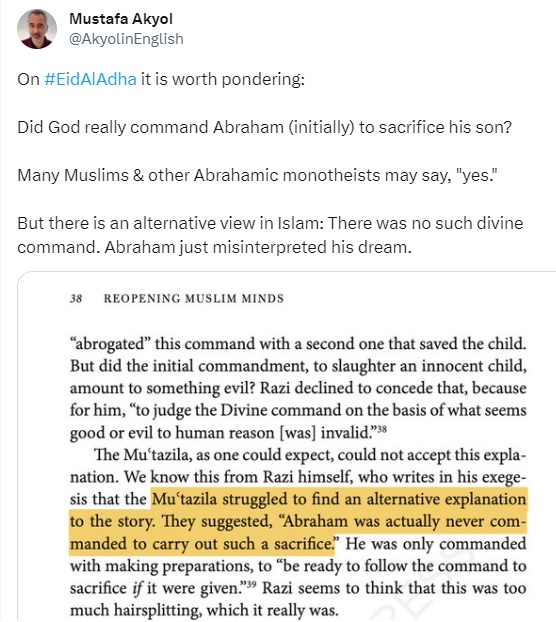
Now Mustafa Akyol had made the following post:
Mustafa Akyol stated:
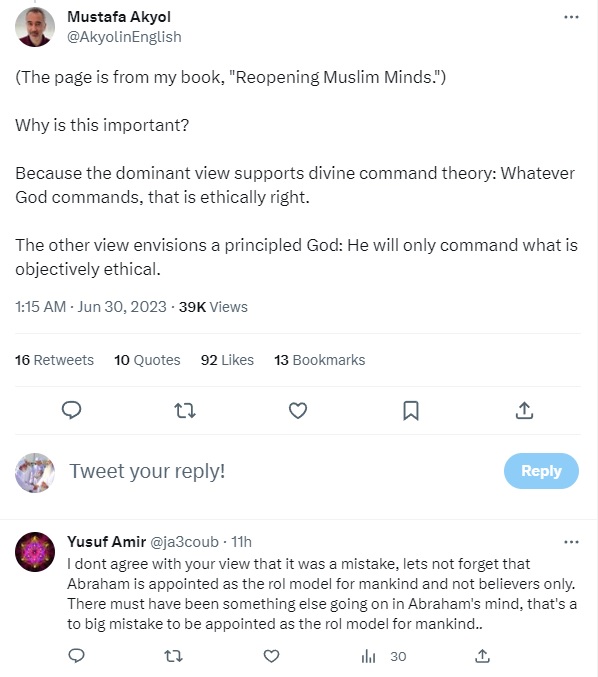
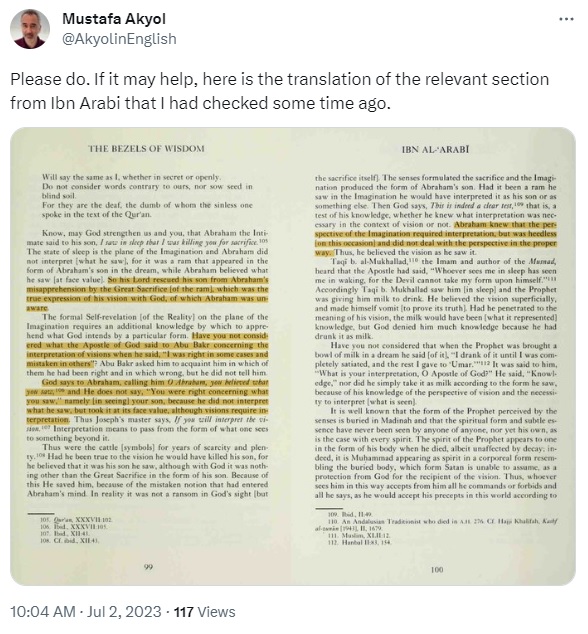
“It is worth pondering: Did God really command Abraham (initially) to sacrifice his son? Many Muslims & other Abrahamic monotheists may say, “yes.” But there is an alternative view in Islam: There was no such divine command. Abraham just misinterpreted his dream.”-Mustafa Akyol
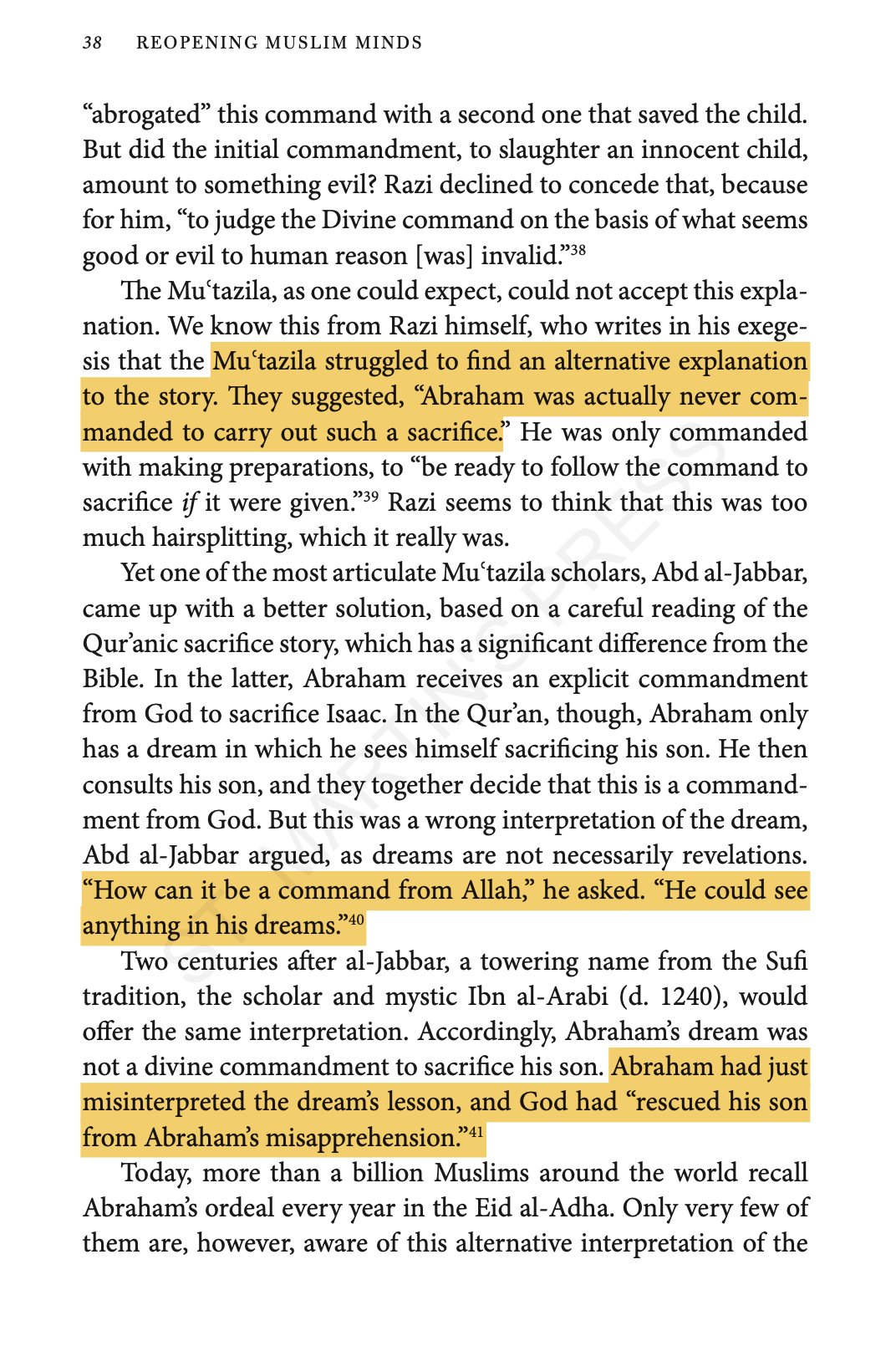
(The page is from my book, “Reopening Muslim Minds.”)
“Why is this important? Because the dominant view supports divine command theory: Whatever God commands, that is ethically right. The other view envisions a principled God: He will only command what is objectively ethical.” -Mustafa Akyol
Prima-Qur’an comments: The obvious problem with Mustafa’s assertion is who or what decides what a principled God would entail? Who also decides what is objectively ethical?
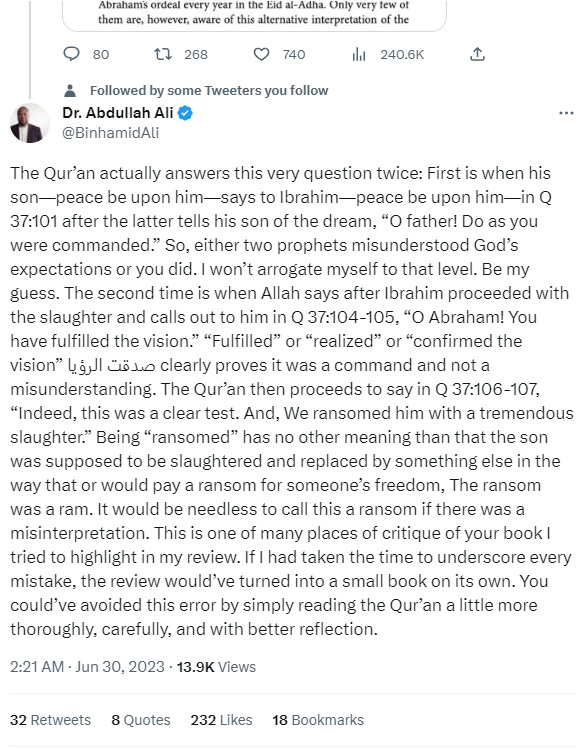
Abdullah bin Hamid Ali responds.
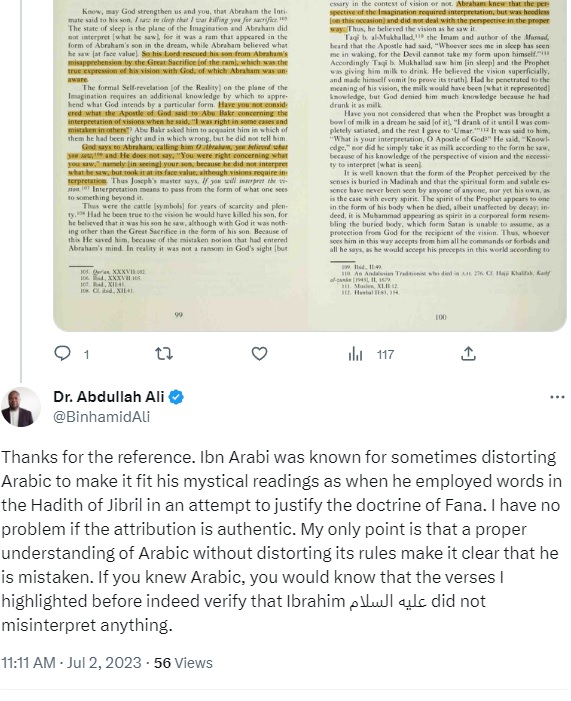
This post was responded to by Dr. Abdullah Bin Hamid Ali with:
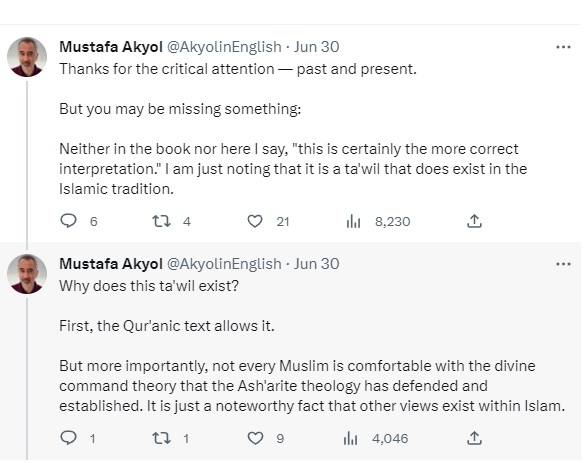
To which Mustafa Aykol responded with:
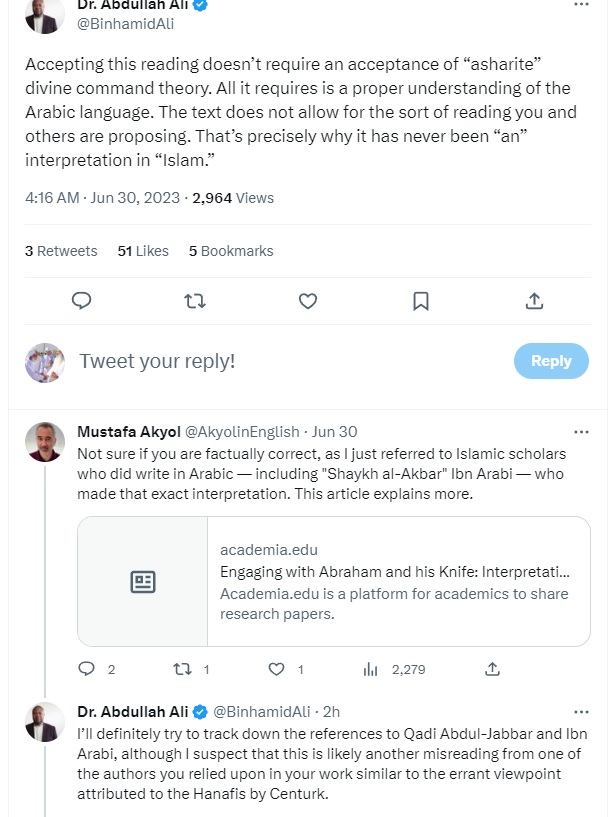
To which Dr. Abdullah bin Hamid Ali responds with:
Prima-Qur’an comments: At this point in the exchange, Dr. Abdullah Bin Hamid Ali noted that Mustafa Akyol had transmitted errors made by others in the past. In particular to viewpoints attributed to the Hanafi school that they did not hold.
Rejoinder from Mustafa
Prima-Qur’an comments: There are a number of problems with the mystic Ibn Al Arabi’s view. He seems that Allah (swt) had veiled him from the truth of the matter.
From the text posted above:
“The state of sleep is the plane of the Imagination and Abraham did not interpret [what he saw], for it was a ram that appeared in the form of Abraham’s son in the dream, while Abraham believed what he saw [at face value] So his Lord rescued his son from Abraham’s misapprehension by the Great Sacrifice [of the ram], which was the true expression of his vision with God, of which Abraham was unaware.”
“Have you not considered what the Apostle of God said to Abu Bakr concerning the interpretation of visions when he said, “I was right in some cases and mistaken in others?” Abu Bakr asked him to acquaint him in which of them he had been right and in which wrong, but he did not tell him.”
“Thus were the cattle [symbols for years of scarcity and plenty. Had he been true to the vision he would have killed his son, for he believed that it was his son he saw, although with God it was nothing other than the Great Sacrifice in the form of his son.”
“Thus Joseph’s master says, If you will interpret the vision. Interpretation means to pass from the form of what one sees to something beyond it. Thus were the cattle [symbols] for years of scarcity and plenty. Had he (Ibrahim) been true to the vision he would have killed his son, for he believed that it was his son he saw, although with God it was nothing other than the Great Sacrifice in the form of his son.”
Prima-Qur’an comments: Ibn Al Arabi as someone making egregious blunders one after the other.
Ibn Al Arabi the one who did not have the dream knows better than Ibrahim himself what the dream entailed?
Ibn Al Arabi doesn’t help his case by stating that Yusuf (as) can interpret his dream correctly but Ibrahim (as) cannot! That is indeed very weak.
Why relate the supposed conversation between Abu Bakr (ra) and the Blessed Messenger (saw) if we are to be let down with…” but he did not tell him”
So now Ibn Al Arabi does what the Prophet (saw) himself did not do?
“he (Ibrahim) been true to the vision he would have killed his son,” Did Ibn Al Arabi not read the Qur’an when Allah (swt) states: We called out to him: “Oh Ibrahim! You have already fulfilled the vision.” What does Ibn Al Arabi think would have happened had that voice not called out?
Rejoinder Dr. Abdullah Bin Hamid Ali
Prima-Qur’an comments: Apparently this is what Dr. Shehzad Saleem conveys what Javed Ahmed Ghamidi says as well. You can see that here: https://www.youtube.com/watch?v=KPR-hzoROaw
So Javed Ahmed Ghamidi & Mustafa Akyol are of the same view here.
Prima-Qur’an comments: To be quite honest, Dr. Abdullah Bin Hamid Ali has already shown us the clear response in his initial reply.
Questions:
What were those words that Ibrahim was tried with?
“And when Ibrahim was tried by his Lord with certain words, which he fulfilled.” (Qur’an 2:124)
“Then when they submitted and Ibrahim laid him on the side of his forehead for sacrifice. We called out to him: “Oh Ibrahim! You have already fulfilled the vision.” Indeed this is how We reward the good-doers. For this was obviously a clear trial.” (Qur’an 37:103-106)
“Then when they submitted” Can it be said that Ibrahim and his son submitted to Satan?
Can it be said that they both submitted to something false (faulty interpretation of a dream)?
“We reward the good-doers” Can it be said that Satan rewards the doers of good?
For this was obviously a clear trial. What is there a clear trial in sacrificing a sheep or lamb? That is something people were accustomed to.
Prima Qur’an summary: What did we learn from this exchange?
This text is a reference to Ibrahim (as) being tried by Allah (swt) by certain words which he fulfilled.
The son (undisclosed) at this point. Was patient with what his father saw in his dream. His father Ibrahim (as) saw that he was to sacrifice his son.
When they had submitted (the son by submitting to the father’s authority and by this the vision given by Allah) and the father by submitting to the vision from Allah (swt). The submission itself was the fulfillment of the vision. Not the sacrificing of anything. The vision was already fulfilled.
“The answer of the Believers, when summoned to Allah and His Messenger, in order that He may judge between them, is no other than this: they say, “We hear and we obey“: it is such as these that will attain felicity.” (Qur’an 24:51)
Lastly, we see that immediately after this were the glad tidings of the second son of Ibrahim (as). That is the Prophet Isaac (as). Think about it. The willingness to sacrifice a son and not only is he sparred, but an announcement of a second son!
You were willing to sacrifice your son to Allah (swt) due to this tremendous test via submission you were awarded two sons! Subhan’Allah!
But as for those who defiantly disobeyed, their refuge is the Fire. Every time they wish to emerge from it, they will be returned to it while it is said to them, “Taste the punishment of the Fire which you used to deny.” (Qur’an 32:20)
“Indeed, the righteous will be in pleasure, And indeed, the wicked will be in Hellfire. They will [enter to] burn therein on the Day of Recompense, And will not be removed from it.” (Qur’an 82:13-16)
﷽
There seems to be some bizarre hadith that are accepted among Sunni Muslims that indicate that Muslims who are destined for hellfire would be ransomed by the hellfire by a Christian or a Jew. Thus, the Christian or the Jew would go to hellfire in place of the Muslims!
We will give the hadith that the Sunni Muslims rely upon for this as well as some of the justifications put forward by their scholars. Then we will give the Ibadi critique of these hadith and why they do not meet our standards.
The hadith that are brought forward to support this are as follows:
Abu Musa’ reported that Allah’s Messenger (saw) said:
When it will be the Day of Resurrection Allah would deliver to every Muslim a Jew or a Christian and say: That is your rescue from Hell-Fire.
Abu Burda reported on the authority of his father that Allah’s Messenger (saw) said:
No Muslim would die but Allah would admit in his stead a Jew or a Christian in Hell-Fire. ‘Umar b. Abd al-‘Aziz took an oath: By One besides Whom there is no god but He, thrice that his father had narrated that to him from Allah’s Messenger (saw).
Abu Burda reported Allah’s Messenger (saw) as saying:
There would come people amongst the Muslims on the Day of Resurrection with as heavy sins as a mountain, and Allah would forgive them and He would place in their stead the Jews and the Christians. (As far as I think), Abu Raub said: I do not know as to who is in doubt. Abu Burda said: I narrated it to ‘Umar b. ‘Abd al-‘Aziz, whereupon he said: Was it your father who narrated it to you from Allah’s Apostle (saw)? I said: Yes.
It seems that there is also a belief held among Sunni Muslims that every person has a place for them in hell and in heaven. This is coupled with the belief that there is a pre-destined and pre-scribed number of people destined for both hell and heaven.
Allah (swt) has never described the hellfire as a place in which it becomes full.
“The Day We will ask Hell, “Are you full?” And it will respond, “Are there any more?” (Qur’an 50:30)
Prima Qur’an comments: In trying to answer why the Jews and Christians in particular are singled out , the Ash’ari, Maliki, Sufi, Al-Qadi ‘Iyad said:
“Because every accountable person has a place in Paradise and a place in Hell, whoever believes truly, his place in Hell will be replaced with a place in Paradise, but for the one who does not believe it will be the opposite, and it will be as if the disbelievers took the places of the believers in Hell. Moreover, because Allah has sworn to fill Hell, it will be filled with the disbelievers so as to save the believers from the Fire. So in that regard they are like a ransom for the believers. Perhaps the reason why the Jews and Christians are singled out for mention is because they are well known for their opposition to the Muslims and for being their opposites with regard to believing in the Messenger, which dictates that they should be saved.” End quote from Mirqaat al-Mafaateeh (8/3525).
Prima Qur’an comments: For us we do not accept the reasoning of Qadi ‘Iyad.
Furthermore the site says:
“On the Day of Resurrection there will be a Jew or a Christian for every Muslim, who will be his ransom from the Fire. That does not contradict the fact that some Muslims sinners will enter the Fire for their sins, so that Allah may purify them thereof, because they will enter it, then they will be brought out of it by Allah’s mercy, then they will enter Paradise, where they will inherit what would have been the disbelievers’ places in it, because Allah has forbidden it to the disbelievers.”
Prima Qur’an comments: The above comment is to be dismissed for the following reasons:
There is absolutely not a single statement or example anywhere in the Qur’an of the believer entering the hellfire. Not one.
There is absolutely not a single statement or example anywhere in the Qur’an of the disbelievers leaving the hellfire. Not one.
On the basis of Aqidah (Creed) the above statement makes no sense. Because if there is a place reserved in hell and heaven for every person created are we truly to believe that the Blessed Prophet (saw), The Prophets in general, small children and so forth have an abode in hellfire? May Allah forgive us and guide us to the truth.
On the basis of Mantiq (Logic) the above statement makes no sense. It’s as if the belief is there is an abode in heaven and hell for all creation but one takes the place of the other, which means there would be empty or reserved spots in both heaven and hell if this was a one to one to every person who has ever lived.
“The words of the Prophet (blessings and peace of Allah be upon him), “Allah (swt) will give every Muslim a Jew or a Christian, and He will say: This is your ransom from the Fire.” Indicate that this bounty will include all the Muslims, with no exceptions, because ransom is salvation, as mentioned above, and salvation will be for every Muslim. That is not contradicted by the fact that he may enter the Fire, because his entering it will be for the purpose of purification.”
Prima Qur’an comments: The above comment is dismissed for the following reasons:
“Allah (swt) will give every Muslim” is contradicted by text that state: “There would come people amongst the Muslims.” So which did the Blessed Prophet (saw) say?
On the basis of Aqidah (Creed) the above statement makes no sense. Because if there is a place reserved in hell and heaven for every person created are we truly to believe that the Blessed Prophet (saw), The Prophets in general, small children and so forth have an abode in hellfire? We seek refuge in Allah from such beliefs!
There is absolutely not a single statement or example anywhere in the Qur’an of the believer entering the hellfire. Not one.
There is absolutely not a single statement or example anywhere in the Qur’an of the disbelievers leaving the hellfire. Not one.
The Ibadi objection.
Our core argument is that these ahadith contradict the clear, unambiguous muhkamat of the Qur’an.
The wicked will not be removed from Hell (82:13-16). This directly contradicts the idea that anyone leaves Hellfire after entering.
Disbelievers will be told “Taste the punishment… you used to deny” (32:20). There is no escape clause.
Therefore, any hadith that suggests:
A Jew or Christian can be a “ransom” for a Muslim, or
Any believer will enter Hellfire (even temporarily), or
Any disbeliever will leave Hellfire
must be shadh (anomalous) or munkar (rejected), regardless of its chain. A sahih chain does not override a sahih text (the Qur’an).
For the Ibadi, this is sufficient to reject these hadith.
The Ibadi Mustalah al-Hadith. We focus on illah (pl. ‘ilal) which refers to a subtle, hidden defect that undermines the authenticity of a hadith, despite its chain of narrators appearing perfectly sound on the surface.
First thing we can notice is that in the matn (the actual text) of the hadith there are some quite notably strange peculiarities.
Defect #1
“Umar b. Abd al-‘Aziz took an oath: By One besides Whom there is no god but He, thrice that his father had narrated that to him from Allah’s Messenger.”
This shows that Umar b. Abd al-‘Aziz took issue with the transmission and demanded that the narrator swear an oath regarding it.
Defect #2
If he was satisfied with the oath he would not need to have included that in the transmission. However, the one who transmits includes the doubt and includes the oath.
The defects as discussed above indicates the narration was mawquf (stopping at a Companion) or mudtarib (shaky). Swearing an oath is not a method of authentication in hadith sciences—it reveals doubt.
Defect #3.
Why the mention of Jews and Christians being a ransom and not mention the Sabians or Zoroastrians or others? What makes the Jews and Christians particularly targeted?
This suggests takhsis (specification) without a Qur’anic basis. If Hell must be filled, any disbeliever would suffice. Mentioning Jews/Christians alone hints at polemical or historical insertion (e.g., early Muslim-Jewish-Christian disputes).
Defect #4. Some what related to defect #3 is that Seeing that the Jews and Christians are Mushrik, why not just simply say that the Mushrik are a ransom?
Defect #5. The conflicting nature of the text:
a) There would come people amongst the Muslims
b) No Muslim would die but Allah would admit
c) Allah would deliver to every Muslim
So is it every Muslim or a group from among the Muslims? That is a huge difference.
A clear idtarab (confusion) in the matn. A prophetic statement would not vacillate between universal and partial inclusion.
Defect #6. Abu Raub said: I do not know as to who is in doubt. Meaning he has doubts about who has doubts about this transmission: Did Umar b. Abd al-‘Aziz express doubt about the transmission, or was doubt expressed about Umar b. Abd al-‘Aziz’s transmission?
This is a sanad collapse. When transmitters themselves cannot identify the source of doubt, the hadith becomes majhul (unknown) and is discarded.
The Ibadi school, Ahl al-Haqq wa-l istiqama (The People of Truth and Straightness) have more than sufficient reasons to dismiss the above hadith. The attempts to explain them by Sunni scholars are not convincing.
We also want to share with you (the respected readers) an easy identifier to show that a hadith which has been classified as ‘sahih’ (sound) itself has doubtful things within it.
Many of you have possibly read our article in which we ripped apart a hadith classified as ‘sahih’ that was attributed to the Blessed Prophet (saw).
“Abu Umamah saw heads (of the Khawarij) hanging on the streets of Damascus. He said: ‘The dogs of the Fire and the worst dead people under the canopy of the heavens. The best dead men are those whom these have killed.’ He then recited: On the Day when some faces will become white and some faces will become black… (3:106) until the end of the Ayah. I said to Abu Umamah: ‘Did you hear IT from the Messenger of Allah (saw)?’ He said: ‘If I had not heard IT but one time, or two times, or three times, or four times – until he reached seven – I would not have narrated it to you.”
Now, we also want to share with you two more hadith and then we want to discuss something about the matn or text. It is absolutely relevant to this blog entry.
Narrated Abu Huraira:
The Prophet (saw) said, “A group of Israelites were lost. Nobody knows what they did. But I do not see them except that they were cursed and changed into rats, for if you put the milk of a she-camel in front of a rat, it will not drink it, but if the milk of a sheep is put in front of it, it will drink it.” I told this to Ka`b who asked me, “Did you hear it from the Prophet (saw) ?” I said, “Yes.” Ka`b asked me the same question several times. I said to Ka`b. “Do I read the Torah? (i.e. I tell you this from the Prophet.)“
Now what is very eye opening is that in the hadith above about a group of the Children of Israel turned into rats, or the hadith about the khawarij being the dogs of hellfire, or about Jews and Christians being ransom for Muslims from hellfire.
There are three things that the keen eye will notice about all of these hadith transmissions.
There is doubt expressed in the transmission.
One of the transmitters is having big doubts about what is being transmitted to him.
The inclusion of the doubt is included in the transmission rather than omitting it altogether.
We have extremely rigid methods for accepting narrations attributed to the Blessed Messenger (saw).
There are theological views among the Sunni Muslims that teach things that have no basis in the Qur’an.
Among them are:
That a believer can enter into hellfire.
That a person may exit the hellfire.
Because the reality of these beliefs is established among the theological schools of Sunni Muslims, it has led them to have some subpar standards for grading and accepting narrationsattributed to the Blessed Messenger (saw).
If you have found the above entry beneficial we invite you to read the following:
“Complete the pilgrimage and minor pilgrimage for Allah.” (Qur’an 2:196)
﷽
May Allah (swt) bless and accept the noble Shaykh for teaching us how to perform the Hajj in accordance with the Qur’an and Sunnah. May all who follow this guide remember the blessed Shaykh in their du’a and may this teaching be a witness for the Shaykh on the day of reckoning. Amin.
Hajj Step by Step | From the Prohibitions of Ihram to the Exit of Umrah | Shaykh Abdul-Munim bin Rashid Al-Saidi
Allah is the Greatest, Allah is the Greatest, Allah is the Greatest. There is no god but Allah.
In the name of Allah, the Most Gracious, the Most Merciful. All praise is due to Allah, Lord of all worlds, and may peace and blessings be upon our Master Muhammad, his family, and all his companions.
To proceed: I greet you, my brothers and sisters watching, with the beautiful, blessed greeting of Islam: Assalamu Alaikum Wa Rahmatullahi Wa Barakatuh (May peace, mercy, and blessings of Allah be upon you all).
We are pleased to meet again for the second part of the jurisprudence course on the rulings of the rituals of Hajj and Umrah. We ask Allah, Glorified and Exalted, to make it full of goodness, benefit, and utility, and to grant us and you reward and blessing.
In our last meeting, we stopped after the person in a state of ritual consecration (Ihram) had entered Ihram and assumed the state of a Muhrim (one in Ihram). As long as he is a Muhrim, there are a number of things he is prohibited from doing, called the prohibitions of Ihram. These are matters he is forbidden from, and he cannot do any of them. If he does any of them, specific legal rulings apply.
What are these prohibitions, and what are these things that the pilgrim must avoid?
First, I note that abstinence is required only during the period of Ihram. Before his Ihram, he is not forbidden from these things, and after exiting his Ihram (Tahalul), they become permissible for him. So this prohibition is during the state of Ihram, from the start of the Talbiyah (chanting) until the Tahalul from the ritual he has entered.
Some of these prohibitions are specific to men, some specific to women, and some common to both. What are these prohibitions?
Let us all watch the following clip on the rulings of Hajj.
Question: What are the prohibitions of Ihram for Hajj and Umrah for men and women in general?
Answer: The prohibitions of Ihram for men and women are three categories:
What is prohibited for both males and females.
What is prohibited only for males.
What is prohibited only for females.
As for what is prohibited for both males and females:
Removing head hair by shaving or other means, due to the saying of Allah: “And do not shave your heads until the sacrificial animal has reached its place of slaughter.” The majority of scholars include the hair of the rest of the body by analogy with head hair.
Trimming or cutting fingernails or toenails, by analogy with shaving hair, according to the well-known view of scholars.
Using perfume after entering Ihram, on one’s clothes, body, or anything else, due to the Prophet’s (saw) statement about the Muhrim: “He should not wear a garment touched by saffron or wars (a yellow dye).”
Concluding a marriage contract, due to the Prophet’s (saw) saying: “The Muhrim should not marry, nor arrange a marriage for himself or others, nor propose marriage.”
Sexual touching with desire, such as kissing, caressing, hugging, etc.
Sexual intercourse, due to Allah’s saying: “The Hajj is during well-known months. So whoever has made Hajj obligatory upon themselves therein [by entering Ihram], there should be no sexual relations, no wicked conduct, and no arguing during Hajj.”
Killing game animals, due to Allah’s saying: “…and hunting of the land is forbidden to you as long as you are in Ihram.” So the Muhrim is not permitted to hunt or kill game, whether directly, indirectly, or by assisting in its killing through guiding, pointing, handing over a weapon, etc.
As for what is prohibited only for men (and permissible for women):
Covering the head with something that adheres to it, like a turban, cap, or head cover, due to the Prophet’s (saw) statement about the Muhrim who was thrown by his mount at Arafat: “Do not cover his head.”
Wearing sewn garments – meaning wearing what is tailored to fit the body parts, whether covering the whole body like a hooded cloak (Burnus) or shirt, or part of it like pants, leather socks, socks, or gloves. This is based on the hadith of the Prophet (saw) when asked what the Muhrim should wear; he said: “He should not wear a shirt, nor a turban, nor a Burnus, nor pants, nor leather socks.”
As for women: She may cover her head and wear whatever clothes she wishes while in Ihram, provided she does not display her adornment (Tabarruj), she should not wear gloves (for hands), nor a face-veil (Niqab), and she should not cover her face unless non-mahram men are passing close by, in which case she may cover her face. And Allah knows best.
So, when the pilgrim enters Ihram and performs the Talbiyah, he becomes a Muhrim and is prohibited from these forbidden things.
What does he do from the moment of Ihram until he reaches Makkah to perform this ritual (Umrah)?
He must recite the Talbiyah frequently throughout the journey, from the moment of Ihram at the Miqat (designated point) until he sees the Sacred House of Allah. He should say it often. It is narrated from the Prophet (saw) that on the Day of Resurrection, those who recited the Talbiyah will have witnessed for them everything to their right and left. The man should raise his voice with the Talbiyah – this was the practice of the companions of the Messenger of Allah (saw). As for the woman, she should not raise her voice but recite it in a low voice audible only to those next to her.
So the Muhrim, whether man or woman, continues reciting the Talbiyah frequently until he reaches Makkah and sees the Sacred House. There, he stops the Talbiyah and begins performing the rituals of Umrah.
The rituals of Umrah include: Tawaf (circumambulation), praying two Rak’ahs behind Maqam Ibrahim (Station of Abraham), Sa’yi (walking) between Safa and Marwah, and then Tahalul (exiting Ihram).
The first is Tawaf. Tawaf has conditions that the pilgrim performing Umrah must adhere to. The Umrah is not valid, nor is the Tawaf, unless these three conditions are met:
Purity (Taharah) from ablution (Wudu): The Messenger of Allah (saw) said: “Tawaf is a prayer, except that Allah has permitted speaking during it. So whoever speaks, should speak only good.” Therefore, the one performing Tawaf must maintain his Wudu throughout the entire Tawaf and until he completes the two Rak’ahs behind Maqam Ibrahim.
The Tawaf must encompass the entire Kaaba: Meaning that no part of his body enters inside the Kaaba; rather, he must go around the entire Kaaba. (Some may ask if the pilgrim can enter any part of his body into the Kaaba – we will clarify this shortly).
He must complete seven circuits (Ashwat) around the Kaaba – no less, and no more than seven. Acts of worship are Tawqifiyyah (based on divine prescription, not personal opinion). It is not valid for the pilgrim to add or subtract anything from the practice of the Messenger of Allah (saw), who said: “Take your rituals from me.”
Just as Tawaf has conditions, it also has recommended practices (Sunnan). The pilgrim should strive to adhere to them:
First Sunnah: Al-Idtiba’ – Exposing the right shoulder. Before starting Tawaf, he takes his upper garment (Rida’) from his right shoulder, passes it under his armpit, and places it over his left shoulder. This is a Sunnah. When does he do it? For all seven circuits. After completing the seventh circuit, he returns his garment to its normal state.
Second Sunnah: Ar-Raml – Walking with quick, short steps (not running). This is specific to men. He does this during the first three circuits only, from the Black Stone to the Yemeni Corner. When he reaches the Yemeni Corner, he walks normally. If he cannot due to severe crowding, there is no sin if he leaves Ar-Raml.
Third Sunnah: Kissing the Black Stone if he can reach it without causing crowding or harm to others. If he cannot (the usual case during Hajj due to crowding), the sensible person should not approach that place to avoid harming or being harmed. He then has another option: to face it, raise his hands, and say “Allahu Akbar” without kissing.
Fourth Sunnah: Touching (Istilam) the Yemeni Corner – touching it with his hand without kissing it or kissing his hand. If he cannot, he does not gesture or say Takbir.
Fifth Sunnah: Supplication (Dhikr) – The one performing Tawaf should frequently remember Allah with all types of Dhikr. The minimum is to say Al-Baqiyat As-Salihat (the enduring good deeds). Each of us has needs when going to this pure place; he should ask Allah in any language, as Allah understands all languages. Is there a specific Dhikr? No specific Dhikr is required during Tawaf except in one place: between the Yemeni Corner and the Black Stone. The Prophet (saw) would say there: “Rabbana atina fid-dunya hasanah, wa fil-akhirati hasanah, wa qina ‘adhab an-nar” (Our Lord, give us in this world good, and in the Hereafter good, and protect us from the punishment of the Fire). For the rest of Tawaf, there is no required specific Dhikr.
My advice to my brothers and sisters is to occupy themselves with venerating the ritual, not paying attention to the actions of others, and seeking Allah’s pleasure. You will find people busy with useless talk, taking pictures with phones, or even having audio/video calls with others in other countries. All of this contradicts the veneration of this blessed ritual. Venerating the rituals of Allah stems from the piety of hearts.
Earlier, we mentioned that the pilgrim must avoid letting any part of his body enter inside the Kaaba during Tawaf. (Visual description of the Kaaba, the Black Stone, the Yemeni Corner, the door, Maqam Ibrahim, and the curved wall called Al-Hijr or Hateem). The common mistake is entering the area between Al-Hijr and the Kaaba. This space is actually part of the Kaaba, as is that wall, based on the foundations laid by Ibrahim and Isma’il (peace be upon them). Whoever performs Tawaf must avoid entering this space or placing his hand on top of the wall. A hand placed on that wall has not circumambulated the Kaaba as Allah commanded: “Let them circumambulate the Ancient House” (22:29).
(Clip showing how to perform Tawaf, from entering the Sacred Mosque until after praying the two Rak’ahs).
After finishing Tawaf at the Sacred House, the pilgrim moves to the second ritual: Sa’yi between Safa and Marwah.
Upon entering the path leading to the Mas’a (place of Sa’yi), he enters through Bab as-Safa. It is Sunnah, when approaching Safa, to recite the verse: “Indeed, As-Safa and Al-Marwah are among the symbols of Allah. So whoever makes Hajj to the House or performs ‘Umrah, there is no blame upon him for walking between them. And whoever volunteers good – indeed, Allah is Appreciating and Knowing.” (2:158).
He recites this, then when he reaches Safa, he faces the Qibla, raises his hands, and makes the supplication narrated from the Prophet (saw), repeating it three times and supplicating between them. Then he descends towards Marwah, remembering Allah, and it is Sunnah for the man only to walk quickly (Ramal) between the two green markers. When he reaches Marwah, he supplicates as he did at Safa (without reciting the verse), completing one circuit. He returns to Safa the same way. Each time he goes from Safa to Marwah or Marwah to Safa counts as one circuit. He continues until he ascends Marwah on the seventh circuit.
The two green markers are the lights found in the Mas’a. The man runs quickly in this area. The woman does not run. A common question: What should a man do if he is with women he might lose during Sa’yi? The solution is to take a specific path – either the far right edge or the far left edge of the Mas’a, not the middle. When he reaches the start of the green markers, he runs. At the end of the running area, he stops at the corresponding pillar and waits for the women, who walk normally, to catch up.
After completing Sa’yi, nothing remains of the Umrah rituals except Tahallul (exiting Ihram). For the man, this is done by taking some hair from all over the head, not just one part. Some take only from one side – this contradicts the Sunnah. The legal principle is to cover the entire head. Since the Mutamatti’ pilgrim will need to shave on the 10th of Dhul-Hijjah, he should shorten (Taqseer) his hair after finishing Umrah, using scissors or a machine, covering the whole head.
As for the woman, she shortens or cuts from the end of her hair by about a fingertip’s length. She gathers all her hair at the back and cuts the end by the length of a fingertip. I remind believing sisters heading to the Sacred House that shortening hair to exit Umrah (or Hajj on the 10th) must be done in a covered place away from men’s eyes, as a woman’s hair is ‘Awrah (must be covered). Secondly, she should do this immediately upon returning to her lodging, before getting busy with something else, so she doesn’t forget and then do something prohibited in Ihram. Can she cut her own hair? Yes, there is no sin in that, Allah willing.
After this Tahallul – either by shortening for the man or cutting a fingertip’s length for the woman – the person performing Umrah has exited his Ihram. For the Mutamatti’ pilgrim, he puts on his normal clothes, and everything prohibited during Ihram becomes permissible. As for the Qarin (performing Hajj and Umrah together) and Mufrid (performing Hajj alone), they remain in their Ihram until the 10th day of Dhul-Hijjah, after completing the actions of that day.
With this, we conclude this blessed episode at the end of the actions of the Umrah rituals. We ask Allah, Glorified and Exalted, to accept righteous deeds from us and you. In the next episode, we will talk about the rituals of Hajj, by the permission of Allah.
We will meet you in the next meeting.
Assalamu Alaikum Wa Rahmatullahi Wa Barakatuh.
Allah is the Greatest, Allah is the Greatest, Allah is the Greatest. There is no god but Allah.
“Call people to the pilgrimage. They will come to you on foot and on every lean camel from every distant path.” (Qur’an 22:27)
﷽
Shaykh Hatim and brother Firdaus Aziz discuss Why Hajj is so Important and why Muslims should not delay the Hajj when given the opportunity.
Welcome to the Voice of Islam, the Friday special podcast. Alhamdulillah, it’s been a while — we’ve been away for quite some time, and all of us have been busy. But alhamdulillah, now we’re back, and we will continue insha’Allah. As you know, brothers and sisters, we are in the month of Hajj, and some of us have been chosen to perform Hajj, alhamdulillah. Today’s topic will be about Hajj. And of course, brothers and sisters, it’s been over eight months since what happened to our brothers and sisters in Palestine. We ask Allah to ease their hardships and give them success, Ameen. Insha’Allah, things will become much easier for them soon. We continuously make du’a and will continue to remember them in every prayer. Again, I ask Allah to ease their hardship, ease their suffering, and give them success in this life and the Hereafter, Ameen.
[Hajj & The Blessing of Proximity]
We had a chat recently about Hajj. Alhamdulillah, some of you in the Gulf countries can go to Hajj every year — may Allah bless you where you are. For us here in New Zealand, it takes a long time to travel for Hajj. Alhamdulillah, I remember last year you performed Hajj as well — is that correct? Yes, you did. Thank you very much, Dr. Feros, for hosting the show. We’ve been busy and away for a very long time, so it’s about time we came back to our weekly show.
Alhamdulillah, we are alive to witness the season of Hajj again. Hajj is a festive season where Allah gives privilege to many Muslims around the world to perform an important pillar of Islam. I remember when I spoke to you and told you that insha’Allah I would be leaving in a few days for Hajj, you said, “I envy you, and I wish I could go as well.” That brings me to the idea of blessings: when does a Muslim recognize something as a blessing? What happens when you recognize it, and what happens when you don’t — until you suddenly find yourself losing it?
A human being is designed by Allah to fall into routine. When he sees something every single day or every month on a continuous basis, he becomes accustomed to it. His interest reduces, and he no longer gets excited because it’s always there. For us in the Middle East, since the day we were born and raised, we knew the Kaaba is next to us — it’s next door. We grew up seeing relatives suddenly decide to switch on the car and drive to Saudi Arabia for Hajj. It’s almost a 22‑hour drive, now even shorter with the new roads. I have friends, relatives, and neighbors who just text me in the morning and say, “You know what? I’m going for ‘Umrah today.” They book a plane ticket and they go. These people feel and know the significance of Makkah and Madinah.
[Why Some Never Go]
But you also have people who have never set foot in Makkah or Madinah their entire lives. Strangely, you even have people living in Makkah who have never entered the Haram. So you wonder: why do some never visit the holiest land? Either they are ignorant and don’t know the value of the place, or they know the value but feel they are not ready because of their sins — they want to be pure first. The problem is, none of us will ever be 100% pure. That day will never come. Then you have another group who feel that Allah has to call them to that place. They are living in a fantasy that Allah will send an angel to call them to Makkah. That will never happen. Allah commanded Ibrahim to call people for Hajj, and the call is already done. If you didn’t hear it, then there’s a problem with your hearing — go check your ears. But if you are still waiting, the Day of Judgment will come and you will not have been called yet.
Then there are those who think, “It will always be there. In the future, when I’m ready, I’ll go.” Let me tell you about “it will always be there.” I have been going for Hajj and ‘Umrah for the past 20 years, alhamdulillah. Previously, whenever I decided to go, I packed my bags and left — no formalities. That is no longer the case. Now there is a system: you can only go every five years, and you have to apply electronically. Every country has a quota. Oman used to have 36,000 pilgrims per year; now the allowed number is only 14,000 — a drop from 36,000 to 14,000. That’s nearly a 30‑40% reduction. The system works on first‑come, first‑serve plus criteria: older people have a better chance, women going with their mahram for the first time are given priority, people with disabilities and chronic diseases, those who have never gone in their life, reverts — all get priority. Then comes you. You might apply and wait three or four years, and your turn may not come. The blessing of going anytime is no longer there. You must follow the system; you might get a seat, or you might not.
When I went for Hajj the first time, I paid 600 OMR for the entire journey. That’s about 2,500 New Zealand dollars. Today, the cost is 3,000 OMR — about 12,000 NZ dollars. Previously, it was cheap and accessible to everyone. Now it’s expensive, and you don’t get to choose when to go. This number will keep shrinking. So to those procrastinating — “I’ll go after marriage, after my house, after my promotion, when I’m older, when I stop sinning” — that day might not come. You have two problems: inflation and shrinking quotas. And a bigger problem: the Angel of Death. If Allah sends him to you and takes your life, game over. You had the chance, the means, the physical capability, and you didn’t perform Hajj.
[Youth vs. Old Age for Hajj]
Dr. Feros, you’ve seen on TV very old people in wheelchairs, barely able to walk. Do you think performing Hajj in that state is easier than when you are young, healthy, and vibrant? Why do people wait until they have to be carried? I understand those who cannot afford it, or those from countries like Indonesia with 280 million Muslims who must wait 10 or 20 years. They may go when old — I understand that. But I don’t understand those who could have gone when younger but instead went to Thailand, Morocco, everywhere except Hajj.
[Oman’s Situation & Special Permission]
How many Muslims are in Oman? The entire population is 5 million — 2.5 million citizens and 2.5 million expats, some of whom are non‑Muslims. So out of that, only 14,000 go. Despite all the rules, you can still go every year — that means not many Omanis are applying. Our category is different: we are part of the service convoys, helping with logistics. We get permits to organize and support the pilgrims. That is a privilege from Allah that allows us to go every year. If we were not doing that, we would be like everyone else, not allowed every year. So alhamdulillah, you’ve been selected — you have connections and ability to go every year. I ask Allah to continue giving you that. Next time I want to go through Oman, I’ll let you know — you have to give me a special mission too. We’ll drive all the way to Makkah, insha’Allah.
[The Privilege of Going Repeatedly]
It’s funny: sometimes friends sarcastically say, “Why do you go to Hajj every year? Go see other places in the world. Is there nowhere else except Makkah?” They don’t understand the privilege or the connection. You mentioned waiting for Allah to give an invitation — but in a way, Allah doesn’t put that interest in some people’s hearts. For some of us, we want to be there, to feel the experience. When you go to Makkah and Madinah, you reflect: the Prophet ﷺ and the Companions used to be in that same spot, walking where you now walk. You try to imagine how it was. When you understand the history — think of Makkah before the time of the Prophet, when idols were there — and you see how things have changed. Prophet Ibrahim was there, he built this place. When you reflect on that, you feel excitement. You have love for our history, love for being a Muslim, love for everything about Islam.
Dr. Feros, the people of Oman were idol worshippers, and we are Muslims today because of the message of Islam that came from Makkah. How ungrateful would we be if we didn’t feel the sacredness of Makkah? The light of Islam started in Makkah, and we became Muslim because of it — not just Oman, but everywhere. That’s why the message was sent: because humanity had forgotten. SubhanAllah, now look — I’m getting jealous just talking about Makkah. I wish it were that easy for us in New Zealand just to pack a bag and be there. Next year, I’ll come to Oman, put me in the back of your car, and drive me.
[Two Reasons to Go Every Year]
I have two reasons why I go to Hajj every year. First, the Day of ‘Arafah. If people knew the value of standing on Mount ‘Arafah and asking Allah — how Allah grants all prayers — they would go, even if just to stand on that mountain. The Prophet ﷺ said that if you don’t stand at ‘Arafah, you don’t have a Hajj. For the past 20 years, every year I go to Mount ‘Arafah and ask Allah to make our lives easier and grant us what is good. Wouldn’t you want that privilege — to have your prayers accepted?
Second, humility. As humans, the devil nurtures our ego. You become successful — a business, education, career, a known figure — and something in your head tells you that you are important. When you go to Hajj, you become equal to everyone else. Once you wear the ihram, nobody cares who you are or what achievements you have. I was telling a friend: one year we were on a bus, and next to us was a pickup truck with five or six people sitting in the back. One of them was President Mahmoud Ahmadinejad of Iran. Can you imagine a president sitting in the back of a pickup truck wearing his ihram? Nobody was staring, nobody was looking, because on that occasion there are no kings, queens, businessmen, or CEOs. In front of Allah, your titles are for you at home. Throw them out the window. So Hajj teaches humility. We need to remind ourselves that we are servants of Allah, property of Allah. This journey helps you understand that — to humble yourself in front of your Lord and Creator.
[Du’a for Palestine & Resilience]
You mentioned du’a. After eight months of suffering and genocide, some of us as Muslims have grown tired of raising our hands to pray for our brothers. I want to remind everyone: the people of Gaza are still solid, resilient, fighting. How can we be tired, sitting in our comfortable homes, when we are only asked to raise our hands in every prayer and pray for them? If I were in the shoes of the people of Gaza, and I knew the least my brothers and sisters in the world could do for me is pray, and they’re not — I would really be upset.
It’s easy to claim we are believers. Anyone who takes shahada is labeled a believer, and those born Muslim carry the label. But faith is truly demonstrated in your actions, not your identity. Allah doesn’t want to know if you call yourself Muslim; He wants to know whether your belief system is translated into your actions. The actions show that you truly believe. Take tawhid: how do you translate that into your daily actions and your understanding of what’s happening around the world?
The issue of Palestine and Gaza is not eight months old. It has been ongoing for as long as I can remember, since the day I was born. But suffering will end — that is Allah’s promise. At the time of the Prophet ﷺ, the Companions struggled and were punished similarly. They would ask the Prophet, “When will we get victory?” They didn’t ask after a little punishment; they endured hardships. We know the story of Bilal, how he was punished — dragged with hot irons on his body, leaving marks and scars. That is exactly what we see now.
The other day, someone forwarded me a video that made me very sad. A young girl’s hands had been burned so badly that her fingers fused together — no fingers, just fused. She had scars on her scalp, legs, and face. You couldn’t read her facial expression. In 2024, 1445 Hijri, some of us have a really good life — we turn on a tap and water flows, we can buy food and drink. Meanwhile, others, who could have been helped, have the whole world against them. I don’t want to say more.
[Hypocrisy & The Return to Islam]
This war has exposed many hypocrites. I assure you: on the day of Palestine’s victory, the first to celebrate will be the hypocrites. They will say, “Alhamdulillah, we defeated the enemy,” while throughout the eight months they did nothing — not a word of support, not a single dollar, not a boycott of a coffee, burger, or donut. But when it comes to celebrating, they will be first. The good thing is, Allah has exposed everyone. Eight months is a long time to be resilient. You’re either on board, or you left the train long ago.
But at the same time, Allah has brought many people back to Islam. Alhamdulillah, here in New Zealand and all over the West — America and elsewhere — people are accepting Islam after seeing what happened in Palestine. Allah exposed some people and brought back Muslims who had drifted away. It’s a difficult time, but this war has also brought believers together as one.
[Hajj as Unity]
Those going for Hajj should take advantage of this occasion to build solidarity within the Ummah. Don’t go with an agenda of “I am Omani, he is Indian; I am black, he is white; I am from this tribe, he is from that; we are better than them.” Forget these differences. These differences are the main cause of what our Ummah is suffering today. We are weak because of our divisions. Before the show, we were talking about the annual dispute over moon sighting — everyone fighting about the moon. The Ummah is mature enough now to sit at one table and make a unified decision that everyone accepts. It is no longer healthy to continue like this.
We have united our fronts in support of Palestine. Let us continue. These eight months have proven that we can work together. We go to the streets and protest alongside atheists, non‑Muslims, even the LGBTQ+ community — all protesting side by side with Muslims against the Zionists. We have gotten along with everybody else. The only remaining people we still need to get along with are the Muslims. Let us put that effort in and unite the Ummah again.
[Closing & Reminders]
Alhamdulillah. Is there anything else you wanted to add? When you go to Hajj, if you take pictures and videos, send them to me so we can share on our Facebook and YouTube. I actually do Instagram reels intentionally to encourage young people to take this journey. When we go on holidays, we take pictures of everything — most of it nonsense. So when we go to the holy places, we want you to see live what it is like to be in the hands of Allah’s blessings, to see your brothers and sisters from around the world — every color, shape, size — all unified, asking for Allah’s mercy. I will share pictures and videos, and you can post them on Voice of Islam. I hope to see you all when I come back, insha’Allah.
Before we end, I want to remind you that you’ve agreed: next year, insha’Allah, you will take me to Hajj in your boot. I don’t need to worry about my visa — that’s your promise. I’ll be there next year, and you’ll take me straight to Hajj with that special visa category.
Look forward to seeing you when you’re back, insha’Allah. Please remember us — all of us here in New Zealand — in your du’a. I look forward to seeing you again, insha’Allah, either in Oman, Malaysia, or if you come visit us again in New Zealand or Fiji. Take care of yourselves.
One final message: Allah will aid His servants with victory. We hope to be alive to see the day Palestine is free again, Ameen. If you found this podcast beneficial, please share and forward. We look forward to seeing you again.
“Complete the pilgrimage and minor pilgrimage for Allah.” (Qur’an 2:196)
﷽
May Allah (swt) bless and accept the noble Shaykh for teaching us how to perform the Hajj in accordance with the Qur’an and Sunnah. May all who follow this guide remember the blessed Shaykh in their du’a and may this teaching be a witness for the Shaykh on the day of reckoning. Amin.
Hajj Step by Step | From the Moment of Preparation to Arriving at the Miqat | Shaykh Abdul Munim bin Rashid Al-Saidi(h)
Allah is the greatest, Allah is the greatest, Allah is the greatest. There is no god but Allah.
In the name of Allah, the Most Gracious, the Most Merciful. Praise be to Allah, Lord of all worlds. Praise be to Allah, by whose grace righteous deeds are completed. Through obedience to Him, life becomes pleasant and blessings descend. I send prayers and peace upon the bringer of glad tidings and warner, the illuminated lamp—the best of those who prayed, fasted, and circumambulated the Sacred House. May Allah’s peace and blessings be upon him, his family, his honorable companions, and upon all who follow his path and tread his way until the Day of Judgment. May He grant them abundant peace.
To proceed: My brothers and sisters, dear viewers, I greet you with the pleasant and blessed greeting of Islam: Peace be upon you all, and the mercy of Allah and His blessings.
We meet in this good and blessed gathering to discuss an important topic that concerns every Muslim, especially those who are about to present themselves to Allah, heading to the Sacred House of Allah to perform one of the rituals of Islam—the ritual of Hajj to the Sacred House of Allah.
At the beginning of this blessed gathering, we open with that which is best. I say: “My Lord, expand my chest for me, ease my affair for me, and untie the knot from my tongue so that they may understand my speech.” O Allah, teach us what benefits us, and benefit us by what You have taught us. Indeed, You are the All-Hearing, the All-Knowing.
We will discuss this topic through several axes, taking them one by one, and we will pause to consider some rulings related to each axis.
When a person resolves to perform Hajj to the Sacred House of Allah, what must he do before setting out to perform this ritual? There are several matters the pilgrim must attend to before heading to Allah to perform this great ritual. We will pause to consider some of these matters that the pilgrim does before going to perform this ritual.
First: He must purify his intention for Allah, because sincerity is the basis for acceptance of deeds. Allah says in the Noble Book: “And they were not commanded except to worship Allah, being sincere to Him in religion, inclining to truth, and to establish prayer and to give zakah. And that is the correct religion.” The correct religion that Allah desires from His servants is the religion based on sincerity to Allah in deeds. He also says: “Say, ‘Indeed, I have been commanded to worship Allah, being sincere to Him in religion.'” In the hadith that the Prophet (peace be upon him) relates from his Lord—a sacred hadith—Allah says: “I am the most self-sufficient of all partners. Whoever does a deed in which he associates others with Me, I leave him and his association.” Therefore, everyone, when performing any act of worship, must be sincere to Allah, seeking only Allah’s Face, not hoping for praise, mention, commendation, or anything from people. Rather, he seeks Allah’s pleasure by that deed, so that the deed may be purely for Allah and thus more worthy of acceptance.
Second: He must make sincere, genuine repentance (tawbah nasūḥ) from every sin and transgression. Repentance is something Allah has encouraged and urged His servants to do: “O you who have believed, repent to Allah with sincere repentance.” Allah has promised the believing servants that He will accept their repentance, forgive their misdeeds, and that He is the One who accepts repentance from His servants and pardons evil deeds. He gives glad tidings to His believing servants that He will accept them if they come to Him: “O My servants who have transgressed against themselves, indeed I am the Forgiving, the Merciful.” Therefore, it is fitting for the one heading to the Sacred House of Allah to purify his inner self through repentance from every sin and transgression before purifying his body by bathing for Ihrām.
Third: As a requirement of sincere repentance, he must settle all obligations, whether these obligations are between him and Allah or between him and other people. Someone might ask: “For example, what obligations between him and Allah?” These could be expiations (kaffārāt) that he must discharge before coming to Allah for this ritual. Or there might be days he owes to make up from Ramadan, which he should fast before setting out. Or there might be vows (nudhūr) he needs to fulfill before coming to Allah. These are obligations between him and Allah.
There might also be obligations between him and other people—rights or wrongs he must restore to their owners. Sincere repentance is not complete until rights are returned to their owners. Sins are of two types: sins between the servant and his Lord, and sins between the servant and his fellow. As for sins between him and his Lord, if he repents, Allah accepts his repentance.
But as for sins between him and his fellow, he must restore the right to its owner for Allah to accept his repentance. The Prophet (peace be upon him) severely warned against taking people’s rights unjustly and commanded believers to return even the smallest items—imagine, O servants of Allah, how much is a thread or a needle worth? A very small, almost negligible thing. Yet he (peace be upon him) said: “Return the thread and the needle.” He warned against anyone seizing a right from another without justification. “Whoever seizes a right from his brother by his oath has obligated the Fire for himself and forbidden Paradise for himself.” One of the Companions asked: “Even if it is something small, O Messenger of Allah?” He said: “Even if it is a twig from an arāk tree.” How much is an arāk twig worth? A small, insignificant thing. Yet it may lead its owner to become among the people of the Fire, may Allah protect us. Therefore, before coming to Allah to perform this great ritual, a person must settle all obligations between himself and others. Likewise, he must reconcile with people. If there are disputes or enmity between him and someone, he must seek absolution and resolve these matters before going for this ritual.
Suppose this person tries to reconcile with the other party, but the other party refuses. Does he bear any sin? No, because he initiated goodness and took the first step. The Prophet (peace be upon him) said: “It is not permissible for a Muslim to abandon his brother for more than three nights. They meet, and this one turns away and that one turns away. The better of them is the one who gives the greeting of peace first.” So if you are the one who initiates and takes the first step, you gain that virtue, even if the other party is not pleased, even if the other party refuses. You have earned the reward and gained the blessing.
There are other matters the pilgrim must attend to before setting out, including:
Learning the rituals: He must learn how to perform this ritual for one purpose: to perform the worship according to what Allah desires. The best way to worship Allah is with knowledge. If a servant performs worship without knowledge—i.e., ignorantly—he is rarely safe from mistakes. These mistakes may cause the worship to be invalid without his realizing it. Many people have fallen into issues due to ignorance that led to their Hajj being invalidated. Imagine a person spends his wealth, exhausts his body, leaves his family, is away from his homeland, and then returns only to find his Hajj invalid. What caused it? Failure to learn how to perform these rituals. Praise be to Allah, the means of learning are now available. Comprehensive books exist, as do concise ones, and clips from scholars and virtuous people are widespread on internet sites and networks. Your watching of this blessed course is part of this—a means of learning how to perform this blessed ritual. Therefore, be keen, may Allah bless you, to learn and to ask the people of knowledge and virtue about every matter that arises.
I draw attention here to a mistake many people make, especially in the rituals of Hajj. What is this mistake? A pilgrim encounters an issue and acts without asking. Then, after doing it, he comes to the scholars and says: “I did such and such, what is the ruling?” This is a mistake, my brothers and sisters. Rather, the principle is that a person should not act until he asks. Allah says: “And do not pursue that of which you have no knowledge. Indeed, the hearing, the sight, and the heart—about all those will be questioned.” A person should not fall into an issue without asking about it first. He should not act until he asks, so that he performs it correctly, avoiding mistakes that might lead to rulings that are difficult to fulfill.
Writing a will: Before setting out to perform this ritual, he should write his will. The principle for a believer is that his will should always be ready and written down. The Prophet (peace be upon him) mentioned concerning the believer that if he has something to bequeath, he should not spend a night without having his will written at his head. This means it should always be present, because a person does not know when the vicissitudes of fate will surprise him. Therefore, he should not set out for this ritual without having written his will. Someone might ask: “What should I write in my will?” First, he writes what he bequeaths to his family and relatives regarding kindness, goodness, and good conduct—advising them to fear Allah. Second, he writes what he owes to Allah in terms of rights. As we mentioned earlier, if there are obligations to Allah—such as vows, making up missed fasts, or expiations—and the person could not fulfill them before his travel time, he records them in his will so that if Allah decrees his death and he does not return from this journey, his heirs execute what he bequeathed. Likewise, he writes the rights that others owe him—debts if he lent money to people, or deposits left with others that belong to him. He also writes in his will if he holds deposits or trusts belonging to others, especially if it is money, because the heirs do not know whether this money is his or someone else’s; they might think it is his and distribute it as inheritance, when in fact it belongs to others or was entrusted to him for a period of time. So he must record those deposits in his will so that people’s rights are not lost. He also writes bequests for relatives—allocating a sum of money to be distributed to close relatives who are not heirs after his death. Allah commanded this in the Noble Book. He also writes in his will what he wishes to bequeath for various charitable purposes—setting aside part of his wealth for ongoing charity (ṣadaqah jāriyah), to be used for works or good causes whose benefit and reward return to him even while in his grave. He records all of this in his will, then has it witnessed by two witnesses. If he registers it officially with a notary, that is better. He leaves this will with a trustworthy person and instructs him to execute it if Allah decrees that he does not return from this blessed journey.
Lastly: He must always remember Allah throughout this blessed journey, remembering Him in his home and on his travels, at all times and in all situations, frequently remembering Allah and keeping his tongue moist with His remembrance throughout the journey. Allah commanded believers to remember Him often: “O you who have believed, remember Allah with much remembrance, and exalt Him morning and evening.” Allah commanded His believing servants to remember Him frequently because remembrance brings tranquility to the heart and peace of mind. Allah says: “Unquestionably, by the remembrance of Allah hearts are assured.” Therefore, the one heading to the Sacred House of Allah should keep his tongue occupied with Allah’s remembrance constantly, from the time he sets out—even before—and continue this throughout his journey, occupying himself with obedience. This is a season of good deeds, and the wise person is he who seizes opportunities—the opportunities of time are only for those who seize them.
The next axis in our discussion of the rulings of Hajj rituals in this jurisprudential course concerns the mīqāt (designated places and times). We will discuss the time-based mīqāt and the place-based mīqāt.
Time-based mīqāt: This is the time period that Allah prescribed for performing the Hajj ritual. Hajj is in “well-known months” (ashhur ma‘lūmāt) as Allah said. The months of Hajj are Shawwāl, Dhul-Qa‘dah, and the first ten days of Dhul-Hijjah. These are the months of Hajj. What this means is that whoever intends to perform Hajj Tamattu‘ must perform his ‘Umrah during this period. If he performs it before that, it does not count as ‘Umrah for Tamattu‘. If someone goes in Ramadan, performs ‘Umrah in Ramadan, then remains in Makkah until the time of the Hajj rituals, does this ‘Umrah suffice him for ‘Umrah al-Tamattu‘? The answer is no, because ‘Umrah al-Tamattu‘ must be performed during the months of Hajj we just mentioned. This is called the time-based mīqāt.
Place-based mīqāt: These are locations specified by the Prophet (peace be upon him) as mīqāt. It is not permissible for anyone heading to the Sacred House of Allah for Hajj or ‘Umrah to pass beyond these places without having entered Ihrām. He absolutely cannot pass them without Ihrām. What are these five locations? We will show them in the following segment:
The journey of glorification begins from the mīqāt. On the way to Makkah, every pilgrim passes by his designated mīqāt. The place-based mīqāt are:
Dhul-Hulayfah (Abyār ‘Ali) for the people of Madinah.
Al-Juhfah (Rābigh) for the people of the Levant (Shām).
Qarn al-Manāzil (Al-Sayl al-Kabīr) for the people of Najd.
Yalamlam (Al-Sa‘diyyah) for the people of Yemen.
Dhāt ‘Irq for the people of Iraq. These mīqāt are for their people and for anyone who passes by them from other regions. The people of Makkah enter Ihrām from “Adnā al-Ḥill,” which is outside the boundaries of the sanctuary. It is from the Sunnah for a traveler passing by land to go to the mīqāt and form the intention for ‘Umrah, saying: “Labbayka Allāhumma labbayk, labbayka ‘Umrah.” If he fears being unable to reach the sanctuary, he may make a condition by saying: “Fa in ḥabasani ḥābisun fa maḥilli ḥaythu ḥabastani” (If something prevents me, my place of removal is where I am prevented). As for one passing parallel to the mīqāt—such as a traveler by air or sea—he must intend Ihrām when parallel to it, and it is not permissible for him to pass the mīqāt without Ihrām.
These are the place-based mīqāt from which the pilgrim enters Ihrām. What does the pilgrim do at Ihrām? Ihrām has several steps that the pilgrim must do upon reaching the mīqāt:
Step one: Bathing (ghusl). The pilgrim bathes as he would for major ritual impurity, i.e., covering his entire body with water. Someone might ask: “Can he use scented soap?” The answer is yes, because he will use the soap and then wash it off with water afterward—there is no religious prohibition.
Step two: Wearing Ihrām garments. As you can see, a man wears two pieces of cloth: one as a lower wrap (izār) and the other over his shoulders, covering them. As for the woman, she enters Ihrām in her ordinary clothes and wears a wide, covering, ample cloak over them, with no outward adornment.
Step three: If an obligatory prayer is due, he prays it. If he reaches the mīqāt at the time of Ẓuhr, he prays it, then enters Ihrām afterward. If he reaches at Maghrib time, he prays Maghrib, then enters Ihrām afterward. If he reaches the mīqāt at a time when no obligatory prayer is due, he may pray two rak‘ahs as a voluntary prayer (tahiyyat al-masjid), then enter Ihrām afterward.
Step four: He then specifies the type of ritual he will enter. You will soon learn about the three types of rituals for which a pilgrim enters Ihrām. He specifies the type and also specifies for whom the Hajj is—if performing Hajj for himself, he intends it for himself; if performing Hajj on behalf of someone else, he intends it for that person.
If he has bathed, put on Ihrām garments, prepared himself, and prayed if an obligatory prayer was due, and has formed the intention in his heart—is he now in a state of Ihrām? Not yet. When does he become in a state of Ihrām? When he begins the Talbiyah. The Talbiyah is the entry into the ritual, exactly like the opening takbīr (takbīrat al-iḥrām) in prayer. Just as the opening takbīr in prayer prohibits certain permissible things for the person (like eating, drinking, speaking, turning away, moving), similarly, the Talbiyah prohibits certain things for the one who recites it. It is not valid for him to do certain prohibited acts once he recites the Talbiyah. We will see what these prohibitions are shortly.
A note for those traveling by air: Someone going by plane may take one of three routes. He may go to Madinah, directly to Jeddah, or to Ta’if. Whoever goes to Madinah enters Ihrām after leaving Madinah from the mīqāt of Dhul-Hulayfah. Whoever goes to Ta’if will land at Ta’if airport, and upon leaving Ta’if, he will pass by the mīqāt of Al-Sayl al-Kabīr and enter Ihrām there. The third case is the one who flies directly to Jeddah. This person will pass by the mīqāt of Al-Sayl al-Kabīr while in the air. What must he do? Airlines announce the mīqāt half an hour before reaching it. At that point, the person should be ready and prepared to enter Ihrām before reaching the mīqāt. As soon as the announcement is made in the plane that the mīqāt is half an hour away, he prepares to enter Ihrām. My advice to my brothers is to wear the lower Ihrām garment (izār) before boarding the plane—either from home or from the last airport they depart from—and keep the other piece in their hand luggage. Then, when the announcement is made in the plane that the mīqāt is half an hour away, while still in his seat, he can remove his clothes and place the second piece of Ihrām cloth over his shoulders, then begin the Talbiyah. The most important thing I emphasize is that the one heading to the Sacred House of Allah should not wait for the second announcement in the plane. The second announcement indicates that the plane is passing over the mīqāt. Rather, he must enter Ihrām before reaching the mīqāt. Therefore, a few minutes after the first announcement, he should immediately put on the second piece of Ihrām cloth (if he hasn’t already) and then begin the Talbiyah. Once he recites the Talbiyah, he becomes in a state of Ihrām.
The wording of the Talbiyah: Someone might ask: “What is the wording of the Talbiyah that the pilgrim recites?” The Talbiyah is: “Labbayka Allāhumma labbayk, labbayka lā sharīka laka labbayk, inna al-ḥamda wa an-ni‘mata laka wa al-mulk, lā sharīka lak.” This same wording is used for all three types of ritual. What are the three types? Tamattu‘, Ifrād, and Qirān. Each of these three has a slightly different Talbiyah wording. Let us take them one by one.
First: Tamattu‘. This means the one who enters Ihrām for ‘Umrah, performs it completely, then exits the state of Ihrām. The wording of his Talbiyah: “Labbayka Allāhumma labbayk, labbayka lā sharīka laka labbayk, inna al-ḥamda wa an-ni‘mata laka wa al-mulk, lā sharīka lak. Labbayka ‘Umrah.” So he says: “Labbayka ‘Umrah.”
Second: Ifrād. This is the one who enters Ihrām for Hajj only, without performing ‘Umrah. When he recites the Talbiyah, he says: “Labbayka Allāhumma labbayk, labbayka lā sharīka laka labbayk, inna al-ḥamda wa an-ni‘mata laka wa al-mulk, lā sharīka lak. Labbayka Ḥajjah.” He says: “Labbayka Ḥajjah.” This is the same wording that the Mutamatti‘ says on the eighth day of Dhul-Hijjah when he enters Ihrām for Hajj, also saying: “Labbayka Ḥajjah.”
Third: Qirān. This means performing ‘Umrah completely but not exiting the Ihrām; he remains in the same Ihrām state and continues until the eighth day of Dhul-Hijjah, then enters the Hajj with the same Ihrām, combining ‘Umrah and Hajj in a single Ihrām. The wording he says is: “Labbayka Allāhumma labbayk, labbayka lā sharīka laka labbayk, inna al-ḥamda wa an-ni‘mata laka wa al-mulk, lā sharīka lak. Labbayka ‘Umratan wa Ḥajjah.” He says: “Labbayka ‘Umratan wa Ḥajjah,” combining the two rituals in one Ihrām.
These are the three wordings for the three types of rituals. I point out here: whoever goes to perform Hajj on behalf of someone else, after reciting the wording we mentioned, adds the name of the person on whose behalf he is performing Hajj. For example, if he is a Mutamatti‘, when entering Ihrām for ‘Umrah he says: “Labbayka ‘Umrah ‘an fulān” (or ‘an fulānah for a female). Then when entering Ihrām for Hajj on the eighth day, he says: “Labbayka Ḥajjah ‘an fulān” (or ‘an fulānah). When the pilgrim completes this wording, he becomes in a state of Ihrām, meaning he has entered the ritual of Ihrām, and consequently a set of prohibitions (muḥarramāt) apply to him.
But before we learn what these prohibitions are, let us watch this short segment that discusses the three types of rituals and what each entails.
Types of Hajj:
Ifrād: The pilgrim enters Ihrām for Hajj only, intending to perform Hajj without ‘Umrah. In his Talbiyah he says: “Labbayka Ḥajjah.” He then performs all the rites of Hajj and remains in Ihrām until exiting it on the Day of Nahr.
Tamattu‘: The pilgrim enters Ihrām intending ‘Umrah during the months of Hajj, saying in his Talbiyah for ‘Umrah: “Labbayka ‘Umrah.” He then exits Ihrām from ‘Umrah and remains in Makkah until he enters Ihrām for Hajj on the Day of Tarwiyah, saying in his Talbiyah for Hajj: “Labbayka Ḥajjah.”
Qirān: The pilgrim combines ‘Umrah and Hajj in a single ritual with one Ihrām, saying in his Talbiyah: “Labbayka ‘Umratan wa Ḥajjah.” He performs ‘Umrah and remains in Ihrām until he exits from both his ‘Umrah and Hajj on the Day of Nahr.
Pillars of Hajj (Arkān): It is not permissible to omit them, and Hajj is invalid without them:
Ihrām
Standing at ‘Arafah
Tawāf around the House
Sa‘y between Safa and Marwah
Obligations of Hajj (Wājibāt): It is not permissible to omit them, but if omitted, a sacrifice (dam) compensates:
Entering Ihrām from the mīqāt
Spending the night in Muzdalifah on the 10th night
Stoning Jamrat al-‘Aqabah on the 10th day
Slaughtering the sacrifice (for those obligated)
Shaving or shortening the hair
Spending the nights of Tashrīq in Minā
Once the pilgrim enters Ihrām by reciting the Talbiyah as described, he becomes in a state of Ihrām, and certain things become forbidden to him. These are the prohibitions (muḥarramāt) of Ihrām, which we will discuss at the beginning of the next episode of this jurisprudential course on the rituals of Hajj and ‘Umrah.
We will meet you again with goodness, may Allah bless you. Peace be upon you and the mercy and blessings of Allah.
Allah is the greatest, Allah is the greatest, Allah is the greatest. There is no god but Allah.
“Cooperate with one another in goodness and righteousness.” (Qur’an 5:2)
﷽
Dr. Soahib Saeed is speaking about his love for tafsir with Ustadh Nouman Ali Khan. You can watch this joyful interaction here. May Allah continue to bless and guide them both.
Nouman Ali Khan makes an excellent point @19:45
“People come into Islam by an investigative process and the moment they come into Islam you should say stop investigating, stop thinking. It’s counter-intuitive.”
They continue until this lighthearted exchange.
@19:52 Sohaib Saeed says: “So, speaking of different groups, I was with you when I got this can you identify where and when?”
Sohaib Saeed @20:22 “This is the Mufti of, ah there we are.”
Nouman Ali Khan @20:28 “Oh Wow!
Sohaib Saeed @20:30 “Did I not tell you did you not get a copy?
Nouman Ali Khan @20:33 “No, I didn’t get a copy.”
Sohaib Saeed @20:34 “Well, I was the one who was going to read it, so let’s be honest here.”
Nouman Ali Khan @20:37, “I hate you.”
@20:51 “And this is the Mufti of Oman.”
@21:10 “These people belong to the Ibadi school.”
Ustadh Nouman Ali Khan is very beloved in Oman.
He attending a Qur’an course while in Oman that was led by – Shaykh Dawud Bu-Sinani (h). He is based in Algeria.
He speaks about his experience in Oman during a retreat with Shaykh Dawud Bu-Sinani (h).
No cellphone. If an emergency someone will contact you via the details you have given the administration.
You can only mention your name and where you are from. You cannot mention anything else about yourself.
Not your marital status, your educational background, your status in society or your job.
You are there for one purpose and one only. To focus on Allah’s revelation.
“And they say, “Never will the Fire touch us, except for a few days.” Say, “Have you taken a covenant with Allah? For Allah will never break His covenant. Or do you say about Allah that which you do not know?” Yes, whoever earns evil and his sin has encompassed him – those are the companions of the Fire; they will abide therein eternally.” (Qur’an 2:80-81)
“Allah effaces whatever He wills and retains whatever He wills. With Him is the Mother of the Book.” (Qur’an 13:39)
﷽
Some questions/objections that are raised by some on this particular subject.
For us the matter is clear, crystal clear.
The hellfire is eternal for who ever enters it.
Our creed is taken from clear verses and not verses subject to multiple interpretations.
Objections are based upon interpretations or emotive in nature.
There is not a single verse anywhere in the Qur’an that believers (mumin) enter the hellfire.
There is not a single verse anywhere in the Qur’an that the ungrateful (kafir) enter heaven.
The Qur’an has to be in harmony with all its verses.
Allah has prescribed mercy for himself.
You often see this quoted in discussions about the eternal suffering of the kafir. However, you usually do not see the verse quoted in its fullness.
“When the believers in Our revelations come to you, say, “Peace be upon you! Your Lord has taken upon Himself to be Merciful. Whoever among you commits evil ignorantly then repents afterwards and mends their ways, then Allah is truly All-Forgiving, Most Merciful.” (Qur’an 6:54)
“Say, “Unto whom belongs whatsoever is in the heavens and on the earth?” Say, “Unto Allah. He has prescribed Mercy for Himself. He will surely gather you on the Day of Resurrection, in which there is no doubt. Those who have lost their souls, they do not believe.” (Qur’an 6:12)
They will also quote the following hadith:
“Narrated Abu Huraira:
The Prophet (ﷺ) said, “When Allah had finished His creation, He wrote over his Throne: ‘My Mercy preceded سَبَقَتْ (sabaqat) = preceded My Anger.’
When Allah created the creation as He was upon the Throne, He put down in His Book: Verily, My mercy predominates تَغْلِبُ (taghlibu) = prevails over / overcomesMy wrath.
First, it should be noted that none of those texts promise an eventual exit or release from hell at all. Neither do any of those texts promise anything about the punishment of hellfire being diminished.
This is completely subjective. There is no measurable scale. One could just as easily argue that Allah sparing no one from eternal hell is still an act of mercy relative to what sinners deserve.
You can see a distinction in the two hadith that are usually quoted.
تَغْلِبُ (taghlibu) = prevails over / overcomes
سَبَقَتْ (sabaqat) = preceded / has gone before
This is exactly why the lone narrator’s reports are not used to produce certainty in matters of creed. However, if we were to offer an interpretation and one interpretation is as good as any other, it would be this. That mercy preceded wrath in the form of sending prophets, scriptures, and warnings. Whoever rejects that mercy after it has come deserves the wrath.
“If Allah were to punish people for their wrongdoing, He would not have left a single living being on earth. But He delays them for an appointed term. And when their time arrives, they cannot delay it for a moment, nor could they advance it.” (Qur’an 16:61)
In a single act of defiance of our Sovereign Majestic Lord deserves utter destruction right then and there. Allah’s forbearance is mercy. His restraint is mercy.
Much of what is addressed here are old discussions that were discussed back and forth at a forum here:
“And they say, “Never will the Fire touch us, except for a few days.” Say, “Have you taken a covenant with Allah? For Allah will never break His covenant. Or do you say about Allah that which you do not know?” Yes, whoever earns evil and his sin has encompassed him – those are the companions of the Fire; they will abide therein eternally.” (Qur’an 2:80-81)
And this alone should be sufficient.
Why would this be true only for Jews and not for every believer? On what consistent basis is this claim made?
“While the wicked will be in Hell. They will roast on the Day of Judgment. And they will never be absent from it.” (Qur’an 82: 14-16)
This verse above is also clear. It says that theywill never be absent from it. Not that they will be there forever and one day maybe not. Never. It is as clear as it may get.
“And when the appointed Day comes, no one shall even dare to speak except by the leave of Allah. Then some will be declared wretched, others blessed. As for the wretched, they shall be in the Fire, and in it they shall sigh and groan. They shall abide in it as long as the heavens and the earth endure, unless your Lord may will otherwise. Surely your Lord does whatsoever He wills. And as for those who are blessed, they shall abide in the Garden as long as the heavens and the earth endure, unless your Lord may will otherwise. They shall enjoy an unceasing gift.” (Qur’an 11:105-109)
So the main point of one of the commenters is as follows:
Notice God says “…your Lord carries out whatever He wills…” after the description of potential release from Hell, as if to support this possibility. Yet, after the same statement made in reference to Heaven, God says “…an unceasing gift”. He doesn’t say “…whatever He wills”, which would support the statement that Heaven will end, but rather “unceasing gift” supports the continuation of Heaven.
Point 1.
Nothing happens except by the will of Allah who has full and total control over all things.
“As for the Righteous, they will be in bliss; And the Wicked – they will be in the Fire, Which they will enter on the Day of Judgment, And they will not be able to keep away therefrom. And what will explain to you what the Day of Judgment is? Again, what will explain to you what the Day of Judgment is? (It will be) the Day when no soul shall have power (to do) aught for another: For the command, that Day, will be (wholly) with Allah.” (Qur’an 82:13-19)
They shall abide in (hellfire) it as long as the heavens and the earth endure, unless your Lord may will otherwise.
they shall abide in the Garden as long as the heavens and the earth endure, unless your Lord may will otherwise.
These people are clearly overlooking the eternality of the garden and hell based upon the eternality of the new heaven and earth itself.
“On the day when the earth is changed into another earth, as well as the heavens, and they emerged before Allah, the One, the Subduer.” (Qur’an 14:48)
Now let us do a thought experiment. What would be the reason or purpose for someone to leave paradise? Is there any text suggesting that a person would be expelled from or leave paradise after entering it?
“Then We said, “O Adam, you and your wife, both dwell in the Garden and eat to your hearts’ content where from you will, but do not go near this tree otherwise you shall become transgressors” After a time Satan tempted them with that tree to disobey Our Command and brought them out of the state they were in, and We decreed, “Now, go down all of you from here; you are enemies of one another. Henceforth you shall dwell and provide for yourselves on the Earth for a specified period.” At that time Adam learnt appropriate words from his Lord and repented, and his Lord accepted his repentance, for He is very Relenting and very Merciful.” (Quran 2:35-37)
Point 3.
The proponents of the idea that people will leave hell seem fixated on the the following endings:
After mentioning hellfire : Surely your Lord does whatsoever He wills.
After mentioning paradise, they shall enjoy an unceasing gift.
Yet, they seem to forget that both statements are preceded by: unless your Lord May will otherwise.
They wish to only focus on ‘They shall enjoy an unceasing gift’ and ignore that the text is preceded by ‘unless your Lord May will otherwise’ as well as ‘as long as the heavens and earth pass’.
For example, in the English language one may say:
Except as I will, you children may have all the chocolates on the table.
Or
You children may have all the chocolates on the table, except as I will.
Both sentence structures indicate that the children may enjoy as long as I will.
Point 4.
Inconsistent methodology.
So, using their logic, and if one was to be consistent, we would need to understand under what circumstances would those believers who go to heaven not enjoy heaven any longer? In the same vein, those who are sent to hellfire under what circumstances would they leave?
Allah (swt) could have removed the “unless your Lord may will otherwise” statement. That would have given the proponents the same weight as that verse. Yet, they would still need to contend with the numerous verses in the Qur’an in which Allah (swt) clearly indicated his will regarding those in hellfire.
“While the wicked will be in Hell. They will roast on the Day of Judgment. And they will never be absent from it.” (Qur’an 82: 14-16)
Point 5.
Lastly, on that text above. It would not indicate who would leave the hell fire.
Remember, there is a belief among Sunni Muslims that believers can enter the hellfire and then be taken out.
They cannot bring a single verse of the Qur’an to substantiate this. So if we are to use the logic of those who believe that hellfire is not eternal for its inhabitants (contrary to what Allah clearly says), it would mean that the polytheist, mushrik, anyone will eventually leave hell.
For us the matter is clear, crystal clear.
The hellfire is eternal for who ever enters it.
Our creed is taken from clear verses and not verses subject to multiple interpretations.
Objections are based upon interpretations or emotive in nature.
There is not a single verse anywhere in the Qur’an that believers (mumin) enter the hellfire.
There is not a single verse anywhere in the Qur’an that the ungrateful (kafir) enter heaven.
The Qur’an has to be in harmony with all its verses.
The next text that was discussed in that forum actually works against them.
“To those who reject Our Signs and treat them with arrogance, no opening will there be of the gates of Heaven, nor will they enter the Garden, until the camel can pass through the eye of the needle: such is Our reward for those in sin.” (Qur’an 7:40)
In the Tafsir attributed to Ibn Abbas (ra) Tanwîr al-Miqbâs min Tafsîr Ibn ‘Abbâs it says:
(Lo! they who deny Our revelations) Muhammed (pbuh) and the Qur’an (and scorn them) scorn believing in them, (for them the gates of Heaven will not be opened) to receive their works or souls (nor will they enter the Garden until the camel goes through the needle’s eye) they will not enter Paradise just as a camel cannot pass through the eye of a needle; it is also said that this means: they will not enter Paradise until a rope goes through a needle’s eye. (Thus do We requite the guilty) the idolaters.”
Even our teacher, Shaykh Hilal Al Wardi (hafidulah), favours the understanding of rope instead of camel.
Even then, as the Shaykh says, it means a big rope and not the thin thread that easily passes through the eye of the needle. The big rope is impossible.
Let us follow through logically.
ALL SUNNI Muslims believe that, at the very least, the unbelievers will go to hellfire. So, if the above verse is to be understood as something possible, a rope that can go through the eye of a needle, then no one will go to hellfire at all!
Now we know that this verse is clear. Allah (swt) has made it clear when he states: “Surely your Lord does whatsoever He wills.” That Allah (swt) has not willed for these people anything other than for them to remain in hellfire.
We know that Allah’s (swt) promise and statements are true.
“But the ones who believe and do righteous deeds – We will admit them to gardens beneath which rivers flow, wherein they will abide forever. It is the promise of Allah , which is truth, and who is more truthful than Allah in statement.” (Qur’an 4:122)
The only other possible straw for these people to clutch is the evil and heinous position that Allah (swt) can lie. So then when Allah (swt) says:
“While the wicked will be in Hell. They will roast on the Day of Judgment. And they will never be absent from it.” (Qur’an 82:14-16)
or
“To those who reject Our Signs and treat them with arrogance, no opening will there be of the gates of Heaven, nor will they enter the Garden, until the camel can pass through the eye of the needle: such is Our reward for those in sin.” (Qur’an 7:40)
We have refuted that vile and godless position here:
“And of no effect is the repentance of those who continue to do evil deeds until death faces one of them and he says: “Now I repent;” nor of those who die while they are ungrateful (kuffarun). For them, We have prepared a painful torment.” (Qur’an 4:18)
“IF (but) eschew the evilest of the things which you are forbidden to do, We shall expel out of (Saiyiatikum) YOU ALL THE EVIL IN YOU, and admit you to a gate of great honor.” –(Qur’an 4:31)
﷽
We can establish two quick points from the very beginning.
1. There is not a verse in the entirety of the Qur’an that gives a single example of a believer (mumin) entering hellfire.
2. There is not a verse in the entirety of the Qur’an that gives a single example of a kafir (ingrate) entering paradise.
“O you who believe! be careful of (your duty to) Allah with the care which is due to Him, and do not die unless you are Muslims.” (Qur’an 3:102)
“And return in repentance to your Lord and submit to Him before the punishment comes upon you; then you will not be helped.” (Qur’an 39:54)
What should be important for us it is not important if our school is right or wrong on the matter.
What is important for us is that we are following the clear evidence as given by the Qur’an and the agreed-upon traditions of the Blessed Messenger (saw)- Al-Sunnah.
The only reason the title is put as such is to make a distinction between what we believe to be the truth of the matter. Other schools have their reasons and justifications.
It is important to understand how we understand the word ‘Muslim’ and the word ‘kufr’ and what they mean based on the agreed-upon sources.
There are states or conditions that we are born into that we can lose and those states or conditions that we cannot lose. For example, if you are born a man or a woman for the rest of your life you will be a man or a woman. (though in this day and age some may even scoff at this reasoning!)
There is one’s ethnic group to which you belong that you are born with. If one is born an Arab they will die as an Arab.
So your gender, your ethnicity you are born as such and die as such.
Now a status can change. You could go from being single to married. You could go from being married to single. You could begin a career as a lawyer and die as a farmer.
So this is why it is important to understand the word ‘Muslim’ as-a state of being.
You can be Muslim and you can lose your faith in Islam. One of the most obvious examples of this without resorting to proof text is that if a Muslim chooses to leave Islam for another religion or no religion at all. This person has gone out of the Milla of Islam.
“Say, My Lord has guided me to a straight path, and to an upright religion, the religion (millata) of Abraham the upright, who was not of those who associate partners with Allah. Say. Surely my prayer and my sacrifice and my life and my death are (all) for Allah, the Lord of the worlds; No associate has He, and this am I commanded, and I am the first of those who submit (l-muslimina)” (Qur’an 6:161-163)
“And those who disbelieved said to their messengers: We will most certainly drive you forth from our land, or else you shall come back into our religion (millatina). So their Lord revealed to them: Most certainly We will destroy the unjust.” (Qur’an 14:13)
“Lo! those who believe, then disbelieve and then (again) believe, then disbelieve, and then increase in disbelief, Allah will never forgive them, nor will He guide them on the way. Give tidings to the hypocrites that for them there is a painful punishment.” (Qur’an 4:137-138)
These verses are very clear that one can leave the Milla of Islam and that one can be upon faith and than kufr and than return to faith and then return back to kufr and than continue on in their kufr.
You want to make sure that when you die you die upon the cycle of iman (belief). Allah (swt) has mentioned several times that we are not to die except in a state of Islam. We should die while upon belief and in a state of surrender, submission, to die as Muslims. Amin for all of us!
“And you do not take revenge on us except because we have believed in the communications of our Lord when they came to us! Our Lord: Pour out upon us patience and cause us to die insubmission (muslimina) ” (Qur’an 7:126)
“And the same did Ibrahim enjoin on his sons and (so did) Yaqoub. O, my sons! surely Allah has chosen for you (this) faith, therefore die not unless you are Muslims (muslimuna). (Qur’an 2:132)
“O you who believe! be careful of (your duty to) Allah with the care which is due to Him, and do not die unless you are Muslims.” (Qur’an 3:102)
So there are two points to be taken from the above text
We want to die in a state of surrender in a state of submission. For these commands to be there means it is possible for one not to die in a state of surrender and submission. We seek protection with Allah (swt) from that-for all of us!
We want to die while having belief/ faith in our hearts. We make supplication that this happens for all of us!
Notice that one of the three verses quoted above admonishes the following:
“Pour out upon us patience.” – In other words, grant us patience in doing what we need to do. & “be careful of (your duty to) Allah with the care which is due to Him.”
So please understand that the word Muslim means action. It is more an adjective that describes a state of being rather than a noun -regardless of anything one says or does.
Muslims are not like our gender or ethnicity. Being in a state of Islam is not something that stays with us no matter what we do. So it is something we must be careful to guard.
Based upon the Qur’an and Sunnah have two types of kafir.
All mushriks (those who associate partners with Allah) are kafir.
However, not all kafir are mushriks.
An example of the first point. Mushrik are kafirs.
“Certainly they are ungrateful (KAFARA)who say: Surely, Allah– He is the Messiah, son of Mary. Say: Who then could control anything as against Allah when He wished to destroy the Messiah son of Mary and his mother and all those on the earth? And Allah’s is the kingdom of the heavens and the earth and what is between them; He creates what He pleases; and Allah has power over all things,” (Qur’an 5:17)
An example of the second point. Not all kafirs are Mushriks.
” And whoever does not judge by what Allah has revealed – then it is those who are the disbelievers (l-kāfirūna).” (Qur’an 5:44)
While the immediate context is a reference to the Jews, it would be a strange thing to say that Jews who do not judge by what Allah has revealed are kafir while Muslims get a free pass.
“Now, surely, sincere obedience is due to Allah (alone) and as for those who take awliyaa besides Him, saying, We do not serve them save that they may make us nearer to Allah, surely Allah will judge between them in that in which they differ; surely Allah does not guide him aright who is a liar, ungrateful(kaffarun) (Qur’an 39:3)
So what or how do we understand the word kufr?
Some want to make the word kufr as that which brings one out of Islam. Often you may see in their books and translations of the Qur’an that the various iterations of the word kufr or kafir will be translated into English as: ‘infidel’ or ‘disbeliever’ or ‘nonbeliever’ or ‘unbeliever’.
However, we want to look at how Allah (swt) the lord of all the worlds uses the word and its different forms throughout the revelation that He (swt) has given to us.
“Know that this world’s life is a sport and play and gaiety and boasting among yourselves, and a vying in the multiplication of wealth and children, like the rain, whose causing the vegetation to grow, pleases the tillers (al-kuffara), then it withers away so that you will see it become yellow, then it becomes dried up and broken down, and in the hereafter is a severe chastisement and (also) forgiveness from Allah and (His) pleasure, and this world’s life is naught but means of deception.” (Qur’an 57:20)
Maa sha Allah! This verse is very powerful. It also has a double meaning on the word kuffar. You can see that people in this life are all about hedonism and narcissism, boasting, and competition. Yet these people are ungrateful. They are compared to tillers who cover the earth. They are happy with their efforts.
Yet, as Allah (swt) mentions that the produce itself becomes nothing. That the life of this world is but means of deception. The produce becomes nothing, we see our youth give way to the challenges of old age. Even the wealth and children disperse. How many families fight over wealth and inheritance? How many children, in turn, are ungrateful to their parents for the sacrifices they made to give them a better lifestyle?
So much can be said about this amazing verse! Subhan’Allah.
“And when your Lord made it known: If you are grateful (shakartum), I would certainly give to you more, and if you are ungrateful (kafartum) , then My torment will be severe.“ (Qur’an 14:7)
So here Allah (swt) contrasted gratefulness with kafar (ungrateful). He also again warned us that His ‘torment will be severe‘ for those who are ungrateful. Note in the above verse one is either grateful or ungrateful. There is no in between. It is akin to a light switch what is the position between on/off?
“How is it you are ungrateful (takfurūna) to Allah? You had been lifeless, then, He gave you life. again, He will cause you to die. Again, He will give you life. And, again, you are returned to Him.” (Qur’an 2:28)
“So when they ride in the ships they call upon Allah, being sincerely obedient to Him, but when He brings them safely to the land, lo! they associate others (yush’rikūna) with Him; being ungrateful (liyakfuru) for what We gave them. So let them take joy for soon they will know!” (Qur’an 29:65-66)
So with all these verses in mind, it should be known that in the Ibadi school we understand Kufr as a denial of truth and ingratitude-either by one’s actions or inaction.
So the second type as mentioned above is kufr ni’mah. So this kufr-ni’mah is when any of us as Muslims commit major sins -persist in those sins and do not repent.
So those Muslims are kafir ni’mah. Ungrateful to Allah (swt) for the overwhelming and manifest blessings that He (swt) has given to them. They show this by their actions or inaction.
Our view is that any Muslim who does this and does not repent before death reaches/him or her will be in eternal hellfire.
So to be clear this is our position. In this life, there are three groups.
There are the Mushrik -those who are outside of Islam. Kufr Ash-Shirk
There are the Mumin (those are the believers) -They are part of the millat of Islam.
There are those who are kafir ni’mah (nifaq).- They are part of the millat of Islam. They share the beliefs of the Muslims. The share with those outside of Islam in kufr.
The one in kafir ni’mah he/she shares with the Mushrik in kufr -not of associating partners with Allah(swt) but in covering up the truth and/or being ungrateful to Allah(swt).
The one in kafir ni’mah he/she shares with the Muslims, thee beliefs of Islam. They are part of the Millat of Islam. Yet, they are Muslim by their tongues and the affirmation of the people. But if they are truly people of wara, and taqwa and emaan they will rush to ask forgiveness from their Lord.
Some people may be familiar with the term:
“The difference between us and the Kharijis is that they oppose us only in that they judge of every punishable act of kufr entailing expulsion from the millah.”-Shaykh Ahmed b. Hamad al-Khalili
As regards the afterlife we believe there are two types of categories and two abodes and the inhabitants of one do not enter the abode of the other.
The two categories are:
One is a destination for the kufar
One is a destination for the mumin.
The two destinations are:
The paradise and the believers do not come out from it. There is no verse in the Qur’an that paradise is for the kafir.
The hellfire and no one comes out from it. There is no verse in the Qur’an that hellfire is for the mumin.
The following three ahadith are something to ponder.
Jabir ibn ‘Abd-Allah reported: The Prophet, (saw) said, “Verily between a man and shirk and kufr there stands his neglect of the prayer.”
“I heard the Messenger of Allah ( saw) ‘The covenant that distinguishes between us and them is the prayer, and whoever neglects it has disbelieved (become a kafir).’”
Abdullah bin Buraidah narrated that his father said: “The Messenger of Allah (saw) said: The covenant that distinguishes between us and them is the prayer; so whoever neglects it, has become a kafir (committed kufr).”
When a person willfully, abandons the prayer he/she/ become a kafir.
They are in a state of Kufr.
The type of kufr is called: “kufr ni’mah” ungratefulness to Allah (swt), for his many blessings by covering or hiding the reality of what Allah (swt) has commanded and prohibited and enjoined upon us.
Muslims who do major sins and persist in this without tauba are in a state of “kufr ni’mah” -they are still part of the Milla of Islam, their children inherit from them. However, if these people die in such a state, without making repentance the position of the Qur’an is clear. That person will go to hell fire-where they will neither reprieve nor escape.
“And of no effect is the repentance of those who continue to do evil deeds until death faces one of them and he says: “Now I repent;” nor of those who die while they are ungrateful (kuffarun). For them, We have prepared a painful torment.” (Qur’an 4:18)
This verse is very clear.
Repentance is no use who continue to do evil deeds upon until death faces them (which could be at any moment) mind you. So it is risky to delay repentance and also shows a type of satisfaction with the sin.
Those who die while they are in a state of ungratefulness (kuffarun).
A painful punishment is prepared for such.
May Allah (swt) protect you and me and all of us!
“Surely as for those whom the angels cause to die while they are unjust to their souls, they shall say: In what state were you? They shall say: We were weak in the earth. They shall say: Was not Allah’s earth spacious so that you should have migrated therein? So those it is whose abode is hell, and it is an evil destination.” (Qur’an 4:99)
“The repentance accepted by Allah is only for those who do wrong in ignorance or carelessness and then repent soon after. It is those to whom Allah will turn in forgiveness, and Allah is ever Knowing and Wise..” (Qur’an 4:17)
So notice that it says even for people who do sins out of ignorance or carelessness that they should repent “soon after” How much more for those who do the major evil sins?
Now, this doesn’t mean if you did something out of ignorance or carelessness that you will be punished. Allah (swt) is merciful and does not want to punish someone for carelessness or slight acts of negligence.
What this verse is stating is that when it now becomes clear to you that what you were doing out of ignorance or carelessness is now made clear that you should repent from it immediately.
“IF (but) eschew the evilest of the things which you are forbidden to do, We shall expel out of (Saiyiatikum) YOU ALL THE EVIL IN YOU, and admit you to a gate of great honor.” -(Qur’an 4:31)
This verse is conditional. If we do our level best to avoid the major sins than Allah (swt) will remove from us the lesser sins. Allah (swt) forgives sins because He is al-ʿAfūw & al-Ghafūr
For more on the above verse please read our article here:
“It is right to hope that Allah will pardon them. For Allah is The one who Effaces, The Ever Forgiving..” (Qur’an 4:99)
Even with this in mind, we should do our level best to avoid small sins. We should never despair of the Mercy of Allah (swt) nor should we take for granted the Mercy of Allah (swt). That is the point is that by taking for granted the Mercy of Allah (swt) is in and of itself ingratitude.
As regards the majority of Muslims supposedly not praying or keeping their duty to Allah (swt) that is not your problem nor mine. We love them and hope they quickly amend their ways. Our duty is to save ourselves and our family from the fire whose fuel is men and jinn, whose fuel is men and stones.
So what does taubah mean?
It means to return or to turn.
Return or turn to whom?
Why would you need to return or turn if you are already in a state of surrender?
The matter of whether or not hell is eternal.
This is another reason why I feel the Muslim community is in the state that it is in. Think about it. The majority Muslim position is telling everyone that:
“Don’t worry Allah will put you in hell for a while, and then you will come out of it.” “Don’t worry you will only be in hell for 257 million years and then you can come out of it!“
May Allah (swt) protect us from perverse doctrines!
As if hell were a light matter! Not only that but they teach that hellfire is not eternal for the Muslim who commits major sins and does not repent!
Now let me ask you, dear readers. What actually is a Muslim?
What do you think should be the case for the Muslim who says:
“I know killing people is wrong but I’ll do it anyway.” “I know drinking alcohol is forbidden, and extramarital affairs are wrong but I’ll do them anyway”
“O you who have believed, fear Allah and give up what remains of interest if you should be believers. And if you do not, then be informed of war against you from Allah and His Messenger. But if you repent, you may have your principal – thus you do no wrong, nor are you wronged.” (Qur’an 2:278-279)
Can you imagine the condition of such a person? A person who says:
“I know that usury is forbidden, and I am in a state of war with Allah and His Messenger and I know that it is wrong, but I will do it anyway.” ?!?
So is simple lip service and acknowledging that it’s a sin and yet continuing to revel in it the hallmark of a Muslim? What is this based on?
Then you have to wonder about the moral decay in the Muslim community. Even though we could die at any moment, the personal reasons, “I can do this and Allah (swt) will just forgive me. Worst-case scenario I’ll go to hell for a while be purified and then released into heaven.” Authubillah min dhalik!
But a Muslim who neglect the prayers from simple laziness or no desire, you have to ask yourself what actually is a Muslim?
What is so hard about doing taubah?
Look at all the places it is mentioned in the Qur’an.
If you think about the major sins they are not things that are altogether to difficult to avoid.
Like do you personally find it difficult not to kill people?
Do you have some overwhelming desire to worship idols and associate partners with Allah (swt)?
Do you feel it’s absolutely necessary to cheat on your husband/wife when divorce is open to you?
The prayer takes discipline, but at the end of the day, it’s roughly 5 minutes (25 minutes) out of a 24 hour period.
You can perform it sitting down, lying on your side, you can combine prayers when traveling, shorten it during the conflict, and so forth.
Look at this hadith.
On the authority of Anas (ra), who said: I heard the Messenger of Allah (saw) say: Allah the Almighty said: O son of Adam, so long as you call upon Me and ask Me, I shall forgive you for what you have done, and I shall not mind. O son of Adam, were your sins to reach the clouds of the sky and were you then to ask forgiveness of Me, I would forgive you, O Son of Adam were you to come to Me with sins nearly as great as the Earth and were you then to face Me, ascribing no partner to Me, I would bring you forgiveness nearly as great as it.”
“He said: “O my people! why do you seek to hasten on the evil before the good? Why do you not ask forgiveness of Allah so that you may be dealt with mercifully? (Qur’an 27:46)
You really have to be a person actively fleeing from the mercy of Allah, an individual actively fleeing from Allah’s forgiveness and mercy to end up in hell. You actively have to want to participate in that end. You do so by continuing to disobey Allah (swt) and not seeking forgiveness, and not wanting transformation in your life. May Allah suffice us!
“The day when neither wealth nor sons shall profit except for him who comes to Allah with a pure heart.” (Qur’an 26:88-89)
“Nay! But on their hearts is the Ran (covering of sins and evil deeds) which they used to earn.’” (Qur’an 83:14)
Can a heart that is filled with ingratitude and hypocrisy be said to be a pure heart?
Look at what the great Shaykh and teacher of spirituality, Imam Al Ghazali has quoted:
“The Messenger of Allah “Allah’s blessings and peace be upon him,” said: “There are four kinds of hearts: a heart which is stripped clean in which a lamp shines and this is the believer’s heart; a heart which is black and upside down, and it is the unbeliever’s heart; a hardened heart bound n its sheath of evil, and it is the heart of the hypocrite; and a broad heart in which there is both belief and hypocrisy. Its belief is like green herbage which pure water causes to abound, and its hypocrisy is like an ulcer which purulent matter and pus cause to spread. This heart is judged to belong to whichever of the two prevails over the other.” This heart is judged to belong to whichever of the two prevails over the other.”
Indeed, the hypocrites will be in the lowest depths of the Fire – and never will you find for them a helper – Except for those who repent, correct themselves, hold fast to Allah, and are sincere in their religion for Allah, for those will be with the believers. And Allah is going to give the believers a great reward. Why should Allah punish you if you are grateful and believe? And ever is Allah Appreciative and Knowing.” (Qur’an 4:145-147)
“Allah does not charge a soul except with that within its capacity. It will have the consequence of what good it has gained, and it will bear the consequence of what evil it has earned. “Our Lord, do not impose blame upon us if we have forgotten or erred. Our Lord, and lay not upon us a burden like that which You laid upon those before us. Our Lord, and burden us not with that which we have no ability to bear. And pardon us, and forgive us, and have mercy upon us. You are our protector, so give us victory over the ungrateful (l-kafirina) people.” (Qur’an 2:286)
“O you who believe! be careful of (your duty to) Allah with the care which is due to Him, and do not die unless you are Muslims.” (Qur’an 3:102)
“And return [in repentance] to your Lord and submit to Him before the punishment comes upon you; then you will not be helped.” (Qur’an 39:54)
Oh Muslims die in a state of surrender to Allah (swt) and not in a state of rebellion to Allah (swt)
There is not a verse in the entirety of the Qur’an that gives a single example of a kafir (ingrate) entering paradise.
One final note. Anyone who in a state of kufr will go to hell. Hell is not for the mumin.
So how to avoid this fate?
Avoid major sins. If you find that you fall short, repent immediately! Return to Allah (swt).
Allah is our success!
You may also be interested in the following articles:
For that cause We decreed for the Children of Israel that whosoever kills a human being for other than manslaughter or corruption in the earth, it shall be as if he had killed all mankind, and whoever saves the life of one, it shall be as if he had saved the life of all mankind.” (Qur’an 5:32)
﷽
Our colleague recalls this when they were at Zaytuna, California. So, one of the views of the Sunni school of Islam is that as long as someone hides their kufr/nifaq among the believers, they are safe.
However, in the Shafi’i school of jurisprudence, if a Muslim is knowingly negligent in prayer, he is killed and buried with the Muslims. It is recommended he repent, but not a must.
f1.3 Someone raised among Muslims who denies the obligatoriness of the prayer, zakat, fasting Ramadan, the pilgrimage, or the unlawfulness of wine and adultery, or denies something else upon which there is scholarly consensus (ijma`, def:b7) and which is necessarily known as being of the religion (N: necessarily known meaning things that any Muslim would know about if asked) thereby becomes an unbeliever (kafir and is executed for his unbelief (O: if he does not admit he is mistaken and acknowledge the Obligatoriness or unlawfulness of that which there is scholarly consensus upon. As for if he denies the obligatoriness of something there is not consensus upon, then he is not adjudged an unbeliever).
f1.4 A Muslim who holds the prayer to be obligatory but through lack of concern neglects to perform it until its proper time is over has not committed unbelief (dis: w18.2). Rather, he is executed, washed, prayed over, and buried in the Muslim’s cemetery as he is one of them. It is recommended, but not obligatory, that he be asked to repent (and if he does, he is not executed)).
Source: (‘Umdat al-Salik (Reliance of the Traveller) by Ahmad Ibn Naqib Al-Misri Translated by Shaykh Nuh Ha Mim Keller)
Prima Qur’an comment: “It is recommended, but not obligatory, that he be asked to repent (and if he does, he is not executed)).”
This is a position that would never be accepted in the Ibadi school. This is because it is the right of every Muslim who falters to be called to repentance. What to do with a Muslim who is willfully negligent in his prayers will be decided by the ruling Imam, Hakam etc.
Taking a life is a huge matter in Islam and one of the things that reached us on taking a life of the believer from the sunnah are:
1. Adultery
2. Apostasy coupled with fighting the Muslims.
3. A person who killed somebody unjustly, was killed (in Qisas)
So someone who is negligent in the prayer (as in just doesn’t even care) is executed?
Would this fall under the category of:
Adultery?
Apostasy?
Manslaughter?
Spreading corruption in the earth?
If the Shafi’i are honest with themselves and with you, it must be reasoned that, according to their principles of interpretation of all that which is based on their understanding of the Qur’an and Sunnah, the clearest category would be that of apostasy.
f1.4 A Muslim who holds the prayer to be obligatory but through lack of concern neglects to perform it until its proper time is over has not committed unbelief (dis: w18.2). Rather, he is executed, washed, prayed over, and buried in the Muslim’s cemetery as he is one of them. It is recommended, but not obligatory, that he be asked to repent (and if he does, he is not executed)).
This view would have many Muslims today executed. As there are a great many Muslims who are negligent in performing the prayer.
‘Abdullah bin Buraidah narrated that his father said:
“The Messenger of Allah (saw) said: ‘The covenant that distinguishes between us and them is prayer; so whoever leaves it, he has committed Kufr.’”
It is narrated on the authority of Abu Zubair that he heard Jabir b. ‘Abdullah saying. I heard the Messenger of Allah (may peace and blessings be upon him) observing this:
“Between man and polytheism and unbelief is the abandonment of salat.”
Buraidah (May Allah be pleased with him) reported:
Messenger of Allah (saw) said, “That which differentiates us from the disbelievers and hypocrites is our performance of Salat. He who abandons it, becomes a disbeliever.”
We have seen from the text above that their belief is as follows:
A person can neglect every aspect of Islam — prayer, fasting, zakat, enjoining good and forbidding evil, as long as they acknowledge through some lip service that what they are doing is wrong.
Only if a person states that the above aspects are not obligatory do they become a kafir (apostate, as Sunnis define it).
“Do you enjoin right conduct on the people, and forget to practice it yourselves, and yet you study the book? Will you not understand?” (Qur’an 2:44)
Dear Muslim brothers and sisters, this Murji’ah doctrine of Sunni Islam is plain error.
May Allah suffice us!
Do you not want certainty in your life? Do you not want certainty in your heart?
Do you not want to know if you are truly a believer or not?
“Say: “If you do love Allah, Follow me: Allah will love you and forgive you your sins: For Allah is Oft-Forgiving, Most Merciful.” (Qur’an 3:31)
Do you love Allah?
Than follow the Prophet Muhammed (saw) by doing such.
Allah will love you AND forgive your sins!
One of the signs that Allah loves us is that we actually obey Allah by following his commands and prohibitions. One of the signs that we are under the wrath of Allah is that we do not follow his commands and prohibitions.
Qur’an (23:1-9) The self-measurement test.
Read for yourself and see that prayer is an essential ingredient to being a believer!
“And they who carefully maintain their prayers.”
Ask yourself: “Am I in a state of ingratitude towards Allah? After everything our creator has given us, that which is beyond counting will I not be a Muslim? Will I not submit? Will I not surrender?”
There is no verse anywhere in the Qur’an where Islam means 51% submission. There is no verse where Islam means even 90% submission.
Read the following and may Allah flood your heart with light!