Tag Archives: ibadi-school

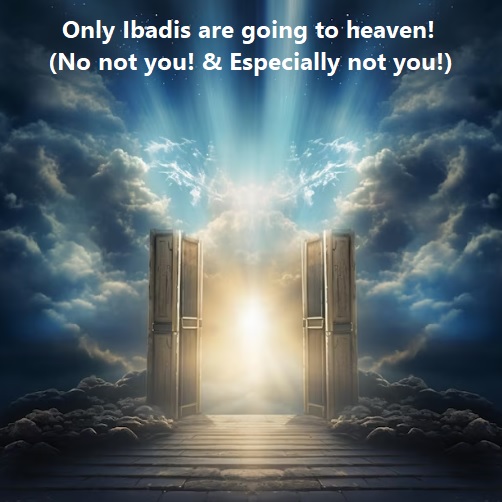
Do only Ibadis go to heaven?

“Indeed, your Lord is most knowing of who has strayed from His way, and He is most knowing of who is guided” (Qur’an 16:125)

“Do they feel secure from Allah’s plan? None can feel secure from Allah’s plan except the people who are losers.” (Qur’an 7:99)
﷽ 

Our colleague recalls the first time they encountered this sentiment from an individual from another school. “Look! This Ibadi scholar says that Non Ibadis are going to hell!” They claimed they had the Arabic text, the book, the quote of the author, the whole package.

It turns out that the statement was that Non Ibadis are guilty of kufr ni’ama (ungrateful of blessings). However, this same nomenclature is used of Ibadis, who commits major sins as well.


So we find these claims incredulous and extremely insincere. Contrary to popular belief, takfir is not a known way with us (those who follow the Ibadi school).

Anyone who says the shahadatayn is a Muslim by default. Just to be clear, this means the Ahmadis, Sunnis (including the Salafis, Sufis, Deobandis, Dhahiri, Maliki, Shafi’i, Hanbali and Hanafi schools), The Shi’i (including the Ismaili, Zaydi, Ithnā ʿAshariyyah). This is the default position with us. All of them are afforded what is afforded a Muslim brother or sister.

That is because it is common knowledge that when you meet any individual you deal with them on the basis of their dhahir (their apparent). People’s beliefs are not known unless they divulge them. When they do, one of their rights upon us is that we correct their errors.

All we have are labels. However, it is best that we deal with beliefs and positions. That we deal with proofs and evidences.

It is important to know that we are not Ibadis who follow Islam. Rather, we are Muslims who follow the Ibadi school. If we put our sectarian label first, how can our commitment ever be to the truth?

In fact, in our experience, we have known of an Ithnā ʿAshariyyah Shi’i, who left the beliefs of his sect behind but retrained the fiqh (jurisprudence of their prayer). Possibly he did not see the need to reinvent the wheel. The same can be said of a Nizari Ismaili who kept the label because he wanted the social contacts that came with the affiliation, but he no longer believed in their creed. Or the Sunni who doesn’t believe the Qur’an is uncreated or that he will see Allah in the hereafter.

So who knows best the inward state and condition of any individual at any given time?

So all we have are labels and dealing with the dhahir (the apparent).

Who is truer than Allah (swt) who says:

“You cannot guide whoever you please: it is Allah who guides whom He will. He best knows those who would accept guidance.” (Qur’an 28:56)

The simple fact that all schools of traditional Islam (even pseudo-Islamic groups) have exclusivist statements.

We have said it before, and we will say it again: Every Muslim is some other Muslims non-Muslim.

It was narrated from ‘Awf bin Malik that the Messenger of Allah(saw) said:

“The Jews split into seventy-one sects, one of which will be in Paradise and seventy in Hell. The Christians split into seventy-two sects, seventy-one of which will be in Hell and one in Paradise. I swear by the One Whose Hand is the soul of Muhammad, my nation will split into seventy-three sects, one of which will be in Paradise and seventy-two in Hell.” It was said: “O Messenger of Allah, who are they?” He said: “The main body.”

Source: (https://sunnah.com/ibnmajah:3992)

In a recent irony, someone from another school brought up that view among some Ibadi scholars that followers of other schools are in kufr ni’ama (ungrateful of blessings). Then this same person claimed that his school was saved, and he quoted the hadith of the 73 groups.

Imagine the irony of the thinking involved here: “Did you know that your school has exclusivist views and, therefore, it is flawed. However, my school has exclusivist views and it is correct.”

Like, really, what was the thought process here? “Look! Your school has scholars who have this view and others who do not. Yet, come and join my school, where there is unanimity that everyone else but us goes to hell. That is because they are the people of innovation.”

Our advise concerning dealing with people like him are as follows:

“Ask him about the 73 sects hadith, are we Ibadi that magical saved group or are we on Pan Am Flight 72 with an express ticket to hell?”

“If we are on Pan Am Flight 72, ask him how long we are in hell for? If he says, 17 minutes, 100 years, a billion, reply: “See you in heaven big guy!” If he says “forever”, then put your hand on your hip and say in your best Southern Mississippi accent: “Darling, look at you over here kicking up a fuss!”

For those who do not understand our sense of humor, the question is very straightforward.

It is to ask this individual how they understand the ultimate destiny of the other 72 sects — aka Pan Am Flight 72? If the rest of us (Ibadi and others) go to hell, what is the duration?

a) If it is only for a little while, then as per instructions to reply to him: “See you in heaven big guy!”

b) If it is forever well, then our second reply is equally relevant: “Darling, look at you over here kicking up a fuss!” Meaning to say: Then why is it a big deal if we have exclusivist views which you, yourself and your school hold onto? This means they believe those who consider themselves Muslims wil burn in hell forever.

c) A way out of the dilemma presented by a and b is to make takfir of the other 72 groups. Which expells them from Islam altogther; and makes the group or individuals takfiris. And if that is not exculusivist we don’t know what exclusivism is.

EXCLUSIVIST VIEWS ARE NOT SOMETHING NOVEL TO THE IBADI SCHOOL.

Recall what what we said above:

The simple fact is that all schools of traditional Islam (even pseudo-Islamic groups) have these types of exclusivist statements.

The Qadiani sect, which is considered pseudo-Islamic due to its belief in another Prophet after Muhammed (saw), has a similar position to some in the Ibadi school on the concept of kufr ni’ama, (though they do not use this terminology). Their moto is : Love for All, Hate for None. However, all Muslims who do not accept their views are Kafir.
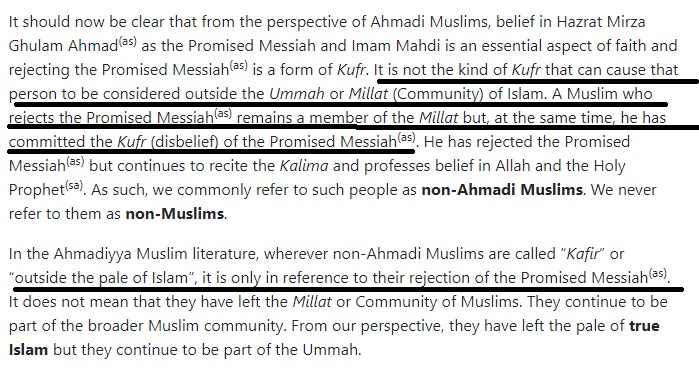
Source is from their website: (https://www.alislam.org/articles/are-non-ahmadis-muslim-or-non-muslim-ahmadiyya-muslim-perspective/)

12ER SH’I AND A VERY MODERATE POSITION TOWARDS OTHER MUSLIM SECTS.
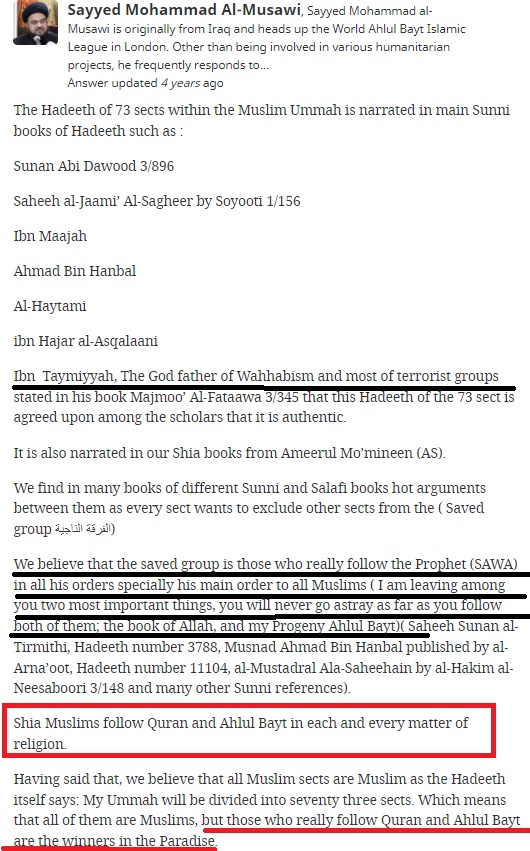
Source: (https://www.al-islam.org/ask/are-the-narrations-authentic-that-talk-of-the-creation-of-73-sects-in-islam-out-of-which-all-but-one-will-be-condemned-to-hellfire-if-so-in-which-place-are-the-shia-and-sunni-in-those-73-sects)

The above stance is very clear about who are those going to heaven. The title Muslim for other sects is futile when it comes to the day of judgment. This, however, is actually a very moderate position.

AN EXAMPLE OF MORE HARDLINE 12ER SHI’I VIEWS:
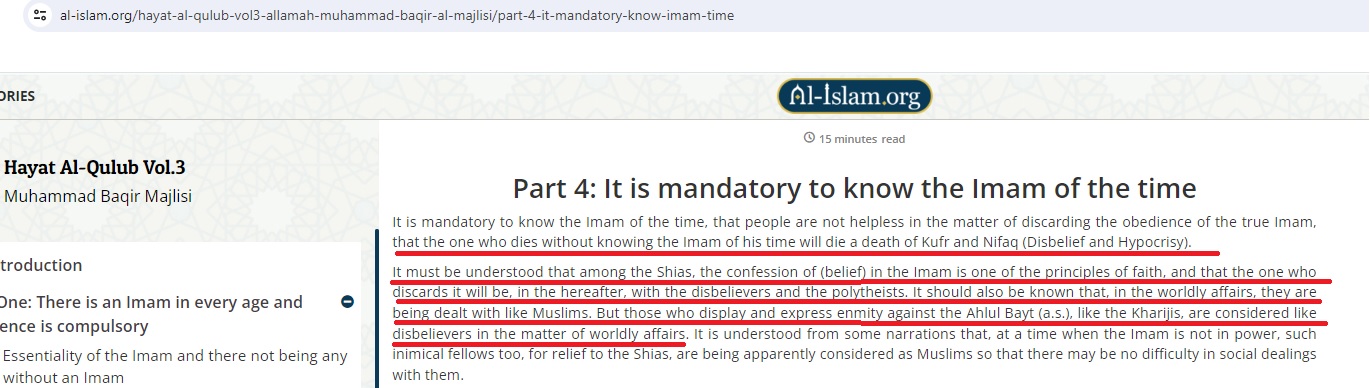
Source: (https://www.al-islam.org/hayat-al-qulub-vol3-allamah-muhammad-baqir-al-majlisi/part-4-it-mandatory-know-imam-time)

The above belief you will find among 12er Shi’i and Imami Shi’i in general, that whoever does not recognize the Imam of the time dies the death of a kafir (unbeliever).

This would mean that different Imami Shi’i groups would takfir each other after splits or schisms.

A concerned member of the Ismaili sect sent us the following concerning the refutation of the Nizari Ismaili (he himself) being a Mustaali Ismaili. He wrote to us of his concern that Nizar, in their view, was a shyster and a fraud.

“Hey brother , I’ll send a reply to the first question later on. Concerning the Nizari-Mustaali split and how to know who is the actual Imam. The primary evidence for any Imam is the Nass from the previous Imam, we as Fatimid Ismailis can demonstrate that Imam Mustaali is the true Imam through the following points :

1-His Nass from his father Imam Mustansir as mentioned in our sources you can find it in Al-Sijillat Al-Mustansariya and Uyun Al-Akhbar. Our Nizari friends fail in providing Nizars Nass.

2- The big Dais of Imam Mustansir in Yemen one of them the Sayyida Arwa Alsulaihi who was the Imams Hujjah (a hujjah is someone very close to the Imam and knows his secrets in a nutshell) all recognized Mustaali as Imam even those in Egypt recognized his Imamate.

3- The family of the Fatimids also recognized Mutaalis Imamate including all his brothers and even Nizars close sister witnessed that Nizar was never an Imam.

4- Nizars fishy behavior makes it even more doubtful that his claims in Imamate were Genuine. e.g Al-Maqrizi mentions in his book that when Mustaali became Imam-Khalifa Nizar refused to accept his Imamate and claimed that he has a Nass from his father, he was given time to go and bring his alleged Nass to the Fatimid officials but instead he secretly escaped to Alexandria and caused a civil war.

“IF he was indeed an Imam and has a Nass why didn’t he show it to the Fatimids and their officials? That would be strong evidence for his case, instead he ran away not demonstrating any evidence for his claim. This behavior shows that his claims were not true and he just wanted the power and prestige of being a Caliph for his own good.“

We wish the brother would do some introspection. Because, by his own admission, this statement itself is enough to show that not everyone who is a descendant of Ali is an upright individual. 

THE ZAYDI SHI’I WE HAVE, FOR EXAMPLE, THE FOLLOWING:

Watch and listen to what he says, citing what came in the book “Al-Ahkam” by Yahya al-Rassi, who brought Zaydism to Yemen. “Islam is not complete except by the guardianship of Ali. The imamate of Ali is one of the pillars of Islam. No one escapes the punishment of the Merciful, nor is the name of faith fulfilled for him, until he believes in the guardianship of Ali with certainty of certainty.”

For us, we do not find this to be a creedal issue or even one of its branches. For Zaydi, this is obviously not the case.

MAKING TAKFIR UPON OTHER GROUPS OR SECTS IS NOT A KNOWN WAY WITH THE IBADI.
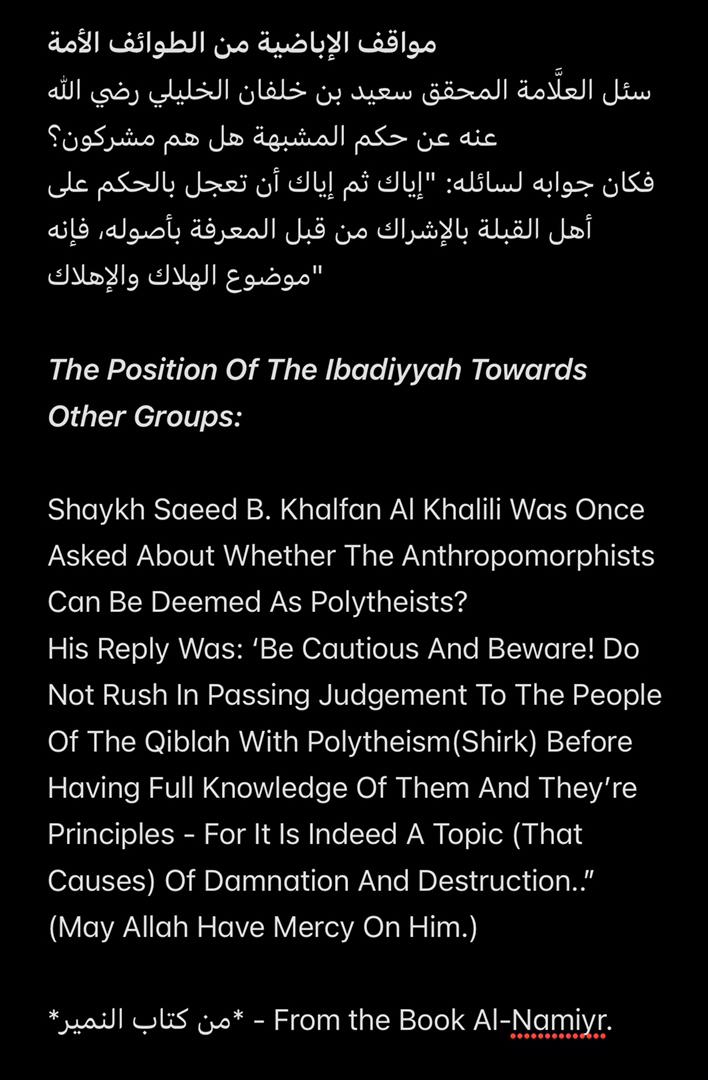
AHL SUNNAH WAL JAMMAH (THE PEOPLE OF THE SUNNAH AND THE GROUP). The name itself implies that ‘They’ are the only people following the Sunnah: as if Shi’i or Ibadis do not eat with their right hands, or keep beards etc or follow the Sunnah.

DOES IMAM MALIK GET HARD CORE ON THE IBADIS?
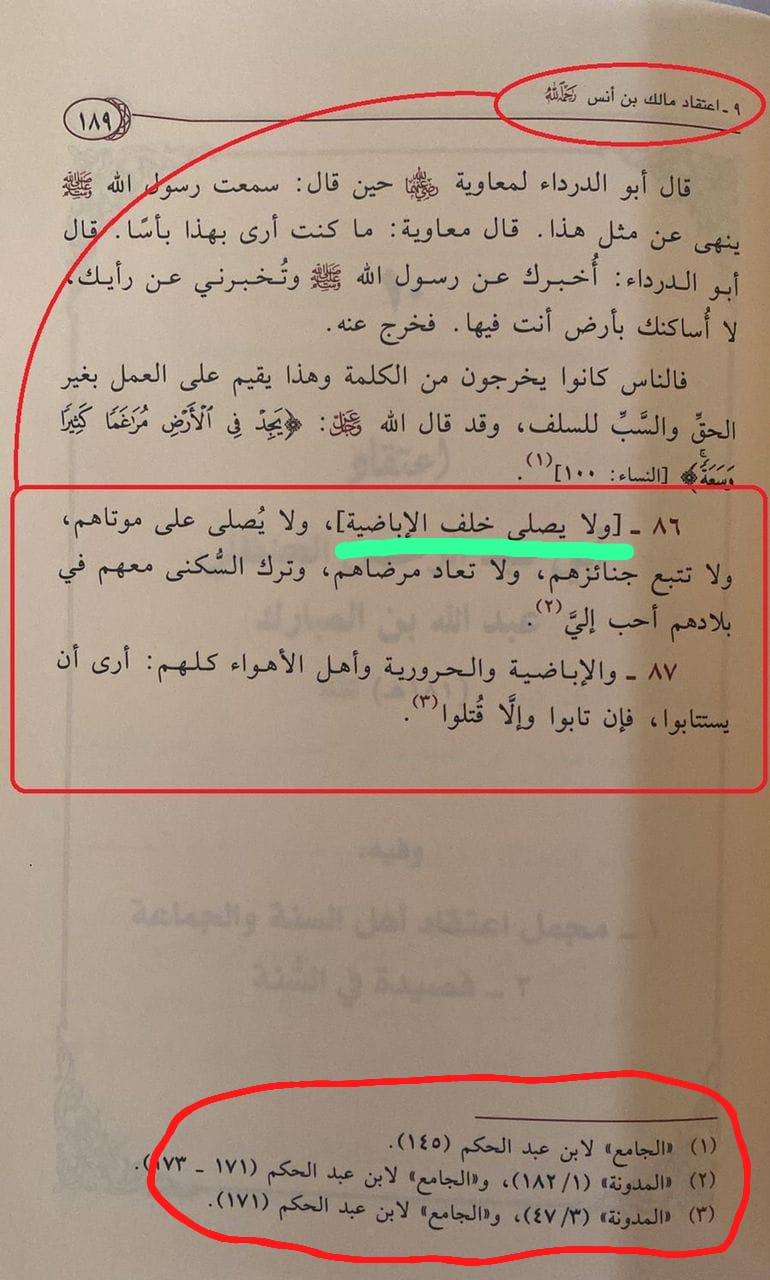
What does the text attributed to Imam Malik say?

  1. And DO NOT pray behind the Ibadis-Neither should their dead be prayed over nor should they’re deceased be followed to the burial. Nor, should their sick be visited.
    It is more beloved to me that one should leave the home/city/country where the Ibadis are.
  2. The Ibadis/ Hururis, and all people of desire: I believe they should repent; either they
    repent or they are to be killed.

What is important to note about the above image is that only the green part of the text is attributed to Imam Malik. All the red parts indicate that the rest of the page belongs to Ibn ‘Abd al-Hakam. So, even if not authentically attributed to Malik there were certainly people who held such views and wanted to attribute them to Malik.

The vast majority of their scholars uphold the validity of the hadith of the 73 groups (though they have dissenting views).

Those that uphold that hadith believe that every other group (Ibadis, Shi’i, Mu’tazilah etc….are on that Pan Am Flight 72, meaning we are all bound for hellfire.

However, it doesn’t stop there.

AMONG THE AHL SUNNAH WAL JAMMAH (THE PEOPLE OF THE SUNNAH AND THE GROUP) ARE MAJOR DIVISIONS.

Ahl Sunnah Wal Jammah (The People of the Sunnah and the Group)

Salafi/Athari — very often believe that followers of the other schools of aqidah (creed), Ashari/Maturidi, are going to hell and vice versa. (Though there are dissenting views).

There is the Deobandi and Barelvis split. With many among them considering the other to be outright kafir (and for them that means outside the fold of Islam).

VIOLENCE AND DIVISION AMONG SUFI TARIQA

If you think for one moment that those loveable hugable Sufis are all above the board when it comes to politics, mud slinging and even violence. Well, let us hold up a mirror and show you a person who has never been affiliated with a Sufi Tariqa.

Lots of rivalry and fighting (often leading to violence) among them.

The “Battle of the Book Seven” (Internal Mevlevi Conflict)
A fascinating example of rivalry within a single order is the controversy over Rumi’s Mathnawī in the 17th century. This dispute shows how doctrinal interpretation could split a community and draw in outside authorities.

The Spark: The renowned Mevlevi shaykh Ismāʿīl Rusūkhī Anqarawī wrote a commentary on what he claimed was the “Book Seven” of Rumi’s Mathnawī. The problem was that the vast majority of Mevlevis believed Rumi’s masterpiece consisted of only six books and considered the seventh text apocryphal.

The Rivalry: This created a bitter internal rift within the Mevlevi order. Anqarawī and his followers were pitted against other Mevlevi shaykhs who saw his work as an illegitimate innovation.

Source: (https://themaydan.com/2020/03/rumis-book-seven-of-the-mathnawi-intra-sufi-debates-in-the-seventeenth-century-ottoman-empire/)

THE HADITH OF THE 73 SECTS ANALYZED & NEUTRALIZED BY THE IBADIS

From what we know (and we admit our collective ignorance of the other schools in this regard), from what we know is that we are the first among the schools of Islam to interpret the hadith of the 73 groups under a lens and interpret it in a more ecumenical fashion.

We are not aware of any school of Islam that has preceded us in this. If you, the reader, find information to the contrary, feel free to correct us.
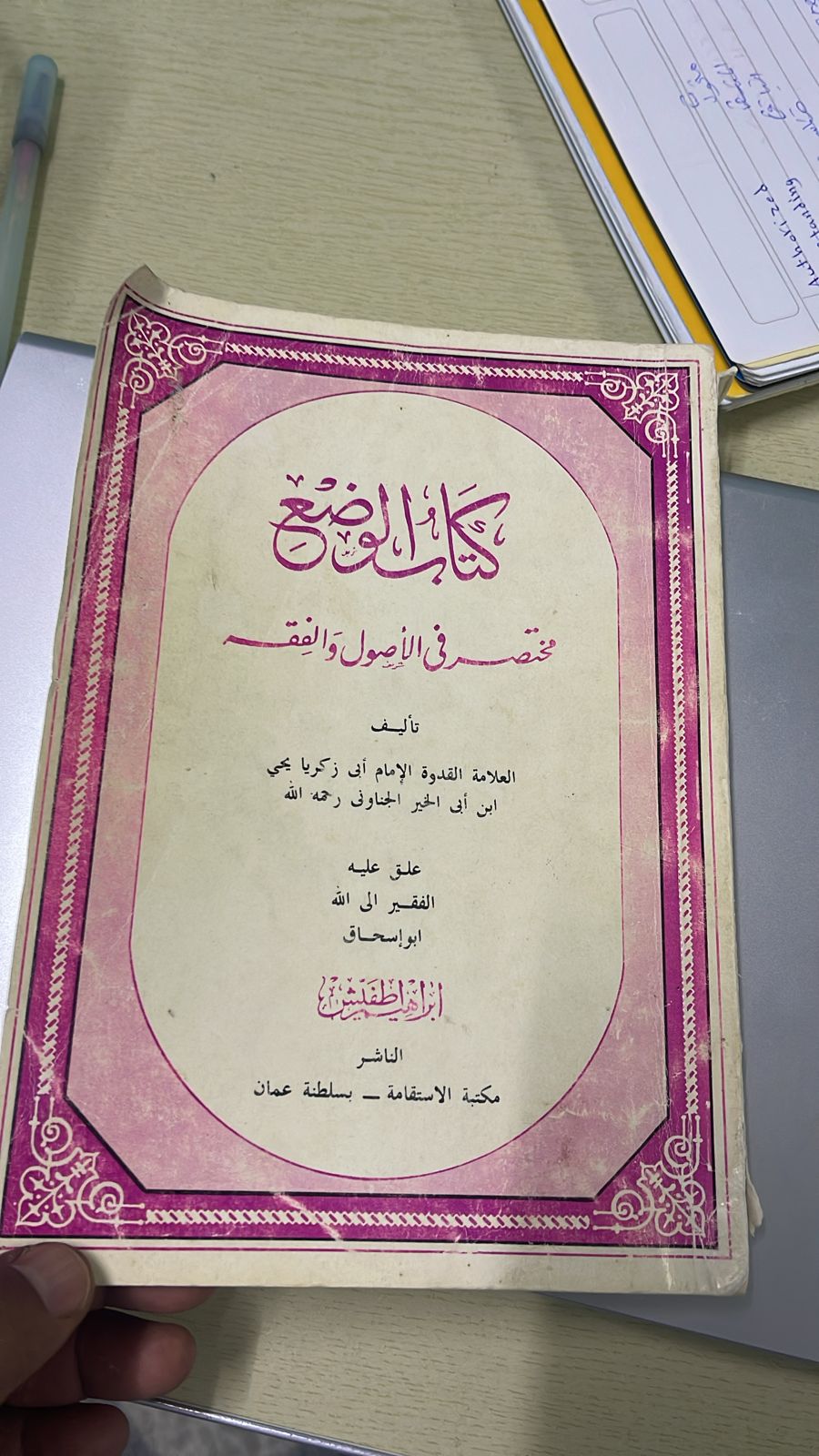
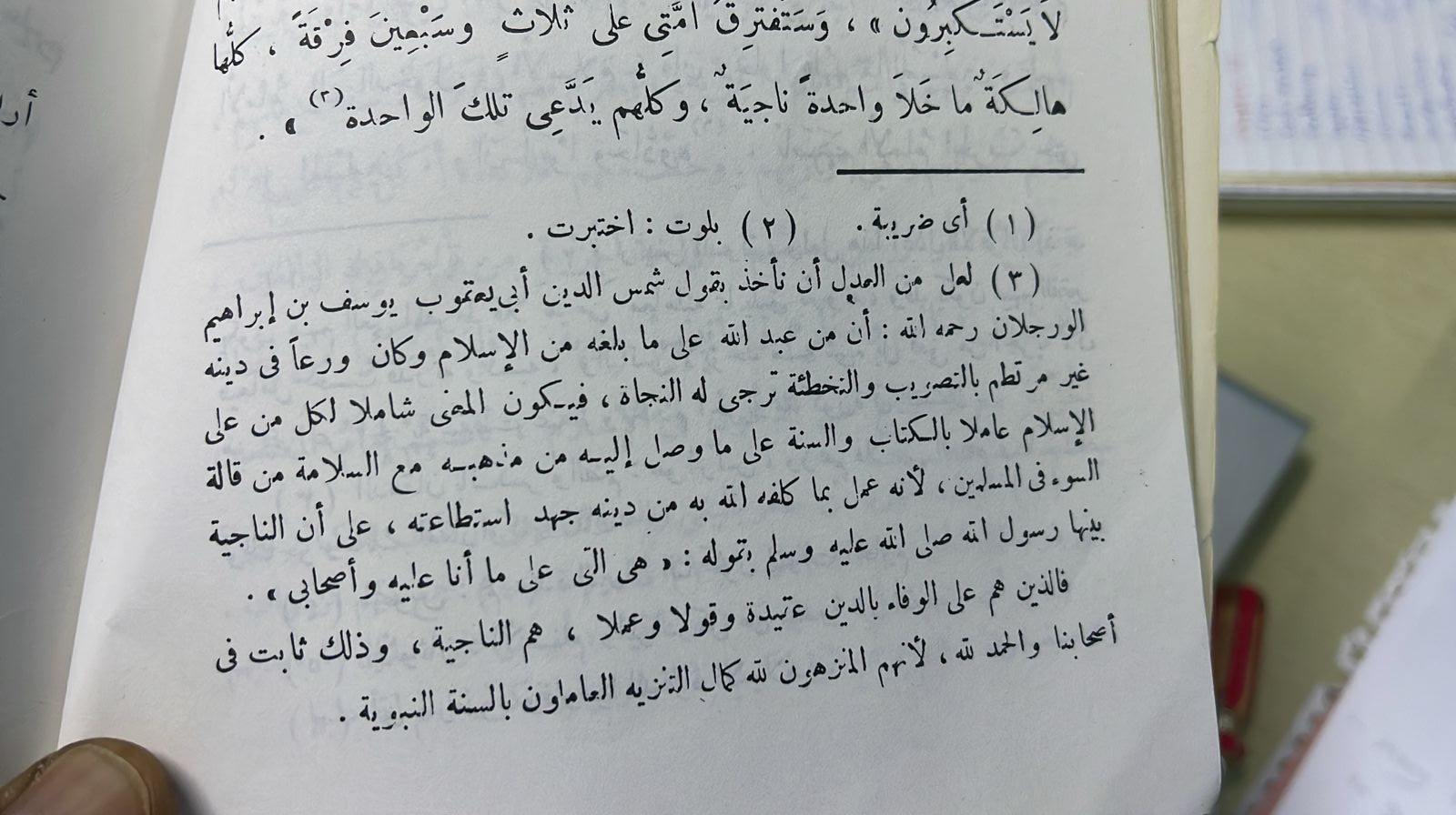
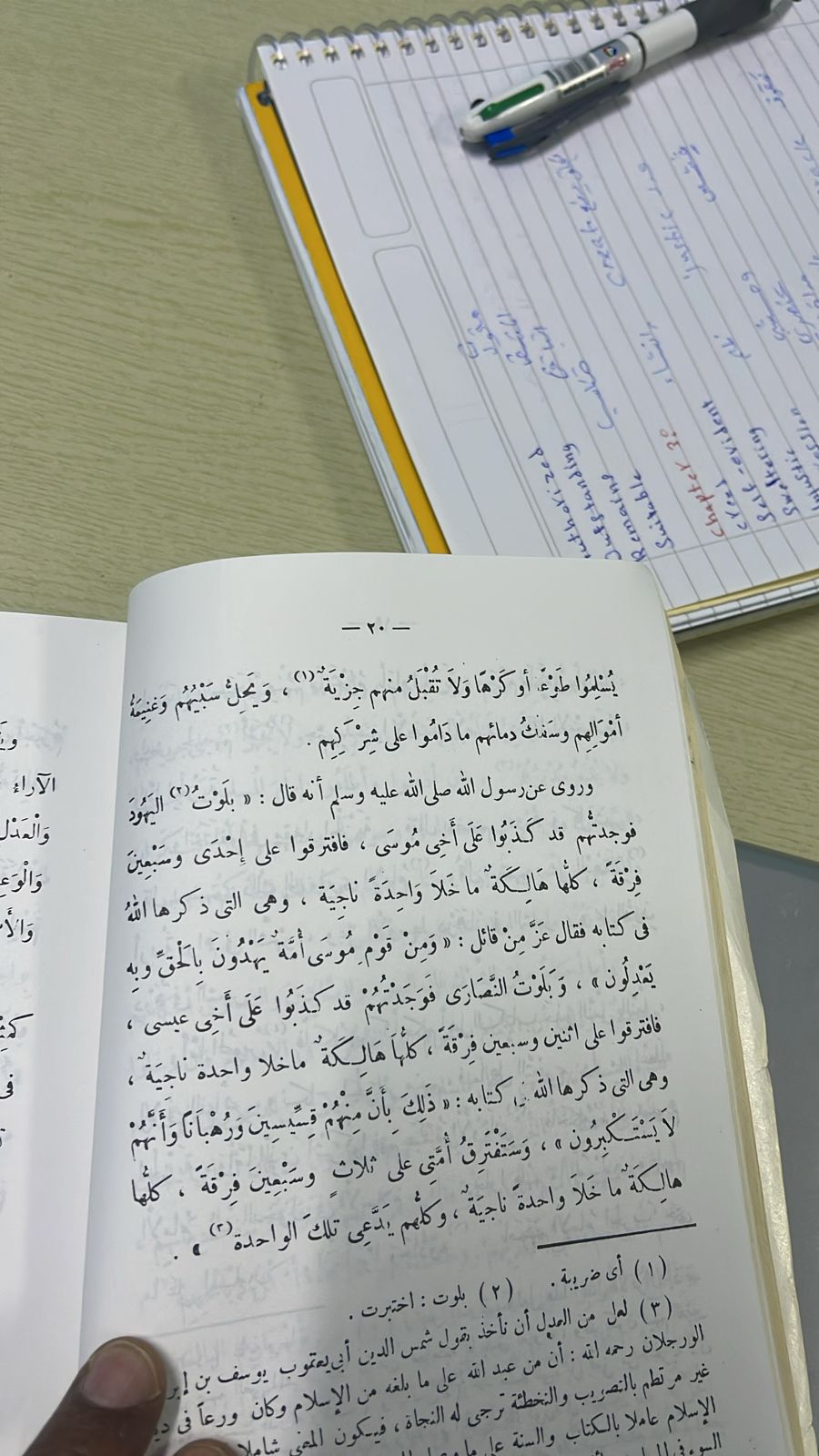
The above book is: Kitab al Wada’ Al Mukhtasar Fi Usul Al -Fiqh Abu Zakariyah Yahya B. Abil Khayer Al Jannawiny. Commentary by: Shaykh Ibrahim At-Fayyish (h)

The comment is concerning Muslims being divided into 73 sects. All will be in loss, except one, and they will all claim that their group is the one that is correct.

In the comments under the line: He states: “It is better to bring the sayings or the view of Shamsu-Deen Abu Ya’aqub Yusuf B. Ibrahim al-Warijilani (May Allah have abundant mercy on him) (d. 570 ah)

Shaykh Shamsu-Deen says: “Whoever worshiped Allah, that which came to him from Islam and that one was ‘wara in his din (that means that person was pious). He was not eating haram. This person had ‘wara (self vigilance against the haram). This one does not say, ‘I am right, and he is wrong’ This one will escape and be on the path to safety. This applies to everyone who follows Allah (swt) and the Sunnah of his Prophet (saw) up to what has reached that individual from his madhab (his school) and this one has not said bad things by his tongue to the Muslims. That would be enough for him because this is what has reached him of his religion by his striving and sincere efforts and ability. The group that escapes is the one that follows the Prophet (saw) and his companions (the pious among them).”

When you look at the time in which the venerable Shaykh al-Warijilani (r) lived, his view would be quite progressive by today’s standards.

This understanding seems to be what is espoused by Shaykh Hatim Abdis-Salam.

We would also like to bring your attention to the understanding of the hadith of the 73 groups by Shaykh Hatim Abdis-Salam (May continue to bless him).

Next we have this intelligent insight into the hadith by the Ibadi master Shaykh Ali Yahya Muammar (r). This is a very short, concise and insightful read.

We are in agreement with the assessment of this master, Shaykh Ali Yahya Muammar (r)

“The hadith states that each of these sects will claim that it is saved. The claim of every sect that is alone is the saved one is only natural: only a madman would insist on following a sect that will perish. The members of each of the sects have tried hard to prove that they follow the truth and are on the right path, the one followed by the Messenger of God, may God bless him and grant him peace and his companions, and that all others have strayed from the way of God, in both doctrine and conduct.”

The following video is titled: PARADISE IS FOR WHO? (Shaykh Dr. Majid Al Kindi. The general custodian of the Iftaa office in Oman. A very knowledgeable scholar with two PhDs.

The following is a translation of the respected Shaykh

تِلۡكَ ٱلۡجَنَّةُ ٱلَّتِى نُورِثُ مِنۡ عِبَادِنَا مَن كَانَ تَقِيًّا (Qur’an 19:63)

“That is Paradise, which We give as inheritance to those of Our servants who were fearing (of Allah).”

“And not for the one who was an ibadi, nor a hanafi, nor a shafi’, nor a maliki and not for other than them from every group, whether it being from a school of theology or a school of jurisprudence, (but) for the one who was God-fearing (God conscious).”

“That which we have affection for and desire, is that people leave all of these labels and commit to that which Allah the Almighty has labelled us when He said, 

وَجَٰهِدُواْ فِى ٱللَّهِ حَقَّ جِهَادِهِۦۚ هُوَ ٱجۡتَبَىٰكُمۡ وَمَا جَعَلَ عَلَيۡكُمۡ فِى ٱلدِّينِ مِنۡ حَرَجٍۚ مِّلَّةَ أَبِيكُمۡ إِبۡرَٰهِيمَۚ هُوَ سَمَّىٰكُمُ ٱلۡمُسۡلِمِينَ مِن قَبۡلُ وَفِى هَٰذَا لِيَكُونَ ٱلرَّسُولُ شَهِيدًا عَلَيۡكُمۡ وَتَكُونُواْ شُهَدَآءَ عَلَى ٱلنَّاسِۚ فَأَقِيمُواْ ٱلصَّلَوٰةَ وَءَاتُواْ ٱلزَّكَوٰةَ وَٱعۡتَصِمُواْ بِٱللَّهِ هُوَ مَوۡلَىٰكُمْۖ فَنِعۡمَ ٱلۡمَوۡلَىٰ وَنِعۡمَ ٱلنَّصِيرُ (Qur’an 22:78)

“And strive for Allah with the striving due to Him. He has chosen you and has not placed upon you in the religion any difficulty. [It is] the religion of your father, Abraham. Allah named you “Muslims” before [in former scriptures] and in this [revelation] that the Messenger may be a witness over you and you may be witnesses over the people. So establish prayer and give zakah and hold fast to Allah . He is your protector; and excellent is the protector, and excellent is the helper.”

This is what we want.

And the Imam (May Allah have mercy on him), when he was asked about the school (ie. al-Ibadiyyah) and its naming, he (May Allah have mercy on him) replied by saying, “We don’t have any school except Islam.”

So, we don’t take the individual’s understanding as Islam or the Shariah of Allah. It is instead ideas that people have come with and call to.”

THERE ARE NO SECTS AT THE GATES OF HELL.

Even though Shaykh Dawud Al BuSinan (h) is of our school, he is giving us a clear and sobering reminder!

So where does your aqidah lead you to? Does it lead you to cause fasad; have pride, disobey Allah; sin more and fear him less? Make light of his promises and punishments and that of his blessed Prophets (upon them all be peace). Does it encourage you to do good and speak good. There is no gate in heaven called: “Ibadiyyah gate.”

There is most likely someone who follows our school, and they are the worst sinner than any of the other groups and Allah (swt) knows best!


SECTARIANISM IS CAUSING DIVISION: OUR MISSION A UNIFIED UMMAH — By Shaykh Khalfan ibn Muhammed Al Esry (May Allah have mercy on him) He is a prominent Omani scholar, and he was a former member of the Omani state council (before he passed away)-May Allah have mercy on him.

IF IBADIS ARE NOT GOING TO CHUCK EVERYONE IN HELL THAN WHY FOLLOW THE SCHOOL?

In an interesting and unfortunate turn of events that once happened in our English WhatsApp group, a brother objected: “Well, if we are not sure if they are all going to hell, then what is the point?” What he means is what is the point of propagating this school of thought?

We feel there is a huge misunderstanding here. How can we be deciders of who goes to heaven or hell when we are not certain about ourselves? How can we be deniers of who goes to paradise when we are not guarantors of paradise ourselves?

In fact, this very much sets us apart from those schools that believe they will all go to heaven (even after a brief sojourn in hell). We have no such position.

For many of us, we follow this school because it is the most sensible and honest about what happened in the past. We discuss it and move on. We are not fiaxted with the past.


We find this school most cohesive and cogent in its theological positions and that gives me peace of mind and peace of heart. We find this school to be a school frozen in time, as if we can see and live the very Islam of the companions. May Allah be pleased with them. We find this school holding fast to the Qur’an and being fervent in calling to the Sunnah of the Blessed Messenger (saw).

Though we have our hardline views, we are also welcoming and willing and ever ready to work with other schools of Islam. We marry Sunni and Shi’i. Our scholars read the works and writings of all other schools of Islam because we recognize and believe what Allah (swt) says:

“He gives wisdom to whom He chooses, and whoever is given wisdom is blessed abundantly. But only insightful people bear this in mind.” (Qur’an 2:269)

Knowledge is not an exclusive to the Ibadi school.


We are probably the only school in Islam in which our scholars have given legal verdicts for the permissibility to pray behind the Imams of other schools. Nor do we issue fatawa saying to kill other Muslims who have different aqidah.

WE HAVE NOT DONE A GOOD JOB OF CLARIFYING THESE POINTS TO PEOPLE OUTSIDE OUR SCHOOL

Observe:

So recently this website received the following comment:
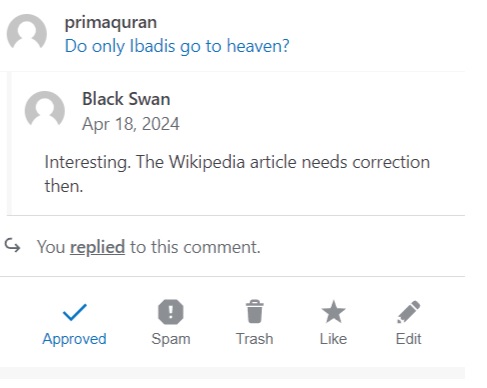
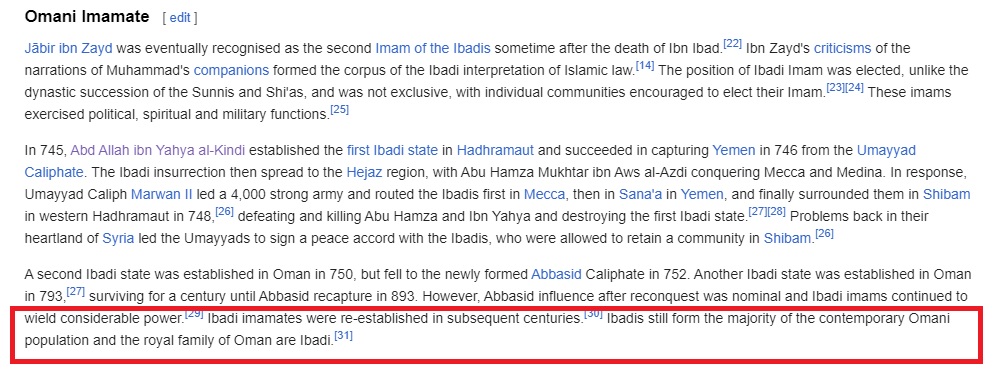
So, we head on over to Shaykh Wikipedia and what do we see? We see impossible feats of mathematics!
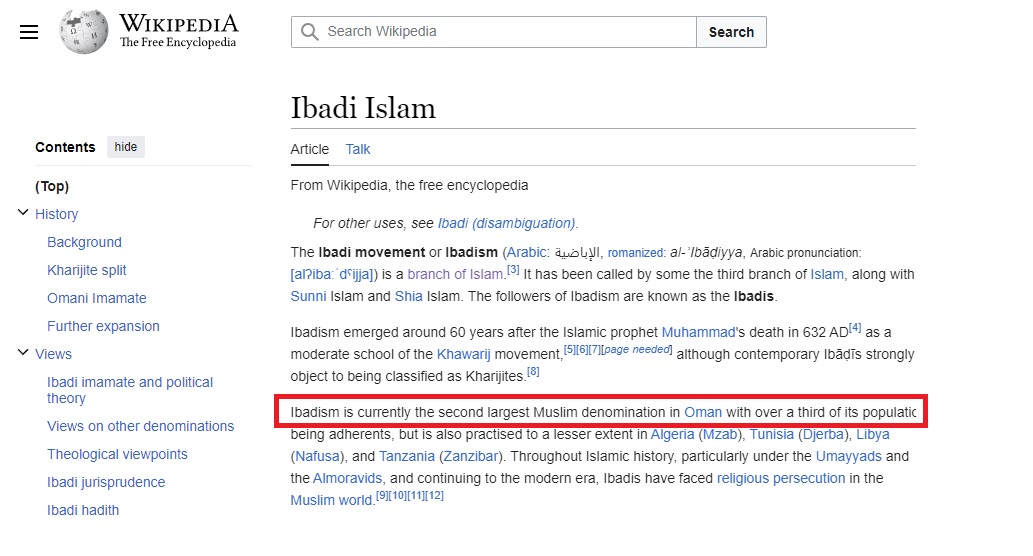
“Ibadism is currently the second-largest Muslim denomination in Oman with over a third of its population being adherents.”

“Ibadis still form the majority of the contemporary Omani population and the royal family of Oman are Ibadi.”

Prima Qur’an has a question for Shaykh Wikipedia. How are we the second-largest denomination and yet still form the majority of the population? Your math is not mathing.

However, it looks like the real source of the misunderstanding with Shaykh Wikipedia was from Ms. Valerie Hoffmans book: Source: The Essentials of Ibadi Islam:-Valerie J. Hoffman.(pg. 30)
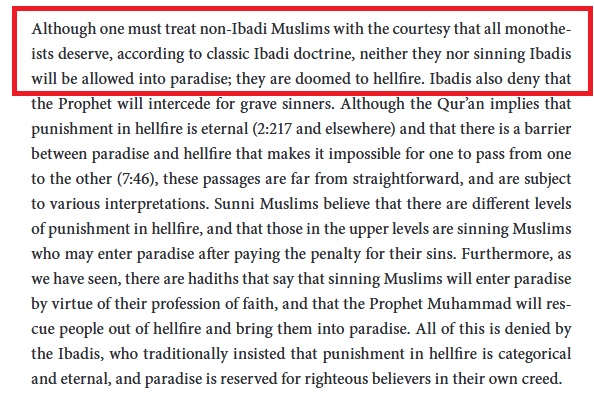
“Although one must treat non-Ibadi Muslims with the courtesy that all monotheists deserve, according to classical Ibadi doctrine, neither they nor sinning Ibadis will be allowed into paradise. They are doomed to hellfire.”-Valerie Hoffman

This is extremely reckless and can be the cause of real-life physical attack upon those in our community. For example, it has NEVER been the position of the Ibadi school that sinning Ibadi or sinning non-Ibadi Muslims are doomed to hellfire. The position has ALWAYS been that Ibadi’s who repent are subject to the mercy of Allah. Second, as regards non-Ibadi, at the very least a person needs to be: mukallāf—someone pubescent and sane. Next, the clear evidence has to be presented to the individual, and we take as evidence the following:

“So after the truth, what else can there be, save error? How then are you turned away?” –(Qur’an 10:32). That judgement can only be passed on non-Ibadi on the basis of masail al-din and not masail al-ra’y.

If she bothered to look into the position of the school in regard to the theological position as regards those who Islam may not have reached (isolated islands etc.) she would have appreciated it as such.

Again, personally, we find it a bit of a disrespect. Here you are being welcomed in a country by its people. They open up their libraries and manuscripts to you. The claim is that you are exposing the Western world to Ibadhism. Yet, you leave comments like the above which could have been clarified. It is certainly not helpful. In regard to one passing comment, it is actually dangerous in today’s hyper-sectarian world not to clarify the position of the school or at the very least pass over the matter.

One thing you will get from Prima Qur’an is full disclosure, transparency and the fact that we believe in laying the cards on the table.

THE “HARD LINE POSITION” AMONG IBADI SCHOLARS CONCERNING NON IBADI MUSLIMS.

So remember what we said about the term: “Ahl Sunnah Wal Jammah”. Well, in general we call ourselves as: Ahl al-Haqq wa-l istiqama (The People of Truth and Straightness). So the very name can imply that others are not people of truth or straightness. Just as the term Ahl Sunnah can imply that others are not following the Sunnah.


If you watch this video on YouTube, do take note of the comments below. The updated comments in the black text are provided by our sincere brother. The brother that is doing his level best to provide all of you with unfiltered information. May Allah (swt) reward him for his sincere efforts! We will provide those comments below:

This is an important video by the late Qadi, Shaykh Salim bin Khalfan al Rashidi(May Allah have mercy on him) where he talks about who will go to heaven and refutes the common notion put forth by people that Ibadis believe only they will go to heaven.(May Allah make this video open our hearts and ease us all and make us amongst the people of Jannah, Ameen. * I think that I need to make this clear to not misunderstand the qadi. Basically, for us Ibadis, all those who disagree with us on anything of aqeeda/belief/whatever you call it, is in Bara’ah. Because in Aqeeda there can only be one absolute truth, unlike fiqh issues where khilaf is possible. But does that mean we say they’ll go to hellfire? No (as they may have repented). Go to Jannah? No. Rather, their judgment is up to Allah (swt). And when someone says it’s not only Ibadis that’ll enter Jannah, then that’s true, as the name is not necessary rather the belief is.* This translation was done by the Ahlul Haqq wal Istiqamah English group, link to our discord is below.

Prima Qur’an comments: May Allah (swt) bless this brother.

So, basically, this is the so-called “hardline view.” We have already mentioned that every sect, or school in Islam has exclusivist views. This is nothing novel to the Ibadi school.

So this line of thinking is that Non-Ibadi Muslims are in a state of “Kufr Ni’ama” — recall the perspective of the Qadiani sect above. That they are still Muslims but because they have rejected the truth. Rejecting the truth = being in a state of sin.

  1. The evidence must be presented.

“So after the truth, what else can there be, save error? How then are you turned away?” –(Qur’an 10:32).

So we can see in the first verse the first condition. “How then are you turned away?”

The proof must come to them by proof it can be : from (messengers, scholars, TV, Internet), whichever way by invitation. Even reading this blog.


You have to present the evidence. You cannot be turned away from something not presented to you. We are 100% supportive of this position, not because this is due to our desires, it is because it is self-evident. If one sees the truths and strengths and evidence of this school, acknowledges it and turns away, they are without doubt in ‘kufr ni’ama’ and if they die in that state, then the apparent with us is that they will meet a terrible ending. As do all who reject the truth. However, in the end, ultimately, Allah is the judge.

“And those who argue about God after having answered His call, their argument has no basis whatsoever with their Lord. Anger enfolds them, and a severe punishment awaits them.” (Qur’an 42:16)

2. Being Baligh, Mukallak or Muhallaq!

“And as for the wall, it belonged to two orphan boys in the city, and under the wall was a treasure that belonged to them, and their father had been a righteous man. So your Lord willed that these children should come of age and retrieve their treasure, as a mercy from your Lord. I did not do it ˹all˺ on my own. This is the explanation of what you could not bear patiently.” (Qur’an 18:82)

“Test the orphans until they reach a marriageable age. Then, if you feel they are capable of sound judgment, return their wealth to them.” (Qur’an 4:6)

It is clear that for one to be able to be entrusted to receive their property and or wealth, they must be both physically and mentally capable to care for it. If this is for the dunya — which is dust and perishing, how much more for the hereafter which is forever and enduring?

Baligh, Mukallak or Muhallaq, one who has reached puberty and mentally matured. That is when they come under Taklif responsibility. Considering that out of 1.8 billion Muslims with an explosion in youth population, how many countless millions who are not of the Ibadi school and at any given time and are not baligh, mukallak or muhallaq!

3. Masa’il Ad-Din & Masa’il Al-Ra’y What the differences must be concerning:

As mentioned above: “Because in Aqeeda there can only be one absolute truth, unlike fiqh issues where khilaf is possible.“

Masa’il Ad-Din: Matters that are proven from the clear nass (text) on aqeeda — the Ahl Khilaf (People of the opposition, those who oppose our school) should not disagree with us on matters of aqeeda, or they would be in “Kufr Ni’ama.”

Masa’il Al-Ra’y: Matters that pertain to (usul al fiqh), if it is a clear text, then there is no room for ijtihad; however, if it is not a clear text, the ijtihad is in the text itself.

4. The different categories of Ahl Khilaf.

A) Muqallids: Understanding that the majority of the people of all schools (including the Ibadi school) are Muqallid—That means one who practices Taqlid. They follow qualified scholars according to their school without knowing the evidence (dalil, burhan, and hujat).

B) Scholars of the different schools.

Further divided into two:


B1) Scholars who have received the evidence, understood the evidence, acknowledge the evidence. Or they knowingly reject the evidence = “Kufr Ni’ama” (Judgement is based upon the dhahir in this case, we are correct) — We judge according to the apparent.

B2) Scholars that are not catching the evidence are not comprehending the evidence. (From the outward we perceive they are rejecting the truth) (Judgement is based upon the dhahir in this case, we are in error) — We judge according to the apparent.

5. A clear delivery of the truth.

“And obey Allah and obey the Messenger. But if you turn away, then Our Messenger is responsible only for conveying the message clearly. (Quran 64:12)

The Blessed Messenger (saw) is said to have delivered the message clearly. So how about non-Messenger humans that use our own styles and methods to speak and demonstrate and use of reasoning which may or may not be flawed?

“˹Say to the believers, O Prophet,˺ “Whatever you may differ about, its judgment rests with Allah. That is Allah—my Lord. In Him I put my trust, and to Him I ˹always˺ turn.” (Qur’an 42:10)

5. Factor of Time. The time needed to comprehend and implement the truth of any particular subject.

For example, a new individual just embraces Islam. The upcoming time for prayer is coming. Is this person excused from the prayer? No they are not. However, they do not know the dalil, burhan, and hujat concerning the prayer. How much time is needed for someone to know the akham — meaning what is wajib (obligatory), mustahabb (recommended), muharram (outright forbidden), makruh (disliked), halal (permissible).


And this is only for prayer. How much more time is needed to establish certainty in other disciplines, like aqeeda.

TOP SCHOLARS OF THE IBADI SCHOOL HAVE SIGNED THE AMMAN MESSAGE.

Ibadi Muslims signed the Amman accords.

The Grand Mufti and Assistant Grand Mufti both signed.
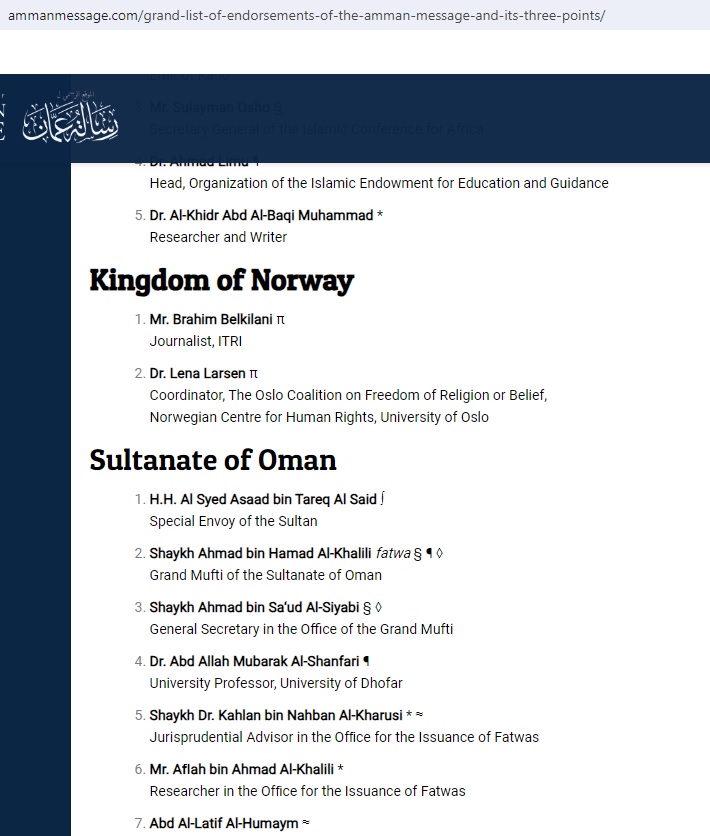
Top scholars of our school have signed the Amman Message. Shaykh Ahmad bin Hamad Al -Khalili (h) the Mufti of the Sultanate of Oman.

Shaykh Dr. Kahlan bin Nahban Al-Kharusi (h) The Jurisprudential Advisor in the Office for the Issuance of Fatwas.

The Muslims can continue to compete and vie with one other for influence over the Ummah of Muhammed (saw).

So respectful engagement is absolutely key to having meaningful discussion. We have Husn al-Dhan, that Muslims from other sects are generally brought up with good parenting. This is the default thinking in regard to them. However, when a Muslim from another sect starts to hurl abuse and insults, we shut down. The dialogue stops immediately. Is this because we wish to retreat? No. Because at that moment the thinking among us is that your parents brought you up with good mannerisms. Mannerism that you are now ignoring. Which means you must not respect your parents. If you do not respect your parents, how can you respect us or even the conversation?

“So compete with one another in doing good. To Allah you will all return, then He will inform you ˹of the truth˺ regarding your differences.” (Qur’an 5:48)

However, it is also incumbent upon us to work together when ever and however we can for the betterment of the communities and countries that each of us live in. Social cohesion is a prerequisite to convey the truth. For, after all, who can convey the truth among the piercing sounds of gunfire and the terrified screams of little children?

“Invite to the way of your Lord with wisdom and good instruction, and argue with them in a way that is best. Indeed, your Lord is most knowing of who has strayed from His way, and He is most knowing of who is guided.” (Qur’an 16:125)

You may also be interested in reading the following:

Heart Felt Pleas from Shaykh Dr. Kahlan Al Kharusi (h). Stop Blood Shedding Fatwas!

Shaykh Dr. Kahlan Al Kharusi is the assistant Mufti of Oman.

May Allah Guide the Ummah.

May Allah Forgive the Ummah.
5 Comments

Filed under Uncategorized

A Christian Dilemma & How might Jesus have died?


“And so, for the breaking of their pledge, and their refusal to acknowledge Allah’s signs, and their slaying of prophets against all right, and their boast, “Our hearts are already full of knowledge”- not so, but Allah has sealed their hearts as a result of their denial of the truth, and now they believe in but few things.” (Qur’an 4:155)

﷽ 

“And because of their disbelief and of their speaking against Mary a terrible slander.”

“And for their saying: “We have killed the Messiah Jesus the son of Mary, the messenger of Allah!” They did not kill him, nor did they impale him, but it appeared to them so. Those who dispute are in doubt of him, they have no knowledge except to follow conjecture; they certainly did not kill him.”

“Rather, Allah exalted him in his presence. Allah is Almighty, the Wise.” (Qur’an 4:155-158)

It is important to understand that the whole context of these verses is in reference to Jews. The Qur’an asserts they, their and them all in reference to Jews. There is absolutely no reference to Romans.

The Qur’an asserts that the Jews mocked Jesus, ‘We have killed the Messiah, Jesus the son of Mary the messenger of Allah!’

This is similar to the mocking recorded here:


“And they said, Prophecy to us, Messiah. Who hit you?” (Matthew 26:68)

As well as:

“In the same way the chief kohen and the teachers of the law mocked him among themselves. “He saved others,” they said, “But he can’t save himself. Let this Messiah, this King of Israel, come down from the cross, that we may see and believe.” (Mark 15:31-32)

It is important to note that the Qur’an in the above passages does not categorically deny the death of Christ Jesus. The Qur’an refutes that Jews were responsible for it.

“They did not kill him” (It means in any way conceivable)

This statement is also asserted here:

“And behold! I did restrain the Children of Israel from (violence to) you when you did show them the clear Signs, and the unbelievers among them said: ‘This is nothing but evident magic.'” (Qur’an 5:110)

Qur’an 4:157 is not a reference to the supposed “Crucifixion” either in support or denial. The Qur’an simply does not mention the event known as the ‘Crucifixion’. The Qur’an is simply ambivalent about it.

Also of importance to note is that the Qur’an 4:157 does not interact with the supposed historical event called the “Crucifixion”. There is no mention of the Romans anywhere in the Qur’an 4:157. It does not even interact with Christian historical beliefs at all!

The only place that Allah (swt) mentions Romans is the following text:

“The Romans have been defeated.” (Qur’an 30:2)

Some people just see Romans where there are no Romans!

Is Qur’an 4:157 an Anti-Semitic Anti-Jewish Text of the Qur’an?

First, the Qur’an cannot be anti-Semitic, because the Arabs themselves are a Semitic people.

Allah informs us in regard to the children of Israel:

“Yet they are not all alike: there are some among the People of the Book who are upright, who recite Allah’s revelations throughout the night, prostrating.” (Qur’an 3:113)

As regards to the clam of Qur’an 4:157 let’s examine the text closely

This is important because most Muslims see Qur’an 4:157 as relating to the so-called “Crucifixion”. They also somehow see Romans in the text! Those Muslims make Jews culpable in the death of Jesus.

Because they somehow, for some ungodly reason, think that the text has to do with Romans crucifying Jesus, they have to make sense of the following:

“BUT IT APPEARED TO THEM SO.“

It is important that the following views all posit cross, crucifixion and Roman involvement in Qur’an 4:157.

View one: Mistaken identity. Allah made someone look like Jesus, and presumably he was killed. Jews are still culpable. They just got the wrong guy. Jews kill “stealth” Jesus.

Second view: Swoon theory. Jews attempted murder via Roman proxy. Jesus was crucified but, he was not crucified to death.

Third view: The Jews didn’t kill Jesus the Romans did! Jews are culpable though, as they hand Jesus over to Roman authorities. The Jews, via Roman proxy, did indeed kill Jesus’ body but not his soul. People like Todd Lawson hold this view.

Prima-Qur’an comments:


Notice that “but it appeared to them so” is in reference to the double denial. Whereas the three views above connect it only to “they did not (ṣalabūhu) him”.

However, the “but it appeared to them so” is in reference to any and all accusations. It is obvious that all the accusations cannot be synchronous, unless it is to be interpreted as a denial of a death (like stoning) and a post-mortem event (like impaling). Which means that(salabuhu) is not a death act.

Please see our article under the discussion of Qur’an 5:33

The three above views believe somehow there was only one particular event and the people were contemporaneous to said event.

Jews did not kill Jesus at all. They are not culpable, they did not kill the body and they did not use the Romans as proxies. The Qur’an does not affirm any of this.

Anti-Semitic. Anti-Jewish Text of the New Testament?

Note this statement by Paul:

“For you, brothers and sisters, became imitators of God’s churches in Judea, which are in Christ Jesus: You suffered from your own people the same things those churches suffered from the Jews who killed the Lord Jesus and the prophets and also drove us out. They displease God and are hostile to everyone.” Source: (1 Thessalonians 2:14-15)  

This one statement, ‘The Jews who killed the Lord Jesus’, has been the bedrock of Christian hatred of Jews for centuries. They were called ‘Christ Killers’ and guilty of committing deicide. Upon this statement, Jews were put in ghettos.

The Protestant Reformer Martin Luther wrote a book: “The Jews and their Lies.”

Some of Martin Luther’s comments were:

That the Jews were: “venomous beasts, vipers, disgusting scum, canders, devils incarnate.”

He also stated: “Their private houses must be destroyed and devastated, they could be lodged in stables. Let the magistrates burn their synagogues and let whatever escapes be covered with sand and mud. Let them be forced to work, and if this avails nothing, we will be compelled to expel them like dogs in order not to expose ourselves to incurring divine wrath and eternal damnation from the Jews and their lies.”

At one point he wrote: “...we are at fault in not slaying them...”

There can be no doubt that such sentiment was influential among Christians who did what they did to Jews during World War 2.

Prior to that, history tells us that:

“On 31 March 1492,Ferdinand 2 of Aragon and Isabella I of Castile, the rulers of Spain in 1492, declared that all Jews in their territories should either convert to Christianity or leave the country.”

It is very important that we give you just an overview of why the Qur’an clears Jews of this false charge; as well as the theological, social and political impact that such a belief had among Christians towards Jews.

The Qur’an refutes the idea that Jews did either of two things:

“They did not kill him, nor did they impale him.”

They did not kill him: (Which is a very general meaning. They did not kill him at all)

Nor did they impale (ṣalabūhu) him.

The Qur’an is interacting with information in circulation among Jews concerning any notion they had about him killing him or playing a part in him being impaled in reference to the idea circulating from oral traditions that Jesus was stoned to death and his body was impaled.

One such report in circulation could be:

Other writings assert that Jesus was killed AND THAN displayed in a tree.

“The mishna teaches that a crier goes out before the condemned man. This indicates that it is only before him, i.e., while he is being led to his execution, that yes, the crier goes out, but from the outset, before the accused is convicted, he does not go out. The Gemara raises a difficulty: But isn’t it taught in a baraita: On Passover Eve they hung the corpse of Jesus the Nazarene after they killed him by way of stoning. And a crier went out before him for forty days, publicly proclaiming: Jesus the Nazarene is going out to be stoned because he practiced sorcery, incited people to idol worship, and led the Jewish people astray. Anyone who knows of a reason to acquit him should come forward and teach it on his behalf. And the court did not find a reason to acquit him, and so they stoned him and hung his corpse on Passover eve.”

Source: [ https://www.sefaria.org/Sanhedrin.43a ]


This is, of course, from the Jewish rabbinical literature. It asserts that Jesus was stoned to death for sorcery, idol worship and leading the Jewish people astray — all charges of which Allah clears Christ Jesus from.

By the way, the above text is taken from the Jewish Sanhedrin. Many times we have noted that Christian apologists will cut the passage up and not mention anything about stoning. Some people can be very slippery.

Remember that according to the Gospel of John, Jews say to Pilate:

“Pilate said, “Take him yourselves and judge him by your own law.” “But we have no right to execute anyone,” they objected.” (John 18:31)

However, this itself is flatly contradicted by the following:

“Then they suborned men, which said, We have heard him speak blasphemous words against Moses, and against God. And they stirred up the people, and the elders, and the scribes, and came upon him, and caught him, and brought him to the council.” (Acts 6:11-12)

” The Jews and religious leaders listened to Stephen. Then they became angry and began to grind their teeth at him. He was filled with the Holy Spirit. As he looked up to heaven, he saw the shining-greatness of God and Jesus standing at the right side of God. He said, “See! I see heaven open and the Son of Man standing at the right side of God!” They cried out with loud voices. They put their hands over their ears and they all pushed on him. Then they took him out of the city and threw stones at him. The men who were throwing the stones laid their coats down in front of a young man named Saul. While they threw stones at Stephen, he prayed, “Lord Jesus, receive my spirit.” After that he fell on his knees and cried out with a loud voice, “Lord, do not hold this sin against them.” When he had said this, he died.” (Acts 7:54-60)

In fact, several times the Gospel accounts tell us that Jews tried to stone Jesus.

“At this, they picked up stones to stone him, but Jesus hid himself, slipping away from the temple grounds.” (John 8:59)

“Again his Jewish opponents picked up stones to stone him..” (John 10:31)

Those Jews certainly don’t sound like people who would say, ” But we have no right to execute anyone, “


“And we are witnesses of all things which he did both in the land of the Jews, and in Jerusalem; whom they slew and hanged on a tree.” (Acts 10:39)

Jesus was put to death first and than hanged on a tree.

“The God of our fathers raised up Jesus, whom you slew and hanged on a tree.” (Acts 5:30)

Jesus was put to death first and then hanged on a tree.

By the way, some translations see the problem with the above text, and they cover this up by saying: “Hung him on the tree and killed him.” or ‘Killed him by hanging him on the tree.”

Again very slippery.

“Christ has redeemed us from the curse of the law, being made a curse for us: for it is written, cursed is everyone that hangs on a TREE.” (Galatians 3:13)

(This is the text that will eventually come back to haunt the Christians.)

Note: The above-mentioned verse is found here:

“If a man have a stubborn and rebellious son, which will not obey the voice of his father, or the voice of his mother, and that, when they have chastened him, will not listen to them: Then shall his father and his mother lay hold on him, and bring him out to the elders of his city, and to the gate of his place; And they will say to the elders of his city, This our son is stubborn and rebellious, he will not obey our voice; he is a glutton, and a drunkard. And all the men of his city should stone him with stones, that he will die: so that you put evil away from among you; and all Israel will hear, and fear.”


“If a man guilty of a sin worthy of death, and is put to death AND his corpse hung on a tree, it shall not remain on the tree overnight. You shall bury it the same day, otherwise, since God’s curse rest on him who hangs on a tree, you will defile the land which the Lord, your God is giving you as an inheritance.” (Deuteronomy 21:18-23)

The Hebrew root ת.ל.ה/י can mean hang. But in the context of corpses, it means “impale,” and thus עץ here means not “tree” or “gallows” but “stake.”

You will notice this as well when you look at disparate translations of the text.

‘Hung on a tree‘ or ‘impaled on a tree.’

In any case, the hanging or impaling was not the means used to execute the criminal; he was first put to death by the ordinary means, stoning, and his corpse was then exposed on high as a salutary warning for others.” Source: (New American Bible pg. 180 commentary on Deuteronomy 21)

So what is the objective of Qur’an 4:157-158 ?

a) It repudiates the claims of those Jews who claimed that they killed him in any way shape or form. In this case, the ‘they didn’t kill him’ would be a reference to stoning.

b) It repudiates the claims of those Jews who claimed the impailed Jesus. The text clearly mentions salabu-impailed. Jesus died by being impailed. The text of Qur’an 4:157 is a reference to what Jews claimed about Jesus.

c) In connection to this, it repudiates the claim that Jesus became a curse or accursed. (Deuteronomy 21:18-23)

All of this can be seen by the following:

“Rather, Allah exalted him in his presence. Allah is Almighty, the Wise.” Source: (Qur’an 4:158)

Whereas the New Testament claims:

“Christ has redeemed us from the curse of the law, being made a curse for us: for it is written, cursed is everyone that hangs on a TREE.” (Galatians 3:13)

Question? Did Jesus commit a sin worthy of death?

“And if a man have committed a sin worthy of death, and he be put to death, and you hang him on a TREE: his body shall not remain all night upon the TREE, but you shall in any wise bury him that day; that thy land be not defiled, which the Lord thy God gives thee for an inheritance.” (Deuteronomy 21:22-23)

If the answer is yes, then Jesus is not an unblemished sacrifice!
If the answer is no, then Jesus is obviously not accursed as he is not guilty of sin and thus never lifted anyone from any law! Allah obviously knows who is guilty and who is not.

Merely being displayed in the tree does not mean one is accursed. You have to have committed a sin worthy of death.

Paul said above in Galatians 3:13 that Jesus became a curse for us.

“Therefore, I make known to you that no one speaking by the Spirit of God calls Jesus accursed, and no one can say that Jesus is Lord except by the Holy Spirit.” (1 Corinthians 12:3)

If no one speaking ‘by the Spirit of God’ calls Jesus accursed, we wonder what spirit motivated Paul to make such a statement?

Accursed has reference to the state of one’s heart. This is not something to attribute to a messenger of Allah.

“When you do read the Qur’an, seek Allah’s protection from Satan the l-rajimi.” (Qur’an 16:98)

l-rajimi means the rejected, accursed or stoned. This verse is also a rejection of the claims of Christians that Jesus became a curse, or those Jews who claim that Jesus was stoned, or the overall claim by those who never accepted him as being rejected.

Satan is the raijim not Jesus!

All three claims in one are refuted.

This is why Christians believe that Jesus said:

“And about the ninth hour, Jesus cried out with a loud voice, saying, “Eli, Eli, lama sabachthani?” that is, “My God, My God, why have You forsaken Me?” (Matthew 27:46)

The Qur’an also repudiates the claim that Jesus was ever forsaken by Allah. Both before, during, and after the death of Jesus.

BEFORE HIS DEATH

“Behold,” the angels told Mary, “Allah has given you the glad news of the coming birth of a son whom He calls His Word, whose name will be Messiah, Jesus, son of Mary, who will be a man of honor in this life and the life to come, and who will be one of the ones nearest to Allah.” (Qur’an 3:45)

Can it be argued that there ever was a time in which Jesus was not ‘near to Allah‘?

During his death. If we assume the Roman imperium impaled Jesus, the following could have been revealed to him as reassurance and solace:

“Allah said, O Jesus, I shall cause you to die and will exalt you in my presence and shall purify you of the ungrateful disbelieving people, and shall place those who follow you above those who deny the truth, until the Day of Judgement; then to Me shall all return and I will judge between you regarding your disputes.” (Qur’an 3:55)

This is also what is meant by:

“The Day when Allah will say, “O Jesus, Son of Mary, remember My favor upon you and upon your mother when I supported you with the Holy Spirit.” (Qur’an 5:110)


This is why we know that if Jesus actually cried out while being impaled, it is an acknowledgment of him willing to die in holy armed struggle against the Roman imperium.

“And at the ninth hour, Jesus cried out with a loud voice, saying, Eli, Ali, lemana, shabakthani! Which means, My God, my God, for this is my purpose! “

Source: (Mark 15: 34 George M Lamsa translation)

AFTER HIS DEATH

“Rather, Allah exalted him in his presence. Allah is Almighty, the Wise.” (Qur’an 4:158)

” And how I prevented the children of Israel from harming you when you came to them with all evidence of the truth.” (Qur’an 5:116)

“I did not say anything to them except what you commanded me with: That worship Allah, my Lord, and your Lord.” (Qur’an 5:116)

THE CHRISTIAN DILEMA. REVISITING GALATIANS 3:13

Temporal Mismatch (Ante-mortem vs. Post-mortem)

Deuteronomy 21:22-23 explicitly describes a two-step process:

  1. The man is put to death (executed by legal means, typically stoning).
  2. Then his corpse is hung on a tree.

The hanging is not the means of execution. It is an additional act of post-mortem shaming.

In Roman crucifixion (or impalement), the person dies on the tree. The tree/cross is the instrument of death, not a display after death. Paul applies “cursed is everyone who hangs on a tree” to a living person dying on the tree. That is a category error according to the original legal context.

The Curse Attaches to a Convicted Criminal, Not the Method Alone

Deuteronomy 21:22 says the man was put to death for a capital offense — a sin worthy of death. The curse is not magical or mechanical. It is juridical: God’s law says a executed criminal’s displayed corpse brings a defilement if left overnight.

Paul, however, treats the phrase “cursed is everyone who hangs on a tree” as if hanging itself imparts a curse, regardless of the person’s innocence or guilt. He then claims Jesus became that curse for us, even though Jesus was (in Christian belief) innocent.

But the Torah text assumes guilt. An innocent person would never be executed, let alone hung. So Paul inverts the logic: an innocent person takes on a curse meant for the guilty by undergoing a death resembling the post-mortem display.

This is massively devastating to Christianity.

The Qur’anic Critique.

The Qur’an implicitly rejects this entire move in *Q 4:157-158* by:

  • Denying Jewish claims to have killed or impaled Jesus.
  • Affirming God exalted Jesus to Himself — no curse, no humiliation.
  • Rejecting the idea that any prophet of God could be in a state of divine curse or abandonment.

From a Qur’anic perspective, Paul’s error is not exegetical sloppiness but theological overreach — applying a law about executed criminals to an innocent messenger of Allah, and then turning that into a doctrine of vicarious atonement.

The writer of Galatians misapplies Deuteronomy 21:22-23 by:

  1. Ignoring the post-mortem context and treating it as ante-mortem.
  2. Ignoring the requirement of a prior capital crime.
  3. Using the verse to claim Jesus became a “curse” — something the Qur’an explicitly denies.

The Dilemma Restated

Premise 1 (from Torah, Deuteronomy 21:22-23):
The “curse of God” applies only to a person who has committed a sin worthy of death, who is executed, and whose corpse is then displayed on a tree.

Premise 2 (from Christian theology):
Jesus died by hanging on a tree (cross), and Galatians 3:13 says he became a curse for us.

Question: Did Jesus commit a sin worthy of death?


A: Yes, Jesus committed a sin worthy of death.

  • If yes, then:
    • Jesus was a legitimate criminal under Torah law.
    • He was not innocent.
    • He cannot be an “unblemished” or sinless sacrifice (contradicting 1 Peter 1:19, Hebrews 9:14).
    • His death was his own just punishment, not a vicarious atonement for others.
    • Christianity collapses because the entire sacrificial logic requires a sinless victim.

Conclusion: Christianity is false.


B: No, Jesus did not commit any sin worthy of death.

  • If no, then:
    • Deuteronomy 21:22-23 does not apply to him.
    • The “curse” in that verse has no legal or theological standing over an innocent person.
    • Paul’s application of the curse to Jesus in Galatians 3:13 is invalid — he is quoting a verse that has nothing to do with an innocent man.
    • Jesus did not “become a curse” for anyone.
    • He therefore did not redeem anyone from the curse of the law, because there is no mechanism by which an innocent person’s undeserved death transfers to the guilty under Torah.

Conclusion: Paul made an exegetical and theological error. Jesus remains innocent, but Pauline atonement theology is unfounded.


Why This Dilemma Is Fatal to Pauline Christianity?

Christian theology wants both:

  1. Jesus is absolutely sinless (no sin worthy of death).
  2. Jesus became a curse for us (Galatians 3:13 quoting Deuteronomy 21).

But the Torah text does not allow an innocent person to be “cursed” in that juridical sense. The curse is not magical or transferable — it is a legal declaration attached to a guilty, executed criminal’s corpse.

Paul’s move is to sever the curse from guilt and reattach it to the method of death alone. That is not exegesis; it is creative theology. But it violates the plain meaning of the Hebrew text.


The Qur’anic Resolution

The Qur’an simply rejects the premise that Jesus was ever in a state of curse or humiliation before God:

“Rather, Allah exalted him in His presence. Allah is Almighty, the Wise.” (Qur’an 4:158)

And:

“They did not kill him, nor did they impale him, but it appeared to them so.” (Qur’an 4:157)

From the Qur’anic perspective:

  • Jesus committed no sin.
  • He was not accursed.
  • He was not abandoned by God (contra Matthew 27:46).
  • Therefore, Galatians 3:13 is a false attribution to God’s law.
  • Allah knows who is guilty and who is innocent. An innocent man does not become cursed, and no prophet is made a curse for others.

Possible Christian Responses (And Why They Fail)

Christian ResponseWhy It Fails
“Jesus became a curse representatively, not because he was guilty.”Deuteronomy 21 does not recognize representative curse. The curse is on the actual criminal.
“The curse is on the manner of death, not the person’s sin.”The text says “cursed by God is everyone who hangs” — but that “everyone” is already defined as an executed criminal. You cannot separate the curse from guilt.
“Paul is doing midrash, not literal exegesis.”Then it is not a proof text. If you abandon literal meaning, you abandon legal force.
“Jesus bore the curse for us as a substitution.”Substitution requires the substitute to be legally eligible to bear the curse. Torah never allows an innocent substitute to be cursed in place of the guilty.

None of these responses resolve the core logical contradiction we have identified.

THE LESSON FOR MUSLIMS IN THE DEATH OF JESUS AS A MARTYR.

This is based on speculation.

It is likely that Jesus died as a martyr in an armed struggle against the authority of the Roman imperium.

“And never think of those who have been killed in the cause of Allah as dead. Rather, they are alive with their Lord, receiving provision, Rejoicing in what Allah has bestowed upon them of His bounty, and they receive good tidings about those after them who have not yet joined them – that there will be no fear concerning them, nor will they grieve.” (Qur’an 3:169-170)

Allow me to share with you a very interesting text from the Qur’an.

The Injil or Gospel is mentioned 12 times in 12 verses of the Qur’an. In one of those verses we have the following:

“Indeed, Allah has purchased from the believers their lives and their properties [in exchange] for that they will have Paradise. They fight in the cause of Allah, so they kill and are killed. [It is] a true promise [binding] upon Him in the Torah and the Gospel and the Qur’an. And who is truer to his covenant than Allah? So rejoice in your transaction which you have contracted. And it is that which is the great attainment.” (Qur’an 9:111)

Prima Qur’an Comment: Out of all the teachings that Allah could inform us about concerning what Jesus taught in the Injil, why did Allah mention the teaching concerning martyrdom? Why would Jesus teach about ‘killing and being killed’ if he was simply a pacifist?

“Do not be afraid of those who kill the body, but cannot kill the soul. Rather, be afraid of the One who can destroy both soul and body in hell.” (Matthew 10:28)

“I tell you, my friends, do not be afraid of those who kill the body and after that can do no more.” (Luke 12:4)

This is exactly what Allah [swt] would have revealed to Jesus if indeed the Romans impaled Christ Jesus.

“Allah said, O Jesus, I shall cause you to die and will exalt you in my presence and shall purify you of the ungrateful disbelieving people, and shall place those who follow you above those who deny the truth, until the Day of Judgement; then to Me shall all return and I will judge between you regarding your disputes.” (Qur’an 3:55)

Jesus received good tidings about those that would come after him and have not joined him yet. While the people were perceiving that Jesus had a horrible ending, the death of Jesus was a tranquil experience, and Jesus was told that he would be cleared of the falsehoods said concerning him.

“It is Allah Who takes away the souls at the time of their death, and those that die not during their sleep. He keeps those for which He has ordained death and sends the rest for a term appointed. Verily, in this are signs for a people who think deeply” (Qur’an 39:42)

“And do not say about those who are killed in the way of Allah, “They are dead.” Rather, they are alive, but you perceive [it] not.(Qur’an 2:154)

“Indeed, Allah has purchased from the believers their lives and their properties in exchange for that they will have Paradise. They fight in the cause of Allah, so they kill and are killed. It is a true promise binding upon Him in the Torah and the GOSPEL and the Qur’an. And who is truer to his covenant than Allah? So rejoice in your transaction which you have contracted. And it is that which is the great attainment.” (Qur’an 9:111)

Look at this astonishing verse above. That the idea of fighting in the cause of Allah [swt] killing and being killed is established in the Qur’an, the Torah and the GOSPEL.

Rather than Christ Jesus being seen as some theological projection onto Judaism, a very different picture emerges. We have a Christ Jesus who was a Jewish prophet, a Muslim, a Messenger of Allah [swt], and a figure ultimately wanted dead by the Roman authorities.

Instead, what emerges is a picture of a Messenger of Allah [swt] who was defiant to the very end. He challenged the religious authorities of his time and challenged the government of his time, ultimately leading to his trial and his death. In the face of this death, Jesus became triumphant and became a symbol of martyrdom.


Jesus had spent most of his life calling the children of Israel to Allah and correcting the learned on points where they were in error. Jesus’ teachings on martyrdom were a threat to the Roman government. Jesus and a group of pious Jews who were sick and tired of the Roman Imperium most likely led a violent revolt against the Romans. Jesus and some of his people were charged with sedition and impailed.

Jesus didn’t die with relative dignity hanging from the cross. He died, suspended on one single stake penetrating his body: he was impaled. There were no nails in his hands or feet. He did not die on a cross-shaped execution tool († or T). Just a sharp stake shoved right into his body upon which he was suspended – that is the most logical and plausible form of execution of Jesus by far…

Furthermore, one of the alleged witnesses, St. Mark, tells us that at the most critical juncture in the life of Jesus — “All his disciples forsook him and fled“- (Mark 14:50).

The Roman spectacle of impalement was meant to be as savage and tortuously cruel as possible because it had to accomplish two things.

  1. To act as a visual deterrent to crime and, in the case of Jesus — uprising against an oppressive regime.
  2. To provide a theater of gore to satisfy the bloodlust of those who came to watch. The spike was the centerpiece of this typically gruesome Roman conception. That is why they didn’t just kill Jesus with a sword and be done with it.


Most likely the Romans introduced the tip of the spike into the victim’s back side and continued hammering it, pushing it far enough to where it passed under the pelvic bone so it would support the body on the impale.

The two thieves, if they were real, (most likely really guilty of sedition), get the same treatment. When the impale device was upright, it kept the victim’s body from being torn loose by his own weight and sliding off. That was its practical use.


But there was also a kind of diabolical sideshow, something to further attract the viewer interest in the impalement process. With the spike thrust under the pelvic bone, but not yet coming out of the body, a man could use the leverage of his arms and his legs to project his body outward, curving it away from the impale and thus preventing the spike from penetrating any further up into the bowels. But as one’s arms gave out, one’s body would slowly sink down on the spike, causing the spike to penetrate further along through one’s maze of intestines.

Eventually, after the leg strength also gave out, all leverage was lost and the body, of its own weight, would slump/slide back against the vertical beam, driving the spike slightly upwards through the body’s maze of vital organs until it pierced the stomach lining from the inside out, spewing blood and guts all over the ground.

Mercifully, death usually followed in a short time thereafter. When it came to devising fiendish methods of torture and death, the Romans were absolutely without equal. They left no sadistic, bloodthirsty detail behind.

It is also reasonable that Jesus hastened his own death by forcing his body down on the spike, an extremely awesome and heroic achievement! It indicates that Jesus had no fear of death. We imagine Jesus looking on at the Romans, with a certain look in his eye as if to say, “Go ahead, make my day!” Whereas the two thieves, if they were real, (most likely rebels) used all their strength to cling to life as long as possible. Hence, the breaking of the legs!

During his death: When the Romans impaled Jesus, it is possible the following was revealed to him as reassurance:

“Allah said, O Jesus, I shall cause you to die and will exalt you in my presence and shall purify you of the ungrateful disbelieving people, and shall place those who follow you above those who deny the truth, until the Day of Judgement; then to Me shall all return and I will judge between you regarding your disputes.” (Qur’an 3:55)

This is also what is meant by:

“The Day when Allah will say, “O Jesus, Son of Mary, remember My favor upon you and upon your mother when I supported you with the Holy Spirit.” (Qur’an 5:110)

WHAT HAPPENS TO THE BODY OF JESUS?

This would be an obvious question from Christian. One that they may find suspect.

The Christian version:

“Jesus, when he began his ministry, was about thirty years of age, being the son (as was supposed) of Joseph, the son of Heli.” (Luke 3:23)

We are told that God incarnate was on the earth for 30-something years, not really doing much of anything. Only 3 years of his life were truly important. He died on the double cross, rose from the dead and ascended bodily up into heaven.

A possible Muslim version

During the impalement, Allah (swt)took the soul of Jesus, leaving behind his body, as he does with everyone else. His body was either given over to his followers or they stole it at night for a more proper burial.

“While the women were on their way, some of the guards went into the city and reported to the chief priests everything that had happened. When the chief priests had met with the elders and devised a plan, they gave the soldiers a large sum of money, telling them, “You are to say, ‘His disciples came during the night and stole him away while we were asleep.’ If this report gets to the governor, we will satisfy him and keep you out of trouble.” So the soldiers took the money and did as they were instructed. And this story has been widely circulated among the Jews to this very day.” (Matthew 28:11-15)

Even though we have not even a shred of evidence outside the New Testament accounts that this was a Jewish polemic directed towards Christianity, we believe it to be plausible. Namely, the disciples took the corpse of Jesus and buried it in a place they found suitable.

The life of Jesus can be likened to a 3-hour Blu-ray in which, in the Christian version, the first 2 hours and 30 minutes are missing (30 years) and in the Islamic version [that we find plausible] the last 15 minutes are missing (last few days).

Whatwe mean by this is that the last 15 minutes are so important to Christian theology that they are obviously not going to be agreeable to what we believe.

Muslims don’t have to lose any sleep over where the bodies of prophets are buried. In the end Allah (swt) knows best.

For reasons why we do not find the supposed crucifixion historical kindly see our article here:

“The Messiah, son of Mary, was no other than a messenger, messengers (the like of whom) had already passed away before him. And his mother was a saintly woman. And they both used to eat (earthly) food. See how We make the revelations clear for them, and see how they are turned away!” (Qur’an 5:75)

“And when they hear what has been revealed to the Messenger, you see their eyes overflowing with tears because of what they have recognized of the truth. They say, “Our Lord, we have believed, so register us among the witnesses.” (Qur’an 5:83)

May Allah (swt) Guide the Ummah.

May Allah (swt) Forgive the Ummah.

11 Comments

Filed under Uncategorized

The Ibadis do not encourage revolts against their Imams in order to avoid bloodshed.

 “And do not obey the order of the transgressors, Who cause corruption in the land and do not amend.” (Qur’an 26:151-152)

﷽ 

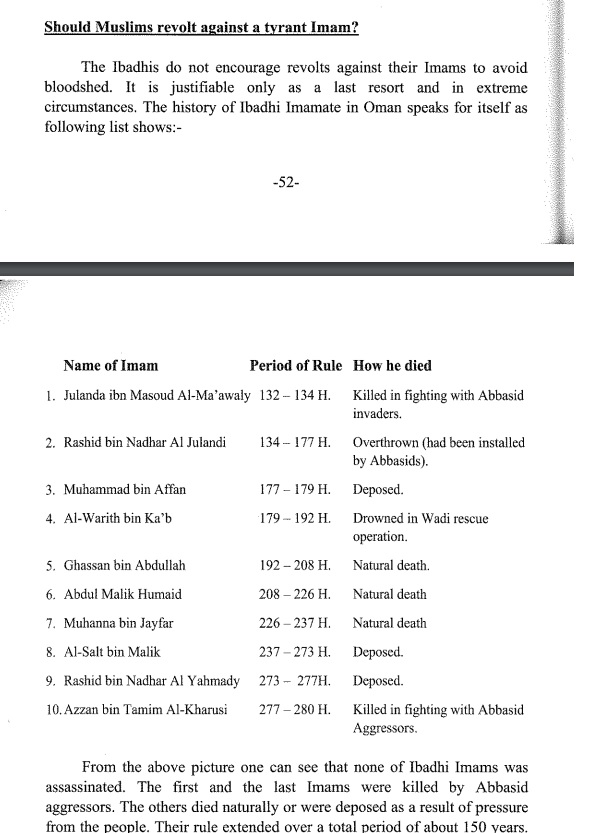
The Ibadis do not encourage revolts against their Imams to avoid bloodshed. It is justifiable only as a last resort and in extreme circumstances. It is the right of every Muslim to be given consultation. The history of the Ibadi Imamate in Oman speaks for itself.

Which are the top 3 longest lasting Muslim empires/dynasties in terms of longevity & stability?

1. 1299-1922 Ottoman/Sunni/Hanafi = 623 years

2. 750-1258 Abbasid/Sunni/Hanafi = 508 years

3. 1154-1624 Nabhani/Ibadi = 470 years

Let us see who really presided over chaos and death and who were beacons of stability.

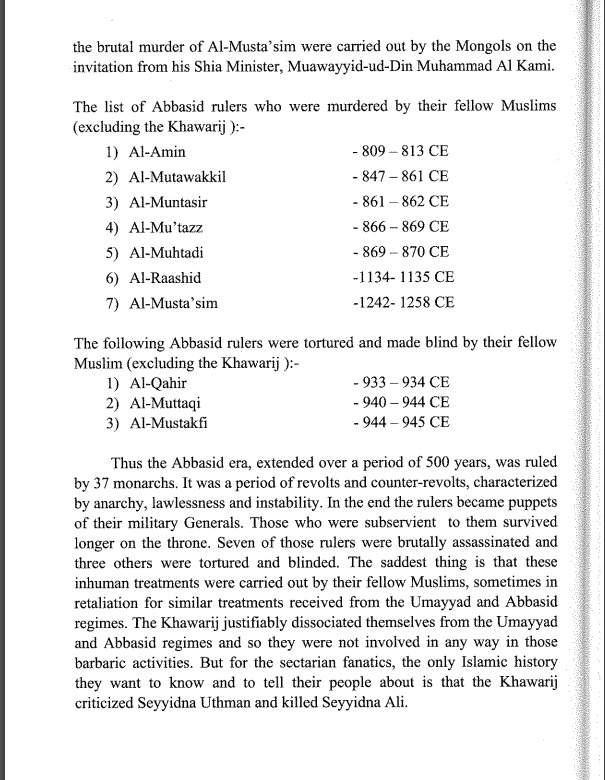
These excerpts are taken from the book: Ibadhism The Cinderella of Islam.

First let us take a look at house Uthmaniyyun

Prima Qur’an comments:

*notes* The above text says:

Uthman ibn Affan—murdered by fellow Muslims — This is because he was not killed by the Uthmaniyyun. He was killed by fellow Muslims as he would not be deposed peacefully.
Ali bin Abi Talib—murdered by a fellow Muslim. He was killed by Ibn Muljam in retaliation for the slaughter at Nahawan.

We would personally have switched out the negative word ‘murdered’ with a more neutral word ‘killed’.

Because Muslims can kill if it is with in the limits set by Allah. But murder would imply that a person had no right.

Also, the use of the term Kharijee and Khawarij here by Shaykh Soud H. Al-Ma’awaly (May Allah continue to benefit us by him) is to grant the term to the sectarian reader.

Becasue on page 8 he clearly states:

“Ibadhism is one of the most misunderstood Islamic sects, and is wrongly considered as one of the Khawarij group of sects that are regarded as heretic or even apostate that has deviated from the mainstream of Islam.”

Now, let us take a look at house Abbasids

Now let us take a look at House Ibadi

Btw, when it says above: * deposed * this is like when the president of the former United States gets impeached, or removed from office, for example. Or like the CEO of a company being asked to step down due to negligence and/or other reasons.

The one who is deposed is not sought out and not killed. They are simply deposed for either being incompetent and/or not fit to lead. No favoritisms based upon tribal, clan, ethnic group or family loyalty.

Deposed is the graceful exit from public office.

However, if that individual does not go quietly, revolution is on the table. The Amir of the Muslims is in service to the Muslims and is not above the commands of Allah nor above public critique for lacking in issues of statecraft.

What happens is that the temperment of the general public is taken into an account. If the will of the people is strong the ruler is deposed by force.

However, if it is seen that the ruler has strong backing then one abides with it in patience. A stalemate in which an endless cylce of bloodshed takes place is never a good thing.

Allah (swt) knows best!

If you wish to read more, you are invited to read:

Ibadhism: The Cinderella Story of Islam.  This is an excellent book by the noble  Shaykh Soud H. Al-Ma’awaly (May Allah continue to benefit us by him)

Or you can try to obtain the book at the following link:

https://alsaidia.com/node/892

May Allah (swt) Forgive the Ummah.

May Allah (swt) Guide the Ummah.

Leave a comment

Filed under Uncategorized

Two AI bots have a conversation about the Ibadi school.

“My Lord! Increase me in knowledge.” (Qur’an 20:114)

﷽ 

This fascinating video came to our attention. It appears to be two AI bots having a conversation about the Ibadi school. As regards the YouTube channel, CIISR is not affiliated or registered with any known university or college in the world. Dr. M A Mufazzal seems to be an individual not known to be attached to any reputable college or university in the world. In fact, leave the reputable aside, he is simply not known at all.

This is the video. We give our comments below.

@4:37 minutes, we were curious where the idea came from that we upheld divine predestination (qadar) in the sense of fatalism. Which was curious given that the AI bots speak about the Ibadi, avoiding binaries. We do not uphold the view of the Mutazil’i nor the Jabariyyah. We hold to the doctrine of kasb (acquisition). This is something the Ash’ari followed us on.

@6:16 this is also incorrect. We do not believe that Ali was a divinely appointed leader. A good portion of the community made shura and among them were the ansar and the muhjirin, who agreed upon him. Once that is done, it is obligatory for the others to pledge allegiance. No such thing as being divinely appointed.

This becomes abundantly clear in our article here:

In fact in that article we stated the following:

The battle of Siffin and practical implications of the above verse.

O you who have believed, obey Allah and obey the Messenger and those in authority among you. And if you disagree over anything, refer it to Allah and the Messenger, if you should believe in Allah and the Last Day. That is the best [way] and best in the result. (Qur’an 4:59)

The battle of Siffin gives us a demonstration of how some of the companions understood the above verse. If we are to believe the historical narrative as told by Shi’i and Sunni sources.

If we are to believe the Shi’i narrative.

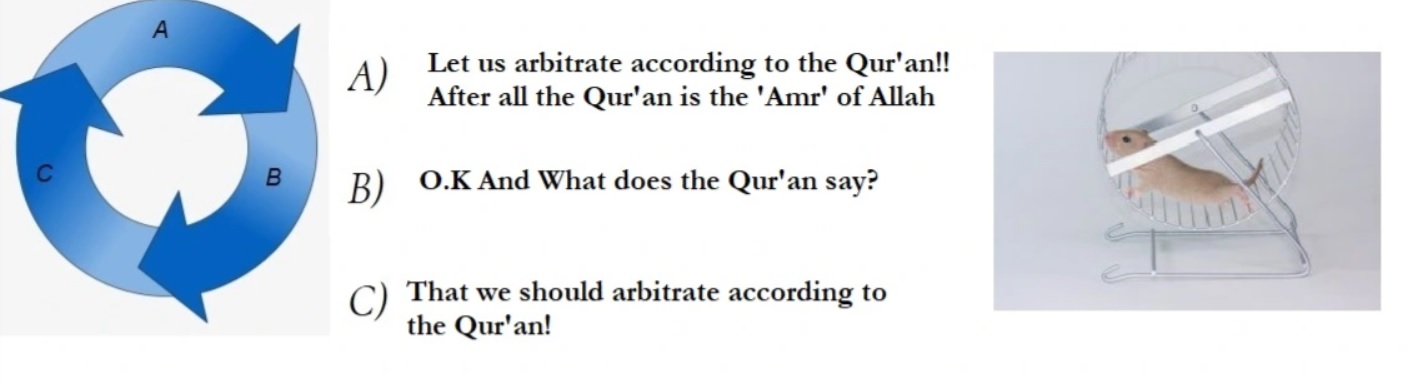
 Ali agreed to arbitration with Muaviya on the basis that they would judge by the Qur’an. If Ali understood that he was of the same authority as the Qur’an and the Messenger (saw) he would not have submitted to arbitration. He would have been on the same page as those in his army who wanted to continue the fight.  However, if he did think he was of the same authority as the Qur’an and the Messenger (saw), then he would be a hypocrite for going against what he himself believed. Or he was not sincere in submitting to the authority of the Qur’an. 

If we are to believe the Sunni narrative. 

If those in Muaviya’s camp believed that the Shi’i held any of the views about Ali that Imami Shi’i held, namely that he (Ali) was maʿṣūm (معصوم) and he (Ali) held ʿiṣmah (عصمة) they themselves would have never asked for arbitration as it too would have simply been a ruse. This becomes very clear that these concepts were not among the followers of Ali because Muaviya’s camp would have known this and would have never cooked up the idea of raising the Mushafs as it would have easily backfired.

@9:03 “They also believe that Ali was wrong to arbitrate.” So this is a contradiction with the AI chatbots. You cannot have a belief in a divinely appointed Imamate and then believe that same Imam is wrong in a decision he makes!

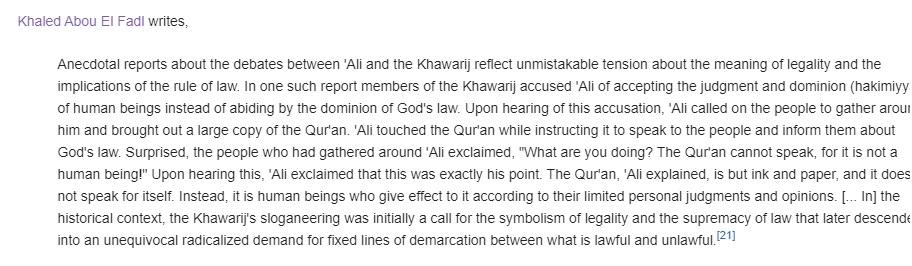
@6:34 is also a tired trope that we hear time and again. Fiqh and Itjihad are a part of Islam. It is something that has been with us in the beginning. The companions who opposed Ali were not claiming you cannot arbitrate God’s law with mortal men. That is a flawed misunderstanding. It is that you cannot make a ruling in place of where the rule is already established and clear.

None of our scholars say that human beings cannot arbitrate. The Qur’an specifically says they can in several places. It is just that humans cannot arbitrate on a matter on which Allah judged. If Allah (swt) gave his ruling on a matter, a human being cannot come along and do otherwise. This is a huge miss by this AI-generated dialogue.

This was established by the companions in their debate with Ibn Abbas (ra). And Ibn Abbas (ra) eventually understood that the people of the river were correct.

And by repeating these same tired tropes, the Sunnis have actually mocked their own Imams. With stories that make Imam Abu Hanifa look ignorant of other people’s positions.

The same ignorant trope that was used by Shi’i reformist Syed Ali Hur Kamoonpuri here:

@12:02 to miss out on the robust populations of the Ibadi in Tunisia, Zanzibar, Tanzania, Ghana is unfortunate. To skip the presence in East Africa altogether is unfortunate.

@13:09 We didn’t quite get the point the AI bots were making: “But again, like with the kharijites question, they take it to its most extreme logical conclusion.” We don’t see the connection they were trying to draw?

@13:40 we were curious as to which verse mentions Allah “sitting” on a throne?

There were other things we could have picked apart, but we did not want to be overly pedantic.

Other than that, for an AI-generated dialogue over all it is o.k. It is what you would expect from agnostic secular academics or historians discussing the matter. Although they would probably refrain from throwing in the occasional ‘eww’ as we saw from the female AI bot. The lasting thoughts were very profound, especially from an AI algorithm.

May Allah Guide the Ummah.

May Allah Forgive the Ummah.
Leave a comment

Filed under Uncategorized

A critique of Apophatic theology, also known as negative theology

Say, “My Lord has only forbidden immoralities – what is apparent of them and what is concealed – and sin, and oppression without right, and that you associate with Allah that for which He has not sent down authority, and that you say about Allah that which you do not know.” (Qur’an 7:33)

“Say (O Muhammed): What thing is of most weight in testimony? Say: Allah is Witness between me and you.” (Qur’an 6:19)

Ibn Abbas reported: The Messenger of Allah (saw) said, “Reflect deeply upon the creation, but do not reflect upon the essence of the Creator. Verily, His essence cannot be known other than to believe in it.”

Source: (Musnad al-Rabī’ 742 عَنِ ابْنِ عَبَّاسٍ قَالَ قَالَ رَسُولُ اللَّهِ صَلَّى اللَّهُ عَلَيْهِ وَسَلَّمَ تَفَكَّرُوا فِي الْخَلْقِ وَلا تَتَفَكَّرُوا فِي الْخَالِقِ فَإِنَّهُ لا يُدْرَكُ إِلا بِتَصْدِيقِهِ 742 مسند الربيع بن حبيب 2976 المحدث الألباني خلاصة حكم المحدث حسن في صحيح الجامع)

﷽ 

This is a (PrimaQur’an) critique of it. So, rather than this being any robust response or engagement from our school, this is an endeavor from a team of non-specialists in philosophy.

The arguments contained here are by no means original from us either. However, this article is sprinkled with our thoughts and conclusions when looking at this particular approach to theology.

For those not formally trained traditionally or academically in theology or philosophy, it is also by no means a deep dive. These are very elementary critiques that we think would appear before any seasoned mind.

Apophatic theology is another name for theology by way of negation. From the Greek ἀπόφημι (apóphemi) ‘to say no’. This is to say that God is known by negating concepts that might apply to him using the insufficiency of human language and rational concepts to describe God.

Ultimately, it is the theology of making no affirmative or positive attributes or assertions of any kind about God. That God is so completely unknowable that we can only engage in conversation about the divine by means of negation. What God is not.

Hopefully, one might appreciate the irony in such an approach, in that both negative and positive statements about God are both equal propositions about divine nature. One is put forward in the positive and the other in the negative. For apophatic theologians, ultimately they must take on the mantle of mysterions and appreciate the complete mystery, otherness and unknowability of God rather than say what could lead to misleading theological concepts about God.

One of our colleagues has said before in this article about an encounter they had while giving a guided tour of a Masjid where a man from California just out of nowhere blurted out the statement: “There is no truth, nothing is true!”

So they turned to the man and said: “Is that true?”

It entails a logical contradiction. It is a logical contradiction because we can be certain that we do not know anything for certain. Which in turn renders our uncertainty very uncertain itself!

Rather, one states that a triangle has three sides or one states that it does not have three sides. Both statements, rather positive or negative, are still both propositions.

” That you say about Allah that which you do not know.” (Qur’an 7:33)

So you could approach this statement: “and that you say about Allah that which you do not know,” from two angles.

Both angles do not support apophatic theology at all.

The first approach may seem clever. That would be to question: “What is it that we actually know about Allah?” They would affirm: “We do not know anything about Allah.” The proponents of apophatic theology would begin with negations.

What is it that we actually know about Allah? Which entails the opposite of an Apophatic theological approach.

What we say about Allah that which we do not know itself entails there are things that we do know about Allah.

You would have to know what something is in order to negate what it is not.

How can we say in any consistent and meaningful way what God is not like unless we have a model or conception of what God is like?

What is a hamburger not like?

How could one provide an answer to this question unless he/she has some idea of what a hamburger is like?

“Creator of the heavens and the earth. He has made for you from yourselves, mates, and among the cattle, mates; He multiplies you thereby. There is nothing like unto Him, and He is the Hearing, the Seeing” (Qur’an 42:11)

This verse poses a number of problems for proponents of apophatic theology.

The verse does not negate Allah (swt) being a ‘shay’. It simply states that there is no shay like unto him.

The verse in context then affirms that Allah (swt) is the Hearing the Seeing. Thus, it immediately supplies us with two affirmations about Him.

So even if we give ta’wil interpretations to Hearing, Seeing, they would be interpretations that would tell us something about Allah (swt).

This immediately shows that apophatic theology is inherently contradictory. In saying that God is unknowable or inexpressible, we have already described God’s nature that it is unknowable and inexpressible, thus asserting propositions about God.

Just as they would when trying to exegete the above text of the Qur’an.

In fact, apophatic theology is not something that can be derived from revelation as one of the purposes of revelation is to tell us the will of God.

Apophatic theology cannot affirm a will for God. Therefore, apophatic theology is an exercise in philosophy(not a belief in revealed revelation).

It relies upon using the very limitations of 3D carbon-based lifeforms, existing in the space/time continuum equipped only with their very limited abilities of perception and reason via a 3D carbon-based lifeform -via from the vantage point of existing in the space/time continuum.

In apophatic or negative theology, we cannot know or affirm that Allah is Love. We do not know or cannot affirm that Allah is Loving.

We cannot know or affirm that Allah loves Muhammed (saw).

We cannot know or affirm that Allah loves Ali ibn Abu Talib.

We cannot know or affirm that Allah loves the Ahl Bayt.

At best, we could still advance propositions: Allah is not hateful. Allah does not hate.

Allah does not hate Muhammed (saw).

Allah does not hate Ali.

Allah does not hate the Ahl Bayt.

Because just as Allah (swt) does not love Muhammed (saw) or love Ali or love the Ahl Bayt, he does not hate any of them either.

The greatest mysterions are those who can give no definite propositional answers about God at all!

In fact, in negative theology, God may not be simple at all. Because to state that God is simple is a positive statement.

God is possibly more complex and more complicated than anything we could imagine. Hence, the very premise of apophatic theology could, in a very real sense, be self-defeating.

Ultimately, it is a belief in an unknown ‘other’ that one cannot explicate. Rendering itself more complicated than the Trinitarian Athanasian creed by far!

Because this concept (which is what it is at this point) is completely unknowable, it gets to the point of asking rather or not if it is even God we are talking about.

We could, for all intents and purposes, talk about God-1.

In other words, the philosophers could have beguiled themselves into believing in an entity that is God in every aspect except the most important, ‘the unknowability’. Surely this itself presents a conundrum.

We simply would not have a basis for knowing at all.

We could simply be talking about a being or entity that is beyond our capacity to fathom but would still not necessitate that entity being God/Allah.

That is because, ultimately, in negative theology, God cannot be perceived and is not perceivable.

We cannot say anything in relation to God and space/time. We cannot really say anything in relation to God and God’s relation to any creation. Because we would not have the slightest clue what a relationship would be like.

Allah is nothing? Allah is something? Allah is everything? Which is correct?

Which of the statements has textual support from the Qur’an?

“Say (O Muhammed): What thing is of most weight in testimony? Say: Allah is Witness between me and you.” (Qur’an 6:19)

The above text clearly states in response to the question of what thing has most weight in testimony that Allah (swt) is that thing which has most weight in testimony.

There is no text in the Qur’an that states that Allah is no-thing.

There is no text in the Qur’an that states that Allah is everything. This too would be defeated by logic as there would not be a creator-created distinction.

Apophatic theology leads to bizarre, contradictory conclusions about the attributes of God.

We cannot say that God Creates Perfection.

We cannot say that God Creates Perfection because we cannot say that God Creates at all.

There are also problems with affirmation of negatives to Allah/God.

So when we don’t say that Allah is Hate or Allah is Love. We can only say that Allah does not Hate and Allah does not Love.

But can we affirm the negatives for the following?

Does God have power and control over himself? Is this something to affirm or negate?

Does God have autonomy?

Does God have sovereignty?

Because the moment we assert negative prepositions for these questions, we are now introducing another force besides God.

If you say that the Divine Essence is not autonomous or not sovereign, then this necessitates another actor.

So, logic dictates that we must assert that the Divine Essence has the positive attributes of Autonomy and Sovereignty at the very least; or we are now redirecting our conversation and our interest away from this supposed ‘God’ to that force that God submits to.

Another conundrum of this philosophical discourse is that if this God has the qualities of essence, the very fact there is conversation concerning it makes it among the categories of things that conversation is being held concerning. Even if the conversation is philosophical or speculative in nature.

In other words, another defeat for apophatic theology is that God is being discussed, even if it is only in the sense of negation. Thus, we are affirming a positive about God. That positive is that God’s very nature can be discussed and mused over like any other subject known or unknown.

We can only discuss subjects that have come to our consciousness. Even if those subjects are abstract concepts like time, infinity and nothingness.

We are using language to describe, negate or affirm the concept just as we would use language to negative or affirm any other thing.

So apophatic theology is helpless to deny that God is beyond the realm of pontification, reflection or discussion, or it would render its own position vain. This is because apophatic theologians themselves discuss, pontificate and muse over what is not God.

Apophatic Theology and Proving Negatives.

Apophatic theologians think they can make negative assertions about God without having to prove those negative assertions.

This gets into the debate we have with atheists, where (the uneducated among them) state one cannot prove a negative.

For one thing, a real actual law of logic is a negative, namely the law of non-contradiction.
This law states that a proposition cannot be both true and not true. Nothing is both true and false. Furthermore, you can prove this law.

For example: the very statement: “You cannot prove a negative” is itself a negative claim that would not be true if it could be proven true!

Here is another negative we can prove via mathematics.

There is no rational number whose square is 2. 

https://www.mytutor.co.uk/answers/1092/University/Maths/Is-there-any-rational-number-whose-square-is-2/

Thank you, Andrei S!

So, when making negative statements about God. God is not like this and God is not like that. What is the contrast?

Remember the earlier question:

What is a hamburger not like?

You would have to know what something is in order to negate what it is not.

This would lead us to some intrusive and counter-intuitive conclusions. Such as the bizarre perspective that perhaps the one who has never ever thought about God is the closest to the truth concerning God.

Here we are not talking about the Atheist who has made a propositional stance against God. Here we are talking about such a hypothetical person that has never considered God at all.

Recall that even apophatic theologians are among those who believe that God’s very nature can be discussed and mused over like any other subject known or unknown.

Apophatic Theology Is Hostile Towards Certain aspects of Mysticism and Sufism in particular.

There are many aspects of mysticism and Sufism that Apophatic Theology is a virulent enemy of.

Examples are: The idea of Fan’a (annihilation of the self in the divine) or having a direct experience with the Divine. This is not possible, and the aspirant, according to apophatic theology, is in a state of grand disillusionment. How would they objectively know that they have arrived? That arrival could be a veil itself and, in the face of apophatic theology, it most certainly is.

The argument from the Qur’an is that God must be something.

“Or were they created by no-thing (ghayri shayin), or are they ˹their own˺ creators?” (Qur’an 52:35)

A no-thing would be a non-shay. Non-existence. Unless one wants to argue that the Qur’an is utilizing a spacious argument. May Allah protect us from the Shaitan!

Why would the argument be used that they were created from nothing if the first creation was created from nothing?

Thus, logically, a true negative theology would entail that we cannot say anything about God, which ultimately you will see is the conclusion that many of them end up reaching, by stating that God does not exist (has existence).

Maybe their perspective is similar to the Ein-Sof of Kabbalist philosophy. Maybe they reduce the perceivably complex to the least complex. A name which is still a composite consisting of letters; such that to escape even that multiplicity in the naming of the nothing they chose ע

Even then, that is problematic.

The Christian tradition has the following:

“See to it that no one takes you captive through hollow and deceptive philosophy, which depends on human tradition and the elemental spiritual forces of this world rather than on Christ.” (Colossians 2:8)

“For as I walked around and looked carefully at your objects of worship, I even found an altar with this inscription: to an unknown god. So you are ignorant of the very thing you worship and this is what I am going to proclaim to you.” (Acts 17:23)

If God is unlike anything that we can understand or relate to at all, then how could one justify any response to God? Prayer, worship, obeying his commands and shunning that which is prohibited?

“Thus We have appointed you a middle nation, that you may be witnesses against mankind, and that the messenger may be a witness against you.” (Qur’an 2:143)

Again, these are some of our initial thoughts on the subject.

The Claim: Apophaticism states that no positive predicate can be applied to God. God is beyond all human categories and language.

The Contradiction: To claim that “God is beyond all predicates” is itself a predicate. To say “God is unknowable” is to claim a piece of knowledge about God (namely, that He possesses the property of being unknowable). The statement “No statement about God is true” must, if true, apply to itself, rendering it false.

In essence, the apophatic approach attempts to use language to assert the failure of all language, which is a logical paradox. It tries to climb a ladder of negation and then kick it away, but the act of kicking it away is still a use of the ladder.

God, beyond being, must have the quality of being able to give or ground being.

As the philosopher Anthony Kenny quipped, “The God of the apophatic theologian and the God of the atheist seem to share a remarkable similarity.”

Meaningful negation logically depends on some prior understanding of what is being negated.

This leads to an infinite regress of negation: to negate a concept, you must use another concept, which you must then also negate, ad infinitum. This process can never logically conclude, as every step requires a conceptual framework that the theory itself claims is invalid.

The Unjustified Starting Assumption
The entire apophatic edifice is built on one key premise: that the human mind is utterly incapable of forming any true concepts about a transcendent God.

This is an epistemological claim presented as an absolute truth. However, it is not logically proven within the system; it is merely asserted.

A critic can ask: How do you know that human concepts are entirely inadequate? To know this would require having access to God’s nature to compare it to our concepts, which is precisely what the apophatic theologian claims is impossible.

Therefore, the foundational premise of apophaticism is both unproven and, by its own standards, unknowable.

Self-Referential Problem

If we say “God is ineffable” or “God cannot be described,” we are still making a positive assertion about God.

This seems self-contradictory: the claim “God cannot be spoken of” is itself a way of speaking about God.

Epistemic Vacuity

If all positive descriptions are denied, what content remains to distinguish God from nothingness?

A purely negative theology risks collapsing into nihilism: saying “God is not this, not that” could equally describe a void or absence.

This makes it hard to explain how believers know they are actually speaking of God rather than simply of “not-X”.

Dependence on Positive Knowledge

Negation requires a prior positive reference. To say “God is not finite,” one must know what “finite” means and apply it meaningfully.

Thus, negation parasitically depends on the very affirmations it claims to reject.

Pure apophaticism may be logically impossible without at least some cataphatic (positive) foundation.

Oh Allah, if anything that was penned by us was in error, we turn ourselves over to your Mercy. You, the knower of intentions.

With Allah (swt) is success.

May Allah Guide the Ummah.

May Allah Forgive the Ummah.
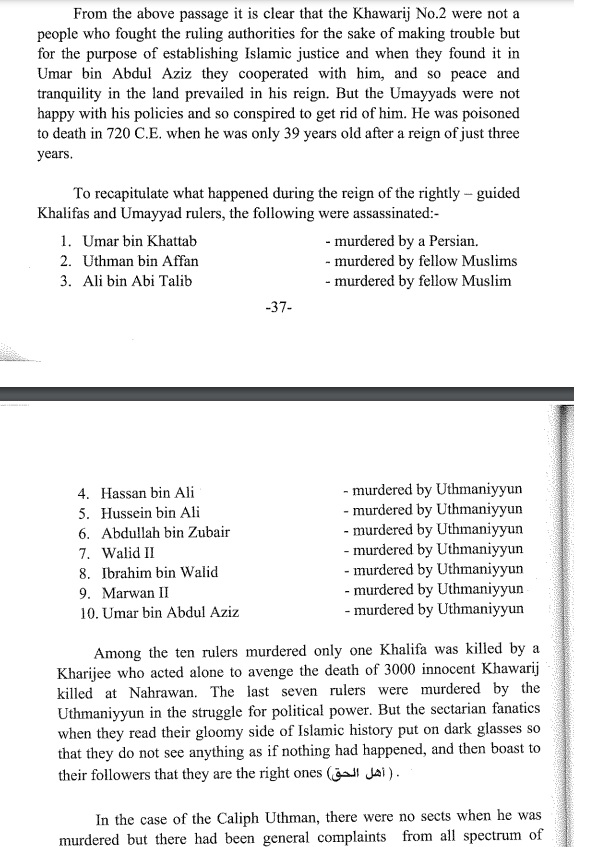
Leave a comment

Filed under Uncategorized

All articles related to Christianity

“Those to whom we gave the Book know it as they know their children, but a group of them knowingly hide the truth”- Qur’an 2:146

﷽ 

“And when they hear what has been revealed to the Messenger, you see their eyes overflowing with tears because of what they have recognized of the truth. They say, “Our Lord, we have believed, so register us among the witnesses.”(Qur’an 5:83)

Pope John Paul Kissing the Qur’an.

“In the first place amongst these there are the Muslims, who, professing to hold the faith of Abraham, along with us adore the one and merciful God, who on the last day will judge mankind.” -POPE PAUL VI

Source: (https://www.vatican.va/archive/hist_councils/ii_vatican_council/documents/vat-ii_const_19641121_lumen-gentium_en.html)

“You are the best nation that ever existed among humanity. You command people to good and prohibit them from evil, and you believe in Allah. Had the People of the Book accepted the faith (Islam), it would certainly have been better for them. Some of them have faith, but most of them are evil doers.” (Qur’an 3:110)

In the future all such articles concerning Christianity will go under the heading Jews and Christians here:

First and foremost any Muslim engaging with Christians should understand that those whom identify as Christians have a wide range of different beliefs. We have seen too often Muslims engage with Christians and assume their beliefs. This is akin to a Christian thinking that an Ayatollah from Iran or a Shaykh from Saudi Arabia speaks on behalf of all Muslims.

For example the Eastern Orthodox Christians do not believe that we bear the sin of Adam rather we bear the consequences of that sin. It is a nuanced position.

Another massive and influential Protestant denomination, the Church of Christ (called Campbellites) by their opponents do not hold that infants are sinless and incapable of making free will decisions to sin.

There are key but major doctrinal differences between Eastern Orthodox and Church of Christ (Campbellites) on this matter as well. With Eastern Orthodox believing original sin corrupts human nature this leads to a deposition towards sin. Whereas the Church of Christ (called Campbellites) They reject original sin altogether, believing that each individual is responsible for their own sins. Adam’s sin affects himself and not future generations.

Not all Christians believe in a Trinity, and those that do have greatly different takes on it, some viewing others as heretical. They do not all agree on the nature of Christ Jesus, rather or not he has one nature, two natures, they do not even agree on a set number of New Testament books. They have New Testament canons that range from 22 books, 27 books and even 35 books!

“And with those who say, We are Christians (nasara), We made a covenant, but they neglected a portion of what they were reminded of, therefore We excited among them enmity and hatred to the day of resurrection; and Allah will inform them of what they did.” (Qur’an 5:14)

The above verse acknowledges that there are whole factions under the umbrella terminology ‘Nasara’ . That these factions clash with one another. Therefore, it is foolhardy to think that the term ‘Nasara’ is a blanket term to refer to all those who call themselves Christians. It can refer to those who were faithful before the breaking of the covenant as well as those who came after.

Some Christians object to certain verses of the Qur’an saying: This is not what we believe. They seem to have forgotten that one person’s orthodoxy is another person’s heterodoxy. This is what the Qur’an acknowledges. There can only be hatred and enmity between those who have sharp and irreconcilable differences among them.

We hope that the students and researchers of comparative religion find the following articles helpful!

GENESIS CHAPTER 3 SEPARATES ISLAM AND CHRISTIAINITY

THE WAY OF LIFE THAT EXISTED BEFORE CHRISTIANITY AND JUDAISM

THE DEATH KNELL OF CHRISTIANITY

THE AMAZING HISTORICITY AND EYEWITNESS TESTIMONY OF THE CHRISTIAN FAITH.

ARE CHRISTIANS TRULY ASSURED AND CERTAIN OF THIER SALVATION? CHRISTIANS CANNOT CLAIM THAT THEY ARE IN WALAYAH AL HAQIQAH WITH ALLAH

THE DEGENERATE AND DISGRACED CHRISTIANS WHO ATTACKED ISLAM AND MUSLIMS

SHOULD MUSLIMS DEBATE JEWS AND CHRISTIANS?

THERE IS NO HATE QUITE LIKE CHRISTIAN LOVE

THE PLACE OF MIRACLES IN ISLAM & CHRISTIANITY

THE MISSION OF JESUS: TO WHOM WAS HE SENT?

ARE PROPHETS JESUS & MUHAMMED FORETOLD IN THE OLD TESTAMENT?

https://primaquran.com/2024/01/14/are-prophets-jesus-muhammed-foretold-in-the-old-testament/

AHMAD IN THE NEW TESTAMENT?

THE NATURE OF GOD. THE NATURE OF JESUS. THE VARIOUS TRINITY DOCTRINES. THE ALLEGED DEITY OF CHRIST JESUS.

THE ANTHROPOMORPHIC GOD OF THE BIBLE.

DISMANTLING THE TRINITY: JESUS WAS NEVER THE ONLY SON.

ADOPTIONIST THEOLOGY: HOW DID JESUS BECOME THE SON OF GOD?

IS CHRIST JESUS GOD?

DISHONEST CHRISTIAN CLAIMS THE QUR’AN TEACHES THAT JESUS IS GOD.

TEXT THAT CLEARLY SHOW JESUS IS NOT GOD AND THE BIBLE DOES NOT UNDERSTAND HUMAN REPRODUCTION.

WHY JESUS IS NOT THE NAME OF GOD.

DOES THE QUR’AN INACCURATELY DESCRIBE ‘THE’ TRINITY?

JESUS FORESKIN, BABY TEETH and UMBILICAL CORD: THE MIAPHYSIS and DYOPHYSIS CONTROVERSY.

https://primaquran.com/2024/11/11/jesus-foreskin-baby-teeth-and-umbilical-cord-the-miaphysis-and-dyophysis-controversy/

JESUS THE GOD/MAN ?

https://primaquran.com/2022/10/04/jesus-the-god-man/

DOES THE BIBLICAL TEXT ASSERT TWO INCARNATIONS?

FORGIVING SINS: DOES THIS MAKE JESUS GOD?

THE LIKNESS OF JESUS IS LIKE ADAM.

CHRISTIAN SCHOLARS DECEIFTUL OVER THE WORD ‘WORSHIP’?

https://primaquran.com/2022/10/05/christians-scholars-deceitful-over-the-word-worship/

SHOULD MUSLIMS STOP USING MARK 13:32 AGAINST CHRISTIANS?

https://primaquran.com/2024/11/21/should-muslims-stop-using-mark-1332-against-christians/

WHAT HAS YOUR GOD DONE FOR YOU?

I DON’T HAVE A RELIGION! I HAVE A RELATIONSHIP WITH CHRIST! I AM A SON OF GOD!

https://primaquran.com/2022/10/04/i-dont-have-a-religion-i-have-a-relationship-with-christ-i-am-a-son-of-god/

MUSLIM, CHRISTIAN AND JEWISH CONCEPTS OF THE AFTERLIFE.

THE CHRISTIAN HEAVEN AND ISLAMIC HEAVEN: VIRGINS, VIOLENCE AND COUP D’ETAT!

DOES THE CHRISTIAN HEAVEN HAVE A PLACE FOR WOMEN?

PAUL: THE ANTI CHRIST

THE FALSE PROPHECIES OF JESUS.

A CHRISTIAN DILEMMA: WHY WOULD JESUS BE SILENT ABOUT THE RISE OF ISLAM?

HOW DO CHRISTIANS DEAL WITH THOSE WHOM THE GOSPEL NEVER REACHED?

WOULD THEY DIE FOR A LIE? A POPULAR CHRISTIAN ARGUMENT.

https://primaquran.com/2017/11/09/would-they-die-for-a-lie-a-popular-christian-argument/

CHRISTIAN EVANGELIST ADMITS ALLAH IS GOD

https://primaquran.com/2018/05/05/christian-evangelist-admits-allah-is-god/

ALL ARITCLES ON RATHER OR NOT THE BIBLE IS THE AUTHENTIC WORD OF GOD.

THE SO CALLED ISLAMIC DILEMMA: LET THE PEOPLE OF THE GOSPEL JUDGE. WHERE IS THE INJEEL?

WHY IS THE INJEEL FROM GREEK?

IS THE BIBLE THE (UNADULTERATED) WORD OF GOD?

THE QUR’AN CHARGES ORAL CORRUPTION OF THE PREVIOUS REVELATIONS.

DOES THE QUR’AN TEACH THAT THE BIBLE WAS CORRUPTED?

NOTHING CAN CHANGE THE WORDS OF ALLAH.

BETWEEN THE HANDS OR HAVING AUTHORITY OVER (MA BAYNA YADAYHI)

KNOWING OUR THEOLOGY: THE ENCOUNTER BETWEEN HABIB ALI AL JIFRI AND MIROSLAV VOLF

https://primaquran.com/2022/10/05/knowing-our-theology-the-encounter-between-habib-ali-al-jifri-and-miroslav-volf/

A MESSAGE TO JEHOVAH WITNESSSES.

https://primaquran.com/2022/10/04/a-message-to-jehovah-witnesses/

BIBLE COMMANDS CHRISTIANS TO PAY JIZYAH TAX

THE THIRD COMING OF JESUS?

GENERAL CHRISTIAN POLEMIC AGAINST ISLAM ANSWERED

DO JEWS AND CHRISTIANS RANSON MUSLIMS FROM HELLFIRE?

GIVING ANSWER TO CHRISTIAN POLEMICS WHOM DISPARAGE THE CHARACHTER OF THE BLESSED PROPHET (SAW)

https://primaquran.com/2019/08/29/giving-answer-to-christian-polemics-whom-disparage-the-character-of-the-prophet/

CHRISTIAN POLEMIC AGAINST ISLAM BACIRES AND TESTIFIES TO THE VERACITY OF THE QUR’AN!

https://primaquran.com/2024/10/23/christian-polemic-against-islam-backfires/

THE SO CALLED: SATANIC VERSES (QISSA GHARANIQ-THE STORY OF INTERMEDIARY CRANES)

https://primaquran.com/2024/10/26/the-so-called-satanic-verses-qissa-gharaniq-the-story-of-intermediary-cranes/

CLAIMS OF APOCRYPHAL SOURCES IN THE QUR’AN?

THE WISDOM OF THE BLESSED PROPHET (SAW) MARRYING ZAYNAB (RA)

https://primaquran.com/2022/10/04/the-wisdom-of-the-blessed-prophet-marrying-zaynab/

ALL ARTICLES IN RELATION TO THE SO CALLED CRUCIFIXION AND EVEN IF THE QUR’AN ADDRESSES THE SO CALLED CRUCIFIXION.

THE QUESTION OF THE HISTORICAL CRUCIFIXION AND THE MARTYDOM OF JESUS.

WHY DIDN’T THE DISCIPLES OF JESUS KNOW THIS?

https://primaquran.com/2022/10/04/why-didnt-they-know/

CRUCIFIED OR IMPALED? UNDERSTANDING QUR’AN 4:157

THE JEWS DON’T CRUCIFY PEOPLE. GREAT EXCHANGE WITH RABBI DOV STEIN.

A CHRISTIAN DILEMMA & HOW MIGHT JESUS HAVE DIED?

JESUS WAS NOT CRUCIFIED: THE EVIDENCE WITH DR. ALI ATAIE.

THE NON-CRUCIFIXION VERSE BY DR. LOUAY FATOOHI: A RESPONSE.

THE OLD TESTAMENT’S FRAMEWORK FOR CHILD RAPE: A PROPERTY CRIME AGAINST THE FATHER, REMEDIED BY BRIDE PRICE AND FORCED CHILD MARRIAGE.

ISHMAEL THE SACRIFICE: RESOLVING THE BIBLICAL CONTRADICTIONS THROUGH THE QUR’ANIC NARRATIVE.

JEWS AND CHRISTIANS AS RANSOM FROM THE HELLFIRE. WHY THE IBADI SCHOOL REJECTS THE SUNNI INTERPRETATION.

90% SILENT: WHY THE CHRISTIAN CASE AGAINST MUHAMMED DEPENDS ON A JESUS WHO BARELY SPEAKS.

GENESIS 11, THE QUR’AN, AND THE ANTHROPOLOGY OF LANGUAGE.

MUSLIMS READ GENESIS CHAPTER 6. THE FLOOD OF NOAH.

NO OBJECTIVE CRITERION: WHY 1 KINGS 22 AND 2 KINGS 3 UNDERMINE TRUST IN BIBLICAL PRPOHECY AND THE GOD OF THE BIBLE.

NEVER THE ONLY GOD: HOW THE BIBLE PRESERVES HENOTHEISM AND THE QUR’AN PROTECTS MONOTHEISM.

Future articles Allah-willing.

Is the Holy Spirit God?

Christian Dominionism: The Violent take it by force.

Subordinationism.

Gregory Palamas and his errors on Islam.

May Allah (swt) guide the sincere Christians to Islam. May Allah (swt) guide them so that they may find peace in this life and the life to come. May Allah (swt) guide the sincere Christians to Islam and save them from the punishment of the hellfire.

Leave a comment

Filed under Uncategorized

Ex 12er Shi’i sister has questions about Siffin.

“If two parties of the believers happen to fight, make peace between them. But then, if one of them transgresses against the other, fight the one that transgresses until it reverts to Allah’s command. And if it does revert, make peace between them with justice,  and be equitable for Allah loves the equitable.” (Qur’an 49:9)

﷽ 

We felt thatthis post would be beneficial concerning an exchange that an Ex 12 Shi’a sister had with a teacher from the Ibadi school.

These are her questions and may Allah (swt) guide her to the truth.

=================================================================================

Salaam Shaykh, I understand your point of view that the arbitration had dire and terrible consequences. I completely agree it was a terrible decision. 

But I still don’t see how it violated the 49:9 ayah. 

Because returning to the command of Allah (swt) could be accepting arbitration. As 4:59 says, when two parties differ, we must return it to Allah (swt) and the Messenger, i.e. the Qur’an and Sunnah.

And Mua’wiya signed an agreement saying he would accept the judgement according to the Qur’an and Sunnah. Whereas before Siffin, he was saying he would not accept any kind of arbitration. Even if he was lying when he signed the agreement, we must accept if someone verbally makes an oath. And Imam Ali included a clause in the agreement that said if the result of the arbitration is not in line with the Qur’an and Sunnah, then we return to fighting.

Which is exactly what he did. After the announcement of the result, which was not in line with the Qur’an and Sunnah, he went back to fighting Mua’wiya.

He asked the Muhakimma to rejoin his army, but they refused, saying he must repent first. But Imam Ali refused because he said the arbitration was not a sin, it was a bad political decision that he was forced to take because of the shura of his own army. He had warned against it, and now the result was bad. He was doing the best to fix it by returning to fighting.

And I don’t understand why the Muhakimma didn’t rejoin him because they also wanted to fight Mua’wiya.

This is the response of one of one of our teachers to the questions put forward by the sister:

=================================================================================

Because the people of Nahrawan knew from the beginning that arbitration is wrong and is not helped by legal evidence.

This is because the followers cannot challenge the ruler in authority but can only advise him.

And they know that the people of Sham did not ask for arbitration in order to follow the Qur’an and submit to the truth, but rather to gain time. That is why they did not raise the Qur’an in arrows except when the circle of war was about to turn on them.

Rather, Imam Ali himself said that at the beginning.

Where he said, by Allah, they raised it only by deception, cunning and intrigue.

Then, if we go back to the principle of shura in Islam and the principle of appointing a caliph, how could Mu’awiyareject the authority of the caliph?

If the people rejected the authority of the caliph, what would be the situation in this nation?

And the companions who were among the people of the Levant knew the intentions of Mu’awiya and the Umayyads.

How is that?

Because they know that Mu’awiya is a tramp according to the text of the hadith of the Prophet, may Allah’s blessings and peace be upon him, and he and his group did not accept Islam until the conquest of Mecca.

And they converted to Islam, and they composed of their hearts.

Likewise, among them is the expulsion of the Messenger of Allah, Al-Hakam bin Al-Aas, as well as the saying of the Prophet, (saw), Allah does not satisfy his stomach.

Where he did not respond to the call of the Prophet (saw) and other events that they know about this sect, including the hadith of the group of unjust, which is that:

Ammar will be killed by the transgressor faction.

As we know, he was killed before arbitration.

All of this evidence was strongly present among the loyal believers of the people of Nahrawan.

There is no doubt that sincere believers see the light of Allah.

And all the events that followed this confirmed the sincerity and strength of the view of the people of Nahrawan.

Therefore, we will see that their position was different from Imam Ali from the beginning.

And they didn’t want to follow up on his mistake.

Nevertheless, we will find some people who are confused about the papers in this time, mistaking the people of Nahrawan and not describing them as being guided in their view and mujtahid.

However, they describe Mu’awiya and Imam Ali as diligent and mujtahid !!!

This is only due to the mixing of standards and the lack of steadfastness and equality in principles.

Wallahu Almustaan

=================================================================================

Prima Qur’an comments: We are quite seasoned at answering such questions. There are always some presumptions in such questions as well as gaps in the data, as you, the reader, will soon see.

Now her first line of questions are very typical of Shi’a and Sunnis, so nothing new here. But here is what you, the astute reader, will soon glean from this exchange.

The sister states:

“But I still don’t see how it violated the 49:9 ayah.”

“Because returning to the command of Allah (swt) could be accepting arbitration. As 4:59 says when two parties differ we must return it to Allah (swt) and the Messenger i.e. the Qur’an and Sunnah.”

So let us take a look at the two verses that are quoted:

“If two parties of the believers happen to fight, make peace between them. But then, if one of them transgresses against the other, fight the one that transgresses until it reverts to Allah’s command. And if it does revert, make peace between them with justice, and be equitable for Allah loves the equitable.” (Qur’an 49:9)

“O believers! Obey Allah and obey the Messenger and those in authority among you. Should you disagree on anything, then refer it to Allah and His Messenger, if you ˹truly˺ believe in Allah and the Last Day. This is the best and fairest resolution.” (Qur’an 4:59)

So far the sister’s logic seems sound right?

But here is where the objection crumbles.

So now we have the Qur’an in front of us. What is/are the verse(s) that give the solution to the conundrum?

This is where we get radio silence, not only from our respected sister (who has a 12er Shi’i background), but our Sunni friends also get their tires stuck in the mud over this question.

To add to the problem of this. If Ali and/or Mu’awiya did not think that the solution was in the Qur’an or Sunnah, it would mean that either or both of them were being pretentious. Not a good trademark for a leader.


Secondly, all Muslims believe that the Qur’an and Sunnah are the solution to all our problems. So why the wait? Like why not just solve the problem right then and there. Quote the relevant verses and be done with it?

Those sahaba, the Muhakkima they would agree. After all:

“So the judgement is with Allah.” (Qur’an 40:12)

So what do the Shi’i and Sunnis give us when we ask: What is that judgement from the Qur’an and Sunnah?

It usually looks and sounds something like this:

That is correct dear readers. Static noise.

So what became of arbitration? Intrigue, betrayal, the sword. Hussein and Karbala.

The Sunni/Shi’i narrative has something in common in that they both make Ali & Mu’awiya like people who do not have a clue.

So what about those sahaba (May Allah be pleased with them all) the Muhakkima. Do we get static from them? No!

“If two parties of the believers happen to fight, make peace between them. But then, if one of them transgresses against the other, fight the one that transgresses until it reverts to Allah’s command. And if it does revert, make peace between them with justice,  and be equitable for Allah loves the equitable.” (Qur’an 49:9)

The verse is clear. You fight UNTIL it reverts to Allah’s command. Not fight until you both decide to take a hiatus trying to figure out what the command of Allah is!

“O believers! Obey Allah and obey the Messenger and those in authority among you. Should you disagree on anything, then refer it to Allah and His Messenger, if you ˹truly˺ believe in Allah and the Last Day. This is the best and fairest resolution.” (Qur’an 4:59)

Mu’awiya should have recognized Ali as the commander of the faithful, gave the oath of allegiance. He should have waited for Ali’s verdict. If he felt the verdict was unjust, then he would bring up his grievances.

It has been narrated on the authority of Abu Sa’id al-Khudri that the Messenger of Allah (saw) said:

When oath of allegiance has been taken for two caliphs, kill the one for whom the oath was taken later.

Source: https://sunnah.com/muslim:1853

So, on the one hand, we have Shi’i & Sunnis who claim that Ali & Mu’awiya wanted to settle the matter through the Qur’an & Sunnah. However, they are not prepared to flesh out for us exactly what that entails.

On the other hand, you have the sahaba (May Allah be pleased with them all) the Muhakkima with penetrating insights who have already seen the signals (as the teacher mentioned in his reply). They knew the verdict of Allah (swt) in Qur’an (Qur’an 49:9) and were not interested in playing any more games of cat and mouse.

Dear Ummah, May Allah (swt) open your eyes wide to what has happened.

You mean to tell us that Mu’awiya and Ali went to war over a matter that is unclear? Ali rallied people to fight fellow Muslims over matters that are unclear, and still needed to be discussed and deliberated upon. Mu’awiya did the same? Human life is so cheap?

The idea that the arbitration was to make matters clear that were not clear before is an absolute joke! It is an insult to the intelligence of thinking people.

Here is another point. Ali and Mu’awiya are human beings. They can make ijtihad and their ijtihad can be wrong. Only the body of the Ummah that think that Ali cannot make errors in judgement will find this difficult to agree with.

Then we have people ascribing to Imam Ali some of the most incredulous statements.

For example: Here is an excerpt from Khaled Abou El Fadl who co-authored a book with Joshua Cohen. By Allah, we have possibly never read a more insulting portrayal of Imam Ali’s intelligence than we have from this excerpt.

It is not even so much about what is said about the so-called “khawarij”. It is the injustice done to Imam Ali here! To think that he would use such infantile “arguments” is just beyond incredulous!


Then we get hadith that are either put in the mouth of Ali, and worse still put in the mouth of the Prophet (saw). In this hadith we get Ali disparaging a black man, who happens to be companion of the Blessed Messenger (saw).

‘Ali said:

Whenever I narrate to you anything from the Messenger of Allah (saw) believe it to be absolutely true as falling from the sky is dearer to me than that of attributing anything to him (the Holy Prophet) which he never said. When I talk to you of anything which is between me and you (there might creep some error in it) for battle is an outwitting. I heard the Messenger of Allah (saw) as saying: There would arise at the end of the age a people who would be young in age and immature in thought, but they would talk (in such a manner) as if their words are the best among the creatures. They would recite the Qur’an, but it would not go beyond their throats, and they would pass through the religion as an arrow goes through the prey. So when you meet them, kill them, for in their killing you would get a reward with Allah on the Day of Judgement.

Source: (https://sunnah.com/muslim:1066a)

Very odd way to preface a statement. As if something that follows might be incredulous.

“Whenever I narrate to you anything from the Messenger of Allah (saw) believe it to be absolutely true as falling from the sky is dearer to me than that of attributing anything to him (the Holy Prophet) which he never said.”

Very interesting admission:

“When I talk to you of anything which is between me and you (there might creep some error in it) for battle is an outwitting.”

Those sahaba who opposed Ali’s decision for arbitration neither came at ‘the end of the age’ nor where they youth.

“There would arise at the end of the age a people who would be young in age and immature in thought.”

But wait, there is more! We have another version of this hadith:

When Haruria (the Khawarij) set out and as he was with ‘Ali b. Abu Talib (Allah be pleased with him) they said, “There is no command but that of Allah.” Upon this ‘Ali said: The statement is true but it is intentionally applied (to support) a wrong (cause). The Messenger of Allah (saw) described their characteristics and I found these characteristics in them. They state the truth with their tongue, but it does not go beyond this part of their bodies (and the narrator pointed towards his throat). The most hateful among the creation of Allah is one black man among them (Khawarij). One of his hand is like the teat of a goat or the nipple of the breast. When ‘Ali b. Abu Talib (Allah be pleased with him) killed them, he said: Search (for his dead body). They searched for him, but they did not find it (his dead body). Upon this he said: Go (and search for him). By Allah, neither I have spoken a lie nor has the lie been spoken to me. ‘Ali said this twice and thrice. They then found him (the dead body) in a rain. They brought (his dead) body till they placed it before him (Hadrat ‘Ali). ‘Ubaidullah said: And, I was present at (that place) when this happened and when ‘Ali said about them. A person narrated to me from Ibn Hanain that he said: I saw that black man.

Source: (https://sunnah.com/muslim:1066g)

Dear reader, as we are not sure which hadith you will be directed to, we would advise you to type into Google: “Ṣaḥīḥ Muslim 1066.” Thus, you will have your choice of hadith to analyze.

  1. The statement is true, but it is intentionally applied (to support) a wrong (cause). Another version in English reads: “A word of truth by which is intended falsehood.“

Is Ali saying that his cause is wrong? Because, that is exactly what those sahaba meant. As mentioned above. It is not an ambiguous matter like the Sunni/Shi’i have made it out to be. The verse in the Qur’an is clear.

2. They state the truth with their tongue, but it does not go beyond this part of their bodies (and the narrator pointed towards his throat)

So why is it they say the truth and it does not go past the throat? Or is that they recite the Qur’an, and it does not go past their throat?

3. That Ali ibn Abu Talib gets to be on record for all posterity for saying: “The most hateful among the creation of Allah is one black man among them (Khawarij). ”

Surely the following is description enough: “One of his hand is like the teat of a goat or the nipple of the breast.” ?

These hadiths we have dealt with here:

Which, by the way, the above hadith we can and have absolutely ripped the chains apart. However, what has gone on concerning the matn (the text) itself should be sufficient. Insh’Allah.

So let us continue with what this ex 12er Shi’i sister states:

“And Mua’wiya signed an agreement saying he would accept the judgement according to the Qur’an and Sunnah. Whereas before Siffin, he was saying he would not accept any kind of arbitration. Even if he was lying when he signed the agreement, we must accept if someone verbally makes an oath. And Imam Ali included a clause in the agreement that said if the result of the arbitration is not in line with the Qur’an and Sunnah then we return to fighting.”

“Which is exactly what he did. After the announcement of the result, which was not in line with the Qur’an and Sunnah, he went back to fighting Mua’wiya.”

So here are some things that this sister could ponder. As stated above, what is this big mystery? What is this big secret evidence from the Qur’an and Sunnah that has been hidden from us for the last 1300 plus years?

“And Mua’wiya signed an agreement saying he would accept the judgement according to the Qur’an and Sunnah.”

“”Which is exactly what he did. After the announcement of the result, which was not in line with the Qur’an and Sunnah, he went back to fighting Mua’wiya.”

This is what we have asked Shi’i time and time again. Over and over and over again ad nauseam. What is from the Qur’an and Sunnah that Mu’awiya went against? What is the evidence the process that Ali was quoting from there that supported him? What is this 1300 year big secret?

The sister continues:

“He asked the Muhakimma to rejoin his army but they refused, saying he must repent first. But Imam Ali refused because he said the arbitration was not a sin, it was a bad political decision that he was forced to take because of the shura of his own army. He had warned against it, and now the result was bad, he was doing the best to fix by returning to fighting.”

“And I don’t understand why the Muhakimma didn’t rejoin him because they also wanted to fight Mua’wiya.”

Let us pick this a part bit by bit.

“He asked the Muhakimma to rejoin his army, but they refused, saying he must repent first.”

Response: Let us say, for the sake of argument, that Ali didn’t think he needed to repent. If he was a judicious leader and wanted these sahaba to rejoin him, why not simply repent for the sake of repentance?

Narrated Abu Huraira:

I heard Allah’s Messenger (saw) saying,” By Allah! I ask for forgiveness from Allah and turn to Him in repentance more than seventy times a day.”

Source: (https://sunnah.com/bukhari:6307)

Another point on this. Whatever one may think about the hadith of Thaqalayn, Ghadir Khum, etc. it is abundantly clear that those sahaba had no idea, clue or concept of Ali being beyond approach. In fact, the matter is very similar to the following:

Narrated Abu Maryam `Abdullah bin Ziyad Al-Aasadi:

“When Talha, AzZubair and `Aisha moved to Basra, `Ali sent `Ammar bin Yasir and Hasan bin `Ali who came to us at Kufa and ascended the pulpit. Al-Hasan bin `Ali was at the top of the pulpit and `Ammar was below Al-Hasan. We all gathered before him. I heard `Ammar saying, “`Aisha has moved to Al-Busra. By Allah! She is the wife of your Prophet in this world and in the Hereafter. But Allah has put you to test whether you obey Him (Allah) or her (`Aisha).”

Source: (https://sunnah.com/bukhari:7100)

So even though Aisha (ra) is acknowledged by Ammar bin Yasir (ra) to be the ‘wife of the Prophet in this world and in the Hereafter,‘ he was not about to leave the dhahir (the apparent) evidence. Which is that Ali was/is/and forever will be the rightful 4th Imam of the Muslims.

So why are we expected to go hard on a woman, the mother of the believers, (ra)? But when it comes to a man, do we take the cautious approach? Doesn’t seem very consistent or chivalrous at all.


So, just like those sahaba abandoned Aisha (ra) in favour of the apparent. In a similar sense, sahaba abandoned the ijtihad of Ali in favour of the Qur’an. It is abundantly clear, as is the admission by this sister of those people asking Ali to repent, that this idea that Ali was infallible, beyond reproach, should never be questioned.

Nope! Get that out of here!

In fact, Shaykh Massoud bin Mohammed Al Miqbal -May Allah bless and protect him. He explains about the position of Ali very clearly.

@50 seconds he says:

“Rather, they looked upon the events and clashes with what occurred in Siffin, and they built upon it a judgement. And it’s a godly judgement. And they see that Ali is alike to the people, alike to the human kind; For him it is that to others, and to him is that to others. And he is obligated by what they’re obligated.”

“So, if he falls on that which obliges deviance, he is considered a deviant. So, if he does tafseeq, he is considered a fasiq/ Kufs he is takfeered.”

“And this is the madhab of the sahaba which you narrate. The companions who had insulted him killed and cursed him. Was it out of a whim?”

“Or by a religious obligation? Without a doubt, the madhab of the sahaba (and you claim you follow the salaf, you say that you’re Salafiyah) this is the madhab of the salaf.”


“That whoever falls on kufr is takfeered, whoever falls on that which obligates cursing is cursed, whoever falls on that which obligates criticism is criticized.”

“This is the madhab of the Salaf, rather the madhab of the Qur’an and the Honest Prophet (saw). This is the madhab that we adopt.”

Narrated `Aisha:

Usama approached the Prophet (saw) on behalf of a woman (who had committed theft).
The Prophet (saw) said, “The people before you were destroyed because they used to inflict the legal punishments on the poor and forgive the rich. By Him in Whose Hand my soul is! If Fatima (the daughter of the Prophet (saw) did that (i.e. stole), I would cut off her hand.”

Source: (https://sunnah.com/bukhari:6787)

So let us imagine a scenario where Fatima (ra) did steal, and she did get caught. Would one necessarily have to have hatred in his/her heart towards Fatima (ra) when executing the punishment?
That means that every judge or Qadi would need to hate the person they pass a sentence on?

Of course not!

Narrated Abu Huraira:

When Allah revealed the Verse: “Warn your nearest kinsmen,” Allah’s Messenger (saw) got up and said, “O people of Quraish (or said similar words)! Buy (i.e. save) yourselves (from the Hellfire) as I cannot save you from Allah’s Punishment; O Bani `Abd Manaf! I cannot save you from Allah’s Punishment, O Safiya, the Aunt of Allah’s Messenger (saw)! I cannot save you from Allah’s Punishment; O Fatima bint Muhammed! Ask me anything from my wealth, but I cannot save you from Allah’s Punishment.”

Source: (https://sunnah.com/bukhari:2753)

As for the sister’s last comment:

“And I don’t understand why the Muhakimma didn’t rejoin him because they also wanted to fight Mua’wiya.”

There is a saying. Once bitten twice shy. These sahaba fought and died for Imam Ali ibn Abu Talib. They bled and watched as companions and colleagues and friends died, some of them possibly maimed for life. Ali had his chance at victory and squandered it. How can it be imagined that these same people would rejoin Ali only for him to find himself in another situation with Mua’wiya and have a bitter repeat of that affair? Thanks but no, thanks!

Besides this they have already elected an Imam.

Why is it that Mu’awiya is culpable for his mistakes as a leader and Ali is not?

Remember, that the Shaykh, in his response to the sister, quoted that signals that let those sahaba, the Muhakimma, to see that Mu’awiya is definitely upon injustice.

Recall that the Shaykh said:

“Where he did not respond to the call of the Prophet (saw) and other events that they know about this sect, including the hadith of the group of unjust, which is that:

“Ammar will be killed by the transgressive faction.”

Narrated `Ikrima:

“That Ibn `Abbas told him and `Ali bin `Abdullah to go to Abu Sa`id and listen to some of his narrations; So they both went (and saw) Abu Sa`id and his brother irrigating a garden belonging to them. When he saw them, he came up to them and sat down with his legs drawn up and wrapped in his garment and said, “(During the construction of the mosque of the Prophet) we carried the adobe of the mosque, one brick at a time while `Ammar used to carry two at a time. The Prophet (saw) passed by `Ammar and removed the dust off his head and said, “May Allah be merciful to `Ammar. He will be killed by a rebellious aggressive group. `Ammar will invite them to (obey) Allah and they will invite him to the (Hell) fire.”

Source: (https://sunnah.com/bukhari:2812)

Yet, surprisingly, he has misinterpreted it by saying: “His killers were those who held weapons and killed him.” Which he means to say not Mu’awiya!!! He says again: “The word “killer”, if loosely or absolutely used, means the one that has killed: not the one that has issued the order (of killing).”

Source: (Al-Tabari Al-Taarikh Vol. 3, p. 133. Ibn Al-Athir Al-Kamil Vol. 2, p. 705)

This bizarre philosophy of Ibn Taymiyyah indicates that if he were to live in the present age, he would – of course – agree with the claim that presidents are not responsible for the crime of the illegal, haphazard bloodshed committed by their armies in different Muslim and non-Muslim countries, but rather their troops are the ones responsible for that!

This is bizarre reasoning. Of course, Mu’awiya is responsible for the actions of his soldiers just as Ali is responsible for the decisions that he makes. You can’t keep looking to shift the blame on others. It further makes Ali look weak and indecisive.

Also, now that history has passed, accordingly it was said that Mu’awiya and Amr ibn al-Aas used a ruse to deceive Ali and his army. Is that something to be proud of, brothers? The founders of the Ummayad dynasty used deception against fellow Muslims like this? Your history portrays them as scheming and conniving! Are you proud of this?

May Allah (swt) guide this sister to the truth.

May the eyes of the Ummah be wide open!

May Allah (swt) guide the Ummah!

May Allah (swt) forgive the Ummah!

Leave a comment

Filed under Uncategorized