“Ramaḍan is the month in which the Quran was revealed as a guide for humanity with clear proofs of guidance and the decisive authority.” (Qur’an 2:185)
﷽
The second day of Ramadan! May Allah (swt) continue to bless this Ummah and bless all of you!
Great tips by brother Hatim Abdis-Salam on what to eat and how to organize one’s day during Ramadan.
*Heart Health: Sincerity*
Sincerity is for a Muslim to seek the pleasure of Allah in their actions. It is also said to be breaking one’s self-interests, cutting off worldly desires, and dedicating oneself to the Hereafter.
The truth of sincerity is between the servant and his lord, so no creature can access one’s intentions, that’s why when a Muslim starts an action, his intention should be for the sake of Allah, so that it’s free of hypocrisy, and in the Hadith: “The intention of the believer is better than his action”
*The three sentences* The first obligation in Islam is three sentences: 1- I bear witness there is no god except for Allah. 2- And that Muhammed is the messenger of Allah. 3- And that what Muhammed came with is the truth from Allah. in Arabic: أشهد الا إله إلا الله، وأن محمداً رسول الله، وأن ما جاء به محمد هو الحق من عند الله The third sentence is differed on, but many of our scholars include it. It is differed on the sense on rather it needs to be uttered. The first two sentences are agreed upon.
The importance of these sentences lie on the fact that they bring people to the fold of Islam, whoever pronounces them then his blood and wealth are Haram.
*Delaying fasting and breaking the fast early* If someone eats after Adhan Al Fajr thinking that it’s still not Fajr, what is his ruling? Answer: Nothing is on him, because the origin is the continuation of the night.
If someone eats before Maghreb thinking it’s already Maghreb, what is his ruling? Answer: He should redo that day after Ramadan, his fasting is broken, because the origin is the continuation of the day.
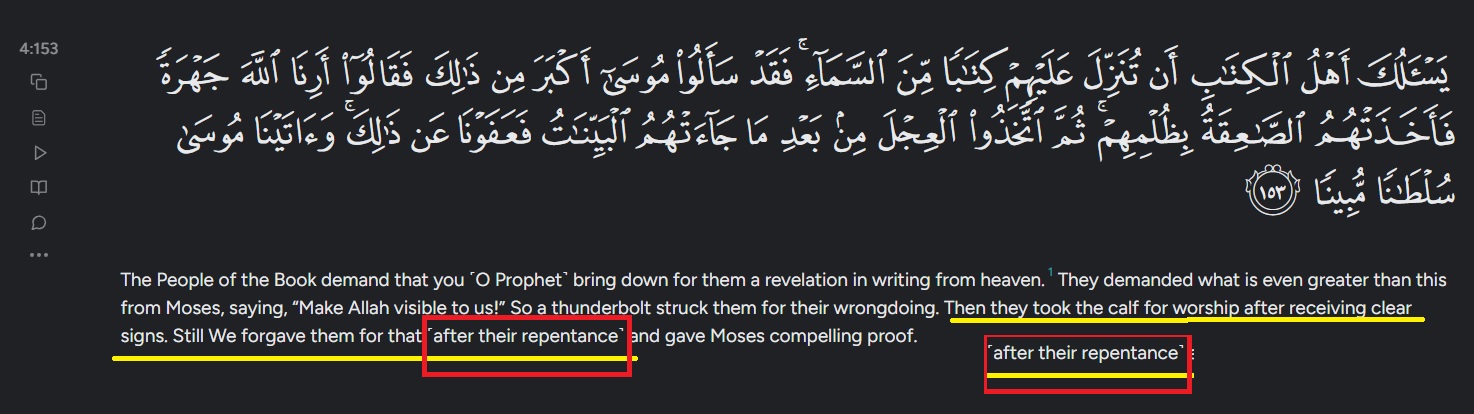
“And they say, “Never will the Fire touch us, except for a few days.” Say, “Have you taken a covenant with Allah? For Allah will never break His covenant. Or do you say about Allah that which you do not know?” Yes, whoever earns evil and his sin has encompassed him – those are the companions of the Fire; they will abide therein eternally.” (Qur’an 2:80-81)
“But whoever disobeys Allah and His Messenger and exceeds their limits will be cast into Hell, to stay there forever. And they will suffer a humiliating punishment.” (Qur’an 4:14)
Do you not consider, [O Muhammed], those who were given a portion of the Scripture? They are invited to the Scripture of Allah that it should arbitrate between them; then a party of them turns away, and they are refusing. “This because they say: “The Fire shall not touch us but for a few numbered days.” What will happen to their belief when We bring them together on the Inevitable Day when every soul will be justly recompensed for its deeds?” For their forgeries deceive them as to their own religion.” (Qur’an 3:23-24)
“Indeed, your Lord’s torment is fearsome.” (Qur’an 17:57)
﷽
As mentioned in a previous post, we would like to clarify that, for those of us who follow the Ibadi school of Islam, for us, it is not important if our school is right or wrong on the matter.
What is important for us is that we are following the clear evidence as given by the Qur’an and the agreed-upon traditions of the Blessed Messenger (saw) Al Sunnah.
What is also important to note is that on this very important issue it is absolutely impossible for us to lose on this issue. As we mentioned to a brother before. We believe that the Ash`aris & Maturidis & Athari are upon batil (falsehood) and we are upon haqq (truth) in this matter.
So why is it impossible for us to lose? Because if the Ashari and Maturidi and Athari are correct, then we will all eventually be in paradise. However, if we are correct, and they are mistaken, your eternal salvation is the price of being upon misguidance.
The first point of clarification. Difference between infinite and everlasting (going backward and forward in time).
The difference between infinite and everlasting. Infinite is something beyond counting, beyond a real measurement. In this regard, only Allah (swt) is truly eternal. The knowledge of the created things is eternal.
Knowledge of the eternal does not equate to the eternality of the thing known.
Whereas everlasting is enduring forever; existing or continuing without end.
“That is Allah, your Lord; there is no deity except Him, the Creator of all things, so worship Him. And He is Disposer of all things.” (Qur’an 6:102)
Only Allah (swt) has no beginning.
Prevalent Muslim attitudes towards the afterlife have precipitated a moral and ethical decline.
Some may wonder if such an article is necessary? What benefit does this have for the Muslim community? Such an article is necessary, and it has an immense benefit for those who are willing to take heed. Every one of us has come short of the Glory of Allah (swt). Every one of us has fallen short in some aspect of our relationship with Allah (swt). Some of us more than others.
Do you ever wonder about moral erosion even in the Muslim communities? Do you think that this possibly has some root in the theology that Muslims have concerning the afterlife?
Do you not think that an attitude that says:
I’ll only be in the hellfire for a little while.
The Blessed Messenger (saw) will make intercession for me, so I have nothing to worry about.
Do you not think that such attitudes are flippant? To already treat hellfire as such a light matter has certainly led many of us not to fear Allah (swt).
An over-emphasis on the Love of Allah (swt). Of course, Allah (swt) is known as Al-Wadud (The Loving) twice in the Qur’an. After that, people have to read Rumi and other forms of poetry and books of saints to get their fix.
However, the Al-Nar (The Fire) is mentioned some 120+ times.
Jahnnam (The Abode of Hell) is mentioned some 70+ times.
Jaheem (Blazing Flames) is mentioned 20+ times.
It is a theme that is threaded all throughout the Qur’an.
We have often wondered at the success of Christian evangelism throughout certain parts of the world. Certainly, they bring food, build wells, hospitals, and schools. All of this is good and Muslims are doing this and should increase our efforts in doing this. Yet, for the Evangelicals, there is one central message that comes packaged with this help. That message is one that says, ‘I care about your eternal hereafter‘. It is a frightening warning, that without faith in Christ Jesus we will burn for all eternity. Unless one is in the habit of scoffing outright at such a proclamation, it is certainly something many take very seriously.
“And thus We have revealed to you an Arabic Qur’an that you may warn the Mother of Cities [Makkah] and those around it and warn of the Day of Assembly, about which there is no doubt. A party will be in Paradise and a party in the Blaze.” (Qur’an 42:7)
Allah (swt) revealed the Qur’an in Arabic. He wanted the Blessed Messenger (saw), to convey the message about the day of resurrection, that people would be in paradise and that people would be in hellfire.
Now, with calling people to Allah (swt), there should be a methodology and wisdom in how we call people. Yet, it cannot be denied that the Blessed Messenger (saw) was sent to warn people against the hellfire.
Keep in mind as well, those very few but loud voices that say that hellfire is an allegory, are now saying the same thing about paradise and the resurrection. They came as a packaged message.
“This is the fire which you used to deny. Is this an illusion (afasih’run) or is it you who are still unable to see?” (Qur’an 52:14-15)
We would like to begin as well with a quotation that is a very heartfelt response taken by the majority of our brothers from Ahl Sunnah today. That those who commit the major sins will still enter paradise. As well as the view as taken by the majority of Sunni Muslims that sinful Muslims will eventually enter paradise.
“This objection is rejected in that, on the basis of this opinion of theirs, they must then say that the committers of fornication, those who do the deed of the people of Lut, the consumers of usury, the killers of souls without right, those who prevent the payment of zakah, and the rest of the people who commit major sins other than shirk, will be counted among the righteous who have been promised Bliss, and greater contentment from Allah. By Allah, there is no more effective means to demolish the foundations of the religion, to abase the rituals, to diffuse evil, than this opinion. It demolishes all the commands and prohibitions of Allah and blows up everything that has come in His Book and the Sunnah of His Messenger, of the warning for people who commit major sins. It is sufficient that fornication, homosexuality, drinking wine, indifference to being cuckolded, and all the prohibited things will be among acts of righteousness because those who commit them are in the ranks of the righteous.” — Shaykh Ahmad b. Hamad al-Khalili (Grand Mufti of the Sultanate of Oman)
“The belief of us Ibadis is that whoever enters the Fire from among the muwahhid disobedient and the associators (mushriks) will remain there permanently, not for a finite period.”-Shaykh Ahmed b. Hamad al-Khalili
“The difference between us and the Kharijis is that they oppose us only in that they judge every punishable act of shirk entailing expulsion from the millah.”-Shaykh Ahmed b. Hamad al-Khalili.
What is the methodology that is used to establish the truth in this matter?
The established rule is that any major belief of the Muslims should come from the agreed- upon text. We see, for example, that those who believe in the second coming of Christ Jesus (as) will try and appeal to various texts of the Qur’an, among them are the following: Qur’an 4:159 Qur’an 43:61 Qur’an 3:46
Yet, when it comes to the belief that a believer will enter hellfire, we do not see that our opponents can establish any evidence from the Qur’an at all for this.
We can turn to the hadith, and we can find hadith promising because of this or that such and such a person will enter paradise. We can also find hadith promising that such and such a person for doing this or that will enter the hellfire. That they will never see paradise or even smell the slightest scent of paradise.
Thus, we turn to the Qur’an.
Methodological principles.
When we analyze the text of the Qur’an. We take the verses that are firm and decisive in their meaning, whereas the Ahl Khilaf (the People of Opposition) base their evidence upon verses that are subject to various interpretations.
“It is He who caused the Book to descend to you. In it are verses, that are (muḥkamāt) definitive. They are the essence of the Book and others, ones that are (mutashābihāt) unspecific. Then, those whose hearts are swerving, they follow what was unspecific in it, looking for dissent and looking for an interpretation.” (Qur’an 3:7)
That is to say we build our belief upon clear-cut evidence from the Qur’an. Ahl Khilaf (the People of Opposition) take an isolated verse that is subject to more than one interpretation and make the clear-cut verses bend to an interpretation.
Looking at the evidence from theQur’an.
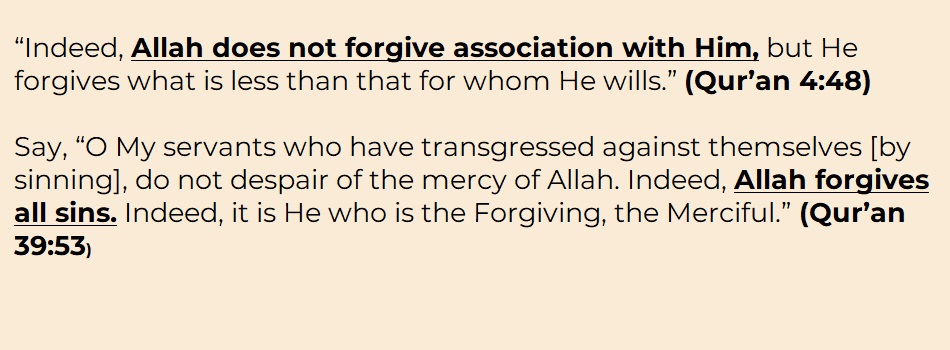
“And they say, “Never will the Fire touch us, except for a few days.” Say, “Have you taken a covenant with Allah? Allah will never break His covenant. Or do you say about Allah that which you do not know?” Yes, whoever earns evil and his sin has encompassed him – those are the companions of the Fire; they will abide therein eternally(khaliduna).”(Qur’an 2:80-81)
Among the people who believe that hellfire is not permanent are the Jews. This assertion of theirs is rebuked and made public to emphasize how very wrong they were in their assertion.
Verily, what has reached us from the Qur’an is that Allah (swt) not once informed us about this doctrine of exit from the hellfire, neither from the Jews nor from others. Rather, what Allah (swt) has informed us is the doctrine of uninterrupted torment, and it includes the invalidation of the doctrine of the exit from hellfire. It also nullifies the doctrine of cessation of torment and its absolute end.
The idea of being in the hellfire ‘except for a few days‘ or ‘awhile’ is juxtaposed next to the phrase ‘companions of the Fire; they will abide therein eternally‘.
There are those who will object to the word khaliduna. Two things must be kept in mind:
The term khaliduna is being contrasted with the bold lie of being in hell for a little while.
” And We granted not to any human being immortality before you (O Muhammed), then if you die, would they live forever (khaliduna)?” (Qur’an 21:34) -This verse contrasts living a long time with living forever.
Whom Allah (swt) addresses in verses: 81–82.It is very clear that this distinguishes a few days, a little while, from non-permanence with everlasting permanence.
This is another text that should make this very clear.
“But I have for you only notification from Allah and His messages.” And whoever disobeys Allah and His Messenger – then indeed, for him is the fire of Hell; they will abide therein(khalidina) forever(abadan).” (Qur’an 72:23)
Those who do not understand the obvious text and wording of khalidina to be forever will also have to come to terms with the idea that heaven is not abiding forever, the paradise will not abide forever, neither will the Blessed messenger (saw) or his family.
They will one day come out of paradise. Do you believe it?
The idea of hellfire being some temporary stay is certainly Jewish penetration into Islamic thought.
Do you not consider, [O Muhammed], those who were given a portion of the Scripture? They are invited to the Scripture of Allah that it should arbitrate between them; then a party of them turns away, and they are refusing. “This is because they say: “The Fire shall not touch us but for a few numbered days.” What will happen to their belief when We bring them together on the Inevitable Day when every soul will be justly recompensed for its deeds?” For their forgeries deceive them as to their own religion.” (Qur’an 3:23-24)
There are a few things to take note of for those who fear Allah (swt) in the above verse:
This text would in no way be sensible to those it addressed if the Qur’an itself contained such a doctrine! (limited time in the hellfire)
These people will say hell is only a number of days, they are going to be in for a really terrible surprise when they approach the inevitable day. ‘What will happen to their belief?‘
These lies have deceived them about their own religion—that there could be laxity in obeying the commands of Allah (swt).
“But whoever kills a believer intentionally – his recompense is Hell, wherein he will abide eternally, and Allah has become angry with him and has cursed him and has prepared for him a great punishment.” (Qur’an 4:93)
Killing is a major sin (less than shirk) but still deserving of everlasting hellfire.
“Those who consume interest cannot stand on the Day of Resurrection except as one stand who is being beaten by Satan into insanity. That is because they say, “Trade is just like interest.” But Allah has permitted trade and has forbidden interest. So whoever has received an admonition from his Lord and desists may have what is past, and his affair rests with Allah. But whoever returns to dealing in interest or usury- those are the companions of the Fire; they will abide eternally therein.” (Qur’an 2:275)
“For them who have done good is the best reward and extra. No darkness will cover their faces, nor humiliation. Those are companions of Paradise; they will abide therein eternally. But they who have earned blame for evil doings – the recompense of an evil deed is its equivalent, and humiliation will cover them. They will have from Allah no protector. It will be as if their faces are covered with pieces of the night – so dark, are they! Those are the companions of the Fire; they will abide therein eternally.” (Qur’an 10:26-27)
Prima Qur’an Comments:
People who were in hell for a while and then admitted to heaven can hardly be described as having, “no darkness covering their faces nor humiliation.”
Those who do not understand the obvious text and wording of khalidina to be forever will also have to come to terms with the idea that heaven is not abiding forever, the paradise will not abide forever, neither will the Blessed messenger (saw) or his family.
They will one day come out of paradise. Do you believe it?
“And those who say, “Our Lord, avert from us the punishment of Hell. Indeed, its punishment is (gharanama) everlasting debt…” (Qur’an 25:65)
“Our Lord! bring us out of this: if ever we return to Evil, then shall we be wrong-doers indeed!” He will say: “Be driven into it with ignominy! And do not speak to Me!” (Qur’an 107- 108)
“But as for those who defiantly disobeyed, their refuge is the Fire. Every time they wish to emerge from it, they will be returned to it while it is said to them, “Taste the punishment of the Fire which you used to deny.” (Qur’an 32:20)
“And for those who disbelieve will be the fire of Hell. Death is not decreed for them so they may die, nor will its torment be lightened for them. Thus do we recompense every ungrateful one. And they will cry out therein, “Our Lord, remove us; we will do righteousness – other than what we were doing!” But did We not grant you life enough for whoever would remember therein to remember, and the warner had come to you? So taste the punishment, for there is not for the wrongdoers any helper.” (Qur’an 35:36-37)
“And those who do not invoke with Allah another deity or kill the soul which Allah has forbidden to be killed, except by right, and do not commit unlawful sexual intercourse. And whoever should do that will meet a penalty. Their punishment will be multiplied on the Day of Judgment, and they will remain in it forever (wayakhlud), in disgrace .” (Qur’an 25:68-69)
“So taste the penalty, and never will We increase you except in torment.” (Qur’an 78:30)
“Indeed, the righteous will be in pleasure, And indeed, the wicked will be in Hellfire. They will [enter to] burn therein on the Day of Recompense, And will not be removed from it.” (Qur’an 82:13-16)
“Indeed, Allah has cursed the ungrateful and prepared for them a Blaze Abiding therein forever (khalidina fiha abadan), they will not find a protector or a helper., they will not find a protector or a helper.” (Qur’an 33:64-65)
Prima Qur’an Comments:
These people are not going to be let out during Ramadan (no helper, no protector).
Allah (swt) is not going to release them after a period of time. (no helper, no protector).
They find no reprieve in the annihilation of hellfire and/or their own existence (no helper, no protector).
“Indeed, those who disbelieve and commit wrong or injustice – never will Allah forgive them, nor will He guide them to a path. Except for the (tariqah)path of Hell; they will abide therein forever(khalidina fiha abadan). And that, for Allah, is always easy.” (Qur’an 4:168-169)
“But the ones who disbelieved and denied Our verses – those are the companions of the Fire, abiding eternally (khalidina) therein; and wretched is the destination.” (Qur’an 64:10)
“Indeed, the criminals will be in the punishment of Hell, abiding eternally (khaliduna). It will not be allowed to subside for them, and they, therein, are in despair. And We did not wrong them, but it was they who were the wrongdoers. And they will call, “O Malik, let your Lord put an end to us!” He will say, “Indeed, you will remain.” (Qur’an 43:74-77)
Prima Qur’an Comments:
Once again, if anyone has any doubts about khaliduna being eternal, forever, everlasting, the guardian of Hellfire himself, the noble angel Malik, told the inhabitants that they will remain there.
The proof of the enduring, eternal, everlasting nature of the punishment of hellfire is overwhelming. In fact, based upon the evidence that has been given every place in the Qur’an that talks about hellfire (is talking about eternal agony)
This is absolutely terrifying. In fact, We would encourage anyone reading this to go and listen to their favorite Qur’an reciter, reciting the verses of Hellfire and you will feel as if a hand has reached deep within your soul and shook you to the core of your being! Except possibly those whose hearts are dead or bereft of faith. May Allah (swt) protect us from that!
POSSIBLE OBJECTIONS TO THIS FIRMLY ESTABLISHED BELIEF.
First, it is important to understand that there are two groups here:
There is Jahm bin Safwan and Ibn Al Qayyim. Keep in mind that most of what is known about Jahm is through polemical works directed at him, so how fair the assessment is can be debated. Their understanding is that there is an end to punishment for both the associators and the disobedient muwahhid .
The Ash’ari holds permanence is for both places. However, they hold that the non-muwahhid will abide in hell forever, whereas the muwahhid disobedient will be in hell for a short while (undefined).
As regards the term ‘khalidina‘, both groups try to dismiss this by interpreting it metaphorically. We have already shown above the problem with doing this, especially when we look at the context.
The argument of the first and the last.
As regards evidence that Jahm bin Safwan advanced to show that heaven and hell are not eternal is the following:
“He is the First and the Last, the Ascendant and the Intimate, and He is, of all things, Knowing.” (Qur’an 57:3)
The argument is that, if we understand this, is that, as Allah (swt) is The Last, it means heaven and hell cannot be enduring.
We understand ‘The First and The Last‘ as the first meaning taking precedence and The Last as remaining after every existent. Nothing brought into being can cancel out anything about him. Presidency over -remaining after every existent. Nothing is before Him and nothing is after Him.
We also understand that Allah (swt) is one. However, we do not understand this as numerically ‘one‘ as zero precedes one.
The argument that ages comes to an end.
Another proof that is used is:
“They will abide therein for ages.” (Qur’an 78:23)
The argument is that ages come to an end.
It is simply an expression of time. One age passes, another follows. Note it does not say ‘until the ages come to an end’.
Even one has to agree that the evidence here is implicit. Whereas the explicit is what is mentioned here:
“They would desire to go forth from the fire, and they shall not go forth from it, and they shall have a lasting punishment.” (Qur’an 5:37)
“Everything(kullu)will perish save His Face.” (Qur’an 28:88)
Texts taken at their apparent meaning in and of themselves are foundational.
If this text is understood without understanding Arabic grammar, it can present a challenge.
This text is a challenge that takes the attributes of Allah (swt) based upon their apparent meaning.
We take into account other places where this is mentioned:
“Everyone upon the earth will perish. And there will remain the Face of your Lord, Owner of Majesty and Honor.” (Qur’an 55:26-27)
We understand this to be that every single being will perish, and their lives will be short. Whereas Allah (swt) is Ever-Living.
This text cited above brings us to the next point.
This above text (Qur’an 28:88) is also used by believers who ascribe to Neoplantonism, and those among the Muslims who believe in the eternality of the universe.
They will argue everything comes to an end (hell, heaven, all of it). That is a huge logical fallacy.
There is a huge logical flaw in this. You cannot have an infinitude that goes one way and not the other. That is why you will see them often come up with other arguments that are nothing more than the machinations of their own imaginations.
In the next section, we will bring forth proof text that can be used by Jahm bin Safwan and Ibn Al Qayyim as well as the Ash’ari/Maturidi
The proof texts
The following will always be the ‘go to’ verse for those who wish to go against the clear verses. They will take a verse that is not definite in meaning and use it to bend the verses which are definitive in meaning.
“As for those who were destined to be wretched, they will be in the Fire. For them therein is violent exhaling and inhaling. They will be abiding therein as long as the heavens and the earth endure, except what your Lord should will. Indeed, your Lord is an effecter of what He intends. And as for those who were destined to be prosperous, they will be in Paradise, abiding therein as long as the heavens and the earth endure, except what your Lord should will – a bestowal uninterrupted.” (Qur’an 11:106-108)
A look at the two clauses.
The first clause: “Except what Allah wills.”
This will deal primarily with the Ash’ari/Maturidi objection.
Those who also cite the above text (Qu’ran 11:106-108) in conjunction with the following verse:
“And the Day when He will gather them together and say, “O company of jinn, you have misled many of mankind.” And their allies among mankind will say, “Our Lord, some of us made use of others, and we have now reached our term, which you appointed for us.” He will say, “The Fire is your residence, wherein you will abide eternally, except for what Allah wills. Indeed, your Lord is Wise and Knowing.” (Qur’an 6:128)
So at 11:108 above and at 6:128, they focus on the phrase: “Except for what Allah wills.“
First, it is important to understand that Allah’s will is not like a human will. If a human being wills something today, that person may change their mind tomorrow, and when tomorrow comes they may again adopt a completely different idea.
“There is no changing in the decree of Allah.” (Qur’an 10:64)
“We would have invented against Allah a lie if we returned to your religion after Allah had saved us from it. And it is not for us to return to it except what Allah wills. Our Lord has encompassed all things in knowledge. Upon Allah, we have relied. Our Lord, decide between us and our people in truth, and You are the best of those who give a decision.” (Qur’an 7:89)
We can see the phrase: ‘Except what Allah wills’ above.
Does anyone think for a moment that the will of Allah (swt) is that people leave Islam for their previous religion? Does anyone think, ‘Well you know there may be exceptions where Allah wants people to leave Islam and practice Shirk again!’. It is an absolutely ridiculous idea.
“The response to this is that exception does not denote the ending (of the punishment). Because exception by the Will of Allah comes in the Word of Allah to emphasize that what is reported happens by His Will (not otherwise). If he wills the opposite of that, it will be so. When Allah (swt) says that something happens if He wills it, it is intended to show His power and majesty because He has control over all things.
That is like in His saying, Exalted is He:
“By degrees shall We teach you, so you will not forget, except what Allah wills” (Qur’an 87:6-7)
With the assurance that the Prophet does not forget anything of what Allah (swt) revealed or taught him.”-Shaykh Ahmed Al Khalili
“By degrees shall We teach you, so you shall not forget except as Allah wills” (Quran 87:6-7)
The meaning is that the exception here is to emphasize the negation.
If Allah (swt) wants the Prophet (saw) to recite the Qur’an without forgetting it, the exceptional clause cannot be construed to mean that, if He wishes, He will make him forget it. That would be a contradiction and defeat the whole purpose of the passage.
If one was to interpret the above passage that Muhammed (saw) did indeed forget some of what Allah (swt) taught him then we have no objective basis to determine that the Muhammed (saw) preserved and passed on what was taught.
Another example:
Certainly, has Allah showed to His Messenger the vision in truth. You will certainly enter al-Masjid al-Haram, if Allah wills, in safety, with your heads shaved and hair shortened, not fearing anyone. He knew what you did not know and has arranged before that a conquest near at hand.” (Qur’an 48:27)
This verse cannot be construed so that Allah (swt) will ‘change his mind‘ as Allah (swt) has already given his decision on this matter: “You will CERTAINLY enter.”
So, as we have seen,’Except what Allah wills‘ can be seen as a rhetorical device.
“In any case, they have not argued from any text which means what they claim. They have only presented some interpretations which can be opposed by what invalidates them. And matters of the faith as I said above-must rely upon the firm text.” -Shaykh Ahmed Al Khalili.
If anyone was ever to be taken out ofthe hellfire it would be a clear contradiction of the following verses:
“And those who followed shall say: Had there been for us a return, then we would renounce them as they have renounced us. Thus will Allah show them their deeds to be intense regret to them, and they shall not come forth from the fire.” (Qur’an 2:167)
“And as for those who disbelieve, for them is the fire of hell; it shall not be finished with them entirely so that they should die, nor shall the chastisement thereof be lightened to them: even thus do We retribute every ungrateful one.” (Qur’an 35:36)
“And as for those who transgress, their abode is the fire; whenever they desire to go forth from it they shall be brought back into it, and it will be said to them: Taste the chastisement of the fire which you called a lie.” (Qur’an 32:20)
“They would desire to go forth from the fire, and they shall not go forth from it, and they shall have a lasting punishment.” (Qur’an 5:37)
“Surely as for those who reject Our communications and turn away from them haughtily, the doors of heaven shall not be opened for them, nor shall they enter the garden until the camel pass through the eye of the needle; and thus do We reward the guilty.” (Qur’an 7:40)
These texts are sufficient to prove that ‘Except As Allah wills‘ -that Allah (swt) has not willed for them anything except enduring punishment.
The ‘will of Allah’ in the verses above is undefined and not defined.
The verses that declare the permanence of punishment are clear, there is no uncertainty as to what they denote.
Matters of Aqidah have to be derived from the explicit text and not ambiguous evidence.
As for the Ash’ari, we say to them there is nothing in those verses that indicates differentiation between the muwahhid disobedient and the others. Rather, those verses are about the warning of ALL the people of the fire.
The second clause: “They will be abiding therein as long as the heavens and the earth endure.”
“As for those who were destined to be wretched, they will be in the Fire. For them therein is violent exhaling and inhaling. They will be abiding therein as long as the heavens and the earth endure, except what your Lord should will. Indeed, your Lord is an effecter of what He intends. And as for those who were destined to be prosperous, they will be in Paradise, abiding therein as long as the heavens and the earth endure, except what your Lord should will – a bestowal uninterrupted.” (Qur’an 11:106-108)
For Jahm bin Safwan and Ibn Al Qayyim. They are focused on the part that says, “They will be abiding therein as long as the heavens and the earth endure.” This means the enjoyment of heaven and the punishment of hellfire are conditional upon the existence of heaven and earth.
However, that very verse can be used to demolish their view. It says, “a bestowal uninterrupted.” Certainly, it would be interrupted if it was contingent upon the endurance of heaven and earth. Unless we are not talking about heaven and the earth that you and I know!
“On the Day when the earth shall be changed into another earth, as shall be the heavens, they will all appear before God, the One, the Most Supreme.” (Qur’an 14:48)
This is an important point. It is important because it is proof that demolishes any claims against the abiding punishment of hellfire. So the clause ‘except as your Lord wills‘ is also understood by the clause ‘abiding therein as long as the heavens and the earth endure‘. This in turn is ‘a bestowal without interruption‘.
Summary:
The bestowal will be uninterrupted
This means the new heavens and the new earth will have no end.
This in turn means no end to paradise and no end to the suffering of hellfire.
So this deals a crushing blow to Jahm bin Safwan and Ibn Al Qayyim.
The Ash’ari will also use the following as an argument:
“Perhaps will wish those who disbelieved, if they had been those-who-submit/Muslims.” (Qur’an 15:2)
Their argument is that those people will so wish to be Muslims when they see the disobedient Muslims getting out of the fire, whereas they still remain in it. That is an interpretation not supported by the wording of the verse, and there is no evidence for it from anywhere else.
There is no scope to argue from what is unclear.
“Indeed, Hell has been lying in wait For the transgressors, a place of return, In which they will remain for ages. They will not taste therein any coolness or drink. Except for scalding water and foul purulence -An appropriate recompense. Indeed, they were not expecting an account. And denied Our verses with emphatic denial. But all the things We have enumerated in writing. “So taste [the penalty], and never will We increase you except in torment.” (Qur’an 78:21-30)
Prima Qur’an Comment:
Also, if the Ash’ari were to apply consistent hermeneutic principles, their understanding invalidates the understanding of surah 78 because it necessarily entails saying the same about the mushrikin, that they will come out of hell, and saying that there is a term (an end) to the blessings of Paradise.
That is in regard to the Qur’an. If the Qur’an is not sufficient for anyone to draw their theological conclusions from, then let that be known.
Arguments from the Sunnah.
They (the Ash’ari)rely on narrations that speak of release from the fire, yet there are narrations that speak of dwelling permanently in the fire. We can give those upon request. We take the text of that which conforms to the strongest evidence, the Qur’an,and not what opposes it.
“Abrogation is never permitted in the reports of the Law-Maker because His Knowledge is not refreshed and He is not ignorant of anything that happens, and He does not reveal but the truth.”-Shaykh Ahmed Al Khalili
Ash’ari rational arguments:
As for their rational argument: that is that, if the muwahhid disobedient are equal to the muhsrikin in dwelling permanently, then there will be no effect of the word of tawhid, and no advantage from pious actions.
The answer to this is that they, though equal in permanence, are not equal in punishment in the same way as the righteous will not be equal in reward. Rather, they will differ in their actions. The fire has stages as the garden has grades.
Philosophical objections:
Allah’s actions are not bound by systems and world views decided by human reason, nor are they to be related to norms derived from human imagination.
“He cannot be questioned concerning what He does and they shall be questioned.” (Qu’ran 21:23)
We must believe that our limited intellects are too disabled, wearied, feeble, and powerless to encompass His wise purpose in His actions, or to penetrate His secrets in His creation:
“You are not given of the knowledge but little.” (Quran 17:85)
Our duty is only to surrender to what Allah (swt) informs us about. Our certainty that Allah, Exalted is He, does not speak but the truth, just as He does not command but to the truth:
“Who is truer in speaking than Allah?” (Quran 4:122)
As the Sufi poet Rabia Basri is recorded to have said: “O my Lord, if I worship you from fear of hell, burn me in hell. If I worship you for the hope of Paradise, bar me from its gates. But if I worship you for yourself alone, grant me then the beauty of your Face.”
Source: (Women in Praise of the Sacred (HarperCollins Publishers Inc, 1994)
One can admire such longing and desire, but it must be realized that such a statement was uttered by a person who never tasted the flames of hellfire. As is the case, paradise should be sufficient for her, you and me.
May Allah (swt) grant you the reader, all Muslims who truly repent and all truth seekers everlasting paradise. Amin!
“This because they say: “The Fire shall not touch us but for a few numbered days.” What will happen to their belief when We bring them together on the Inevitable Day when every soul will be justly recompensed for its deeds?” For their forgeries deceive them as to their own religion.” (Qur’an 3:24)
“O you who believe! If a wicked person comes to you with any news, verify it, lest you harm people in ignorance and afterwards regret what you have done.” (Qur’an 49:6)
﷽
A recently started YouTube Channel called: Make Hijrah (which otherwise seemingly had good objectives) looks to promote sectarian strife in Muslim countries.
Now, in fairness and because Allah (swt) calls us to be just and to do justice there was an excellent interview here:
Also, to all Omani brothers reading this please note that the brother above, (brother Mustafa) has absolutely nothing to do with the sectarianism that the Make Hijrah channel promotes.
Also, I do want to bring attention to a Sunni Muslim brother that has an excellent website about moving to Muscat.
He is absolutely worth it to follow on X (Elon’s echo-chamber)
His X account is: https://x.com/movetomuscat and he has a website here: https://movetomuscat.com/ His name is Anwar. He has shown nothing but respect and love to Oman and the Omani people and I have only ever seen him speak respectfully about Shaykh Ahmed Al Khalili (h).
Please follow the brother below. Anwar@Move to Muscat. He is a respectful person and respects Oman’s diversity.
Dear readers by Allah (swt) in whose power is my life, there was an Omani brother that was going to do an interview with Make Hijrah YouTube channel about coming to Oman and living in Oman. However, this Make Hijrah channel flat out asked the brother, ‘Are you Ibadi’ to which he replied ‘yes’ and that was an issue for them!
What does being an Ibadi have to do with an interview about people coming to live in Oman?
So, instead the Make Hijra channel decided to make this blunder of a video:
So the title has: “Is There a DARK SIDE to Moving to Oman.” And most likely Jr. (the one on the left) chose the thumbnail of someone in prayer standing with their arms at the side. Once again the Salafis showcase their deficiency in fiqh and over all ignorance of the Sunnah of the Blessed Messenger (saw).
These are not the 90s. These must be the only Salafis I have encountered that didn’t the memo that they were so thoroughly refuted on the issue of hand placement in prayer that one must have been living in an isolated village in Papua New Guinea that didn’t get the memo.
Listen to Shaykh Assim Al Hakeem explain here:
@ 1:51 “These are fiqhi differences, whether you put your hand here (on the chest) you put your hand here (below the navel)you don’t put your hands at all in salat.“
You would expect with a title like: “Is There a DARK SIDE to Moving to Oman.” that these individuals might speak about hidden cost of living, or maybe there is bribery in the country, or perhaps there is a red light district that people do not know about. Maybe there is human trafficking going on.
Or maybe they had something controversial like Avicii’s death in Oman was not truly a suicide. They could have brought anything, but noooo, they had to focus on sectarianism.
Here it is:
“Is There a DARK SIDE to Moving to Oman.”
Jr speaks @3:15 “It then spread in Oman following the remnants of the Khawarijduring the Umayyad period.”
Senior speaks @3:20 “If you really want to know if the Ibadi are from the Khawarijor not it would require examining their statements from their original sources approved books and the words of their contemporary scholars. This is not for the average person. For common people and beginner students it’d be better to consult a person of knowledge you trust on this issue.”
Senior @4:24 “If you decided you want to move to Oman you can completely avoid that issueby just going to the south of the country and living among the Sunnis and in the Sunni cities.”
Jr speaks up @14:02 “Not one dude on the corner of the road praying like with his (out/down?)” This solicits laughter from Senior.
Jr. chimes in again @14:11 “It just wasn’t there like regular joint.”
So really the question for Jr. and Senior is as follows:
What is the issue in praying with the Ibadi or even behind an Ibadi Imam?
Let us say for the sake of argument that Ibadi are Khawarij or their descendants. Are Jr. and Senior more knowledgeable then the companions of the Blessed Prophet (saw)?
They can feel free to consult the sources:
However, from the video it does not seem that Jr. and Senior are fluent in reading and writing Arabic. This means they make Taqlid to the Salafi school and make Taqlid to it’s scholars as they have neither the tools or the means to go to the sources directly.
The translation of the above Arabic text states:
“And what indicates that the Companions did not consider the Khawarij to be disbelievers is that they used to pray behind them. Abdullah ibn Umar -RA- and others[companions] used to pray behind Najda al-Haruri. They also used to engage in debates with them, as the Muslim would debate with a Muslim, as Abdullah ibn Abbas debated with Najda al-Haruri when he was sent to him to ask about certain issues, and his hadith is in Al-Bukhari. Likewise, Nafi’ ibn Al-Azraq debated on famous issues. Nafi’ used to debate on matters in the Quran, as any two Muslims would debate among themselves”
Source: (The Path of the Prophetic Sunnah-In Refutation of the Shiite Qadariyyah Doctrine By Ibn Taymiyya Abu Al Abbas Taqi al Din Ahmad ibn Abd al-Halim.-Edited by Dr. Muhammed Rashad Salim Volume 5)
2. They (Jr & Senior mentioned that after eating camel meat the topic switched to jurisprudence (fiqh). So that is fiqh what about aqidah which to Salafis is the number one issue.
So my question for Jr & Senior is on what consistent basis can one pray behind an Ash’ari Shafi’i (whom they believe are deviant in aqidah but not pray behind an Ibadi) ???
Unless of course when they (Jr & Senior) say Sunni what they really mean is: “Their Salafi sect.”
So this should certainly alarm the Sunni Muslims in Oman (and indeed it has from the comments) because that means that ultimately these people would not just separate from the Ibadi but from the dominant Sunni Muslims as well!
Unfortunately all the Make Hijrah did was get the attention of the Omani government and immigration to look closer at their channel and scrutinized their intentions.
I would encourage the readers to listen to the interview between two Omanis, Sunni & Ibadi who speak about the video. Oman FM is listened all across Oman.
Listen to Religious Tolerance & Islamic Values – Shaykh Hatim Al Abdissalaam by Oman FM (English) on #SoundCloud
The only part where I would personally disagree with brother Shaykh Hatim on is where he said that in Oman they do not speak of these things or discuss them. Everyone’s upbringing is different in Oman. What Shaykh Hatim experiences is not the experience of another Omani.
What Shaykh Hatim may be speaking to is his own experience growing up and/or his own household and their particular priorities, and outlook.
There are Omani youth, 14 years of age that are very well acquainted with the conflicts that arose among the companions, and the history of the Ibadi school. This is widely discussed -because it is a right of a people to not be ignorant nor blur about their history.
That being said, they are also taught by the Mufti, May Allah (swt) continue to bless us by him, that we as Muslims need to live together in tolerance and respect for each other. This is certainly instilled in them as well.
In Oman all Muslims live together and they do not want the ghettoization of their country! So for those who want to come and live in Oman, you have something to contribute and you can live there in peace and coexistence Oman will welcome you with open arms.
However, anyone who wants to go to Oman and spread fitna or sectarianism and has that mindset, Oman does not want you, Oman certainly does not need you and the people of Oman are free from you nor are you welcomed!
“And hold firmly to the rope of Allah and do not be divided. Remember Allah’s favour upon you when you were enemies, then He united your hearts, so you—by His grace—became brothers. And you were at the brink of a fiery pit and He saved you from it. This is how Allah makes His revelations clear to you, so that you may be ˹rightly˺ guided.” (Qur’an 3: 103)
﷽
The following PDF file upload is an article written by Amr Osman a Professor from Qatar University about the Sunni doctrine of Adalat Al Sahaba.
We cannot hide the fact that over all we are dissapointed with the paper.
We feel one does not get into the meat until page 33 and 34 and even then it is designated to a mere footnote 145.
We feel the author could have done more to give concrete Murji’ sources rather than that which is held in dispute.
He could have elaborated examples of the Murji’ making use of the same hadith that Sunnis in general use for justification of all the companions being just.
The other point we disagree with is the contention that Adalat Al Sahaba is some how a Sunni doctrine. This is something we have come to learn is simply not true. It is simply not true because it is well known that the Umayyads had cursing of Ali at the pulpits. So, if there was such a doctrine it was either blatantly ignored (a highly contentious position) or simply was not developed as of yet (which is what we contend).
It would be correct to say that Adalat Al Sahaba is an Abbasid Sunni doctrine. Yes, this we would agree. But we certainly would not hold this doctrine to be contemporaneous with the Umayyads.
In fact it is a real missed opportunity to show why the growing Sunni Abbasid imperium would develop such a doctrine that would do it’s level best to try and bridge the gap between Umayyad, Alid and other factions of the Muslims. Especially when it came to the contentions civil wars of the early companions.
This would have given a great deal of thrust to the article and indeed show the readers ‘how the sausage is made‘ so to speak.
The other point in the article is the tired oft repeated and lazy claims concerning the so called “Khawarij.”
“Other 4th/10th-century writings reflect more aspects of the emerging doctrine. Defining the proper attitude towards the Companions as a middle way between excessive hate (similar to that of Harigis towards ‘Ali b. Abi Talib and Mu’awiya b. Abi Sufyan who fought each other during the schisms) and excessive love (like that of Si’is towards ‘Ali).”
1) You have to wonder on what basis is the claim being made. Source material for example?
2) The Ibadis are the one’s who went to Umar Abdul Aziz and asked that they stop cursing Ali at the pulpits. This is hardly the marker of people who hate an individual.
The other eye opening take away from the PDF article below, is that practically every study done by orientalist you will find one of them contradicting the findings of other other.
One of them strongly disagrees with the perspective of the other. This simply shows that they do not have a consistent ontology nor a consistent epistemology either. They often critique traditional views as speculative only for the avid reader to find out that they (orientalist) offer speculation as well. Albeit with the wide eyed claim of not having any presuppositions.
What we can show is that the doctrine of everyone’s ijtihad is correct, even if it leads to the separation of the Muslim Ummah, and killing; is demonstrably a false doctrine.
“And hold firmly to the rope of Allah and do not be divided. Remember Allah’s favour upon you when you were enemies, then He united your hearts, so you—by His grace—became brothers. And you were at the brink of a fiery pit and He saved you from it. This is how Allah makes His revelations clear to you, so that you may be ˹rightly˺ guided.” (Qur’an 3: 103)
Hold firm to the rope of Allah and do not be divided.
You were enemies and Allah united your hearts.
By the unification of your hearts you became brothers.
By being divided and being enemies you were at the bring of a fiery pit.
By being being united and being brothers you avoid this fiery pit.
This whole idea that everything the companions did is simply a matter of ijtihad even if it leads to killing each other flies in the face of this very verse of the Qur’an!
Meeting on a field and killing each other does not result in being united and not being divided.
Killing each other’s sons and father’s does not unite a person’s heart and make one have the feeling of brotherhood.
In fact, those Sunnis doing Daʿwah in Hyde Park United Kingdom and other venues throughout the world would get destroyed in a discussion on logic.
You see if person A says that an Elephant has a tail and person B says that an Elephant has four legs these are not mutually exclusive points.
It is both possible that a person A and person B are correct.
However, if person B says that an Elephant has four legs and person A says that an Elephant has two legs we have a problem. One of them is in clear error.
So on this point, those who engage with these people can point out that Sunnis do indeed believe that contradictory information can indeed be acceptable.
Now, it is one thing to believe that contradictory information is acceptable, and quite another thing, altogether to say contradictory information that leads to separation and division and killing is acceptable.
Those that believe that ijtihad that leads to killing and strife among the believers and on top of it gets rewarded even if they are upon error is such a surprising doctrine.
Narrated Ibn `Umar:
I heard the Prophet (saw) saying, “Do not revert to disbelief after me by striking (cutting) the necks of one another.”
“Those to whom we gave the Book know it as they know their children, but a group of them knowingly hide the truth”- Qur’an 2:146
﷽
“And when they hear what has been revealed to the Messenger, you see their eyes overflowing with tears because of what they have recognized of the truth. They say, “Our Lord, we have believed, so register us among the witnesses.”(Qur’an 5:83)
Pope John Paul Kissing the Qur’an.
“In the first place amongst these there are the Muslims, who, professing to hold the faith of Abraham, along with us adore the one and merciful God, who on the last day will judge mankind.” -POPE PAUL VI
“You are the best nation that ever existed among humanity. You command people to good and prohibit them from evil, and you believe in Allah. Had the People of the Book accepted the faith (Islam), it would certainly have been better for them. Some of them have faith, but most of them are evil doers.” (Qur’an 3:110)
In the future all such articles concerning Christianity will go under the heading Jews and Christians here:
First and foremost any Muslim engaging with Christians should understand that those whom identify as Christians have a wide range of different beliefs. We have seen too often Muslims engage with Christians and assume their beliefs. This is akin to a Christian thinking that an Ayatollah from Iran or a Shaykh from Saudi Arabia speaks on behalf of all Muslims.
For example even our dear brother Paul Williams (whom we consider to be one of the more read Muslims on Christianity and Christian theology in general, made a post on his X (Twitter) timeline that show cases a massive blunder in regard to what is called: ‘Christianity.’
That being said: Blogging Theology is still the best YouTube channel in English that one will find in my opinion.
For example the Eastern Orthodox Christians do not believe that we bear the sin of Adam rather we bear the consequences of that sin. It is a nuanced position.
Another massive and influential Protestant denomination, the Church of Christ (called Campbellites) by their opponents do not hold that infants are sinless and incapable of making free will decisions to sin.
There are key but major doctrinal differences between Eastern Orthodox and Church of Christ (Campbellites) on this matter as well. With Eastern Orthodox believing original sin corrupts human nature this leads to a deposition towards sin. Whereas the Church of Christ (called Campbellites) They reject original sin altogether, believing that each individual is responsible for their own sins. Adam’s sin affects himself and not future generations.
So brother Paul’s statement paints a very broad brush of Christianity, one which we as Muslims would not want done with us.
Not all Christians believe in a Trinity, and those that do have greatly different takes on it, some viewing others as heretical. They do not all agree on the nature of Christ Jesus, rather or not he has one nature, two natures, they do not even agree on a set number of New Testament books. They have New Testament canons that range from 22 books, 27 books and even 35 books!
“And with those who say, We are Christians (nasara), We made a covenant, but they neglected a portion of what they were reminded of, therefore We excited among them enmity and hatred to the day of resurrection; and Allah will inform them of what they did.” (Qur’an 5:14)
The above verse acknowledges that there are whole factions under the umbrella terminology ‘Nasara’ . That these factions clash with one another. Therefore, it is foolhardy to think that the term ‘Nasara’ is a blanket term to refer to all those who call themselves Christians. It can refer to those who were faithful before the breaking of the covenant as well as those who came after.
Some Christians object to certain verses of the Qur’an saying: This is not what we believe. They seem to have forgotten that one person’s orthodoxy is another person’s heterodoxy. This is what the Qur’an acknowledges. There can only be hatred and enmity between those who have sharp and irreconcilable differences among them.
We hope that the students and researchers of comparative religion find the following articles helpful!
GENESIS CHAPTER 3 SEPARATES ISLAM AND CHRISTIAINITY
Christian Dominionism: The Violent take it by force.
Subordinationism.
Gregory Palamas and his errors on Islam.
May Allah (swt) guide the sincere Christians to Islam. May Allah (swt) guide them so that they may find peace in this life and the life to come. May Allah (swt) guide the sincere Christians to Islam and save them from the punishment of the hellfire.
“They made not a just estimate of Allah such as is due to Him. ” (Qur’an 39:67)
﷽
So Shaykh Uthaymeen was asked about Allah’s blanket.
The questioner says, can we say it is a metaphor?
Uthaymeen is agitated. “Will you say to Allah on judgement day that he doesn’t have a blanket?!”
If you want to perfect your aqidah (your creed) in accordance with this bizarre sect then if it is affirmed that Allah (swt) has a blanket are you going to deny this?!
You may also be interested in reading the following:
“The Messiah, son of Mary, was not but a messenger; [other] messengers have passed on before him. And his mother was a supporter of truth. They both used to eat food. Look how We make clear to them the signs; then look how they are deluded.” (Qur’an 5:75)
“There is nothing like unto Him, and He is the Hearing, the Seeing.” (Qur’an 42:11)
“There is no comparison to His absoluteness.” (Qur’an 112:4)
﷽
I used to think that the Salafi/Athari were people who had subtlety in their doctrine. And people who at least claimed to take the apparent meaning of a text. They would claim that Allah (swt) is not like his creation and that they do not liken Allah (swt) to the creation.
I couldn’t have been more wrong!
I am now of the view that the God of the Salafis is one that has a form or a shape. This is from THEIR understanding of certain text.
It was narrated that Abu Umamah Al-Bahili said:
“The Messenger of Allah (saw) addressed us, and most of his speech had to do with telling us about Dajjal. He warned about him, and among the things he said was: ‘There will not be any tribulation on earth, since the time Allah created the offspring of Adam, that will be greater than the tribulation of Dajjal. Allah has not sent any Prophet but he warned his nation about Dajjal. I am the last of the Prophets, and you are the last of the nations. He will undoubtedly appear among you. If he appears while I am among you, I will contend with him on behalf of every Muslim, and if he appears while I am not among you, then each man must fend for himself and Allah will take care of every Muslim on my behalf. He will emerge from Al-Khallah, between Sham and Iraq, and will wreak havoc right and left. O slaves of Allah, remain steadfast. I will describe him to you in a manner in which none of the Prophets has described him before me. He will start by saying “I am a Prophet,” and there is no Prophet after me. Then a second time he will say: “I am your Lord.” But you will not see your Lord until you die. He is one-eyed, and your Lord is not one-eyed, and written between his eyes is Kafir. Every believer will read it, whether he is literate or illiterate.”
Notice that the text that is attributed to the Blessed Prophet (saw) does not even remotely begin to refute the idea that Allah could be in the form of a human being.
The text only gives the following assurances.
Your Lord is not One-Eyed.
You will not see your Lord until you die.
In other words it is not at the core of one’s innate fitra or it is not innate to the mind that Allah (swt) is not something that takes on forms and shapes!
To have such an assurance tied to this particular hadith, of which the multitude have not even heard of!?
The proof is irrefutable.
The Prophet (saw) said, “Allah did not send any prophet but that he warned his nation of the one-eyed liar (Ad-Dajjal). He is one-eyed while your Lord is not one-eyed, The word ‘Kafir’ (unbeliever) is written between his two eyes.”
Now those who follow the Neo-Salafi Athari school will use the above text to claim that Allah (swt) has two eyes. Although that is pure speculation. Saying that the Dajjal has eye one does not necessitate that Allah (swt) has two eyes. Or saying that Allah (swt) isn’t defective in one eye does not entail Allah (swt) has more than one eye. You could say that a spider has 8 eyes and that it does not have a defective eye and both statements could be true.
However, when Allah (swt) opened my eyes to something deeper and more sinister. That the Neo-Salafi believe that the above text is trying to teach a theological point!
So what they are saying and think about this…what they are saying is that the way to DISTINGUISH Allah (swt) from the dajjal, is that the dajjal has ONE EYE and ALLAH DOES NOT HAVE ONE EYE.
What about the fact that the very hadith says, “THE WORD KAFIR IS WRITTEN BETWEEN HIS TWO EYES.”? Wouldn’t that be a big tale tell sign that THIS IS NOT Allah (swt)?
But even more bone chilling and down right frightening is that this flawed analogy leads one to think what seems to be THE ONLY thing that distinguishes Allah (swt) from the dajjal? Wouldn’t it be OBVIOUS that if a PERSON, ANY PERSON were to claim to Allah (swt) that we as Muslims would KNOW that this person is a charlatan, simply on the basis of:
Allah (swt) cannot be and is not a man/human being.
Allah (swt) cannot and does not assume form/shape.
Allah (swt) cannot be and is not a person.
However, if one is to take the Neo-Salafi perspective apparently not! Think about this good people.
What if you were to find a person that does amazing feats of magic, or breaks the laws of physics or does the unexplained. Would YOUR criteria as a Muslim be, well the person has two eyes, 20/20 vision, so maybe, possibly it COULD be Allah?
REALLY?
If the Neo-Salafi do not understand this hadith as the Blessed Messenger (saw) simply informing that Allah (swt) is not unaware and has full grasp, and has no defects than brothers and sisters, dear readers…
WE HAVE A BIG PROBLEM!
We have a big problem because nothing else is obvious; like the fact that the dajjal is:
human
has eyes.
has hands.
has feet.
has curly hair.
has a mouth.
most likely eats food (Qur’an 5:75) thus answers the call of nature.
has mass.
occupies space.
needs to have an army to effect change. Where as Allah (swt) gives the command ‘Kun faya kun’ (be and it is) ?wouldn’t ALL THESE BE A DEAD GIVE AWAY THAT THIS IS NOT ALLAH? According to the Neo-Salafi, NOPE!
But one way to POSSIBLY TELL THAT IT IS NOT ALLAH IS THIS: Is the person blind in one eye?
Imagine being brought up with this belief and you are out on police patrol one night in Saudi Arabia and you spot someone with one eye. “Hello, headquarters this is dispatch. Suspect has one defective eye. Possibly Dajjal, Definitely not Allah.”
So according to the Neo-Salafi the above hadith has come to teach us a theological point concerning Allah (swt). That being don’t be fooled because dajjal has one eye (one eye is defective) and your Lord does not have a defective eye.
This is what lead me to believe beyond a shadow of a doubt that these people believe that Allah (swt) has a form, and can even come in the form of a human being!
Saying that the Lord is not one eyed is not an affirmation that he has two eyes!
“The Originator of the heavens and earth. How could He have children when He has no mate? He created all things and has knowledge of everything.” (Qur’an 6:101)
This is a negation that Allah (swt) could not have children as he has no companion. So does this entail the opposite? If Allah (swt) had a companion he could have children? How bizarre is this type of thinking! That Allah (swt) would need anything in order to accomplish what he wants is not the belief of the Muslims.
Subhan’Allah!
May Allah (swt) rescue the Muslims and save the Muslims from perversion in their faith!
“Oh, Mankind! Behold, We have created you all out of a male and a female, and have made you into nations and tribes so that you might come to know one another. Truly, the noblest of you in the sight of Allah is the one who is most deeply conscious of Him. Behold, God is all-knowing, All-Aware.” (Qur’an 49:13)
﷽
Ahmad ibn Sulayman, Sahnun’s companion, said: “That whoever says that the Prophet was black is killed. The Prophet was not black.”
One of our team members was in a discussion with someone named ‘Rider’ who had commented on the recent post titled “Are Arabs superior to Malays and everyone else? Imam Shafi’i and Ibn Taymiyyah think so!”
Rider seems to suggest that it is quite fine to treat African Americans differently from Caucasians in the United States as long as, ultimately, we are all treated spiritually equal (by our creator).
So those Muslim converts, rather than being converts from the Dalit in India, or our African American sisters and brothers coming to Islam expecting not to be treated in a prejudiced manner, may need to reassess the reasons for which they came into Islam.
Now coming to this statement.
Ahmad ibn Sulayman, Sahnun’s companion, said: “That whoever says that the Prophet was black is killed. The Prophet was not black.”
If we were an apologist for “classical scholarship” we would reply and say, this whole text was really aimed at those who falsely attributed something to the Blessed Messenger (saw) that is not true. Thus, the issue is not whether the Blessed Messenger (saw) was ‘black’ or not, but rather whether someone attributed a false ascription to him. That is what our defending “classical scholarship” at all costs response would be.
However, our rationale is we are no longer prepared to defend this kind of nonsense says, “That is all fine and well except that the person could have simply stated, ‘falsely ascribing anything to the Prophet (saw) is punishable by death’.”
It must have been such an issue for this particular point (ascribing blackness) to be highlighted.
Seems like it may even have some merit in it and Allah (swt) knows best.
Lastly, it still does not answer the point. Why would death be issued against anyone who made false physical descriptions of the Blessed Messenger (saw)? Like if they said he (saw) was 5 9in instead of 5–8 in? Or if they said that he (saw) had a broad forehead instead of around one?
Seems like correcting someone would be in order rather than a knee-jerk emotional reaction like this.
So this drives home the point that this statement seems embedded in some of the more racist elements in the Muslim ummah. Racism is a disease of the heart. So, ironically, even a classical text called “Al Shifa” (Healing, Purification, Cure) didn’t seem to be free of this. Wallahu ‘Alim!
However, we now understand that Muslims like Rider may understand “Verily, the noblest of you in the sight of Allah is the one who is most deeply conscious of Him.” to mean that, yes, we are equal in the sight of Allah. However, the understanding of Islam that they have is that some people, even among Muslims, can be given preference and special treatment simply based upon their ethnic-racial origins.
It is now a curiosity of ours about how they would interact with the Brahman philosophical schools that give sound arguments to the caste system, or maybe they wouldn’t try to approach from that angle, seeing that Islam can, from Rider’s perspective, share some strong similarities with the Brahman caste system.
Or how appropriate these teachings may not be in a nation like Singapore that teaches meritocracy not based upon purported notions of racial superiority. Should a nation like Singapore not only be on guard against certain aspects of the Salafi movement, but equally should nations like Singapore and others engage more robustly with such concepts coming from ‘traditionalists?’.
We were wondering how this bias may cause prejudice among our local Imams, Shyookh, or even Professors when it came to their interaction with people of other races, even judging their term papers. For example: Let us say that these professors or teachers had this concept that the Arabs are superior to non-Arabs. How might this affect a situation where the Chinese student is performing better than the Arab student in a particular field? Assuming that this is true and that we have some elements in our Muslim community who hold this position on what consistent basis, they should be allowed to hold teaching positions or positions of authority over other ethnic groups.
This is a grave matter that any society that has a growing Muslim population needs to look at quite seriously and earnestly. Allah (swt) knows best and Allah’s help is sought.
Interesting times we live in.
Recently, an Ex-Qadiani convert to Sunni Islam, who embraced the Hanafi-Barelvi-aligned school of thought used this verse of the Qur’an to disparage Muslims that have more melatonin.
“On the Day when some faces will be (lit up with) white, and some faces will be (in the gloom of) black: To those whose faces will be black, (will be said): “Did ye reject Faith after accepting it? Taste then the penalty for rejecting Faith.” (Qur’an 3:106)
It really says more about what is in this individual’s heart. However, being from the Sub Continent where the caste system is still operative and being inundated with a belief in a racial and genetic hierarchy (You will find this among the Zaydi, Shi’i, and Sufi’) in particular.
“It has been narrated on the authority of Ibn ‘Abdullah al-Bajali that the Messenger of Allah (saw) said:
One who is killed under the banner of a man who is blind (to his just cause), who raises the slogan of family or supports his own tribe, dies the death of one belonging to the days of Jahiliyya.
This individual and those like him are reminiscent of Iblis, who defiantly says in the Qur’an:
“He said, “Never would I prostrate to a human whom You created out of clay from an altered (hama-in)black mud.” (Qur’an 15:33)
Here clearly Allah (swt) honoured this particular pigment, the pigment black, and our All-Wise, All-Knowing Creator deemed it fit to create the progenitor of the human race out of black mud.
The way this lost individual states that: “The Salafi interpreted this Ayah as white faces referring to Sunnis and black faces referring to Kharijis.”
As no sources are cited, we are inclined to believe this individual received this suggestion from the one who whispered (and we seek protection with Allah from that).
Secondly, let us say that there was such a source. The Qur’an does not say this.
To draw the type of bizarre conclusion that this individual did would be akin to condemning a great many Caucasians on account of simply having blue eyes? Or anyone who has blue eyes, for that matter.
“(The) Day will be blown in the Trumpet, and We will gather the criminals, that Day, blue-eyed.” (Qur’an 20:102)
“It’s usually the negro that is attracted to Kharijism. Remember the prophecy about there being a black man among the Khawarij whose arm is like a woman’s breast. Why? It is a sickness of having hasad towards the Elite of our community.”
So here he is saying that usually the negro is attracted to “kharijism”.
Our response to this individual (who clearly suffers from an inferiority complex himself) is that Allah (swt) has illuminated the hearts of people who have more melatonin in their skin to the truth than surely that is a favour from Allah (swt)!
That there is a prophecy about a black man among the Khawarij.
Presumably he is talking about the following hadith in which the Ahl Sunnah attack one of the companions of the Blessed Prophet (saw).
That, ultimately, the Negro has hasad (jealousy) towards the Elite (which seemingly are those with less melanin in their skin).
It is a wonder to me those who are blinded by tribalism and racism and the idea of hereditary supremacy based upon family and clan in the face of the light of the Qur’an.
The light of the Qur’an is such that it blinds not the eyes, but illuminates the heart.
“Indeed, it is not the eyes that are blind, but it is the hearts in the chests that grow blind.” (Qur’an 22:46)
Adam (as) had two sons. One of which murdered the other. How does being a descendant of a Prophet (saw) guarantee righteousness?
As regards the proper understanding of the verse:
“On the Day when some faces will be (lit up with) white, and some faces will be (in the gloom of) black: To those whose faces will be black, (will be said): “Did ye reject Faith after accepting it? Taste then the penalty for rejecting Faith.” (Qur’an 3:106)
The verse is self-explanatory. This is the day of judgement. People are being distinguished by their piety and deeds; rather, they held fast or became among those who rejected faith.
It has nothing to do with the amount of melatonin an individual has.
“And whoever obeys Allah and the Messenger will be in the company of those blessed by Allah: the prophets, the people of truth, the martyrs, and the righteous—what honourable company!” (Qur’an 4:69)
﷽
Shaykh Al Qanoubi (h) is the luminary of the Ibadi school in the sciences of the hadith. The one whom Allah (swt) has illuminated his mind, and given sharp wit. Able to be among the scientists who detect the ʿillah, the hidden defects that often escape the grasp of the most astute.
This entry is in regard to what is known as: Hadith Al Thaqalyan or two matters of weight or two matters of importance.
Source: (Hadith 40, in Al Jami’ Al Sahih)
In the short video clip below, Shaykh Dr. Abdullah bin Sa’ed Al Ma’mari (h) mentions that Shaykh Al Qanoubi (h), in his study on the subject, has not found the narrations that include: “and my family” as being authentic from the Blessed Prophet (saw).
As Shaykh Dr Abdullah bin Sa’ed Al Ma’mari (h) says, what is authentic for us in the Ibadi school are the words: “The book of Allah and my Sunnah.”
Obeying Allah and his Messenger is transmitted via tawatur from the Qur’an.It does not need confirmation from the hadith.
What Shaykh Dr Abdullah bin Sa’ed Al Ma’mari (h) has said is true. We don’t find a single mention of obey Allah, Obey the Messenger and Obey the Ahl Bayt.
“He who obeys the Messenger has obeyed Allah, but those who turn away-We have not sent you over them as a guardian.” (Qur’an 4:80)
“O you who believe, you shall obey Allah, and obey the messenger. Otherwise, all your works will be in vain.” (Qur’an 47:33)
“And obey Allah and obey the Messenger. But if you turn away, then Our Messenger is responsible only for conveying the message clearly. (Quran 64:12)
“Say, “Obey Allah and obey the Messenger. But if you turn away, then he is only responsible for his duty, and you are responsible for yours. And if you obey him, you will be guided. The Messenger’s duty is only to deliver the message clearly.” (Qur’an 24:54)
“Believe in Allah and His Messenger, and the scripture which He has sent to His Messenger and the scripture which He sent to those before (him)” (Qur’an 4:136)
O you who have believed, obey Allah and obey the Messenger and those in authority among you. And if you disagree over anything, refer it to Allah and the Messenger, if you should believe in Allah and the Last Day. That is the best [way] and best in the result. (Qur’an 4:59)
The hadiths that the Sunni and Shi’i primarily dispute about are as follows:
Follow the Qur’an
“I have left among you the Book of Allah, and if you hold fast to it, you would never go astray. And you would be asked about me (on the Day of Resurrection), (now tell me) what would you say? They (the audience) said: We will bear witness that you have conveyed (the message), discharged (the ministry of Prophethood) and given wise (sincere) counsel. He (the narrator) said: He (the Holy Prophet) then raised his forefinger towards the sky and pointing it at the people (said):” O Allah, be witness. 0 Allah, be witness,” saying it thrice.”
On the authority of Ikrimah, on the authority of Ibn Abbas, that the Messenger of Allah, (saw) , addressed the people during the Farewell Pilgrimage and said: “O people, I have I have left among you that which if you hold fast to it you will never go astray: the Book of Allah and the Sunnah of His Prophet.”
“On the authority of Ikrimah, on the authority of Ibn Abbas, that the Messenger of Allah, (saw), The Prophet (saw) addressed the people during the Farewell Pilgrimage and said: “Satan has despaired of being worshipped in your land, but he is content to be obeyed in other than that, of your deeds that you despise. So beware, O people, for I have left among you that which, if you hold fast to it, you will never go astray: The Book of Allah and the Sunnah of His Prophet (saw). Indeed, every Muslim is a brother to Allah.” A Muslim, Muslims are brothers, and it is not permissible for a man to take from his brother’s wealth except what he gives of his own free will. And do not wrong, and do not revert after me to disbelief, striking one another’s necks . ”
That the Messenger of Allah (saw) said: “Indeed, I am leaving among you, that which if you hold fast to them, you shall not be misguided after me. One of them is greater than the other: The Book of Allah is a rope extended from the sky to the earth, and my family – the people of my house – and they shall not split until they meet at the Hawd, so look at how you deal with them after me.”
The problem with the above hadith is it contains the vile and evil al-A’mash! No consideration is given to it.
Narrated Jabir bin ‘Abdullah:
“I saw the Messenger of Allah during his Hajj, on the Day of ‘Arafah. He was upon his camel Al-Qaswa, giving a Khutbah, so he said: ‘O people! Indeed, I have left among you, that which if you hold fast to it, you shall not go astray: The Book of Allah and my family, the people of my house.'”
Yazid b. Hayyan reported, I went along with Husain b. Sabra and ‘Umar b. Muslim to Zaid b. Arqam and, as we sat by his side, Husain said to him:
Zaid. you have been able to acquire a great virtue that you saw Allah’s Messenger (saw) listened to his talk, fought by his side in (different) battles, offered prayer behind me. Zaid, you have in fact earned a great virtue. Zaid, narrate to us what you heard from Allah’s Messenger (saw). He said: I have grown old and have almost spent my age and I have forgotten some of the things which I remembered in connection with Allah’s Messenger (saw), so accept whatever I narrate to you, and which I do not narrate do not compel me to do that. He then said: One day Allah’s Messenger (saw) stood up to deliver sermon at a watering place known as Khumm situated between Mecca and Medina. He praised Allah, extolled Him and delivered the sermon and. exhorted (us) and said: Now to our purpose. O people, I am a human being. I am about to receive a messenger (the angel of death) from my Lord and I, in response to Allah’s call, (would bid good-bye to you), but I am leaving among you two weighty things: the one being the Book of Allah in which there is right guidance and light, so hold fast to the Book of Allah and adhere to it. He exhorted (us) (to hold fast) to the Book of Allah and then said: The second are the members of my household I remind you (of your duties) to the members of my family.He (Husain) said to Zaid: Who are the members of his household? Aren’t his wives the members of his family? Thereupon he said: His wives are the members of his family (but here) the members of his family are those for whom acceptance of Zakat is forbidden. And he said: Who are they? Thereupon he said: ‘Ali and the offspring of ‘Ali, ‘Aqil and the offspring of ‘Aqil and the offspring of Ja’far and the offspring of ‘Abbas. Husain said: These are those for whom the acceptance of Zakat is forbidden. Zaid said: Yes.
Notice dear reader: “and the offspring of ‘Abbas.” Surely Ibn Abbas (ra) would know best what the Blessed Prophet (saw) said.
Prima Qur’an comments:
As mentioned, the inclusion of the Book of Allah and my family is important for the Shi’i in helping to establish their positions. This is not the case for us (the Ibadi school).
Some Sunni Muslims (in particular those who follow a Sufi Tariqah) reconcile the narrations by stating that they (Sunni Muslims who follow a Sufi Tariqah) follow the Qur’an and Sunnah via the descendants of the Blessed Messenger (saw). Since it is claimed by Sunni Muslims that the bulk of the descendants of Prophet Muhammed (saw) are actually contained within the house of ‘Ahl Sunnah Wal Jammah’, then they are best suited to teach and guide.
So, for example: Shaykh Muhammed Al Yaqoubi, who is a claimed descendant of the Blessed Prophet (saw) via Hasan ibn Ali. People who follow a Sufi order that he is affiliated with would find that he is best suited to guide.
As seen in two of the narrations above, Ibn Abbas (ra) is in the chain of transmission. For us (The Ibadi school) he is part of the household of the Blessed Prophet (saw). Thus, he, being a member of Ahl Bayt, transmitted that we are to follow the Qur’an and Sunnah.
That statement aligns with what we find in the Qur’an.
It could be very well that the Prophet (saw) was meant to convey the following:
Did he convey the message? Did he bring the Qur’an? Of which everyone agrees that he did.
That he would want people to look after and take care of his kinsfolk. This is only natural and something any honourable person would desire. How much more the most honorable among creation?
As we find in the Qur’an:
“That is the good news which Allah gives to His servants who believe and do good. Say, “I do not ask you for a reward for this—only honour for kinship.” Whoever earns a good deed, We will increase it in goodness for them. Surely Allah is All-Forgiving, Most Appreciative” (Qur’an 42:23)
Rest assured that if there are any lectures or writings from Shaykh Al Qanoubi (h) where he fleshes out the more reasons for not accepting the transmissions that include ‘and my family’ insh’Allah will be sure to share them. Allah-Willing.
“And he is with you wherever you are.” (Qur’an 57:4)
﷽
First and foremost let us be clear.
There is no such hadith of the Slave Girl.
As if it is an ahad narration with only one type of matn (textual tradition).
What is true however, is that there is the incident of the slave girl and then we have many narrations of that incident with many textual variations.
We can see that those who call themselves the Sunni Muslims will dispute over the question: Where is Allah?
They get into conflict among themselves in regard to the following ahadith:
Narrated Mu’awiyah b. al-Hakam al-Sulami:
I said: Messenger of Allah, I have a slave girl whom I slapped. This grieved the Messenger of Allah (saw). I said to him: Should I not emancipate her? He said: Bring her to me. He said: Then I brought her. He asked: Where is Allah ? She replied: In the heaven. He said: Who am I ? She replied: You are the Messenger of Allah. He said: Emancipate her, she is a believer.
A man brought the Prophet (saw) a black slave girl. He said: Messenger of Allah, emancipation of believing slave is due to me. He asked her: Where is Allah ? She pointed to the heaven with her finger. He then asked her: Who am I ? She pointed to the Prophet (saw) and to the heaven, that is to say: You are the Messenger of Allah. He then said: Set her free, she is a believer.
So what happens is that the Sunni Muslims that are Ash’ari or Maturidi will usually quote the hadith about the woman using an action by “pointing to heaven“.
This gives opportunity for a quick counter rebuttal (to those who believe Allah is in a defalt location) because we know that Earth is spinning on its axis. Thus, if the Blessed Prophet (saw) were to ask the woman the same question a few hours from that point or eleven hours later the same response would hold true.
The Sunni Muslims that are Athari/Salafi/Wahabbi they tend to prefer the first hadith where the woman is reported to have verbally replied: “In the heaven”.
Not withstanding that some of their scholars have graded the hadith on pointing with the finger as being weak.
I have always found their appeal to this particular narration about the woman replying: “In the heaven” to be quite fascinating and perplexing. Why I find it as such is because I was always of the impression that Athari/Salafi/Wahhabi have always found the concept of Hulul (divine indwelling) in the creation to be blasphemous.
Yet, not so fast….Prima Qur’an!
Do the Athari/Salafi/Wahabbi REALLY BELIEVE ALLAH IS IN THE HEAVEN as the woman affirmed?
No, no they don’t.
“The text which describe Allah as being in heaven mean that He is high above his creation: they do not mean that the heavens surrounds and encompasses Him. That is because heaven [sama’] here means high, and it is not referring to the created heaven. Or it may be said that the proportion in [fi] in this case means above [‘ala], i.e, above the heaven.”
In other words these people practice Ta’wil figurative interpretation of text that state that Allah (swt) is IN and replace it with ABOVE. Even thought the text have an explicit meaning.
Narrated `Abdullah:
A (Jewish) Rabbi came to Allah’s Messenger (saw) and he said, “O Muhammed! We learn that Allah will put all the heavens on one finger, and the earths on one finger, and the trees on one finger, and the water and the dust on one finger, and all the other created beings on one finger. Then He will say, ‘I am the King.’ Thereupon the Prophet (saw) smiled so that his pre-molar teeth became visible, and that was the confirmation of the Rabbi. Then Allah’s Messenger (saw) recited: ‘They made not a just estimate of Allah such as is due to Him. And on the Day of Resurrection the whole of the earth will be grasped by His Hand and the heavens will be rolled up in His Right Hand.Glorified is He, and High is He above all that they associate as partners with Him.‘ (39.67)
“They did not recognise the true worth of Allah.(Such is Allah’s power that) on the Day of Resurrection the whole earth will be in His grasp, and the heavens (wal-samāwātu) shall be folded up in His Right Hand. Glory be to Him! Exalted be He from all that they associate with Him.” (Qur’an 39:67)
“Have you taken security from Him Who is in the heaven(fi samwati) that He will not cause the earth to swallow you when lo! it is convulsed?” (Qur’an 67:16)
So this is how we know that there is majaz figurative language in the Qur’an and the Sunnah. There is a section of Muslims who endanger the creed of themselves and the Ummah because they take the apparent meaning of text (well they do when they can’t except for when they are trapped like we demonstrated above).
The above verse of the (Qur’an 39:67) states that the heavens will be rolled up.
Narrated Imran bin Husain:
I went to the Prophet (saw) and tied my she-camel at the gate. The people of Bani Tamim came to the Prophet (saw) who said “O Bani Tamim! Accept the good tidings.” They said twice, ‘You have given us the good tidings, now give us something” Then some Yemenites came to him and he said, “Accept the good tidings, O people of Yemem, for Bani Tamim refused them.” They said, “We accept it, O Allah’s Messenger (saw)! We have come to ask you about this matter (i.e. the start of creations).” He said, “First of all, there was nothing but Allah, and (then He created His Throne). His throne was over the water, and He wrote everything in the Book (in the Heaven) and created the Heavens and the Earth.” Then a man shouted, “O Ibn Husain! Your she-camel has gone away!” So, I went away and could not see the she-camel because of the mirage. By Allah, I wished I had left that she-camel (but not that gathering).
Is is quite obvious from even the apparent reading of the above text that Allah (swt) is not above the heavens and the earth at the point of which they are not even have been created.
Waki’ bin Hudus narrated that his paternal uncle Abu Razin said:
“I said: ‘O Messenger of Allah (saw), where was our Lord before He created His creation?’ He said: He was above the clouds, below which was air, and above which was air and water. Then He created His Throne above the water.'”
This hadith has a grading of Hassan (it is fair) and before the establishment of various categories of hadith it would have received the grading of sahih (sound). Yet, the problem with it is very clear from the matn (text) itself.
Clouds, air, water are all creations. The wording of the text indicates that these things existed along with Allah (swt) and that his relation with them is simply in being above them but not being the creator of them. This can be solved by harmonizing it with other text that Allah (swt) clearly mention Allah (swt) is the creator of all things and by that it would mean the clouds, air and water.
There are other obvious problems with just taking the hadith of the slave girl at face value: Even if she replied that Allah is in the heaven how would that be taken to mean that she is a believer?
The belief that “Allah is in the heaven” neither establishes monotheism nor negates polytheism — because some polytheists acknowledged the existence of Allah, as do Christians, yet they associate others with Him in divinity.
The Christians believe that as well:
“He sat down at the right hand of the Majesty in heaven.” (Hebrews 1:3)
“But Stephen, full of the Holy Spirit, looked up to heaven and saw the glory of God, and Jesus standing at the right hand of God. “Look,” he said, “I see heaven open and the Son of Man standing at the right hand of God.” (Acts 7:55-56)
The very fact of something being in heaven does not indicate that it is God.
The very concept or idea of God being in heaven does not indicate that someone believes that this God is one being that is not comprised of persons.
Recall what the Ahl Khilaf (people of the opposition) of the truth: Salafi/Athari/Wahhabis have said above:
“The texts which describe Allah as being in heaven mean that He is high above His creation: they do not mean that the heaven surrounds and encompasses Him. That is because heaven [sama’] here means high, and it is not referring to the created heaven. Or it may be said that the proposition in [fi] in this case means above [‘ala], i.e., above the heaven.”
DOES THE IBADI HADITH COLLECTION HAVE ANYTHING INTERESTING TO SAY ON THIS MATTER?
We find in the Al Jami al Sahih, musnad al rabi’
47) – “Freeing of a Slave”
681- ‘Abū Ubayda narrated from Jābir ‘Ibn Zayd that a man went to the Prophet (saw), and said to him: “O Prophet, I have a slave girl who tends my flock of sheeps. But, I just found out that I lost a sheep. When I questioned her about this, she replied that the wolf had devoured her. I became irritated so much that I slapped her. Now, I have to free a slave. Should I free her?” The Prophet (saw) said: “If she can come, bring her to me!”. The man went to get her and brought her with him. The Prophet, (saw) said to her: “Who is your lord?“. She said: “Allah is my lord”. The Prophet, (saw) said: “Who then is your Prophet?”. She replied: “You are Muḥammad, the Prophet of Allah”. So, the Prophet, (saw) said at that time: “free her because she is a believer”.
Source:al-Imām al-Rabī‘ — His Status and His Musnad, by Shaykh Sa‘īd al-Qanūbī.
(“Who is your lord”) Source: https://sunnah.com/nasai:3653 this matches with the hadith in the ibadi hadith collection.
There are many other issues with the particular version of the hadith
First: It contradicts what has been mutawātir (mass-transmitted) from the Prophet (saw) — that when someone came to him wanting to accept Islam, he would command them to utter the two testimonies (shahādah), without asking them this question or anything similar.
Second: It contradicts what has been authentically established from the Prophet (saw)— that when he sent some of his Companions to call people to Islam, he instructed them to order the people to testify “that there is no god but Allah and that Muhammad is the Messenger of Allah”, without commanding them to explain or ask about this alleged belief.
Third: The Prophet (saw) explained the pillars of Islam and faith in the Hadith of Jibrīl (Gabriel) — peace be upon him — and did not mention the belief that “Allah is in the heaven”, which is the belief of the anthropomorphist (mujassimah). Exalted is Allah far above that.
Fourth: It contradicts the Hadith: “I have been commanded to fight the people until they testify that there is no god but Allah and that Muhammed is the Messenger of Allah. If they do so, they have protected from me their blood and their wealth, except by the right of Islam, and their reckoning is with Allah.” Many have stated that this Hadith is mutawātir.
Fifth: It contradicts the consensus of the ummah — that whoever utters the two testimonies and believes in what the Messenger (saw) brought has entered Islam.
Sixth: As mentioned from the beginning there is no such thing as ‘the hadith of the slave girl’. Rather we have many narrations of that incident with many textual variations
Among them: it has also been reported as: “Do you testify that there is no god but Allah?” She replied: “Yes…” etc. Reported by Mālik, Ahmad (vol. 3 p. 452), ‘Abd al-Razzāq in al-Muṣannaf (vol. 9 p. 175), ‘Abd ibn Ḥumayd, al-Bazzār, al-Dārimī (vol. 2 p. 187), al-Ṭabarānī (vol. 12 p. 27), Ibn Abī Shaybah, Ibn al-Jārūd (no. 931), and al-Bayhaqī (vol. 10 p. 57). Al-Haythamī said in Majma‘ al-Zawā’id (vol. 4 p. 244): “The men of Ahmad’s chain are those of the authentic collections”, and similarly in vol. 1 p. 23. Ibn Kathīr said in his Tafsīr (1/547): “Its chain is authentic, and the anonymity of the Companion does not harm it.” It was also authenticated by Ibn ‘Abd al-Barr in al-Tamhīd (vol. 9 p. 114)
The second wording is correct, as it conforms to the mutawātir practice of the Prophet (saw), as explained above.
If it is said: The first wording is correct because Imām Muslim narrated it — we reply: Preferring the narration of the two Shaykhs (al-Bukhārī and Muslim) or one of them over others merely for that reason is very weak, rather baseless, for there is no evidence for it. In fact, the evidences — by Allah’s grace — are abundant against it. This is the view of the majority of the ummah.
Among those who adopted this view from later scholars are: the great scholar Qāsim, al-Kamāl ibn al-Humām in Fatḥ al-Qadīr and al-Taḥrīr, his commentators Ibn Amīr al-Ḥajj Muḥammad al-Amīn (known as Amīr Bād Shāh), Ibn Kathīr, al-Qasṭallānī, ‘Alī al-Qārī, al-Ṣan‘ānī, Akram al-Sindī, Aḥmad Shākir, al-Kawtharī, and others — and it is the truth
Seventh: Even if we hypothetically accepted that Muslim’s wording is equal to the other two, it would still not be permissible to use it as proof, because in that case the Hadith would be open to multiple interpretations. And when there is such uncertainty, the proof is invalidated, as is established among the people of knowledge and virtue.
Eighth: Yaḥyā ibn Abī Kathīr — one of the narrators of this Hadith — was a mudallis (one who conceals the source of his narration). Although he did explicitly state hearing in some reports, some scholars still do not accept the narration of a mudallis even if he states hearing. There is no doubt that what is agreed upon takes precedence over what is disputed.
Ninth: This Hadith contradicts definitive rational and textual proofs indicating that the Exalted Lord is not confined to the direction above. A solitary (āḥād) Hadith is not used as proof in matters of creed — as we have clarified in the treatise Akhbār al-Āḥād — especially when it contradicts definitive proofs.
Be careful of those who are not sound in their theology.